
Section 15.3 Concepts
Subsection 15.3.1 Lines in the plane
When we view a single linear equation in two variables as a (very simple) system of equations, we require a single parameter to solve. We’ve previously seen that we can use matrix algebra to express the general solution to a system of equations as a linear combination of column matrices, where the parameters appear as coefficients. (See Examples 4.4.8–4.4.11 in Subsection 4.4.4. But we also reminded ourselves of this in Discovery 15.1.2.)
When we interpret the column matrices in such a linear combination as vectors, we can investigate the geometry of the set of solutions, as we did in Discovery 15.1.1. For a general solution to \(ax+by=c\) of the form
\begin{equation*}
\uvec{x} = \uvec{x}_0 + t \uvec{p} \text{,}
\end{equation*}
the vector \(\uvec{x}_0\) corresponds to the particular solution for \(t=0\text{,}\) and we can think of its terminal point as a “base” point on the line. When we vary the value of the parameter \(t\text{,}\) we get solutions that are vector sums of the base point \(\uvec{x}_0\) and scalar multiples of \(\uvec{p}\text{.}\) Geometrically, these vector sums all involve tacking some scaled copy of \(\uvec{p}\) onto the end of \(\uvec{x}_0\text{.}\) The terminal points of all such vectors \(\uvec{x}\) trace out the line parallel to \(\uvec{p}\) that passes through the terminal point of \(\uvec{x}_0\text{.}\) Since \(\uvec{p}\) is parallel to the line, we might think of \(\uvec{p}\) as a “direction” vector for the line.
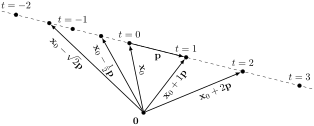
A diagram of the geometric interpretation of a parametric vector description of a line in the plane. A dashed line runs from top-left to centre-right. Along this line six points are plotted at regular intervals, labelled (from left to right) \(t = -2\text{,}\) \(t = -1\text{,}\) \(t = 0\text{,}\) and so on, with the last point labelled \(t = 3\text{.}\) A directed line segment representing a vector labelled \(\uvec{p}\) runs along a portion of the line, from initial point at \(t = 0\) to terminal point at \(t = 1\text{.}\)
A point external to the line is placed at the bottom of the diagram, slightly right of centre, and is labelled \(\uvec{0}\) to represent the zero vector at the origin. Five directed line segments emanate from this common initial point to various terminal points on the line:
-
One representing a vector labelled \(\uvec{x}_0\) and terminating at the point on the line labelled \(t = 0\text{.}\)
-
One representing the linear combination vector \(\uvec{x}_0 + 1 \uvec{p}\text{,}\) terminating at the point on the line labelled \(t = 1\text{.}\)
-
One representing the linear combination vector \(\uvec{x}_0 + 2 \uvec{p}\text{,}\) terminating at the point on the line labelled \(t = 2\text{.}\)
-
One representing the linear combination vector \(\uvec{x}_0 - \frac{1}{2} \uvec{p}\text{,}\) terminating at an additional, unlabelled point on the line halfway between the points labelled \(t = 0\) and \(t = -1\text{.}\)
-
One representing the linear combination vector \(\uvec{x}_0 - \sqrt{2} \uvec{p}\text{,}\) terminating at an additional, unlabelled point on the line slightly right of halfway between the points labelled \(t = -1\) and \(t = -2\text{.}\)
Subsection 15.3.2 Lines in space
Two nonparallel planes in space must intersect in a line, as in Discovery 15.1.3. If we have algebraic equations \(a_1 x + b_1 y + c_1 z = d_1\) and \(a_2 x + b_2 y + c_2 z = d_2\) for these planes, then solving for the points of intersection is the same as solving the linear system formed by these two equations. The assumption that the planes are not parallel guarantees that we will need one (and only one) parameter to solve the system, and then the general solution can be expressed in a vector form
\begin{equation*}
\uvec{x} = \uvec{x}_0 + t\uvec{p} \text{,}
\end{equation*}
just as in the previous case of a line in the plane. To visualize, we can imagine the diagram in the previous subsection above as floating in space instead of lying in the plane.
Subsection 15.3.3 Planes in space
In Discovery 15.1.4, we viewed a single linear equation in three variables as a system of equations, and required two parameters to solve. We then used matrix algebra to express the general solution as a linear combination of column matrices, where the parameters appeared as coefficients. We can do this for any such linear equation.
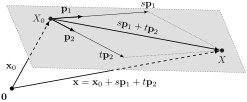
A diagram of the geometric interpretation of a parametric vector description of a plane in space. At the top-right of the diagram appears a large parallelogram with a shaded-in interior. The interior of this parallelogram should be imagined as if it is a two-dimensional, solid, rectangular surface suspended within a three-dimensional space (similar to a tabletop “suspended” above the floor in a room), but viewed at an angle from above. Embedded within this two-dimensional surface are two points, one labelled \(X_0\) in the upper-left region of the surface and the other labelled \(X\) in the lower-right region. A third point representing the zero vector at the origin appears external to the surface in the lower-left of the diagram, and is labelled \(\zerovec\text{.}\) The directed line segments \(\abray{OX_0}\) and \(\abray{OX}\) are drawn pointing from the point zero vector up into the shaded surface, and represent vectors labelled \(\uvec{x}_0\) and \(\uvec{x}\text{.}\)
Two short directed line segments, both with initial point \(X_0\text{,}\) are drawn parallel to (along) the shaded surface but not parallel to each other, representing vectors labelled \(\uvec{p}_1\) and \(\uvec{p}_2\text{.}\) emanate from the point at the head of vector \(\uvec{x}_0\text{,}\) so that they appear to lie along the shaded surface. Viewing the shaded surface as a map, one could say that \(\uvec{p}_1\) heads mostly east but also slightly north along the surface, while \(\uvec{p}_2\) heads southeast along the surface. Two longer directed line segments, also both with initial point \(X_0\text{,}\) run along the shaded surface parallel to \(\uvec{p}_1\) and \(\uvec{p}_2\text{,}\) representing scalar multiple vectors \(s \uvec{p}_1\) and \(t \uvec{p}_2\text{,}\) respectively. Dotted lines segments run from the terminal points of \(s \uvec{p}_1\) and \(t \uvec{p}_2\) to \(X\) (the terminal point of \(\uvec{x}\)), creating a parallelogram together with those two scalar multiple vectors within the “rectangular” shaded surface.
Finally, a directed line segment representing the linear combination vector \(s \uvec{p}_1 + t \uvec{p}_2\) runs along the shaded surface between initial point \(X_0\) and terminal point \(X\) to form a diagonal of the parallelogram within the surface. Hence, \(\uvec{x} = \uvec{x}_0 + s \uvec{p}_1 + t \uvec{p}_2\text{.}\)
Similarly to the vector description of a line, a parametric vector expression
\begin{equation*}
\uvec{x} = \uvec{x}_0 + s \uvec{p}_1 + t \uvec{p}_2
\end{equation*}
can be interpreted as follows. The terminal point of the vector \(\uvec{x}_0\) is an “base” point on the plane, corresponding to parameter values \(s=0\) and \(t=0\text{.}\) The vectors \(\uvec{p}_1\) and \(\uvec{p}_2\) are parallel to the plane. Similarly to the vector description of a line, as we vary the values of \(s\) and \(t\) we obtain other points on the plane by tacking on linear combinations of \(\uvec{p}_1\) and \(\uvec{p}_2\) to the end of \(\uvec{x}_0\text{.}\)
Subsection 15.3.4 Parallel vectors as a “basis” for lines and planes
In a vector description \(\uvec{x} = \uvec{x}_0 + t \uvec{p}\) for a line, the “base” point at the head of \(\uvec{x}_0\) gets you onto the line, and then one can get to any other point on the line by following a scalar multiple of the parallel vector \(\uvec{p}\text{.}\) In this way, the parameter \(t\) effectively places a coordinate system on the line, where the integers are spaced apart by the length of \(\uvec{p}\text{.}\) (See the line diagram earlier in Subsection 15.3.1.)
Values of the parameter \(t\) are mapped to specific positions on the line, just as when we visualize the set of real numbers \(\R\) along the real number line, where each real number represents a position on a line. This idea of a coordinate system along the line is more natural when the line passes through the origin, so that we can take \(\uvec{x}_0 = \zerovec\text{.}\) In this case we have \(\uvec{x} = t \uvec{p}\text{,}\) so that all points on the line correspond to scalar multiples of the parallel vector \(\uvec{p}\text{,}\) and parameter value \(t=0\) corresponds to the origin. So the vector \(\uvec{p}\) tells us pretty much all we need to know about the line, and any other line that is parallel to this line could use the same parallel vector \(\uvec{p}\text{,}\) it would just need a different “base point” vector \(\uvec{x}_0\text{.}\)

A diagram of the parameterization of a line via a parallel vector. A dash line runs between the upper-left and lower-right corners of the diagram. Six points are plotted on the line at regular intervals, labelled \(t = -2\text{,}\) \(t = -1\text{,}\) \(t = 0\text{,}\) and so on, with the sixth point labelled \(t = 3\text{.}\) The point labelled \(t = 0\) is also labelled \(\zerovec\text{,}\) so that it represents the zero vector. A directed line segment representing a vector labelled \(\uvec{p}\) runs along the dashed line from the point zero vector to the next point to right labelled \(t = 1\text{.}\)
In the plane, the standard basis vectors \(\uvec{e}_1\text{,}\)\(\uvec{e}_2\) play the same role for the whole plane, representing our \(xy\)-coordinate system and setting up a grid as in Discovery 15.1.5.
Aside: Recall.
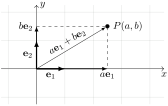
A diagram illustrating how Cartesian coordinates in the plane correspond precisely to linear combinations of the standard basis vectors. A set of \(xy\)-axis is drawn, and in the background appears in light gray a grid of evenly spaced lines at regular intervals, parallel to the axes. A directed line segment representing the standard basis vector \(\uvec{e}_1\) extends rightwards along the \(x\)-axis from the origin to the first vertical grid line to the right of the \(y\)-axis. A longer directed line segment representing the scalar multiple vector \(a \uvec{e}_1\) extends rightwards along the \(x\)-axis from the origin to some point between the second and third vertical grid lines to the right of the \(y\)-axis. Similarly, a directed line segment representing the standard basis vector \(\uvec{e}_2\) extends upwards along the \(y\)-axis from the origin to the first horizontal grid line above the \(x\)-axis, and another directed line segment representing the scalar multiple vector \(b \uvec{e}_2\) extends upwards along the \(y\)-axis from the origin to some point between the first and second vertical grid lines above of the \(x\)-axis. The point \(P(a,b)\) is plotted in the first quadrant of the plane directly above the terminal point of \(a \uvec{e}_1\) and at the same height as the terminal point of the \(b \uvec{e}_2\text{,}\) and dashed line segments are drawn from \(P\) to the terminal points of those two scalar multiple vectors, forming a rectangle with them. Finally, the directed line segment \(\abray{OP}\) is drawn (where \(O\) represents the origin), forming a diagonal in that rectangle and representing the linear combination vector \(a \uvec{e}_1 + b \uvec{e}_2\text{.}\)
When we have a vector description \(\uvec{x} = \uvec{x}_0 + s \uvec{p}_1 + t \uvec{p}_2\) for a plane in space, scalar multiples of the vectors \(\uvec{p}_1\) and \(\uvec{p}_2\) form a grid on the plane in the same way (except that the grid lines will not be at right angles to each other if \(\uvec{p}_1\) and \(\uvec{p}_2\) are not).
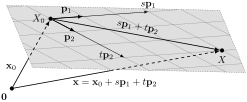
A diagram illustrating how a pair of vectors that are parallel to a plane in space, but not parallel to each other, can be used to parametrically describe the entire plane. The diagram of Figure 15.3.2 is reproduced, with the addition of slant, gray grid lines superimposed on the shaded surface. One set of grid lines consists of lines parallel to \(\uvec{p}_1\text{,}\) with one grid line that lies precisely “through” \(\uvec{p}_1\) so that \(\uvec{p}_1\) runs along it. Similarly, the other set of grid lines consists of lines parallel to \(\uvec{p}_2\text{,}\) with one grid line that lies precisely “through” \(\uvec{p}_2\) so that \(\uvec{p}_2\) runs along it. The two specific grid lines through \(\uvec{p}_1\) and \(\uvec{p}_2\) act as a pair of two-dimensional (possibly slant) “axes” on the shaded surface.
The vectors \(\uvec{p}_1\) and \(\uvec{p}_2\) set up an \(st\)-coordinate system on the plane, where every point on the plane corresponds to a particular pair of parameter values, and vice versa, by adding the linear combination \(s \uvec{p}_1 + t \uvec{p}_2\) onto \(\uvec{x}_0\text{.}\) If the plane passes through the origin (as in Discovery 15.1.7), then we can take \(\uvec{x}_0\) to be the zero vector, so that the origin corresponds to \((s,t) = (0,0)\text{.}\) Then every other point in the plane could be constructed as a linear combination of \(\uvec{p}_1\) and \(\uvec{p}_2\text{.}\)
Subsection 15.3.5 Summary
Combining with our knowledge of normal vectors from the previous chapter, we now have several ways to describe lines and planes in \(\R^2\) and \(\R^3\text{.}\)
| Algebraic | Geometric | Vector | |
| line in \(\R^2\) | \(a x + b y = c \) |
\(\dotprod{\uvec{n}}{(\uvec{x} - \uvec{x}_0)} = 0 \) where \(\uvec{n} = (a,b)\)
|
\(\uvec{x} = \uvec{x}_0 + t \uvec{p} \) |
| plane in \(\R^3\) | \(a x + b y + c z = d \) |
\(\dotprod{\uvec{n}}{(\uvec{x} - \uvec{x}_0)} = 0 \) where \(\uvec{n} = (a,b,c) \)
|
\(\uvec{x} = \uvec{x}_0 + s \uvec{p}_1 + t \uvec{p}_2 \) |
| line in \(\R^3\) |
intersection of planes \(a_1 x + b_1 y + c_1 z = d_1 \) and \(a_2 x + b_2 y + c_2 z = d_2 \)
|
common \(\uvec{x}\) that satisfy \(\dotprod{\uvec{n}_1}{(\uvec{x} - \uvec{x}_0)} = 0 \) and \(\dotprod{\uvec{n}_2}{(\uvec{x} - \uvec{x}_0)} = 0 \) where \(\uvec{n}_1 = (a_1,b_1,c_1) \text{,}\) \(\uvec{n}_2 = (a_2,b_2,c_2) \)
|
\(\uvec{x} = \uvec{x}_0 + t\uvec{p}\) |
Remark 15.3.7.
-
In both the Geometric and Vector columns, the vector \(\uvec{x}_0\) represents a fixed “base” point that is on the line or plane.
-
In the Geometric column, the \(\uvec{n}\) vectors are normal vectors to the line or plane, and their components are precisely the coefficients from the corresponding entry in the Algebraic column. Note that in \(\R^3\text{,}\) there are 360 ° of normal directions to a line, so we need two normal vectors (\(\uvec{n}_1\) and \(\uvec{n}_2\)) to be able to specify the direction of the line — and then the line is parallel to \(\crossprod{\uvec{n}_1}{\uvec{n}_2}\text{.}\) While the normal vector \(\uvec{n}\) for a line in \(\R^2\) or a plane in \(\R^3\) are essentially unique (for a specific line or plane, it can only be replaced by a nonzero scalar multiple), the pair of normal vectors for a line in \(\R^3\) is not unique (there are many pairs of normal vectors that are not just scalar multiples of other pairs that would describe the same line). We can say something about \(\uvec{n}_1\) and \(\uvec{n}_2\) though — for a given line in \(\R^3\text{,}\) every such pair of normal vectors must be parallel to a plane that is normal to the line.
-
In the Vector column, the \(\uvec{p}\) vectors are parallel to the line or plane. For a line in either \(\R^2\) or \(\R^3\text{,}\) we would just need to know a second “base point” vector \(\uvec{x}_1\text{,}\) and the we could take \(\uvec{p} = \uvec{x}_1 - \uvec{x}_0\text{.}\) Or, for a line in \(\R^3\text{,}\) we could start with two known, nonparallel normal vectors \(\uvec{n}_1,\uvec{n}_2\) for the line, and then we could take \(\uvec{p} = \crossprod{\uvec{n}_1}{\uvec{n}_2}\text{.}\) For a plane in \(\R^3\text{,}\) we need three “known” points total, represented by some vectors \(\uvec{x}_0\text{,}\) \(\uvec{x}_1\text{,}\) \(\uvec{x}_2\text{.}\) As long as these “known” points are not noncollinear, we can get the necessary vectors parallel to that plane by taking \(\uvec{p}_1 = \uvec{x}_1 - \uvec{x}_0\) and \(\uvec{p}_2 = \uvec{x}_2 - \uvec{x}_0\text{.}\)
-
We can realize similar geometric “shapes” in \(\R^4\text{,}\) \(\R^5\text{,}\) and higher dimensions, even though we can’t “see” them. A line or plane in higher dimensions would have the same kind of vector description. The algebraic and geometric descriptions of lines in \(\R^2\) and planes in \(\R^3\text{,}\) if adapted to be used in higher dimensions, would describe a hyperplane — some sort of “subspace” of \(n\)-dimensional space that is of one dimension lower. For example, similarly to how we might think of a plane in \(\R^3\) as a “copy” of the plane (\(\R^2\)) sitting inside space (\(\R^3\)), we might imagine a hyperplane in \(\R^4\) as a “copy” of \(\R^3\) sitting inside \(\R^4\text{.}\)

