Exercises 13.6 Exercises

Sign of the dot product.

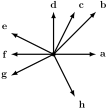
At right is a diagram of several vectors in \(\R^2 \text{.}\) Based on the diagram, in each case state whether the dot product result should be positive, negative, or zero.
Diagram of several two-dimensional vectors.
A diagram consisting of six vectors at a right angle in the \(xy\)-plane. A directed line segment labelled as vector \(\uvec{v} \) extends from the origin to the point \((9,2) \text{.}\) A second directed line segment labelled as vector \(\uvec{w} \) extends from the origin to the point \((-4,9/2) \text{.}\) Where these vectors meet at the origin forms a right angle.

1.

\(\udotprod{a}{b} \)
Answer.
The angle is acute, so the dot product result should be positive.

2.

\(\udotprod{f}{d} \)
Answer.
The angle is right, so the dot product result should be zero.

3.

\(\udotprod{h}{e} \)
Answer.
The angle is obtuse, so the dot product result should be negative.

4.

\(\udotprod{a}{f} \)
Answer.
The angle is straight but the vectors are oppositely directed, so the dot product result should be negative.

5.

\(\udotprod{f}{g} \)
Answer.
The angle is acute, so the dot product result should be positive.

6.

\(\udotprod{c}{c} \)
Answer.
The angle is zero, so the dot product result should be positive.

Size of angle in \(\R^2 \).

In each case:
  1. Use the dot product to determine if the angle between \(\uvec{v} \) and \(\uvec{w} \) is acute, right, or obtuse.
  2. Are \(\uvec{v} \) and \(\uvec{w} \) orthogonal?
  3. Draw a diagram of \(\uvec{v} \) and \(\uvec{w} \) in the \(xy \)-plane, with initial points of the vectors at the origin.

7.

\(\uvec{v} = ( 9, 8) \text{,}\) \(\uvec{w} = (-4, 9/2) \)
Answer.
  1. Right: \(\udotprod{v}{w} = 0 \text{.}\)
  2. Yes.
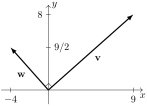
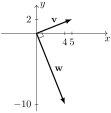
  3. Diagram illustrating two orthogonal vectors.
    A diagram consisting of two vectors at a right angle in the \(xy\)-plane. A directed line segment labelled as vector \(\uvec{v} \) extends from the origin to the point \((9,2) \text{.}\) A second directed line segment labelled as vector \(\uvec{w} \) extends from the origin to the point \((-4,9/2) \text{.}\) Where these vectors meet at the origin forms a right angle.

8.

\(\uvec{v} = (3, -2) \text{,}\) \(\uvec{w} = (1, 6) \)
Answer.
  1. Obtuse: \(\udotprod{v}{w} = -3 \lt 0 \) and the vectors are not parallel (not scalar multiples of one another) so the angle cannot be straight.
  2. No.
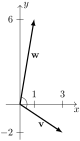
  3. Diagram illustrating two vectors at an obtuse angle.
    A diagram consisting of two vectors at an obtuse angle in the \(xy\)-plane. A directed line segment labelled as vector \(\uvec{v} \) extends from the origin to the point \((3,-2) \text{.}\) A second directed line segment labelled as vector \(\uvec{w} \) extends from the origin to the point \((1,6) \text{.}\) Where these vectors meet at the origin forms an obtuse angle.

9.

\(\uvec{v} = (-6, -2) \text{,}\) \(\uvec{w} = (-8, 4) \)
Answer.
  1. Acute: \(\udotprod{v}{w} = 40 \gt 0 \) and the vectors are not parallel (not scalar multiples of one another) so the angle cannot be zero.
  2. No.
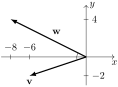
  3. Diagram illustrating two vectors at an acute angle.
    A diagram consisting of two vectors at an acute angle in the \(xy\)-plane. A directed line segment labelled as vector \(\uvec{v} \) extends from the origin to the point \((-6,-2) \text{.}\) A second directed line segment labelled as vector \(\uvec{w} \) extends from the origin to the point \((-8,4) \text{.}\) Where these vectors meet at the origin forms an acute angle.

10.

\(\uvec{v} = ( 5, 2) \text{,}\) \(\uvec{w} = ( 4, -10) \)
Answer.
  1. Right: \(\udotprod{v}{w} = 0 \text{.}\)
  2. Yes.
  3. Diagram illustrating two orthogonal vectors.
    A diagram consisting of two vectors at a right angle in the \(xy\)-plane. A directed line segment labelled as vector \(\uvec{v} \) extends from the origin to the point \((5,2) \text{.}\) A second directed line segment labelled as vector \(\uvec{w} \) extends from the origin to the point \((4,-10) \text{.}\) Where these vectors meet at the origin forms a right angle.

Size of angle in \(\R^n \).

In each case:
  1. Use the dot product to determine if the angle between \(\uvec{v} \) and \(\uvec{w} \) is acute, right, or obtuse.
  2. Are \(\uvec{v} \) and \(\uvec{w} \) orthogonal?

11.

\(\uvec{v} = (-1,3,0) \text{,}\) \(\uvec{w} = (-5,2,4) \)
Answer.
  1. Acute: \(\udotprod{v}{w} = 11 \gt 0 \text{.}\)
  2. No.

12.

\(\uvec{v} = (1,3,6) \text{,}\) \(\uvec{w} = (6,1,-2) \)
Answer.
  1. Obtuse: \(\udotprod{v}{w} = -3 \lt 0 \text{.}\)
  2. No.

13.

\(\uvec{v} = (3,6,1,2) \text{,}\) \(\uvec{w} = (1,0,-1,-1) \)
Answer.
  1. Right: \(\udotprod{v}{w} = 0 \text{.}\)
  2. Yes.

14.

\(\uvec{v} = (-3,-3, 4,-4, 2) \text{,}\) \(\uvec{w} = ( 1,-1,-2,-2,-4) \)
Answer.
  1. Obtuse: \(\udotprod{v}{w} = -8 \lt 0 \text{.}\)
  2. No.

15.

\(\uvec{v} = (-3,-3, 4,-4, 2) \text{,}\) \(\uvec{w} = ( 1,-1,-2,-2, 0) \)
Answer.
  1. Right: \(\udotprod{v}{w} = 0 \text{.}\)
  2. Yes.

Creating orthogonal vectors.

Use the guess-and-check method to determine a vector that is orthogonal to the given vector.

16.

\((2,3) \)
Answer.
\((3,-2) \) or \((-3,2) \) (or any other scalar multiple of \((3,-2) \)).

17.

\((3,-1) \)
Answer.
\((1,3) \) or \((-1,-3) \) (or any other scalar multiple of \((1,3) \)).

18.

\((-5,-3) \)
Answer.
\((3,-5) \) or \((-3,5) \) (or any other scalar multiple of \((3,-5) \)).

Solving for orthogonality.

In each case, determine all values of \(k \) for which \(\uvec{v} \) is orthogonal to \(\uvec{w} \text{.}\)

21.

\(\uvec{v} = (3,k,4) \text{,}\) \(\uvec{W} = (-1,-3,6) \)
Solution.
Calculate
\begin{equation*} \udotprod{v}{w} = 3 \cdot (-1) + k \cdot (-3) + 4 \cdot 6 = 21 - 3 k \text{.} \end{equation*}
Two vectors are orthogonal precisely when their dot product is \(0 \text{,}\) so set the above expression equal to \(0 \) and solve for \(k \text{:}\)
\begin{equation*} 21 - 3 k = 0 \qquad \implies \qquad k = 7 \text{.} \end{equation*}

22.

\(\uvec{v} = (k^2, 3, -6 k, 4) \text{,}\) \(\uvec{W} = (1,-3,-2,5) \)
Solution.
Calculate
\begin{equation*} \udotprod{v}{w} = k^2 \cdot 1 + 3 \cdot (-3) + (-6 k) \cdot (-2) + 4 \cdot 5 = k^2 + 12 k + 11 \text{.} \end{equation*}
Two vectors are orthogonal precisely when their dot product is \(0 \text{,}\) so we would like to know when the above expression is equal to \(0 \text{.}\) Factoring, we have
\begin{equation*} k^2 + 12 k + 11 = (k + 1) (k + 11) \text{,} \end{equation*}
so the two vectors are orthogonal precisely when either \(k = -1 \) or \(k = -11 \text{.}\)

Normal vector to a line in \(\R^2 \) from its equation.

In each of the following, a linear equation corresponding to a line in \(\R^2 \) and two points \(P \) and \(Q \) are provided.
  1. By inspection, determine a normal vector for the line from its equation.
  2. Verify that points \(P \) and \(Q \) lie the line.
  3. Compute the vector \(\uvec{v} \) associated to directed line segment \(\abray{PQ} \text{,}\) and then verify that \(\uvec{v} \) is orthogonal to your normal vector from part a.
  4. Sketch the line in the \(xy \)-plane, along with points \(P, Q \) and vector \(\uvec{v} \text{.}\) Then draw your normal vector with its initial point at one of either \(P \) or \(Q \text{.}\)

23.

\(\ell \colon \:\: 3 x - 5 y = -2 \)
\(P(-4,-2), Q(1,1) \)
Answer.
  1. The line equation coefficients form a normal vector:
    \begin{equation*} \uvec{n} = (3,-5) \text{.} \end{equation*}
  2. \begin{align*} P \amp \colon \:\: 3 \cdot (-4) - 5 \cdot (-2) = -2 \\ Q \amp \colon \:\: 3 \cdot 1 - 5 \cdot 1 = -2 \end{align*}
  3. \(\uvec{v} = (5,3) \)
    \begin{equation*} \udotprod{n}{v} = 3 \cdot 5 + (-5) \cdot 3 = 0 \text{,} \end{equation*}
    hence orthogonal.
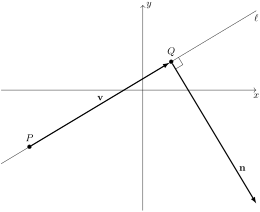
  4. Diagram illustrating a normal vector to a line in the plane.
    A diagram consisting of a line with positive slope, a vector parallel to it, and a vector normal to it. The graph of the line \(3 x - 5 y = -2 \) is sketched and labelled as \(\ell \text{.}\) passing through plotted points \(P(-4,-2) \) and \(Q(1,1) \text{.}\) The directed line segment \(\abray{PQ} \) is drawn and labelled as vector \(\uvec{v} \text{.}\) A directed line segment labelled as vector \(\uvec{n} \) extends from \(Q \) downwards and rightwards, forming a right angle with line \(\ell \) at \(Q \text{.}\)

24.

\(\ell \colon \:\: 2 x + 4 y = -5 \text{,}\)
\(P(0, -5/4), Q(-5, 5/4) \)
Answer.
  1. The line equation coefficients form a normal vector:
    \begin{equation*} \uvec{n} = (2,4) \text{.} \end{equation*}
  2. \begin{align*} P \amp \colon \:\: 2 \cdot 0 + 4 \cdot (- 5 / 4) = -5 \\ Q \amp \colon \:\: 2 \cdot (-5) + 4 \cdot (5 / 4) = -5 \end{align*}
  3. \(\uvec{v} = (-5, 5/2) \)
    \begin{equation*} \udotprod{n}{v} = 2 \cdot (-5) + 4 \cdot (5 / 2) = 0 \text{,} \end{equation*}
    hence orthogonal.
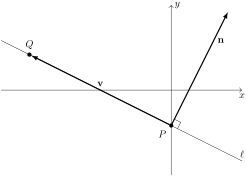
  4. Diagram illustrating a normal vector to a line in the plane.
    A diagram consisting of a line with negative slope, a vector parallel to it, and a vector normal to it. The graph of the line \(2 x + 4 y = -5 \) is sketched and labelled as \(\ell \text{.}\) passing through plotted points \(P(0,-5/4) \) and \(Q(-5,5/4) \text{.}\) The directed line segment \(\abray{PQ} \) is drawn and labelled as vector \(\uvec{v} \text{.}\) A directed line segment labelled as vector \(\uvec{n} \) extends from \(P \) upwards and rightwards, forming a right angle with line \(\ell \) at \(P \text{.}\)

Point-normal form for a line in \(\R^2 \).

In each case:
  1. Determine a normal vector for the line that passes through the points \(P \) and \(Q \text{.}\)
  2. Sketch the line in the \(xy \)-plane, and draw your normal vector with its initial point at one of either \(P \) or \(Q \text{.}\)
  3. Write the equation of the line in point-normal form, then expand and re-write in typical algebraic form.

25.

\(P(2,1), Q(3,3) \)
Answer.
  1. The directed line segment \(\abray{PQ} \) is parallel to the line through \(P \) and \(Q \text{.}\) Calculate the associated vector \(\uvec{v} \) as
    \begin{equation*} \uvec{v} = (3 - 2, 3 - 1) = (1, 2) \text{.} \end{equation*}
    Using the pattern from Discovery 13.1.2 (see also Subsubsection 13.3.2.1), we can create normal vector \(\uvec{n} = (2, -1) \text{.}\)
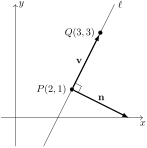
  2. Diagram illustrating a normal vector to a line in the plane.
    A diagram consisting of a vector between two points, the line through those two points, and a vector normal to the line. The points \(P(2,1) \) and \(Q(3,3) \) are plotted in the \(xy \)-plane, and the directed line segment \(\abray{PQ} \) is drawn between them and labelled as vector \(\uvec{v} \text{.}\) The line that passes through \(P \) and \(Q \) is also drawn and labelled as \(\ell \text{.}\) Finally, the vector \(\uvec{n} = (2,-1) \) is drawn with initial point at \(P \) and terminal point \((4,0) \text{,}\) meeting \(\ell \) at a right angle at \(P \text{.}\)
  3. Point-normal form (using point \(P\)):
    \begin{equation*} \dotprod{ (2,-1) }{\bbrac{ (x,y) - (2,1) }} = 0 \text{.} \end{equation*}
    Expanded algebraic form:
    \begin{equation*} 2 x - y = 3 \text{.} \end{equation*}

26.

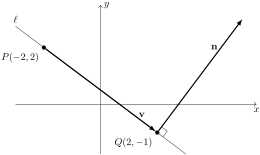
\(P(-2,2), Q(2,-1) \)
Answer.
  1. The directed line segment \(\abray{PQ} \) is parallel to the line through \(P \) and \(Q \text{.}\) Calculate the associated vector \(\uvec{v} \) as
    \begin{equation*} \uvec{v} = \bbrac{2 - (-2), -1 - 2} = (4, -3) \text{.} \end{equation*}
    Using the pattern from Discovery 13.1.2 (see also Subsubsection 13.3.2.1), we can create normal vector \((-3, -4) \text{,}\) though maybe we would prefer to take the negative: \(\uvec{n} = (3,4) \text{.}\)
  2. Diagram illustrating a normal vector to a line in the plane.
    A diagram consisting of a vector between two points, the line through those two points, and a vector normal to the line. The points \(P(-2,2) \) and \(Q(2,-1) \) are plotted in the \(xy \)-plane, and the directed line segment \(\abray{PQ} \) is drawn between them and labelled as vector \(\uvec{v} \text{.}\) The line that passes through \(P \) and \(Q \) is also drawn and labelled as \(\ell \text{.}\) Finally, the vector \(\uvec{n} = (3,4) \) is drawn with initial point at \(Q \) and terminal point \((5,3) \text{,}\) meeting \(\ell \) at a right angle at \(Q \text{.}\)
  3. Point-normal form (using point \(P\)):
    \begin{equation*} \dotprod{ (3,4) }{\bbrac{ (x,y) - (-2,2) }} = 0 \text{.} \end{equation*}
    Expanded algebraic form:
    \begin{equation*} 3 x + 4 y = 2 \text{.} \end{equation*}

Normal vector to a plane in \(\R^3 \) from its equation.

In each of the following, a linear equation corresponding to a plane in \(\R^3 \) and two points \(P \) and \(Q \) are provided.
  1. By inspection, determine a normal vector for the plane from its equation.
  2. Verify that points \(P \) and \(Q \) lie on the plane.
  3. Compute the vector \(\uvec{v} \) associated to directed line segment \(\abray{PQ} \text{,}\) and then verify that \(\uvec{v} \) is orthogonal to your normal vector from part a.

27.

\(\Pi \colon \:\: 5 x + 3 y - 5 z = 2 \)
\(P(1,-1,0), Q(-1,-1,-2) \)
Answer.
  1. The plane equation coefficients form a normal vector:
    \begin{equation*} \uvec{n} = (5,3,-5) \text{.} \end{equation*}
  2. \begin{align*} P \amp \colon \:\: 5 \cdot 1 + 3 \cdot (-1) - 5 \cdot 0 = 2 \\ Q \amp \colon \:\: 5 \cdot (-1) + 3 \cdot (-1) - 5 \cdot (-2) = 2 \end{align*}
  3. \(\uvec{v} = (-2,0,-2) \)
    \begin{equation*} \udotprod{n}{v} = 5 \cdot (-2) + 3 \cdot 0 + (-5) \cdot (-2) = 0 \text{,} \end{equation*}
    hence orthogonal.

28.

\(\Pi \colon \:\: 4 x - 5 y + z = -2 \)
\(P(1,1,-1), Q(4,3,-3) \)
Answer.
  1. The plane equation coefficients form a normal vector:
    \begin{equation*} \uvec{n} = (4,-5,1) \text{.} \end{equation*}
  2. \begin{align*} P \amp \colon \:\: 4 \cdot 1 - 5 \cdot 1 + (-1) = -2 \\ Q \amp \colon \:\: 4 \cdot 4 - 5 \cdot 3 + (-3) = -2 \end{align*}
  3. \(\uvec{v} = (3,2,-2) \)
    \begin{equation*} \udotprod{n}{v} = 4 \cdot 3 + (-5) \cdot 2 + 1 \cdot (-2) = 0 \text{,} \end{equation*}
    hence orthogonal.

Normal vector to a hyperplane in \(\R^n \) from its equation.

Just as a line in \(\R^2 \) is defined by a linear equation in the two variables \(x,y\) and a plane in \(\R^3 \) is defined by a linear equation in the three variables \(x,y,z \text{,}\) a hyperplane in \(\R^n \) is defined by a linear equation in all \(n \) variables \(x_1, x_2, \dotsc, x_n \text{.}\)
In each of the following, a linear equation corresponding to a hyperplane in \(\R^n \) and two points \(P \) and \(Q \) are provided.
  1. By inspection, determine a normal vector for the hyperplane from its equation.
  2. Verify that points \(P \) and \(Q \) lie on the hyperplane.
  3. Compute the vector \(\uvec{v} \) associated to directed line segment \(\abray{PQ} \text{,}\) and then verify that \(\uvec{v} \) is orthogonal to your normal vector from part a.

29.

\(n = 4 \)
\(H \colon \:\: 2 x_1 - x_2 - 2 x_3 + 6 x_4 = 2 \)
\(P(1,-4,-1,-1), Q(-1,0,1,1) \)
Answer.
  1. The hyperplane equation coefficients form a normal vector:
    \begin{equation*} \uvec{n} = (2,-1,-2,6) \text{.} \end{equation*}
  2. \begin{align*} P \amp \colon \:\: 2 \cdot 1 - (-4) - 2 \cdot (-1) + 6 \cdot (-1) = 2 \\ Q \amp \colon \:\: 2 \cdot (-1) - 0 - 2 \cdot 1 + 6 \cdot 1 = 2 \end{align*}
  3. \(\uvec{v} = (-2,4,2,2) \)
    \begin{equation*} \udotprod{n}{v} = 2 \cdot (-2) + (-1) \cdot 4 + (-2) \cdot 2 + 6 \cdot 2 = 0 \text{,} \end{equation*}
    hence orthogonal.

30.

\(n = 5 \)
\(H \colon \:\: 4 x_1 + 5 x_2 - 4 x_4 - 3 x_5 = 3 \)
\(P(1,0,5,1,-1), Q(4,-2,-3,0,1) \)
Answer.
  1. The hyperplane equation coefficients form a normal vector:
    \begin{equation*} \uvec{n} = (4,5,0,-4,-3) \text{.} \end{equation*}
  2. \begin{align*} P \amp \colon \:\: 4 \cdot 1 + 5 \cdot 0 - 4 \cdot 1 - 3 \cdot (-1) = 3 \\ Q \amp \colon \:\: 4 \cdot 4 + 5 \cdot (-2) - 4 \cdot 0 - 3 \cdot 1 = 3 \end{align*}
  3. \(\uvec{v} = (3,-2,-8,-1,2) \)
    \begin{equation*} \udotprod{n}{v} = 4 \cdot 3 + 5 \cdot (-2) + 0 \cdot (-8) + (-4) \cdot (-1) + (-3) \cdot 2 = 0 \text{,} \end{equation*}
    hence orthogonal.

31.

\(n = 6 \)
\(H \colon \:\: 2 x_1 + x_2 + 3 x_3 + 5 x_4 + 2 x_5 - 4 x_6 = 3 \)
\(P(1,0,1,0,1,1), Q(3,6,-2,-3,2,-2) \)
Answer.
  1. The hyperplane equation coefficients form a normal vector:
    \begin{equation*} \uvec{n} = (2,1,3,5,2,-4) \text{.} \end{equation*}
  2. \begin{align*} P \amp \colon \:\: 2 \cdot 1 + 0 + 3 \cdot 1 + 5 \cdot 0 + 2 \cdot 1 - 4 \cdot 1 = 3 \\ Q \amp \colon \:\: 2 \cdot 3 + 6 + 3 \cdot (-2) + 5 \cdot (-3) + 2 \cdot 1 - 4 \cdot (-2) = 3 \end{align*}
  3. \(\uvec{v} = (2,6,-3,-3,1,-3) \)
    \begin{equation*} \udotprod{n}{v} = 2 \cdot 2 + 1 \cdot 6 + 3 \cdot (-3) + 5 \cdot (-3) + 2 \cdot 1 + (-4) \cdot (-3) = 0 \text{,} \end{equation*}
    hence orthogonal.

32.

Suppose \(P(a_1,a_2,\dotsc,a_n), Q(b_1,b_2,\dotsc,b_n) \) are points on a hyperplane
\begin{equation*} c_1 x_1 + c_2 x_2 + \dotsb + c_n x_n = d \end{equation*}
in \(\R^n \text{.}\)
Verify that the vector \(\uvec{v} \) associated to the directed line segment \(\abray{PQ} \) (“parallel” to the hyperplane) is orthogonal to the vector of coefficients \(\uvec{n} = (c_1,c_2,\dotsc,c_n) \text{.}\)

Computing cross product.

In each case:
  1. Use the determinant method to compute \(\ucrossprod{u}{v} \text{.}\)
  2. Use the dot product to verify that your computed answer for \(\ucrossprod{u}{v} \) is orthogonal to each of \(\uvec{u} \) and \(\uvec{v} \text{.}\)

33.

\(\uvec{u} = ( 1,1,2) \text{,}\) \(\uvec{v} = (-3,1,4) \)
Answer.
  1. \(\displaystyle \ucrossprod{u}{v} = \begin{avmatrix}{rrr} \ivec{} \amp \jvec{} \amp \kvec{} \\ 1 \amp 1 \amp 2 \\ -3 \amp 1 \amp 4 \end{avmatrix} = (2, -10, 4)\)
  2. \begin{align*} \dotprod{ \uvec{u} }{( \ucrossprod{u}{v} )} \amp = \dotprod{ (1,1,2) }{ (2,-10,4) }\\ \amp = 1 \cdot 2 + 1 \cdot (-10) + 2 \cdot 4\\ \amp = 0 \end{align*}
    \begin{align*} \dotprod{ \uvec{v} }{( \ucrossprod{u}{v} )} \amp = \dotprod{ (-3,1,4) }{ (2,-10,4) }\\ \amp = -3 \cdot 2 + 1 \cdot (-10) + 4 \cdot 4\\ \amp = 0 \end{align*}

34.

\(\uvec{u} = (-3,1,4) \) \(\uvec{v} = ( 1,1,2) \text{,}\)
Answer.
  1. \(\displaystyle \ucrossprod{u}{v} = \begin{avmatrix}{rrr} \ivec{} \amp \jvec{} \amp \kvec{} \\ -3 \amp 1 \amp 4 \\ 1 \amp 1 \amp 2 \end{avmatrix} = (-2, 10, -4)\)
  2. \begin{align*} \dotprod{ \uvec{u} }{( \ucrossprod{u}{v} )} \amp = \dotprod{ (-3,1,4) }{ (-2,10,-4) } \amp = (-3) \cdot (-2) + 1 \cdot (10) + 4 \cdot (-4)\\ \\ \amp = 0 \end{align*}
    \begin{align*} \dotprod{ \uvec{v} }{( \ucrossprod{u}{v} )} \amp = \dotprod{ (1,1,2) }{ (-2,10,-4) }\\ \amp = 1 \cdot (-2) + 1 \cdot 10 + 2 \cdot (-4)\\ \amp = 0 \end{align*}

35.

\(\uvec{u} = ( 2,2,4) \text{,}\) \(\uvec{v} = (-3,1,4) \)
Answer.
  1. \(\displaystyle \ucrossprod{u}{v} = \begin{avmatrix}{rrr} \ivec{} \amp \jvec{} \amp \kvec{} \\ 2 \amp 2 \amp 4 \\ -3 \amp 1 \amp 4 \end{avmatrix} = (4, -20, 8)\)
  2. \begin{align*} \dotprod{ \uvec{u} }{( \ucrossprod{u}{v} )} \amp = \dotprod{ (2,2,4) }{ (4,-20,8) }\\ \amp = 2 \cdot 4 + 2 \cdot (-20) + 4 \cdot 8\\ \amp = 0 \end{align*}
    \begin{align*} \dotprod{ \uvec{v} }{( \ucrossprod{u}{v} )} \amp = \dotprod{ (-3,1,4) }{ (4,-20,8) }\\ \amp = -3 \cdot 4 + 1 \cdot (-20) + 4 \cdot 8\\ \amp = 0 \end{align*}

36.

\(\uvec{u} = (1,1,2) \text{,}\) \(\uvec{v} = (2,2,4) \)
Answer.
  1. \(\displaystyle \ucrossprod{u}{v} = \begin{vmatrix} \ivec{} \amp \jvec{} \amp \kvec{} \\ 1 \amp 1 \amp 2 \\ 2 \amp 2 \amp 4 \end{vmatrix} = (0,0,0)\)
  2. Clearly both \(\dotprod{ \uvec{u} }{ \zerovec } = 0 \) and \(\dotprod{ \uvec{v} }{ \zerovec } = 0 \text{.}\)

37. The right-hand rule.

Recall that the standard basis vectors in \(\R^3 \) are
\begin{align*} \uvec{i} \amp = \uvec{e}_1 = (1,0,0) \text{,} \amp \uvec{j} \amp = \uvec{e}_2 = (0,1,0) \text{,} \amp \uvec{k} \amp = \uvec{e}_3 = (0,0,1) \text{.} \amp \end{align*}
Compute the cross products of the standard basis vectors in the various combinations
\begin{equation*} \ucrossprod{i}{j} \text{,} \quad \ucrossprod{i}{k} \text{,} \quad \ucrossprod{j}{i} \text{,} \quad \ucrossprod{j}{k} \text{,} \quad \ucrossprod{k}{i} \text{,} \quad \ucrossprod{k}{j} \text{.} \end{equation*}
and verify that the right-hand rule holds in these cases.

Point-normal form for a plane in \(\R^3 \).

In each case:
  1. Determine a normal vector for the plane that passes through the points \(P \text{,}\) \(Q \text{,}\) and \(R \text{.}\)
  2. Write the equation of the plane in point-normal form, then expand and re-write in typical algebraic form.

38.

\(P(-3,1,3), Q(0,-2,-1), R(1,-1,-2) \)
Answer.
  1. The directed line segments \(\abray{PQ} \) and \(\abray{PR} \) are parallel to the plane through \(P, Q, R \text{.}\) Calculate the associated vectors \(\uvec{u} \) and \(\uvec{v} \) as
    \begin{align*} \uvec{u} \amp = \bbrac{0 - (-3), -2 - 1, -1 - 3} = (3, -3, -4) \text{,} \amp \uvec{v} \amp = \bbrac{1 - (-3), -1 - 1, -2 - 3} = (4, -2, -5) \text{.} \end{align*}
    Compute a normal to the plane using the cross product:
    \begin{equation*} \uvec{n} = \ucrossprod{u}{v} = (7, -1, 6) \text{.} \end{equation*}
  2. Point-normal form (using point \(P\)):
    \begin{equation*} \dotprod{ (7,-1,6) }{\bbrac{ (x,y,z) - (-3,1,3) }} = 0 \text{.} \end{equation*}
    Expanded algebraic form:
    \begin{equation*} 7 x - y + 6 z = -4 \text{.} \end{equation*}

39.

\(P(-3,3,1), Q(4,6,-2), R(-2,0,0) \)
Answer.
  1. The directed line segments \(\abray{PQ} \) and \(\abray{PR} \) are parallel to the plane through \(P, Q, R \text{.}\) Calculate the associated vectors \(\uvec{u} \) and \(\uvec{v} \) as
    \begin{align*} \uvec{u} \amp = \bbrac{ 4 - (-3), 6 - 3, -2 - 1} = (7, 3, -3) \text{,} \amp \uvec{v} \amp = \bbrac{-2 - (-3), 0 - 3, 0 - 1} = (1, -3, -1) \text{.} \end{align*}
    The cross product
    \begin{equation*} \ucrossprod{u}{v} = (-12, 4, -24) \end{equation*}
    is normal to the plane, but we’ll scale this by a factor of \(-1/4 \) to \(\uvec{n} = (3, -1, 6) \text{.}\)
  2. Point-normal form (using point \(P\)):
    \begin{equation*} \dotprod{ (3,-1,6) }{\bbrac{ (x,y,z) - (-3,3,1) }} = 0 \text{.} \end{equation*}
    Expanded algebraic form:
    \begin{equation*} 3 x - y + 6 z = -6 \text{.} \end{equation*}

Point-normal form for a hyperplane in \(\R^n \).

In each case, \(n \) points in \(\R^n \) have been provided.
  1. Determine a normal vector for the hyperplane that passes through the provided points.
  2. Write the equation of the hyperplane in point-normal form, then expand and re-write in typical algebraic form.
(See the preamble to Exercises 29–31 for the meaning of the term hyperplane.)
Hint. While we have not explored a “cross product” construction in \(\R^n \) in general, you may instead proceed by solving a homogeneous system similar to the initial setup in Subsection 13.3.6.

40.

\(P_1(5, 2, -4, 6), P_2(6, 3, -7, -1), P_3(6, 4, -1, 6), P_4(6, 4, -2, 4)\)
Answer.
  1. The directed line segments \(\abray{P_1 P_2} \text{,}\) \(\abray{P_1 P_3} \text{,}\) \(\abray{P_1 P_4} \) are parallel to the hyperplane through \(P_1, P_2, P_3, P_4 \text{.}\) Calculate the associated vectors:
    \begin{gather*} \uvec{v}_1 = \abray{P_1 P_2} = (1, 1, -3, -7) \text{,} \:\: \uvec{v}_2 = \abray{P_1 P_3} = (1, 2, 3, 0) \text{,}\\ \uvec{v}_3 = \abray{P_1 P_4} = (1, 2, 2, -2) \text{.} \end{gather*}
    A normal vector \(\uvec{n} = (n_1,n_2,n_3,n_4) \) to the hyperplane must be orthogonal to each of the three vectors above:
    \begin{align*} \udotprod{\uvec{v}_1}{\uvec{n}} \amp = 0 \text{,} \amp \udotprod{\uvec{v}_2}{\uvec{n}} \amp = 0 \text{,} \amp \udotprod{\uvec{v}_3}{\uvec{n}} \amp = 0 \text{.} \end{align*}
    This is a homogeneous system in the variables \(n_1, n_2, n_3, n_4 \text{;}\) solve:
    \begin{equation*} \begin{abmatrix}{rrrr} 1 \amp 1 \amp -3 \amp -7 \\ 1 \amp 2 \amp 3 \amp 0 \\ 1 \amp 2 \amp 2 \amp -2 \end{abmatrix} \quad \rowredarrow \quad \begin{abmatrix}{rrrr} 1 \amp 0 \amp 0 \amp 4 \\ 0 \amp 1 \amp 0 \amp -5 \\ 0 \amp 0 \amp 1 \amp 2 \end{abmatrix}\text{.} \end{equation*}
    To ensure a positive value for \(n_1 \text{,}\) choose parameter value \(n_4 = -1 \text{,}\) leading to solution \(\uvec{n} = (4,-5,2,-1) \text{.}\)
  2. Point-normal form (using point \(P_1\)):
    \begin{equation*} \dotprod{ (4,-5,2,-1) }{\bbrac{ (x_1,x_2,x_3,x_4) - (5, 2, -4, 6) }} = 0 \text{.} \end{equation*}
    Expanded algebraic form:
    \begin{equation*} 4 x_1 - 5 x_2 + 2 x_3 - x_4 = 4 \text{.} \end{equation*}

41.

\begin{gather*} P_1(4, -1, -6, 3, - 4), \:\: P_2(5, 1, -4, -1, -11), \:\: P_3(4, 0, -3, -5, -12),\\ P_4(4, -2, -8, 7, 3), \:\: P_5(3, -1, -3, -4, -13) \end{gather*}
Answer.
  1. The directed line segments \(\abray{P_1 P_2} \text{,}\) \(\abray{P_1 P_3} \text{,}\) \(\abray{P_1 P_4} \text{,}\) \(\abray{P_1 P_5} \) are parallel to the hyperplane through \(P_1, P_2, P_3, P_4, P_5 \text{.}\) Calculate the associated vectors:
    \begin{align*} \uvec{v}_1 \amp = \abray{P_1 P_2} = ( 1, 2, 2, -4, -7) \text{,} \amp \uvec{v}_3 \amp = \abray{P_1 P_4} = ( 0, -1, -2, 4, 7) \text{,}\\ \uvec{v}_2 \amp = \abray{P_1 P_3} = ( 0, 1, 3, -8, -8) \text{,} \amp \uvec{v}_4 \amp = \abray{P_1 P_5} = (-1, 0, 3, -7, -9) \text{.} \end{align*}
    A normal vector \(\uvec{n} = (n_1,n_2,n_3,n_4,n_5) \) to the hyperplane must be orthogonal to each of the four vectors above:
    \begin{align*} \udotprod{\uvec{v}_1}{\uvec{n}} \amp = 0 \text{,} \amp \udotprod{\uvec{v}_2}{\uvec{n}} \amp = 0 \text{,} \amp \udotprod{\uvec{v}_3}{\uvec{n}} \amp = 0 \text{,} \amp \udotprod{\uvec{v}_4}{\uvec{n}} \amp = 0 \text{.} \end{align*}
    This is a homogeneous system in the variables \(n_1, n_2, n_3, n_4, n_5 \text{;}\) solve:
    \begin{equation*} \begin{abmatrix}{rrrrr} 1 \amp 2 \amp 2 \amp -4 \amp -7 \\ 0 \amp 1 \amp 3 \amp -8 \amp -8 \\ 0 \amp -1 \amp -2 \amp 4 \amp 7 \\ -1 \amp 0 \amp 3 \amp -7 \amp -9 \end{abmatrix} \quad \rowredarrow \quad \begin{abmatrix}{rrrrr} 1 \amp 0 \amp 0 \amp 0 \amp 1 \\ 0 \amp 1 \amp 0 \amp 0 \amp -1 \\ 0 \amp 0 \amp 1 \amp 0 \amp -5 \\ 0 \amp 0 \amp 0 \amp 1 \amp -1 \end{abmatrix}\text{.} \end{equation*}
    To ensure a positive value for \(n_1 \text{,}\) choose parameter value \(n_5 = -1 \text{,}\) leading to solution \(\uvec{n} = (1,-1,-5,-1,-1) \text{.}\)

  2. Point-normal form (using point \(P_1\)):
    \begin{equation*} \dotprod{ (1,-1,-5,-1,-1) }{\bbrac{ (x_1,x_2,x_3,x_4,x_5) - (4,-1,-6,3,-4) }} = 0 \text{.} \end{equation*}
    Expanded algebraic form:
    \begin{equation*} x_1 - x_2 - 5 x_3 - x_4 - x_5 = -36 \text{.} \end{equation*}

Determining equations of lines/planes/hyperplanes.

In each of the following, determine the equation of the line/plane/hyperplane that passes through point \(P \) and satisfies the stated geometric condition.

42.

\(P(2,3) \text{;}\) line normal to the vector \(\uvec{v} = (1,-3) \text{.}\)
Solution.
Using point-normal form, the line is
\begin{equation*} \dotprod{(1,-3)}{\bbrac{(x,y) - (2,3)}} = 0 \quad \implies \quad x - 3 y = -7\text{.} \end{equation*}

43.

\(P(3,0) \text{;}\) line parallel to the line \(5 x + 6 y = 3 \text{.}\)
Solution.
In \(\R^2 \text{,}\) parallel lines have parallel normal vectors, so we may use \(\uvec{n} = (5,6) \) as a normal vector for the desired line. Using point-normal form, the line is
\begin{equation*} \dotprod{(5,6)}{\bbrac{(x,y) - (3,0)}} = 0 \quad \implies \quad 5 x + 6 y = 15\text{.} \end{equation*}

44.

\(P(-4,-3,6) \text{;}\) plane normal to the vector \(\uvec{v} = (1,-1,6) \text{.}\)
Solution.
Using point-normal form, the plane is
\begin{equation*} \dotprod{(1,-1,6)}{\bbrac{(x,y,z) - (-4,-3,6)}} = 0 \quad \implies \quad x - y + 6 z = 35\text{.} \end{equation*}

45.

\(P(3,-6,1) \text{;}\) plane parallel to the plane \(2 x - 5 y + 5 z = 4 \text{.}\)
Solution.
In \(\R^3 \text{,}\) parallel planes have parallel normal vectors, so we may use \(\uvec{n} = (2,-5,5) \) as a normal vector for the desired plane. Using point-normal form, the plane is
\begin{equation*} \dotprod{(2,-5,5)}{\bbrac{(x,y) - (3,-6,1)}} = 0 \quad \implies \quad 2 x - 5 y + 5z = 41\text{.} \end{equation*}

46.

\(P(3,-5,6,5) \text{;}\) hyperplane normal to the vector \(\uvec{v} = (4,3,-3,-3) \text{.}\)
Solution.
Using point-normal form, the hyperplane is
\begin{gather*} \dotprod{(4,3,-3,-3)}{\bbrac{(x_1,x_2,x_3,x_4) - (3,-5,6,5)}} = 0 \\ \implies \quad 4 x_1 + 3 x_2 - 3 x_3 - 3 x_4 = -36 \text{.} \end{gather*}

47.

\(P(5,5,-4,-3); \)
hyperplane parallel to the hyperplane \(3 x_1 - 2 x_2 - 4 x_3 - 2 x_4 = -2 \text{.}\)
Solution.
In \(\R^4 \text{,}\) parallel hyperplanes have parallel normal vectors, so we may use \(\uvec{n} = (3,-2,-4,-2) \) as a normal vector for the desired hyperplane. Using point-normal form, the hyperplane is
\begin{gather*} \dotprod{(3,-2,-4,-2)}{\bbrac{(x,y) - (5,5,-4,-3)}} = 0 \\ \implies \quad 3 x_1 - 2 x_2 - 4 x_3 - 2 x_4 = 27 \text{.} \end{gather*}

Orthogonal projection in \(\R^2 \).

In each case:
  1. Compute \(\uproj{u}{a} \text{.}\)
  2. Express \(\uvec{u} \) as a decomposition into a sum of its vector component parallel to \(\uvec{a} \) and its vector component orthogonal to \(\uvec{a} \).
  3. Sketch a diagram of the decomposition from part b in the \(xy \)-plane, with the initial point of \(\uvec{u} \) at the origin. On your diagram also draw:
    • Vector \(\uvec{a} \text{,}\) with its initial point at the origin.
    • The line through the origin parallel to \(\uvec{a} \text{.}\)

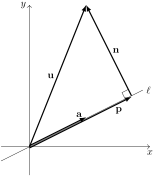
48.

\(\uvec{u} = (2,5) \text{,}\) \(\uvec{a} = (2,1) \)
Answer.
  1. \(\displaystyle \uproj{u}{a} = ( 18/5, 9/5) \)
  2. \(\uvec{u} = \uvec{p} + \uvec{n} \text{,}\) where \(\uvec{p} = \uproj{u}{a} \) as already computed, and
    \begin{equation*} \uvec{n} = \uvec{u} - \uvec{p} = ( -8/5, 16/5) \text{.} \end{equation*}
  3. Diagram illustrating a decomposition of a vector into a sum of its components parallel to and orthogonal to a specific vector.
    A diagram consisting of a right triangle of vectors in the first quadrant of the \(xy \)-plane. The legs of the right triangle are vector \(\uvec{p} \text{,}\) drawn from the origin to the point \(( 18/5, 9/5) \text{,}\) and vector \(\uvec{n} \text{,}\) drawn from the terminal point of \(\uvec{p} \) to the point \((2,5) \text{.}\) The hypotenuse of the triangle is vector \(\uvec{u} \text{,}\) drawn from the origin to the point \((2,5) \text{.}\) A fourth vector \(\uvec{a} \text{,}\) parallel to but shorter than \(\uvec{p} \text{,}\) is drawn from the origin to the point \((2, 1) \text{.}\) Finally, the line through the origin parallel to \(\uvec{a} \) and \(\uvec{p} \) is drawn and labelled as \(\ell \text{.}\)

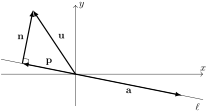
49.

\(\uvec{u} = (-2,3) \text{,}\) \(\uvec{a} = (5,-1) \)
Answer.
  1. \(\displaystyle \uproj{u}{a} = ( -5/2, 1/2) \)
  2. \(\uvec{u} = \uvec{p} + \uvec{n} \text{,}\) where \(\uvec{p} = \uproj{u}{a} \) as already computed, and
    \begin{equation*} \uvec{n} = \uvec{u} - \uvec{p} = ( 1/2, 5/2) \text{.} \end{equation*}
  3. Diagram illustrating a decomposition of a vector into a sum of its components parallel to and orthogonal to a specific vector.
    A diagram consisting of a right triangle of vectors in the second quadrant of the \(xy \)-plane. The legs of the right triangle are vector \(\uvec{p} \text{,}\) drawn from the origin to the point \(( -5/2, 1/2) \text{,}\) and vector \(\uvec{n} \text{,}\) drawn from the terminal point of \(\uvec{p} \) to the point \((-2,3) \text{.}\) The hypotenuse of the triangle is vector \(\uvec{u} \text{,}\) drawn from the origin to the point \((-2,3) \text{.}\) A fourth vector \(\uvec{a} \text{,}\) parallel but oppositely directed to \(\uvec{p} \text{,}\) is drawn from the origin to the point \((5, -1) \text{.}\) Finally, the line through the origin parallel to \(\uvec{a} \) and \(\uvec{p} \) is drawn and labelled as \(\ell \text{.}\)

Orthogonal projection in \(\R^n \).

In each case:
  1. Compute \(\uproj{u}{a} \text{.}\)
  2. Express \(\uvec{u} \) as a decomposition into a sum of its vector component parallel to \(\uvec{a} \) and its vector component orthogonal to \(\uvec{a} \).

50.

\(\uvec{u} = ( -1, 3, 1) \text{,}\) \(\uvec{a} = ( 5, 5, -4) \)
Answer.
  1. \(\displaystyle \uproj{u}{a} = (5/11, 5/11, -4/11) \)
  2. \(\uvec{u} = \uvec{p} + \uvec{n} \text{,}\) where \(\uvec{p} = \uproj{u}{a} \) as already computed, and
    \begin{equation*} \uvec{n} = \uvec{u} - \uvec{p} = (-16/11, 28/11, 15/11) \text{.} \end{equation*}

51.

\(\uvec{u} = ( 6, 0, 4) \text{,}\) \(\uvec{a} = ( -5, -1, 5) \)
Answer.
  1. \(\displaystyle \uproj{u}{a} = (50/51, 10/51, -50/51) \)
  2. \(\uvec{u} = \uvec{p} + \uvec{n} \text{,}\) where \(\uvec{p} = \uproj{u}{a} \) as already computed, and
    \begin{equation*} \uvec{n} = \uvec{u} - \uvec{p} = (256/51, -10/51, 254/51) \text{.} \end{equation*}

52.

\(\uvec{u} = ( 0, -2, 6, 0) \)
\(\uvec{a} = ( 1, -2, -6, -1) \)
Answer.
  1. \(\displaystyle \uproj{u}{a} = (-16/21, 32/21, 32/7, 16/21) \)
  2. \(\uvec{u} = \uvec{p} + \uvec{n} \text{,}\) where \(\uvec{p} = \uproj{u}{a} \) as already computed, and
    \begin{equation*} \uvec{n} = \uvec{u} - \uvec{p} = (16/21, -74/21, 10/7, -16/21) \text{.} \end{equation*}

53.

\(\uvec{u} = ( 3, 4, -5, -1, 2) \)
\(\uvec{a} = ( -1, 4, 0, 2, 6) \)
Answer.
  1. \(\displaystyle \uproj{u}{a} = (-23/57, 92/57, 0, 46/57, 46/19) \)
  2. \(\uvec{u} = \uvec{p} + \uvec{n} \text{,}\) where \(\uvec{p} = \uproj{u}{a} \) as already computed, and
    \begin{equation*} \uvec{n} = \uvec{u} - \uvec{p} = (194/57, 136/57, -5, -103/57, -8/19) \text{.} \end{equation*}

Distance from a point to a line.

Determine the distance from point \(R \) to the line through points \(P \) and \(Q \text{.}\)

54.

\(P(0,0), Q(4,1), R(3,-5) \)
Solution.
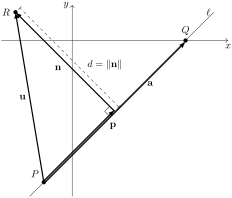
The line through \(P \) and \(Q \) is parallel to the vector \(\uvec{a} = \abray{PQ} = (4,1) \text{.}\) The distance from \(R \) to this line is then the norm of the vector component of \(\uvec{u} \) orthogonal to \(\uvec{a} \), where \(\uvec{u} = \abray{PR} = (3,-5) \text{.}\)
Diagram illustrating distance between a point and a line as represented by the vector component of a vector from the line to the point orthogonal to a vector parallel to the line.
A diagram consisting of a right triangle of vectors in the \(xy \)-plane. The legs of the right triangle are vector \(\uvec{p} \text{,}\) drawn from the origin to the point \((28/17, 7/17) \text{,}\) and vector \(\uvec{n} \text{,}\) drawn from the terminal point of \(\uvec{p} \) to the point \(R(3,-5) \text{.}\) The hypotenuse of the triangle is vector \(\uvec{u} \text{,}\) drawn from the origin to \(R \text{.}\) A fourth vector \(\uvec{a} \text{,}\) parallel to but longer than \(\uvec{p} \text{,}\) is drawn from the origin to the point \(Q(4,1) \text{.}\) Finally, the line through the origin and \(Q \) is drawn and labelled as \(\ell \text{,}\) and the distance from \(R \) to \(\ell \) is labelled as \(d = \unorm{n} \text{.}\)
\begin{equation*} \uvec{p} = \uproj{u}{a} = \left( \frac{28}{17}, \frac{7}{17} \right) \text{.} \end{equation*}
Next compute the vector component of \(\uvec{u} \) orthogonal to \(\uvec{a} \text{:}\)
\begin{equation*} \uvec{n} = \uvec{u} - \uvec{p} = \left( \frac{23}{17}, - \frac{92}{17} \right) \text{.} \end{equation*}
Finally, compute the distance from point \(R \) to the line as the norm of \(\uvec{n} \text{:}\)
\begin{equation*} d = \unorm{n} = \frac{23}{\sqrt{17}} \text{.} \end{equation*}

55.

\(P(-1,-5), Q(4,0), R(-2,1) \)
Solution.
The line through \(P \) and \(Q \) is parallel to the vector \(\uvec{a} = \abray{PQ} = (5,5) \text{.}\) The distance from \(R \) to this line is then the norm of the vector component of \(\uvec{u} \) orthogonal to \(\uvec{a} \), where \(\uvec{u} = \abray{PR} = (-1,6) \text{.}\)
Diagram illustrating distance between a point and a line as represented by the vector component of a vector from the line to the point orthogonal to a vector parallel to the line.
A diagram consisting of a right triangle of vectors in the \(xy \)-plane. The legs of the right triangle are vector \(\uvec{p} \text{,}\) drawn from point \(P(-1,-5) \) to the point \((3/2, -5/2) \text{,}\) and vector \(\uvec{n} \text{,}\) drawn from the terminal point of \(\uvec{p} \) to the point \(R(-2,1) \text{.}\) The hypotenuse of the triangle is vector \(\uvec{u} \text{,}\) drawn from \(P \) to \(R \text{.}\) A fourth vector \(\uvec{a} \text{,}\) parallel to but longer than \(\uvec{p} \text{,}\) is drawn from \(P \) to the point \(Q(4,0) \text{.}\) Finally, the line \(P \) and \(Q \) is drawn and labelled as \(\ell \text{,}\) and the distance from \(R \) to \(\ell \) is labelled as \(d = \unorm{n} \text{.}\)
\begin{equation*} \uvec{p} = \uproj{u}{a} = \left( \frac{5}{2}, \frac{5}{2} \right) \text{.} \end{equation*}
Next compute the vector component of \(\uvec{u} \) orthogonal to \(\uvec{a} \text{:}\)
\begin{equation*} \uvec{n} = \uvec{u} - \uvec{p} = \left( - \frac{7}{2}, \frac{7}{2} \right) \text{.} \end{equation*}
Finally, compute the distance from point \(R \) to the line as the norm of \(\uvec{n} \text{:}\)
\begin{equation*} d = \unorm{n} = \frac{7}{\sqrt{2}} \text{.} \end{equation*}

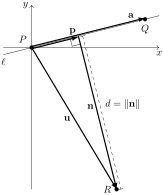
56.

\(P(0,0,0), Q(2,1,-6), R(1,0,-4) \)
Solution.
The line through \(P \) and \(Q \) is parallel to the vector \(\uvec{a} = \abray{PQ} = (2, 1, -6) \text{.}\) The distance from \(R \) to this line is then the norm of the vector component of \(\uvec{u} \) orthogonal to \(\uvec{a} \), where \(\uvec{u} = \abray{PR} = (1, 0, -4) \text{.}\)
\begin{equation*} \uvec{p} = \uproj{u}{a} = \left( \frac{52}{41}, \frac{26}{41}, - \frac{156}{41} \right) \text{.} \end{equation*}
Next compute the vector component of \(\uvec{u} \) orthogonal to \(\uvec{a} \text{:}\)
\begin{equation*} \uvec{n} = \uvec{u} - \uvec{p} = (-11/41, -26/41, -8/41) \text{.} \end{equation*}
Finally, compute the distance from point \(R \) to the line as the norm of \(\uvec{n} \text{:}\)
\begin{equation*} d = \unorm{n} = \sqrt{\frac{21}{41}} \text{.} \end{equation*}

57.

\(P(1,0,-1), Q(3,-2,3), R(-1,5,-5) \)
Solution.
The line through \(P \) and \(Q \) is parallel to the vector \(\uvec{a} = \abray{PQ} = (2, -2, 4) \text{.}\) The distance from \(R \) to this line is then the norm of the vector component of \(\uvec{u} \) orthogonal to \(\uvec{a} \), where \(\uvec{u} = \abray{PR} = (-2, 5, -4) \text{.}\)
\begin{equation*} \uvec{p} = \uproj{u}{a} = \left( - \frac{5}{2}, \frac{5}{2}, -5 \right) \text{.} \end{equation*}
Next compute the vector component of \(\uvec{u} \) orthogonal to \(\uvec{a} \text{:}\)
\begin{equation*} \uvec{n} = \uvec{u} - \uvec{p} = \left( \frac{1}{2}, \frac{5}{2}, 1 \right) \text{.} \end{equation*}
Finally, compute the distance from point \(R \) to the line as the norm of \(\uvec{n} \text{:}\)
\begin{equation*} d = \unorm{n} = \sqrt{\frac{15}{2}} \text{.} \end{equation*}

58.

\(P(0,0,0,0), Q(3,5,4,1), R(5,-2,1,3) \)
Solution.
The line through \(P \) and \(Q \) is parallel to the vector \(\uvec{a} = \abray{PQ} = (3, 5, 4, 1) \text{.}\) The distance from \(R \) to this line is then the norm of the vector component of \(\uvec{u} \) orthogonal to \(\uvec{a} \), where \(\uvec{u} = \abray{PR} = (5, -2, 1, 3) \text{.}\)
\begin{equation*} \uvec{p} = \uproj{u}{a} = \left( \frac{12}{17}, \frac{20}{17}, \frac{16}{17}, \frac{4}{17} \right) \text{.} \end{equation*}
Next compute the vector component of \(\uvec{u} \) orthogonal to \(\uvec{a} \text{:}\)
\begin{equation*} \uvec{n} = \uvec{u} - \uvec{p} = \left( \frac{73}{17}, - \frac{54}{17}, \frac{1}{17}, \frac{47}{17} \right) \text{.} \end{equation*}
Finally, compute the distance from point \(R \) to the line as the norm of \(\uvec{n} \text{:}\)
\begin{equation*} d = \unorm{n} = \sqrt{\frac{615}{17}} \text{.} \end{equation*}

59.

\(P(2,0,-2,-6), Q(-1,-1,-5,1), R(1,-4,-5,-5) \)
Solution.
The line through \(P \) and \(Q \) is parallel to the vector \(\uvec{a} = \abray{PQ} = (-3, -1, -3, 7) \text{.}\) The distance from \(R \) to this line is then the norm of the vector component of \(\uvec{u} \) orthogonal to \(\uvec{a} \), where \(\uvec{u} = \abray{PR} = (-1, -4, -3, 1) \text{.}\)
\begin{equation*} \uvec{p} = \uproj{u}{a} = \left( - \frac{69}{68}, - \frac{23}{68}, - \frac{69}{68}, \frac{161}{68} \right) \text{.} \end{equation*}
Next compute the vector component of \(\uvec{u} \) orthogonal to \(\uvec{a} \text{:}\)
\begin{equation*} \uvec{n} = \uvec{u} - \uvec{p} = \left( \frac{1}{68}, - \frac{249}{68}, - \frac{135}{68}, - \frac{93}{68} \right) \text{.} \end{equation*}
Finally, compute the distance from point \(R \) to the line as the norm of \(\uvec{n} \text{:}\)
\begin{equation*} d = \unorm{n} = \frac{1}{2} \, \sqrt{\frac{1307}{17}} \text{.} \end{equation*}

Distance from a point to a plane defined by an equation.

Use the method of Discovery 13.1.9 to determine the distance from point \(R \) to plane \(\Pi \text{.}\)

60.

\(R(6,-1,-1) \)
\(\Pi \colon \:\: 6 x + 5 y + 2 z = 0 \)
Solution.
Since the equation for \(\Pi \) is homogeneous, it passes through the origin, and we can create a vector from the plane to \(R \) by using the origin as the initial point:
\begin{equation*} \uvec{u} = \abray{OR} = (6,-1,-1) \text{.} \end{equation*}
Also, from the plane equation we obtain a normal vector for \(\Pi \text{:}\)
\begin{equation*} \uvec{n} = (6,5,2) \text{.} \end{equation*}
The distance from \(R \) to the plane will be the norm of the orthogonal projection of \(\uvec{u} \) onto \(\uvec{n} \text{.}\)
So first compute that projection:
\begin{equation*} \uvec{p} = \uproj{u}{n} = \left( \frac{174}{65}, \frac{29}{13}, \frac{58}{65} \right) \text{.} \end{equation*}
Finally, compute the distance from \(R \) to the plane as the norm of \(\uvec{p} \text{:}\)
\begin{equation*} d = \unorm{p} = \frac{29}{\sqrt{65}} \text{.} \end{equation*}

61.

\(R(4,-4,-1) \)
\(\Pi \colon \:\: 5 x + 6 y + 2 z = -4 \)
Solution.
By inspection, the point \(P(0,-1,1) \) is on \(\Pi \) because its coordinates satisfy the plane equation. Then we can create a vector from the plane to \(R \) by using \(P \) as the initial point:
\begin{equation*} \uvec{u} = \abray{PR} = (4, -3, -2) \text{.} \end{equation*}
Also, from the plane equation we obtain a normal vector for \(\Pi \text{:}\)
\begin{equation*} \uvec{n} = (5,6,2) \text{.} \end{equation*}
The distance from \(R \) to the plane will be the norm of the orthogonal projection of \(\uvec{u} \) onto \(\uvec{n} \text{.}\)
So first compute that projection:
\begin{equation*} \uvec{p} = \uproj{u}{n} = \left( - \frac{2}{13}, - \frac{12}{65}, - \frac{4}{65} \right) \text{.} \end{equation*}
Finally, compute the distance from \(R \) to the plane as the norm of \(\uvec{p} \text{:}\)
\begin{equation*} d = \unorm{p} = \frac{2}{\sqrt{65}} \text{.} \end{equation*}

62. Distance from a point to a plane defined by points.

Determine the distance from point \(S(3,5,-4) \) to the plane that passes through points \(P(-5,-6,-1), Q(-1,-1,4), R(-4,3,0) \text{.}\)
Solution.
Create a vector from the plane to \(S \) by using any one of \(P,Q,R \) as the initial point; we’ll use \(P \text{:}\)
\begin{equation*} \uvec{u} = \abray{PS} = (8, 11, -3) \text{.} \end{equation*}
Create two vectors parallel to the plane from the provided points:
\begin{align*} \uvec{v} \amp = \abray{PQ} = (4, 5, 5) \text{,} \\ \uvec{w} \amp = \abray{PR} = (1, 9, 1) \text{,} \end{align*}
Now use the cross product to create a normal vector to the plane:
\begin{equation*} \uvec{n} = \ucrossprod{v}{w} = (-40, 1, 31) \text{.} \end{equation*}
The distance from \(S \) to the plane will be the norm of the orthogonal projection of \(\uvec{u} \) onto \(\uvec{n} \text{.}\)
So first compute that projection:
\begin{equation*} \uvec{p} = \uproj{u}{n} = \left( \frac{2680}{427}, - \frac{67}{427}, - \frac{2077}{427} \right) \text{.} \end{equation*}
Finally, compute the distance from \(S \) to the plane as the norm of \(\uvec{p} \text{:}\)
\begin{equation*} d = \unorm{p} = 67 \, \sqrt{\frac{6}{427}} \text{.} \end{equation*}

Distance from a point to a line in \(\R^2 \) using a normal vector.

In each case, use an analogous method to the one for Exercises 60–61 to determine the distance in \(\R^2 \) from the point \(Q \) to the line \(\ell \text{.}\)

63.

\(Q(5,0) \)
\(\ell \colon \:\: 4 x + 5 y = 0 \)
Solution.
Since the equation for \(\ell \) is homogeneous, it passes through the origin, and we can create a vector from the line to \(Q \) by using the origin as the initial point:
\begin{equation*} \uvec{u} = \abray{OQ} = (5,0) \text{.} \end{equation*}
Also, from the line equation we obtain a normal vector for \(\ell \text{:}\)
\begin{equation*} \uvec{n} = (4,5) \text{.} \end{equation*}
The distance from \(Q \) to the line will be the norm of the orthogonal projection of \(\uvec{u} \) onto \(\uvec{n} \text{.}\)
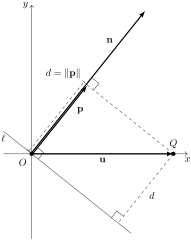
Diagram illustrating using a projection onto a normal vector to a line in two-dimensional space to compute distance from a point to a line.
A diagram consisting of a rectangle with one side along a negatively-sloped line, where the two sides perpendicular to the line represent the distance from the point at one corner of the rectangle to the line. The graph of the line \(4 x + 5 y = 0 \) is sketched, passing through the origin, and is labelled as \(\ell \text{.}\) The point \(Q(5,0) \) is plotted, and a perpendicular is dropped from \(Q \) to \(\ell \text{.}\) A vector labelled \(\uvec{n} \) is drawn extending from the origin to the point \((4,5) \text{,}\) and the angle at the origin between \(\uvec{n} \) and \(\ell \) is right. Another perpendicular is dropped from \(Q \) to the shaft of \(\uvec{n} \text{,}\) and another vector labelled \(\uvec{p} \) is drawn extending from the origin to the foot of this second perpendicular from \(Q \text{.}\) A rectangle has now been formed, with sides consisting of \(\uvec{p} \text{,}\) the perpendicular from \(Q \) to \(\uvec{n} \text{,}\) the perpendicular from \(Q \) to \(\ell \text{,}\) and the segment along \(\ell \) from the origin to the foot of the perpendicular from \(Q \) to \(\ell \text{.}\) Finally, the lengths of the two sides of the rectangle that are perpendicular to \(\ell \) are labelled as \(d \text{,}\) representing the distance from \(Q \) to \(\ell \text{.}\)
So first compute that projection:
\begin{equation*} \uvec{p} = \uproj{u}{n} = \left( \frac{80}{41}, \frac{100}{41} \right) \text{.} \end{equation*}
Finally, compute the distance from \(Q \) to the line as the norm of \(\uvec{p} \text{:}\)
\begin{equation*} d = \unorm{p} = \frac{20}{\sqrt{41}} \text{.} \end{equation*}

64.

\(Q(5,3) \)
\(\ell \colon \:\: x - y = -2 \)
Solution.
By inspection, point \(P(0,2) \) is on \(\ell \) because its coordinates satisfy the line equation (and is in fact the \(y \)-intercept of the line). Then we can create a vector from the line to \(Q \) by using \(P \) as the initial point:
\begin{equation*} \uvec{u} = \abray{PQ} = (5, 1) \text{.} \end{equation*}
Also, from the line equation we obtain a normal vector for \(\Pi \text{:}\)
\begin{equation*} \uvec{n} = (1,-1) \text{.} \end{equation*}
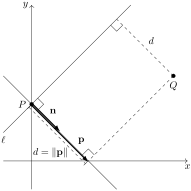
The distance from \(Q \) to the line will be the norm of the orthogonal projection of \(\uvec{u} \) onto \(\uvec{n} \text{.}\)
Diagram illustrating using a projection onto a normal vector to a line in two-dimensional space to compute distance from a point to a line.
A diagram consisting of a rectangle with one side along a positively-sloped line, where the two sides perpendicular to the line represent the distance from the point at one corner of the rectangle to the line. The graph of the line \(x - y = -2 \) is sketched and labelled as \(\ell \text{.}\) Its \(y \)-intercept is labelled as point \(P(0,2) \text{.}\) The point \(Q(5,3) \) is plotted, and a perpendicular is drawn from \(Q \) to \(\ell \text{.}\) A vector labelled \(\uvec{n} \) is drawn extending from \(P \) to the point \((1,1) \text{,}\) and the angle at \(P \) between \(\uvec{n} \) and \(\ell \) is right. Another perpendicular is dropped from \(Q \) to the line through \(P \) and parallel to \(\uvec{n} \text{,}\) landed beyond the terminal point of \(\uvec{n} \) along this line. Another vector labelled \(\uvec{p} \) is drawn extending from \(P \) to the foot of this second perpendicular from \(Q \text{.}\) A rectangle has now been formed, with sides consisting of \(\uvec{p} \text{,}\) the perpendicular from \(Q \) to the line “through” \(\uvec{n} \text{,}\) the perpendicular from \(Q \) to \(\ell \text{,}\) and the segment along \(\ell \) from \(P \) to the foot of the perpendicular from \(Q \) to \(\ell \text{.}\) Finally, the lengths of the two sides of the rectangle that are perpendicular to \(\ell \) are labelled as \(d \text{,}\) representing the distance from \(Q \) to \(\ell \text{.}\)
So first compute that projection:
\begin{equation*} \uvec{p} = \uproj{u}{n} = ( 2, - 2) \text{.} \end{equation*}
Finally, compute the distance from \(Q \) to the line as the norm of \(\uvec{p} \text{:}\)
\begin{equation*} d = \unorm{p} = 2 \sqrt{2} \text{.} \end{equation*}

Distance from a point to a hyperplane in \(\R^n \).

In each case, use an analogous method to the one for Exercises 60–61 to determine the distance in \(\R^n \) from the point \(R \) to the hyperplane \(H \text{.}\) (See the preamble to Exercises 29–31.)

65.

\(R(1,0,-6,6) \)
\(H \colon \:\: 5 x_1 + 2 x_2 - 5 x_3 + 2 x_4 = 0 \)
Solution.
Since the equation for \(H \) is homogeneous, it passes through the origin, and we can create a vector from the hyperplane to \(R \) by using the origin as the initial point:
\begin{equation*} \uvec{u} = \abray{OR} = (1,0,-6,6) \text{.} \end{equation*}
Also, from the hyperplane equation we obtain a normal vector for \(H \text{:}\)
\begin{equation*} \uvec{n} = (5,2,-5,2) \text{.} \end{equation*}
The distance from \(R \) to the hyperplane will be the norm of the orthogonal projection of \(\uvec{u} \) onto \(\uvec{n} \text{.}\)
So first compute that projection:
\begin{equation*} \uvec{p} = \uproj{u}{n} = \left( \frac{235}{58}, \frac{47}{29}, - \frac{235}{58}, \frac{47}{29} \right) \text{.} \end{equation*}
Finally, compute the distance from \(R \) to the hyperplane as the norm of \(\uvec{p} \text{:}\)
\begin{equation*} d = \unorm{p} = \frac{47}{\sqrt{58}} \text{.} \end{equation*}

66.

\(R(1,3,-3,2) \)
\(H \colon \:\: 6 x_1 - 2 x_2 + 2 x_3 - 4 x_4 = 3 \)
Solution.
By inspection, the point \(P(1/2,0,0,0) \) is on \(H \) because its coordinates satisfy the hyperplane equation. Then we can create a vector from the hyperplane to \(R \) by using \(P \) as the initial point:
\begin{equation*} \uvec{u} = \abray{PR} = \left( \frac{1}{2}, 3, -3, 2 \right) \text{.} \end{equation*}
Also, from the hyperplane equation we obtain a normal vector for \(\Pi \text{:}\)
\begin{equation*} \uvec{n} = (6,-2,2,-4) \text{.} \end{equation*}
The distance from \(R \) to the hyperplane will be the norm of the orthogonal projection of \(\uvec{u} \) onto \(\uvec{n} \text{.}\)
So first compute that projection:
\begin{equation*} \uvec{p} = \uproj{u}{n} = \left( - \frac{17}{10}, \frac{17}{30}, - \frac{17}{30}, \frac{17}{15} \right) \text{.} \end{equation*}
Finally, compute the distance from \(R \) to the hyperplane as the norm of \(\uvec{p} \text{:}\)
\begin{equation*} d = \unorm{p} = \frac{17}{2 \sqrt{15}} \text{.} \end{equation*}

67.

\(R(2,-3,6,5,1) \)
\(H \colon \:\: x_1 - 2 x_2 + 3 x_4 + 5 x_5 = 0 \)
Solution.
Since the equation for \(H \) is homogeneous, it passes through the origin, and we can create a vector from the hyperplane to \(R \) by using the origin as the initial point:
\begin{equation*} \uvec{u} = \abray{OR} = (2,-3,6,5,1) \text{.} \end{equation*}
Also, from the hyperplane equation we obtain a normal vector for \(H \text{:}\)
\begin{equation*} \uvec{n} = (1,-2,0,3,5) \text{.} \end{equation*}
The distance from \(R \) to the hyperplane will be the norm of the orthogonal projection of \(\uvec{u} \) onto \(\uvec{n} \text{.}\)
So first compute that projection:
\begin{equation*} \uvec{p} = \uproj{u}{n} = \left( \frac{28}{39}, - \frac{56}{39}, 0, \frac{28}{13}, \frac{140}{39}\right) \text{.} \end{equation*}
Finally, compute the distance from \(R \) to the hyperplane as the norm of \(\uvec{p} \text{:}\)
\begin{equation*} d = \unorm{p} = \frac{28}{\sqrt{39}} \text{.} \end{equation*}

68.

\(R(-6,1,1,0,-5) \)
\(H \colon \:\: 6 x_1 + 3 x_2 + 3 x_3 - 2 x_4 - 3 x_5 = 1 \)
Solution.
By inspection, the point \(P(0,0,1,1,0) \) is on \(H \) because its coordinates satisfy the hyperplane equation. Then we can create a vector from the hyperplane to \(R \) by using \(P \) as the initial point:
\begin{equation*} \uvec{u} = \abray{PR} = (-6, 1, 0, -1, -5) \text{.} \end{equation*}
Also, from the hyperplane equation we obtain a normal vector for \(\Pi \text{:}\)
\begin{equation*} \uvec{n} = (6,3,3,-2,-3) \text{.} \end{equation*}
The distance from \(R \) to the hyperplane will be the norm of the orthogonal projection of \(\uvec{u} \) onto \(\uvec{n} \text{.}\)
So first compute that projection:
\begin{equation*} \uvec{p} = \uproj{u}{n} = \left( - \frac{96}{67}, - \frac{48}{67}, - \frac{48}{67}, \frac{32}{67}, \frac{48}{67} \right) \text{.} \end{equation*}
Finally, compute the distance from \(R \) to the hyperplane as the norm of \(\uvec{p} \text{:}\)
\begin{equation*} d = \unorm{p} = \frac{16}{\sqrt{67}} \text{.} \end{equation*}

69. Orthogonal projection onto an axis in \(\R^2 \).

Recall that the standard basis vectors in \(\R^2 \) are \(\uvec{e}_1 = (1,0) \) and \(\uvec{e}_2 = (0,1) \text{.}\)
In the following, consider general \(\R^2 \) vector \(\uvec{u} = (x,y) \text{.}\)

(a)

Express \(\uvec{u} \) as a decomposition into a sum of its vector component parallel to \(\uvec{e}_1 \) and its vector component orthogonal to \(\uvec{e}_1 \). Then sketch a representative diagram in the first quadrant of the \(xy \)-plane that illustrates this decomposition using a vector addition triangle.
Answer.
Parallel component: \(\uvec{p} = \proj_{\uvec{e}_1} (x,y) = (x,0) \text{.}\)
Orthogonal component: \(\uvec{n} = (x,y) - \proj_{\uvec{e}_1} (x,y) = (0,y) \text{.}\)
Decomposition: \((x,y) = (x,0) + (0,y) \text{.}\)
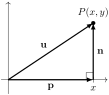
Diagram illustrating a decomposition of a vector in two-dimensional space into a sum of its components parallel to and orthogonal to the first standard basis vector.
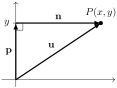
A diagram consisting of a right triangle of vectors in the first quadrant of the \(xy \)-plane. The legs of the right triangle are vector \(\uvec{p} \text{,}\) drawn from the origin horizontally rightward along the \(x \)-axis to the point \((x,0) \text{,}\) and vector \(\uvec{n} \text{,}\) drawn from the terminal point of \(\uvec{p} \) vertically upward to the point \(P(x,y) \text{.}\) The hypotenuse of the triangle is vector \(\uvec{u} \text{,}\) drawn from the origin to the point \(P(x,y) \text{.}\)

(b)

Express \(\uvec{u} \) as a decomposition into a sum of its vector component parallel to \(\uvec{e}_2 \) and its vector component orthogonal to \(\uvec{e}_2 \).
Answer.
Parallel component: \(\uvec{p} = \proj_{\uvec{e}_2} (x,y) = (0,y) \text{.}\)
Orthogonal component: \(\uvec{n} = (x,y) - \proj_{\uvec{e}_2} (x,y) = (x,0) \text{.}\)
Decomposition: \((x,y) = (0,y) + (x,0) \text{.}\)
Diagram illustrating a decomposition of a vector in two-dimensional space into a sum of its components parallel to and orthogonal to the first standard basis vector.
A diagram consisting of a right triangle of vectors in the first quadrant of the \(xy \)-plane. The legs of the right triangle are vector \(\uvec{p} \text{,}\) drawn from the origin horizontally rightward along the \(x \)-axis to the point \((x,0) \text{,}\) and vector \(\uvec{n} \text{,}\) drawn from the terminal point of \(\uvec{p} \) vertically upward to the point \(P(x,y) \text{.}\) The hypotenuse of the triangle is vector \(\uvec{u} \text{,}\) drawn from the origin to the point \(P(x,y) \text{.}\)

70. Orthogonal projection onto an axis in \(\R^n \).

Compute \(\proj_{\uvec{e}_j} \uvec{u} \) for general \(n \)-dimensional vector \(\uvec{u} = (u_1,u_2,\dotsc,u_n) \text{,}\) where \(\uvec{e}_j \) is the \(\nth[j] \) standard basis vector in \(\R^n \text{.}\)
Answer.
\(\proj_{\uvec{e}_j} \uvec{u} = u_j \uvec{e}_j \)

Properties of orthogonal projection, geometrically.

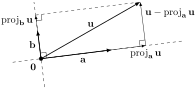
For each of the following, begin by making a fresh copy of the orthogonal projection diagram in Figure 13.2.1, and then draw in additional vectors as instructed.

71. Projection of a negative vector.

(a)

Draw in vectors \(- \uvec{u} \) and \(\proj_{\uvec{a}} (- \uvec{u}) \text{.}\)
Answer.
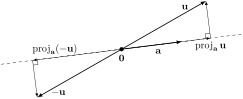
Diagram illustrating the relationship between the orthogonal projection of a first vector onto a second vector and the orthogonal projection of the negative of the first vector onto the second.
A diagram consisting of two right triangles sharing a vertex at a point labelled \(\zerovec \text{.}\) A vector labelled \(\uvec{a} \) emanates rightwards from \(\zerovec \) at a slight positive slope. A second vector labelled \(\uvec{u} \) also emanates rightwards from \(\zerovec \text{,}\) at a greater positive slope and longer than \(\uvec{a} \text{.}\) A third vector labelled \(\uproj{u}{a} \) emanates rightwards from \(\zerovec \text{,}\) parallel to but longer than \(\uvec{a} \text{,}\) and a fourth unlabelled vector runs between the terminal points of \(\uproj{u}{a} \) and \(\uvec{u} \) so that a right-angled triangle is formed, with \(\uvec{u} \) as the hypotenuse.
On the other side of \(\zerovec \text{,}\) the negative vector \(- \uvec{u} \) is drawn with initial point at \(zerovec \text{.}\) A vector labelled \(\proj_{\uvec{a}} (-\uvec{u}) \) emanates leftwards from \(\zerovec \text{,}\) parallel to but oppositely directed from \(\uvec{a} \text{,}\) and another unlabelled vector runs between the terminal points of \(\proj_{\uvec{a}} (- \uvec{u}) \) and \(- \uvec{u} \) so that a second right-angled triangle is formed, with \(- \uvec{u} \) as the hypotenuse.

(b)

Based on your diagram and Euclidean geometry, give a geometric argument why \(\proj_{\uvec{a}} (- \uvec{u}) \) is equal to the negative of \(\uproj{u}{a} \text{.}\)
Answer.
First, \(\uproj{u}{a} \) and \(\proj_{\uvec{a}} (- \uvec{u}) \) share the same initial point and their terminal points must both lie on the line through \(\zerovec \) that is parallel to \(\uvec{a} \text{.}\) So the two angles at \(\zerovec \) are opposite and therefore congruent, which makes the two right-angled triangles similar by Angle-Angle. But \(\norm{- \uvec{u}} = \unorm{u} \text{,}\) hence the two triangles must in fact be congruent. Therefore, \(\proj_{\uvec{a}} (- \uvec{u}) \) has the same length as \(\uproj{u}{a} \text{.}\)
Furthermore, since the terminal points of \(\uproj{u}{a} \) and \(\proj_{\uvec{a}} (- \uvec{u}) \) are collinear, these two vectors are parallel but oppositely directed. Since they have the same length, we may conclude that they are negatives of each other.

72. Projection onto a negative vector.

(a)

Draw in vectors \(- \uvec{a} \) and \(\proj_{(- \uvec{a})} \uvec{u} \text{.}\)
Answer.
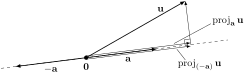
Diagram illustrating the relationship between the orthogonal projection of a first vector onto a second vector and the orthogonal projection of the first vector onto the negative of the second.
A diagram consisting of a right triangle with one leg sitting on a line. A point representing the origin is plotted and labelled \(\zerovec \text{.}\) A vector labelled \(\uvec{a} \) emanates rightwards from \(\zerovec \) at a slight positive slope, and the line through \(\zerovec \) and parallel to \(\uvec{a} \) is sketched as a dashed line. A second vector labelled \(\uvec{u} \) also emanates rightwards from \(\zerovec \text{,}\) at a greater positive slope and longer than \(\uvec{a} \text{.}\) A third vector labelled \(\uproj{u}{a} \) emanates rightwards from \(\zerovec \text{,}\) parallel to but longer than \(\uvec{a} \text{,}\) and a fourth unlabelled vector runs between the terminal points of \(\uproj{u}{a} \) and \(\uvec{u} \) so that a right-angled triangle is formed, with \(\uvec{u} \) as the hypotenuse.
The negative vector \(- \uvec{a} \) is also drawn with its initial point at the origin, so that it is oppositely directed to \(\uvec{a} \) along the dashed line, and finally a vector labelled \(\proj_{(- \uvec{a})} \uvec{u} \) is drawn spanning the same segment as \(\uproj{u}{a} \text{.}\)

(b)

Based on your diagram and our conception of orthogonal projection as providing the answer to Question 13.3.4 (see Subsection 13.3.3), give a geometric argument why \(\proj_{(- \uvec{a})} \uvec{u} \) is the same as \(\uproj{u}{a} \text{.}\)
Answer.
When \(\uvec{a} \) and \(\uvec{u} \) are positioned with initial points at the origin, as in the diagram, \(\uproj{u}{a} \) is defined to be the vector (also with initial point at the origin) whose terminal point lies at the point closest to \(\uvec{u} \) on the line through the origin and parallel to \(\uvec{a} \text{.}\) As \(- \uvec{a} \) is parallel to \(\uvec{a} \text{,}\) the point closest to \(\uvec{u} \) on the line through the origin and parallel to \(- \uvec{a} \) is the same point again, since the two lines are the same line. Therefore, \(\proj_{(- \uvec{a})} \uvec{u} \) has the same initial and terminal points as \(\uproj{u}{a} \text{,}\) and so the two vectors are the same.

73. Projection of a scaled vector.

(a)

Draw in vectors \(2 \uvec{u} \) and \(\proj_{\uvec{a}} (2 \uvec{u}) \text{.}\)
Answer.
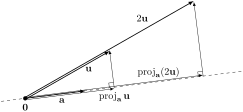
Diagram illustrating the relationship between the orthogonal projection of a first vector onto a second vector and the orthogonal projection of double the first vector onto the second.
A diagram consisting of two right triangles sharing a vertex at a point labelled \(\zerovec \text{.}\) A vector labelled \(\uvec{a} \) emanates rightwards from \(\zerovec \) at a slight positive slope. A second vector labelled \(\uvec{u} \) also emanates rightwards from \(\zerovec \text{,}\) at a greater positive slope and longer than \(\uvec{a} \text{.}\) A third vector labelled \(\uproj{u}{a} \) emanates rightwards from \(\zerovec \text{,}\) parallel to but longer than \(\uvec{a} \text{,}\) and a fourth unlabelled vector runs between the terminal points of \(\uproj{u}{a} \) and \(\uvec{u} \) so that a right-angled triangle is formed, with \(\uvec{u} \) as the hypotenuse.
The scaled vector \(2 \uvec{u} \) is also drawn with initial point at \(\uvec{u} \text{.}\) A vector labelled \(\proj_{\uvec{a}} {(2 \uvec{u})} \) again emanates rightwards from \(\zerovec \text{,}\) parallel to but longer than \(\uvec{a} \text{,}\) and another unlabelled vector runs between the terminal points of \(\proj_{\uvec{a}} {(2 \uvec{u})} \) and \(2 \uvec{u} \) so that a second right-angled triangle is formed, with \(2 \uvec{u} \) as the hypotenuse.

(b)

Based on your diagram and Euclidean geometry, give a geometric argument why \(\proj_{\uvec{a}} (2 \uvec{u}) \) is equal to \(2 \uproj{u}{a} \text{.}\)
Answer.
The two right triangles in the diagram share an acute angle at \(\zerovec \text{,}\) and so are similar by Angle-Angle. In similar triangles, lengths of corresponding sides are at a constant ratio. Therefore, since the ratio of lengths of the hypotenuses \(2 \uvec{u} \) and \(\uvec{u} \) is \(2 \text{,}\) the ratio of lengths of the bases \(\proj_{\uvec{a}} (2 \uvec{u}) \) and \(\uproj{u}{a} \) is also \(2 \text{.}\) Furthermore, each of those base vectors is parallel to \(\uvec{a} \text{,}\) hence they are parallel to and therefore scalar multiples of each other. Combining all this, we conclude that \(\proj_{\uvec{a}} (2 \uvec{u}) \) must be equal to \(2 \uproj{u}{a} \text{.}\)

(c)

Using our formula for orthogonal projection, algebraically verify that the following identity holds for all scalars \(k \text{:}\)
\begin{equation*} \proj_{\uvec{a}} (k \uvec{u}) = k \uproj{u}{a} \text{.} \end{equation*}

74. Projection onto a scaled vector.

(a)

Draw in vectors \(2 \uvec{a} \) and \(\proj_{(2 \uvec{a})} \uvec{u} \text{.}\)
Answer.
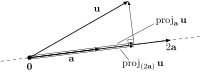
Diagram illustrating the relationship between the orthogonal projection of a first vector onto a second vector and the orthogonal projection of the first vector onto the double of the second.
A diagram consisting of a right triangle with one leg sitting on a line. A point representing the origin is plotted and labelled \(\zerovec \text{.}\) A vector labelled \(\uvec{a} \) emanates rightwards from \(\zerovec \) at a slight positive slope, and the line through \(\zerovec \) and parallel to \(\uvec{a} \) is sketched as a dashed line. A second vector labelled \(\uvec{u} \) also emanates rightwards from \(\zerovec \text{,}\) at a greater positive slope and longer than \(\uvec{a} \text{.}\) A third vector labelled \(\uproj{u}{a} \) emanates rightwards from \(\zerovec \text{,}\) parallel to but longer than \(\uvec{a} \text{,}\) and a fourth unlabelled vector runs between the terminal points of \(\uproj{u}{a} \) and \(\uvec{u} \) so that a right-angled triangle is formed, with \(\uvec{u} \) as the hypotenuse.
The scaled vector \(2 \uvec{a} \) is also drawn with its initial point at the origin, so that it extends past the terminal point of \(\uvec{a} \) along the dashed line, and finally a vector labelled \(\proj_{(2 \uvec{a})} \uvec{u} \) is drawn spanning the same segment as \(\uproj{u}{a} \text{.}\)

(b)

Based on your diagram and our conception of orthogonal projection as providing the answer to Question 13.3.4 (see Subsection 13.3.3), give a geometric argument why \(\proj_{(2 \uvec{a})} \uvec{u} \) is the same as \(\uproj{u}{a} \text{.}\)
Answer.
When \(\uvec{a} \) and \(\uvec{u} \) are positioned with initial points at the origin, as in the diagram, \(\uproj{u}{a} \) is defined to be the vector (also with initial point at the origin) whose terminal point lies at the point closest to \(\uvec{u} \) on the line through the origin and parallel to \(\uvec{a} \text{.}\) As \(2 \uvec{a} \) is parallel to \(\uvec{a} \text{,}\) the point closest to \(\uvec{u} \) on the line through the origin and parallel to \(2 \uvec{a} \) is the same point again, since the two lines are the same line. Therefore, \(\proj_{(2 \uvec{a})} \uvec{u} \) has the same initial and terminal points as \(\uproj{u}{a} \text{,}\) and so the two vectors are the same.

75. Orthogonal component versus orthogonal projection in \(\R^2 \).

Note. For this exercise, assume \(n = 2 \text{.}\)

(a)

Draw in a vector \(\uvec{b} \) orthogonal to \(\uvec{a} \text{,}\) with its initial point at \(\zerovec \text{.}\) Then draw in \(\uproj{u}{b} \text{.}\)
Answer.
Diagram illustrating congruence between the component of a first vector orthogonal to a second vector, and the orthogonal projection of the first vector onto a third vector that is orthogonal to the second.
A diagram consisting of a rectangle in the \(xy \)-plane. A point labelled \(zerovec \) appears in the lower left corner of the rectangle, and a vector labelled \(\uvec{u} \) emanates from this point to the upper right corner of the rectangle, forming a diagonal for the rectangle. A vector labelled \(\uvec{a} \) emanates rightwards from the \(\zerovec \) point at a slightly positive slope along the bottom side of the rectangle, but not all the way to the lower right corner. Another vector parallel to \(\uvec{a} \) and labelled as \(\uproj{u}{a} \) emanates from the \(\zerovec \) point, this time extending all the way to the lower right corner of the rectangle, thus forming the bottom side of the rectangle. A vector labelled \(\uvec{u} - \uproj{u}{a} \) extends from the lower right corner to the upper right corner of the rectangle, forming the right side of the rectangle. A vector labelled \(\uvec{b} \) emanates upwards from the \(\zerovec \) point at a right angle to \(\uvec{a} \text{,}\) along the left side of the rectangle, but not all the way to the upper left corner. Another vector parallel to \(\uvec{b} \) and labelled as \(\uproj{u}{b} \) emanates from the \(\zerovec \) point, this time extending all the way to the upper left corner of the rectangle, thus forming the left side of the rectangle. Finally, a dashed line between the terminal points of \(\uproj{u}{b} \) and \(\uvec{u} \) forms the upper side of the rectangle.

(b)

Based on your diagram and Euclidean geometry, give a geometric argument for why \(\uproj{u}{b} \) is equal to the vector component of \(\uvec{u} \) orthogonal to \(\uvec{a} \) in \(\R^2 \text{.}\)
Answer.
In the diagram we have a quadrilateral with vertices at \(\zerovec \) and the terminal points of \(\uproj{u}{a} \text{,}\) \(\uvec{u} \text{,}\) and \(\uproj{u}{b} \text{.}\) Because \(\uvec{b} \) is assumed to be orthogonal to \(\uvec{a} \text{,}\) we have a right angle at the vertex at \(\zerovec \text{.}\) And the nature of orthogonal projections ensures that we have right angles at the vertices at the terminal points of \(\uproj{u}{a} \) and \(\uproj{u}{b} \text{.}\)
In Euclidean geometry, a quadrilateral with three right angles must be a rectangle, and opposite sides in a rectangle are always parallel and congruent. Therefore, \(\uproj{u}{b} \) is parallel to (but not oppositely directed to) and the same length as \(\uvec{u} - \uproj{u}{a} \text{.}\) Therefore, \(\uproj{u}{b} \) is equal to the vector component of \(\uvec{u} \) orthogonal to \(\uvec{a} \text{.}\)

(c)

Why does a similar argument not work in \(\R^n \) for \(n \gt 2 \text{?}\)
Answer.
This geometric argument only works in \(\R^2 \) because in \(\R^2 \) every vector that is orthogonal to \(\uvec{a} \) is parallel to every other vector orthogonal to \(\uvec{a} \text{,}\) forcing the shape to be a rectangle. In \(\R^3 \text{,}\) for example, there are \(360 \) degrees of directions that are orthogonal to \(\uvec{a} \text{,}\) and choosing an arbitrary \(\uvec{b} \) would most likely cause \(\uproj{u}{b} \) to not even be parallel to \(\uvec{u} - \uproj{u}{a} \text{.}\)
However, in a further course in linear algebra you may learn about orthogonal projections in inner product spaces more generally, in which case you will discover an analogous pattern involving projection onto an orthogonal complement.

76. Orthogonality versus vector operations.

Assume all vectors are in \(\R^n \text{.}\) In each case, use Algebra rules of the dot product (Proposition 12.5.3) to verify that the statement is always true.

(a) Orthogonality versus addition.

If \(\uvec{w} \) is orthogonal to both \(\uvec{u} \) and \(\uvec{v} \text{,}\) then \(\uvec{w} \) is also orthogonal to \(\uvec{x} \) for \(\uvec{x} = \uvec{u} + \uvec{v} \text{.}\)

(b) Orthogonality versus scalar multiplication.

If \(\uvec{w} \) is orthogonal to \(\uvec{v} \text{,}\) then \(\uvec{w} \) is also orthogonal to \(\uvec{x} \) for \(\uvec{x} = k \uvec{v} \) for all scalars \(k \text{.}\)

(c) Orthogonality versus linear combination.

If \(\uvec{w} \) is orthogonal to each of \(\uvec{v}_1, \uvec{v}_2, \dotsc, \uvec{v}_m \text{,}\) then \(\uvec{w} \) is also orthogonal to \(\uvec{x} \) for
\begin{equation*} \uvec{x} = k_1 \uvec{v}_1 + k_2 \uvec{v}_2 + \dotsb + k_m \uvec{v}_m \end{equation*}
for all scalars \(k_1, k_2, \dotsc, k_m \text{.}\)

77. Maximum orthogonality.

An orthogonal set of vectors is a collection \(\{ \uvec{v}_1, \uvec{v}_2, \dotsc, \uvec{v}_m \} \) where each \(\uvec{v}_i \) is orthogonal to every \(\uvec{v}_j \text{,}\) \(j \neq i \text{.}\)

(a)

Reasoning geometrically, what is the maximum number of vectors possible in an orthogonal set in \(\R^2 \text{?}\)

(b)

Reasoning geometrically, what is the maximum number of vectors possible in an orthogonal set in \(\R^3 \text{?}\)

(c)

Based on your answers so far, what do you think is the maximum number of vectors possible in an orthogonal set in \(\R^4 \text{?}\)

(d)

Generalizing, what do you think is the maximum number of vectors possible in an orthogonal set in \(\R^n \text{?}\)

Properties the cross product.

For each property of the cross product from Proposition 13.5.5, use (†††) (and/or (‡)) from Subsection 13.3.6 to verify it is true for all vectors \(\uvec{u}, \uvec{v}, \uvec{w} \) in \(\R^3 \) and all scalars \(k \text{.}\)
Note. Be sure to use proper left-hand side versus right-hand side procedure for verifying an equality!

78. Rule 1.

\(\dotprod{\uvec{u}}{(\ucrossprod{u}{v})} = 0 \text{.}\)

79. Rule 2.

\(\dotprod{\uvec{v}}{(\ucrossprod{u}{v})} = 0 \text{.}\)

80. Rule 3.

\(\crossprod{\uvec{u}}{\zerovec} = \zerovec \text{.}\)

81. Rule 4.

\(\crossprod{\zerovec}{\uvec{v}} = \zerovec \text{.}\)

82. Rule 5.

\(\ucrossprod{v}{u} = - \ucrossprod{u}{v} \text{.}\)

83. Rule 6.

\(\crossprod{(k \uvec{u})}{\uvec{v}} = k (\ucrossprod{u}{v}) \text{.}\)

84. Rule 7.

\(\crossprod{\uvec{u}}{(k \uvec{v})} = k (\ucrossprod{u}{v}) \text{.}\)

85. Rule 8.

\(\crossprod{(\uvec{u} + \uvec{v})}{\uvec{w}} = \ucrossprod{u}{w} + \ucrossprod{v}{w} \text{.}\)

86. Rule 9.

\(\crossprod{\uvec{u}}{(\uvec{v} + \uvec{w})} = \ucrossprod{u}{v} + \ucrossprod{u}{w} \text{.}\)

87. Rule 10.

\(\ucrossprod{u}{u} = \zerovec \text{.}\)

88. Rule 11.

If \(\uvec{u} \) and \(\uvec{v} \) are parallel, then \(\ucrossprod{u}{v} = \zerovec \text{.}\)