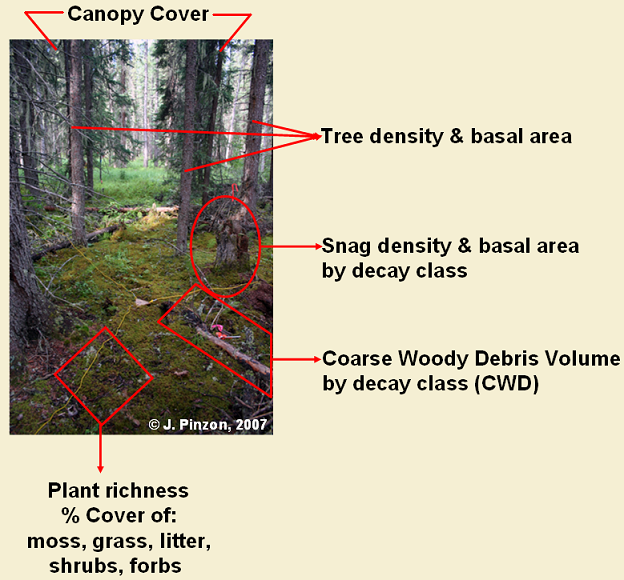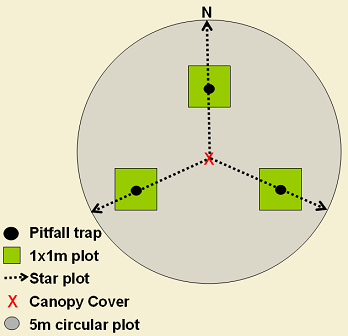
CWD Volume: On the circular plot described above, a star plot with three lines was displayed on the ground with line 1 heading north and the other two separated by 120 degrees to the east and west from line one. All pieces of down woody debris with a diameter over 7cm touching any of the three lines were recorded b decay class and species when possible. Decay was estimated following the 7 decay classification system. Volume was estimated following Van Wagner (1968), pooling the area from the three lines as one single 15m line.
Snag density and basal area by decay class: Was measured following the same methodology for living trees. Decay was estimated following the 6 decay classification system.
Tree density and basal area: A 5m radius circular plot was set on the ground of each site. All individual trees with a basal diameter over 5cm were counted and measured. Tree density is an estimation of the number of trees of each species (Populus tremuloides, Populus balsamifera, Picea glauca) by square meter. Basal area/m2 per species was estimated from the basal diameter of each individual found in the circular plot.
Plant richness and percentage cover: Described above, click here for more details.
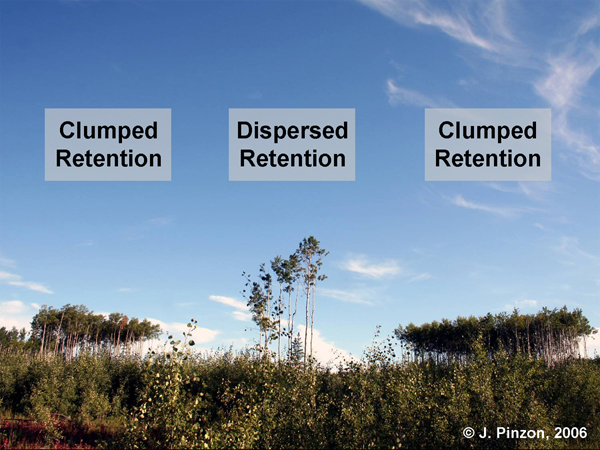
Clumped retention area: Area of the uncut patches of trees was measured using a GPS.
Canopy Cover: Was measured using a Mode A densiometer (spherical convex mirror). Four measures (each cardinal direction) were recorded by site and averaged. The resulting value was adjusted to estimate the percent canopy cover.
To better understand the effects of harvesting on ground-dwelling spider assemblages in the boreal forest, the following environmental variables were measured:
For instance, plants depend on soil characteristics, temperature, light intensity, among many other variables. As a consequence, depending on how structurally complex a forest stand is, other physical features are influenced as well, affecting the presence of other organisms. Intuitively, some environmental variables are better predictors of species composition than others; it has been shown that natural (or human induced) disturbances that shape environmental variables play important roles controlling community assemblages; thus, changes in these variables should be considered as important features for conservation purposes.
Species in general are tied to environmental characteristics due to specific habitat/microhabitat requirements that consequently model and drive species composition in a given place. These requirements are influenced by biotic and abiotic factors which are generally closely related to each other. Thus, species that are present in a particular ecosystem or habitat, for example, depend on or are influenced by the presence of other species, which in turn depend on certain physical features.
For the purpose of this project, spiders and plants were collected at EMEND field site from clumped and dispersed retention areas of conifer and deciduous stands harvested to clear-cut, 10% & 75% retention and uncut controls. More details about the experimental design can be found in the Study Area page.
Similarly, plants were sampled on a 1x1m plot during the summer of 2007. Each plot was located in the same area were the pitfall traps operated the previous year, using the trap position as the center point. A 10x10cm cardboard was used to estimate the percentage cover of each individual species inside the plot. Only vascular plants were considered and species were grouped according to their habitus (tree saplings, shrubs, dwarf shrubs & forbs). Using the same method, total percentage cover of moss, leaf/niddle litter, grass, forbs and shrubs was estimated.
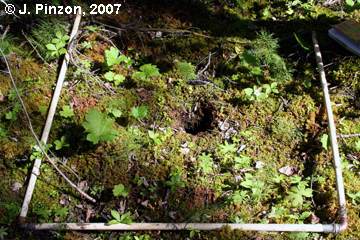
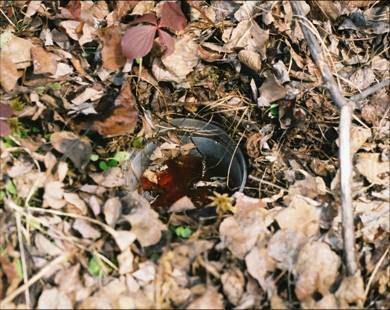
Spiders were collected using pitfall traps. These traps consist on a plastic cup placed inside a cylindrical hole on the ground, the cup is filled up to 1/3 of its volume with a preserving fluid; the upper edge of the cup is leveled off to the ground, allowing invertebrates to fall into the killing agent. A roof like structure is used on top of the trap to reduce rain fall and leaf litter inside the trap. Traps were collected in three-week intervals (4 collections) throughout the summer of 2006. Specimens were sorted and grouped to family in the field; then adults were identified to species in the lab.
In total, 180 traps/plots were randomly distributed within the collecting sites. Three (3) traps/plots were used to sample the representative fauna/flora of each site. Sites are represented by the combination of forest cover type (deciduous, conifer), harvest treatment (clear-cut, 10% & 75% retention, plus control) and retention type (small and large clumped & dispersed retention), for a total of 20 sites. This design was replicated 3 times.
Pitfall traps are designed to collect active wandering spiders, therefore, species that show low activity rates are more sedentary and are somehow underrepresented in these traps. Thus, there is an inherent sampling error using pitfall traps; however, active wandering spiders constitue a high proportion of the total of species that can be found in the litter, reducing this source of bias.