
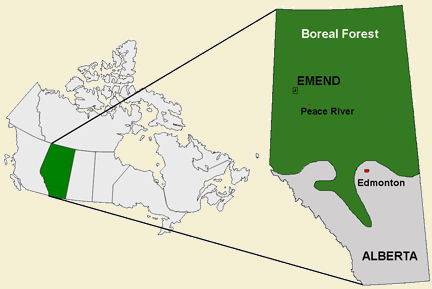
This project takes place at the
EMEND (Ecosystem Management Emulating
Natural Disturbance) landbase, approximately 90 km northwest of Peace River
in the Clear Hills Upland, Lower Foothills Ecoregion of north-western
Alberta. This area is located in the
Boreal Forest forest of Canada (for more information click
here). The EMEND
Experiment, established by variable retention harvests and the first
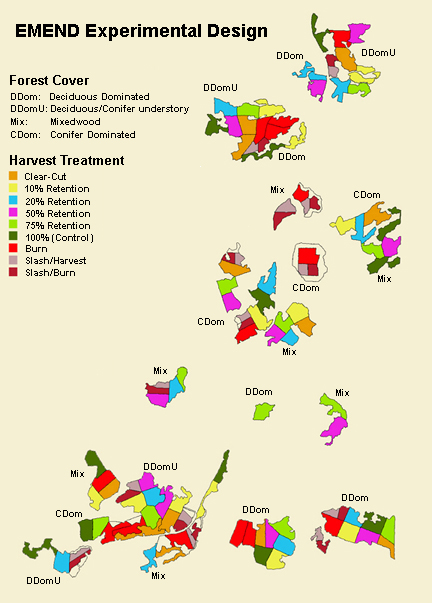
prescribed burns in 1999, includes 24 10-Ha compartments in each of 4
mixedwood cover types (pure deciduous, deciduous with conifer understory,
mixedwood and pure coniferous).
For the purpose of this project, spiders and plants were collected from clumped and dispersed retention areas of deciduous and conifer dominated compartments, harvested to clear-cut, 10% & 75% residual and uncut controls. There were 3 replicates for each treatment and forest type combination, for a total of 24 compartments.
At EMEND, harvesting activities were carried out with the objective to emulate natural disturbances (such as fire). These harvested areas mimic different tree residual patterns (dispersed and clumped retention) distributed in the landscape. As a consequence, five (5) harvesting treatments (dispersed retention) were applied during the winter 1998-1999 as follows: I. 75% retention consist on 5m wide machine corridors spaced 20m apart, leaving 15m wide uncut corridors; II. 50% retention consists on the same harvest pattern but removing additional trees from the uncut corridors at a ratio of 1:2 (removed:standing); III. 20% retention, trees were removed from the uncut corridors at a ratio of 3:4; IV. 10% retention, tress were removed from the uncut corridors at a ratio of 7:8; V. Clear-cut, trees were removed from the whole compartment up to a 2% residual.
Harvesting treatments and uncut controls are replicated three times each. Each harvested compartment contains a large (c. 0.40 Ha) and a small (c. 0.15 Ha) elliptical patch of uncut trees (clumped retention).
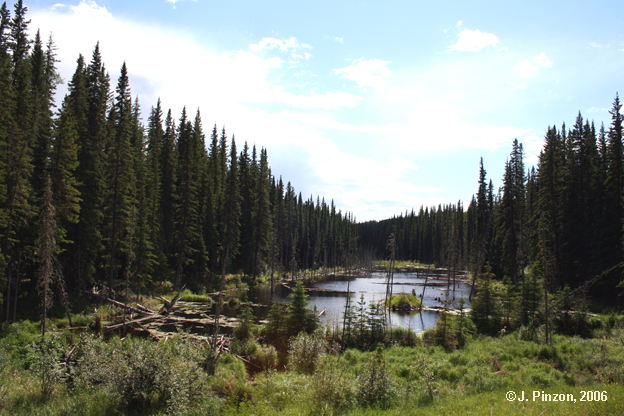
Pure deciduous stands are early successional stages consisting of more than 70% of deciduous species (Populus tremuloides, P. balsamifera, Betula papyrifera). Deciduous with conifer understory stands are early mid-successional stages where conifers reach at least 50% of canopy height. Mixedwood stands are late mid-successional stages composed of both conifer and deciduous species in the canopy. Pure conifer stands are late successional stages consisting of more than 70% of conifer species (Picea glauca, P. mariana, Pinus contorta).