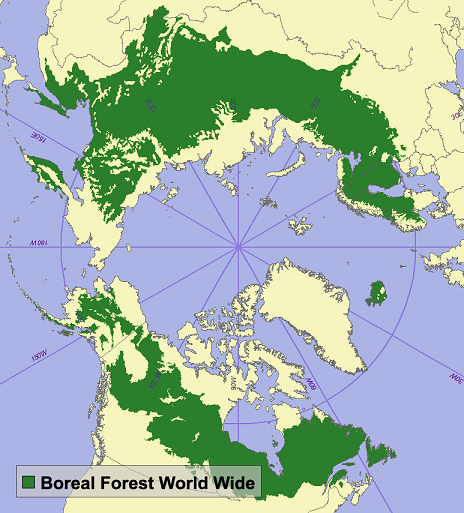
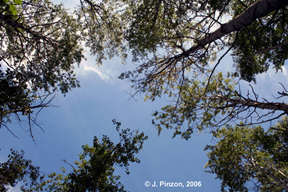






The Boreal Forest, also known as Taiga, is one of the world's largest terrestrial biomes (Wein & MacLean 1983), covering as a nearly continuous belt of forest in most of the northern latitudes in both North America and Eurasia (Canada, United States (Alaska), Finland, Sweden, Russia and Norway).
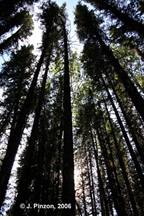
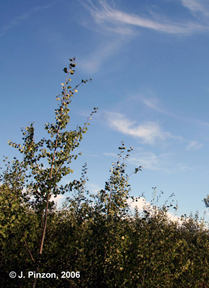
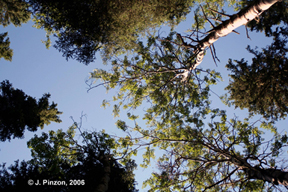
In North America, this ecosystem is dominated by evergreen tree species, mainly by White Spruce (Picea glauca) and Black Spruce (Picea mariana), and other less abundant species such as Balsam fir (Abies balsamea), Larch (Larix laricina), Jack Pine (Pinus contorta) among others. However, these species are characteristic of late successional stages (Chen & Popadiouk 2002). Early stages are characterized by broadleaf deciduous species such as Aspen (Populus tremuloides), Balsam Poplar (Populus balsamifera), Birch (Betula papyrifera) and Alder (Alnus spp.)
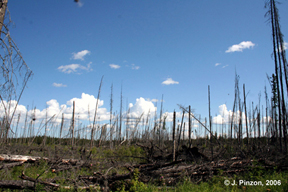
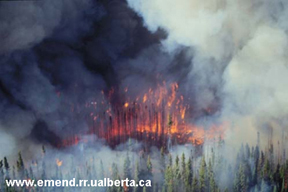
Boreal mixedwood forests are shaped mainly by natural disturbances, specially by fire, wind blow down and insect outbreaks (Chen & Popadiouk 2002), although fire is the major disturbance (Wein 1993), influencing both forest structure and species composition. As a consequence the Boreal Forest is a mosaic of different stand types according to the age and type of the previous disturbance. Thus, various forest covers dominate the landscape following a successional pathway or as it is better known as stand development stages.
Four main stages are defined (Chen & Popadiouk 2002): 1. Stand Initiation, characterized by pioneer species (poplar) that colonize after a stand-replacing disturbance (e.g. fire), 2. Stem exclusion, characterized by intense inter and intra-specific competition, 3. Canopy transition, when original cohort begins to die and the main canopy is started to be replaced by shade-tolerant species (spruce), and 4. Gap dynamics, a stage dominated by shade-tolerant coniferous species and gaps created by death of groups of trees that are characterized by shade-intolerant species. Below, it is shown in a succinct way the general forest succession pathway in the Boreal Forest.