

Contact Information:
Mailing Address
Department of PsychologyP-217 Biological Sciences Bldg
University of Alberta
Edmonton, AB
Canada T6G 2E9
VLS Research Design
Toward Investigating Interindividual Differences in Intraindividual Change
Key Design Features: The Victoria Longitudinal Study follows a Longitudinal Sequential design. Such designs were developed (by luminaries such as Paul B. Baltes, John R. Nesselroade, and K. Warner Schaie) in order to assess the impact of historical or generational differences in individual changes with aging. Accordingly, they feature a sequence of equivalent independent samples initiated across historical time. This provides the opportunity to (a) compare historically different cohorts in change and influence patterns, (b) examine a single cohort that is known to have experienced a major historical event (e.g., educational changes, occupational opportunities, pandemic), or (c) combine across historical cohorts for larger sample analyses. As shown by our colleague, John J. McArdle, longitudinal data analyses and interpretations are advanced with such accelerated designs.
Implementing Design Features: The VLS implements this dynamic and complex design by recruiting a series of independent but equivalent samples in three successive decades. In each cohort sample, the participants are cognitively unimpaired females and males between the ages of 55 and 85 and are followed at regular intervals. With some minor changes, the assessment battery for all cohorts across all assessment intervals is identical. The three independent samples of 55–85-year-old participants began their research journey in successive decades.
Growing the N Through Time: At present reporting, Sample 1 has been tested on nine different occasions (over ~25 years), Sample 2 has been tested on six different occasions (over ~20 years), and Sample 3 has been tested on four occasions (over ~12 years). Each occasion of testing involves ~16 hours of in-person contact time (plus homework!) with each participant. Multiple comparison groups (e.g., younger, middle-aged, special populations, such as persons living with Alzheimer's disease) have been assembled. Whereas the VLS static n (simple number of total persons) is ~2000, the dynamic n (number of total person testing visits) is ~6000.
Research Design
A summary graph of the research design may be viewed below.
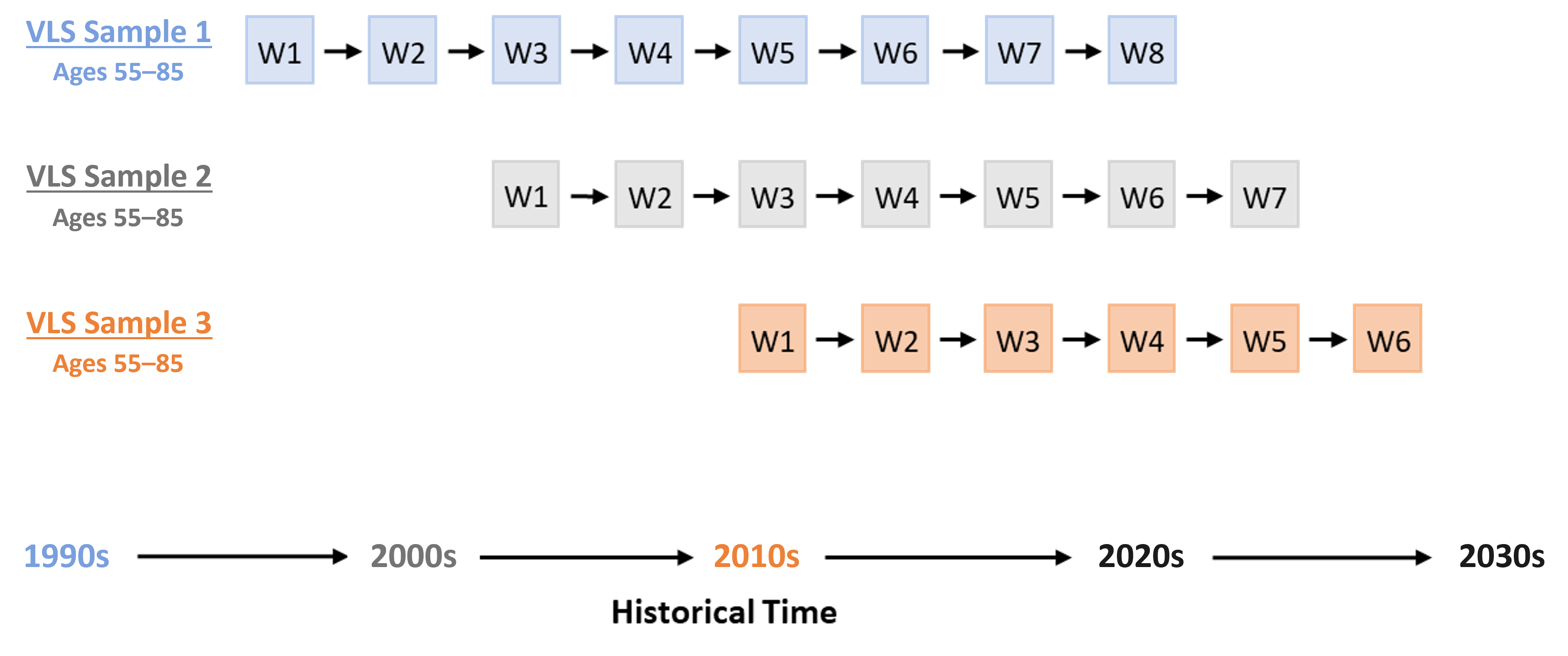
As can be seen in the blueprint above, the overall design called for multiple waves of measurement for an historical sequence of three samples. A wide range of information is collected during VLS testing sessions. These include multiple indicators of the following constructs, many of which are rendered computationally as latent variables.
Memory
- Word Recall
- Story Recall
- Fact Recall/Knowledge
- Implicit Memory
- Working Memory
Other Cognitive Measures
- Vocabulary
- Reading Comprehension
- Metamemory in Adulthood (MIA)
- Memory Compensation Questionnaire (MCQ)
- Implicit Theories of Cognitive Aging
Neuropsychological Battery
- Cognitive Style
- Laterality
- Benton Facial Recognition Test
- Brixton Spatial Anticipation Test
- Color Trails
- Hayling Sentence Completion Test
- Rey Auditory Verbal Learning Task
- Stroop
Neurocognitive Speed and Resources
- Reaction Time (Rate, Inconsistency)
- Perceptual Speed
- Semantic Speed
- Comprehension Speed
- Fine Motor Speed
- Verbal Fluency
- Inductive Reasoning
- Working Memory
Biological Vitality and Risk
- Genetic Markers
- Sensory Acuity (Vision, Audition, Smell)
- Blood Pressure
- Peak Expiratory Flow
- Grip Strength
- Height, Weight, BMI
- Balance and Gait (Rate, Variability)
- Biological Age
- Metabolic Biomarkers (Metabolomics)
Health Status
- Comprehensive Health Inventory
- Health Conditions (Stroke, Diabetes, Vascular)
- Subjective Health Ratings
- Functional/Instrumental Health
- Medications, Dosage, and Use
- Health Risks (Alcohol, Tobacco)
- Injuries (Head)
- Physical Fitness
Psychosocial Aspects
- Personal and Demographic Data
- Education
- Occupational Status
- Personality (NEO)
- Well-being (Positive/Negative Affect)
- Depressive Affect
Lifestyle and Exposures
- Lifestyle: Cognitive Activities
- Lifestyle: Physical Activities
- Lifestyle: Social Engagement
- Risk and Protective Factors