
Research



















Laser cooling and trapping
It’s often said that laser cooled atoms are the “coldest stuff in the universe.” But just how cold is that?
When we talk about the temperatures of a gas of atoms, what we are describing is the average kinetic energy of the system, which can be characterised by the speeds of the atoms in the gas.
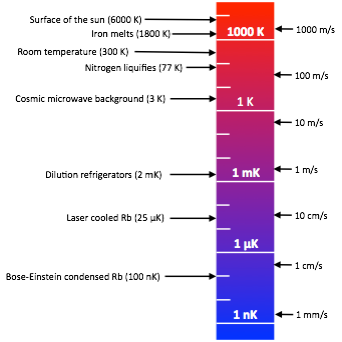
To the right is a logarithmic temperature scale (each line tick mark represents a factor of ten in temperature). Typical temperatures, from that of the sun’s surface to that of the laser-cooled Rb atoms are shown, indicating that the difference in temperature of a Bose-Einstein condensate is a greater than the difference between the sun and the deepest reaches of outer space.
Also indicated on this scale are the average speeds of rubidium atoms (one of the most popular atoms for laser cooling), showing that the atoms moving in the condensate are moving at just millimeters per second.
What it means to be cold
