
Even Sherlock Holmes, that most rational of detectives, succumbed to the power of the "poisoned arrow" stories. In one of Holmes's most famous adventures, The Sign of The Four, author Conan Doyle drew on the potent mythology of empire to create a horrifying new villain.
"Now, do consider the data. Diminutive footmarks, toes never fettered by boots,
naked feet, stone-headed wooden mace, great agility, small poisoned darts.
What do you make of all this? 'A savage!' I exclaimed."
Watson was drawing on a century of imperial exploration to come to his conclusion, and his mentor Holmes was pleased. In explaining the mysterious villain further, however, he was less than his usual incisive self. Claiming to be reading from a gazeteer about the Andaman Islands (in the Indian Ocean), Holmes read out a litany of "savage" characteristics worthy of any sailor story or trader's tale from the south Pacific:
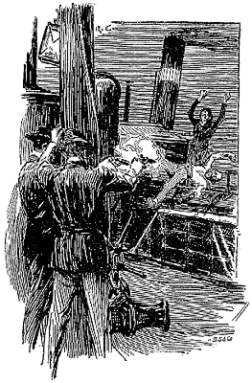 Holmes and Watson shooting the 'savage'
"Now, then, listen to this. 'They are naturally hideous, having large misshapen
heads, small fierce eyes, and distorted features … They have always been a
terror to shipwrecked crews, braining the survivors with their
stone-headed clubs, or shooting them with their poisoned arrows. These massacres
are invariably concluded by a cannibal feast.' Nice, amiable people, Watson!"
Note how "small poisoned darts" have become "poisoned arrows": even the unemotional Holmes cannot escape the romantic lure of these fascinating objects.
Source of quotations: Arthur Conan Doyle, The Sign of the
Four (New York: Hurst & Company, 19--?), 103. Illustration by Richard
Gutschmidt (1902) from The Complete Sherlock Holmes, http://camdenhouse.ignisart.com/canon/2-sign.htm
(accessed
1 August, 2006).
© 2006, Jane Samson and Matthew and Katalin Wangler.