
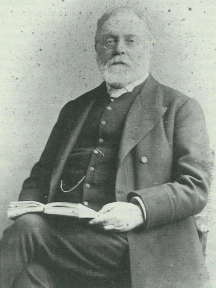
An Oxford-educated missionary, Codrington was interested in anthropology. After discussion with islanders in their own language, he concluded that the "poison" in Melanesian arrows was meant to be spiritual rather than physical.
Describing a conversation with a young naval officer (probably from HMS
Rosario), Codrington noted the "common belief" that islanders poisoned
their arrow heads with decomposing human flesh. "Asked whether he had taken
one into his hand to examine it", the young officer "replied with disgust
that he would not have the thing near him. He probably to this day believes
that he has the witness of his own eyes to the truth of the common belief."
Source of quotations: R.H. Codrington, The Melanesians. Studies in their Anthropology and Folk-Lore (Oxford: Clarendon Press, 1957), 308.; James Edge-Partington, An album of the weapons, tools, ornaments, articles of dress of the natives of the Pacific islands (London: Holland Press, 1969; orig. publ. 1890), XXXX
Islanders were not primarily interested in the physical consequences of arrow wounds, Codrington continued. They were much more concerned with the spiritual power, or mana, of the arrows: "The point is of a dead man’s bone, and has therefore mana, it has been tied on with powerful mana charms, and has been smeared with stuff hot and burning, as the wound is meant to be, prepared and applied with charms; that is what they mean by what we, not they, call poisoned arrows."
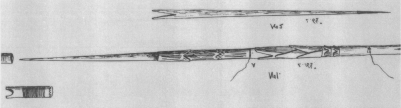
Codrington donated his Melanesian collection to the Pitt Rivers Museum. Here is a Victorian visitor's sketch of one of the "poisoned arrows" from the Codrington donation."
© 2006, Jane Samson and Matthew and Katalin Wangler.