The DIVERSE Seed Selection Tool is a web-based decision support tool for selecting tree species and seed sources for reforestation under climate change. It was developed to support DIVERSE project partners and stakeholders working within their forest management areas across Canada. The tool identifies species likely to remain or become suitable under future climates and recommends seed sources from ecosystems with similar climate and soil conditions. A broader, continent-wide version of this approach is available through the North America Seed Selection Tool (NA-SST).
| Web tool and data access: | Launch the tool | |
|
Forest management area summaries: |
|
Guide to interpretation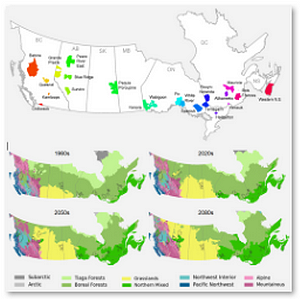
|
Background
The tool is based on an ecosystem-level climate matching approach. For each target planting area, projected future climate conditions are compared with historical climates of ecosystems across North America to identify the closest matches. Tree species recommendations are then derived from the composition of these climate-matched ecosystems, expressed as relative frequencies within the land base.
Climate similarity is evaluated first, with ecosystem-level soil similarity used as a secondary constraint to refine candidate matches. Historical climate data are derived from high-resolution gridded datasets (Wang et al. 2024), and future conditions are represented using a CMIP6 ensemble for the SSP2-4.5 scenario (Mahony et al.). Methodological details can be found in Dorrell (2025) and Dorrell et al. (2026).
References


Acknowledgements
This work would not have been possible without the participation and support of DIVERSE project partners across Canada, including • Agence Forestière des Bois-Francs • BC Council of Forest Industries • BC Timber Sales • Conseil des Atikamekw de Manawan • Domtar Inc. • Eacom Timber Corporation • GreenFirst Forest Products QC Inc. • Haliburton Forest & Wildlife Reserve Ltd. • Kenauk Canada ULC • Mercer Peace River Pulp Ltd. • Miisun Integrated Resource Management • National Council for Air and Stream Improvement • Nawiinginokiima Forest Management Corporation • Resolute Forest Products • Sustainable Forestry Initiative (Comité Québec, Central Canada Implementation Committee) • Temagami Forest Management Corporation • Ts’elxwéyeqw Tribe Management Ltd. • West Fraser Timber Co. • Weyerhaeuser Company Ltd. • the provincial forestry agencies of Alberta, British Columbia, Nova Scotia, Ontario and Québec.