A Minimal Article

Exercises 2 Exercises

Vectors associated to directed line segments.

In each case, compute the components of the vector \(\vec{v}\) that corresponds to the directed line segment \(\abray{PQ}\text{.}\) Then draw both that directed line segment, and the vector \(\vec{v}\) with its initial point at the origin.

1.

\(P(3,5) \text{,}\) \(Q(7,4) \)
Answer.
\(\vec{v} = (7 - 3, 4 - 5) = (4,-1) \)
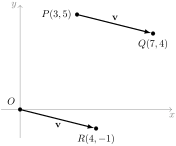
Diagram illustrating vectors as representing directed line segments.
A diagram consisting of a directed line segment, along with the corresponding vector β€œbased” at the origin. The directed line segment \(\abray{PQ}\) extends from the point \(P(3,5)\) to the point \(Q(7,4)\text{.}\) The corresponding vector \(\vec{v}\) is drawn as a directed line segment from the origin to the point \(R(4,-1)\text{.}\)

2.

\(P(2,-1) \text{,}\) \(Q(-1,2) \)
Answer.
\(\vec{v} = \bbrac{-1 - 2, 2 - (-1)} = (-3,3) \)
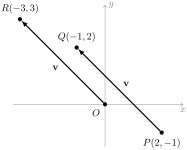
Diagram illustrating vectors as representing directed line segments.
A diagram consisting of a directed line segment, along with the corresponding vector β€œbased” at the origin. The directed line segment \(\abray{PQ}\) extends from the point \(P(2,-1)\) to the point \(Q(-1,2)\text{.}\) The corresponding vector \(\vec{v}\) is drawn as a directed line segment from the origin to the point \(R(-3,3)\text{.}\)

3.

\(P(3,6) \text{,}\) \(Q(-3,3) \)
Answer.
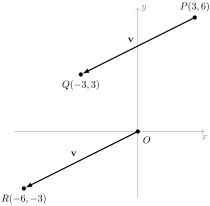
\(\vec{v} = (-3 - 3, 3 - 6) = (-6,-3) \)
Diagram illustrating vectors as representing directed line segments.
A diagram consisting of a directed line segment, along with the corresponding vector β€œbased” at the origin. The directed line segment \(\abray{PQ}\) extends from the point \(P(3,6)\) to the point \(Q(-3,3)\text{.}\) The corresponding vector \(\vec{v}\) is drawn as a directed line segment from the origin to the point \(R(-6,-3)\text{.}\)

4.

\(P\left( - \dfrac{6}{5}, - \dfrac{ 2}{9} \right) \text{,}\) \(Q\left( \dfrac{3}{5}, \dfrac{11}{9} \right) \)
Answer.
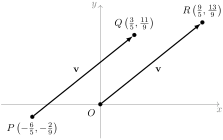
\(\vec{v} = \left( \dfrac{ 3}{5} - \left(- \dfrac{6}{5} \right), \dfrac{11}{9} - \left(- \dfrac{2}{9} \right) \right) = \left( \dfrac{9}{5}, \dfrac{13}{9} \right)\)
Diagram illustrating vectors as representing directed line segments.
A diagram consisting of a directed line segment, along with the corresponding vector β€œbased” at the origin. The directed line segment \(\abray{PQ}\) extends from the point \(P\left(-\frac{6}{5},-\frac{2}{9}\right)\) to the point \(Q\left(\frac{3}{5},\frac{11}{9}\right)\text{.}\) The corresponding vector \(\vec{v}\) is drawn as a directed line segment from the origin to the point \(R(-6,-3)\text{.}\)

5.

We can use vectors to represent other kinds of β€œdisplacements” besides position displacements. Vectors can be used to represent change between states of any collection of related variables.
For example, suppose an investor sinks $10,000 into stock in each of companies A, B, C, and D. After a year, the various items in their portfolio have the following values: company A, $10,475; company B, $11,240; company C, $9,756; company D, $10,054.
Represent the β€œdisplacement” in the collection of values of the investor’s holdings, from initial state
\begin{equation*} (A,B,C,D) = (10000, 10000, 10000, 10000) \end{equation*}
to terminal state
\begin{equation*} (A,B,C,D) = (10475, 11240, 9756, 10054) \end{equation*}
as a four-dimensional β€œprofit” vector \(\vec{p} \text{.}\)
Answer.
\(\vec{p} = (475, 1240, -244, 54) \)

Recognizing the dimension of a vector.

In each case, determine the value of \(n \) for which the given vector is a member of the collection \(\R^n \text{.}\)

Vector equality.

In each case, determine the value(s) of \(k \text{,}\) if any, for which the vector equality is true.

10.

\((k + 2, k^2, 1, k + 6) = (-3, 25, -1, 1) \)
Answer.
There is no such value of \(k \text{,}\) as the two vectors will always disagree in the third component.

11.

\((k + 2, k^2, 1, k + 6, 0) = (-3, 25, 1, 1) \)
Answer.
There is no such value of \(k \text{,}\) as the first vector is \(5\)-dimensional while the second vector is only \(4\)-dimensional.

Geometric addition of vectors.

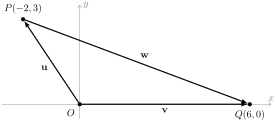
In each case, draw a vector addition triangle in the Cartesian plane that represents \(\vec{w} = \vec{u} + \vec{v}\text{,}\) with the initial point of \(\vec{u}\) at the origin. Then calculate the sum vector \(\vec{w}\) and verify that its terminal point (from the origin) agrees with the terminal point of addition chain \(\vec{u} + \vec{v}\) on your diagram.

12.

\(\vec{u} = (-2,3) \text{,}\) \(\vec{v} = (6,0) \)
Answer.
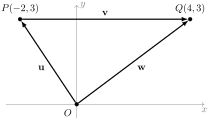
Diagram illustrating vector addition.
A diagram consisting of a triangle in the \(xy\)-plane, with a directed line segment for each side. One side is a vector labelled \(\vec{u}\text{,}\) extending from the origin to the point \(P(-2,3)\text{.}\) The next side is a vector labelled \(\vec{v}\text{,}\) extending from \(P\) to the point \(Q(4,3)\text{.}\) The last side is a vector labelled \(\vec{w}\text{,}\) extending from the origin to \(Q\text{.}\)
\(\vec{w} = (-2,3) + (6,0) = (4,3) \)

13.

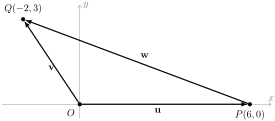
\(\vec{u} = (6,0) \text{,}\) \(\vec{v} = (-2,3) \)
Answer.
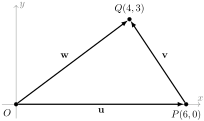
Diagram illustrating vector addition.
A diagram consisting of a triangle in the \(xy\)-plane, with a directed line segment for each side. One side is a vector labelled \(\vec{u}\text{,}\) extending from the origin to the point \(P(6,0)\text{.}\) The next side is a vector labelled \(\vec{v}\text{,}\) extending from \(P\) to the point \(Q(4,3)\text{.}\) The last side is a vector labelled \(\vec{w}\text{,}\) extending from the origin to \(Q\text{.}\)
\(\vec{w} = (6,0) + (-2,3) = (4,3) \)

14.

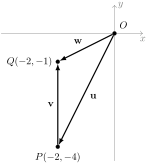
\(\vec{u} = (-2,-4) \text{,}\) \(\vec{v} = (0,3) \)
Answer.
Diagram illustrating vector addition.
A diagram consisting of a triangle in the \(xy\)-plane, with a directed line segment for each side. One side is a vector labelled \(\vec{u}\text{,}\) extending from the origin to the point \(P(-2,-4)\text{.}\) The next side is a vector labelled \(\vec{v}\text{,}\) extending from \(P\) to the point \(Q(-2,-1)\text{.}\) The last side is a vector labelled \(\vec{w}\text{,}\) extending from the origin to \(Q\text{.}\)
\(\vec{w} = (-2,-4) + (0,3) = (-2,-1) \)

15.

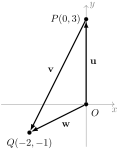
\(\vec{u} = (0,3) \text{,}\) \(\vec{v} = (-2,-4) \)
Answer.
Diagram illustrating vector addition.
A diagram consisting of a triangle in the \(xy\)-plane, with a directed line segment for each side. One side is a vector labelled \(\vec{u}\text{,}\) extending from the origin to the point \(P(0,3)\text{.}\) The next side is a vector labelled \(\vec{v}\text{,}\) extending from \(P\) to the point \(Q(-2,-1)\text{.}\) The last side is a vector labelled \(\vec{w}\text{,}\) extending from the origin to \(Q\text{.}\)
\(\vec{w} = (0,3) + (-2,-4) = (-2,-1) \)

16.

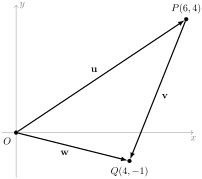
\(\vec{u} = (6,4) \text{,}\) \(\vec{v} = (-2,-5) \)
Answer.
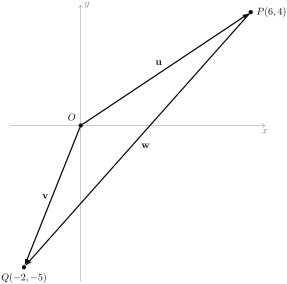
Diagram illustrating vector addition.
A diagram consisting of a triangle in the \(xy\)-plane, with a directed line segment for each side. One side is a vector labelled \(\vec{u}\text{,}\) extending from the origin to the point \(P(6,4)\text{.}\) The next side is a vector labelled \(\vec{v}\text{,}\) extending from \(P\) to the point \(Q(4,-1)\text{.}\) The last side is a vector labelled \(\vec{w}\text{,}\) extending from the origin to \(Q\text{.}\)
\(\vec{w} = (6,4) + (-2,-5) = (4,-1) \)

17.

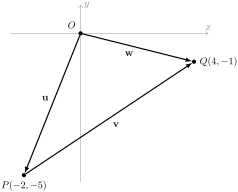
\(\vec{u} = (-2,-5) \text{,}\) \(\vec{v} = (6,4) \)
Answer.
Diagram illustrating vector addition.
A diagram consisting of a triangle in the \(xy\)-plane, with a directed line segment for each side. One side is a vector labelled \(\vec{u}\text{,}\) extending from the origin to the point \(P(-2,-5)\text{.}\) The next side is a vector labelled \(\vec{v}\text{,}\) extending from \(P\) to the point \(Q(4,-1)\text{.}\) The last side is a vector labelled \(\vec{w}\text{,}\) extending from the origin to \(Q\text{.}\)
\(\vec{w} = (-2,-5) + (6,4) = (4,-1) \)

Geometric negation of vectors.

In each case, draw both the vector \(\vec{v}\) and its negative in the Cartesian plane with initial points at the origin. Then calculate the negative vector \(- \vec{v}\) and verify that its terminal point on your diagram agrees with your calculation.

18.

\(\vec{v} = (5,0) \)
Answer.
Diagram illustrating vector negation.
A diagram consisting of two oppositely directed line segments in the \(xy\)-plane. One represents a vector labelled \(\vec{v}\text{,}\) and extends from the origin to the point \(P(5,0)\text{.}\) The other represents the negative vector \(- \vec{v}\text{,}\) and extends from the origin to the point \(P'(-5,0)\text{.}\)
\(- \vec{v} = - (5,0) = (-5,0) \)

19.

\(\vec{v} = (0,-3) \)
Answer.
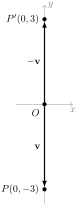
Diagram illustrating vector negation.
A diagram consisting of two oppositely directed line segments in the \(xy\)-plane. One represents a vector labelled \(\vec{v}\text{,}\) and extends from the origin to the point \(P(0,-3)\text{.}\) The other represents the negative vector \(- \vec{v}\text{,}\) and extends from the origin to the point \(P'(0,3)\text{.}\)
\(- \vec{v} = - (0,-3) = (0,3) \)

20.

\(\vec{v} = (6,1) \)
Answer.
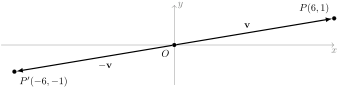
Diagram illustrating vector negation.
A diagram consisting of two oppositely directed line segments in the \(xy\)-plane. One represents a vector labelled \(\vec{v}\text{,}\) and extends from the origin to the point \(P(6,1)\text{.}\) The other represents the negative vector \(- \vec{v}\text{,}\) and extends from the origin to the point \(P'(-6,-1)\text{.}\)
\(- \vec{v} = - (6,1) = (-6,-1) \)

21.

\(\vec{v} = (-3,2) \)
Answer.
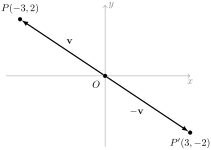
Diagram illustrating vector negation.
A diagram consisting of two oppositely directed line segments in the \(xy\)-plane. One represents a vector labelled \(\vec{v}\text{,}\) and extends from the origin to the point \(P(-3,2)\text{.}\) The other represents the negative vector \(- \vec{v}\text{,}\) and extends from the origin to the point \(P'(3,-2)\text{.}\)
\(- \vec{v} = - (-3,2) = (3,-2) \)

Geometric scaling of vectors.

In each case, draw both the vector \(\vec{v}\) and the scaled vector \(k \vec{v}\) in the Cartesian plane with initial points at the origin. Then calculate \(k \vec{v}\) and verify that its terminal point on your diagram agrees with your calculation.

22.

\(\displaystyle \vec{v} = (-2,0) \text{,}\) \(k = 5\)
Answer.
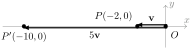
Diagram illustrating scaling of a vector.
A diagram consisting of two parallel directed line segments in the \(xy\)-plane. One represents a vector labelled \(\vec{v}\text{,}\) and extends from the origin to the point \(P(-2,0)\text{.}\) The other represents the scaled vector \(5 \vec{v}\text{,}\) and extends from the origin to the point \(P'(-10,0)\text{.}\)
\(5 \vec{v} = 5 (2,0) = (10,0) \)

23.

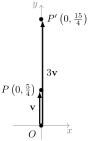
\(\displaystyle \vec{v} = \left(0, \frac{5}{4}\right) \text{,}\) \(k = 3\)
Answer.
Diagram illustrating scaling of a vector.
A diagram consisting of two parallel directed line segments in the \(xy\)-plane. One represents a vector labelled \(\vec{v}\text{,}\) and extends from the origin to the point \(P\left(0,\frac{5}{4}\right)\text{.}\) The other represents the scaled vector \(5 \vec{v}\text{,}\) and extends from the origin to the point \(P'\left(0,\frac{15}{4}\right)\text{.}\)
\(3 \vec{v} = 3 \left(0,\frac{5}{4}\right) = \left(0,\frac{15}{4}\right) \)

24.

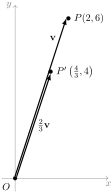
\(\displaystyle \vec{v} = (2, 6) \text{,}\) \(k = \dfrac{2}{3}\)
Answer.
Diagram illustrating scaling of a vector.
A diagram consisting of two parallel directed line segments in the \(xy\)-plane. One represents a vector labelled \(\vec{v}\text{,}\) and extends from the origin to the point \(P(2,6)\text{.}\) The other represents the scaled vector \(\frac{2}{3} \vec{v}\text{,}\) and extends from the origin to the point \(P'\left(\frac{4}{3},4\right)\text{.}\)
\(\displaystyle \frac{2}{3} \vec{v} = \frac{2}{3} (2,6) = \left(\frac{4}{3},4\right) \)

25.

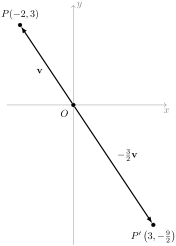
\(\displaystyle \vec{v} = (-2, 3) \text{,}\) \(k = -\dfrac{3}{2}\)
Answer.
Diagram illustrating scaling of a vector.
A diagram consisting of two parallel directed line segments in the \(xy\)-plane. One represents a vector labelled \(\vec{v}\text{,}\) and extends from the origin to the point \(P(-2,3)\text{.}\) The other represents the scaled vector \(- \frac{3}{2} \vec{v}\text{,}\) and extends from the origin to the point \(P'\left(3,-\frac{9}{2}\right)\text{.}\)
\(\displaystyle - \frac{3}{2} \vec{v} = - \frac{3}{2} (-2,3) = \left(3, - \frac{9}{3}\right) \)

Geometric subtraction of vectors.

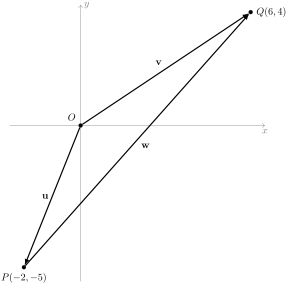
In each case, draw a vector difference triangle in the Cartesian plane that represents \(\vec{w} = \vec{v} - \vec{u}\text{,}\) with the initial points of both \(\vec{u}\) and \(\vec{v}\) at the origin. Then calculate the difference vector \(\vec{w}\) and verify that its components represent the corresponding displacement on your diagram.

26.

\(\vec{u} = (6,0) \text{,}\) \(\vec{v} = (-2,3) \)
Answer.
Diagram illustrating vector subtraction.
A diagram consisting of a triangle in the \(xy\)-plane, with a directed line segment for each side. One side is a vector labelled \(\vec{u}\text{,}\) extending from the origin to the point \(P(6,0)\text{.}\) The next side is a vector labelled \(\vec{v}\text{,}\) extending from the origin to the point \(Q(-2,3)\text{.}\) The last side is a vector labelled \(\vec{w}\text{,}\) extending from \(P\) to \(Q\text{.}\)
\(\vec{w} = (-2,3) - (6,0) = (-8,3) \)

27.

\(\vec{u} = (-2,3) \text{,}\) \(\vec{v} = (6,0) \)
Answer.
Diagram illustrating vector subtraction.
A diagram consisting of a triangle in the \(xy\)-plane, with a directed line segment for each side. One side is a vector labelled \(\vec{u}\text{,}\) extending from the origin to the point \(P(-2,3)\text{.}\) Another side is a vector labelled \(\vec{v}\text{,}\) extending from the origin to the point \(Q(6,0)\text{.}\) The last side is a vector labelled \(\vec{w}\text{,}\) extending from \(P\) to \(Q\text{.}\)
\(\vec{w} = (6,0) - (-2,3) = (8,-3) \)

28.

\(\vec{u} = (0,3) \text{,}\) \(\vec{v} = (-2,-4) \)
Answer.
Diagram illustrating vector subtraction.
A diagram consisting of a triangle in the \(xy\)-plane, with a directed line segment for each side. One side is a vector labelled \(\vec{u}\text{,}\) extending from the origin to the point \(P(0,3)\text{.}\) The next side is a vector labelled \(\vec{v}\text{,}\) extending from the origin to the point \(Q(-2,-4)\text{.}\) The last side is a vector labelled \(\vec{w}\text{,}\) extending from \(P\) to \(Q\text{.}\)
\(\vec{w} = (-2,-4) - (0,3) = (-2,-7) \)

29.

\(\vec{u} = (-2,-4) \text{,}\) \(\vec{v} = (0,3) \)
Answer.
Diagram illustrating vector subtraction.
A diagram consisting of a triangle in the \(xy\)-plane, with a directed line segment for each side. One side is a vector labelled \(\vec{u}\text{,}\) extending from the origin to the point \(P(-2,-4)\text{.}\) The next side is a vector labelled \(\vec{v}\text{,}\) extending from the origin to the point \(Q(0,3)\text{.}\) The last side is a vector labelled \(\vec{w}\text{,}\) extending from \(P\) to \(Q\text{.}\)
\(\vec{w} = (0,3) - (-2,-4) = (2,7) \)

30.

\(\vec{u} = (-2,-5) \text{,}\) \(\vec{v} = (6,4) \)
Answer.
Diagram illustrating vector subtraction.
A diagram consisting of a triangle in the \(xy\)-plane, with a directed line segment for each side. One side is a vector labelled \(\vec{u}\text{,}\) extending from the origin to the point \(P(-2,-5)\text{.}\) The next side is a vector labelled \(\vec{v}\text{,}\) extending from the origin to the point \(Q(6,4)\text{.}\) The last side is a vector labelled \(\vec{w}\text{,}\) extending from \(P\) to \(Q\text{.}\)
\(\vec{w} = (6,4) - (-2,-5) = (8,9) \)

31.

\(\vec{u} = (6,4) \text{,}\) \(\vec{v} = (-2,-5) \)
Answer.
Diagram illustrating vector subtraction.
A diagram consisting of a triangle in the \(xy\)-plane, with a directed line segment for each side. One side is a vector labelled \(\vec{u}\text{,}\) extending from the origin to the point \(P(6,4)\text{.}\) The next side is a vector labelled \(\vec{v}\text{,}\) extending from \(P\) to the point \(Q(-2,-5)\text{.}\) The last side is a vector labelled \(\vec{w}\text{,}\) extending from \(P\) to \(Q\text{.}\)
\(\vec{w} = (-2,-5) - (6,4) = (-8,-9) \)

Geometric relationships.

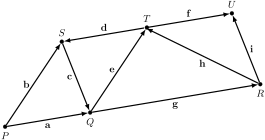
In each case, state whether the equality of vectors is true or false based on the diagram below.
Diagram of several vectors in various geometric relationships.
A planar diagram consisting of six points, \(P,Q,R,S,T,U \text{.}\) Quadrilateral \(\abcdquad{PQTS} \) is a parallelogram. Side \(\absegment{PQ} \) is extended past \(Q \) to a point \(R\) and side \(\absegment{ST} \) is extended past \(T \) to a point \(U \) so that quadrilateral \(\abcdquad{QRUS} \) is also a parallelogram, with \(T \) at the midpoint of side \(\absegment{SU} \text{.}\) Finally, the following directed line segments are drawn in:
  • \(\abray{PQ} \text{,}\) labelled as vector \(\vec{a} \text{.}\)
  • \(\abray{PS} \text{,}\) labelled as vector \(\vec{b} \text{.}\)
  • \(\abray{SQ} \text{,}\) labelled as vector \(\vec{c} \text{.}\)
  • \(\abray{TS} \text{,}\) labelled as vector \(\vec{d} \text{.}\)
  • \(\abray{QT} \text{,}\) labelled as vector \(\vec{e} \text{.}\)
  • \(\abray{TU} \text{,}\) labelled as vector \(\vec{f} \text{.}\)
  • \(\abray{QR} \text{,}\) labelled as vector \(\vec{g} \text{.}\)
  • \(\abray{RT} \text{,}\) labelled as vector \(\vec{h} \text{.}\)
  • \(\abray{UR} \text{,}\) labelled as vector \(\vec{i} \text{.}\)

Recognizing parallel vectors.

In each case, determine whether the two vectors are parallel.

Vector arithmetic.

In each case, carry out the vector operation(s).

Decomposing vectors in \(\R^2\) in terms of standard basis vectors.

In each case, express the vector \(\vec{v}\) as a linear combination of the standard basis vectors \(\vec{e}_1\) and \(\vec{e}_2\text{.}\) Then draw a vector addition triangle in the Cartesian plane that represents your decomposition.

70.

\(\vec{v} = (3,4) \)
Answer.
\((3,4) = 3 (1,0) + 4 (0,1) \)
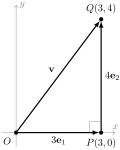
Diagram illustrating a decomposition relative to the standard basis vectors in two dimensions.
A diagram consisting of a right triangle in the \(xy\)-plane, with a directed line segment for each side. One leg of the triangle is a vector lying along the horizontal axis, extending from the origin to the point \(P(3,0)\text{.}\) This vector is labelled \(3 \vec{e}_1\text{.}\) The other leg of the triangle is a vector running parallel to the vertical axis, extending from \(P\) to the point \(Q(3,4)\text{.}\) This vector is labelled \(4 \vec{e}_2\text{.}\) The hypotenuse of the triangle is a vector labelled \(\vec{v}\text{,}\) extending from the origin to \(Q\text{.}\)

71.

\(\vec{v} = (5,-2) \)
Answer.
\((5,-2) = 5 (1,0) + (-2) (0,1) \)
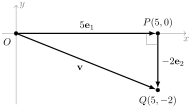
Diagram illustrating a decomposition relative to the standard basis vectors in two dimensions.
A diagram consisting of a right triangle in the \(xy\)-plane, with a directed line segment for each side. One leg of the triangle is a vector lying along the horizontal axis, extending from the origin to the point \(P(5,0)\text{.}\) This vector is labelled \(3 \vec{e}_1\text{.}\) The other leg of the triangle is a vector running parallel to the vertical axis, extending from \(P\) to the point \(Q(5,-2)\text{.}\) This vector is labelled \(-2 \vec{e}_2\text{.}\) The hypotenuse of the triangle is a vector labelled \(\vec{v}\text{,}\) extending from the origin to \(Q\text{.}\)

72.

\(\vec{v} = (-3,1) \)
Answer.
\((-3,1) = (-3) (1,0) + 1 (0,1) \)
Diagram illustrating a decomposition relative to the standard basis vectors in two dimensions.
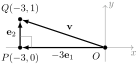
A diagram consisting of a right triangle in the \(xy\)-plane, with a directed line segment for each side. One leg of the triangle is a vector lying along the horizontal axis, extending from the origin to the point \(P(-3,0)\text{.}\) This vector is labelled \(-3 \vec{e}_1\text{.}\) The other leg of the triangle is a vector running parallel to the vertical axis, extending from \(P\) to the point \(Q(-3,1)\text{.}\) This vector is labelled \(\vec{e}_2\text{.}\) The hypotenuse of the triangle is a vector labelled \(\vec{v}\text{,}\) extending from the origin to \(Q\text{.}\)

73.

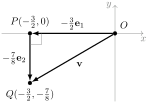
\(\vec{v} = \left(- \dfrac{3}{2}, - \dfrac{7}{8} \right) \)
Answer.
\(\left( - \dfrac{3}{2}, - \dfrac{7}{8} \right) = \left(- \frac{3}{2}\right) (1,0) + \left(- \frac{7}{8}\right) (0,1) \)
Diagram illustrating a decomposition relative to the standard basis vectors in two dimensions.
A diagram consisting of a right triangle in the \(xy\)-plane, with a directed line segment for each side. One leg of the triangle is a vector lying along the horizontal axis, extending from the origin to the point \(P(-\frac{3}{2},0)\text{.}\) This vector is labelled \(-\frac{3}{2} \vec{e}_1\text{.}\) The other leg of the triangle is a vector running parallel to the vertical axis, extending from \(P\) to the point \(Q(-\frac{3}{2},-\frac{7}{8})\text{.}\) This vector is labelled \(-\frac{7}{8} \vec{e}_2\text{.}\) The hypotenuse of the triangle is a vector labelled \(\vec{v}\text{,}\) extending from the origin to \(Q\text{.}\)

Decomposing vectors in \(\R^n\) in terms of standard basis vectors.

In each case, express the vector \(\vec{v}\) as a linear combination of the standard basis vectors \(\vec{e}_1,\dotsc,\vec{e}_n\text{.}\)

Creating a vector parallel to a line in \(\R^2 \).

In each case, create a vector that is parallel to the given line. Then draw both the graph of the line and your vector with its initial point at the origin.

78.

\(\ell \colon \;\; x - 3 y = 4 \)
Answer.
One such vector is \(\vec{v} = (3,1) \text{.}\)
Diagram of a line and a vector parallel to it.
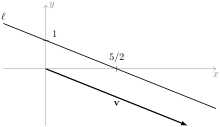
A diagram consisting of the graph of the line \(x - 3 y = 4 \) in the \(xy\)-plane, along with the vector \(\vec{v} = (3,1) \) drawn with its initial point at the origin, so that its terminal point is at \((3,1) \text{.}\)
Note: Any nonzero scalar multiple of the provided answer is another suitable answer.

79.

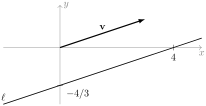
\(\ell \colon \;\; 2 x + 5 y = 5\)
Answer.
One such vector is \(\vec{v} = (5,-2) \text{.}\)
Diagram of a line and a vector parallel to it.
A diagram consisting of the graph of the line \(2 x + 5 y = 5 \) in the \(xy\)-plane, along with the vector \(\vec{v} = (5,-2) \) drawn with its initial point at the origin, so that its terminal point is at \((5,-2) \text{.}\)
Note: Any nonzero scalar multiple of the provided answer is another suitable answer.

Creating vectors parallel to a plane in \(\R^3 \).

In each case, create two vectors each of which is parallel to the given plane but that are not parallel to each other.

80.

\(\ell \colon \;\; x - 5 y - 6 z = 1\)
Answer.
One such pair of vectors is \(\vec{u} = (6,0,1) \text{,}\) \(\vec{v} = (1,-1,1) \text{.}\)
Note: Any nonzero vector that is a linear combination of the two provided answer vectors is a suitable replacement for either of the two provided vectors, as long as the final pair of vectors are not scalar multiples of each other.

81.

\(\ell \colon \;\; 5 x + 3 y - 4 z = 2 \)
Answer.
One such pair of vectors is \(\vec{u} = (-1,3,1) \text{,}\) \(\vec{v} = (0,4,3) \text{.}\)
Note: Any nonzero vector that is a linear combination of the two provided answer vectors is a suitable replacement for either of the two provided vectors, as long as the final pair of vectors are not scalar multiples of each other.

Geometry using vector calculations.

For each pair of points \(P,Q \text{:}\)
  1. Use a vector calculation to determine the point that bisects segment \(\absegment{PQ} \text{.}\)
  2. Use a vector calculation to determine the two points that trisect segment \(\absegment{PQ} \text{.}\)
Hint: Think of vector addition as a sequence of consecutive displacements, beginning at the origin.

82.

\(P(1,-8) \text{,}\) \(Q(-7,-3) \text{.}\)
Solution.
Let \(\vec{u} \) represent the vector associated to directed line segment \(\abray{OP} \) and let \(\vec{v} \) represent the vector associated to directed line segment \(\abray{PQ} \text{,}\) so that \(\vec{u} = (1,-8) \) and \(\vec{v} = (-8,5) \text{.}\)
  1. The bisecting point will be the terminal point of the vector
    \begin{equation*} \vec{b} = \vec{u} + \tfrac{1}{2} \vec{v} = ( -3, -11/2 ) \text{,} \end{equation*}
    when placed with its initial point at the origin. That is, the bisecting point is \(R(-3,-11/2) \text{.}\)
  2. The trisecting points will be the terminal points of the vectors
    \begin{align*} \vec{t}_1 \amp = \vec{u} + \tfrac{1}{3} \vec{v} = ( - 5/3, -19/3 ) \text{,} \\ \vec{t}_2 \amp = \vec{u} + \tfrac{2}{3} \vec{v} = ( -13/3, -14/3 ) \text{,} \end{align*}
    when placed with their initial points at the origin. That is, the trisecting points are \(R(-5/3,-19/3) \) and \(S(-13/3,-14/3) \text{.}\)

83.

\(P(4,0,6) \text{,}\) \(Q(-2,9,-1) \text{.}\)
Solution.
Let \(\vec{u} \) represent the vector associated to directed line segment \(\abray{OP} \) and let \(\vec{v} \) represent the vector associated to directed line segment \(\abray{PQ} \text{,}\) so that \(\vec{u} = (4,0,6) \) and \(\vec{v} = (-6,9,-7) \text{.}\)
  1. The bisecting point will be the terminal point of the vector
    \begin{equation*} \vec{b} = \vec{u} + \tfrac{1}{2} \vec{v} = (1,9/2,5/2) \text{,} \end{equation*}
    when placed with its initial point at the origin. That is, the bisecting point is \(R(1,9/2,5/2) \text{.}\)
  2. The trisecting points will be the terminal points of the vectors
    \begin{align*} \vec{t}_1 \amp = \vec{u} + \tfrac{1}{3} \vec{v} = (2,3,11/3) \text{,} \\ \vec{t}_2 \amp = \vec{u} + \tfrac{2}{3} \vec{v} = (0,6, 4/3) \text{,} \end{align*}
    when placed with their initial points at the origin. That is, the trisecting points are \(R(2,3,11/3) \) and \(S(0,6, 4/3) \text{.}\)

84. Creating a linear combination.

Determine values for scalars \(k_1, k_2, k_3 \) so that the vector equality is true.
\begin{equation*} k_1 (4,-1,-1) + k_2 (-3,1,2) + k_3 (-2,-1,-6) = (1,2,10) \end{equation*}
Solution.
First compute
\begin{equation*} k_1 (4,-1,-1) + k_2 (-3,1,2) + k_3 (-2,-1,-6) = ( 4 k_1 - 3 k_2 - 2 k_3, - k_1 + k_2 - k_3, - k_1 + 2 k_2 - 6 k_3 )\text{.} \end{equation*}
Thus our vector equality becomes
\begin{equation*} ( 4 k_1 - 3 k_2 - 2 k_3, - k_1 + k_2 - k_3, - k_1 + 2 k_2 - 6 k_3 ) = (1,2,10) \text{.} \end{equation*}
Matching corresponding components on each side of this equality leads to a linear system of equations.
\begin{equation*} \begin{sysofeqns}{rcrcrcr} 4 k_1 \amp - \amp 3 k_2 \amp - \amp 2 k_3 \amp = \amp 1 \\ - k_1 \amp + \amp k_2 \amp - \amp k_3 \amp = \amp 2 \\ - k_1 \amp + \amp 2 k_2 \amp - \amp 6 k_3 \amp = \amp 10 \end{sysofeqns} \end{equation*}
Convert the system into an augmented matrix and reduce.
\begin{equation*} \begin{abmatrix}{rrr|r} 4 \amp -3 \amp -2 \amp 1 \\ -1 \amp 1 \amp -1 \amp 2 \\ -1 \amp 2 \amp -6 \amp 10 \end{abmatrix} \qquad\rowredarrow\qquad \begin{abmatrix}{rrr|r} 1 \amp 0 \amp 0 \amp 2 \\ 0 \amp 1 \amp 0 \amp 3 \\ 0 \amp 0 \amp 1 \amp -1 \end{abmatrix} \end{equation*}
Thus the original vector equality is true for scalar values \(k_1 = 2 \text{,}\) \(k_2 = 3 \text{,}\) \(k_3 = -1 \text{.}\)
Determining if a vector is a linear combination of others.

In each case, determine whether the vector \(\vec{w}\) can be expressed as a linear combination of the vectors \(\vec{v}_1, \vec{v}_2, \dotsc, \vec{v}_m \text{.}\)
85.

\(\vec{w} = ( 4, 7, 9) \text{;}\) \(\vec{v}_1 = ( 0, -2, -1) \text{,}\) \(\vec{v}_2 = (-1, 3, 0) \text{,}\) \(\vec{v}_3 = ( 2, 7, 6) \)
Answer.
Yes,
\begin{equation*} \vec{w} = -3 \vec{v}_1 - 2 \vec{v}_2 + \vec{v}_3 \text{.} \end{equation*}

86.

\(\vec{w} = ( 2, 3, 2) \text{;}\) \(\vec{v}_1 = ( 1, 1, 1) \text{,}\) \(\vec{v}_2 = ( 0, 1, -1) \text{,}\) \(\vec{v}_3 = ( 3, 4, 2) \)
Answer.

87.

\(\vec{w} = (-1, 1, -3) \text{;}\) \(\vec{v}_1 = ( 1, 1, 1) \text{,}\) \(\vec{v}_2 = ( 0, 1, -1) \text{,}\) \(\vec{v}_3 = ( 3, 4, 2) \)
Answer.
Yes, there are an infinite number of ways of expressing \(\vec{w} \) as a linear combination of \(\vec{v}_1, \vec{v}_2, \vec{v}_3 \text{.}\) The β€œsimplest” is
\begin{equation*} \vec{w} = -7 \vec{v}_1 + 0 \vec{v}_2 + 2 \vec{v}_3 = 2 \vec{v}_3 - 7 \vec{v}_1 \text{.} \end{equation*}

88.

\(\vec{w} = ( 6, 9, 3, 11) \text{;}\) \(\vec{v}_1 = ( 1, 2, 1, 2) \text{,}\) \(\vec{v}_2 = ( 4, -1, -2, 3) \text{,}\) \(\vec{v}_3 = ( 5, -4, -4, 2) \)
Answer.
Yes,
\begin{equation*} \vec{w} = \vec{v}_1 + 5 \vec{v}_2 - 3 \vec{v}_3 \text{.} \end{equation*}