Commentary
Misreading the Picturesque -- by David S. Miall
As the sun is shining this afternoon I contemplate whether to take an hour off from work and go for a walk. The image that comes to mind is from the Mactaggart sanctuary, a mainly wild area of hilly woodland nearby, threaded by the Whitemud creek. There is a circular path which, for preference, we usually follow clockwise, and the image in question is a point on this path where it weaves between fir trees, over projecting roots and a thick carpet of pine needles, with the creek just off to the left below a steep bank. The footing will be slippery in places at this time of year (mid-January, recent snow), but at this point the path is sheltered and may still be free of ice. Further on the path arrives at a small, dramatic bluff: there is a prospect of the creek curving to the left beneath a steep escarpment covered in trees (mixed birch, aspen, and fir). From here the path descends abruptly down a bank of slippery, exposed clay -- my least favourite part of the walk.
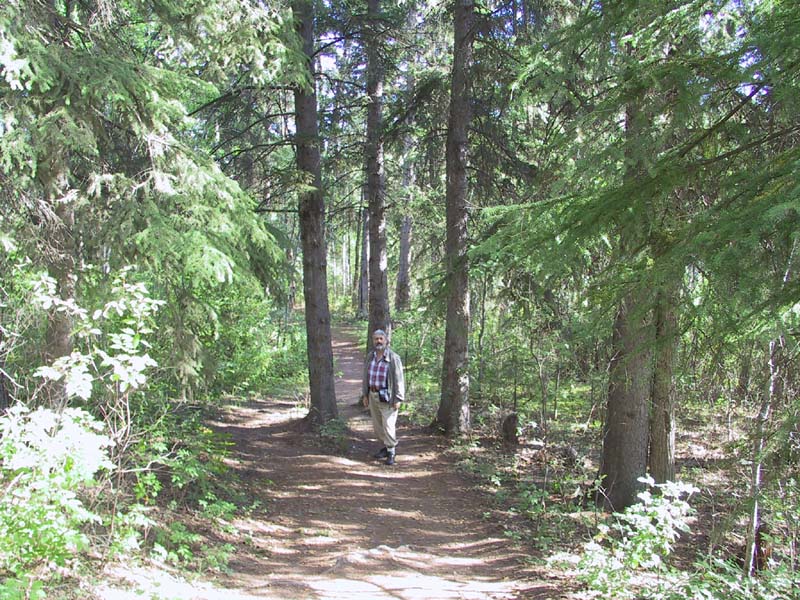 |
walking in the Mactaggart during the summer (click image to enlarge) |
Having walked this way frequently over the last two or three years at different times of the year, the images I can summon are clear and detailed. Like Wordsworth in "Tintern Abbey," I can say to myself, "Once again / Do I behold these steep and lofty cliffs," although the cliffs here are perhaps less lofty or steep. I can also recall the pleasure the images have held for me during intervening times in the "lonely rooms" of "towns and cities," even if I cannot attest to their influence in more profound ways.
So far, then, I recognize the workings of something like the picturesque. No doubt, such workings are mediated by earlier experiences both literary and practical, going back to an upbringing in the English countryside where the main leisure activity in my family was walking. In other words, I have been interpellated (as Althusser would put it) by an ideology of Nature in which the pleasures of Nature seem immediate, natural, and inevitable. If it seems this way, the historicist would tell me, it is because the Picturesque vision, inculcated in the late eighteenth century in order to foster and define the aesthetic sensibilities of an emergent middle class, became normative. Transmitted to subsequent generations by Picturesque Tours and other travel books, and by influential literary treatments from Wordsworth to Richard Jefferies, it shaped the assumptions and practices of the class in which I grew up just after the second World War.
This seems right to me, yet at the same time, unsatisfactory. It is to downplay or deprecate another perspective -- one which Wordsworth promoted: his view, as James McKusick summarizes it, "that human passion incorporates the forms of nature" (376). Although human life is imbued at every point with historically inflected cultural formations, this need not exclude their basis in some part, at certain times, in "the forms of nature." The Picturesque seems to me a case in point, marking the shift from an earlier, emblematic use of Nature (cf. Denham, Dyer, and other early loco-descriptive poets) to one that, through the development of aesthetic principles, shows a new sensitivity to forms of nature that are intrinsic, expressive of the animate and inanimate agents that collaborate to evolve a landscape. It should hardly surprise us if a certain sector of the gentry (William Gilpin and his followers) would take up these affordances of landscape to foster their class aims, drawing pictures and publishing books in order to produce that familiar cultural capital, the Picturesque. This does not invalidate the originating impulses and their source in the response to nature. While we do well to remain alert to the aims behind such appropriation and their specific, historical effects (e.g., Repton's actual, as opposed to Gilpin's supposed, landscape alterations), the forms of nature to which they drew attention were not invented but discovered; they have been there for eons, and remain available as objects for our attention and passion now. They suggest, indeed, a first, unconscious framing of an ecological conception, apparent in the emphasis of Whately or Gilpin on wholeness, variety, and contrast, and the animation that finds a correspondence in human feelings.
The images of the Mactaggart sanctuary continue to resonate in memory because they provide (among other things) a vehicle for registering and reflecting on my feelings. That is, I am better able to recognize the forces operative in my mind and body by sympathy with the fir tree I pass on my walk or by my feeling for the Whitemud creek curving away below the bluff. In our present age such feelings also suggest a sympathy for nature's autonomy and variety which underlies the resistance to such destructive agents as oil prospecting, logging, and surburban developments. While four or five thousand years ago such feelings would have had only personal or local significance, it is hard not to see them now as critical to our survival. At the present moment, to misread the Picturesque as pure ideology, historically conditioned, seems a dangerous stance.
January 14th 2003 (848 words)
Works cited
Althusser, Louis. "Ideology and Ideological State Apparatuses." Lenin and Philosophy and Other Essays. London: New Left Books, 1971.
McKusick, James. "Coleridge and the Economy of Nature." Studies in Romanticism
35 (1996): 375-390.
return to Commentaries | to Romantic Travellers
Document prepared January 14th 2003