Walks & Bloch band theory on periodic tessellations
A Bloch band theory approach to counting returning walks on periodic tessellations.
Reference

Imagine being lost in a maze, trying to find a way out by exploring different paths. You are particularly confused so you don’t hesitate to backtrack your steps. Your trajectory might look like the following
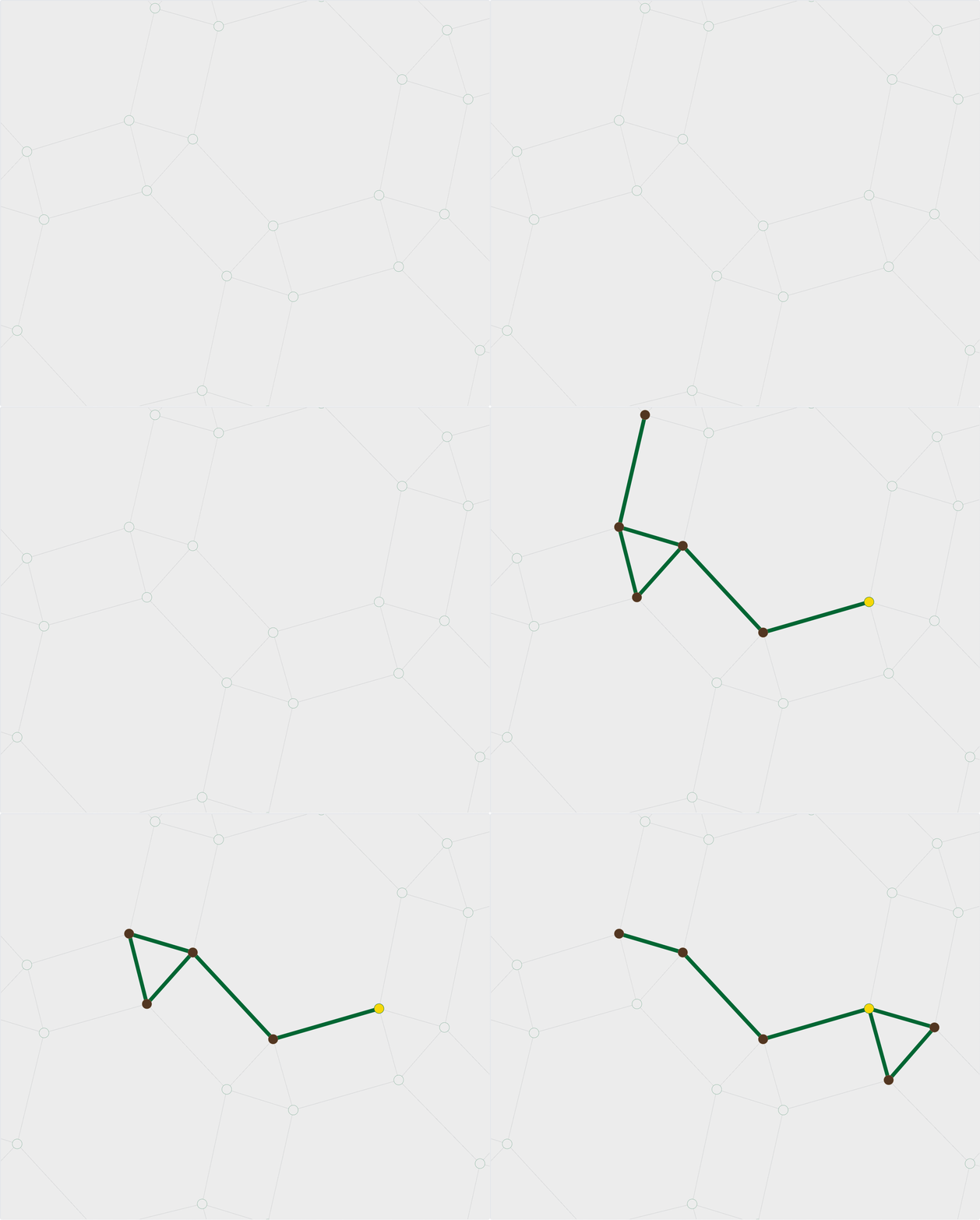
We identify the maze with a graph that contains vertices and edges; Each trajectory here is a walk which is a sequence of vertices through edges. Furthermore, you might’ve noticed that these trajectories actually end where they started – they are what’s called returning walks. As the number of possible steps increase, one can ask the following natural question: what fraction of paths return? The return probability $p_n$ is the fraction of paths that return to the start (called returning walk number) in $n$ steps. This lattice-dependent quantity can be estimated through variety of means, a brute force computation for $n=20$ yields
\[p_{20}=\frac{20,110,694,272}{4^20}=0.0182.\]Would you believe it if this pure combinatorial number is directly related to $\pi$, the geometric constant? In the limit, we showed that this lattice (called the Maple-Leaf lattice), the return probability as $n\to \infty$ asymptotically scales as
\[p_{n} \sim \frac{1}{\pi} \frac{2}{\sqrt{3}} \frac{1}{n}.\]Setting $n=20$, we find that
\[p_{2O} \sim \frac{1}{\pi} \frac{2}{\sqrt{3}} \frac{1}{20}=0.0183\approx 0.0182.\]In our paper, we developed a framework to derive the asymptotic return probabilities for various periodic tessellations tested on a class of two-dimensional planar lattices called Archimedean lattices. In particular, we package these returning walk numbers into a generating function. Our formalism involves Bloch band theory using the notion of a Bloch generating function we introduce in our work. In addition, we used these generating functions to derive the density of states – an important physical observable – for the tight-binding model on these lattices and present a method to construct finite flakes of periodic lattices using graph-stitching.