 Define the problem
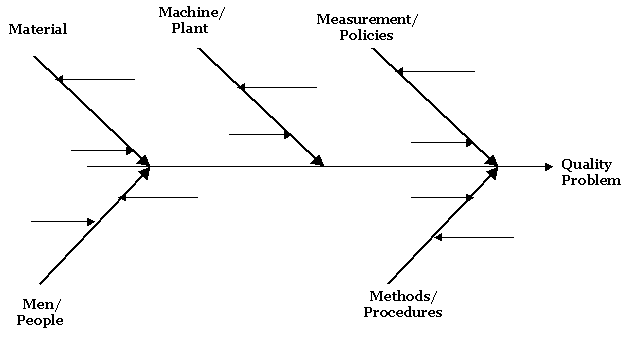
CREATING A FISHBONE DIAGRAM
Cause Enumeration/Dispersion Analysis
Kauro Ishikawa. 1982. Guide to
Quality Control: 18-29
Yonatan Reshef
School of Business
University of Alberta
Edmonton, Alberta
T6G 2R6 CANADA
Define the problem
|
Low course evaluations |
Collect information
from students - 15 minutes
Use tools such as check sheets or brainstorming. If check sheets are used,
each cause should be totalled across 13/26/39 class meetings. If brainstorming is used,
decide on the technique:
- Structured brainstorming (Round Robin; 6-3-5 [6 people - 5 minutes - 3 ideas]; etc.)
- Ask: Why does it happen?
Arrange the causes
Write causes on sticky notes.
Place the causes generated through the former step on a flip chart so that all
the students can clearly see them. Place the sheets on the wall.
Collect information from
professors - 15
minutes
Get more information from a different source, professors. Now, place the
new set of causes on a flip chart so that all the students can clearly see them.
Place the sheets on the wall.
Decide
on the root causes - 10 minutes
Use check
sheets, Pareto charts, and brainstorming to identify root causes (e.g. material, machine, measurement,
methods, men) and agree on secondary causes
Construct
your diagram with the root causes
Review - 5
minutes
Construct
the rest of the diagram - 15 minutes
Attach the secondary causes to their respective root causes
Review - 15
minutes
If time
permits
Prioritize root/secondary causes using
the Nominal Group Technique, which allows a team to quickly come to a consensus
on the relative importance of issues by integrating individual importance
rankings into a team final priorities.
STEP 1 - The Team Attaches a Letter to Each Major Cause
A Professor
B Students
C Facility
D Technology
STEP 2 - Each Team
Member Prioritizes
the Major Causes
A 3
B 4
C 2
D 1
Here, "4" is the most important and "1" is the least important ranking .
STEP 3
Summarize points across all the team member rankings
Prepare an action plan for improvement.