Vascular Anatomy

  • Anterior Circulation
    • Internal Carotid Arteries (ICA)
      • first intradural branch is the ophthalmic artery
      • anterior choroidal arteries
      • Posterior Communicating Artery (PComm)
    • ICA forks to form...
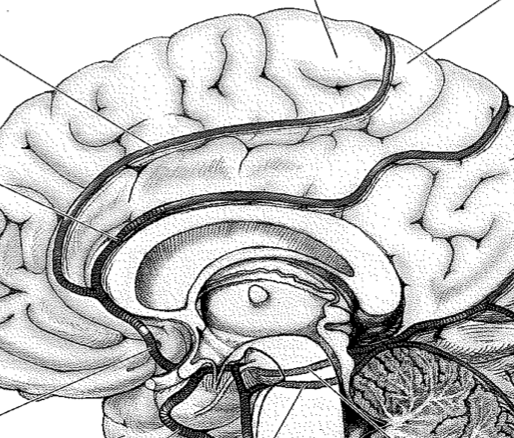
      • Anterior Cerebral Artery (ACA)
        • recurrent artery of Heubner
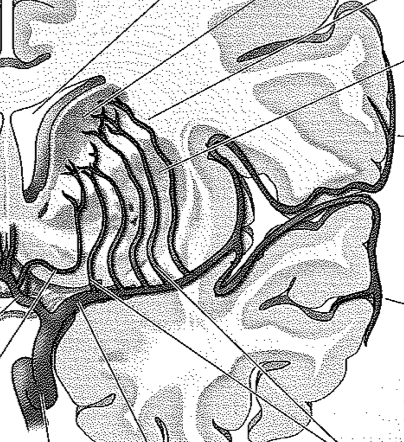
      • Middle Cerebral Artery (MCA)
        • proximal (M1) segment
          • lenticulostriate perforating branches
        • M2 branches
          • superior division of MCA
          • inferior division of MCA
  • Posterior Circulation
    • Vertebral Arteries
      • Posterior Inferior Cerebellar Arteries (PICA)
      • Anterior Spinal Artery
    • ...join to form Basilar Artery
      • Anterior Inferior Cerebellar Arteries (AICA)
      • Brainstem perforating branches (paramedian and circumferential)
      • Superior Cerebral Arteries (SCA)
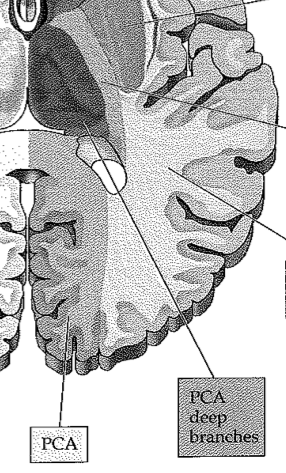
    • Basilar artery forks and becomes proximal (P1 segment) of posterior cerebral arteries (PCA)
      • Posterior communicating arteries (PComm) connect with anterior circulation (at level of ICA)
      • distal branches (P2) of PCA supply the posterior cerebral cortex
  • Anatomy Review
    • CT Angiogram (axial)
    • CT Angiogram (coronal COW)

MCA Syndromes
  • Left superior division
    • Broca aphasia
    • Right face and arm weakness
    • Right-sided cortical sensory loss (variable)
  • Left inferior division
    • Wernicke aphasia
    • Mild (or no) right-sided weakness
    • Right-sided cortical sensory loss
  • Left deep territory
    • "Pure" right-sided weakness (face/arm/leg)
    • Larger lesions may be accompanied by "cortical" signs such as aphasia
  • Left proximal occlusion
    • (complete left MCA syndrome)
    • Left gaze preference
    • Global aphasia
    • Right homonymous hemianopia
    • Right hemiparesis
    • Right hemianesthesia
  • Right superior division
    • Left face and arm weakness
    • Left-sided sensory loss (variable)
    • Left-sided hemineglect (variable)
  • Right inferior division
    • Left gaze preference
    • Profound left hemineglect
    • Left-sided cortical sensory loss (but difficult to evaluate in setting of hemineglect)
    • Left homonymous hemianopia (but difficult to evaluate in setting of hemineglect)
    • Normal left-sided strength, but movement decreased due to motor neglect
  • Right deep territory
    • "Pure" left-sided weakness (face/arm/leg)
    • Larger lesions may be accompanied by "cortical" signs such as left hemineglect
  • Right proximal occlusion
    • (complete right MCA syndrome)
    • Left gaze preference
    • Left homonymous hemianopsia
    • Left hemiparesis
    • Left hemianesthesia
    • Profound left hemineglect

PCA Syndromes

  • Left PCA
    • Right homonymous hemianopia
    • Alexia without agraphia (if involvement of splenium of corpus callosum)
      • "disconnects" visual areas from language areas
    • Aphasia (if involvement of thalamus)
    • Right hemisensory loss (if involvement of thalamus)
    • Right hemiparesis (if involvement of internal capsule)
  • Right PCA
    • Left homonymous hemianopia
    • Left hemisensory loss (if involvement of thalamus)
    • Left hemiparesis (if involvement of internal capsule)

ACA Syndromes

  • Left ACA
    • Right leg weakness
    • Right leg cortical sensory loss
    • Transcortical motor aphasia
    • Behavioural changes
    • Right hemiplegia (if large infarct)
  • Right ACA
    • Left leg weakness
    • Left leg cortical sensory loss
    • Left hemineglect
    • Behavioural changes
    • Left hemiplegia (if large infarct)

Lacunar Syndromes

  • Lacunar infarctions are caused by occlusion of small, perforating cerebral vessels
    • associated with typical vascular risk factors, especially hypertension
    • small, perforating vessels become gradually occluded by a process called lipohyalinosis
    • lacunar infarcts tend to be found within white matter regions
    • the same "lacunar syndrome" may be produced by multiple different cerebral lesions
  • Five (or six) classically described lacunar syndromes:
    • Pure motor hemiparesis
      • unilateral face/arm/leg weakness (with or without dysarthria)
      • localizations:
        • posterior limb of internal capsule (lenticulostriate arteries, anterior choroidal artery, PCA perforators)
        • ventral pons (perforating branches of basilar artery)
        • corona radiata (small MCA branches)
        • cerebral peduncle (small MCA branches)
    • Dysarthria hemiparesis ("dysarthria/clumsy hand syndrome")
      • dysarthria with hand weakness/clumsiness
      • localizations:
        • same as for pure motor hemiparesis
        • posterior limb of internal capsule (lenticulostriate arteries, anterior choroidal artery, PCA perforators)
        • ventral pons (perforating branches of basilar artery)
        • corona radiata (small MCA branches)
        • cerebral peduncle (small MCA branches)
    • Ataxic hemiparesis
      • unilateral face/arm/leg weakness, with limb clumsiness/ataxia
      • the ataxia is "out of keeping" with the weakness - e.g. the limb ataxia is more than would be expected for the amount of weakness
      • localizations:
        • same as for pure motor hemiparesis
        • posterior limb of internal capsule (lenticulostriate arteries, anterior choroidal artery, PCA perforators)
        • ventral pons (perforating branches of basilar artery)
        • corona radiata (small MCA branches)
        • cerebral peduncle (small MCA branches)
    • Pure sensory syndrome
      • contralateral loss of all primary sensory modalities
      • localization:
        • ventral posterior lateral (VPL) nucleus of the thalamus (thalamoperforator branches of the PCA)
    • Sensorimotor stroke
      • unilateral face/arm/leg weakness (with or without dysarthria)
      • contralateral loss of all primary sensory modalities
      • localization:
        • posterior limb of the internal capsule and thalamic VPL or thalamic somatosensory radiations (thalamoperforator branches of the PCA, or lenticulostriate arteries)
    • Basal ganglia lacune
      • often asymptomatic, but may cause hemiballismus
      • localization:
        • caudate nucleus, putamen, globus pallidus, or subthalamic nucleus (lenticulostriate, anterior choroidal, thalamoperforator, or Heubner's arteries)

Brainstem Syndromes

  • There are more than 25 named brainstem stroke syndromes
    • many are rare
    • descriptions in clinical literature may be inconsistent
    • many were described before the MRI era
    • some of them might not exist...
    • ... in a study of 245 patients with MRI-confirmed brainstem strokes, only 19 had a "classic" brainstem stroke syndrome (14 of those were Wallenberg) - Marx, J. J., & Thömke, F. (2009). J of Neurology, 256(6), 898–903.
  • Brainstem lesions classically produce "crossed deficits"
    • unilateral cranial nerve deficits with contralateral motor/sensory deficits ("long tract signs")
    • typical signs/symptoms of brainstem ischemia: (table)
      • nystagmus
      • ptosis
      • diplopia
      • dysarthria
      • dysphagia
      • ataxia
      • contralateral motor/sensory deficits
      • isolated dizziness is rarely due to brainstem ischemia
  • A few brainstem syndromes worth knowing:
    • Weber syndrome
      • CN III palsy and contralateral hemiparesis
      • midbrain lesion of cerebral peduncle and CN III fascicles (figure 1) (figure 2)
    • Millard-Gubler syndrome
      • CN VI and VII palsy and contralateral hemiparesis
      • pontine lesion (anterior paramedial pons) affecting CN VI and VII nucleus/fascicles, and corticospinal tracts (figure 1) (figure 2)
    • Wallenberg (lateral medullary) syndrome
      • the classic! worth knowing, as it is probably the most common "named" brainstem syndrome
      • lateral medullary lesion, affecting producing... (figure 1) (figure 2)
        • ipsilateral facial pain and numbness - spinal trigeminal nucleus
        • contralateral hemibody sensory loss - spinothalamic tract
        • ispilateral clumsiness (hemiataxia), gait ataxia with lateralpulsion - spinocerebellar tract
        • oscillopsia, vertigo, nausea, and vomiting - vestibular nuclei
        • loss of taste sensation - nucleus of the tractus solitarus (NTS)
        • dysphagia, diminished gag, hoarseness - CN IX and X fibres, NTS
        • Horner syndrome - descending sympathetic tract (hypothalmospinal fibres)
  • ...the reason to learn brainstem syndromes is to understand neuroanatomy, not because they are commonly encountered in clinical practice!

Thalamic Syndromes

  • There are 4 major thalamic vascular territories (figure 1) (figure 2)
    • Tuberothalamic artery - arises from middle third of PComm
    • Paramedian artery (of Percheron) - the superior ramus of the interpeduncular branches of P1 segment of PCA (middle and inferior branches supply midbrain and pons) - bilateral branches may arise from a single common pedicle
    • Inferolateral artery - 5 to 10 branches arising from the P2 segment of the PCA, supply lateral regions of thalamus
    • Posterior choroidal artery - also arise from P2, except for one or two branches that may arise from distal P1
  • Vascular syndromes of the thalamus (table)

Cases

Case One

  • 80 yo F with PMHx of A. Fib, HTN, T2DM, dyslipidemia, obesity
  • acute onset of confusion, decreased movement of left arm and leg
  • Examination
    • Awake, inattentive, not following commands consistently, no aphasia or dysarthria
    • Left homonymous hemianopsia
    • Left-sided sensory loss
    • Left hemineglect
    • Left hemiparesis (uncertain due to neglect)
    • Left extensor plantar response
  • Imaging
    • CT Scan

Case Two

  • 87 yo F with PMHx of A. Fib, HTN, dyslipidemia, obesity
  • Presented to ER 2 hours from symptom onset with speech difficulty, right-sided weakness
  • Examination (at presentation)
    • Awake, follows commands
    • Expressive (Broca) aphasia and severe dysarthria
    • Right-sided homonymous hemianopsia
    • Severe right-sided UMN facial weakness
    • No movement of right arm, anti-gravity only of right leg
    • Right extensor plantar response
  • treated with IV tPA in the emergency department
    • symptoms improving the next day, with improvement of language but ongoing right-sided weakness
  • Imaging (the next day, post-tPA)
    • CT Scan

Case Three

  • 72 yo M farmer with PMHx of HTN, smoking, dyslipidemia
  • Presented with a three day history of right-sided weakness
  • Examination
    • Awake, alert
    • Normal language exam
    • Full visual fields
    • Mild right UMN facial weakness
    • Right pronator drift, decreased dexterity of right hand/fingers
    • Mild right leg weakness
    • Significant clumsiness of right arm and leg (finger-to-nose and heel-shin testing)
  • Imaging
    • MRI Scan

Case Four

  • 73 yo M with PMHx of HTN, PVD, impaired fasting glucose, mild cognitive impairment
  • Presents with diplopia, dysarthria, and right-sided weakness
  • Examination
    • Awake, alert
    • Normal language exam, but dysarthric
    • Full visual fields
    • Left ptosis, mild anisocoria (OD<OS), eye deviated "down and out"
    • Right arm and leg weakness
  • Imaging
    • MRI Scan

Case Five

  • 74 yo M with PMHx of HTN, smoking, A. Fib, surgical repair of spinal dural fistual (residual Rt LE weakness with upgoing toe)
  • Presents with 4 day history of nausea, vomiting, malaise
  • 3 days ago - gait ataxia
  • On the day of presentation, ataxia worsening, fell at home, came to hospital
  • Denied headache, neck pain, or recent trauma
  • Examination
    • Awake, alert
    • Normal language
    • ?mild diminished pinprick sensation on right side of face
    • left-beating horizontal nystagmus
    • decreased gag
    • right UE dysmetria on finger-to-nose testing
    • severe gait ataxia with right lateralpulsion
  • Imaging
    • MRI Scan

Case Six

  • 77 yo M adm to hospital with mild right-sided weakness and global aphasia, treated with IV tPA
  • 2 days after admission, he had a seizure and required intubation for decreased LOC
  • off sedation, he was confused, with severe right-sided hemiparesis
  • Examination
    • Confused, drowsy
    • Unable to assess language due to ETT but does not follow commands
    • No response to visual threat on right side
    • No movement of right arm and leg
    • Withdraws left arm and leg to pain
  • Imaging
    • CT Scan (done after clinical deterioration)

Case Seven

  • 79 yo M found down by his son in the garage
  • Last seen well the night before
  • Had managed to shovel the sidewalk before he collapsed
  • Examination
    • Drowsy, obeys some commands, incomprehensible speech, withdraws to pain
    • Left sided facial droop, no movement of left side
    • Withdraws right arm and leg to pain
  • Imaging
    • CT Scan

References

references in bold are highly recommended

  1. Marx, J. J., & Thömke, F. (2009). Classical crossed brain stem syndromes: myth or reality? Journal of Neurology, 256(6), 898–903. doi:10.1007/s00415-009-5037-2
  2. Schmahmann, J. D. (2003). Vascular syndromes of the thalamus. Stroke; a journal of cerebral circulation, 34(9), 2264–2278. doi:10.1161/01.STR.0000087786.38997.9E
  3. Blumenfeld, H. (2002). Neuroanatomy through Clinical Cases, 1–480.
  4. Haines, D. E. (2008). Neuroanatomy. Lippincott Williams & Wilkins.

Stroke Syndromes

November 21st, 2013

printer-friendly
(-)
  • Hohol, M.J. The Neurologic Exam. Accessed at: http://neuroexam.med.utoronto.ca/main.htm