
VLADIK KREINOVICH
Biography
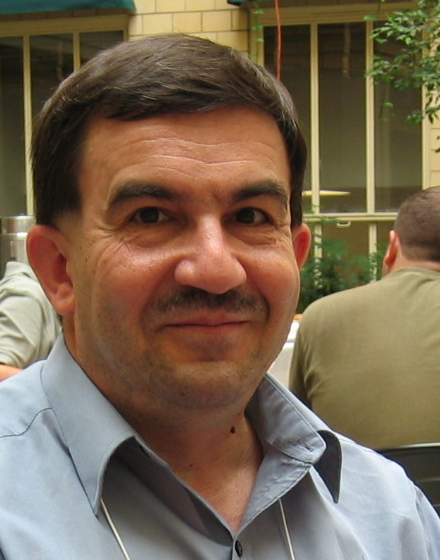
Vladik Kreinovich received his M.Sc. in Mathematics and Computer Science from St. Petersburg University, Russia, in 1974, and Ph.D. from the Institute of Mathematics, Soviet Academy of Sciences, Novosibirsk, in 1979. In 1975-80, he worked with the Soviet Academy of Sciences, in particular, in 1978-80, with the
Special Astrophysical Observatory (representation and processing of uncertainty in radioastronomy). In 1982-89, he worked on error estimation and intelligent information processing for the National Institute for Electrical Measuring
Instruments, Russia. In 1989, he was a Visiting Scholar at Stanford University. Since 1990, he is with the Department of Computer Science, University of Texas at El Paso. Also, served as an invited professor in Paris (University of Paris VI), Hong Kong, St. Petersburg, Russia, and Brazil.
Main interests: representation and processing of uncertainty, especially interval computations and intelligent control. Published 3 books, 6 edited books, and more than 800 papers. Member of the editorial board of the international journal "Reliable Computing" (formerly, "Interval Computations"), and several other journals. Co-maintainer of the international website on interval computations http://www.cs.utep.edu/interval-comp
Honors: President-Elect, North American Fuzzy Information Processing Society; Foreign Member of the Russian Academy of Metrological Sciences; recipient of the 2003 El Paso Energy Foundation Faculty Achievement Award for Research awarded by the University of Texas at El Paso, and a co-recipient of the 2005 Star Award from the University of Texas System.
Talk
Need for Expert Knowledge (and Soft Computing) in
Cyberinfrastructure-Based Data Processing
Abstract: A large amount of data has been collected and stored
at different locations. When a researcher or a practitioner is
interested in a certain topic, it is desirable that he or she
gets easy and fast access to all the relevant data. For
example, when a geoscientist is interested in the geological
structure of a certain area, it will be helpful if he or she
get access to a state geological map (which is usually stored
at the state's capital), NASA photos (stored at NASA
Headquarters and/or at one of corresponding NASA centers),
seismic data stored at different seismic stations, etc.
Similarly, when an environmental scientist is interested in the
weather and climate conditions in a certain area, it is helpful
if he or she has access to satellite radar data, to data from
bio-stations, to meteorological data, etc. Cyberinfrastructure
is a general name for hardware and software tools that
facilitate this data transfer and data processing, making it
easier for the user. Ideally, a user should simply type in the
request, and the system will automatically find and process the
relevant data -- it should be as easy and convenient as a
google search.
At present, the main challenges in cyberinfrastructure design
are related to the actual development of the corresponding
hardware and software tools. Most existing tools are
concentrating on moving the data and on processing the data by
using existing well defined algorithms. As cyberinfrastructure
becomes a reality, it becomes clear that we while some of its
results are exciting, other results require additional expert
analysis and corrections. To make results more relevant, it is
therefore desirable to incorporate expert knowledge into the
cyberinfrastructure. Some expert knowledge is formulated in
precise terms; these types of knowledge are easier to
incorporate. However, a large part of expert knowledge is
formulated not in precise terms, but by using imprecise (fuzzy)
words from a natural language (like "small"). To incorporate
this knowledge, it is therefore natural to use fuzzy techniques
(and more generally, soft computing techniques), techniques
specifically designed for formalizing such imprecise facts and
rules.
In this talk, we describe several problems in which such
incorporation is needed, and we overview our experience of such
incorporation in geosciences and environmental sciences
applications of cyberinfrastructure.
1) Somewhat surprisingly, the need for such expert knowledge
emerges even in situations when we simply want to "fuse" data
from different sources. In such situations, seemingly natural
statistical approaches (such as Maximum Likelihood methods),
sometimes lead to physically meaningless results. To get
physically meaningful results, we must supplement the data
itself (and the corresponding statistical information) with
expert knowledge describing which fusion results are physically
meaningful and which are not. In the talk, we show how this
expert knowledge can help.
2) The need for an expert knowledge is even more acute in the
actual data processing, e.g., in solving inverse problems, when
we need to reconstruct the values of the quantities of interest
-- such as density at different depths and different locations
-- from the measurement results. From the mathematical
viewpoint, the corresponding problems are often "ill-posed",
meaning that usually, several drastically different density
distributions are consistent with the same observations. Out of
all these distributions, we need to select the physically
meaningful one(s) -- and this is where expert knowledge is
needed, to describe what "physically meaningful" means. On the
example of the above geophysical problem, we show how this
expert knowledge can be taken into account.
3) The above two applications are related to processing the
existing data, the data coming from the existing measuring
instruments. In many practical situations, the data from the
existing instruments is not sufficient, so new measuring
instruments are needed. For example, to get a better
understanding of weather and climate processes, we need to
place more meteorological stations in under-covered areas --
such as Arctic, Antarctic, and desert areas. Which are the best
locations for these new instruments? Which are the best
designs? We would like to gain as much information as possible
from these new instruments. The problem is that we do not know
exactly what processes we will observe -- this uncertainty is
what motivates us to build the new stations in the first place.
Because of this uncertainty, to make a reasonable decision, we
need to use expert knowledge. In this talk, we show how we have
used NASA's experience of solving a similar problem of
optimization under uncertainty -- when NASA selected the sites
for the first Moon landings -- to find the optimal location of
a meteorological tower.