Council
Home Page
A Short History of NASA
Introduction
The Early Days
Branch 22
The Sixties
NASA: Building A Union
Moving Ahead
Conclusion
Last updated: 02/26/99
Introduction
On July 30, 1997, the University of Alberta Non-Academic Staff Association celebrates the fiftieth anniversary of a movement that began the present-day Association. You may wonder why this historical fact is relevant for you today. Why should the history of U of A support staff be important? After all, it's well known that university support staff rarely get the positive recognition they deserve for doing the essential work that keeps this institution functioning whether that is in administration, maintenance, research, or any of the other support activities.
However, while we don't get that public recognition, knowing our union's history does help us to understand why NASA exists. By understanding something of the past, we can recognize the continuity of our union in the U of A community. More important, that understanding helps us to make decisions about future directions of the Association.
We are fortunate that Earl Stephanson, a local Edmonton writer, was able to prepare a summary from the research he has done in compiling a History of NASA. This web-page short "unofficial" history draws from his work and should be seen as an introduction for Reps and members on our union. However, this is a personal interpretation and can never encompass the entire picture. I apologize for any errors or omissions in the final text. NASA continues to collect information and archival material and your donations towards that effort are encouraged and greatly appreciated.
Peter Matilainen
Council Chair
December 1997
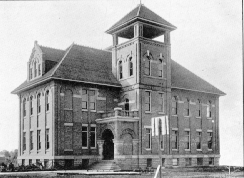
There have been support staff at the University of Alberta since the first classes were held on the top floor of Duggan Street (Queen Alexandra) School in Strathcona beginning in 1908. However, an employee association that represented non-academic staff did not begin to emerge until after the Second World War. Once called "Servants of the University," but also known as "sub-staff," non-academic university employees are barely acknowledged in university archival documents. The presence and contribution of a major group of university personnel has been virtually excluded from this institutions historical records, yet extensive research through assorted archives reveals a diverse and colourful past that deserves its place alongside other histories of this institution.
Alberta's first University Act (1906) -- through its definition of support staff as "other necessary officers, assistants and servants to the University" -- brought staff under the purview of the University Act and not the Labour Act, thus limiting labour activity on campus. Before the Second World War, the University, as employer, had absolute and arbitrary control over the working conditions and wages of support staff, and Provincial Governments controlled the institutions funding.
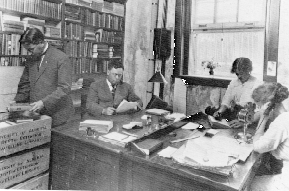 The inadequate legislation was exploited
by both the University administration and Provincial government to arbitrarily set staff
working conditions and wages. Seventy hours of work per week was not uncommon and there
were no policies defining occupational duties and responsibilities. Workers performed any
task or risked losing jobs. Employees could be terminated for unauthorized smoke-breaks.
There were no guidelines to set wages and salaries. Two individuals with the same
qualifications and experience, performing similar duties -- but in different departments
-- might receive radically disparate wages. And the reason could be as arbitrary as the
whim of a supervisor or department head. Supervisors were known to 'spy on staff and
demote or fire those not in ones good graces. In some campus buildings, staff were not
provided access to locker or washroom facilities.
The inadequate legislation was exploited
by both the University administration and Provincial government to arbitrarily set staff
working conditions and wages. Seventy hours of work per week was not uncommon and there
were no policies defining occupational duties and responsibilities. Workers performed any
task or risked losing jobs. Employees could be terminated for unauthorized smoke-breaks.
There were no guidelines to set wages and salaries. Two individuals with the same
qualifications and experience, performing similar duties -- but in different departments
-- might receive radically disparate wages. And the reason could be as arbitrary as the
whim of a supervisor or department head. Supervisors were known to 'spy on staff and
demote or fire those not in ones good graces. In some campus buildings, staff were not
provided access to locker or washroom facilities.
Rapid expansion of the university following the Second World War put tremendous strain upon working relations between the University and its support staff. Employees began to realize they needed to organize bargaining collectively, and they sought information from established unions and associations, including the Canadian Congress of Labour (CCL). The CCL had organized employees at the University of Saskatchewan and elsewhere in Canada, but CCL recruitment drives in Edmonton brought opposition from University administrators and campus employees with affiliations to other unions.
The war-time alliance between the Soviet Union and the West had collapsed and we saw the rise of the Cold War. Union activists with communist affiliations -- real and alleged -- were accused of being subversives. In Alberta, the CCL was attacked for having ties with international and local communist organizations. University funding came directly from the Provincial Government, and it was no secret that Premier Ernest C. Manning was vehemently anti-Communist and anti-union.
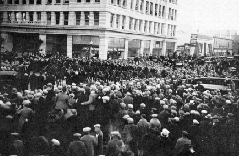 Concern spread through administrative
levels that the University might have to deal with a militant union if the CCL gained a
foothold on campus. The past success of the CCL to win representation on other campuses
was a clear signal. Intervention from the office the University President resulted in
moves to obstruct the CCL and to facilitate a more benign alternative. In the end, over
ninety percent of University support staff were encouraged to vote to form an independent,
non-aligned, organization.
Concern spread through administrative
levels that the University might have to deal with a militant union if the CCL gained a
foothold on campus. The past success of the CCL to win representation on other campuses
was a clear signal. Intervention from the office the University President resulted in
moves to obstruct the CCL and to facilitate a more benign alternative. In the end, over
ninety percent of University support staff were encouraged to vote to form an independent,
non-aligned, organization.
However, this initiative was blocked by the CCL-backed organizing group who pointed to their earlier charter application for representation. It became clear to opponents of the CCL that the only way to circumvent the appeal was for support staff to apply individually for associate membership in the already-established Civil Service Association of Alberta (CSA). A small corps of support staff -- working with the active assistance of University Administration -- generated a recruiting drive that quickly signed nearly every non-academic employee as associate members of the CSA. The drive culminated on July 30, 1947, with the inauguration of Branch 22, representing full-time non-academic staff in Edmonton and Calgary.
Charges of unfair labour practices inevitably followed. The CCL contested the legality of Branch 22, but lost a ruling by the Labour Relations Board. The CCL was driven off campus.
Branch 22
Over the next two decades support staff worked through their CSA branch for better working conditions and wages. However, they experienced frustrations at achieving these objectives for a number of reasons. The great diversity of employees and occupations, combined with relative isolation of certain employees from others on campus, meant that many staff either could not identify with Branch 22, or did not see any direct personal benefits from participating in the Association. Since membership was voluntary, Branch Executives were continually faced with the need to find ways to recruit new members and broaden the support base for the Association so it could claim to speak for staff.
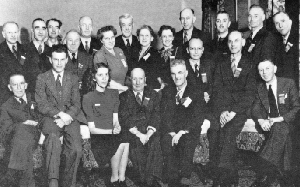 Complicating efforts to sign up these new members was an apparent
impotence of Branch 22 to resolve grievances presented to the employer, or to influence
terms of employment or working conditions. Social Credit provincial government labour
legislation that covered the University basically left the employer in charge and able to
manipulate their staff. Support staff had little recourse in either negotiations or
grievances. University employees and branch members, through their Department
Representatives, would inform the Branch Executive of concerns and demands, making
recommendations to pass on to the Negotiating Committee of the Provincial Executive of the
CSA. This committee would meet with the University Administration, reach a settlement, and
then pass whatever new terms were agreed upon to Branch members through their Executive.
Complicating efforts to sign up these new members was an apparent
impotence of Branch 22 to resolve grievances presented to the employer, or to influence
terms of employment or working conditions. Social Credit provincial government labour
legislation that covered the University basically left the employer in charge and able to
manipulate their staff. Support staff had little recourse in either negotiations or
grievances. University employees and branch members, through their Department
Representatives, would inform the Branch Executive of concerns and demands, making
recommendations to pass on to the Negotiating Committee of the Provincial Executive of the
CSA. This committee would meet with the University Administration, reach a settlement, and
then pass whatever new terms were agreed upon to Branch members through their Executive.
The University dealt from a very strong hand and the Branch was often faced with a 'take-it-or-leave-it position. There was little the members could do about it since the University was not even legally bound to uphold any terms reached with the CSA. And Branch 22 had neither sufficient numbers of signed members nor broad enough general support to significantly influence negotiations on employment and working conditions.
The University -- through what has come to be known today as a "Sweetheart" deal -- would usually match wages and working conditions similar to those obtained by civil servants who worked for the government and were also represented by the CSA. Consequently, most of the staff felt little need to work actively to build strong representation at the local level.
The Branch was not in a position to bargain very effectively for staff during these times. However, it was able to successfully provide services and activities for the care and well-being of co-workers that mark most traditional employee associations. A benevolence committee was among the first committees established by Branch 22, collecting and distributing funds to members in need. A housing fund was created to purchase a building to house the Association.
Annual social events were sponsored and became major news on campus. In its first year, Branch 22 began a tradition of an annual Christmas party for families of support staff. (This continued yearly until the 1970s when NASA directed its funds to orphans and social organizations in Edmonton.) Sports and recreation also provided opportunities to socialize with co-workers. Clubs, tournaments, and gala events brought staff together and played an important role in staff relations.
The Sixties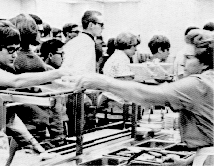
If the fifties represented a time of stability, the next decade was one of rapid change and developments that affected the entire world.
Starting in 1959, the University went through a ten-year period of expansion that redefined labour relations on campus. In 1960, the University opened new buildings and facilities on campus, but the number of janitorial staff remained constant, because, as university documents report, "Administration and Personnel plan to use the present staff more efficiently." Similar circumstances were happening elsewhere on campus. In response, special Reps meetings were held in 1961 by Branch 22 to address issues of "work conditions being changed without consultation, and disregard for work agreements."
In 1963, the University of Calgary support staff -- historically part of Branch 22 until the U of C was established as an independent body -- opted to affiliate with the Canadian Union of Public Employees (eventually affiliating with the Alberta Union of Provincial Employees the successor to the CSA). Efforts to create a more meaningful role for Branch 22 and more effective representation for its members was impeded by both the ambiguity of the Branch's legal status and by actions of unhappy members.
Frustration was evident in a 1963 letter from Charles Saunter -- then President of Branch 22 -- to University Personnel Officer, Murray Cooke. Saunter voiced concern over attempts by groups of university support staff who were seeking to establish union affiliation with national or provincial labour organizations. (The Canadian economy's rapid expansion in the sixties also brought on a parallel growth of unions as employees sought ways to better their working conditions in the new times.) Saunter warned of the existence of recruiting drives on campus from a number of these labour organizations. He suggested that support staff were interested in alternatives because of "disappointment and frustration over the useless and ineffective role that Branch 22 has been permitted to play on the University of Alberta campus."
Early in the 1960s, support staff -- individually and in small groups -- did, in fact, express their growing discontent with the status quo by seeking various solutions. Some staff wanted to apply to become sub-branches of Branch 22, while still others were intent on following the lead of the former members at the U of C by developing new affiliations with bigger provincial or national unions or associations. These strategies were impeded by Provincial labour legislation that discouraged union activity.
Those who decided to work to change the political structure and effectiveness of the Branch from within found their efforts blocked by the By-laws and the CSA Constitution. (There were even unsuccessful efforts by a few to gerrymander votes to take over the Branch.)
Facing the increasing breakdown of the traditional image of a university community as a "family", and divided over which direction to take, support staff found themselves working against each other to achieve largely the same goals: better representation.
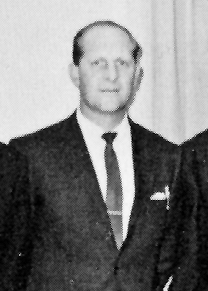 It was Phil Arnold, a technician by trade who worked in the
university's mechanical engineering department, who emerged in the mid-sixties as someone
who through his drive -- some might say "forceful" personality -- was able to
temporarily unite the disparate efforts of dissatisfied University of Alberta staff. Born
and raised in Britain, Arnold witnessed first-hand that country's labour movement. He used
that experience to organize Branch members into a cohesive force to seek an independent
organization. (He was also to eventually become the first paid full-time manager of the
association.)
It was Phil Arnold, a technician by trade who worked in the
university's mechanical engineering department, who emerged in the mid-sixties as someone
who through his drive -- some might say "forceful" personality -- was able to
temporarily unite the disparate efforts of dissatisfied University of Alberta staff. Born
and raised in Britain, Arnold witnessed first-hand that country's labour movement. He used
that experience to organize Branch members into a cohesive force to seek an independent
organization. (He was also to eventually become the first paid full-time manager of the
association.)
The push for independence had its most direct external pressure from the University's Board of Governors who continued to seek ways to resist employee demands. The Board had decided that they were only prepared to negotiate with a local campus-based group, and not the CSA. The CSA was, for all practical purposes, out of the picture and actually admitted they could not really bargain for the University support staff. This added further impetus to see a break with the CSA.
Arnold did not believe they were in a position to challenge Provincial legislation that bound them to the CSA. However, he concluded they could initiate others steps that could result in eventual independence from the parent body.
First came changes in the CSA Constitution to alter the relationship between Branch 22 and the CSA. Opposition from within the Provincial Executive of the CSA delayed this process but only temporarily. A new association with a new name was created, with a local leadership that was formed, in part, from its battles with the CSA leadership. Finally, in 1969, a motion allowing Branch 22 to become an affiliate rather than a branch was passed at the CSA convention. And Branch 22 became NASA. Within two years, NASA dropped affiliation with the CSA and became an independent association.
In some ways, it could be said that Branch 22 represented only the first step of the transformation of the employer-influenced civil service association. Within a matter of years the CSA membership chose to form the Alberta Union of Provincial Employees (AUPE) which came to represent most provincial government employees. However, the earlier animosity existing between key players in the events of NASA's genesis resulted in an enmity between the two organizations that has still to fade even though the major participants have since departed the scene.
NASA: Building A Union
Although U of A non-academic employees had achieved the goal of creating their own organization, a longer term vision remained elusive. In fact, the University was not legally bound to recognize NASA as the formal bargaining agent, but did so in an apparent act of good faith towards the newly-independent group. Administration was not critical of this turn of events, quite possibly because they were familiar with those involved and did not see it changing the substantial relationship between the association and management. Negotiations commenced immediately between the University and NASA toward a collective agreement.
The first contract took nearly two years in the making, but even then, the existing provincial legislation did not make the terms binding. By the end of 1969, and into the early seventies, support staff had repeatedly demonstrated the desire for a more effective organization. They also showed their support for NASA at crucial points along the way. This was a period of activism and solidarity that brought new ideas and energies to the fore, yet more difficulties would arise because of the Associations legal stature.
When the Public Service Employee Relations Act (PSERA) was enacted in 1978, NASA -- for the first time -- could obtain legal recognition as an independent employee organization. However, the first application for certification submitted by NASA was rejected. The university had provided NASA with office space and university property -- NASA House -- thus suggesting NASA might be subject to undue influence and not an independent representative of employees.
As soon as NASA's application under PSERA was rejected the University Board of Governors took the opportunity to withdraw its earlier voluntary recognition, leaving NASA without legal status, and no employer sitting on the other side of the negotiating table. Without any representation at that time, other employee organizations began recruiting efforts on the campus.
The leadership of NASA had little choice. The lease on NASA House was given up and offices on campus vacated, and, in very short order, a new application was submitted to PSERA Board. Certification was granted on September 26, 1978. For the first time in its thirty years, the employee organization representing support staff was a legally certified independent association and bargaining agent.
Negotiations began immediately to draft a new contract, including -- for the first time -- all hourly and temporary employees. The process took one-and-a-half years with delays attributed to a position taken by the Board of Governors that this was a first contract and everything had to be negotiated from scratch. When negotiations bogged down, arbitration was used to settle the terms of this first contract.
Compulsory arbitration was a key component of the provincial labour legislation that covered provincial government employees and other public sector employee groups like NASA. It made strikes illegal for employees and, instead, brought in third party arbitrators whenever there were a serious impasse in negotiations. Where before a "sweetheart deal" would set the terms of the working conditions, now a mutually agreed upon third party would sit with two representatives -- who were each selected by NASA and the university -- and the three would decide in their majority on what the contract would and would not contain. NASA has since gone to arbitration over a contract a number of times.
Moving Ahead
Although the University of Alberta Non-Academic Staff Association was now a legal entity, it faced--and continues to face--many of the same issues confronted in the past. Wage rates and employment equity, job descriptions, benefits, security, and employee representation in grievances and negotiations. These are not new concerns on the campus work-site. The Association continues a pursuit of new members, seeking ways to extend its appeal and encourage more active participation in affairs of the organization. Most recently, NASA was recognized as the legal representative of Trust employees on campus. The university, for its part, has decided to fight that in the courts.
Provincial politics and economics have also been and continue to be significant factors influencing the nature and process of personnel relations on campus. Legislation has been both detrimental to and helpful for non-academic employees and the Association. Fiscal policies of restraint throughout the mid-1980s and into the 1990s have callously slashed educational and research resources and created tension and anxiety as difficult reductions are forced upon already dilapidated educational institutions.
Non-academic employees who struggle to maintain the
functions of daily campus life face the Herculean challenge of keeping obsolete equipment
and facilities operating beyond their capacity, with declining numbers of staff
shouldering ever-greater loads. A growing number of occupations, formerly filled by
unionized support staff, are now contracted out to companies who do not provide the wages
or benefits that NASA members have fought long and hard to obtain. 
When the Provincial Government austerity programs led to cuts in funding to education, NASA joined in solidarity with others in the university community to oppose those cuts. The present state of local and global economies suggests that now, more than ever before, the Association needs to establish closer and more extensive ties with others involved in protecting the educational system and our society's overall standard of living. These include community groups, student and faculty associations, and other labour organizations. Just one example of this is the Alberta Association of Post-Secondary Institutions (AAPSI), a coalition of post-secondary employee organizations in Alberta. NASA continues to play a major role in this group.
Conclusion
The Non-Academic Staff Association has a diverse membership with different and sometimes competing interests. This has been true for University support staff since 1908. As this short history has hopefully demonstrated, the staff have been most effective when they have been able to unite and respond collectively through decisive action on key issues that affect the greatest majority of non-academic employees.
Similar conditions and circumstances confronted by non-academic employees in the past continue to arise today in the ongoing contest between management and labour. Traditional demands like wage rates are raised at the same time as more recent issues like sexual harassment and TQM. NASA, as an organization, is the form in which university support staff have come together to achieve their goals. However, history also suggests that the employer, the University's Board of Governors, has had a critical influence on its employees and their organization -- whether for good or for bad depends on your perspective.
Support staff at the University have been in contact with
others in the labour movement ever since the thirties. As has been noted, this has often
been a source of internal conflict within the University and among the staff themselves.
Whether there was any doubt before, it is clear that the University isn't a small
community or "family" which exists in isolation to the outside world. The
"new world ord er" of the 1990s has confirmed how integrated the global
economy and labour has become. University support staff are an integral part of the
broader labour movement in Alberta. While NASA actually represents one of the largest
remaining independent labour groups in this province, its members are affected by the same
legislation and political decisions that other employees face. To survive, labour
organizations -- like NASA -- will need to work together more closely than ever before to
protect their members wages, working conditions, and job security.
er" of the 1990s has confirmed how integrated the global
economy and labour has become. University support staff are an integral part of the
broader labour movement in Alberta. While NASA actually represents one of the largest
remaining independent labour groups in this province, its members are affected by the same
legislation and political decisions that other employees face. To survive, labour
organizations -- like NASA -- will need to work together more closely than ever before to
protect their members wages, working conditions, and job security.
Lastly, the "Association" -- regardless of its formal name -- acts as a union, protecting the interests of its members and seeking a better future for all. That future is not yet written. That is why an understanding of the events and history of the support staff at the University of Alberta should be an integral part of your understanding -- as a NASA member -- when you discuss and make decisions that will become the next chapter in this history.
