The Economic Status of Elderly Canadian Immigrants
Hugh Grant
Department of Economics
University of Winnipeg
Winnipeg, MB
1. Introduction
- Canada's aging population and the expected growth in the "dependency burden"
threatens to strain Canada's social security system and place greater demands
on government expenditures.
- concurrently, the prospect of a labour shortage looms as the baby boom generation
reaches retirement age and the declining birth rate makes it unlikely that
there will be a sufficient number of workers to take their place in the labour
market. 0 27.2 per cent of elderly Canadians are immigrants.
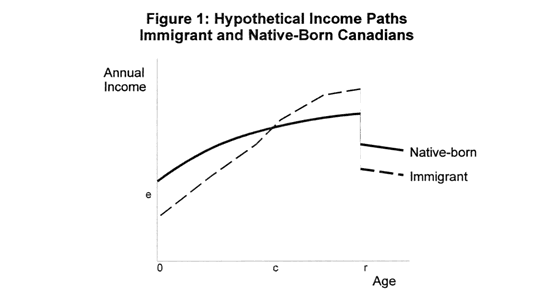
- immigrants typically arrive with little personal wealth, earn less income
over the duration of their working lives in Canada and, as a result, experience
lower incomes after the age of normal retirement.
- accordingly, any policy dealing with income maintenance and employment rights
of the elderly must consider the "intersection" between age and immigration
status.
2. A Stylized Account of the Incomes of Elderly Canadians
Research on the "economic assimilation" of immigrants:
- immigrants tend have little accumulated savings upon arrival and enter the
Canadian labour market relatively late in life.
- after adjusting for all measurable productivity characteristics (such as
education, work experience, language skills), immigrant workers face an "entry
penalty" in terms of a lower initial wage.
- over time, the earnings of immigrants "catch-up" with those of native-born
workers with equivalent observable skills. This may reflect the acquisition
of "unobservable skills" (such as greater English to French language proficiency
or greater familiarity with Canadian cultural norms) or a decline in discrimination
faced by new immigrants, particularly visible minorities, as they acculturate.
- the rate of economic assimilation has varied among different cohorts
of immigrants depending upon their year of arrival.
Scant literature on the post-retirement incomes of immigrants.
- the simple life-cycle model implies that individuals will save during their
working lives in order to accumulate sufficient wealth for their retirement
years; during retirement their assets gradually diminish as they dissave.
- the overriding result is that many individuals or households do not accumulate
sufficient wealth for their retirement years, which results in a greater dependence
on government transfers, a high incidence of low income, and a gradual decline
in total income with age.
- this is probably especially true of immigrants who, because of their late
entry into the Canadian labour market, accumulate less savings by normal retirement
age.
3. Average Incomes of the Elderly
- the average income of elderly immigrants is roughly 90 per cent of that
of their nativeborn counterparts (by gender).
- pronounced difference when disaggregated by country of birth with particularly
low average incomes among elderly immigrants from south-east Asia and south
Asia.
- likely due to year of arrival
4. Policy Implications
- Studies in both Canada and the United States observe the increasing dependence
of elderly immigrants upon social assistance, particularly among those who
arrive after age 55.
- In Canada, this has prompted calls for greater aged-based discrimination
in the selection of immigrants (Trempe, Davis and Kunin, 1997) without considering
whether or not the dependence of social assistance is itself a reflection
of age-based discrimination in the Canadian labour market and other aspects
of Canadian social policy.
a. Incomes Policy and Low-income Status
- A distinct success story of recent Canadian social policy has been the increase
in average income and the significant decline in the incidence of low income
among the elderly.
- This has occurred largely because of an expansion in the coverage and value
of employment-based pension plans, both public and private, and Registered
Retirement Savings Plans (RRSPs) that have fostered greater saving.
- "Earn ings-related pensions are not the usual policy instrument one thinks
of when considering reducing income inequality or low-income rates among seniors.
They are aimed, after all, at reproducing the income differentials created
during the working years. Since a large share of benefits in all such plans
goes to middle and upper income families, it is often argued that the social
insurance (ie. earnings-related) model creates welfare states for the middle
class that do little to help the poor or achieve more equality" (Myles, 2000).
- This reliance upon pension income and savings derived from past employment,
while raising the average income of elderly Canadians, has had little impact
on the economic well-being of many elderly immigrants: the incidence of low
income among elderly immigrants (17.5 per cent among men and 26.4 per cent
among women) remains unacceptably high and is significantly greater than that
for native-born Canadians (11.4 per cent for men and 22.6 per cent for women),
- it is appropriate to rethink income maintenance policies for elderly Canadians
with specific reference to immigrants. If the vulnerability to poverty is
particularly acute among recent arrivals or among refugees, it casts into
doubt the purpose of offering immigrants entry into the country only to be
at risk of living in poverty. If the objectives of immigration policy and
income maintenance policies are at odds, they should be reconciled by adjusting
the latter to meet the goals of the former.
b. Age Discrimination and Employment Rights
- While the human rights code in each Canadian jurisdiction includes protection
against age discrimination, several important exceptions exist. Where employment
rights are concerned, four Provinces--Newfound land, Ontario, Saskatchewan
and British Columbia--define age to exclude those 65 years of age and older.
In addition, most provincial human rights codes, as well as the Canadian Human
Rights Act, identify a bona fide mandatory retirement plan as reasonable limitation
on the equality rights of the elderly.
- restrictions on the employment rights of the elderly may entail "adverse
effect" discrimination ("discrimination per effet préjudiciable" or
"discrimination par suite d'un effet préjudiciable" for immigrants
to Canada. Immigrants compose 27 per cent of the Canadian population 65 years
of age and older, and many--by virtue of arriving relatively late in life
and with little personal wealth--frequently have a shorter working career
in which to accumulate sufficient savings for retirement.
5. Immigrants and the "Lump-of-Labour" Fallacy
- the lump-of-labour fallacy: every job occupied by one worker denies employment
to another.
- most immigrants would refute argument this with respect to immigration:
immigrants do not take jobs away from native-born Canadians.
- however, the elderly immigrants we have interviewed frequently invoke the
"lump-oflabour" fallacy when discussing mandatory retirement: i.e.. that older
workers should retire to make jobs available to younger workers.