





The TV/Radiation Problem
Suppose that the edge of a TV screen is given by 2x^4 + 3y^4 = 32.
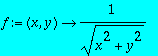
If the intensity of radiation is given by I(x,y) = 1 / sqrt( x^2 + y^2 ),
find the maximum intensity on the edge of the TV screen.
PART I: GRAPHICAL EXPLORATION OF THE PROBLEM
We'll do some fancy plotting, so we need to tell Maple to load its fancy plotting commands ...
| > | with( plots ); |
Define the intensity of radiation, and plot it ...
| > | f := (x,y) -> 1 / sqrt( x^2 + y^2 ); |
| > | plot3d( f(x,y), x=-3..3, y=-3..3, axes=BOXED ); |
![[Maple Plot]](images/tvRadiation8.gif)
Because of the symmetry in I(x,y), we expect the level curves to be circles in the (x,y) plane ...
Note that I'm using a two-step process here to see the plot.
First, I use the contourplot command, and assign the result to graph1
(note the use of the colon instead of the semicolon).
Then I use the display command to see the contourplot.
You don't have to do this. You can use the contourplot directly (with a semicolon at the end instad of a colon).
The reason for using the two-step process will become clear shortly.
| > | graph1 := contourplot( f(x,y), x=-5..5, y=-5..5, contours=15, color=black ): |
| > | display( graph1 ); |
![[Maple Plot]](images/tvRadiation9.gif)
Indeed, we see circles, as expected.
Take a minute to interpret the level curves.
Which ones correspond to a low intensity,
and which ones correspond to a high intensity?
Now define the equation that determines the edge of the TV screen, and plot it ...
Note the use of the two-step process again.
| > | g := (x,y) -> 2*x^4+3*y^4; |
| > | graph2 := implicitplot( g(x,y)=32, x=-3..3, y=-3..3, color=red, thickness=3 ): |
| > | display( graph2 ); |

![[Maple Plot]](images/tvRadiation11.gif)
Display the two graphs together
(now you see why the two-step process used above is helpful!),
and think about where the maximum radiation is going to occur.
Hint: think about the meaning of the contour plot.
Which of the level curves represent high intensity,
which represent lowest intensity?
| > | display( graph1, graph2 ); |
![[Maple Plot]](images/tvRadiation12.gif)
The smallest circle (why are we interested in this one?)
that just touches the edge of the screen does so at x=0.
On the edge of the tv screen (the red curve),
when x=0, y is given by the fourth root of 32/3 ...
| > | root(32/3,4); |
| > | evalf(%); |


By symmetry, maximum intensity is obtained at x=0, y=1.807204007 and at x=0, y=-1.807204007.
At those points, what is the intensity?
| > | f( 0, root(32/3,4) ); |
| > | evalf(%); |


PART II: SAME PROBLEM, NOW SOLVED WITH THE TECHNIQUE OF LAGRANGE MULTIPLIERS
We are looking for locations where the gradient of f and the gradient of g are parallel to each other. If we let lam be the parallellity parameter, then we need to solve: grad(f) = lam*grad(g) together with the constraint that the solution must lie on the curve g(x,y)=32. This gives three equations for three unknowns, as follows:
| > | dfdx := diff( f(x,y), x ): |
| > | dfdy := diff( f(x,y), y ): |
| > | dgdx := diff( g(x,y), x ): |
| > | dgdy := diff( g(x,y), y ): |
| > | solve( {dfdx=lam*dgdx, dfdy=lam*dgdy, g(x,y)=32}, {x,y,lam} ); |
Mmh, we're not getting a solution.
Maple is having trouble solving this system of equations analytically/symbolically.
Try helping Maple along a bit, and look for numerical solutions
(by symmetry, there must be two points) ...
| > | fsolve( {dfdx=lam*dgdx, dfdy=lam*dgdy, g(x,y)=32}, {x,y,lam}, y=-2..-1.5 ); |
| > | fsolve( {dfdx=lam*dgdx, dfdy=lam*dgdy, g(x,y)=32}, {x,y,lam}, y=1.5..2 ); |


We found exactly the same points as above.
Use the same method to find the locations where the radiation is minimized ...
| > | fsolve( {dfdx=lam*dgdx, dfdy=lam*dgdy, g(x,y)=32}, {x,y,lam}, x=-2.5..-1.5); |

Check the value of the radiation at this point ...
| > | f(-1.760223474,-1.437216448); |

Exercise: I have found one of the minima.
Find the others (how many?).