
African Francophone
and English-speaking Tertiary Programs
in Music Education[1]
By
Pascal Zabana KONGO
Western languages officially adopted by
the African continent at the dawn of the Independences correspond to
a re-partition of
2.
UNESCO efforts
2.1. For a Pan-African dialogue about Music Education.
It comes nowadays
into
sight
[2]
that at a primary school level, a Pan-African dialogue
led by the English-speaking intellectual community exists of which an
appropriate example has been the workshop organized by the Malawi National
Commission for UNESCO and the Music Department of Fine and Performing
Arts in July 1997, in Zomba, at the University of Malawi.
[3]
The discourse carefully elaborated on Educational
Philosophy – to enable each area and each country cope with its cultural
identity and specificities – before planning tangible models for a classroom
situation, with a continuous reference to cultural identity in the choice
of resource materials. The “Guide for the Preparation of Primary School
African Music Teaching Manuals” published as the proceedings of the
workshop, was designed as follows:
The guide shows up (1) the place of Traditional
Music in Education, (2) the Orientation of the Music Teacher, and (3)
after developing a Philosophy of Music Education, (4) presenting Music
as a subject of Instruction and (5) having considered the Socio-cultural
development of the Child, the recommendations turned to actual in-classroom
models for planning the Teaching of Fundamentals, Music in the Community,
Songs, Musical Instruments, Instrumental Ensembles and Dance, with a
note showing how to integrate the “Guide” into Existing Syllabus.
2.2. ICM Training programs in Francophone Area
A second type of Music Education Programs
organized by UNESCO (ICM) and in which I was involved as a resource
person included the 1999 symposium and Francophone workshop for the
training of music teachers in French-speaking
A conclusion occurs to me that many teachers
need a more formalized training in Music to benefit fully from resource
persons and materials from their environment.
|
|
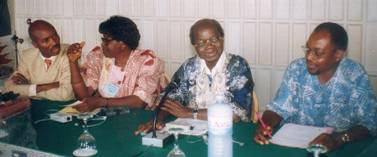
Lomé February 1998: Pan-African Consultation on Cultural
Policies for Development. Sponsored by UNESCO, OAU, Rockefeller
and Ford Foundations, SIDA. Opposite:
the DR of Congo participants. |
3. Training of music scholars and educators
in Francophone and English-speaking
3.1. The Legacy:
The use of the abovementioned “Guide” presupposes
an Africa-centered production, or review and organization of knowledge
about music and its dissemination in each country. The other way round
of looking at music as a subject of instruction with an integrated corpus
– at all educational levels – is to observe the training of scholars
and educators who have taken on to consolidate the efforts carried at
a variable level by non-Africans.
Although a team of fellows in African Studies, Legon, put in place as
soon as 1952, focused on musical aspect of area
studies, it appears that in Sub-Saharan Africa, Music Education
settings corresponding to the tertiary level whose curricula fall under
my comparison are not likely to be found before the 60’s. Sources of
musical erudition were either church, seminaries and other mission-driven
associations, meant to meet church needs and ensuing socio-cultural
activities
[4]
, or they followed from private
[5]
schooling initiatives primarily made for expatriate
youth related to western culture but including finally a small number
of Africans.
3.2. The Advent of Tertiary Education in Francophone
area.
Recruitment of candidates to a Tertiary
Educational level in music poses problems that are not peculiar to
In central Africa, the absence of the intensive
and generalized choir practice
[6]
observable in West Africa and the lack of metropolitan
distance learning certificates, available in the colonial West-Africa,
had in turn favored a flowering of secular
popular music which, before the Independences, shrouded its theory and
sociology, preventing it, at a municipal level, from gaining a status
of subject of instruction as such. In
The
Since the 1970’s, most acknowledged Francophone
poles of Tertiary Music Education have been the National Institutes
of Arts of Kinshasa and
3.3.
In English-speaking area
Some beginnings of biographies of adequate
personalities will tell us clearly about the state of music education
in English-speaking
Uzoigwe,
Joshua
In 1960, Joshua Uzoigwe, born on July 1, 1946 in Umuahia,
Sowande,
Fela
Fela Sowande, born in
Nketia,
J.H. Kwabena
Professor Joseph Hanson Kwabena Nketia,
born in 1921 at Asante Mampong, Ghana, displayed exceptional
talent and sensitivity to music, during his studies at the Presbyterian Training College, Akropong, under the mentorship of the
musical theorist and organist, Robert Danso…
Ekwueme, Lazarus
Professor Lazarus Edward Nnanyelu Ekwueme
is one of the most learned Nigerian composers. He was born in 1936
in
From the above, it becomes visible that
in terms of musical erudition, the English-speaking area, mostly Nigeria
and Ghana, although musically trained through church and private initiatives
like the Francophone area, bared a relatively more systematized enculturation
specifically in Western music theory, starting digesting it since
the 1920’s
[8]
into a cross-rhythmic Africanized hymn wise compositional
idiom, before launching openly into a scholarship in African Music since
1952
[9]
.
In the early 60’s, the Ghanaian president
Kwame Nkrumah wished to acknowledge the nationalist composer Ephraim
Amu by entrusting to him the creation of an African Academy of Music
which did not come off. It is in 1962, with the advent of J. H. Nketia
as the Director of the African Studies (Legon) that began the
By lack of candidates coming from secondary
schools where music programs were underprovided or inexistent, a preparatory
certificate was introduced to start the new
The name of the Institute was rethought
around 1967 as the “
It will be remembered that the
3.4. Comparison between the Francophone and English-speaking
Tertiary Programs in Music Education
During the 1976–1979 three academic years,
in the Democratic Republic of Congo, under the auspices of the University
and Scientific Research Tertiary Education, the National Institute of
Arts of
| 1st year
(Premier Graduat) |
2nd year (Deuxième Graduat) |
3rd year (Troisième Graduat) |
| 1. Français 2. Anglais
3. Langue
Nationale 4. Civisme
et Développement 5. Psychologie
générale 6. Philosophie 7. Solfège 8 Harmonie 9. Orchestre 10. Histoire de l'Art 11. Histoire des civilizations 12. Transposition 13. Histoire de la musique 14. Linguistique africaine 15. Instrument principal |
1. Français 2. Anglais
3. Langue
Nationale 4. Civisme
et Développement 5. Psychologie
de la musique 6. Pédagogie
musicale 7. Ethnomusicologie 8 Solfège 9. Harmonie 10. Contrepoint 11. Histoire de l’art 12. Problèmes juridiques 13. Instrument principal 14.
Histoire de la musique |
1. Harmonie 2. Pédagogie de la musique 3. Eléments
de composition 4. Ethnomusicologie 5. Problèmes économiques et juridiques de l’art 6. Contrepoint
et Fugue 7. Esthétique 8 Théâtre
musical 9. Instrument
traditionnel 10. Instrument principal 11. Interprétation musicale 12. Ethique et Déontologie 13. Stage 14.
Présentation d’un travail de fin d’études |
Hereafter
a basic translation of the above course tittles:
| 1. French 2. English 3. National Language 4. Civism and Development 5. Elements
of Psychology 5. Philosophy 7. Musicianship 8 Harmony 9. Ensemble 10.
History of Art 11.
History of civilizations 12.
Transposition 13.
History of Music 14.
African Linguistics 15. Major Instrument |
1. French 2. English 3. National Language 4. Civism and Development 5. Psychology of Music 5. Pedagogy of Music 7. Ethnomusicology 8 Musicianship 9. Harmony 10.
Counterpoint 11.
History of Art 12.
Copyright issues 13.
Major Instrument 14.
History of Music |
1. Harmony 2. Pedagogy of Music 3. Rudiments of Composition 4. Ethnomusicology 5. Art Copyright issues 5. Counterpoint and Fugue 7. Aesthetics 8 Musical Theatre 9. Traditional Instrument 10.
Major Instrument 11.
Musical Interpretation 12.
Ethics and Deontology 13.
Training Period 14.
Final Year Dissertation |
This
program (meant for music educators) combines music theory with pedagogical
and professionally related disciplines, which brings out its difference
from the conservatory that preceded it
As
an alternative, the 3-year Diploma
in General Music offered at the
| 1st year |
2nd year |
3rd year |
| 001 ‑ Introduction to Part‑Writing Techniques
I 002 ‑ Introduction to Part‑Writing
Techniques
II 003 ‑ Outlines of Music History I 004 ‑ Outlines of Music History II 005 ‑ Musical Form and Analysis I 006 ‑ Musical
Form and Analysis II 007 ‑ Music in African Cultures I 008 ‑
Music in African Cultures II 009 ‑ Practicals 012 ‑ Practicals |
041 Harmony and Counterpoint I 042 Harmony and Counterpoint II 043 ‑ Outlines of Music History II 044
‑ Musical
Form and Analysis III
045 ‑ Music
in African Cultures Ill
046 ‑ Music
in African Cultures IV
047 ‑ Orchestration I
048 ‑ Orchestration II 049 ‑ Musicianship I 052 ‑ Musicianship II 053 ‑ Practicals 054 ‑ Practicals |
071 ‑ Elements of Composition I 072 ‑ Elements of Composition II 073 ‑ Outlines of Music History IV 074 ‑ Musical Form and Analysis
IV
075 - Music
in African Cultures V
076 ‑ Music
in African Cultures VI
077 ‑ Orchestration III
078 ‑ Orchestration IV 079 ‑ Musicianship III 082 ‑ Musicianship IV 083
‑ Practicals
084
‑ Practicals |
Although
a number of candidates at a Diploma
in General Music level in Legon have been teachers designed to join
back their ministry, Pedagogy of music is better entrusted to specific
University Colleges of Education, Winneba and
Coexisting
with this Diploma in General Music, a 2-year Diploma in African Music is more centered on Ethnomusicology, linking
Analysis to the Anthropology of African Music as follows:
| 1st year |
2nd year |
| 013 ‑ Form and Structure in African Music I 014 ‑ Form and Structure in African Music II 015 ‑ African Music and related Arts I 016 ‑ African Music and related Arts II 017 ‑ Ethnography and Musical Styles of Selected
Areas I 018 ‑ Ethnography and Musical Styles of Selected
Areas II
019 ‑ Theories and Methods in Ethnomusicology I 020 ‑ Theories and Methods in Ethnomusicology
I I 023 ‑ Practicals 024 ‑ Practicals |
055 ‑ Cultural and Historical Background
of African
Music I 056 ‑ Cultural and Historical Background
of African
Music II 057 ‑ Comparative Musicology I 058 ‑ Comparative Musicology II 059 ‑ Practicals 062 ‑ Practicals 064 – Long Essay |
Unlike the Francophone counterparts,
DEPARTMENT OF MUSIC
LEVEL 100 COURSES
BACHELOR OF ARTS
IST SEMESTER
CODE/COURSE NO. COURSE TITLE CREDITS
MUSC 101
INTRODUCTION TO MUSIC
3
MUSC 103
INTRODUCTION TO MUSICAL TRADITIONS OF
2ND SEMESTER
MUSC 102
FUNDAMENTALS OF WESTERN MUSIC
3
MUSC 104
TRADITIONAL AFRICAN MUSIC
3
IST SEMESTER
COURSE TITLE AND DESCRIPTION
CREDITS
MUSC 101
Introduction to Music
3
Learning to listen to and
enjoy music. The Human Voice and Musical Instruments as sound sources.
Types of Music for Voice and types/forms of Instrumental music. The
different kinds of music folk, pop, and art music.
Selected musical cultures
of the world ‑ Black Africa, Moslem Africa and the Near East,
Asia, Europe and the
Music and Culture contact;
Musical interaction in different parts of the world. The impact of Western
music on non‑Western cultures.
MUSC 103
Introduction to Musical Traditions of
The musical scene in
Context of music making
in
Students will look at video
tapes of music and dance with emphasis on performance and its organization.
2ND SEMESTER
MUSC 102
Fundamentals of Western Music
3
The concept of scales.
Modal structures. Measure, Rhythm Tempo in music. Transposing melodies
into other keys. Simple and compound intervals. Two‑part and three‑part
writing. Triads. Formation of chords. Cadences. Harmonization of simple
tunes. Modulation to related keys. Notation. Terms, signs, Ornaments
and Abbreviations.
MUSC 104
Traditional African Music
3
Fundamentals of African
music ‑ scale, melody, rhythm, form, etc. Text‑tune relationship.
Principle of voice separation in African music. Hocket technique, etc.
Speech rhythm and song
rhythm. Concept of time span in bell patterns and supporting drum parts.
Polyrhythm.
Call and Response pattern/Antiphonal
technique, Influence of dance on form in music.
Students will listen to
illustrations of melodies, rhythms, forms, etc. from composite tapes
of music from different parts of
B.A./B.MUS (LEVEL 200)
SEMESTER COURSES
IST SEMESTER
CODE AND COURSE NO. COURSE TITLE
CREDITS
MUSC 201
Literature and Materials of Music
2
MUSC 203
Introduction to Musical Cultures of the World
2
MUSC 205
Practicals:
2
i) African Percussion and
Melodic instruments
ii) Western Keyboard and
Orchestral Instruments
2ND SEMESTER
MUSC 202
Functional Harmony and Counterpoint
2
MUSC 204
Music History and Literature 2
MUSC 206
Practicals
2
i) African Percussion and
Melodic instruments
ii) Western Keyboard and
Orchestral Instruments.
B.A./B.MUS (LEVEL 200)
SEMESTER COURSES
DETAILS OF SYLLABUS
IST SEMESTER
CODE AND COURSE NO. COURSE TITLE AND DESCRIPTION
CREDITS
MUSC 201
Literature and Materials of Music
2
The fundamentals of melody,
rhythm, harmony, form and Structure studied through representative recordings
of music of different stylistic periods.
Systematic study of harmonic
and other usages of the common practice period (18th and 19th century
Europe) with particular reference to triads and their inversions, diatonic
chords of the seventh and their inversions in major and minor keys,
and higher dominants (ninth, eleventh and thirteenth) and their inversions.
Modulation to related keys.
Introduction to contrapuntal
techniques in two part writing.
MUSC 203
Introduction to Musical Cultures of the World
2
Contemporary concepts of
a world view of music. The concept of a musical culture; social and
stylistic differentiations within music cultures.
Stylistic characteristics
of music in the major geo‑cultural regions of the world, illustrated
through selected recordings, performance organization, musical instruments,
concepts of aesthetics, artistic and philosophical values. Survey will
include selections from Africa, Caribbean and Latin America, North America
and Europe, the Near East and
MUSC 205
Practicals
2
Individual and group lessons
in vocal and instrumental playing techniques, mastery of scales and
arpeggios where appropriate and selected pieces for chosen instrument
or voice. Instruments available for instruction include a selection
of
African percussion and
melodic instruments, Western keyboard instruments and Western orchestral
instruments.
The study of piano is compulsory
for all music majors.
Participation
in performance ensembles.
MUSC 202
Functional Harmony and Counterpoint
2
Advanced diatonic modulation;
figured bass harmony: harmonization of upper and inner melodies. Appoggiaturas,
anticipations, suspensions, accented and unaccented passing notes.
Contrapuntal techniques
in two‑part writing.
MUSC 204
Music History and Literature
2
Outlines of the History
of Western Music from 1600 to the present. Selected topics including
the plain song, suite, orchestra, programme music, impressionism and
twentieth century trends.
Forms: Minuet and Trio,
Scherzo, Rondo, Sonata, Concerto, Divertimento, Serenade, Fugue and
others will be studied.
Outlines of African Music
History: Early historical accounts of African music by travelers, traders
and missionaries; evolution of bi‑musical education in
MUSC 206
Practicals
2
Further development of
skills and techniques in the playing of scales and arpeggios where appropriate,
technical exercises and studies. Improvement on skills acquired in MUSC
205 and the widening of the scope of repertoire with a greater emphasis
on interpretation.
The study of piano is compulsory
for all music majors. Participation in performance ensembles.
BACHELOR OF MUSIC
LEVEL 300 SEMESTER COURSES
SINGLE MAJOR PROGRAMME
A student
intending to major in Music is required to take the following core semester‑courses
and two prescribed‑electives to obtain at least 36 credits by
the end of the year.
CODE
AND NUMBER COURSE TITLE CREDITS
CORE
MUSC 3011 Diatonic
Harmony 3
MUSC 3022 Chromatic
Harmony 3
MUSC 3033 Renaissance
Counterpoint
3
MUSC 305 Music
of the Baroque and Classical Periods
3
MUSC 306 Music
of the Romantic Period
3
MUSC 308 Orchestral
Techniques
3
MUSC 309 Music
of West African
3
MUSC 314 Contemporary
Compositional Practice
3
MUSC 315 Practicals
3
MUSC 316 Practicals
3
ELECTIVES
MUSC 3044 Baroque
Counterpoint
3
MUSC 307 The
Orchestra
3
MUSC 312 Music
of
MUSC 313 Traditional
Compositional Techniques
3
(The above
courses which have no prerequisites may be offered as FREE ELECTIVES
by students from other departments).
_______________________________________________
1 Prerequisite:
MUSC 201
2 “
“ 202
3 “
“ 202
4 “
“ 202
BACHELOR OF MUSIC
LEVEL 300 SEMESTER COURSES
SINGLE MAJOR PROGRAMME
A student who wishes to offer Music as a Single
Major is required to take the following core semester‑courses
and two prescribed electives to obtain at least 36 Credits by the end
of the year.
CODE
AND NUMBER COURSE TITLE CREDITS
CORE
MUSC 301 Diatonic Harmony
3
The Diatonic Triads of
the Major key and their inversions. The Minor key: Its Diatonic Triads
and their inversions. The Six‑Four Chord. The chord of the Dominant
Seventh. Key Relationship ‑ Modulation to Nearly Related keys.
Unessential discords ‑ Auxiliary Notes, Passing Notes, and Anticipations:
Suspensions. The chords of the Dominant Ninth, Dominant Eleventh, Dominant
Thirteenth.
Prerequisite:
MUSC 201
MUSC 302
Chromatic‑Harmony
3
Chromatic Triads ‑
The chromatic scale. Chromatic chords of the Ninth ‑ False Notation.
Enharmonic Modulation. Chromatic chords of the Eleventh and Thirteenth.
The chord of the Augmented Sixth. Pedals and other Sustained notes.
Harmony in fewer and more than four parts. Modern harmonic tendencies.
Prerequisite:
MUSC 232
MUSC 303
‑ Renaissance Counterpoint
3
Listening and reading (including
sight‑singing) ‑ of selected excerpts from the works of
Prerequisite: MUSC 202.
MUSC 305
‑ Music of the Baroque and Classical
Periods
3
Principal forms, their
rise and developments: Opera, the Masque, the Chorale, the Oratorio
(including the Cantata); Occasional Music. Baroque instrumental music;
the Thorough Bass; Virginals and Harpsichord music; Ensemble and Orchestral
music. Handel and Bach. Classical period ‑ Transition and break
with Baroque. The sons of Bach, Mozart and contemporaries. The Symphony;
Chamber music; The Concerto. Influence of Classical and Baroque music
on the course of the growth of music in
MUSC 306
- Music of the Romantic Period
3
Social foundations of West
European romanticism. Heritage of Romantic composers and performers.
Precursors of Romanticism in Western music. Prevailing course of development
of the period: orchestral structural and architectonic developments
in opera, symphonic music, song form, etc. Reflections of European Romanticism
in the African music‑making world. Selected composers: Berlioz,
Schumann, Wagner, Brahms, Wolf, Graves‑Abayie or substitutes.
MUSC 303
‑ Orchestral
Techniques
3
Coverage of listening programmes
with strategic exercises to test student's grasp of illustrated principles
of orchestration. Aspects covered will include: ‑ texture, inter‑sectional
blends, balance, influence of dynamics of selection of instruments,
etc. Selections will cover Baroque, Classical, Romantic and 20th Century
models. Critical reviews of ensembles of African instruments.
MUSC 309
‑ Music
of
MUSC 314
‑ Contemporary
Compositional Practice
3
Construction of little
models of African creativity in response to Western music, depicting:
popular types, worship music, celebration music, modal tendencies, chromaticism,
etc. in accordance with existing pioneering examples. Creativity in
atonal models. Original piece of up to five minutes duration depicting
some origina1 principle of piece construction: to be worked out in outline
under close supervision and then completed by student without further
guidance from instructor.
MUSC 315
‑ Practicals
3
Individual and group instruction
in vocal and instrumental playing techniques. Development of skills
and techniques in the performance of moderately difficult pieces/songs
from chosen instrument or voice. Instruments available for instruction
include African percussion or melodic instruments, Western keyboard
and orchestral instruments. Participation in performance ensembles.
MUSC 314
‑ Practicals
3
Further development of
skills and techniques acquired in the singing and playing of exercises,
studies and selected moderately advanced pieces for chosen instrument
‑ Voice, African percussion or melodic instrument, and Western
keyboard or orchestral instrument, Participation in performance ensembles.
ELECTIVES
MUSC 304
‑ Baroque
Counterpoint
3
Study and analysis of J.
S. Bach's Two‑Part and Three-Part Inventions. Quick review of
favourite examples of 18th century contrapuntal writing. Elementary
Two-Part writing. Two‑Part writing with imitation. Three and
Four‑Part contrapuntal writing. Invertible counterpoint.
Prerequisite: MUSC 202
MUSC 307
- The Orchestra
3
The Western orchestra:
Past and Present. The instruments of the Western orchestra: the strings,
the woodwind, the brass, the keyboard and the percussion instruments.
Orchestral musics: Conducting and conductors.
MUSC 312
‑ Music
of
MUSC 313
‑ Traditional
Compositional Techniques
3
Devices of Creative Construction
in African Music: rhythm construction and combination; melody; pitch
combination; devices of extension. All studies to be modeled on traditional
African examples. Creative adventures through given exercises requiring
application of musical concepts deriving from cultures external to African
traditions e.g.: Arab nauba, Indian raga/tala/rasa,
BACHELOR OF MUSIC
LEVEL 400 SEMESTER COURSES
SINGLE
MAJOR PROGRAMME
A student
intending to major in Music is required to take the following core semester‑courses
and two prescribed‑electives to obtain at least 37 credits by
the end of the year.
CODE
AND NUMBER COURSE TITLE CREDITS
CORE
MUSC 4011 20th
Century Composition
3
MUSC 4022 Extended
Composition
3
MUSC 4033 History
of Contemporary Music
3
MUSC 405 The
Small Orchestra
3
MUSC 407 Music
of
MUSC 4094 Fugue
3
MUSC 411 Musical
Traditions of the African Diaspora
3
MUSC 400 Long
Essay/Original Composition
3
MUSC 413 Practicals
3
MUSC 414 Practicals
3
ELECTIVES
MUSC 404 Selected
Composers of the 20th Century
3
MUSC 406 The
Full Orchestra
3
MUSC 403 Music
of
MUSC 412 The
Complete Fugue
3
The above
courses which have no prerequisites may be offered as FREE ELECTIVES.
_______________________________________________
1 Prerequisite:
MUSC 302
2 “
“ 401
3 “
“ 301
4 “
“ 303 and 304
B.MUS (LEVEL 400) SEMESTER
COURSES
SINGLE MAJOR PROGRAMME
A student who wishes to offer Music as a Single
Major is required to take the following core semester‑courses
and two prescribed electives to obtain at least 37 Credits by the end
of the year.
CODE AND NUMBER COURSE TITLE AND DESCRIPTION
CREDITS
CORE
MUSC 401
‑ 20th
Century Composition
3
Compositional techniques
of the 20th Century including Secundal, Tertial and Quartal harmony,
Dodecaphony, Microtonal and Aleatory music. Composition in the styles
of the various African composers.
Prerequisite:
MUSC 302
MUSC 402
- Extended Composition
3
Harmonic textures in not
more than six voices using both diatonic and chromatic harmony. Writing
for Strings, Woodwinds, Brass instruments and the piano. Pianoforte
accompaniment. Setting words to music. Unaccompanied choral composition
including text‑tone relationship in African music. Contrapuntal
writing in the 16th Century styles of Palestrina, Byrd and Victoria.
Motet in not more than six parts.
Prerequisite: MUSC 401
MUSC 403
- History
of Contemporary Music
3
The current African scene
of music and musicians: evidence of African responses to external pressures
in terms of musical vocabulary, structural forms and instrumentation;
selected composers. The contemporary composer’s artistic and technical
resources: pitch combinations, scale patterns: (vertical and horizontal
structures) course of development of these resources to be followed
through the works of selected composers of the West, including
Prerequisite: MUSC 301
MUSC 405
- The Small Orchestra
3
Scoring for the Brass,
Percussion and the Harp, the Full Orchestral tutti. Rearrangement of
music for various sets of transposing instruments including African
instruments. Reading from orchestral scores on the pianoforte.
MUSC 407
‑ Music
of
MUSC 409
‑ Fugue
3
Writing contrapuntal textures
in the 18th Century ''style; Imitation, Invertible counterpoint. Subject
and Answer, Countersubject. Exposition of a fugue.
Prerequisite. MUSC 303
and 304.
MUSC 411
‑ Musical
Traditions of the African Diaspora
3
The Musical heritage of
the African‑American ‑ Blues, Spirituals, Gospel songs,
Ragtime and Jazz. Developments of Jazz from 1920 to 1950; Symphonic
jazz.
MUSC 400
‑ Long
Essay/Original Composition
3
Either: Long
Essay
Each candidate will be
required to present a thesis of about 80 pages, including illustrative
musical examples:
Or Original Composition of not more than 15 minutes and not less
than 10 minutes duration. Such a work should address a specific audience
or a specific method of composition.
Topics of Long Essays and
genre of original composition are to be approved by the Head
of Department by the end
of the First Semester.
MUSC 413
‑ Practicals
3
Advanced study of the performance
practice of voice, traditional African melodic or percussion instrument,
and/or Western keyboard or orchestral instrument. Emphasis is laid on
the use of a wider scope of repertoire. Participation in performance
ensembles.
MUSC 414
- Practicals
3
Advanced instruction in
the performance of selected pieces for voice, traditional African melodic
or percussion instruments, as well as Western keyboard or orchestral
instruments, one of which is chosen by the student in the first year.
Participation in performance ensembles.
ELECTIVES
MUSC 404
‑ Selected
Composers of the 20th Century
3
Six composers to be studied
in depth to illustrate the following schools and trends: ‑ neo‑classicism,
nationalism and democracy; pre‑serial and serial techniques; music
theatre; African musical values in extended writing: composers from
Africa, Caribbean and South America, as well as North America and
MUSC 406
‑ The
Full Orchestra
3
Advanced scoring for a
full orchestra. Scoring for African ensemble. Microtonal and Multiphonic
scoring.
MUSC 408
‑ Music
of
MUSC 412
‑ The
Complete Fugue
3
Development; writing of
episodes, inversion, augmentation, diminution, stretto devices, canon.
The final section. Fugue with not more than two subjects.
* The above courses which have no prerequisites
may be offered as FREE ELECTIVES by students from other departments.
POST‑GRADUATE PROGRAMMES
M.A/M. PHIL SEMESTER COURSES
ADMISSION REQUIREMENT
M.A. - A good first degree in Music or Music in combination
with another subject.
M.PHIL
- A good first degree
in Music
COURSE STRUCTURE AND UNIT REQUIREMENTS (LEVEL 600)
M.A. (Music) Students require 39 credits to graduate,
while those offering M.Phil (Music) require a minimum of 66 credits
to graduate.
The breakdown is as follows:
M.A.
Course Work
- 24 Credits
Seminar Presentation
- 3
“
Dissertation
‑ 12 "
Tota1 - 39 Credits
M.PHIL
1st Year
Course Work
- 30 Credits
2nd Year
Seminar Presentation (l)
3
Credits
Seminar Presentation (2)
- 3
“
Thesis
- 30
“
Tota1 - 66 Credits
M.A. COURSES
An M.A. student is required
to take the following four courses each semester.
MUSC 601
‑ Theories and Methods in Ethnomusicology
I
MUSC 602
‑ Theories and Methods in Ethnomusicology
II
MUSC 603
‑ Organology, I
MUSC 604
‑ Organology II
MUSC 605
‑ Area Studies in Music I
MUSC 606
‑ Area Studies in Music II
MUSC 607
‑ Practicals
MUSC 607
‑ Practicals Il
M.PHIL COURSES
It is recommended that
M.Phil students take the following core courses and three prescribed
electives each semester during the first year of the programme.
Core
MUSC 601
‑ Theories and Methods in Ethnomusicology
I
MUSC 602
‑ Theories and Methods in Ethnomusicology
II
MUSC 611
‑ Practicals
MUSC 612
‑ Practicals
Electives
MUSC 603
‑ Organology, I
MUSC 604
‑ Organology II
MUSC 613
‑ Music Theory and Composition I
MUSC 614
‑ Music Theory and Composition II
MUSC 615
‑ Orchestration I
MUSC 616
‑ Orchestration II
MUSC 617
‑ History of Music (Western)
MUSC 618
‑ History of Music (African)
MUSC 621
‑ Counterpoint I
MUSC 622
‑ Counterpoint II
MUSC 623
‑ Aesthetics
and Music Criticism I
MUSC 624
‑ Aesthetics
and Music Criticism II
MUSC 625
- Sociology
of Music l
MUSC 626
‑ Sociology
of Music II
MUSC 627
- African Popular Music and Jazz I
MUSC 628
‑ African Popular Music and Jazz II
MUSC 631
‑ Literature and Performance Techniques
of Selected
African Instruments
I
MUSC 631
‑ Literature and Performance Techniques
of Selected
African Instruments
II
COURSE DESCRIPTION
M.A. (MUSIC)
IST SEMESTER
CODE
AND NUMBER COURSE TITLE AND DESCRIPTION
CREDITS
MUSC 601
Theories and Methods in Ethnomusicology
3
Introduction to the main
branches of Musicology: historical, systematic, and ethnomusicology.
Research methods and bibliography in ethnomusicology.
MUSC 603
Organology
3
History and ethnography
of musical instruments. Systems of classification of musical instruments.
MUSC 605
Area Studies in Music
3
Detailed study of the socio-cultural
background, the musical instruments, and the musics of selected societies
in Africa and the
MUSC 607
Practicals
3
Students shall study traditional
African instrumental music practices. The course shall consist of instruction
on traditional percussion instruments (drums, etc.) and a melodic instrument
(xylophone, lute, harp, hand‑piano (mbira), lyre, flute, (etc).
Students should demonstrate proficiency as master instrumentalists at
the end of the semester.
2ND SEMESTER
MUSC 602
Theories and Methods in Ethnomusicology
3
Notation and transcription.
Field and laboratory techniques. Main theories of ethnomusicological
analysis: approaches by Hornbostel, Herzog, Curt Sachs, Lomax, Bartok,
and others. Historical and systematic approaches in ethnomusicology.
Selected readings.
Pre‑requisite: MUSC
601 ‑ Theories and Methods in Ethnomusicology. Subject to approval
by the department, a student may be exempted from this pre‑requisite.
MUSC 604
Organology I
3
Techniques employed in
the performance of musical instruments. The Acoustics of musical instruments.
MIJSC 606
Area Studies in Music
3
The ethnography, instruments
and musical styles of
MUSC 608
Practicals
3
Development of the skills
and techniques in the performance of selected Music on the various traditional
African percussion and melodic instruments. Students shall be requested
to produce ensemble performance in a concert situation.
M. PHIL (MUSIC) YEAR I
CODE
AND NUMBER COURSE TITLE AND DESCRIPTION CREDITS
CORE
MUSC 601
Theories and Methods in Ethnomusicology
3
Introduction to the main
branches of Musicology: historical, systematic, and ethnomusicology.
Research methods and bibliography in ethnomusicology.
MUSC 611
Practicals
3
Traditional African instrumental
music practices. The course shall consist of instruction on African
percussion instruments (drums, etc.) and a melodic instrument (xylophone,
lute, harp, mbira. lyre, flute, etc.) Students should demonstrate proficiency
as master instrumentalists at the end of the semester.
MUSC 603
Organology
3
History and ethnography
of musical instruments. Systems of classification of musical instruments.
MUSC 613
Music Theory and Composition
3
Western Music: Polyphony, chords of
figured bass. New systems of music theory; Generation of harmony and
other theoretical approaches of Rameau. The theoretical importance of
the chord of the ninth; development of the added third; theory of chord
generation; origin of its diminished seventh chord.
African Music: Compositional procedures
in African Music: Conventional procedures in traditional African vocal
and instrumental music and the different ways in which they are applied
in the creative practice of traditional musicians.
MUSC 615
Orchestration
3
Study of stylistic scoring
and score analysis. Transcription and editing.
MUSC 617
History of Music
3
History of Western Music
of the Middle Ages and Renaissance. Styles and forms from the Gregorian
chant to polyphony. Medieval and mensural notation, tablatures, emergence
of' modern systems of notation.
MUSC 621
Counterpoint
3
Counterpoint in not more
than eight voices including the Italian and English styles from the
Renaissance period to the 18th Century. Study of contrapuntal
textures; consideration of cadence and form; melodic contour and motive;
rhythm, text handling, simple and complex imitation. Treatment of dissonance
in the sacred music of Orlando di Lasso, Josquin de Prez, Giovanni Pierluigi
da Palestrina, William Byrd, Thomas Luis de Victoria and others.
MUSC 623
Aesthetics and Music Criticism
3
A survey of the main forms
of aesthetic thought and criticism in Western music from the Greek times
to the present. Selected readings and seminar papers on prescribed topics
of interest.
MUSC 625
Sociology of Music
3
A review of the relationship
between music‑makers and society as exemplified in the social
history of Western music from the Greek times to the present. An in-depth
study of the musical life of a society within a given period in western
music history. Term papers on the above.
MUSC 627
African Popular Music and Jazz
3
African popular music in
traditional and contemporary idioms. African popular music in history.
Popular music and social change.
MUSC 628 Literature and
Performance Techniques
of Selected African Instruments
3
The Course will cover important
historical and current sources, as well as usages of traditional African
percussion instruments.
2ND SEMESTER
MUSC 602
Theories and Methods in Ethnomusicology
3
Notation and transcription.
Field and laboratory techniques. Main theories of ethnomusicological
analysis: approaches by Hornbostel, Herzog, Curt Sachs, Lomax, Bartok,
and others. Historical and systematic approaches in ethnomusicology.
Selected readings.
Pre‑requisite: MUSC
601 ‑ Theories and Methods in Ethnomusicology. Subject to approval
by the department, a student may be exempted from this pre‑requisite.
MUSC 612
Practicals
3
Development of the skills
and techniques in the performance of selected music on the various traditional
African percussion and melodic instruments.
Student shall be requested
to produce ensemble performance in a concert situation.
ELECTIVES
MUSC 604
Organology
3
Techniques employed in
the performance of musical instruments. The Acoustics of musical instruments.
MUSC 614
Music Theory and composition
3
Western Music - Theoretical writings
of the German theorists: Kirnberger, Fetis, Hauptmann, Helmholtz, Ottingen,
and Dr. Riemann. Theoretical writings of the English theorists: Dr.
Alfred Day, Macfarren, Ouselay, Stainer, E. Prout. Techniques of analysis
developed by Schenker, Reti, Hindemith, and others.
African Music – Further examination
of selected works that exemplify the traditional techniques and usages
and other aspects of contemporary African compositions. Contemporary
applications of traditional techniques and usages in students' own compositions.
MUSC 616
Orchestration
3
Scoring and arranging of
music for various instrumental groups.
MUSC 618
History of Music
3
History of African Music
- the musical history of particular areas in Africa; the effects of
Islam on the musical traditions of different areas in
MUSC 622
Counterpoint
3
Imitative texture; Invertible
counterpoint and techniques associated with canon and fugue in the style
of J.S. Bach, G.F. Handel and other composers, Contrapuntal Techniques
in traditional and contemporary African musics.
MUSC 624
Aesthetics and Music Criticism
3
The problem of aesthetic
evaluation and meaning in African and Oriental musical cultures. Rationalizations
by Merriam, MacAlester, d’Azevedo, Steber, Nketia, Bebey, etc; the concept
of the raga in Indian thought; systems relating music to State
structure and welfare, etc.
Practice in music criticism.
MUSC 626
Sociology Of Music
3
A critical examination
of the systematic aspect of the field. The application of sociologic
principles, concepts and research methods and techniques to the study
of music and social behaviour and processes in
MUSC 628
African Popular Music and Jazz
3
African popular musicians
as innovators; their function as role models. Jazz and other popular
musics of
MUSC 632
Literature and Performance Techniques
Study of the historical
and current sources, as well as usages of selected traditional African
melodic instruments.
Ph.D. programs are nowadays available in
the English-speaking area. This, even in terms of an Africa-oriented
production and organization of musical knowledge, preparation of pedagogical
material, training of music educators, philosophy of music education,
transcription of traditional music and Art Music, might become at the
long run detrimental to the Francophone area.
4. Steps for Developing Musical Tertiary Education in Francophone
Africa
If the above goals justify the coexistence of Music
Tertiary Education beside the preservation, festivals and marketing
goals which prevail in Francophone Africa, then
1. English-speaking Tertiary Institutions
in Africa might lend a helping hand
to their homologues by accepting a generation of Francophone finalists
in the missing degrees before those badges of scholars, educators and
composers come back and handle an extended education in their countries.
2. If any fund raising were to intervene,
it would be limited to the previous step and possibly extended to the
initial period of creation of jobs, before handing over this financial
effort to the respective governments without bearing insurmountable
limitations on the infrastructures.
3. It is also possible to wait for history
to improve things from inside the Francophone area, provide a closer
dialogue with the English-speaking world brings a sustained awareness
on Music Education issues at all levels.
Most Francophone scholars whose essentially
musical profile matches the English-speaking high standards:
-
Kazadi wa Mukuna (
-
Damien Pwono (Rockefeller and Ford Foundations, CIM Secretary-General…)
-
Adepo Yapo (CIM Regional Secretary, PASMAE Vice-President)
- Pascal Zabana
Kongo (PASMAE, ICAMD,
- Anicet Mundundu
(
have already penetrated the English-speaking
environment. At this stage, landing from my theory-driven perspective,
it appears worthy to pay tribute to the worldly contribution by many
Francophone Music scholars and educators from a linguistic, psychological,
philosophic, history and journalistic background.
Pascal Zabana
KONGO (Dr)
PASMAE
Ambassador-Extraordinary in Francophone area
[1] Music Education in its broadest sense.
[2]
A
“Guide for the Preparation of Primary School African Music Teaching
Manuals” has been published by Afram (
[3] The workshop, sponsored by UNESCO – according to its Resolution 188 –, was attended by Mitchel Strumpf (Malawi Convenor and Resource person at that time), Ezra Abate Yiman (Ethiopia), Moses Serwadda (Uganda), Omibiyi Obidike (Nigeria), Adepo Yapo (Ivory Coast), Ludumo Mngangane (South Africa), Dumisani Maraire (Zimbabwe) with Barbara Reeder Lunquist (University of Washington, Seattle) and J. H. Kwabena Nketia (International Centre for African Music and Dance, Accra) as invited resource persons. The outlet of this dialogue held from 20 to 27 July 1997, has been crystallized in the abovementioned “Guide for the Preparation of Primary School African Music Teaching Manuals”
[4] The DR of Congo for instance is prominently catholic. But the protestant clusters have been much more inspiring in their hymn culture with an earlier indigenous song text practice and a less scholarly Tonic-Sol-Fa system of music transmission. Their introduction of guitar bands in traditional settings in the 1950’s for mutual social assistance sparked a golden age of secular neo-traditional music.
[5]
Such
as Mr. Alario’s
[6] This, for instance, had remarkably prepared Ghanaian and Nigerian audiences to African Vocal Art Music.
[7] When searching for Music Department History on the Internet.
[8] With composers like Ephraim Amu, acknowledged as the originator of African Art Music.
[9] With scholars like J. H. K. Nketia.