Draw the vector \(\uvec{u} = (3,2)\) in the \(xy\)-plane, then draw a representation of the decomposition \(\uvec{u} = 3 \uvec{e}_1 + 2 \uvec{e}_2\text{,}\) where \(\uvec{e}_1\) and \(\uvec{e}_2\) are the standard basis vectors in \(\R^2\text{.}\)
The quantity for which we developed formulas in Discovery 12.1 is called the norm of \(\uvec{v}\text{,}\) and is denoted \(\unorm{v}\text{.}\) (We don’t use the word “length” for \(n>3\) — how do you measure length in four dimensions?)
In this activity, make sure you can answer the questions for all dimensions, and make sure you can justify your answer using the formula for norm from Discovery 12.2, not just geometrically.
Plot points \(P(1,3)\) and \(Q(4,-1)\) in the \(xy\)-plane. Now draw in the vectors \(\uvec{u}\) and \(\uvec{v}\) that correspond to \(\abray{OP}\) and \(\abray{OQ}\text{.}\) Complete the triangle by drawing a vector between \(P\) and \(Q\text{.}\) Do you remember how to express this vector as a combination of \(\uvec{u}\) and \(\uvec{v}\text{?}\) Now compute the distance between \(P\) and \(Q\) by computing the norm of this third vector.
In the \(xy\)-plane, what is the angle between \(\uvec{e}_1\) and \(\uvec{e}_2\text{?}\) … between \(\uvec{e}_1\) and \(\uvec{u} = (1,1)\text{?}\) … between \(\uvec{e_1}\) and \(2\uvec{e}_1\text{?}\) … between \(\uvec{e_1}\) and \(-\uvec{e}_2\text{?}\) … between \(\uvec{e}_1\) and \(\uvec{v} = (1,-1)\text{?}\) … between \(\uvec{e_1}\) and \(-\uvec{e}_1\text{?}\)
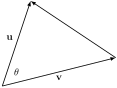
In the diagram below, consider \(\uvec{u}\) and \(\uvec{v}\) to be two-dimensional vectors. Label the third vector with the appropriate combination of \(\uvec{u}\) and \(\uvec{v}\text{,}\) just as you did in Discovery 12.5.
A diagram to assist in exploring the law of cosines via vector geometry. Three directed line segments are arranged in a triangular configuration. One directed line segment representing a vector labelled \(\uvec{u}\) extends steeply upwards and slightly rightwards from a point in the lower-left corner to a point at the top of the diagram. A second directed line segment representing a vector labelled \(\uvec{v}\) extends rightwards and slightly upwards from the same initial point as \(\uvec{u}\) in the lower-left corner to a point at the right edge of the diagram. A third directed line segment representing an unnamed vector compeletes the triangle, extending from the terminal point of \(\uvec{v}\) to the terminal point of \(\uvec{u}\text{.}\) Finally, the angle formed by \(\uvec{u}\) and \(\uvec{v}\) in the lower-left corner is labelled \(\theta\text{.}\)
Applied to our diagram, \(a\) represents the length of \(\uvec{u}\text{,}\)\(b\) represents the length of \(\uvec{v}\text{,}\) and \(c\) represents the length of the “hypotenuse” across from \(\theta\text{.}\) (If \(\theta\) were \(\degree{90}\text{,}\) the right-hand side of this equality would be zero and this law would “collapse” to the same equality as Pythagoras.)
Use the formulas from Discovery 12.2 to rewrite the left-hand side of the law of cosines in terms of the components of \(\uvec{u} = (u_1,u_2)\) and \(\uvec{v} = (v_1,v_2)\text{,}\) then simplify. You should eventually arrive at \(\text{LHS} = 2 \times (\text{simple formula})\text{.}\)
Using the new expression \(2\times(\text{simple formula})\) from Discovery 12.7 as the left-hand side in the law of cosines, and dividing both sides by \(2 a b\text{,}\) we get
The “simple formula” part of this angle formula turns out to be an important one — it is called the Euclidean inner product or standard inner product (or just simply the dot product) of \(\uvec{u}\) and \(\uvec{v}\text{,}\) and written \(\udotprod{u}{v}\text{.}\)
Let’s extend the computational pattern from Discovery 12.7. In the two-dimensional case in Task a below, you should just enter the “simple formula” you discovered above. In the subsequent tasks in higher dimensions, use the pattern from the two-dimensional case to create a similar higher-dimensional formula.
Suppose \(\uvec{u}\) and \(\uvec{v}\) are \(n\)-dimensional column vectors and \(A\) is an \(n\times n\) matrix. Use what you discovered in Task a to fill in the blank: