Recall that for \(\uvec{u} = (u_1,u_2,\dotsc,u_n)\) and \(\uvec{v} = (v_1,v_2,\dotsc,v_n)\text{,}\) the dot product of \(\uvec{u}\) and \(\uvec{v}\) is defined by the formula given below on the left. It is an important formula because if \(\theta\) is the angle between two nonzero vectors \(\uvec{u}\) and \(\uvec{v}\text{,}\) then \(\theta\) satisfies both \(0 \le \theta \le \pi\) and the formula given below on the right.
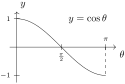
Based on the graph of \(y = \cos\theta\) on domain \(0 \le \theta \le \pi\) provided below, what can you say about \(\udotprod{u}{v}\) in the case that \(\theta\) is acute? … obtuse? … right?
A partial graph of \(y = \cos \theta\) on axes labelled \(\theta\) on the horizontal and \(y\) on the vertical. A half-period of the graph is displayed, beginning at the \(y\)-intercept at point \((0, 1)\text{,}\) continuing down through the \(\theta\)-intercept at point \((\pi / 2, 0)\text{,}\) and ending at the point \((\pi, -1)\text{.}\)
Extending the concept of perpendicular to higher dimensions, vectors \(\uvec{u}\) and \(\uvec{v}\) are called orthogonal if \(\udotprod{u}{v} = 0\text{.}\)
Can you guess a vector \(\uvec{v} = (v_1,v_2)\) that is orthogonal to \(\uvec{u} = (1,-3)\) in the plane? Make sure your guess satisfies the definition of orthogonal: you need \(\udotprod{u}{v} = 0\text{.}\)
Draw a diagram of your vectors \(\uvec{u}\) and \(\uvec{v}\text{,}\) both with initial points at the origin. On your diagram, how can you modify your intial guess \(\uvec{v}\) geometrically while still maintaining orthogonality with \(\uvec{u}\text{?}\)
Turn the pattern of your guess from Task a into a general pattern for vectors in the plane: if \(\uvec{u} = (a,b)\text{,}\) then an example of a vector orthogonal to \(\uvec{u}\) is
Draw the vector \(\uvec{a} = (3,1)\) in the \(xy\)-plane with its tail at the origin. Now imagine you were to also draw in every possible scalar multiple of \(\uvec{a}\) (positive, negative, zero, fractional, etc.). What geometric shape would these scalar multiples of \(\uvec{a}\) trace out? Draw this shape on your diagram.
Plot the point \(Q(4,4)\) on your diagram. On the line defined by \(\uvec{a}\) that you drew in the first part of this activity, draw in the point that you think is closest to \(Q\text{.}\) Label this point \(P\text{.}\) Now draw \(\abray{PQ}\text{,}\) and label this vector as \(\uvec{n}\text{.}\)
Vector \(\abray{OP}\) is parallel to \(\uvec{a}\text{,}\) so \(\abray{OP}\) is a scalar multiple of \(\uvec{a}\text{.}\) Our goal is to determine the scalar \(k\) so that the head of \(k\uvec{a}\) lies at \(P\text{.}\) Complete the triangle in your diagram by drawing in the vector \(\uvec{u} = \abray{OQ}\text{.}\)
Substitute your expression for \(\uvec{n}\) from Task c into your equation for \(\udotprod{n}{a}\) from Task b, and then solve for \(k\) as a formula in \(\uvec{u}\) and \(\uvec{a}\text{.}\)
(where in the brackets you should fill in a formula in the variable letters \(\uvec{u}\) and \(\uvec{a}\text{,}\)without using their actual numerical components, that describes how to compute \(k\uvec{a}\) from \(\uvec{u}\) and \(\uvec{a}\)).
The vector \(k\uvec{a}\) in Discovery 13.3 is called the orthogonal projection of \(\uvec{u}\) onto \(\uvec{a}\), and we write \(\uproj{u}{a}\) to mean this vector. It is also sometimes called the vector component of \(\uvec{u}\) parallel to \(\uvec{a}\). The vector \(\uvec{n} = \uvec{u}-\uproj{u}{a}\) is called the vector component of \(\uvec{u}\) orthogonal to \(\uvec{a}\).
Suppose \(\uvec{u}\) is orthogonal to \(\uvec{a}\text{.}\) What is \(\uproj{u}{a}\text{?}\) What is the component of \(\uvec{u}\) orthogonal to \(\uvec{a}\text{?}\)
If \(\ell\) is the line through the origin and parallel to a vector \(\uvec{a}\text{,}\) and \(\uvec{u}\) is some other vector, then our construction in Discovery 13.3 guarantees that \(\proj_{\uvec{a}} \uvec{u}\) represents the closest point on \(\ell\) to the terminal point of \(\uvec{u}\text{.}\)
The distance between a point and a line is defined as the shortest (i.e. perpendicular) distance between the two. Use the orthogonal projection to come up with a procedure to determine the distance between the line \(\ell\colon\,y=x/2\) and the point \(Q(2,4)\text{.}\)
Recall that a point \((x,y)\) lies on the line if and only if its coordinates satisfy the given equation. Let’s consider such a point as the terminal point of the vector \(\uvec{x} = (x,y)\) with its initial point at the origin. Does the left-hand side of the equation for the line look like the formula for some quantity related to \(\uvec{x}\) and some other vector? Perhaps some quantity that we’ve been exploring in detail recently?
In light of the first part of this activity, what does the right-hand side of the equation for the line say about the relationship between a vector \(\uvec{x}=(x,y)\) that lies along the line and the other special vector you identified in Task a?
Draw the line and label the point \(P(1,2)\text{.}\) Choose another arbitrary point on the line and label it \(Q(x,y)\text{.}\) Draw the vector \(\uvec{v} = \abray{PQ}\) along the line. Express the components of \(\uvec{v}\) as formulas in \(x\) and \(y\text{.}\)
Draw the vector \(\uvec{n} = (2,3)\) (from the coefficients in the line equation, just as in Discovery 13.6) with its tail at \(P\text{.}\) What do you notice about the relationship between this normal vector and the vector \(\uvec{v}\) parallel to the line? Express this relationship in terms of the dot product, and then expand out this dot product.
The same sort of analysis can be carried out for a plane in space determined by algebraic equation \(a x + b y + c z = d\text{.}\) The coefficients form a normal vector \(\uvec{n} = (a,b,c)\) that is perpendicular to the plane (i.e. orthogonal to every vector that is parallel to the plane), and given some specific point \(\uvec{x}_0 = (x_0,y_0,z_0)\) that lies on the plane, the plane can be described by the point-normal form \(\dotprod{\uvec{n}}{(\uvec{x}-\uvec{x}_0)} = 0\text{.}\)
Consider the planes \(\Pi_1\text{,}\)\(\Pi_2\text{,}\) and \(\Pi_3\) described algebraically below.
\begin{align*}
\Pi_1 \amp \colon x - y + 2 z = 2 \amp
\Pi_2 \amp \colon 2 x - 2 y + 4 z = 7 \amp
\Pi_3 \amp \colon x - y + 3 z = 2
\end{align*}
Use the concept of normal vector to justify the claim that \(\Pi_1\) and \(\Pi_2\) are parallel, but that \(\Pi_3\) is not parallel to either of \(\Pi_1\) or \(\Pi_2\text{.}\)
Orthogonal projection onto a plane in space is a little more complicated, and is likely something you would learn about in a second course in linear algebra. But it’s possible to use a different strategy to determine the distance between a point and a plane by using the fact that a plane has one unique normal “direction.”
Come up with a procedure using vectors to determine the distance between parallel planes. Do not assume that either of the planes passes through the origin.
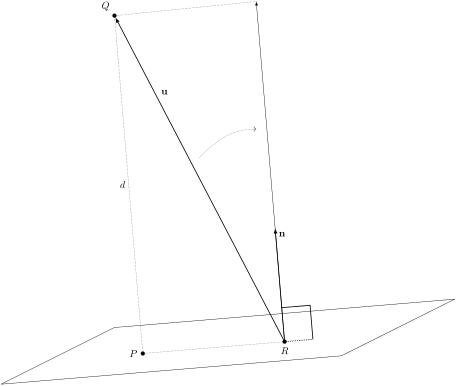
A three-dimensional diagram illustrating a procedure for determining the distance \(d\) between a point \(Q\) and a plane \(\Pi\) in three-dimensional space. A parallelogram with a shaded-in interior is drawn. The interior of this parallelogram should be imagined as if it is a two-dimensional, solid, rectangular surface suspended within a three-dimensional space (similar to a tabletop “suspended” above the floor in a room), but viewed at an angle from above. This surface is labelled as representing a portion of the plane \(\Pi\text{.}\) The point \(Q\) is plotted above this surface, external to it, and a dashed line segment is drawn from it down to meet the surface at a right angle. The point where the dashed line meets the surface is also plotted.
Another point is plotted on the surface and labelled \(R\text{.}\) The directed line segment \(\abray{RQ}\) is drawn and labelled as representing a vector \(\uvec{u}\text{.}\) Another directed line segment is drawn with its initial point at \(R\text{,}\) rising up out of the shaded surface at a right angle, and is labelled as representing a vector \(\uvec{n}\text{.}\) A longer, directed line segment with initial point at \(R\text{,}\) representing an unnamed vector, is drawn in parallel with \(\uvec{n}\text{,}\) rising to the same height above the shaded surface as \(Q\text{.}\) A dashed line segment is drawn from the terminal point of this vector to \(Q\text{,}\) and a parallel dashed line segment is drawn along the shaded surface from \(R\) to the point “underneath” \(Q\text{.}\) Together, these two dashed line segments, the dashed line segment from \(Q\) down to the plane, and the vector parallel to \(\uvec{n}\) up to the same height as \(Q\) form rectangle sitting on and rising vertically up from the shaded surface.
Finally, an arrow with a dotted line for the shaft points suggestively from the shaft of vector \(\uvec{u}\) to the shaft of the longer, unlabelled vector that is parallel to \(\uvec{n}\text{.}\)