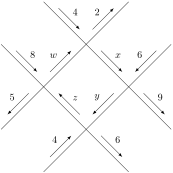
Use the Law of Conservation (in this case, flow in equals flow out at each point of intersection) in the flow network below to set up a system of equations to determine the internal flow rates. (Do not solve your system.)
A flow network consisting of two pairs of parallel lines intersecting in a grid pattern. Four nodes of intersection are created from the intersection of non-parallel lines. Around each node of intersection, arrows placed above the grid lines and adorned with numbers/variables indicate the direction and magnitude of flow into or out of the node:
Node 1.
Along one of the two lines intersecting at this node, \(4\) units flow into the node and then \(x\) units flow out again on the other side. Along the other line, \(w\) units flow in and then \(2\) units flow out again on the other side.
Along one of the two lines intersecting at this node, \(x\) units flow into the node and then \(9\) units flow out again on the other side. Along the other line, \(6\) units flow in and then \(y\) units flow out again on the other side.
Along one of the two lines intersecting at this node, \(y\) units flow into the node from one side and another \(4\) units flow in from the other side. Along the other line, \(z\) units flow out from the node and another \(6\) units flow out from the other side.
Along one of the two lines intersecting at this node, \(z\) units flow into the node from one side and another \(8\) units flow in from the other side. Along the other line, \(w\) units flow out from the node and another \(5\) units flow out from the other side.
Two (distinct) points in the Cartesian plane determine a unique line. Set up a system of equations that would let you solve for the slope and \(y\)-intercept of the line \(y=mx+b\) that passes through the points \((-3,4)\) and \((2,-1)\) (but do not solve the system). Write down the augmented matrix for your system.
Any three (distinct, noncollinear) points in the Cartesian plane determine a unique parabola. Set up a system of equations that would let you solve for the coefficients \(a,b,c\) of the parabola \(y=ax^2+bx+c\) that passes through the points \((-1,-4)\text{,}\)\((1,0)\text{,}\) and \((2,5)\) (but do not solve the system). Write down the augmented matrix for your system.
and you used them to create a linear system to determine the coefficients of the polynomial, what would be the pattern in the rows of the resulting augmented matrix for the system?