
Welcome to the University of Alberta's Engineering Program Plan Visualizer.
On this page, you will find all of the information found on the University Calendar, presented in an easier to understand format.
There are some features you should be aware of:
- Hover over a course to see its Calendar description pop-up.
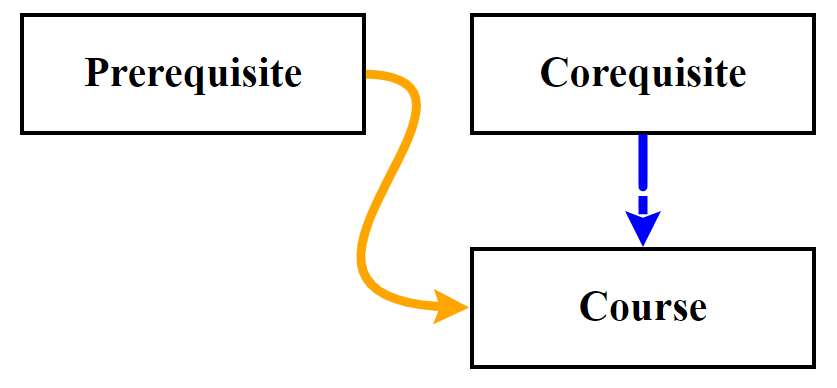
- Left click on a course to draw arrows between that course and its prerequisites and corequisites, as well as the courses it is a prerequisite and corequisite for.
- Right click on a course to have its Calendar description stay in place.
- Switch the ordering of course groups by toggling the buttons to the right of the selected plan. The selected course group will be displayed first (before the other course group).
- Switch between plans by toggling the buttons below "Plan".
- Highlight all courses in a category by left-clicking on one of the colored boxes to the right of the course group selector.
- To clear all selections, refresh the page.
Plan
Fall Term 1
CHEM 103
★ 4.3
(fi 6)(either term,
3-1s-3/2)
Atoms and molecules, states of matter, chemistry of the elements. Prerequisite: Chemistry 30, or equivalent. Note: Restricted to Engineering students only. Other students who take this course will receive *3.0.
Accreditation Units
Math and Natural Sciences: 53.5 Units
ENGG 100
★ 1.1
(fi 2)(either term,
1.5-1.5-0)
An introduction to the Faculty of Engineering, the engineering profession, the skills required for academic success, and the fundamentals of leadership: study and life skills; time management and goal setting; interpersonal skills; career planning; engineering and society including elements of ethics, equity, concepts of sustainable development, environmental stewardship, and public safety.
Accreditation Units
ENGG 130
★ 4.0
(fi 6)(either term,
3-0-2)
Equilibrium of planar systems. Analysis of statically determinate trusses and frames. Friction. Centroids and centres of gravity. Forces and moments in beams. Second moments of area. Note: Students in all sections of this course will write a common final examination. Corequisite: MATH 100.
Accreditation Units
Engineering Science and Engineering Design: 50.4 Units
ENGL 199
★ 3.0
(fi 6)(either term,
3-0-0)
This course aims to develop the student's ability to provide effective written and oral information. It will focus on instruction in fundamental writing skills, including building effective sentences and paragraphs, and on learning to communicate clearly across a range of genres and media used in academic and professional contexts, including correspondence and presentations. Students will be introduced to the principles of information gathering, analysis, and citation. Note: Restricted to students in the Faculty of Engineering only.
Accreditation Units
MATH 100
★ 3.5
(fi 6)(either term,
3-0-1)
Review of numbers, inequalities, functions, analytic geometry; limits, continuity; derivatives and applications, Taylor polynomials; log, exp, and inverse trig functions. Integration, fundamental theorem of calculus substitution, trapezoidal and Simpson's rules. Prerequisites: Mathematics 30-1 and Mathematics 31. Notes: (1) Credit can be obtained in at most one of MATH 100, 113, 114, 117, 134, 144, 154, or SCI 100. (2) Students in all sections of this course will write a common final examination. (3) Restricted to Engineering students. Non-Engineering students who take this course will receive *3.0.
Accreditation Units
Math and Natural Sciences: 44.1 Units
PHYS 130
★ 3.8
(fi 6)(either term,
3-0-3/2)
Geometrical optics, optical instruments, oscillations, waves, sound, interference, diffraction. Prerequisites: Mathematics 30-1, Mathematics 31, Physics 30. Corequisite: MATH 100 or 113 or 114 or 117 or 134 or 144 or equivalent. Restricted to Engineering students. Other students who take this course will receive *3.0.
Accreditation Units
Math and Natural Sciences: 47.2 Units
Winter Term 2
CHEM 105
★ 3.8
(fi 6)(either term,
3-0-3/2)
Rates of reactions, thermodynamics and equilibrium, electrochemistry, modern applications of chemistry. Prerequisite: CHEM 103. Note: Restricted to Engineering students only. Other students who take this course will receive *3.0.
Accreditation Units
Math and Natural Sciences: 47.2 Units
ENCMP 100
★ 3.8
(fi 6)(either term,
3-0-1.5)
Fundamentals of computer programming with emphasis on solving engineering problems. Structure and syntax of computer programs, variables, data types, data structures, control structures, functions, input/output operations, debugging, software development process.
Accreditation Units
Engineering Design: 21.3 Units
Engineering Science and Engineering Design: 47.2 Units
ENGG 160
★ 2.0
(fi 4)(either term or Spring/Summer,
1-0-2)
Fundamental design process and theory in a multidisciplinary context. Importance, in engineering design, of communications; team work; the engineering disciplines, career fields; professional responsibilities of the engineer including elements of ethics, equity, concepts of sustainable development and environmental stewardship, public and worker safety and health considerations including the context of the Alberta Occupational Health and Safety Act. Corequisite ENGL 199. This course is delivered in a blended format.
Accreditation Units
Engineering Design: 12.6 Units
Engineering Science and Engineering Design: 12.6 Units
EN PH 131
★ 4.3
(fi 6)(either term,
3-1s-3/2)
Kinematics and dynamics of particles; gravitation; work and energy; linear momentum; angular momentum; systems of particles; introduction to dynamics of rigid bodies. Prerequisites: MATH 100 or 117, and ENGG 130. Corequisite: MATH 101 or 118. Restricted to Engineering students. Other students who take this course will receive *3.0.
Accreditation Units
Math and Natural Sciences: 26.8 Units
Engineering Science: 26.8 Units
Engineering Science and Engineering Design: 26.8 Units
MATH 101
★ 3.5
(fi 6)(either term,
3-0-1)
Area between curves, techniques of integration. Applications of integration to planar areas and lengths, volumes and masses. First order ordinary differential equations: separable, linear, direction fields, Euler's method, applications. Infinite series, power series, Taylor expansions with remainder terms. Polar coordinates. Rectangular, spherical and cylindrical coordinates in 3-dimensional space. Parametric curves in the plane and space: graphing, arc length, curvature; normal binormal, tangent plane in 3- dimensional space. Volumes and surface areas of rotation. Prerequisite: MATH 100. Notes: (1) Credit can be obtained in at most one of MATH 101, 115, 118, 136, 146, 156 or SCI 100. (2) Students in all sections of this course will write a common final examination. (3) Restricted to Engineering students. Non-Engineering students who take this course will receive *3.0.
Accreditation Units
Math and Natural Sciences: 44.1 Units
MATH 102
★ 3.5
(fi 6)(either term,
3-0-1)
Vectors and matrices, solution of linear equations, equations of lines and planes, determinants, matrix algebra, orthogonality and applications (Gram-Schmidt), eigenvalues and eigenvectors and applications, complex numbers. Prerequisite or corequisite: MATH 100. Notes: (1) Credit can be obtained in at most one of MATH 102, 125, or 127. (2) Students in all sections of this course will write a common final examination. (3) Restricted to Engineering students. Non-Engineering students who take this course will receive *3.0.
Accreditation Units
Math and Natural Sciences: 44.1 Units
Fall Term 3
ECE 202
★ 4.3
(fi 6)(first term,
3-1s-3/2)
Circuit element definitions. Circuit laws: Ohm's, KVL, KCL. Resistive voltage and current dividers. Basic loop and nodal analysis. Dependent sources. Circuit theorems: linearity, superposition, maximum power transfer, Thevenin, Norton. Time domain behavior of inductance and capacitance, energy storage. Sinusoidal signals, complex numbers, phasor and impedance concepts. Magnetically coupled networks. Single phase power and power factor. Prerequisites: MATH 101, 102. Credit may be obtained in only one of ECE 202, E E 240, ECE 209 or E E 239, unless approved by the Department.
Accreditation Units
Engineering Design: 13.4 Units
Engineering Science and Engineering Design: 53.5 Units
MAT E 201
★ 3.0
(fi 6)(either term,
3-0-0)
An introduction to the science of materials from the standpoint of the relationships between atomic, molecular and crystal structure to material properties. Atomic bonding, crystal structure and crystal imperfections. Structures of metallic, non-metallic and composite materials. Diffusion, electrochemical and corrosion properties; strengthening mechanisms, mechanical properties and failure; electrical conductors, semiconductors, and dielectrics; thermal, magnetic, and optical properties. Prerequisite: CHEM 105 or consent of Department.
Accreditation Units
Engineering Science and Engineering Design: 37.8 Units
MATH 201
★ 3.5
(fi 6)(either term or Spring/Summer,
3-0-1)
First-order equations; second-order linear equations: reduction of order, variation of parameters; Laplace transform; linear systems; power series; solution by series; separation of variables for PDEs. Prerequisite or corequisite: MATH 209 or 214. Notes: (1) Open only to students in Engineering, Specialization Physics, and Specialization Geophysics. (2) Credit can be obtained in at most one of MATH 201, 334 or 336. (3) Students in all sections of this course will write a common final examination. Non-Engineering students who take this course will receive *3.0.
Accreditation Units
Math and Natural Sciences: 44.1 Units
MATH 209
★ 3.5
(fi 6)(either term,
3-0-1)
Partial differentiation, derivatives of integrals. Multiple integration using rectangular, cylindrical, and spherical coordinates. Vector Field Theory. Prerequisite: MATH 101. Prerequisite or corequisite: MATH 102. Notes: (1) This course may not be taken for credit if credit has already been obtained in MATH 215 or 317. (2) Students in all sections of this course will write a common final examination. (3) Restricted to Engineering students. Non-Engineering students who take this course will receive *3.0.
Accreditation Units
Math and Natural Sciences: 44.1 Units
PHYS 281
★ 3.0
(fi 6)(either term,
3-0-0)
Electric fields; Gauss' law; electric potential; capacitance and dielectrics; electric current and resistance; DC circuits; magnetic fields; Ampere's Law; Faraday's Law; inductance; magnetic properties of matter, AC circuits; Maxwell's equations; electromagnetic waves. Prerequisite: one of PHYS 124, PHYS 144, or EN PH 131, and one of PHYS 126, PHYS 146, or PHYS 130. Corequisite: MATH 209 or 214 or 217 or equivalent. Credit may normally be obtained for only one of PHYS 230 or 281.
Accreditation Units
Math and Natural Sciences: 37.8 Units
PHYS 292
★ 0.0
(fi 3)(two term,
0-0-3)
Experiments in mechanics, electromagnetism and atomic physics. Corequisites: PHYS 281 or 230, and MATH 209 or 214 or equivalent. Note: Restricted to Engineering students.
Accreditation Units
Complementary Elective
A complementary elective of the student's choice. Please consult the calendar for more information.
Winter Term 4
CH E 243
★ 3.5
(fi 6)(either term or Spring/Summer,
3-1s-0)
An introduction to the first and second laws of thermodynamics. Prerequisites: MATH 101.
Accreditation Units
Engineering Science and Engineering Design: 44.1 Units
ECE 203
★ 4.3
(fi 6)(second term or Spring/Summer,
3-1s-3/2)
Nonlinear circuit analysis. Diodes: ideal and simple and models, single phase rectifiers. Ideal and finite gain op-amps. Treatment of RLC circuits in the time domain, frequency domain and s-plane. Two port networks. Prerequisites: ECE 202 or E E 240. Corequisite: ECE 240 or E E 238. Credit may be obtained in only one of ECE 203 or E E 250.
Accreditation Units
Engineering Design: 13.4 Units
Engineering Science and Engineering Design: 53.5 Units
ECE 240
★ 3.5
(fi 6)(either term,
3-1s-0)
Introduction to linear systems and signal classification. Delta function and convolution. Fourier series expansion. Fourier transform and its properties. Laplace transform. Analysis of linear time invariant (LTI) systems using the Laplace transform. Prerequisites: ECE 202 or MCTR 202 or E E 240, MATH 201. Credit may be obtained in only one of ECE 240 or E E 238.
Accreditation Units
Engineering Design: 11.0 Units
Engineering Science and Engineering Design: 44.1 Units
PHYS 244
★ 3.0
(fi 6)(either term,
3-0-0)
Particle dynamics; oscillating systems and normal modes; conservative forces and energy; introduction to Lagrangian and Hamiltonian dynamics; central forces; orbital motion and scattering. Prerequisite: one of PHYS 124, PHYS 144, or EN PH 131, and one of PHYS 126, PHYS 146, or PHYS 130. Corequisite: MATH 120 or 125 or 127 or 102 or equivalent, and MATH 209 or 215 or 317 or equivalent.
Accreditation Units
Math and Natural Sciences: 18.9 Units
Engineering Design: 18.9 Units
Engineering Science and Engineering Design: 18.9 Units
PHYS 271
★ 3.0
(fi 6)(either term,
3-0-0)
Experimental evidence for limitations of classical physics; review of special relativity: quantization of charge, light, and energy; blackbody radiation, photoelectric effect, Compton effect; models of the atom; wavelike properties of particles; the uncertainty principle, the Schrodinger Equation, the infinite and finite square well, the harmonic oscillator, tunneling; the hydrogen atom, orbital angular momentum and electron spin; spin and statistics; selected topics. Prerequisite: one of PHYS 124, PHYS 144, or EN PH 131, and one of PHYS 126, PHYS 146, or PHYS 130. Pre- or Corequisite: MATH 209 or 215 or 317 or equivalent. Note: Credit may be obtained in only one of PHYS 208 or 271.
Accreditation Units
Math and Natural Sciences: 37.8 Units
PHYS 292
★ 0.0
(fi 3)(two term,
0-0-3)
Experiments in mechanics, electromagnetism and atomic physics. Corequisites: PHYS 281 or 230, and MATH 209 or 214 or equivalent. Note: Restricted to Engineering students.
Accreditation Units
Complementary Elective
A complementary elective of the student's choice. Please consult the calendar for more information.
Fall Term 5
ECE 210
★ 3.8
(fi 6)(either term,
3-0-3/2)
Boolean algebra, truth tables, Karnaugh maps. Switching devices and their symbology with an introduction to NAND and NOR logic. Number systems, codes, minimization procedures, synthesis of combinational networks. Synchronous sequential circuits, flip-flops, counters. Arithmetic circuits. Introduction to computer-aided design and simulation tools for digital design and implementation. Requires payment of additional student instructional support fees. Refer to the Tuition and Fees page in the University Regulations section of the Calendar. Credit may be obtained in only one of ECE 210, E E 280 or CMPUT 329.
Accreditation Units
Engineering Design: 35.4 Units
Engineering Science and Engineering Design: 47.2 Units
ECE 302
★ 4.3
(fi 6)(either term,
3-1s-3/2)
PN junction semiconductor basics, charge flow and diode equation. Zener diodes. BJT and MOSFET devices and operating regions. Amplifier basics: biasing, gain, input and output resistance, analysis and design. Large signal effects. Requires payment of additional student instructional support fees. Refer to the Tuition and Fees page in the University Regulations section of the Calendar. Prerequisite: ECE 203 or E E 250. Credit may be obtained in only one of ECE 302 or E E 340.
Accreditation Units
Engineering Design: 24.1 Units
Engineering Science and Engineering Design: 53.5 Units
ECE 340
★ 3.8
(fi 6)(either term,
3-0-3/2)
Discrete time signals and systems; Sampled signals and sampling theorem, aliasing, A/D converter; Z-transform, stability analysis; Discrete-time Fourier transform; Discrete Fourier transform, leakage, spectral analysis; Digital filter design, filter structure. Prerequisite: ECE 240 or E E 238. Credit may be obtained in only one of ECE 340 or E E 338.
Accreditation Units
Engineering Design: 11.8 Units
Engineering Science and Engineering Design: 47.2 Units
ECE 471
★ 3.8
(fi 6)(either term,
3-0-3/2)
Electromagnetic wave propagation at optical frequencies and approximations. Thermal and luminescent light sources, optical beams. Ray and Gaussian optics and simple optical components. Wave optics, polarization, interference, interferometric devices. Light-matter interactions. Optics of crystals; polarizers and waveplates. Photodetectors. Photonic engineering applications. Corequisite: ECE 370 or E E 315, or PHYS 381. Note: Only one of the following courses may be taken for credit: ECE 471, E E 471 or PHYS 362.
Accreditation Units
Engineering Design: 21.3 Units
Engineering Science and Engineering Design: 47.2 Units
MATH 311
★ 3.0
(fi 6)(either term,
3-0-0)
Complex numbers. Complex series. Functions of a complex variable. Cauchy's theorem and contour integration. Residue Theorem and its applications. Prerequisite or corequisite: A Calculus IV course.
Accreditation Units
Math and Natural Sciences: 37.8 Units
PHYS 381
★ 3.0
(fi 6)(either term,
3-0-0)
Review of scalar and vector fields; Gauss and Stokes theorems; curvilinear coordinates; Dirac delta function; electrostatic field and potential; electrostatic energy; conductors, capacitors; Laplace's equation; boundary value problems; methods of images; multipoles; electrostatic field in matter; polarization; displacement; linear dielectrics; magnetostatic field; Biot-Savart and Ampere's law; vector potential; magnetostatic field in matter; magnetization; linear and nonlinear magnetic media. Prerequisites: PHYS 230 or 281. Pre- or corequisite: MATH 334 or 201 or equivalent
Accreditation Units
Math and Natural Sciences: 25.2 Units
Engineering Science: 12.6 Units
Engineering Science and Engineering Design: 12.6 Units
Winter Term 6
ECE 220
★ 3.8
(fi 6)(either term,
3-0-3/2)
Architecture and basic components of computing systems. Programming environment and program development methodology. Basics of programming: from data structures and functions to communication with external devices. Principles of object-oriented programming. Good programming style. Prerequisite: ENCMP 100.
Accreditation Units
Engineering Design: 11.8 Units
Engineering Science and Engineering Design: 47.2 Units
ECE 303
★ 4.3
(fi 6)(either term or Spring/Summer,
3-1s-3/2)
Differential amplifiers. Frequency response: active device high-frequency behaviour and circuit models; amplifier circuits and design. Feedback: concepts and structure; feedback topologies and amplifiers; open- and closed-loop response. Operational amplifiers: behaviour, circuit analysis and design. Requires payment of additional student instructional support fees. Refer to the Tuition and Fees page in the University Regulations section of the Calendar. Prerequisite: ECE 302 or E E 340. Credit may be obtained in only one of ECE 303 or E E 350.
Accreditation Units
Engineering Design: 24.1 Units
Engineering Science and Engineering Design: 53.5 Units
ECE 341
★ 3.5
(fi 6)(either term,
3-1s-0)
Introduction to analytical solutions of partial differential equations, eigenfunctions and eigenvalue problems, special functions in cylindrical and spherical coordinates, Green's functions, and transform methods. These concepts provide the necessary mathematical foundation for understanding and analyzing important physical phenomena encountered at the micro and nanoscales. Examples drawn from electromagnetics, quantum mechanics, solidstate physics, photonics, thermal transport, and microelectromechanical systems. Prerequisites: ECE 240 or E E 238, and MATH 309 or 311. Credit may be obtained in only one of ECE 341 or E E 323.
Accreditation Units
Math and Natural Sciences: 19.8 Units
Engineering Science: 24.3 Units
Engineering Science and Engineering Design: 24.3 Units
PHYS 311
★ 3.0
(fi 6)(either term,
3-0-0)
Quantum states, probability distributions, temperature and entropy; canonical ensemble and the partition function; ideal gases, paramagnets; blackbody radiation. Debye model for phonons; quantum statistics; Fermi-Dirac distribution and electrons in metals; Bose-Einstein distribution. Prerequisites: PHYS 310 (or CH E 243 for Engineering Physics Program students), PHYS 271 and MATH 209 or 215 or 317 or equivalent.
Accreditation Units
Math and Natural Sciences: 18.9 Units
Engineering Science: 18.9 Units
Engineering Science and Engineering Design: 18.9 Units
PHYS 372
★ 3.0
(fi 6)(either term,
3-0-0)
Origins of quantum mechanics; wave functions; Schrodinger equation and its application to one dimensional systems, postulates and physical interpretation of quantum mechanics; orbital angular momentum, central potentials and three-dimensional systems. Prerequisites: PHYS 271, PHYS 230 or 281, MATH 225 or 227 (or 102), MATH 334 or 201.
Accreditation Units
Math and Natural Sciences: 37.8 Units
Program/Technical Elective
A program/technical elective of the student's choice. Please consult the calendar for more information.
Fall Term 7
ECE 494
★ 2.5
(fi 4)(first term,
1-0-3)
The first of two design courses that must be taken in the same academic year. Students research and propose a design project to enhance or create an engineering system, process or device; they exercise creativity and make assumptions and decisions based on technical knowledge. This first course includes project definition, planning, and initial prototyping or design. Formal reports and presentation of the project proposal is required. Prerequisite: Completion of at least three years of study in the program or by consent of the Instructor. Credit may be obtained in only one of ECE 494 or E E 494.
Accreditation Units
Engineering Design: 23.6 Units
Engineering Science and Engineering Design: 31.5 Units
ENGG 404
★ 3.8
(fi 6)(either term or Spring/Summer,
3-3s/2-0)
Basic concepts of risk and consequences of loss incidents; risk management principles and practices; incident investigation, causation, root cause analysis; process safety management; the roles of government agencies, professional bodies and industry associations; workplace safety; risk-based decision-making processes; leadership and the human-factors side of risk management. The course focuses on the principles and practices of leadership towards the effective application and implementation of risk management in major organizations across all engineering disciplines. Industry virtual tours, case studies, seminars and team projects specific to the student's engineering program will be used to develop competencies and proficiencies in applying leadership and organizational effectiveness for successful risk management.
Accreditation Units
PHYS 415
★ 3.0
(fi 6)(either term,
3-0-0)
Lattice structure and binding; lattice vibrations; electrons in solids, band structure of metals, Fermi surface; semiconductors and junctions; paramagnetism and diamagnetism; introduction to lattice defects. Prerequisites: PHYS 311 and 372, and MATH 337 or ECE 341 or equivalent.
Accreditation Units
Math and Natural Sciences: 12.6 Units
Engineering Science: 25.2 Units
Engineering Science and Engineering Design: 25.2 Units
PHYS 481
★ 3.0
(fi 6)(either term,
3-0-0)
Electromotive force; Faraday's law; inductance; Maxwell's equations in free space and in matter; electromagnetic potentials; gauges; energy and momentum conservation laws; plane waves in vacuum, in nonconducting and in conducting media; reflection and refraction of electromagnetic waves; dispersion, wave guides; dipole radiation; radiation due to moving charge; radiation reaction. Prerequisite: PHYS 381, MATH 337 or ECE 341 or equivalent.
Accreditation Units
Math and Natural Sciences: 25.2 Units
Engineering Science: 12.6 Units
Engineering Science and Engineering Design: 12.6 Units
Program/Technical Elective
A program/technical elective of the student's choice. Please consult the calendar for more information.
Program/Technical Elective
A program/technical elective of the student's choice. Please consult the calendar for more information.
Winter Term 8
ECE 360
★ 3.8
(fi 6)(either term,
3-0-3/2)
Linear system models. Time response and stability. Block diagrams and signal flow graphs. Feedback control system characteristics. Dynamic compensation. Root locus analysis and design. Frequency response analysis and design. Prerequisites: ECE 203 or E E 250, and ECE 240 or E E 238. Credit may be obtained in only one of ECE 360, ECE 362, E E 357, E E 462 or E E 469.
Accreditation Units
Engineering Design: 11.8 Units
Engineering Science and Engineering Design: 47.2 Units
ECE 495
★ 4.0
(fi 6)(second term,
1-0-6)
The second of two design courses that must be taken in the same academic year, in which students implement an engineering system, process or device. Emphasis is placed on continued execution of the project plan developed in ECE 494. Prerequisite: ECE 494 in the preceding Fall Term. Credit may be obtained in only one of ECE 495 or E E 495
Accreditation Units
Engineering Science and Engineering Design: 50.4 Units
ENG M 310
★ 3.0
(fi 6)(either term or Spring/Summer,
3-0-0)
The application of the fundamentals of economics to engineering alternatives in planning, developing and managing industrial projects. Note: Credit cannot be obtained for more than one of ENGG 310, 401, ENG M 310 or 401.
Accreditation Units
OR
ENG M 401
★ 3.0
(fi 6)(either term,
3-0-0)
The application of the fundamentals of engineering economics, financial analysis and market assessment to engineering alternatives in the planning, development and ongoing management of industrial enterprises. The course covers the use of engineering, economic, financial and market assessment information in investment and business operation decisions in technology oriented companies. Note: Credit cannot be obtained for more than one of ENGG 310, ENGG 401, ENG M 310, or ENG M 401.
Accreditation Units
ENGG 400
★ 1.0
(fi 2)(either term,
1-0-0)
The technical and professional duties and responsibilities of the engineer; the ethics of the engineering profession; technical and professional organizations. The role of the engineer in the social environment including elements of equity, concepts of sustainable development and environmental stewardship, public and worker safety and health considerations including the context of the Alberta Occupational Health and Safety Act. Note: Restricted to fourth-year traditional and fifth-year co-op engineering students. Must be taken in last term of program.
Accreditation Units
ITS Elective
An ITS elective of the student's choice. Please consult the calendar for more information.
Program/Technical Elective
A program/technical elective of the student's choice. Please consult the calendar for more information.
Program/Technical Elective
A program/technical elective of the student's choice. Please consult the calendar for more information.
Fall Term 1
CHEM 103
★ 4.3
(fi 6)(either term,
3-1s-3/2)
Atoms and molecules, states of matter, chemistry of the elements. Prerequisite: Chemistry 30, or equivalent. Note: Restricted to Engineering students only. Other students who take this course will receive *3.0.
Accreditation Units
Math and Natural Sciences: 53.5 Units
ENGG 100
★ 1.1
(fi 2)(either term,
1.5-1.5-0)
An introduction to the Faculty of Engineering, the engineering profession, the skills required for academic success, and the fundamentals of leadership: study and life skills; time management and goal setting; interpersonal skills; career planning; engineering and society including elements of ethics, equity, concepts of sustainable development, environmental stewardship, and public safety.
Accreditation Units
ENGG 130
★ 4.0
(fi 6)(either term,
3-0-2)
Equilibrium of planar systems. Analysis of statically determinate trusses and frames. Friction. Centroids and centres of gravity. Forces and moments in beams. Second moments of area. Note: Students in all sections of this course will write a common final examination. Corequisite: MATH 100.
Accreditation Units
Engineering Science and Engineering Design: 50.4 Units
ENGL 199
★ 3.0
(fi 6)(either term,
3-0-0)
This course aims to develop the student's ability to provide effective written and oral information. It will focus on instruction in fundamental writing skills, including building effective sentences and paragraphs, and on learning to communicate clearly across a range of genres and media used in academic and professional contexts, including correspondence and presentations. Students will be introduced to the principles of information gathering, analysis, and citation. Note: Restricted to students in the Faculty of Engineering only.
Accreditation Units
MATH 100
★ 3.5
(fi 6)(either term,
3-0-1)
Review of numbers, inequalities, functions, analytic geometry; limits, continuity; derivatives and applications, Taylor polynomials; log, exp, and inverse trig functions. Integration, fundamental theorem of calculus substitution, trapezoidal and Simpson's rules. Prerequisites: Mathematics 30-1 and Mathematics 31. Notes: (1) Credit can be obtained in at most one of MATH 100, 113, 114, 117, 134, 144, 154, or SCI 100. (2) Students in all sections of this course will write a common final examination. (3) Restricted to Engineering students. Non-Engineering students who take this course will receive *3.0.
Accreditation Units
Math and Natural Sciences: 44.1 Units
PHYS 130
★ 3.8
(fi 6)(either term,
3-0-3/2)
Geometrical optics, optical instruments, oscillations, waves, sound, interference, diffraction. Prerequisites: Mathematics 30-1, Mathematics 31, Physics 30. Corequisite: MATH 100 or 113 or 114 or 117 or 134 or 144 or equivalent. Restricted to Engineering students. Other students who take this course will receive *3.0.
Accreditation Units
Math and Natural Sciences: 47.2 Units
Winter Term 2
CHEM 105
★ 3.8
(fi 6)(either term,
3-0-3/2)
Rates of reactions, thermodynamics and equilibrium, electrochemistry, modern applications of chemistry. Prerequisite: CHEM 103. Note: Restricted to Engineering students only. Other students who take this course will receive *3.0.
Accreditation Units
Math and Natural Sciences: 47.2 Units
ENCMP 100
★ 3.8
(fi 6)(either term,
3-0-1.5)
Fundamentals of computer programming with emphasis on solving engineering problems. Structure and syntax of computer programs, variables, data types, data structures, control structures, functions, input/output operations, debugging, software development process.
Accreditation Units
Engineering Design: 21.3 Units
Engineering Science and Engineering Design: 47.2 Units
ENGG 160
★ 2.0
(fi 4)(either term or Spring/Summer,
1-0-2)
Fundamental design process and theory in a multidisciplinary context. Importance, in engineering design, of communications; team work; the engineering disciplines, career fields; professional responsibilities of the engineer including elements of ethics, equity, concepts of sustainable development and environmental stewardship, public and worker safety and health considerations including the context of the Alberta Occupational Health and Safety Act. Corequisite ENGL 199. This course is delivered in a blended format.
Accreditation Units
Engineering Design: 12.6 Units
Engineering Science and Engineering Design: 12.6 Units
EN PH 131
★ 4.3
(fi 6)(either term,
3-1s-3/2)
Kinematics and dynamics of particles; gravitation; work and energy; linear momentum; angular momentum; systems of particles; introduction to dynamics of rigid bodies. Prerequisites: MATH 100 or 117, and ENGG 130. Corequisite: MATH 101 or 118. Restricted to Engineering students. Other students who take this course will receive *3.0.
Accreditation Units
Math and Natural Sciences: 26.8 Units
Engineering Science: 26.8 Units
Engineering Science and Engineering Design: 26.8 Units
MATH 101
★ 3.5
(fi 6)(either term,
3-0-1)
Area between curves, techniques of integration. Applications of integration to planar areas and lengths, volumes and masses. First order ordinary differential equations: separable, linear, direction fields, Euler's method, applications. Infinite series, power series, Taylor expansions with remainder terms. Polar coordinates. Rectangular, spherical and cylindrical coordinates in 3-dimensional space. Parametric curves in the plane and space: graphing, arc length, curvature; normal binormal, tangent plane in 3- dimensional space. Volumes and surface areas of rotation. Prerequisite: MATH 100. Notes: (1) Credit can be obtained in at most one of MATH 101, 115, 118, 136, 146, 156 or SCI 100. (2) Students in all sections of this course will write a common final examination. (3) Restricted to Engineering students. Non-Engineering students who take this course will receive *3.0.
Accreditation Units
Math and Natural Sciences: 44.1 Units
MATH 102
★ 3.5
(fi 6)(either term,
3-0-1)
Vectors and matrices, solution of linear equations, equations of lines and planes, determinants, matrix algebra, orthogonality and applications (Gram-Schmidt), eigenvalues and eigenvectors and applications, complex numbers. Prerequisite or corequisite: MATH 100. Notes: (1) Credit can be obtained in at most one of MATH 102, 125, or 127. (2) Students in all sections of this course will write a common final examination. (3) Restricted to Engineering students. Non-Engineering students who take this course will receive *3.0.
Accreditation Units
Math and Natural Sciences: 44.1 Units
Fall Term 3
ECE 202
★ 4.3
(fi 6)(first term,
3-1s-3/2)
Circuit element definitions. Circuit laws: Ohm's, KVL, KCL. Resistive voltage and current dividers. Basic loop and nodal analysis. Dependent sources. Circuit theorems: linearity, superposition, maximum power transfer, Thevenin, Norton. Time domain behavior of inductance and capacitance, energy storage. Sinusoidal signals, complex numbers, phasor and impedance concepts. Magnetically coupled networks. Single phase power and power factor. Prerequisites: MATH 101, 102. Credit may be obtained in only one of ECE 202, E E 240, ECE 209 or E E 239, unless approved by the Department.
Accreditation Units
Engineering Design: 13.4 Units
Engineering Science and Engineering Design: 53.5 Units
ENGG 299
★ 1.5
(fi 2)(first term,
1-1s-0)
An examination of the history, philosophy and objectives of Cooperative Education; introduction to the operation of the Cooperative Education Program; self-assessment of transferable skills and work values; preparation of the resume; practice of job interview skills; goal setting on the job; ethics; human rights; and public and worker safety and health considerations including the context of the Alberta Occupational Health and Safety Act. Note: This course is only open to students registered in the Cooperative Education Program and must be taken prior to a student's first work placement.
Accreditation Units
MAT E 201
★ 3.0
(fi 6)(either term,
3-0-0)
An introduction to the science of materials from the standpoint of the relationships between atomic, molecular and crystal structure to material properties. Atomic bonding, crystal structure and crystal imperfections. Structures of metallic, non-metallic and composite materials. Diffusion, electrochemical and corrosion properties; strengthening mechanisms, mechanical properties and failure; electrical conductors, semiconductors, and dielectrics; thermal, magnetic, and optical properties. Prerequisite: CHEM 105 or consent of Department.
Accreditation Units
Engineering Science and Engineering Design: 37.8 Units
MATH 201
★ 3.5
(fi 6)(either term or Spring/Summer,
3-0-1)
First-order equations; second-order linear equations: reduction of order, variation of parameters; Laplace transform; linear systems; power series; solution by series; separation of variables for PDEs. Prerequisite or corequisite: MATH 209 or 214. Notes: (1) Open only to students in Engineering, Specialization Physics, and Specialization Geophysics. (2) Credit can be obtained in at most one of MATH 201, 334 or 336. (3) Students in all sections of this course will write a common final examination. Non-Engineering students who take this course will receive *3.0.
Accreditation Units
Math and Natural Sciences: 44.1 Units
MATH 209
★ 3.5
(fi 6)(either term,
3-0-1)
Partial differentiation, derivatives of integrals. Multiple integration using rectangular, cylindrical, and spherical coordinates. Vector Field Theory. Prerequisite: MATH 101. Prerequisite or corequisite: MATH 102. Notes: (1) This course may not be taken for credit if credit has already been obtained in MATH 215 or 317. (2) Students in all sections of this course will write a common final examination. (3) Restricted to Engineering students. Non-Engineering students who take this course will receive *3.0.
Accreditation Units
Math and Natural Sciences: 44.1 Units
PHYS 281
★ 3.0
(fi 6)(either term,
3-0-0)
Electric fields; Gauss' law; electric potential; capacitance and dielectrics; electric current and resistance; DC circuits; magnetic fields; Ampere's Law; Faraday's Law; inductance; magnetic properties of matter, AC circuits; Maxwell's equations; electromagnetic waves. Prerequisite: one of PHYS 124, PHYS 144, or EN PH 131, and one of PHYS 126, PHYS 146, or PHYS 130. Corequisite: MATH 209 or 214 or 217 or equivalent. Credit may normally be obtained for only one of PHYS 230 or 281.
Accreditation Units
Math and Natural Sciences: 37.8 Units
PHYS 292
★ 0.0
(fi 3)(two term,
0-0-3)
Experiments in mechanics, electromagnetism and atomic physics. Corequisites: PHYS 281 or 230, and MATH 209 or 214 or equivalent. Note: Restricted to Engineering students.
Accreditation Units
Winter Term 4
CH E 243
★ 3.5
(fi 6)(either term or Spring/Summer,
3-1s-0)
An introduction to the first and second laws of thermodynamics. Prerequisites: MATH 101.
Accreditation Units
Engineering Science and Engineering Design: 44.1 Units
ECE 203
★ 4.3
(fi 6)(second term or Spring/Summer,
3-1s-3/2)
Nonlinear circuit analysis. Diodes: ideal and simple and models, single phase rectifiers. Ideal and finite gain op-amps. Treatment of RLC circuits in the time domain, frequency domain and s-plane. Two port networks. Prerequisites: ECE 202 or E E 240. Corequisite: ECE 240 or E E 238. Credit may be obtained in only one of ECE 203 or E E 250.
Accreditation Units
Engineering Design: 13.4 Units
Engineering Science and Engineering Design: 53.5 Units
ECE 220
★ 3.8
(fi 6)(either term,
3-0-3/2)
Architecture and basic components of computing systems. Programming environment and program development methodology. Basics of programming: from data structures and functions to communication with external devices. Principles of object-oriented programming. Good programming style. Prerequisite: ENCMP 100.
Accreditation Units
Engineering Design: 11.8 Units
Engineering Science and Engineering Design: 47.2 Units
ECE 240
★ 3.5
(fi 6)(either term,
3-1s-0)
Introduction to linear systems and signal classification. Delta function and convolution. Fourier series expansion. Fourier transform and its properties. Laplace transform. Analysis of linear time invariant (LTI) systems using the Laplace transform. Prerequisites: ECE 202 or MCTR 202 or E E 240, MATH 201. Credit may be obtained in only one of ECE 240 or E E 238.
Accreditation Units
Engineering Design: 11.0 Units
Engineering Science and Engineering Design: 44.1 Units
PHYS 271
★ 3.0
(fi 6)(either term,
3-0-0)
Experimental evidence for limitations of classical physics; review of special relativity: quantization of charge, light, and energy; blackbody radiation, photoelectric effect, Compton effect; models of the atom; wavelike properties of particles; the uncertainty principle, the Schrodinger Equation, the infinite and finite square well, the harmonic oscillator, tunneling; the hydrogen atom, orbital angular momentum and electron spin; spin and statistics; selected topics. Prerequisite: one of PHYS 124, PHYS 144, or EN PH 131, and one of PHYS 126, PHYS 146, or PHYS 130. Pre- or Corequisite: MATH 209 or 215 or 317 or equivalent. Note: Credit may be obtained in only one of PHYS 208 or 271.
Accreditation Units
Math and Natural Sciences: 37.8 Units
PHYS 292
★ 0.0
(fi 3)(two term,
0-0-3)
Experiments in mechanics, electromagnetism and atomic physics. Corequisites: PHYS 281 or 230, and MATH 209 or 214 or equivalent. Note: Restricted to Engineering students.
Accreditation Units
Complementary Elective
A complementary elective of the student's choice. Please consult the calendar for more information.
Summer Co-op Term 1
WKEXP 901
★ 0.5
(fi 7)(either term or Spring/Summer,
unassigned)
A four-month work placement for Engineering students registered in the Cooperative Education Program. This work experience will provide the student with exposure to the practical application of engineering and the general work environment. Evaluation will be based on the employer's performance appraisal, the student's work term report, and the student's ability to learn from the experiences of the work term. Prerequisite: ENGG 299.
Accreditation Units
Fall Term 5
ECE 210
★ 3.8
(fi 6)(either term,
3-0-3/2)
Boolean algebra, truth tables, Karnaugh maps. Switching devices and their symbology with an introduction to NAND and NOR logic. Number systems, codes, minimization procedures, synthesis of combinational networks. Synchronous sequential circuits, flip-flops, counters. Arithmetic circuits. Introduction to computer-aided design and simulation tools for digital design and implementation. Requires payment of additional student instructional support fees. Refer to the Tuition and Fees page in the University Regulations section of the Calendar. Credit may be obtained in only one of ECE 210, E E 280 or CMPUT 329.
Accreditation Units
Engineering Design: 35.4 Units
Engineering Science and Engineering Design: 47.2 Units
ECE 302
★ 4.3
(fi 6)(either term,
3-1s-3/2)
PN junction semiconductor basics, charge flow and diode equation. Zener diodes. BJT and MOSFET devices and operating regions. Amplifier basics: biasing, gain, input and output resistance, analysis and design. Large signal effects. Requires payment of additional student instructional support fees. Refer to the Tuition and Fees page in the University Regulations section of the Calendar. Prerequisite: ECE 203 or E E 250. Credit may be obtained in only one of ECE 302 or E E 340.
Accreditation Units
Engineering Design: 24.1 Units
Engineering Science and Engineering Design: 53.5 Units
ECE 340
★ 3.8
(fi 6)(either term,
3-0-3/2)
Discrete time signals and systems; Sampled signals and sampling theorem, aliasing, A/D converter; Z-transform, stability analysis; Discrete-time Fourier transform; Discrete Fourier transform, leakage, spectral analysis; Digital filter design, filter structure. Prerequisite: ECE 240 or E E 238. Credit may be obtained in only one of ECE 340 or E E 338.
Accreditation Units
Engineering Design: 11.8 Units
Engineering Science and Engineering Design: 47.2 Units
ECE 471
★ 3.8
(fi 6)(either term,
3-0-3/2)
Electromagnetic wave propagation at optical frequencies and approximations. Thermal and luminescent light sources, optical beams. Ray and Gaussian optics and simple optical components. Wave optics, polarization, interference, interferometric devices. Light-matter interactions. Optics of crystals; polarizers and waveplates. Photodetectors. Photonic engineering applications. Corequisite: ECE 370 or E E 315, or PHYS 381. Note: Only one of the following courses may be taken for credit: ECE 471, E E 471 or PHYS 362.
Accreditation Units
Engineering Design: 21.3 Units
Engineering Science and Engineering Design: 47.2 Units
MATH 311
★ 3.0
(fi 6)(either term,
3-0-0)
Complex numbers. Complex series. Functions of a complex variable. Cauchy's theorem and contour integration. Residue Theorem and its applications. Prerequisite or corequisite: A Calculus IV course.
Accreditation Units
Math and Natural Sciences: 37.8 Units
PHYS 381
★ 3.0
(fi 6)(either term,
3-0-0)
Review of scalar and vector fields; Gauss and Stokes theorems; curvilinear coordinates; Dirac delta function; electrostatic field and potential; electrostatic energy; conductors, capacitors; Laplace's equation; boundary value problems; methods of images; multipoles; electrostatic field in matter; polarization; displacement; linear dielectrics; magnetostatic field; Biot-Savart and Ampere's law; vector potential; magnetostatic field in matter; magnetization; linear and nonlinear magnetic media. Prerequisites: PHYS 230 or 281. Pre- or corequisite: MATH 334 or 201 or equivalent
Accreditation Units
Math and Natural Sciences: 25.2 Units
Engineering Science: 12.6 Units
Engineering Science and Engineering Design: 12.6 Units
Winter Co-op Term 2
WKEXP 902
★ 0.5
(fi 7)(either term or Spring/Summer,
unassigned)
A four-month work placement for Engineering students registered in the Cooperative Education Program. This work experience will provide the student with exposure to the practical application of engineering and the general work environment. Evaluation will be based on the employer's performance appraisal, the student's work term report, and the student's ability to learn from the experiences of the work term. Prerequisite: WKEXP 901.
Accreditation Units
Summer Co-op Term 3
WKEXP 903
★ 0.5
(fi 7)(either term or Spring/Summer,
unassigned)
A four-month work placement for Engineering students registered in the Cooperative Education Program. This work experience will provide students with personal involvement in the practice of their engineering discipline commensurate with their level of academic preparation. Evaluation will be based on the employer's performance appraisal, the student's work term report, and the student's ability to learn from the experiences of the work term. Prerequisite: WKEXP 902.
Accreditation Units
Fall Co-op Term 4
WKEXP 904
★ 0.5
(fi 7)(either term or Spring/Summer,
unassigned)
A four-month work placement for Engineering students registered in the Cooperative Education Program. This work experience will provide students with personal involvement in the practice of their engineering discipline commensurate with their level of academic preparation. Evaluation will be based on the employer's performance appraisal, the student's work term report, and the student's ability to learn from the experiences of the work term. Prerequisite: WKEXP 903.
Accreditation Units
Winter Term 6
ECE 303
★ 4.3
(fi 6)(either term or Spring/Summer,
3-1s-3/2)
Differential amplifiers. Frequency response: active device high-frequency behaviour and circuit models; amplifier circuits and design. Feedback: concepts and structure; feedback topologies and amplifiers; open- and closed-loop response. Operational amplifiers: behaviour, circuit analysis and design. Requires payment of additional student instructional support fees. Refer to the Tuition and Fees page in the University Regulations section of the Calendar. Prerequisite: ECE 302 or E E 340. Credit may be obtained in only one of ECE 303 or E E 350.
Accreditation Units
Engineering Design: 24.1 Units
Engineering Science and Engineering Design: 53.5 Units
ECE 341
★ 3.5
(fi 6)(either term,
3-1s-0)
Introduction to analytical solutions of partial differential equations, eigenfunctions and eigenvalue problems, special functions in cylindrical and spherical coordinates, Green's functions, and transform methods. These concepts provide the necessary mathematical foundation for understanding and analyzing important physical phenomena encountered at the micro and nanoscales. Examples drawn from electromagnetics, quantum mechanics, solidstate physics, photonics, thermal transport, and microelectromechanical systems. Prerequisites: ECE 240 or E E 238, and MATH 309 or 311. Credit may be obtained in only one of ECE 341 or E E 323.
Accreditation Units
Math and Natural Sciences: 19.8 Units
Engineering Science: 24.3 Units
Engineering Science and Engineering Design: 24.3 Units
PHYS 244
★ 3.0
(fi 6)(either term,
3-0-0)
Particle dynamics; oscillating systems and normal modes; conservative forces and energy; introduction to Lagrangian and Hamiltonian dynamics; central forces; orbital motion and scattering. Prerequisite: one of PHYS 124, PHYS 144, or EN PH 131, and one of PHYS 126, PHYS 146, or PHYS 130. Corequisite: MATH 120 or 125 or 127 or 102 or equivalent, and MATH 209 or 215 or 317 or equivalent.
Accreditation Units
Math and Natural Sciences: 18.9 Units
Engineering Design: 18.9 Units
Engineering Science and Engineering Design: 18.9 Units
PHYS 311
★ 3.0
(fi 6)(either term,
3-0-0)
Quantum states, probability distributions, temperature and entropy; canonical ensemble and the partition function; ideal gases, paramagnets; blackbody radiation. Debye model for phonons; quantum statistics; Fermi-Dirac distribution and electrons in metals; Bose-Einstein distribution. Prerequisites: PHYS 310 (or CH E 243 for Engineering Physics Program students), PHYS 271 and MATH 209 or 215 or 317 or equivalent.
Accreditation Units
Math and Natural Sciences: 18.9 Units
Engineering Science: 18.9 Units
Engineering Science and Engineering Design: 18.9 Units
PHYS 372
★ 3.0
(fi 6)(either term,
3-0-0)
Origins of quantum mechanics; wave functions; Schrodinger equation and its application to one dimensional systems, postulates and physical interpretation of quantum mechanics; orbital angular momentum, central potentials and three-dimensional systems. Prerequisites: PHYS 271, PHYS 230 or 281, MATH 225 or 227 (or 102), MATH 334 or 201.
Accreditation Units
Math and Natural Sciences: 37.8 Units
Program/Technical Elective
A program/technical elective of the student's choice. Please consult the calendar for more information.
Fall Co-op Term 5
WKEXP 905
★ 3.0
(fi 7)(either term or Spring/Summer,
unassigned)
A four-month work placement for Engineering students registered in the Cooperative Education Program. This work experience will provide students with personal involvement in the practice of their engineering discipline commensurate with their level of academic preparation. Evaluation will be based on the employer's performance appraisal, the student's work term report, and the student's ability to learn from the experiences of the work term. Prerequisite: WKEXP 904.
Accreditation Units
Fall Term 7
ECE 494
★ 2.5
(fi 4)(first term,
1-0-3)
The first of two design courses that must be taken in the same academic year. Students research and propose a design project to enhance or create an engineering system, process or device; they exercise creativity and make assumptions and decisions based on technical knowledge. This first course includes project definition, planning, and initial prototyping or design. Formal reports and presentation of the project proposal is required. Prerequisite: Completion of at least three years of study in the program or by consent of the Instructor. Credit may be obtained in only one of ECE 494 or E E 494.
Accreditation Units
Engineering Design: 23.6 Units
Engineering Science and Engineering Design: 31.5 Units
ENGG 404
★ 3.8
(fi 6)(either term or Spring/Summer,
3-3s/2-0)
Basic concepts of risk and consequences of loss incidents; risk management principles and practices; incident investigation, causation, root cause analysis; process safety management; the roles of government agencies, professional bodies and industry associations; workplace safety; risk-based decision-making processes; leadership and the human-factors side of risk management. The course focuses on the principles and practices of leadership towards the effective application and implementation of risk management in major organizations across all engineering disciplines. Industry virtual tours, case studies, seminars and team projects specific to the student's engineering program will be used to develop competencies and proficiencies in applying leadership and organizational effectiveness for successful risk management.
Accreditation Units
PHYS 415
★ 3.0
(fi 6)(either term,
3-0-0)
Lattice structure and binding; lattice vibrations; electrons in solids, band structure of metals, Fermi surface; semiconductors and junctions; paramagnetism and diamagnetism; introduction to lattice defects. Prerequisites: PHYS 311 and 372, and MATH 337 or ECE 341 or equivalent.
Accreditation Units
Math and Natural Sciences: 12.6 Units
Engineering Science: 25.2 Units
Engineering Science and Engineering Design: 25.2 Units
PHYS 481
★ 3.0
(fi 6)(either term,
3-0-0)
Electromotive force; Faraday's law; inductance; Maxwell's equations in free space and in matter; electromagnetic potentials; gauges; energy and momentum conservation laws; plane waves in vacuum, in nonconducting and in conducting media; reflection and refraction of electromagnetic waves; dispersion, wave guides; dipole radiation; radiation due to moving charge; radiation reaction. Prerequisite: PHYS 381, MATH 337 or ECE 341 or equivalent.
Accreditation Units
Math and Natural Sciences: 25.2 Units
Engineering Science: 12.6 Units
Engineering Science and Engineering Design: 12.6 Units
Complementary Elective
A complementary elective of the student's choice. Please consult the calendar for more information.
Program/Technical Elective
A program/technical elective of the student's choice. Please consult the calendar for more information.
Program/Technical Elective
A program/technical elective of the student's choice. Please consult the calendar for more information.
Winter Term 8
ECE 360
★ 3.8
(fi 6)(either term,
3-0-3/2)
Linear system models. Time response and stability. Block diagrams and signal flow graphs. Feedback control system characteristics. Dynamic compensation. Root locus analysis and design. Frequency response analysis and design. Prerequisites: ECE 203 or E E 250, and ECE 240 or E E 238. Credit may be obtained in only one of ECE 360, ECE 362, E E 357, E E 462 or E E 469.
Accreditation Units
Engineering Design: 11.8 Units
Engineering Science and Engineering Design: 47.2 Units
ECE 495
★ 4.0
(fi 6)(second term,
1-0-6)
The second of two design courses that must be taken in the same academic year, in which students implement an engineering system, process or device. Emphasis is placed on continued execution of the project plan developed in ECE 494. Prerequisite: ECE 494 in the preceding Fall Term. Credit may be obtained in only one of ECE 495 or E E 495
Accreditation Units
Engineering Science and Engineering Design: 50.4 Units
ENG M 310
★ 3.0
(fi 6)(either term or Spring/Summer,
3-0-0)
The application of the fundamentals of economics to engineering alternatives in planning, developing and managing industrial projects. Note: Credit cannot be obtained for more than one of ENGG 310, 401, ENG M 310 or 401.
Accreditation Units
OR
ENG M 401
★ 3.0
(fi 6)(either term,
3-0-0)
The application of the fundamentals of engineering economics, financial analysis and market assessment to engineering alternatives in the planning, development and ongoing management of industrial enterprises. The course covers the use of engineering, economic, financial and market assessment information in investment and business operation decisions in technology oriented companies. Note: Credit cannot be obtained for more than one of ENGG 310, ENGG 401, ENG M 310, or ENG M 401.
Accreditation Units
ENGG 400
★ 1.0
(fi 2)(either term,
1-0-0)
The technical and professional duties and responsibilities of the engineer; the ethics of the engineering profession; technical and professional organizations. The role of the engineer in the social environment including elements of equity, concepts of sustainable development and environmental stewardship, public and worker safety and health considerations including the context of the Alberta Occupational Health and Safety Act. Note: Restricted to fourth-year traditional and fifth-year co-op engineering students. Must be taken in last term of program.
Accreditation Units
ITS Elective
An ITS elective of the student's choice. Please consult the calendar for more information.
Program/Technical Elective
A program/technical elective of the student's choice. Please consult the calendar for more information.
Program/Technical Elective
A program/technical elective of the student's choice. Please consult the calendar for more information.
Fall Term 1
CHEM 103
★ 4.3
(fi 6)(either term,
3-1s-3/2)
Atoms and molecules, states of matter, chemistry of the elements. Prerequisite: Chemistry 30, or equivalent. Note: Restricted to Engineering students only. Other students who take this course will receive *3.0.
Accreditation Units
Math and Natural Sciences: 53.5 Units
ENGG 100
★ 1.1
(fi 2)(either term,
1.5-1.5-0)
An introduction to the Faculty of Engineering, the engineering profession, the skills required for academic success, and the fundamentals of leadership: study and life skills; time management and goal setting; interpersonal skills; career planning; engineering and society including elements of ethics, equity, concepts of sustainable development, environmental stewardship, and public safety.
Accreditation Units
ENGG 130
★ 4.0
(fi 6)(either term,
3-0-2)
Equilibrium of planar systems. Analysis of statically determinate trusses and frames. Friction. Centroids and centres of gravity. Forces and moments in beams. Second moments of area. Note: Students in all sections of this course will write a common final examination. Corequisite: MATH 100.
Accreditation Units
Engineering Science and Engineering Design: 50.4 Units
ENGL 199
★ 3.0
(fi 6)(either term,
3-0-0)
This course aims to develop the student's ability to provide effective written and oral information. It will focus on instruction in fundamental writing skills, including building effective sentences and paragraphs, and on learning to communicate clearly across a range of genres and media used in academic and professional contexts, including correspondence and presentations. Students will be introduced to the principles of information gathering, analysis, and citation. Note: Restricted to students in the Faculty of Engineering only.
Accreditation Units
MATH 100
★ 3.5
(fi 6)(either term,
3-0-1)
Review of numbers, inequalities, functions, analytic geometry; limits, continuity; derivatives and applications, Taylor polynomials; log, exp, and inverse trig functions. Integration, fundamental theorem of calculus substitution, trapezoidal and Simpson's rules. Prerequisites: Mathematics 30-1 and Mathematics 31. Notes: (1) Credit can be obtained in at most one of MATH 100, 113, 114, 117, 134, 144, 154, or SCI 100. (2) Students in all sections of this course will write a common final examination. (3) Restricted to Engineering students. Non-Engineering students who take this course will receive *3.0.
Accreditation Units
Math and Natural Sciences: 44.1 Units
PHYS 130
★ 3.8
(fi 6)(either term,
3-0-3/2)
Geometrical optics, optical instruments, oscillations, waves, sound, interference, diffraction. Prerequisites: Mathematics 30-1, Mathematics 31, Physics 30. Corequisite: MATH 100 or 113 or 114 or 117 or 134 or 144 or equivalent. Restricted to Engineering students. Other students who take this course will receive *3.0.
Accreditation Units
Math and Natural Sciences: 47.2 Units
Winter Term 2
CHEM 105
★ 3.8
(fi 6)(either term,
3-0-3/2)
Rates of reactions, thermodynamics and equilibrium, electrochemistry, modern applications of chemistry. Prerequisite: CHEM 103. Note: Restricted to Engineering students only. Other students who take this course will receive *3.0.
Accreditation Units
Math and Natural Sciences: 47.2 Units
ENCMP 100
★ 3.8
(fi 6)(either term,
3-0-1.5)
Fundamentals of computer programming with emphasis on solving engineering problems. Structure and syntax of computer programs, variables, data types, data structures, control structures, functions, input/output operations, debugging, software development process.
Accreditation Units
Engineering Design: 21.3 Units
Engineering Science and Engineering Design: 47.2 Units
ENGG 160
★ 2.0
(fi 4)(either term or Spring/Summer,
1-0-2)
Fundamental design process and theory in a multidisciplinary context. Importance, in engineering design, of communications; team work; the engineering disciplines, career fields; professional responsibilities of the engineer including elements of ethics, equity, concepts of sustainable development and environmental stewardship, public and worker safety and health considerations including the context of the Alberta Occupational Health and Safety Act. Corequisite ENGL 199. This course is delivered in a blended format.
Accreditation Units
Engineering Design: 12.6 Units
Engineering Science and Engineering Design: 12.6 Units
EN PH 131
★ 4.3
(fi 6)(either term,
3-1s-3/2)
Kinematics and dynamics of particles; gravitation; work and energy; linear momentum; angular momentum; systems of particles; introduction to dynamics of rigid bodies. Prerequisites: MATH 100 or 117, and ENGG 130. Corequisite: MATH 101 or 118. Restricted to Engineering students. Other students who take this course will receive *3.0.
Accreditation Units
Math and Natural Sciences: 26.8 Units
Engineering Science: 26.8 Units
Engineering Science and Engineering Design: 26.8 Units
MATH 101
★ 3.5
(fi 6)(either term,
3-0-1)
Area between curves, techniques of integration. Applications of integration to planar areas and lengths, volumes and masses. First order ordinary differential equations: separable, linear, direction fields, Euler's method, applications. Infinite series, power series, Taylor expansions with remainder terms. Polar coordinates. Rectangular, spherical and cylindrical coordinates in 3-dimensional space. Parametric curves in the plane and space: graphing, arc length, curvature; normal binormal, tangent plane in 3- dimensional space. Volumes and surface areas of rotation. Prerequisite: MATH 100. Notes: (1) Credit can be obtained in at most one of MATH 101, 115, 118, 136, 146, 156 or SCI 100. (2) Students in all sections of this course will write a common final examination. (3) Restricted to Engineering students. Non-Engineering students who take this course will receive *3.0.
Accreditation Units
Math and Natural Sciences: 44.1 Units
MATH 102
★ 3.5
(fi 6)(either term,
3-0-1)
Vectors and matrices, solution of linear equations, equations of lines and planes, determinants, matrix algebra, orthogonality and applications (Gram-Schmidt), eigenvalues and eigenvectors and applications, complex numbers. Prerequisite or corequisite: MATH 100. Notes: (1) Credit can be obtained in at most one of MATH 102, 125, or 127. (2) Students in all sections of this course will write a common final examination. (3) Restricted to Engineering students. Non-Engineering students who take this course will receive *3.0.
Accreditation Units
Math and Natural Sciences: 44.1 Units
Fall Term 3
ECE 202
★ 4.3
(fi 6)(first term,
3-1s-3/2)
Circuit element definitions. Circuit laws: Ohm's, KVL, KCL. Resistive voltage and current dividers. Basic loop and nodal analysis. Dependent sources. Circuit theorems: linearity, superposition, maximum power transfer, Thevenin, Norton. Time domain behavior of inductance and capacitance, energy storage. Sinusoidal signals, complex numbers, phasor and impedance concepts. Magnetically coupled networks. Single phase power and power factor. Prerequisites: MATH 101, 102. Credit may be obtained in only one of ECE 202, E E 240, ECE 209 or E E 239, unless approved by the Department.
Accreditation Units
Engineering Design: 13.4 Units
Engineering Science and Engineering Design: 53.5 Units
MAT E 201
★ 3.0
(fi 6)(either term,
3-0-0)
An introduction to the science of materials from the standpoint of the relationships between atomic, molecular and crystal structure to material properties. Atomic bonding, crystal structure and crystal imperfections. Structures of metallic, non-metallic and composite materials. Diffusion, electrochemical and corrosion properties; strengthening mechanisms, mechanical properties and failure; electrical conductors, semiconductors, and dielectrics; thermal, magnetic, and optical properties. Prerequisite: CHEM 105 or consent of Department.
Accreditation Units
Engineering Science and Engineering Design: 37.8 Units
MATH 201
★ 3.5
(fi 6)(either term or Spring/Summer,
3-0-1)
First-order equations; second-order linear equations: reduction of order, variation of parameters; Laplace transform; linear systems; power series; solution by series; separation of variables for PDEs. Prerequisite or corequisite: MATH 209 or 214. Notes: (1) Open only to students in Engineering, Specialization Physics, and Specialization Geophysics. (2) Credit can be obtained in at most one of MATH 201, 334 or 336. (3) Students in all sections of this course will write a common final examination. Non-Engineering students who take this course will receive *3.0.
Accreditation Units
Math and Natural Sciences: 44.1 Units
MATH 209
★ 3.5
(fi 6)(either term,
3-0-1)
Partial differentiation, derivatives of integrals. Multiple integration using rectangular, cylindrical, and spherical coordinates. Vector Field Theory. Prerequisite: MATH 101. Prerequisite or corequisite: MATH 102. Notes: (1) This course may not be taken for credit if credit has already been obtained in MATH 215 or 317. (2) Students in all sections of this course will write a common final examination. (3) Restricted to Engineering students. Non-Engineering students who take this course will receive *3.0.
Accreditation Units
Math and Natural Sciences: 44.1 Units
PHYS 281
★ 3.0
(fi 6)(either term,
3-0-0)
Electric fields; Gauss' law; electric potential; capacitance and dielectrics; electric current and resistance; DC circuits; magnetic fields; Ampere's Law; Faraday's Law; inductance; magnetic properties of matter, AC circuits; Maxwell's equations; electromagnetic waves. Prerequisite: one of PHYS 124, PHYS 144, or EN PH 131, and one of PHYS 126, PHYS 146, or PHYS 130. Corequisite: MATH 209 or 214 or 217 or equivalent. Credit may normally be obtained for only one of PHYS 230 or 281.
Accreditation Units
Math and Natural Sciences: 37.8 Units
PHYS 292
★ 0.0
(fi 3)(two term,
0-0-3)
Experiments in mechanics, electromagnetism and atomic physics. Corequisites: PHYS 281 or 230, and MATH 209 or 214 or equivalent. Note: Restricted to Engineering students.
Accreditation Units
Complementary Elective
A complementary elective of the student's choice. Please consult the calendar for more information.
Winter Term 4
CH E 243
★ 3.5
(fi 6)(either term or Spring/Summer,
3-1s-0)
An introduction to the first and second laws of thermodynamics. Prerequisites: MATH 101.
Accreditation Units
Engineering Science and Engineering Design: 44.1 Units
ECE 203
★ 4.3
(fi 6)(second term or Spring/Summer,
3-1s-3/2)
Nonlinear circuit analysis. Diodes: ideal and simple and models, single phase rectifiers. Ideal and finite gain op-amps. Treatment of RLC circuits in the time domain, frequency domain and s-plane. Two port networks. Prerequisites: ECE 202 or E E 240. Corequisite: ECE 240 or E E 238. Credit may be obtained in only one of ECE 203 or E E 250.
Accreditation Units
Engineering Design: 13.4 Units
Engineering Science and Engineering Design: 53.5 Units
ECE 240
★ 3.5
(fi 6)(either term,
3-1s-0)
Introduction to linear systems and signal classification. Delta function and convolution. Fourier series expansion. Fourier transform and its properties. Laplace transform. Analysis of linear time invariant (LTI) systems using the Laplace transform. Prerequisites: ECE 202 or MCTR 202 or E E 240, MATH 201. Credit may be obtained in only one of ECE 240 or E E 238.
Accreditation Units
Engineering Design: 11.0 Units
Engineering Science and Engineering Design: 44.1 Units
PHYS 244
★ 3.0
(fi 6)(either term,
3-0-0)
Particle dynamics; oscillating systems and normal modes; conservative forces and energy; introduction to Lagrangian and Hamiltonian dynamics; central forces; orbital motion and scattering. Prerequisite: one of PHYS 124, PHYS 144, or EN PH 131, and one of PHYS 126, PHYS 146, or PHYS 130. Corequisite: MATH 120 or 125 or 127 or 102 or equivalent, and MATH 209 or 215 or 317 or equivalent.
Accreditation Units
Math and Natural Sciences: 18.9 Units
Engineering Design: 18.9 Units
Engineering Science and Engineering Design: 18.9 Units
PHYS 271
★ 3.0
(fi 6)(either term,
3-0-0)
Experimental evidence for limitations of classical physics; review of special relativity: quantization of charge, light, and energy; blackbody radiation, photoelectric effect, Compton effect; models of the atom; wavelike properties of particles; the uncertainty principle, the Schrodinger Equation, the infinite and finite square well, the harmonic oscillator, tunneling; the hydrogen atom, orbital angular momentum and electron spin; spin and statistics; selected topics. Prerequisite: one of PHYS 124, PHYS 144, or EN PH 131, and one of PHYS 126, PHYS 146, or PHYS 130. Pre- or Corequisite: MATH 209 or 215 or 317 or equivalent. Note: Credit may be obtained in only one of PHYS 208 or 271.
Accreditation Units
Math and Natural Sciences: 37.8 Units
PHYS 292
★ 0.0
(fi 3)(two term,
0-0-3)
Experiments in mechanics, electromagnetism and atomic physics. Corequisites: PHYS 281 or 230, and MATH 209 or 214 or equivalent. Note: Restricted to Engineering students.
Accreditation Units
Complementary Elective
A complementary elective of the student's choice. Please consult the calendar for more information.
Fall Term 5
ECE 210
★ 3.8
(fi 6)(either term,
3-0-3/2)
Boolean algebra, truth tables, Karnaugh maps. Switching devices and their symbology with an introduction to NAND and NOR logic. Number systems, codes, minimization procedures, synthesis of combinational networks. Synchronous sequential circuits, flip-flops, counters. Arithmetic circuits. Introduction to computer-aided design and simulation tools for digital design and implementation. Requires payment of additional student instructional support fees. Refer to the Tuition and Fees page in the University Regulations section of the Calendar. Credit may be obtained in only one of ECE 210, E E 280 or CMPUT 329.
Accreditation Units
Engineering Design: 35.4 Units
Engineering Science and Engineering Design: 47.2 Units
ECE 302
★ 4.3
(fi 6)(either term,
3-1s-3/2)
PN junction semiconductor basics, charge flow and diode equation. Zener diodes. BJT and MOSFET devices and operating regions. Amplifier basics: biasing, gain, input and output resistance, analysis and design. Large signal effects. Requires payment of additional student instructional support fees. Refer to the Tuition and Fees page in the University Regulations section of the Calendar. Prerequisite: ECE 203 or E E 250. Credit may be obtained in only one of ECE 302 or E E 340.
Accreditation Units
Engineering Design: 24.1 Units
Engineering Science and Engineering Design: 53.5 Units
ECE 457
★ 4.0
(fi 6)(either term,
3-0-2)
Microfabrication processes for CMOS, bipolar, MEMS, and microfluidics devices. Laboratory safety. Deposition processes of oxidation, evaporation and sputtering. Lithography, wet and dry etch, and device characterization. Note: Consent of Department required. Credit may be obtained in only one of ECE 457 or E E 457.
Accreditation Units
Engineering Design: 16.8 Units
Engineering Science and Engineering Design: 50.4 Units
ECE 471
★ 3.8
(fi 6)(either term,
3-0-3/2)
Electromagnetic wave propagation at optical frequencies and approximations. Thermal and luminescent light sources, optical beams. Ray and Gaussian optics and simple optical components. Wave optics, polarization, interference, interferometric devices. Light-matter interactions. Optics of crystals; polarizers and waveplates. Photodetectors. Photonic engineering applications. Corequisite: ECE 370 or E E 315, or PHYS 381. Note: Only one of the following courses may be taken for credit: ECE 471, E E 471 or PHYS 362.
Accreditation Units
Engineering Design: 21.3 Units
Engineering Science and Engineering Design: 47.2 Units
MATH 311
★ 3.0
(fi 6)(either term,
3-0-0)
Complex numbers. Complex series. Functions of a complex variable. Cauchy's theorem and contour integration. Residue Theorem and its applications. Prerequisite or corequisite: A Calculus IV course.
Accreditation Units
Math and Natural Sciences: 37.8 Units
PHYS 381
★ 3.0
(fi 6)(either term,
3-0-0)
Review of scalar and vector fields; Gauss and Stokes theorems; curvilinear coordinates; Dirac delta function; electrostatic field and potential; electrostatic energy; conductors, capacitors; Laplace's equation; boundary value problems; methods of images; multipoles; electrostatic field in matter; polarization; displacement; linear dielectrics; magnetostatic field; Biot-Savart and Ampere's law; vector potential; magnetostatic field in matter; magnetization; linear and nonlinear magnetic media. Prerequisites: PHYS 230 or 281. Pre- or corequisite: MATH 334 or 201 or equivalent
Accreditation Units
Math and Natural Sciences: 25.2 Units
Engineering Science: 12.6 Units
Engineering Science and Engineering Design: 12.6 Units
Winter Term 6
ECE 303
★ 4.3
(fi 6)(either term or Spring/Summer,
3-1s-3/2)
Differential amplifiers. Frequency response: active device high-frequency behaviour and circuit models; amplifier circuits and design. Feedback: concepts and structure; feedback topologies and amplifiers; open- and closed-loop response. Operational amplifiers: behaviour, circuit analysis and design. Requires payment of additional student instructional support fees. Refer to the Tuition and Fees page in the University Regulations section of the Calendar. Prerequisite: ECE 302 or E E 340. Credit may be obtained in only one of ECE 303 or E E 350.
Accreditation Units
Engineering Design: 24.1 Units
Engineering Science and Engineering Design: 53.5 Units
ECE 341
★ 3.5
(fi 6)(either term,
3-1s-0)
Introduction to analytical solutions of partial differential equations, eigenfunctions and eigenvalue problems, special functions in cylindrical and spherical coordinates, Green's functions, and transform methods. These concepts provide the necessary mathematical foundation for understanding and analyzing important physical phenomena encountered at the micro and nanoscales. Examples drawn from electromagnetics, quantum mechanics, solidstate physics, photonics, thermal transport, and microelectromechanical systems. Prerequisites: ECE 240 or E E 238, and MATH 309 or 311. Credit may be obtained in only one of ECE 341 or E E 323.
Accreditation Units
Math and Natural Sciences: 19.8 Units
Engineering Science: 24.3 Units
Engineering Science and Engineering Design: 24.3 Units
ECE 360
★ 3.8
(fi 6)(either term,
3-0-3/2)
Linear system models. Time response and stability. Block diagrams and signal flow graphs. Feedback control system characteristics. Dynamic compensation. Root locus analysis and design. Frequency response analysis and design. Prerequisites: ECE 203 or E E 250, and ECE 240 or E E 238. Credit may be obtained in only one of ECE 360, ECE 362, E E 357, E E 462 or E E 469.
Accreditation Units
Engineering Design: 11.8 Units
Engineering Science and Engineering Design: 47.2 Units
ECE 456
★ 3.0
(fi 6)(either term,
3-0-0)
Fundamental concepts related to current flow in nanoelectronic devices. Energy level diagram and the Fermi function. Single-energy-level model for current flow and associated effects, such as the quantum of conductance, Coulomb blockade, and single electron charging. The Schroedinger equation and quantum mechanics for applications in nanoelectronics. Matrix-equation approach for numerical band structure calculations of transistor channel materials. k-space, Brillouin zones, and density of states. Subbands for quantum wells, wires, dots, and carbon nanotubes. Current flow in nanowires and ballistic nanotransistors, including minimum possible channel resistance, quantum capacitance, and the transistor equivalent circuit under ballistic operation. Prerequisite: ECE 302 or E E 340. Credit may be obtained in only one of ECE 456 or E E 456.
Accreditation Units
Engineering Design: 9.4 Units
Engineering Science and Engineering Design: 37.8 Units
PHYS 311
★ 3.0
(fi 6)(either term,
3-0-0)
Quantum states, probability distributions, temperature and entropy; canonical ensemble and the partition function; ideal gases, paramagnets; blackbody radiation. Debye model for phonons; quantum statistics; Fermi-Dirac distribution and electrons in metals; Bose-Einstein distribution. Prerequisites: PHYS 310 (or CH E 243 for Engineering Physics Program students), PHYS 271 and MATH 209 or 215 or 317 or equivalent.
Accreditation Units
Math and Natural Sciences: 18.9 Units
Engineering Science: 18.9 Units
Engineering Science and Engineering Design: 18.9 Units
PHYS 372
★ 3.0
(fi 6)(either term,
3-0-0)
Origins of quantum mechanics; wave functions; Schrodinger equation and its application to one dimensional systems, postulates and physical interpretation of quantum mechanics; orbital angular momentum, central potentials and three-dimensional systems. Prerequisites: PHYS 271, PHYS 230 or 281, MATH 225 or 227 (or 102), MATH 334 or 201.
Accreditation Units
Math and Natural Sciences: 37.8 Units
Fall Term 7
CHEM 261
★ 3.0
(fi 6)(either term,
3-0-3)
The correlation of structure and chemical bonding in carbon compounds with the physical properties and chemical reactivity of organic molecules. Discussion will be based on functional groups with emphasis on hydrocarbons and derivatives that contain halogens, oxygen, sulfur, and the hydroxy group. Introduction to stereochemistry, three dimensional structure, reaction mechanisms, especially addition to double bonds, nucleophilic substitution and elimination reactions. Prerequisite CHEM 101 or 103. Note: Students who have obtained credit for CHEM 161 or 164 cannot take CHEM 261 for credit. Engineering students who take this course will receive *4.5.
Accreditation Units
Math and Natural Sciences: 56.7 Units
ECE 494
★ 2.5
(fi 4)(first term,
1-0-3)
The first of two design courses that must be taken in the same academic year. Students research and propose a design project to enhance or create an engineering system, process or device; they exercise creativity and make assumptions and decisions based on technical knowledge. This first course includes project definition, planning, and initial prototyping or design. Formal reports and presentation of the project proposal is required. Prerequisite: Completion of at least three years of study in the program or by consent of the Instructor. Credit may be obtained in only one of ECE 494 or E E 494.
Accreditation Units
Engineering Design: 23.6 Units
Engineering Science and Engineering Design: 31.5 Units
ENGG 404
★ 3.8
(fi 6)(either term or Spring/Summer,
3-3s/2-0)
Basic concepts of risk and consequences of loss incidents; risk management principles and practices; incident investigation, causation, root cause analysis; process safety management; the roles of government agencies, professional bodies and industry associations; workplace safety; risk-based decision-making processes; leadership and the human-factors side of risk management. The course focuses on the principles and practices of leadership towards the effective application and implementation of risk management in major organizations across all engineering disciplines. Industry virtual tours, case studies, seminars and team projects specific to the student's engineering program will be used to develop competencies and proficiencies in applying leadership and organizational effectiveness for successful risk management.
Accreditation Units
PHYS 415
★ 3.0
(fi 6)(either term,
3-0-0)
Lattice structure and binding; lattice vibrations; electrons in solids, band structure of metals, Fermi surface; semiconductors and junctions; paramagnetism and diamagnetism; introduction to lattice defects. Prerequisites: PHYS 311 and 372, and MATH 337 or ECE 341 or equivalent.
Accreditation Units
Math and Natural Sciences: 12.6 Units
Engineering Science: 25.2 Units
Engineering Science and Engineering Design: 25.2 Units
PHYS 481
★ 3.0
(fi 6)(either term,
3-0-0)
Electromotive force; Faraday's law; inductance; Maxwell's equations in free space and in matter; electromagnetic potentials; gauges; energy and momentum conservation laws; plane waves in vacuum, in nonconducting and in conducting media; reflection and refraction of electromagnetic waves; dispersion, wave guides; dipole radiation; radiation due to moving charge; radiation reaction. Prerequisite: PHYS 381, MATH 337 or ECE 341 or equivalent.
Accreditation Units
Math and Natural Sciences: 25.2 Units
Engineering Science: 12.6 Units
Engineering Science and Engineering Design: 12.6 Units
Program/Technical Elective
A program/technical elective of the student's choice. Please consult the calendar for more information.
Winter Term 8
BIOCH 200
★ 3.0
(fi 6)(either term or spring/summer,
3-0-0)
An introduction to the fundamental principles of biochemistry. Protein structure and function; enzymes; lipids and the structure of biological membranes; nucleotides and the structure of nucleic acids; bioenergetics and the catabolism of carbohydrates. Prerequisites: CHEM 101 and CHEM 261 or 164, or SCI 100.
Accreditation Units
Math and Natural Sciences: 37.8 Units
ECE 455
★ 3.0
(fi 6)(either term,
3-0-0)
Microfluidic and nanobiotechnological devices. Fabrication techniques for devices: self-assembly, lithographic technologies. Applications of nanobiotechnology in computing, electronics, human health, environment and manufacture. Prerequisites: MATH 201 or PHYS 230. Credit may be obtained in only one of ECE 455 or E E 455.
Accreditation Units
Engineering Design: 12.6 Units
Engineering Science and Engineering Design: 37.8 Units
ECE 495
★ 4.0
(fi 6)(second term,
1-0-6)
The second of two design courses that must be taken in the same academic year, in which students implement an engineering system, process or device. Emphasis is placed on continued execution of the project plan developed in ECE 494. Prerequisite: ECE 494 in the preceding Fall Term. Credit may be obtained in only one of ECE 495 or E E 495
Accreditation Units
Engineering Science and Engineering Design: 50.4 Units
ENG M 310
★ 3.0
(fi 6)(either term or Spring/Summer,
3-0-0)
The application of the fundamentals of economics to engineering alternatives in planning, developing and managing industrial projects. Note: Credit cannot be obtained for more than one of ENGG 310, 401, ENG M 310 or 401.
Accreditation Units
OR
ENG M 401
★ 3.0
(fi 6)(either term,
3-0-0)
The application of the fundamentals of engineering economics, financial analysis and market assessment to engineering alternatives in the planning, development and ongoing management of industrial enterprises. The course covers the use of engineering, economic, financial and market assessment information in investment and business operation decisions in technology oriented companies. Note: Credit cannot be obtained for more than one of ENGG 310, ENGG 401, ENG M 310, or ENG M 401.
Accreditation Units
ENGG 400
★ 1.0
(fi 2)(either term,
1-0-0)
The technical and professional duties and responsibilities of the engineer; the ethics of the engineering profession; technical and professional organizations. The role of the engineer in the social environment including elements of equity, concepts of sustainable development and environmental stewardship, public and worker safety and health considerations including the context of the Alberta Occupational Health and Safety Act. Note: Restricted to fourth-year traditional and fifth-year co-op engineering students. Must be taken in last term of program.
Accreditation Units
ITS Elective
An ITS elective of the student's choice. Please consult the calendar for more information.
Program/Technical Elective
A program/technical elective of the student's choice. Please consult the calendar for more information.
Fall Term 1
CHEM 103
★ 4.3
(fi 6)(either term,
3-1s-3/2)
Atoms and molecules, states of matter, chemistry of the elements. Prerequisite: Chemistry 30, or equivalent. Note: Restricted to Engineering students only. Other students who take this course will receive *3.0.
Accreditation Units
Math and Natural Sciences: 53.5 Units
ENGG 100
★ 1.1
(fi 2)(either term,
1.5-1.5-0)
An introduction to the Faculty of Engineering, the engineering profession, the skills required for academic success, and the fundamentals of leadership: study and life skills; time management and goal setting; interpersonal skills; career planning; engineering and society including elements of ethics, equity, concepts of sustainable development, environmental stewardship, and public safety.
Accreditation Units
ENGG 130
★ 4.0
(fi 6)(either term,
3-0-2)
Equilibrium of planar systems. Analysis of statically determinate trusses and frames. Friction. Centroids and centres of gravity. Forces and moments in beams. Second moments of area. Note: Students in all sections of this course will write a common final examination. Corequisite: MATH 100.
Accreditation Units
Engineering Science and Engineering Design: 50.4 Units
ENGL 199
★ 3.0
(fi 6)(either term,
3-0-0)
This course aims to develop the student's ability to provide effective written and oral information. It will focus on instruction in fundamental writing skills, including building effective sentences and paragraphs, and on learning to communicate clearly across a range of genres and media used in academic and professional contexts, including correspondence and presentations. Students will be introduced to the principles of information gathering, analysis, and citation. Note: Restricted to students in the Faculty of Engineering only.
Accreditation Units
MATH 100
★ 3.5
(fi 6)(either term,
3-0-1)
Review of numbers, inequalities, functions, analytic geometry; limits, continuity; derivatives and applications, Taylor polynomials; log, exp, and inverse trig functions. Integration, fundamental theorem of calculus substitution, trapezoidal and Simpson's rules. Prerequisites: Mathematics 30-1 and Mathematics 31. Notes: (1) Credit can be obtained in at most one of MATH 100, 113, 114, 117, 134, 144, 154, or SCI 100. (2) Students in all sections of this course will write a common final examination. (3) Restricted to Engineering students. Non-Engineering students who take this course will receive *3.0.
Accreditation Units
Math and Natural Sciences: 44.1 Units
PHYS 130
★ 3.8
(fi 6)(either term,
3-0-3/2)
Geometrical optics, optical instruments, oscillations, waves, sound, interference, diffraction. Prerequisites: Mathematics 30-1, Mathematics 31, Physics 30. Corequisite: MATH 100 or 113 or 114 or 117 or 134 or 144 or equivalent. Restricted to Engineering students. Other students who take this course will receive *3.0.
Accreditation Units
Math and Natural Sciences: 47.2 Units
Winter Term 2
CHEM 105
★ 3.8
(fi 6)(either term,
3-0-3/2)
Rates of reactions, thermodynamics and equilibrium, electrochemistry, modern applications of chemistry. Prerequisite: CHEM 103. Note: Restricted to Engineering students only. Other students who take this course will receive *3.0.
Accreditation Units
Math and Natural Sciences: 47.2 Units
ENCMP 100
★ 3.8
(fi 6)(either term,
3-0-1.5)
Fundamentals of computer programming with emphasis on solving engineering problems. Structure and syntax of computer programs, variables, data types, data structures, control structures, functions, input/output operations, debugging, software development process.
Accreditation Units
Engineering Design: 21.3 Units
Engineering Science and Engineering Design: 47.2 Units
ENGG 160
★ 2.0
(fi 4)(either term or Spring/Summer,
1-0-2)
Fundamental design process and theory in a multidisciplinary context. Importance, in engineering design, of communications; team work; the engineering disciplines, career fields; professional responsibilities of the engineer including elements of ethics, equity, concepts of sustainable development and environmental stewardship, public and worker safety and health considerations including the context of the Alberta Occupational Health and Safety Act. Corequisite ENGL 199. This course is delivered in a blended format.
Accreditation Units
Engineering Design: 12.6 Units
Engineering Science and Engineering Design: 12.6 Units
EN PH 131
★ 4.3
(fi 6)(either term,
3-1s-3/2)
Kinematics and dynamics of particles; gravitation; work and energy; linear momentum; angular momentum; systems of particles; introduction to dynamics of rigid bodies. Prerequisites: MATH 100 or 117, and ENGG 130. Corequisite: MATH 101 or 118. Restricted to Engineering students. Other students who take this course will receive *3.0.
Accreditation Units
Math and Natural Sciences: 26.8 Units
Engineering Science: 26.8 Units
Engineering Science and Engineering Design: 26.8 Units
MATH 101
★ 3.5
(fi 6)(either term,
3-0-1)
Area between curves, techniques of integration. Applications of integration to planar areas and lengths, volumes and masses. First order ordinary differential equations: separable, linear, direction fields, Euler's method, applications. Infinite series, power series, Taylor expansions with remainder terms. Polar coordinates. Rectangular, spherical and cylindrical coordinates in 3-dimensional space. Parametric curves in the plane and space: graphing, arc length, curvature; normal binormal, tangent plane in 3- dimensional space. Volumes and surface areas of rotation. Prerequisite: MATH 100. Notes: (1) Credit can be obtained in at most one of MATH 101, 115, 118, 136, 146, 156 or SCI 100. (2) Students in all sections of this course will write a common final examination. (3) Restricted to Engineering students. Non-Engineering students who take this course will receive *3.0.
Accreditation Units
Math and Natural Sciences: 44.1 Units
MATH 102
★ 3.5
(fi 6)(either term,
3-0-1)
Vectors and matrices, solution of linear equations, equations of lines and planes, determinants, matrix algebra, orthogonality and applications (Gram-Schmidt), eigenvalues and eigenvectors and applications, complex numbers. Prerequisite or corequisite: MATH 100. Notes: (1) Credit can be obtained in at most one of MATH 102, 125, or 127. (2) Students in all sections of this course will write a common final examination. (3) Restricted to Engineering students. Non-Engineering students who take this course will receive *3.0.
Accreditation Units
Math and Natural Sciences: 44.1 Units
Fall Term 3
ECE 202
★ 4.3
(fi 6)(first term,
3-1s-3/2)
Circuit element definitions. Circuit laws: Ohm's, KVL, KCL. Resistive voltage and current dividers. Basic loop and nodal analysis. Dependent sources. Circuit theorems: linearity, superposition, maximum power transfer, Thevenin, Norton. Time domain behavior of inductance and capacitance, energy storage. Sinusoidal signals, complex numbers, phasor and impedance concepts. Magnetically coupled networks. Single phase power and power factor. Prerequisites: MATH 101, 102. Credit may be obtained in only one of ECE 202, E E 240, ECE 209 or E E 239, unless approved by the Department.
Accreditation Units
Engineering Design: 13.4 Units
Engineering Science and Engineering Design: 53.5 Units
ENGG 299
★ 1.5
(fi 2)(first term,
1-1s-0)
An examination of the history, philosophy and objectives of Cooperative Education; introduction to the operation of the Cooperative Education Program; self-assessment of transferable skills and work values; preparation of the resume; practice of job interview skills; goal setting on the job; ethics; human rights; and public and worker safety and health considerations including the context of the Alberta Occupational Health and Safety Act. Note: This course is only open to students registered in the Cooperative Education Program and must be taken prior to a student's first work placement.
Accreditation Units
MAT E 201
★ 3.0
(fi 6)(either term,
3-0-0)
An introduction to the science of materials from the standpoint of the relationships between atomic, molecular and crystal structure to material properties. Atomic bonding, crystal structure and crystal imperfections. Structures of metallic, non-metallic and composite materials. Diffusion, electrochemical and corrosion properties; strengthening mechanisms, mechanical properties and failure; electrical conductors, semiconductors, and dielectrics; thermal, magnetic, and optical properties. Prerequisite: CHEM 105 or consent of Department.
Accreditation Units
Engineering Science and Engineering Design: 37.8 Units
MATH 201
★ 3.5
(fi 6)(either term or Spring/Summer,
3-0-1)
First-order equations; second-order linear equations: reduction of order, variation of parameters; Laplace transform; linear systems; power series; solution by series; separation of variables for PDEs. Prerequisite or corequisite: MATH 209 or 214. Notes: (1) Open only to students in Engineering, Specialization Physics, and Specialization Geophysics. (2) Credit can be obtained in at most one of MATH 201, 334 or 336. (3) Students in all sections of this course will write a common final examination. Non-Engineering students who take this course will receive *3.0.
Accreditation Units
Math and Natural Sciences: 44.1 Units
MATH 209
★ 3.5
(fi 6)(either term,
3-0-1)
Partial differentiation, derivatives of integrals. Multiple integration using rectangular, cylindrical, and spherical coordinates. Vector Field Theory. Prerequisite: MATH 101. Prerequisite or corequisite: MATH 102. Notes: (1) This course may not be taken for credit if credit has already been obtained in MATH 215 or 317. (2) Students in all sections of this course will write a common final examination. (3) Restricted to Engineering students. Non-Engineering students who take this course will receive *3.0.
Accreditation Units
Math and Natural Sciences: 44.1 Units
PHYS 281
★ 3.0
(fi 6)(either term,
3-0-0)
Electric fields; Gauss' law; electric potential; capacitance and dielectrics; electric current and resistance; DC circuits; magnetic fields; Ampere's Law; Faraday's Law; inductance; magnetic properties of matter, AC circuits; Maxwell's equations; electromagnetic waves. Prerequisite: one of PHYS 124, PHYS 144, or EN PH 131, and one of PHYS 126, PHYS 146, or PHYS 130. Corequisite: MATH 209 or 214 or 217 or equivalent. Credit may normally be obtained for only one of PHYS 230 or 281.
Accreditation Units
Math and Natural Sciences: 37.8 Units
PHYS 292
★ 0.0
(fi 3)(two term,
0-0-3)
Experiments in mechanics, electromagnetism and atomic physics. Corequisites: PHYS 281 or 230, and MATH 209 or 214 or equivalent. Note: Restricted to Engineering students.
Accreditation Units
Winter Term 4
CH E 243
★ 3.5
(fi 6)(either term or Spring/Summer,
3-1s-0)
An introduction to the first and second laws of thermodynamics. Prerequisites: MATH 101.
Accreditation Units
Engineering Science and Engineering Design: 44.1 Units
ECE 203
★ 4.3
(fi 6)(second term or Spring/Summer,
3-1s-3/2)
Nonlinear circuit analysis. Diodes: ideal and simple and models, single phase rectifiers. Ideal and finite gain op-amps. Treatment of RLC circuits in the time domain, frequency domain and s-plane. Two port networks. Prerequisites: ECE 202 or E E 240. Corequisite: ECE 240 or E E 238. Credit may be obtained in only one of ECE 203 or E E 250.
Accreditation Units
Engineering Design: 13.4 Units
Engineering Science and Engineering Design: 53.5 Units
ECE 240
★ 3.5
(fi 6)(either term,
3-1s-0)
Introduction to linear systems and signal classification. Delta function and convolution. Fourier series expansion. Fourier transform and its properties. Laplace transform. Analysis of linear time invariant (LTI) systems using the Laplace transform. Prerequisites: ECE 202 or MCTR 202 or E E 240, MATH 201. Credit may be obtained in only one of ECE 240 or E E 238.
Accreditation Units
Engineering Design: 11.0 Units
Engineering Science and Engineering Design: 44.1 Units
PHYS 244
★ 3.0
(fi 6)(either term,
3-0-0)
Particle dynamics; oscillating systems and normal modes; conservative forces and energy; introduction to Lagrangian and Hamiltonian dynamics; central forces; orbital motion and scattering. Prerequisite: one of PHYS 124, PHYS 144, or EN PH 131, and one of PHYS 126, PHYS 146, or PHYS 130. Corequisite: MATH 120 or 125 or 127 or 102 or equivalent, and MATH 209 or 215 or 317 or equivalent.
Accreditation Units
Math and Natural Sciences: 18.9 Units
Engineering Design: 18.9 Units
Engineering Science and Engineering Design: 18.9 Units
PHYS 271
★ 3.0
(fi 6)(either term,
3-0-0)
Experimental evidence for limitations of classical physics; review of special relativity: quantization of charge, light, and energy; blackbody radiation, photoelectric effect, Compton effect; models of the atom; wavelike properties of particles; the uncertainty principle, the Schrodinger Equation, the infinite and finite square well, the harmonic oscillator, tunneling; the hydrogen atom, orbital angular momentum and electron spin; spin and statistics; selected topics. Prerequisite: one of PHYS 124, PHYS 144, or EN PH 131, and one of PHYS 126, PHYS 146, or PHYS 130. Pre- or Corequisite: MATH 209 or 215 or 317 or equivalent. Note: Credit may be obtained in only one of PHYS 208 or 271.
Accreditation Units
Math and Natural Sciences: 37.8 Units
PHYS 292
★ 0.0
(fi 3)(two term,
0-0-3)
Experiments in mechanics, electromagnetism and atomic physics. Corequisites: PHYS 281 or 230, and MATH 209 or 214 or equivalent. Note: Restricted to Engineering students.
Accreditation Units
Complementary Elective
A complementary elective of the student's choice. Please consult the calendar for more information.
Summer Co-op Term 1
WKEXP 901
★ 0.5
(fi 7)(either term or Spring/Summer,
unassigned)
A four-month work placement for Engineering students registered in the Cooperative Education Program. This work experience will provide the student with exposure to the practical application of engineering and the general work environment. Evaluation will be based on the employer's performance appraisal, the student's work term report, and the student's ability to learn from the experiences of the work term. Prerequisite: ENGG 299.
Accreditation Units
Fall Term 5
ECE 210
★ 3.8
(fi 6)(either term,
3-0-3/2)
Boolean algebra, truth tables, Karnaugh maps. Switching devices and their symbology with an introduction to NAND and NOR logic. Number systems, codes, minimization procedures, synthesis of combinational networks. Synchronous sequential circuits, flip-flops, counters. Arithmetic circuits. Introduction to computer-aided design and simulation tools for digital design and implementation. Requires payment of additional student instructional support fees. Refer to the Tuition and Fees page in the University Regulations section of the Calendar. Credit may be obtained in only one of ECE 210, E E 280 or CMPUT 329.
Accreditation Units
Engineering Design: 35.4 Units
Engineering Science and Engineering Design: 47.2 Units
ECE 302
★ 4.3
(fi 6)(either term,
3-1s-3/2)
PN junction semiconductor basics, charge flow and diode equation. Zener diodes. BJT and MOSFET devices and operating regions. Amplifier basics: biasing, gain, input and output resistance, analysis and design. Large signal effects. Requires payment of additional student instructional support fees. Refer to the Tuition and Fees page in the University Regulations section of the Calendar. Prerequisite: ECE 203 or E E 250. Credit may be obtained in only one of ECE 302 or E E 340.
Accreditation Units
Engineering Design: 24.1 Units
Engineering Science and Engineering Design: 53.5 Units
ECE 457
★ 4.0
(fi 6)(either term,
3-0-2)
Microfabrication processes for CMOS, bipolar, MEMS, and microfluidics devices. Laboratory safety. Deposition processes of oxidation, evaporation and sputtering. Lithography, wet and dry etch, and device characterization. Note: Consent of Department required. Credit may be obtained in only one of ECE 457 or E E 457.
Accreditation Units
Engineering Design: 16.8 Units
Engineering Science and Engineering Design: 50.4 Units
ECE 471
★ 3.8
(fi 6)(either term,
3-0-3/2)
Electromagnetic wave propagation at optical frequencies and approximations. Thermal and luminescent light sources, optical beams. Ray and Gaussian optics and simple optical components. Wave optics, polarization, interference, interferometric devices. Light-matter interactions. Optics of crystals; polarizers and waveplates. Photodetectors. Photonic engineering applications. Corequisite: ECE 370 or E E 315, or PHYS 381. Note: Only one of the following courses may be taken for credit: ECE 471, E E 471 or PHYS 362.
Accreditation Units
Engineering Design: 21.3 Units
Engineering Science and Engineering Design: 47.2 Units
MATH 311
★ 3.0
(fi 6)(either term,
3-0-0)
Complex numbers. Complex series. Functions of a complex variable. Cauchy's theorem and contour integration. Residue Theorem and its applications. Prerequisite or corequisite: A Calculus IV course.
Accreditation Units
Math and Natural Sciences: 37.8 Units
PHYS 381
★ 3.0
(fi 6)(either term,
3-0-0)
Review of scalar and vector fields; Gauss and Stokes theorems; curvilinear coordinates; Dirac delta function; electrostatic field and potential; electrostatic energy; conductors, capacitors; Laplace's equation; boundary value problems; methods of images; multipoles; electrostatic field in matter; polarization; displacement; linear dielectrics; magnetostatic field; Biot-Savart and Ampere's law; vector potential; magnetostatic field in matter; magnetization; linear and nonlinear magnetic media. Prerequisites: PHYS 230 or 281. Pre- or corequisite: MATH 334 or 201 or equivalent
Accreditation Units
Math and Natural Sciences: 25.2 Units
Engineering Science: 12.6 Units
Engineering Science and Engineering Design: 12.6 Units
Winter Co-op Term 2
WKEXP 902
★ 0.5
(fi 7)(either term or Spring/Summer,
unassigned)
A four-month work placement for Engineering students registered in the Cooperative Education Program. This work experience will provide the student with exposure to the practical application of engineering and the general work environment. Evaluation will be based on the employer's performance appraisal, the student's work term report, and the student's ability to learn from the experiences of the work term. Prerequisite: WKEXP 901.
Accreditation Units
Summer Co-op Term 3
WKEXP 903
★ 0.5
(fi 7)(either term or Spring/Summer,
unassigned)
A four-month work placement for Engineering students registered in the Cooperative Education Program. This work experience will provide students with personal involvement in the practice of their engineering discipline commensurate with their level of academic preparation. Evaluation will be based on the employer's performance appraisal, the student's work term report, and the student's ability to learn from the experiences of the work term. Prerequisite: WKEXP 902.
Accreditation Units
Fall Co-op Term 4
WKEXP 904
★ 0.5
(fi 7)(either term or Spring/Summer,
unassigned)
A four-month work placement for Engineering students registered in the Cooperative Education Program. This work experience will provide students with personal involvement in the practice of their engineering discipline commensurate with their level of academic preparation. Evaluation will be based on the employer's performance appraisal, the student's work term report, and the student's ability to learn from the experiences of the work term. Prerequisite: WKEXP 903.
Accreditation Units
Winter Term 6
ECE 303
★ 4.3
(fi 6)(either term or Spring/Summer,
3-1s-3/2)
Differential amplifiers. Frequency response: active device high-frequency behaviour and circuit models; amplifier circuits and design. Feedback: concepts and structure; feedback topologies and amplifiers; open- and closed-loop response. Operational amplifiers: behaviour, circuit analysis and design. Requires payment of additional student instructional support fees. Refer to the Tuition and Fees page in the University Regulations section of the Calendar. Prerequisite: ECE 302 or E E 340. Credit may be obtained in only one of ECE 303 or E E 350.
Accreditation Units
Engineering Design: 24.1 Units
Engineering Science and Engineering Design: 53.5 Units
ECE 341
★ 3.5
(fi 6)(either term,
3-1s-0)
Introduction to analytical solutions of partial differential equations, eigenfunctions and eigenvalue problems, special functions in cylindrical and spherical coordinates, Green's functions, and transform methods. These concepts provide the necessary mathematical foundation for understanding and analyzing important physical phenomena encountered at the micro and nanoscales. Examples drawn from electromagnetics, quantum mechanics, solidstate physics, photonics, thermal transport, and microelectromechanical systems. Prerequisites: ECE 240 or E E 238, and MATH 309 or 311. Credit may be obtained in only one of ECE 341 or E E 323.
Accreditation Units
Math and Natural Sciences: 19.8 Units
Engineering Science: 24.3 Units
Engineering Science and Engineering Design: 24.3 Units
ECE 360
★ 3.8
(fi 6)(either term,
3-0-3/2)
Linear system models. Time response and stability. Block diagrams and signal flow graphs. Feedback control system characteristics. Dynamic compensation. Root locus analysis and design. Frequency response analysis and design. Prerequisites: ECE 203 or E E 250, and ECE 240 or E E 238. Credit may be obtained in only one of ECE 360, ECE 362, E E 357, E E 462 or E E 469.
Accreditation Units
Engineering Design: 11.8 Units
Engineering Science and Engineering Design: 47.2 Units
ECE 456
★ 3.0
(fi 6)(either term,
3-0-0)
Fundamental concepts related to current flow in nanoelectronic devices. Energy level diagram and the Fermi function. Single-energy-level model for current flow and associated effects, such as the quantum of conductance, Coulomb blockade, and single electron charging. The Schroedinger equation and quantum mechanics for applications in nanoelectronics. Matrix-equation approach for numerical band structure calculations of transistor channel materials. k-space, Brillouin zones, and density of states. Subbands for quantum wells, wires, dots, and carbon nanotubes. Current flow in nanowires and ballistic nanotransistors, including minimum possible channel resistance, quantum capacitance, and the transistor equivalent circuit under ballistic operation. Prerequisite: ECE 302 or E E 340. Credit may be obtained in only one of ECE 456 or E E 456.
Accreditation Units
Engineering Design: 9.4 Units
Engineering Science and Engineering Design: 37.8 Units
PHYS 311
★ 3.0
(fi 6)(either term,
3-0-0)
Quantum states, probability distributions, temperature and entropy; canonical ensemble and the partition function; ideal gases, paramagnets; blackbody radiation. Debye model for phonons; quantum statistics; Fermi-Dirac distribution and electrons in metals; Bose-Einstein distribution. Prerequisites: PHYS 310 (or CH E 243 for Engineering Physics Program students), PHYS 271 and MATH 209 or 215 or 317 or equivalent.
Accreditation Units
Math and Natural Sciences: 18.9 Units
Engineering Science: 18.9 Units
Engineering Science and Engineering Design: 18.9 Units
PHYS 372
★ 3.0
(fi 6)(either term,
3-0-0)
Origins of quantum mechanics; wave functions; Schrodinger equation and its application to one dimensional systems, postulates and physical interpretation of quantum mechanics; orbital angular momentum, central potentials and three-dimensional systems. Prerequisites: PHYS 271, PHYS 230 or 281, MATH 225 or 227 (or 102), MATH 334 or 201.
Accreditation Units
Math and Natural Sciences: 37.8 Units
Summer Co-op Term 5
WKEXP 905
★ 3.0
(fi 7)(either term or Spring/Summer,
unassigned)
A four-month work placement for Engineering students registered in the Cooperative Education Program. This work experience will provide students with personal involvement in the practice of their engineering discipline commensurate with their level of academic preparation. Evaluation will be based on the employer's performance appraisal, the student's work term report, and the student's ability to learn from the experiences of the work term. Prerequisite: WKEXP 904.
Accreditation Units
Fall Term 7
CHEM 261
★ 3.0
(fi 6)(either term,
3-0-3)
The correlation of structure and chemical bonding in carbon compounds with the physical properties and chemical reactivity of organic molecules. Discussion will be based on functional groups with emphasis on hydrocarbons and derivatives that contain halogens, oxygen, sulfur, and the hydroxy group. Introduction to stereochemistry, three dimensional structure, reaction mechanisms, especially addition to double bonds, nucleophilic substitution and elimination reactions. Prerequisite CHEM 101 or 103. Note: Students who have obtained credit for CHEM 161 or 164 cannot take CHEM 261 for credit. Engineering students who take this course will receive *4.5.
Accreditation Units
Math and Natural Sciences: 56.7 Units
ECE 494
★ 2.5
(fi 4)(first term,
1-0-3)
The first of two design courses that must be taken in the same academic year. Students research and propose a design project to enhance or create an engineering system, process or device; they exercise creativity and make assumptions and decisions based on technical knowledge. This first course includes project definition, planning, and initial prototyping or design. Formal reports and presentation of the project proposal is required. Prerequisite: Completion of at least three years of study in the program or by consent of the Instructor. Credit may be obtained in only one of ECE 494 or E E 494.
Accreditation Units
Engineering Design: 23.6 Units
Engineering Science and Engineering Design: 31.5 Units
ENGG 404
★ 3.8
(fi 6)(either term or Spring/Summer,
3-3s/2-0)
Basic concepts of risk and consequences of loss incidents; risk management principles and practices; incident investigation, causation, root cause analysis; process safety management; the roles of government agencies, professional bodies and industry associations; workplace safety; risk-based decision-making processes; leadership and the human-factors side of risk management. The course focuses on the principles and practices of leadership towards the effective application and implementation of risk management in major organizations across all engineering disciplines. Industry virtual tours, case studies, seminars and team projects specific to the student's engineering program will be used to develop competencies and proficiencies in applying leadership and organizational effectiveness for successful risk management.
Accreditation Units
PHYS 415
★ 3.0
(fi 6)(either term,
3-0-0)
Lattice structure and binding; lattice vibrations; electrons in solids, band structure of metals, Fermi surface; semiconductors and junctions; paramagnetism and diamagnetism; introduction to lattice defects. Prerequisites: PHYS 311 and 372, and MATH 337 or ECE 341 or equivalent.
Accreditation Units
Math and Natural Sciences: 12.6 Units
Engineering Science: 25.2 Units
Engineering Science and Engineering Design: 25.2 Units
PHYS 481
★ 3.0
(fi 6)(either term,
3-0-0)
Electromotive force; Faraday's law; inductance; Maxwell's equations in free space and in matter; electromagnetic potentials; gauges; energy and momentum conservation laws; plane waves in vacuum, in nonconducting and in conducting media; reflection and refraction of electromagnetic waves; dispersion, wave guides; dipole radiation; radiation due to moving charge; radiation reaction. Prerequisite: PHYS 381, MATH 337 or ECE 341 or equivalent.
Accreditation Units
Math and Natural Sciences: 25.2 Units
Engineering Science: 12.6 Units
Engineering Science and Engineering Design: 12.6 Units
Complementary Elective
A complementary elective of the student's choice. Please consult the calendar for more information.
Program/Technical Elective
A program/technical elective of the student's choice. Please consult the calendar for more information.
Winter Temr 8
BIOCH 200
★ 3.0
(fi 6)(either term or spring/summer,
3-0-0)
An introduction to the fundamental principles of biochemistry. Protein structure and function; enzymes; lipids and the structure of biological membranes; nucleotides and the structure of nucleic acids; bioenergetics and the catabolism of carbohydrates. Prerequisites: CHEM 101 and CHEM 261 or 164, or SCI 100.
Accreditation Units
Math and Natural Sciences: 37.8 Units
ECE 455
★ 3.0
(fi 6)(either term,
3-0-0)
Microfluidic and nanobiotechnological devices. Fabrication techniques for devices: self-assembly, lithographic technologies. Applications of nanobiotechnology in computing, electronics, human health, environment and manufacture. Prerequisites: MATH 201 or PHYS 230. Credit may be obtained in only one of ECE 455 or E E 455.
Accreditation Units
Engineering Design: 12.6 Units
Engineering Science and Engineering Design: 37.8 Units
ECE 495
★ 4.0
(fi 6)(second term,
1-0-6)
The second of two design courses that must be taken in the same academic year, in which students implement an engineering system, process or device. Emphasis is placed on continued execution of the project plan developed in ECE 494. Prerequisite: ECE 494 in the preceding Fall Term. Credit may be obtained in only one of ECE 495 or E E 495
Accreditation Units
Engineering Science and Engineering Design: 50.4 Units
ENG M 310
★ 3.0
(fi 6)(either term or Spring/Summer,
3-0-0)
The application of the fundamentals of economics to engineering alternatives in planning, developing and managing industrial projects. Note: Credit cannot be obtained for more than one of ENGG 310, 401, ENG M 310 or 401.
Accreditation Units
OR
ENG M 401
★ 3.0
(fi 6)(either term,
3-0-0)
The application of the fundamentals of engineering economics, financial analysis and market assessment to engineering alternatives in the planning, development and ongoing management of industrial enterprises. The course covers the use of engineering, economic, financial and market assessment information in investment and business operation decisions in technology oriented companies. Note: Credit cannot be obtained for more than one of ENGG 310, ENGG 401, ENG M 310, or ENG M 401.
Accreditation Units
ENGG 400
★ 1.0
(fi 2)(either term,
1-0-0)
The technical and professional duties and responsibilities of the engineer; the ethics of the engineering profession; technical and professional organizations. The role of the engineer in the social environment including elements of equity, concepts of sustainable development and environmental stewardship, public and worker safety and health considerations including the context of the Alberta Occupational Health and Safety Act. Note: Restricted to fourth-year traditional and fifth-year co-op engineering students. Must be taken in last term of program.
Accreditation Units
ITS Elective
An ITS elective of the student's choice. Please consult the calendar for more information.
Program/Technical Elective
A program/technical elective of the student's choice. Please consult the calendar for more information.