
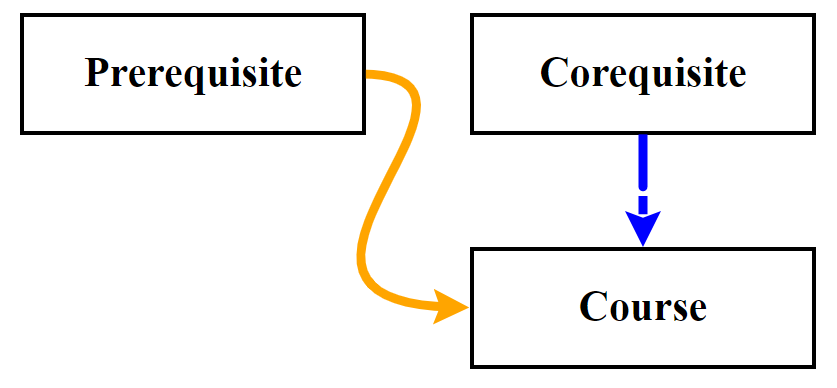
Plan
Graduate Attributes
Categories
Fall Term 1
CHEM 103
★ 4.3
(fi 6)(either term,
3-1s-3/2)
Atoms and molecules, states of matter, chemistry of the elements. Prerequisite: Chemistry 30, or equivalent. Note: Restricted to Engineering students only. Other students who take this course will receive 3 units.
Accreditation Units
Math and Natural Sciences: 53.5 Units
Graduate Attributes
| KB | PA | IN | DE | ET | TW | CS | PR | IS | EE | EP | LL |
|---|---|---|---|---|---|---|---|---|---|---|---|
| I | I |
ENGG 100
★ 1.1
(fi 2)(either term,
.75-.75s-0)
An introduction to the Faculty of Engineering, the engineering profession, the skills required for academic success, and the fundamentals of leadership: study and life skills; time management and goal setting; interpersonal skills; career planning; engineering and society including elements of ethics, equity, concepts of sustainable development, environmental stewardship, and public safety.
Accreditation Units
Graduate Attributes
| KB | PA | IN | DE | ET | TW | CS | PR | IS | EE | EP | LL |
|---|---|---|---|---|---|---|---|---|---|---|---|
| I | I | I | I |
ENGG 130
★ 4.0
(fi 6)(either term,
3-0-2)
Equilibrium of planar systems. Analysis of statically determinate trusses and frames. Friction. Centroids and centres of gravity. Forces and moments in beams. Second moments of area. Note: Students in all sections of this course will write a common final examination. Corequisite: MATH 100.
Accreditation Units
Engineering Science and Engineering Design: 50.4 Units
Graduate Attributes
| KB | PA | IN | DE | ET | TW | CS | PR | IS | EE | EP | LL |
|---|---|---|---|---|---|---|---|---|---|---|---|
| I | I |
ENGL 199
★ 3.0
(fi 6)(either term,
3-0-0)
This course aims to develop the student's ability to provide effective written and oral information. It will focus on instruction in fundamental writing skills, including building effective sentences and paragraphs, and on learning to communicate clearly across a range of genres and media used in academic and professional contexts, including correspondence and presentations. Students will be introduced to the principles of information gathering, analysis, and citation. Note: Restricted to students in the Faculty of Engineering only.
Accreditation Units
Graduate Attributes
| KB | PA | IN | DE | ET | TW | CS | PR | IS | EE | EP | LL |
|---|---|---|---|---|---|---|---|---|---|---|---|
| I | D |
MATH 100
★ 3.5
(fi 6)(either term,
3-0-1)
Review of numbers, inequalities, functions, analytic geometry; limits, continuity; derivatives and applications, Taylor polynomials; log, exp, and inverse trig functions. Integration, fundamental theorem of calculus substitution, trapezoidal and Simpson's rules. Prerequisites: Mathematics 30-1 and Mathematics 31. Notes: (1) Credit can be obtained in at most one of MATH 100, 113, 114, 117, 134, 144, 154, or SCI 100. (2) Students in all sections of this course will write a common final examination. (3) Restricted to Engineering students. Non-Engineering students who take this course will receive 3 units.
Accreditation Units
Math and Natural Sciences: 44.1 Units
Graduate Attributes
| KB | PA | IN | DE | ET | TW | CS | PR | IS | EE | EP | LL |
|---|---|---|---|---|---|---|---|---|---|---|---|
| I | I |
PHYS 130
★ 3.8
(fi 6)(either term,
3-0-3/2)
Geometrical optics, optical instruments, oscillations, waves, sound, interference, diffraction. Prerequisites: Mathematics 30-1, Mathematics 31, Physics 30. Corequisite: MATH 100 or 113 or 114 or 117 or 134 or 144 or equivalent. Restricted to Engineering students. Other students who take this course will receive 3 units.
Accreditation Units
Math and Natural Sciences: 47.2 Units
Graduate Attributes
| KB | PA | IN | DE | ET | TW | CS | PR | IS | EE | EP | LL |
|---|---|---|---|---|---|---|---|---|---|---|---|
| I | I |
Winter Term 2
CHEM 105
★ 3.8
(fi 6)(either term,
3-0-3/2)
Rates of reactions, thermodynamics and equilibrium, coordination chemistry, electrochemistry, modern applications of chemistry. Prerequisite: CHEM 103 or 101. Note: Restricted to Engineering students only. Other students who take this course will receive 3 units.
Accreditation Units
Math and Natural Sciences: 47.2 Units
Graduate Attributes
| KB | PA | IN | DE | ET | TW | CS | PR | IS | EE | EP | LL |
|---|---|---|---|---|---|---|---|---|---|---|---|
| I | D |
ENCMP 100
★ 3.8
(fi 6)(either term,
3-0-1.5)
Fundamentals of computer programming with emphasis on solving engineering problems. Structure and syntax of computer programs, variables, data types, data structures, control structures, functions, input/output operations, debugging, software development process.
Accreditation Units
Engineering Design: 21.3 Units
Engineering Science and Engineering Design: 47.2 Units
Graduate Attributes
| KB | PA | IN | DE | ET | TW | CS | PR | IS | EE | EP | LL |
|---|---|---|---|---|---|---|---|---|---|---|---|
| I | I | I | I | I | I | I | I |
ENGG 160
★ 2.0
(fi 4)(either term or Spring/Summer,
1-0-2)
Fundamental design process and theory in a multidisciplinary context. Importance, in engineering design, of communications; team work; the engineering disciplines, career fields; professional responsibilities of the engineer including elements of ethics, equity, concepts of sustainable development and environmental stewardship, public and worker safety and health considerations including the context of the Alberta Occupational Health and Safety Act. Corequisite ENGL 199. This course is delivered in a blended format.
Accreditation Units
Engineering Design: 12.6 Units
Engineering Science and Engineering Design: 12.6 Units
Graduate Attributes
| KB | PA | IN | DE | ET | TW | CS | PR | IS | EE | EP | LL |
|---|---|---|---|---|---|---|---|---|---|---|---|
| I | I | I | I | I | I | I |
EN PH 131
★ 4.3
(fi 6)(either term,
3-1s-3/2)
Kinematics and dynamics of particles; gravitation; work and energy; linear momentum; angular momentum; systems of particles; introduction to dynamics of rigid bodies. Prerequisites: MATH 100 or 117, and ENGG 130. Corequisite: MATH 101 or 118. Restricted to Engineering students. Other students who take this course will receive 3 units.
Accreditation Units
Math and Natural Sciences: 26.8 Units
Engineering Science: 26.8 Units
Engineering Science and Engineering Design: 26.8 Units
Graduate Attributes
| KB | PA | IN | DE | ET | TW | CS | PR | IS | EE | EP | LL |
|---|---|---|---|---|---|---|---|---|---|---|---|
| I | I | I |
MATH 101
★ 3.5
(fi 6)(either term,
3-0-1)
Area between curves, techniques of integration. Applications of integration to planar areas and lengths, volumes and masses. First order ordinary differential equations: separable, linear, direction fields, Euler's method, applications. Infinite series, power series, Taylor expansions with remainder terms. Polar coordinates. Rectangular, spherical and cylindrical coordinates in 3-dimensional space. Parametric curves in the plane and space: graphing, arc length, curvature; normal binormal, tangent plane in 3- dimensional space. Volumes and surface areas of rotation. Prerequisite: MATH 100. Notes: (1) Credit can be obtained in at most one of MATH 101, 115, 118, 136, 146, 156 or SCI 100. (2) Students in all sections of this course will write a common final examination. (3) Restricted to Engineering students. Non-Engineering students who take this course will receive 3 units.
Accreditation Units
Math and Natural Sciences: 44.1 Units
Graduate Attributes
| KB | PA | IN | DE | ET | TW | CS | PR | IS | EE | EP | LL |
|---|---|---|---|---|---|---|---|---|---|---|---|
| D | I |
MATH 102
★ 3.5
(fi 6)(either term,
3-0-1)
Vectors and matrices, solution of linear equations, equations of lines and planes, determinants, matrix algebra, orthogonality and applications (Gram-Schmidt), eigenvalues and eigenvectors and applications, complex numbers. Prerequisite or corequisite: MATH 100. Notes: (1) Credit can be obtained in at most one of MATH 102, 125, or 127. (2) Students in all sections of this course will write a common final examination. (3) Restricted to Engineering students. Non-Engineering students who take this course will receive 3 units.
Accreditation Units
Math and Natural Sciences: 44.1 Units
Graduate Attributes
| KB | PA | IN | DE | ET | TW | CS | PR | IS | EE | EP | LL |
|---|---|---|---|---|---|---|---|---|---|---|---|
| D |
Fall Term 3
CIV E 265
★ 3.5
(fi 6)(either term,
2-0-3)
Multiview representation, pictorial views of three-dimensional objects. Computer-aided graphics using AutoCAD.
Accreditation Units
Engineering Science and Engineering Design: 44.1 Units
Graduate Attributes
| KB | PA | IN | DE | ET | TW | CS | PR | IS | EE | EP | LL |
|---|---|---|---|---|---|---|---|---|---|---|---|
| D | D |
EAS 210
★ 4.5
(fi 6)(first term,
3-0-3)
Rock-forming minerals, origins of igneous, metamorphic and sedimentary rocks; economic minerals and ore deposits; rock weathering and soil formation, mass-wasting, groundwater, deformation of the earth's crust. Laboratories on identification of minerals and rocks and the interpretation of topographic and geologic maps and aerial photography. Prerequisite: Any 100-level Science course. Not available to students with credit in EAS 101, 105, or SCI 100. Intended for students in Engineering programs. Restricted to students in Engineering programs. [Faculty of Science]
Accreditation Units
Math and Natural Sciences: 56.7 Units
ECE 209
★ 3.8
(fi 6)(either term or Spring/Summer,
3-0-3/2)
Physical concepts of passive circuit elements, Kirchhoff's laws and DC circuit equations. Energy concepts, time domain analysis of AC circuits. Impedance, complex numbers and phasor algebra. AC power concepts, resonance, three phase circuits, introduction to machines. Credit may be obtained in only one of ECE 209, E E 239, ECE 202, or E E 240, unless approved by the Department.
Accreditation Units
Engineering Design: 11.8 Units
Engineering Science and Engineering Design: 47.2 Units
MATH 209
★ 3.5
(fi 6)(either term,
3-0-1)
Partial differentiation, derivatives of integrals. Multiple integration using rectangular, cylindrical, and spherical coordinates. Vector Field Theory. Prerequisite: MATH 101. Prerequisite or corequisite: MATH 102. Notes: (1) This course may not be taken for credit if credit has already been obtained in MATH 215, MATH 315, MATH 317 or MA PH 351. (2) Students in all sections of this course will write a common final examination. (3) Restricted to Engineering students. Non-Engineering students who take this course will receive 3 units.
Accreditation Units
Math and Natural Sciences: 44.1 Units
Graduate Attributes
| KB | PA | IN | DE | ET | TW | CS | PR | IS | EE | EP | LL |
|---|---|---|---|---|---|---|---|---|---|---|---|
| D | D |
MIN E 295
★ 3.8
(fi 6)(either term,
3-0-3/2)
Mining concepts and terminology, company operations, stages of mining, unit mining operations, surface and underground mine development and methods, feasibility studies and mine costs, ethics, equity, sustainable development and environmental stewardship, public and worker safety and health considerations including the context of the Alberta Occupational Health and Safety Act.
Accreditation Units
Engineering Design: 26.0 Units
Engineering Science and Engineering Design: 47.2 Units
Graduate Attributes
| KB | PA | IN | DE | ET | TW | CS | PR | IS | EE | EP | LL |
|---|---|---|---|---|---|---|---|---|---|---|---|
| I | I | I |
Winter Term 4
CH E 243
★ 3.5
(fi 6)(either term or Spring/Summer,
3-1s-0)
An introduction to the first and second laws of thermodynamics. Prerequisites: MATH 101.
Accreditation Units
Engineering Science and Engineering Design: 44.1 Units
Graduate Attributes
| KB | PA | IN | DE | ET | TW | CS | PR | IS | EE | EP | LL |
|---|---|---|---|---|---|---|---|---|---|---|---|
| I | I | I |
CIV E 250
★ 4.5
(fi 6)(either term or Spring/Summer,
3-0-3)
Basic surveying concepts and instrumentation, measurement errors, coordinate systems, leveling, traversing, layout surveys, earthwork volumes, conventional, and digital mapping, GIS concepts, aerial photography, and GPS. Prerequisites: MATH 101 and 102.
Accreditation Units
Engineering Science and Engineering Design: 56.7 Units
Graduate Attributes
| KB | PA | IN | DE | ET | TW | CS | PR | IS | EE | EP | LL |
|---|---|---|---|---|---|---|---|---|---|---|---|
| D |
CIV E 270
★ 4.5
(fi 6)(either term or Spring/Summer,
3-0-3)
Plane stress and strain; stress-strain relationships; stresses and deformations resulting from axial and transverse loads; buckling of columns; torsion of circular sections; combined stress; statically indeterminate problems. Laboratory to demonstrate mechanical properties and verify assumptions of analysis. Prerequisites: ENGG 130 and MATH 101.
Accreditation Units
Engineering Science and Engineering Design: 56.7 Units
Graduate Attributes
| KB | PA | IN | DE | ET | TW | CS | PR | IS | EE | EP | LL |
|---|---|---|---|---|---|---|---|---|---|---|---|
| I | D |
MATH 201
★ 3.5
(fi 6)(either term or Spring/Summer,
3-0-1)
First-order equations; second-order linear equations: reduction of order, variation of parameters; Laplace transform; linear systems; power series; solution by series; separation of variables for PDEs. Prerequisite or corequisite: MATH 209 or 214. Notes: (1) Open only to students in Engineering and Specialization Geophysics. (2) Credit can be obtained in at most one of MATH 201, MATH 334, MATH 336, or MA PH 251. (3) Students in all sections of this course will write a common final examination. Non-Engineering students who take this course will receive 3 units.
Accreditation Units
Math and Natural Sciences: 44.1 Units
Graduate Attributes
| KB | PA | IN | DE | ET | TW | CS | PR | IS | EE | EP | LL |
|---|---|---|---|---|---|---|---|---|---|---|---|
| D | D |
MIN E 325
★ 4.5
(fi 6)(either term or Spring/Summer,
3-0-3)
Introduction to mine planning and design using professional software tools. Experiential learning through a design project using drillhole databases; geological and economic block models; open pit mine layout and planning requirements; pit limit optimization; haul road design; pit and waste dump design; and strategic mine planning and closure. Prerequisites: MIN E 295, CIV E 265.
Accreditation Units
Engineering Science and Engineering Design: 56.7 Units
Graduate Attributes
| KB | PA | IN | DE | ET | TW | CS | PR | IS | EE | EP | LL |
|---|---|---|---|---|---|---|---|---|---|---|---|
| I | I | I |
Summer Term 5
CIV E 330
★ 3.5
(fi 6)(either term,
3-1s-0)
Fluid properties; dimensional analysis; hydrostatics; fundamental equations of fluid motion; laminar, turbulent and inviscid flows; boundary layers and flow around immersed bodies; elementary building aerodynamics. Prerequisite: MATH 209. Corequisite: MATH 201.
Accreditation Units
Engineering Science and Engineering Design: 44.1 Units
OR
CH E 312
★ 3.5
(fi 6)(either term or Spring/Summer,
3-1s-0)
Newtonian and non-Newtonian fluid behavior; hydrostatics; buoyancy, application of Bernoulli and momentum equations; frictional losses through pipes, ducts, and fittings; pipe networks; pumps; drag on submerged bodies and flow through porous media. Prerequisites: CH E 243 EN PH 131 and MATH 209. Corequisite: MATH 201.
Accreditation Units
Engineering Design: 19.8 Units
Engineering Science and Engineering Design: 44.1 Units
Graduate Attributes
| KB | PA | IN | DE | ET | TW | CS | PR | IS | EE | EP | LL |
|---|---|---|---|---|---|---|---|---|---|---|---|
| D | D | D | I | D |
ENG M 310
★ 3.0
(fi 6)(either term or Spring/Summer,
3-0-0)
The application of the fundamentals of economics to engineering alternatives in planning, developing and managing industrial projects. Note: Credit cannot be obtained for more than one of ENGG 310, 401, ENG M 310 or 401.
Accreditation Units
OR
ENG M 401
★ 3.0
(fi 6)(either term,
3-0-0)
The application of the fundamentals of engineering economics, financial analysis and market assessment to engineering alternatives in the planning, development and ongoing management of industrial enterprises. The course covers the use of engineering, economic, financial and market assessment information in investment and business operation decisions in technology oriented companies. Note: Credit cannot be obtained for more than one of ENGG 310, ENGG 401, ENG M 310, or ENG M 401.
Accreditation Units
Graduate Attributes
| KB | PA | IN | DE | ET | TW | CS | PR | IS | EE | EP | LL |
|---|---|---|---|---|---|---|---|---|---|---|---|
| I | I | D |
MIN E 310
★ 4.0
(fi 6)(either term or Spring/Summer,
3-2-0)
Methods for construction of mineral deposit models. Resources and reserves estimation and simulation for characterizing best estimates and grade variability. Fundamental statistical and mathematical principles for spatial prediction. Mineral reserve classification and uncertainty assessment. Co-requisites: MATH 209, EAS 210, and MIN E 325.
Accreditation Units
Engineering Design: 17.0 Units
Engineering Science and Engineering Design: 37.8 Units
Graduate Attributes
| KB | PA | IN | DE | ET | TW | CS | PR | IS | EE | EP | LL |
|---|---|---|---|---|---|---|---|---|---|---|---|
| I | D | D | D | D |
MIN E 323
★ 4.5
(fi 6)(first term or Spring/Summer,
3-0-3)
Mechanical properties of rock masses, field and laboratory determination; classification and index testing; permeability and flow; stresses around underground openings, elastic prototypes and numerical methods; ground support principles and mechanics of common support systems, loads on supports; hydraulic backfill, earth pressures, consolidation theory and practical consequences in mining; mechanics of subsidence and caving; rockburst mechanics; slope stability, rock mechanics instrumentation. Prerequisite: CIV E 270.
Accreditation Units
Engineering Design: 28.3 Units
Engineering Science and Engineering Design: 56.7 Units
Graduate Attributes
| KB | PA | IN | DE | ET | TW | CS | PR | IS | EE | EP | LL |
|---|---|---|---|---|---|---|---|---|---|---|---|
| D | D | D | D |
Fall Term 6
CIV E 381
★ 4.5
(fi 6)(either term or Spring/Summer,
3-0-3)
Compaction; site investigation; theories of water seepage; effective stress principles; settlement; strength and mechanical properties; introduction to retaining structures, foundation, and slope stability. Prerequisite: EAS 210.
Accreditation Units
Engineering Design: 14.2 Units
Engineering Science and Engineering Design: 56.7 Units
Graduate Attributes
| KB | PA | IN | DE | ET | TW | CS | PR | IS | EE | EP | LL |
|---|---|---|---|---|---|---|---|---|---|---|---|
| D | A |
CME 421
★ 3.8
(fi 6)(first term,
3-0-3/2)
Unit operations employed to concentrate minerals including comminution, classification, gravity concentration, froth flotation, thickening, filtering; tailings disposal; economics.
Accreditation Units
Engineering Science and Engineering Design: 47.2 Units
Graduate Attributes
| KB | PA | IN | DE | ET | TW | CS | PR | IS | EE | EP | LL |
|---|---|---|---|---|---|---|---|---|---|---|---|
| D | D | D | I | D |
ENGG 404
★ 3.8
(fi 6)(either term or Spring/Summer,
3-3s/2-0)
Basic concepts of risk and consequences of loss incidents; risk management principles and practices; incident investigation, causation, root cause analysis; process safety management; the roles of government agencies, professional bodies and industry associations; workplace safety; risk-based decision-making processes; leadership and the human-factors side of risk management. The course focuses on the principles and practices of leadership towards the effective application and implementation of risk management in major organizations across all engineering disciplines. Industry virtual tours, case studies, seminars and team projects specific to the student's engineering program will be used to develop competencies and proficiencies in applying leadership and organizational effectiveness for successful risk management.
Accreditation Units
Graduate Attributes
| KB | PA | IN | DE | ET | TW | CS | PR | IS | EE | EP | LL |
|---|---|---|---|---|---|---|---|---|---|---|---|
| D | D | D | A | A | D | D |
TECH E
★ 3.0
(fi 6)(either term or Spring/Summer,
3-0-0)
Choose a Technical Elective from the approved list.
Accreditation Units
STAT 235
★ 3.8
(fi 6)(either term or Spring/Summer,
3-0-1.5)
Descriptive data analysis. Calculus of Probability. Binomial, multinomial, Poisson, normal, beta, exponential, gamma, hypergeometric, and Weibull distributions. Sampling distributions. Estimation, testing hypotheses, goodness-of-fit tests, and one-way analysis of variance. Linear correlation and regression. Sampling. Quality control. Use of a microcomputer software package for statistical analyses in engineering applications. Prerequisite: MATH 100. Corequisite: MATH 101. Notes: (1) This course may not be taken for credit if credit has already been obtained in one of STAT 151, 161, 222, 265, 266, 276, 281; KIN 109, PEDS 109, PSYCH 211, PTHER 352, SCI 151 or SOC 320. (2) Intended for Engineering students. (2) Intended for Engineering students. Other students who take this course will receive 3.0 units.
Accreditation Units
Math and Natural Sciences: 47.2 Units
Graduate Attributes
| KB | PA | IN | DE | ET | TW | CS | PR | IS | EE | EP | LL |
|---|---|---|---|---|---|---|---|---|---|---|---|
| D | D | I |
CIV E 251
★ 1.5
(fi 3)(second term or Spring/Summer,
1 week)
Practical exercises in field methods; project type of assignments; field astronomy; electronic distance measuring instruments. Prerequisite: CIV E 250.
Accreditation Units
Engineering Science and Engineering Design: 19.3 Units
Graduate Attributes
| KB | PA | IN | DE | ET | TW | CS | PR | IS | EE | EP | LL |
|---|---|---|---|---|---|---|---|---|---|---|---|
| A | D |
Winter Term 7
MIN E 324
★ 3.0
(fi 6)(either term,
3-0-0)
Drilling methods, breakage mechanics, performance, and equipment. Explosive characteristics, initiation systems, selection, handling, and loading. Blasting, rock dynamics, design of surface and underground blasts, fragmentation prediction, vibrations and damage control, monitoring. Prerequisite: MIN E 295.
Accreditation Units
Engineering Design: 18.9 Units
Engineering Science and Engineering Design: 37.8 Units
Graduate Attributes
| KB | PA | IN | DE | ET | TW | CS | PR | IS | EE | EP | LL |
|---|---|---|---|---|---|---|---|---|---|---|---|
| D | I | I | I |
MIN E 330
★ 3.8
(fi 6)(either term,
3-0-3/2)
Underground and surface mine transport systems, including truck haulage, free steered vehicles, rail haulage, wire rope hoisting, belt conveying, silo storage, hydraulic pipelining and pneumatic conveying. Auxiliary mining services such as electric power distribution, pumping and compressed air power. Labs include software-based design problems dealing with the materials taught in the classroom. Prerequisites: MIN E 295 and ECE 209.
Accreditation Units
Engineering Design: 21.3 Units
Engineering Science and Engineering Design: 47.2 Units
Graduate Attributes
| KB | PA | IN | DE | ET | TW | CS | PR | IS | EE | EP | LL |
|---|---|---|---|---|---|---|---|---|---|---|---|
| I | D | I |
MIN E 408
★ 3.0
(fi 6)(either term,
2-0-2)
Fundamentals of economic evaluation. Economic evaluation of mining ventures, profitability, risks and uncertainty analyses. Implementation of data-driven decision making for mine optimization and management strategies. Weekly laboratory/tutorial sessions explore the application of data analytics to economic challenges using case studies and specific problems. Prerequisites: ENG M 310 OR ENG M 401, and STAT 235.
Accreditation Units
Graduate Attributes
| KB | PA | IN | DE | ET | TW | CS | PR | IS | EE | EP | LL |
|---|---|---|---|---|---|---|---|---|---|---|---|
| A | A | A |
COMP E
★ 3.0
(fi 6)(either term or Spring/Summer,
3-0-0)
Choose a Complementary Studies Elective from the approved list.
Accreditation Units
COMP E
★ 3.0
(fi 6)(either term or Spring/Summer,
3-0-0)
Choose a Complementary Studies Elective from the approved list.
Accreditation Units
Fall Term 8
MIN E 402
★ 4.5
(fi 6)(first term,
1-1s-6)
First phase of a dynamic scenario-based mine feasibility study from exploration through operations to final mine closure plan. Includes preparation of a geological model, calculation of resources, generation of focused technical reports, community consultation and economic reports. Identify and compare conceptual mining methods for consideration in Mine Design Project II (see MIN E 403). Prepare regular team reports and presentations. Present findings during a half-day final industry seminar. Weekly seminars with instructor and industry experts. Corequisites: MIN E 413 and MIN E 414. Note: Restricted to fourth-year traditional and fifth-year co-op engineering students.
Accreditation Units
Engineering Science and Engineering Design: 56.7 Units
Graduate Attributes
| KB | PA | IN | DE | ET | TW | CS | PR | IS | EE | EP | LL |
|---|---|---|---|---|---|---|---|---|---|---|---|
| D | D | A | D | D | D |
MIN E 413
★ 3.8
(fi 6)(first term,
3-0-3/2)
Principles and application of surface mining methods (mechanical, aqueous, and continuous surface mining methods). Production and productivity considering the generation of mine specific landform structures. Loading and hauling systems. Water drainage systems. Haul road design and maintenance. Waste dump and tailings facility design and management. Closure and reclamation. Prerequisites: MIN E 310, 330, 323, and 325.
Accreditation Units
Engineering Design: 14.2 Units
Engineering Science and Engineering Design: 47.2 Units
Graduate Attributes
| KB | PA | IN | DE | ET | TW | CS | PR | IS | EE | EP | LL |
|---|---|---|---|---|---|---|---|---|---|---|---|
| D | D |
MIN E 414
★ 3.8
(fi 6)(first term,
3-0-3/2)
Methods and applications in underground excavation and tools to select equipment for underground drilling and loading processes. Methodology to examine shape, size and orientation effects, as well as support requirements, in the design of underground mine opening. Methods include room-and-pillar, sublevel stoping and caving, vertical crater retreat, block caving, selective methods for vein mines, and underground coal mining systems. Labs include software-based design problems dealing with underground mining methods selection, visualization and optimization. Prerequisites: MIN E 323, MIN E 324 and MIN E 325 or consent of Instructor.
Accreditation Units
Engineering Design: 26.0 Units
Engineering Science and Engineering Design: 47.2 Units
Graduate Attributes
| KB | PA | IN | DE | ET | TW | CS | PR | IS | EE | EP | LL |
|---|---|---|---|---|---|---|---|---|---|---|---|
| D | D | D |
TECH E
★ 3.0
(fi 6)(either term or Spring/Summer,
3-0-0)
Choose a Technical Elective from the approved list.
Accreditation Units
ITS E
★ 3.0
(fi 6)(either term or Spring/Summer,
3-0-0)
Choose a Impact of Technology on Society from the approved list.
Accreditation Units
Winter Term 9
ENGG 400
★ 1.0
(fi 2)(either term,
1-0-0)
The technical and professional duties and responsibilities of the engineer; the ethics of the engineering profession; technical and professional organizations. The role of the engineer in the social environment including elements of equity, concepts of sustainable development and environmental stewardship, public and worker safety and health considerations including the context of the Alberta Occupational Health and Safety Act. Note: Restricted to fourth-year traditional and fifth-year co-op engineering students. Must be taken in last term of program.
Accreditation Units
Graduate Attributes
| KB | PA | IN | DE | ET | TW | CS | PR | IS | EE | EP | LL |
|---|---|---|---|---|---|---|---|---|---|---|---|
| D | A | D | A | A |
MIN E 403
★ 4.5
(fi 6)(second term,
1-1s-6)
Second phase of a dynamic scenario-based mine feasibility study from exploration through operations to final mine closure plan. This course follows MIN E 402 with detailed mine plans and equipment selection, manpower, ventilation, processing, environment and economic analyses. Prepare regular team reports and presentations. Present findings during an industry seminar. Weekly seminars with instructor and industry experts. Prerequisite: MIN E 402. Note: Restricted to fourth-year traditional and fifth-year co-op engineering students.
Accreditation Units
Engineering Science and Engineering Design: 56.7 Units
Graduate Attributes
| KB | PA | IN | DE | ET | TW | CS | PR | IS | EE | EP | LL |
|---|---|---|---|---|---|---|---|---|---|---|---|
| A | D | A | A | A | A |
MIN E 407
★ 3.8
(fi 6)(second term,
3-0-3/2)
Principles and practices of underground total air conditioning. Control of quantity, quality, and temperature-humidity of the underground mines. Design and analyses of mine ventilation networks. Theory and applications of fans to mine ventilation systems. Ventilation planning and overall system design. Prerequisites: MIN E 414 and one of CIV E 330 or CH E 312. Corequisite: MIN E 422.
Accreditation Units
Engineering Design: 26.0 Units
Engineering Science and Engineering Design: 47.2 Units
Graduate Attributes
| KB | PA | IN | DE | ET | TW | CS | PR | IS | EE | EP | LL |
|---|---|---|---|---|---|---|---|---|---|---|---|
| A | A |
MIN E 420
★ 3.8
(fi 6)(second term,
3-3s/2-0)
Introduction to the principles of equipment selection and maintenance practice. Selected issues of machine and component longevity, wear, service and performance for both surface and underground equipment. Basic principles of maintenance management are introduced. Prerequisites: CIV E 270, MIN E 413 and MIN E 414.
Accreditation Units
Engineering Design: 23.6 Units
Engineering Science and Engineering Design: 47.2 Units
Graduate Attributes
| KB | PA | IN | DE | ET | TW | CS | PR | IS | EE | EP | LL |
|---|---|---|---|---|---|---|---|---|---|---|---|
| A | A | A | A |
MIN E 422
★ 2.5
(fi 4)(second term,
2-1s-0)
Environmental impact of mining projects and activities. Topics include: environmental impact assessment (EIA) processes, sustainable development, mine closure, reclamation planning, social responsibility of mining, regulations, guidelines, surface subsidence, tailings disposal, erosion and acid rock drainage. Corequisite: MIN E 413.
Accreditation Units
Engineering Design: 23.6 Units
Engineering Science and Engineering Design: 23.6 Units
Graduate Attributes
| KB | PA | IN | DE | ET | TW | CS | PR | IS | EE | EP | LL |
|---|---|---|---|---|---|---|---|---|---|---|---|
| A | A | A | A |
| M: | 518.4 | / | 195 | ✅ |
| NS: | 1148.0 | / | 195 | ✅ |
| CS: | 474.1 | / | 225 | ✅ |
| ES: | 1306.7 | / | 225 | ✅ |
| ED: | 691.7 | / | 225 | ✅ |
| M+NS: | 1666.4 | / | 420 | ✅ |
| ES+ED: | 1998.4 | / | 900 | ✅ |
| Total: | 4138.9 | / | 1850 | ✅ |
TOTAL
Program and Tech Elec (1)
B LAW 201
★ 3.0
(fi 6)(either term,
3-0-0)
Synoptic view of the Canadian legal system, with emphasis on underlying considerations of social policy. While considering the nature, sources, philosophy, and policy objectives of the law, selected topics from the fields of tort and contract will be analyzed. Credit will be granted for only one of B LAW 201 (formerly B LAW 301) and ENGG 420. Students may not receive credit for both B LAW 201 and B LAW 301.
Accreditation Units
B LAW 428
★ 3.0
(fi 6)(either term,
3-0-0)
The legal framework in which managerial decisions affecting the environment are taken. Substance of environmental law and the procedures for enforcing it. Interaction of this legal approach with business strategies for dealing with environmental issues is analyzed. Prerequisite: B LAW 301 or ENGG 420.
Accreditation Units
Graduate Attributes
| KB | PA | IN | DE | ET | TW | CS | PR | IS | EE | EP | LL |
|---|---|---|---|---|---|---|---|---|---|---|---|
| I |
CH E 374
★ 3.5
(fi 6)(either term,
3-1s-0)
Formulation and solution of chemical and materials engineering problems; solution of systems of linear and nonlinear algebraic equations; numerical interpolation, differentiation and integration; numerical solution of ordinary and partial differential equations. Prerequisites: ENCMP 100 (or equivalent). MATH 102, 201 and 209.
Accreditation Units
Math and Natural Sciences: 17.6 Units
Engineering Science: 13.2 Units
Engineering Design: 13.2 Units
Engineering Science and Engineering Design: 26.5 Units
Graduate Attributes
| KB | PA | IN | DE | ET | TW | CS | PR | IS | EE | EP | LL |
|---|---|---|---|---|---|---|---|---|---|---|---|
| D | D | D | I | D |
CIV E 221
★ 3.8
(fi 6)(second term,
3-0-3/2)
Basic mechanisms of chemistry, biology, and physics relevant to environmental engineering processes. Principles of equilibrium reactions and kinetics, mass transfer and material balances, microbial growth and kinetics, water, energy, and nutrient cycles. Applications to environmental engineering systems as biological degradation, mass and energy movement through the environment, and design of water and wastewater treatment systems. Prerequisites: CHEM 103 and CHEM 105.
Accreditation Units
Engineering Science and Engineering Design: 47.2 Units
CIV E 303
★ 3.8
(fi 6)(either term,
3-0-3/2)
Planning and scheduling; theories and techniques of project management.
Accreditation Units
Engineering Science: 14.2 Units
Engineering Science and Engineering Design: 14.2 Units
Graduate Attributes
| KB | PA | IN | DE | ET | TW | CS | PR | IS | EE | EP | LL |
|---|---|---|---|---|---|---|---|---|---|---|---|
| A | A |
CIV E 321
★ 3.8
(fi 6)(either term,
3-0-3/2)
Introduction modeling environmental processes to predict the movement of water and fate of contaminants in the hydrologic cycle. Principles of mass transfer, conservation of mass, environmental transformations, nutrient enrichment and depletion are developed. Introduction to storm events, rainfall, runoff, stream discharge and stormwater management. Applications of modeling results to the quantification of risk using examples from hydrology, water pollution and health protection and development of environmental regulations. Prerequisite: CIV E 221. Corequisite: CIV E 330.
Accreditation Units
Engineering Science and Engineering Design: 47.2 Units
CIV E 331
★ 3.8
(fi 6)(either term,
3-0-3/2)
Introduction to applied hydraulics; control volume methods, open channel hydraulics, pipe systems, pumps, distribution and collection system hydraulics and design. Prerequisite: CIV E 330. Corequisite: either CIV E 221 or ENV E 325.
Accreditation Units
Engineering Design: 11.8 Units
Engineering Science and Engineering Design: 47.2 Units
Graduate Attributes
| KB | PA | IN | DE | ET | TW | CS | PR | IS | EE | EP | LL |
|---|---|---|---|---|---|---|---|---|---|---|---|
| D | A |
CIV E 391
★ 4.5
(fi 6)(either term,
3-0-3)
Classification of soils. Properties of Portland cement concrete related to micro- and macro-structure and constituent materials. Properties of bituminous materials and design of bituminous mixes. Prerequisite: MAT E 202 or ENV E 220.
Accreditation Units
Engineering Science and Engineering Design: 56.7 Units
CIV E 431
★ 3.8
(fi 6)(either term,
3-0-3/2)
Hydrotechnical analysis, including: advanced open channel hydraulics; advanced surface water hydrology; groundwater and well hydraulics; and environmental hydraulics. Prerequisites: CIV E 321, 331.
Accreditation Units
Engineering Design: 23.6 Units
Engineering Science and Engineering Design: 47.2 Units
Graduate Attributes
| KB | PA | IN | DE | ET | TW | CS | PR | IS | EE | EP | LL |
|---|---|---|---|---|---|---|---|---|---|---|---|
| A | A | A | A | A | A |
Program and Tech Elec (2)
CIV E 481
★ 3.8
(fi 6)(either term,
3-0-3/2)
Site investigation; strength of soils; geosynthetics for soil improvement; design of excavations and earth pressures on retaining structures; stability of natural slopes and their improvement; design of cuts and embankments; foundation design, stability and settlement; pile foundations; frost action and permafrost. Prerequisite: CIV E 381.
Accreditation Units
Engineering Design: 35.4 Units
Engineering Science and Engineering Design: 47.2 Units
Graduate Attributes
| KB | PA | IN | DE | ET | TW | CS | PR | IS | EE | EP | LL |
|---|---|---|---|---|---|---|---|---|---|---|---|
| A | A | D | A | A | A |
CME 472
★ 3.5
(fi 6)(either term,
3-1s-0)
Physical and chemical preparation of ore feed. Roasting, briquetting, sintering and pelletizing. Leaching processes and chemicals, kinetics of leaching, ion exchange, activated carbon adsorption, solvent extraction and McCabe-Thiele Diagram. Metal recovery from solutions, electrowinning and electrorefining. Furnaces and fuels, refractories, slags and mattes. Reduction of metal compounds, smelting and converting, pyrometallurgical metal refining. Credit may not be obtained in this course if previous credits have been obtained in MAT E 430 and MAT E 332. Prerequisites: CME 265, MAT E 341, or consent of the Department.
Accreditation Units
Engineering Science and Engineering Design: 44.1 Units
CMPUT 201
★ 3.0
(fi 6)(either term,
3-0-3)
Introduction to the principles, methods, tools, and practices of the professional programmer. The lectures focus on the fundamental principles of software engineering based on abstract data types and their implementations. The laboratories offer an intensive apprenticeship to the aspiring software developer. Students use C and software development tools of the Unix environment. Prerequisite: CMPUT 175. Credit cannot be obtained for both CMPUT 201 and CMPUT 275.
Accreditation Units
Engineering Design: 42.5 Units
Engineering Science and Engineering Design: 56.7 Units
CMPUT 204
★ 3.0
(fi 6)(either term,
3-1s-0)
The first of two courses on algorithm design and analysis, with emphasis on fundamentals of searching, sorting, and graph algorithms. Examples include divide and conquer, dynamic programming, greedy methods, backtracking, and local search methods, together with analysis techniques to estimate program efficiency. Prerequisites: CMPUT 175 or 275, and CMPUT 272; and one of MATH 100, 114, 117, 134, 144, or 154.
Accreditation Units
Engineering Science and Engineering Design: 44.1 Units
EAS 204
★ 3.0
(fi 6)(either term,
3-0-0)
Near-surface geological processes and the physical environment in western Canada. Topics include: natural hazards in developed areas; rivers and flooding; surface water and groundwater resources; soil resources and degradation; air and water pollution; waste management and disposal; environmental geoscience and resource extraction; and global change. Prerequisites: Any 100-level Science course. [Faculty of Science]
Accreditation Units
Math and Natural Sciences: 37.8 Units
EAS 205
★ 3.0
(fi 6)(either term,
3-0-0)
Processes and geological evidence of natural catastrophes, such as volcanoes, earthquakes, slope failures, tsunamis, floods, extraterrestrial impacts, and other rapid environmental changes. Natural hazard risk in the context of geological time. Prerequisite: Any 100-level Science course. [Faculty of Science]
Accreditation Units
Math and Natural Sciences: 37.8 Units
EAS 208
★ 3.0
(fi 6)(either term,
3-0-0)
Natural and anthropogenic causes of global scale environmental change; the role of the atmosphere, oceans, biosphere and cryosphere in the processes of environmental change; relationships between levels of technology and development and the character of environmental change associated with human activity. Prerequisite: Any 100-level Science course. [Faculty of Science]
Accreditation Units
Math and Natural Sciences: 37.8 Units
EAS 209
★ 3.0
(fi 6)(either term,
3-0-0)
An overview of the geology and landscapes of Western Canada. The spectacularly exposed rocks of the prairie and mountain parks of Alberta and British Columbia will be fitted into a regional geological framework and examples from parks such as Yoho, Banff, Jasper, Dinosaur, and Kananaskis will be highlighted. Geological processes of mountain building and past and present landscape evolution will be emphasized. Prerequisite: One of EAS 100, 101, 103, 105, 201, 210 or SCI 100. [Faculty of Science]
Accreditation Units
Math and Natural Sciences: 37.8 Units
EAS 221
★ 3.0
(fi 6)(either term,
3-0-3)
Background to the principles of Geographic Information Systems and Remote Sensing. Lectures emphasize the theoretical and methodological underpinnings, labs impart the technical aspects through hands-on experience with appropriate software. Prerequisite: Any 100-level Science course. [Faculty of Science]
Accreditation Units
Math and Natural Sciences: 56.7 Units
Program and Tech Elec (3)
EAS 224
★ 3.0
(fi 6)(either term,
3-0-3)
Principles of crystallography, physical and chemical properties of minerals, determinative mineralogy. Prerequisite: EAS 101, 105, 210 or SCI 100. [Faculty of Science]
Accreditation Units
Math and Natural Sciences: 56.7 Units
EAS 233
★ 3.0
(fi 6)(either term,
3-0-3)
Orientation, measurement description, and analysis of planar and linear structures in rocks, including folds, faults, and fabrics. Introduction to mapping and the collection of structural information. Construction of geologic maps and cross-sections. Introduction to stereographic and equal-area projections. Basic concepts of strain and stress in rock deformation. Prerequisite: EAS 105, 210 or SCI 100. [Faculty of Science]
Accreditation Units
Math and Natural Sciences: 56.7 Units
EAS 323
★ 3.0
(fi 6)(either term,
3-0-3)
The hydrologic cycle, water budgets and basic hydrologic processes; physical properties of porous media and groundwater flow principles; steady-state groundwater flow; transient groundwater flow, well hydraulics and groundwater resource evaluation; regional groundwater flow; and, basic hydrochemistry and transport processes. Prerequisites: One of EAS 100, 101, 102, 201 or 210 and MATH 113 or 114, PHYS 124 or 144, and one of PHYS 126, 130, or 146. SCI 100 may be used in lieu of EAS 100, MATH 114, PHYS 144 and 146. Not available to students with credit in EAS 223. [Faculty of Science]
Accreditation Units
Math and Natural Sciences: 56.7 Units
EAS 368
★ 3.0
(fi 6)(either term,
3-0-3)
Mineralogy and petrography of ore and gangue minerals under the reflected and transmitted light microscope and in hand specimen. Interpretation of ore textures and paragenetic sequences. Geological characteristics and distribution of ore deposits, including deposits of base and precious metals, diamonds, and industrial minerals. Prerequisite: EAS 331. Not available to students with credit in EAS 433. [Faculty of Science]
Accreditation Units
Math and Natural Sciences: 56.7 Units
EAS 421
★ 3.0
(fi 6)(either term,
3-0-3)
Geometric, kinematic, and dynamic analysis of structures produced by deformation. Stress and the origin of faults, joints, veins, folds, and tectonites. Brittle and ductile strain in rocks. Extensional, strike-slip, and compressional structural associations. Regional structure, orogens, and crustal tectonics. Lab exercises include structural interpretation for subsurface hydrocarbon and mineral exploration, stereographic techniques for structural analysis, and the study of rock fabrics. Prerequisites: EAS 233 and any 300-level EAS course. Not available to students with credit in EAS 321. [Faculty of Science]
Accreditation Units
Math and Natural Sciences: 56.7 Units
ECON 366
★ 3.0
(fi 6)(either term,
3-0-0)
The economics of producing and consuming energy: pricing, role in economic growth; energy sources and markets; the role of government; regulation and other energy policy issues. Prerequisite: ECON 281.
Accreditation Units
ENCS 352
★ 3.0
(fi 6)(first term,
3-0-0)
Overview of Canadian laws and policies designed to control air, land, and water pollution including licensing systems, quasi-criminal sanctions, and environmental impact assessment processes. The course will also review relevant constitutional issues and consider alternative legal approaches to the resolution of environmental problems. Prerequisite: Completion of 60 units of university-level course work. [Resource Economics and Environmental Sociology].
Accreditation Units
Math and Natural Sciences: 37.8 Units
ENGG 420
★ 3.0
(fi 6)(either term,
3-0-0)
Contracts; specifications; tenders; bonds; construction contract forms; Public Works Act; building trades; company law; the engineer as an expert witness; patents; trademarks; copyrights; negligence; arbitration. Note: Restricted enrolment. Credit will not be granted for both ENGG 420 and B LAW 301.
Accreditation Units
Graduate Attributes
| KB | PA | IN | DE | ET | TW | CS | PR | IS | EE | EP | LL |
|---|---|---|---|---|---|---|---|---|---|---|---|
| I | D | D |
ENG M 501
★ 3.0
(fi 6)(either term,
3-0-0)
Production and operations management, analysis, and design of work, forecasting, inventory management including MRP, JIT, and Kanban, maintenance management, facility layout, operations scheduling, and project planning and management.
Accreditation Units
Engineering Science and Engineering Design: 37.8 Units
Graduate Attributes
| KB | PA | IN | DE | ET | TW | CS | PR | IS | EE | EP | LL |
|---|---|---|---|---|---|---|---|---|---|---|---|
| I | D | I | I | I |
Program and Tech Elec (4)
ENG M 512
★ 3.0
(fi 6)(either term,
3-0-0)
Quality engineering and management definitions, concepts and principles. Essential quality management theories and models. ISO 9000 principles, models and applications. ISO 10000 augmentative standards. Seven quality engineering and management tools. Quality function deployment. Failure analysis. Statistical quality.
Accreditation Units
ENG M 514
★ 3.0
(fi 6)(either term,
3-0-0)
Concepts of reliability, failure rate, maintainability, and availability. Properties of various statistical distributions and their applications in reliability engineering. Failure data analysis techniques including probability plotting. Load and strength interference in mechanical component design. System reliability models and system reliability evaluation methods. Optimal system design considering reliability issues.
Accreditation Units
Engineering Design: 18.9 Units
Engineering Science and Engineering Design: 37.8 Units
Graduate Attributes
| KB | PA | IN | DE | ET | TW | CS | PR | IS | EE | EP | LL |
|---|---|---|---|---|---|---|---|---|---|---|---|
| D | D | I |
ENG M 530
★ 3.0
(fi 6)(either term or Spring/Summer,
3-0-0)
Introduction to project management tools, techniques, templates, and methodologies. This course examines the knowledge areas of the Project Management Institute (PMI) which provide an integrated approach to managing engineering projects.
Accreditation Units
Engineering Science and Engineering Design: 37.8 Units
Graduate Attributes
| KB | PA | IN | DE | ET | TW | CS | PR | IS | EE | EP | LL |
|---|---|---|---|---|---|---|---|---|---|---|---|
| I | D | A |
ENV E 302
★ 2.5
(fi 6)(either term,
2-1s-0)
Need and objectives of environmental impact assessment (EIA). Basic tasks and methods for need justification, project description, environmental factor determination, impact prediction, significance testing, mitigation design, evaluation, reporting, and public review. Review of impacts of different types of engineering projects and activities. Corequisite: ENV E 325.
Accreditation Units
Engineering Design: 23.6 Units
Engineering Science and Engineering Design: 23.6 Units
ENV E 320
★ 3.8
(fi 6)(either term,
3-0-3/2)
Introduction to concepts in hydrology and hydrogeology. Hydrology topics include precipitation, evaporation, infiltration, streamflow, and hydrograph analysis. Hydrogeology topics include infiltration, percolation, seepage, drainage, aquifer hydraulics, and urban runoff quality. Prerequisite: CIV E 330; Corequisite: CIV E 331.
Accreditation Units
Engineering Design: 11.8 Units
Engineering Science and Engineering Design: 47.2 Units
ENV E 326
★ 3.0
(fi 6)(either term,
3-0-0)
Protection of human/ecological receptors from contaminant exposure. Key topics: risk management frameworks (guideline setting/use of standards for air, water, and soil); environmental investigation strategies (sample program design and collection techniques, data interpretation); environmental site assessment standards; conceptual contaminated site modeling; contaminant transport calculations. Case studies. Prerequisite: ENV E 220. Credit cannot be obtained for both ENV E 322 and ENV E 326.
Accreditation Units
ENV E 423
★ 3.0
(fi 6)(first term,
3-0-0)
A first course on air quality and air pollution, dealing with: types of gaseous and particulate pollutants and their sources, effects of air pollution on man, vegetation, and materials, indoor air pollution, sampling and analysis of air pollutants, air pollution meteorology and dispersion, control techniques for gaseous and particulate pollutants, and air quality management aspects. Prerequisite: ENV E 325. Credit cannot be obtained for both ENV E 323 and ENV E 423.
Accreditation Units
Engineering Design: 9.4 Units
Engineering Science and Engineering Design: 37.8 Units
FIN 201
★ 3.0
(fi 6)(either term,
3-1s-0)
Types of securities and basic methods of valuation. Valuation and selection of physical and intellectual assets. Operation of asset markets and market efficiency. Risk measures and risk reduction methods. Financing policy, including choices between debt and equity financing. Note: Students are expected to have basic familiarity with microcomputer applications. Prerequisite: STAT 161 or equivalent. Pre- or corequisites: ACCTG 200 or 300 or ACCTG 211 or 311. Students may not receive credit for both FIN 201 and FIN 301.
Accreditation Units
FIN 413
★ 3.0
(fi 6)(either term,
3-0-0)
This course examines the markets and valuation models for options and future contracts, and their application to hedging and the valuation of the other financial contracts. Prerequisite: FIN 301.
Accreditation Units
Program and Tech Elec (5)
FIN 322
★ 3.0
(fi 6)(either term,
3-0-0)
Capital budgeting and the determination of the cost of capital to the firm. Prerequisite: FIN 201 or 301 and MGTSC 212 or 312. Students may not receive credit for both FIN 322 and FIN 422.
Accreditation Units
GEOPH 223
★ 3.0
(fi 6)(either term,
3-0-3)
Near-surface geophysical imaging techniques with focus on applications in hydrogeology, glaciology, and environmental studies; rock properties; imaging methods covered include: shallow seismic exploration, magnetic exploration, radiometric techniques, electrical resistivity tomography (ERT); electromagnetic (EM) methods; ground penetrating radar (GPR), application to environmental monitoring, climate change, environmental legislation. Prerequisites: Mathematics 30 and Physics 20. Note: Not available to students in Honors or Specialization Geophysics.
Accreditation Units
Math and Natural Sciences: 56.7 Units
GEOPH 224
★ 3.0
(fi 6)(either term,
3-0-3)
Geophysical exploration with focus on techniques relevant to hydrocarbon and mineral exploration; gravity and magnetic exploration techniques; basics of seismic wave propagation in Earth; seismic data processing; the geological interpretation of seismic reflection and refraction data. Prerequisites: Physics 20 and Mathematics 30. Note: Not available to students in Honors or Specialization Geophysics. Note: offered alternate years only. Consult Department for course schedule.
Accreditation Units
Math and Natural Sciences: 56.7 Units
MIN E 555
★ 3.0
(fi 6)(either term,
3-0-0)
Research studies and/or projects dealing with selected metal, nonmetal and coal mining subjects. Suitable subjects are chosen in consultation with a mining engineering faculty member. Typical study categories are reserve evaluation, surface and underground mining methods and operations, mine planning, computer simulation of mining operations, mineral processing, ventilation, regulations, mine safety, feasibility studies, economics and management. Prerequisite: consent of Instructor
Accreditation Units
Engineering Science and Engineering Design: 37.8 Units
OM 252
★ 3.0
(fi 6)(either term,
3-0-0)
A problem-solving course which introduces the student to deterministic and stochastic models which are useful for production planning and operations management in business and government. Note: Students are expected to have basic familiarity with microcomputer applications. Prerequisite: MATH 154 or equivalent and STAT 161 or equivalent. Students may not receive credit for both OM 252 and OM 352.
Accreditation Units
OM 422
★ 3.0
(fi 6)(either term,
3-0-0)
Computer modelling of management systems in such functional areas as accounting, finance, marketing and operations. Basic concepts of deterministic and probabilistic (Monte Carlo) simulation and their applications. Microcomputer implementation of case studies using spreadsheets particularly emphasized. Required term project. Prerequisites: MGTSC 312 (or equivalent STAT course), MGTSC 352 or OM 352; and FIN 301 or ACCTG 311. Not to be taken by students with credit in MGTSC 422.
Accreditation Units
PET E 364
★ 4.3
(fi 6)(either term,
3-1s-3/2)
Rotary drilling systems, elements of rock mechanics, properties and field testing procedures of drilling fluids, drilling fluids hydraulics, drill bit hydraulics and mechanics, well control, factors affecting rate of penetration, drill string mechanics, fundamentals of directional drilling. Prerequisites: CH E 312 or equivalent and CIV E 270.
Accreditation Units
Engineering Design: 26.8 Units
Engineering Science and Engineering Design: 53.5 Units
Graduate Attributes
| KB | PA | IN | DE | ET | TW | CS | PR | IS | EE | EP | LL |
|---|---|---|---|---|---|---|---|---|---|---|---|
| A | A | A | D | A | D | A | D | D |
PHYS 230
★ 3.8
(fi 6)(either term,
3-0-3/2)
Electric fields, Gauss' Law; electric potential; capacitance and dielectrics; electric current and resistance; magnetic fields, Ampere's Law; Faraday's Law; inductance; magnetic properties of matter. Prerequisites: PHYS 130 or 144 or 146, and MATH 100 or 114 or 117 or 144. Corequisite: MATH 101 or 115 or 118. Note: Restricted to Engineering students. Other students who take this course will receive 3 units. Credit can normally be obtained for only one of PHYS 181, 230, or 281.
Accreditation Units
Math and Natural Sciences: 47.2 Units
Graduate Attributes
| KB | PA | IN | DE | ET | TW | CS | PR | IS | EE | EP | LL |
|---|---|---|---|---|---|---|---|---|---|---|---|
| D | D | D | I |
REN R 210
★ 3.0
(fi 6)(first term,
3-0-3)
Elementary aspects of soil formation, occurrence in natural landscapes, and classification, including basic morphological, physical, and chemical characteristics employed in the identification of soils. Introduction to soil mineralogy, water movement, reactivity, organic matter, and nutrient cycling for predicting soil performance in both managed and natural landscapes. Prerequisite: 30 units. CHEM 101 and (BIOL 208 or EAS 201) recommended.
Accreditation Units
Math and Natural Sciences: 56.7 Units
Program and Tech Elec (6)
REN R 250
★ 3.0
(fi 6)(second term,
3-0-0)
The course introduces basic hydrological principles, the global water cycle, global demand and supply of freshwater, history and current concepts in water resource management, water conflict, water law, and water economics. The course emphasizes Canadian and global water management issues of the 21st century, including water regulation, climate change, drinking water availability, water quality, eutrophication, and freshwater biodiversity. Prerequisite: 30 units.
Accreditation Units
Math and Natural Sciences: 37.8 Units
REN R 260
★ 3.0
(fi 6)(second term,
3-0-0)
A philosophical and sociological exploration of historical and contemporary perspectives on human-environmental relationships and their implications. Explores these perspectives in a framework of critical thinking and through case studies.
Accreditation Units
Math and Natural Sciences: 37.8 Units
REN R 307
★ 3.0
(fi 6)(first term,
3-0-0)
Principles and elements of environmental assessment with an interdisciplinary focus. Topics include types of environmental assessments and when to use them, the Alberta and Canadian environmental assessment processes, the relevant legal framework, sampling and pathways of effects for different biophysical components, mitigation of environmental impacts and assessment of risk. Prerequisites: 60 units and one of REN R 290 or REN R 299. One course each on soils, plants, wildlife, and water are recommended.
Accreditation Units
Math and Natural Sciences: 37.8 Units
REN R 350
★ 3.0
(fi 6)(second term,
3-0-3)
Principles of physical and land-use hydrology. The interaction of vegetation, soils, and storage processes with physiography and climate in regulation of hydrologic processes and hydrologic response of watersheds including effects of disturbance on these functions. Prerequisite: REN R 210.
Accreditation Units
Math and Natural Sciences: 56.7 Units
SEM 301
★ 3.0
(fi 6)(either term,
3-0-0)
Provides an understanding of the behavior of individuals in organizations. Draws from psychology, sociology, organization theory and covers topics such as personality, motivation, leadership, communication, conflict, and group dynamics. Prerequisite: Not open to students in the Faculty of Business. Open only to students from other faculties where the course is a requirement. Not to be taken by students with credit in SEM 200, 201 or 310.
Accreditation Units
SEM 402
★ 3.0
(fi 6)(either term,
3-0-0)
The purpose of this course is to increase understanding of leadership roles and skill in exercising those roles. These include team building, mentoring, managing conflict, delegating, managing participative decision making, creative problem solving, and time and stress management. Prerequisite: SEM 201, 301, 210 or 310. Open to third- and fourth-year students.
Accreditation Units
STAT 361
★ 3.0
(fi 6)(either term,
3-0-0)
Simple random sampling from finite populations, stratified sampling, regression estimators, cluster sampling. Prerequisite: One of STAT 266 or STAT 276, or STAT 235 with consent of the Department. Note: This course may only be offered in alternate years.
Accreditation Units
Math and Natural Sciences: 37.8 Units
STAT 368
★ 3.0
(fi 6)(either term,
3-0-0)
Basic principles of experimental design, completely randomized design-one way ANOVA and ANCOVA, randomized block design, Latin square design, Multiple comparisons. Nested designs. Factorial experiments. Prerequisite: One of STAT 266 or STAT 276, or STAT 235 with consent of the Department.
Accreditation Units
Math and Natural Sciences: 37.8 Units
STAT 378
★ 3.0
(fi 6)(either term,
3-0-0)
Simple linear regression analysis, inference on regression parameters, residual analysis, prediction intervals, weighted least squares. Multiple regression analysis, inference about regression parameters, multicollinearity and its effects, indicator variables, selection of independent variables. Non-linear regression. Prerequisite: One of STAT 266 or STAT 276, or STAT 235 with consent of the Department.
Accreditation Units
Math and Natural Sciences: 37.8 Units
Program and Tech Elec (7)
STAT 432
★ 3.0
(fi 6)(either term,
3-0-0)
Survival models, model estimation from complete and incomplete data samples, parametric survival models with concomitant variables, estimation of life tables from general population data. Prerequisites: STAT 372 and 378.
Accreditation Units
Math and Natural Sciences: 37.8 Units
STAT 441
★ 3.0
(fi 6)(either term,
3-0-0)
Review of linear and nonlinear regression and brief introduction to generalized linear models, the course covers selected methods of dimension reduction (principal components, factor analysis, canonical correlations), of unsupervised (clustering, multidimensional scaling ordination) and supervised classification (discriminant analysis, logistic regression, nearest neighbours - including, among others, the machine learning methods like classification trees, neural networks, and support vector machines). Prerequisite: STAT 378.
Accreditation Units
Math and Natural Sciences: 44.1 Units
STAT 479
★ 3.0
(fi 6)(either term,
3-0-0)
Stationary series, spectral analysis, models in time series: autoregressive, moving average, ARMA and ARIMA. Smoothing series, computational techniques and computer packages for time series. Prerequisites: STAT 372 and 378. Note: This course may only be offered in alternate years.
Accreditation Units
Math and Natural Sciences: 37.8 Units
Fall Term 1
CHEM 103
★ 4.3
(fi 6)(either term,
3-1s-3/2)
Atoms and molecules, states of matter, chemistry of the elements. Prerequisite: Chemistry 30, or equivalent. Note: Restricted to Engineering students only. Other students who take this course will receive 3 units.
Accreditation Units
Math and Natural Sciences: 53.5 Units
Graduate Attributes
| KB | PA | IN | DE | ET | TW | CS | PR | IS | EE | EP | LL |
|---|---|---|---|---|---|---|---|---|---|---|---|
| I | I |
ENGG 100
★ 1.1
(fi 2)(either term,
.75-.75s-0)
An introduction to the Faculty of Engineering, the engineering profession, the skills required for academic success, and the fundamentals of leadership: study and life skills; time management and goal setting; interpersonal skills; career planning; engineering and society including elements of ethics, equity, concepts of sustainable development, environmental stewardship, and public safety.
Accreditation Units
Graduate Attributes
| KB | PA | IN | DE | ET | TW | CS | PR | IS | EE | EP | LL |
|---|---|---|---|---|---|---|---|---|---|---|---|
| I | I | I | I |
ENGG 130
★ 4.0
(fi 6)(either term,
3-0-2)
Equilibrium of planar systems. Analysis of statically determinate trusses and frames. Friction. Centroids and centres of gravity. Forces and moments in beams. Second moments of area. Note: Students in all sections of this course will write a common final examination. Corequisite: MATH 100.
Accreditation Units
Engineering Science and Engineering Design: 50.4 Units
Graduate Attributes
| KB | PA | IN | DE | ET | TW | CS | PR | IS | EE | EP | LL |
|---|---|---|---|---|---|---|---|---|---|---|---|
| I | I |
ENGL 199
★ 3.0
(fi 6)(either term,
3-0-0)
This course aims to develop the student's ability to provide effective written and oral information. It will focus on instruction in fundamental writing skills, including building effective sentences and paragraphs, and on learning to communicate clearly across a range of genres and media used in academic and professional contexts, including correspondence and presentations. Students will be introduced to the principles of information gathering, analysis, and citation. Note: Restricted to students in the Faculty of Engineering only.
Accreditation Units
Graduate Attributes
| KB | PA | IN | DE | ET | TW | CS | PR | IS | EE | EP | LL |
|---|---|---|---|---|---|---|---|---|---|---|---|
| I | D |
MATH 100
★ 3.5
(fi 6)(either term,
3-0-1)
Review of numbers, inequalities, functions, analytic geometry; limits, continuity; derivatives and applications, Taylor polynomials; log, exp, and inverse trig functions. Integration, fundamental theorem of calculus substitution, trapezoidal and Simpson's rules. Prerequisites: Mathematics 30-1 and Mathematics 31. Notes: (1) Credit can be obtained in at most one of MATH 100, 113, 114, 117, 134, 144, 154, or SCI 100. (2) Students in all sections of this course will write a common final examination. (3) Restricted to Engineering students. Non-Engineering students who take this course will receive 3 units.
Accreditation Units
Math and Natural Sciences: 44.1 Units
Graduate Attributes
| KB | PA | IN | DE | ET | TW | CS | PR | IS | EE | EP | LL |
|---|---|---|---|---|---|---|---|---|---|---|---|
| I | I |
PHYS 130
★ 3.8
(fi 6)(either term,
3-0-3/2)
Geometrical optics, optical instruments, oscillations, waves, sound, interference, diffraction. Prerequisites: Mathematics 30-1, Mathematics 31, Physics 30. Corequisite: MATH 100 or 113 or 114 or 117 or 134 or 144 or equivalent. Restricted to Engineering students. Other students who take this course will receive 3 units.
Accreditation Units
Math and Natural Sciences: 47.2 Units
Graduate Attributes
| KB | PA | IN | DE | ET | TW | CS | PR | IS | EE | EP | LL |
|---|---|---|---|---|---|---|---|---|---|---|---|
| I | I |
Winter Term 2
CHEM 105
★ 3.8
(fi 6)(either term,
3-0-3/2)
Rates of reactions, thermodynamics and equilibrium, coordination chemistry, electrochemistry, modern applications of chemistry. Prerequisite: CHEM 103 or 101. Note: Restricted to Engineering students only. Other students who take this course will receive 3 units.
Accreditation Units
Math and Natural Sciences: 47.2 Units
Graduate Attributes
| KB | PA | IN | DE | ET | TW | CS | PR | IS | EE | EP | LL |
|---|---|---|---|---|---|---|---|---|---|---|---|
| I | D |
ENCMP 100
★ 3.8
(fi 6)(either term,
3-0-1.5)
Fundamentals of computer programming with emphasis on solving engineering problems. Structure and syntax of computer programs, variables, data types, data structures, control structures, functions, input/output operations, debugging, software development process.
Accreditation Units
Engineering Design: 21.3 Units
Engineering Science and Engineering Design: 47.2 Units
Graduate Attributes
| KB | PA | IN | DE | ET | TW | CS | PR | IS | EE | EP | LL |
|---|---|---|---|---|---|---|---|---|---|---|---|
| I | I | I | I | I | I | I | I |
ENGG 160
★ 2.0
(fi 4)(either term or Spring/Summer,
1-0-2)
Fundamental design process and theory in a multidisciplinary context. Importance, in engineering design, of communications; team work; the engineering disciplines, career fields; professional responsibilities of the engineer including elements of ethics, equity, concepts of sustainable development and environmental stewardship, public and worker safety and health considerations including the context of the Alberta Occupational Health and Safety Act. Corequisite ENGL 199. This course is delivered in a blended format.
Accreditation Units
Engineering Design: 12.6 Units
Engineering Science and Engineering Design: 12.6 Units
Graduate Attributes
| KB | PA | IN | DE | ET | TW | CS | PR | IS | EE | EP | LL |
|---|---|---|---|---|---|---|---|---|---|---|---|
| I | I | I | I | I | I | I |
EN PH 131
★ 4.3
(fi 6)(either term,
3-1s-3/2)
Kinematics and dynamics of particles; gravitation; work and energy; linear momentum; angular momentum; systems of particles; introduction to dynamics of rigid bodies. Prerequisites: MATH 100 or 117, and ENGG 130. Corequisite: MATH 101 or 118. Restricted to Engineering students. Other students who take this course will receive 3 units.
Accreditation Units
Math and Natural Sciences: 26.8 Units
Engineering Science: 26.8 Units
Engineering Science and Engineering Design: 26.8 Units
Graduate Attributes
| KB | PA | IN | DE | ET | TW | CS | PR | IS | EE | EP | LL |
|---|---|---|---|---|---|---|---|---|---|---|---|
| I | I | I |
MATH 101
★ 3.5
(fi 6)(either term,
3-0-1)
Area between curves, techniques of integration. Applications of integration to planar areas and lengths, volumes and masses. First order ordinary differential equations: separable, linear, direction fields, Euler's method, applications. Infinite series, power series, Taylor expansions with remainder terms. Polar coordinates. Rectangular, spherical and cylindrical coordinates in 3-dimensional space. Parametric curves in the plane and space: graphing, arc length, curvature; normal binormal, tangent plane in 3- dimensional space. Volumes and surface areas of rotation. Prerequisite: MATH 100. Notes: (1) Credit can be obtained in at most one of MATH 101, 115, 118, 136, 146, 156 or SCI 100. (2) Students in all sections of this course will write a common final examination. (3) Restricted to Engineering students. Non-Engineering students who take this course will receive 3 units.
Accreditation Units
Math and Natural Sciences: 44.1 Units
Graduate Attributes
| KB | PA | IN | DE | ET | TW | CS | PR | IS | EE | EP | LL |
|---|---|---|---|---|---|---|---|---|---|---|---|
| D | I |
MATH 102
★ 3.5
(fi 6)(either term,
3-0-1)
Vectors and matrices, solution of linear equations, equations of lines and planes, determinants, matrix algebra, orthogonality and applications (Gram-Schmidt), eigenvalues and eigenvectors and applications, complex numbers. Prerequisite or corequisite: MATH 100. Notes: (1) Credit can be obtained in at most one of MATH 102, 125, or 127. (2) Students in all sections of this course will write a common final examination. (3) Restricted to Engineering students. Non-Engineering students who take this course will receive 3 units.
Accreditation Units
Math and Natural Sciences: 44.1 Units
Graduate Attributes
| KB | PA | IN | DE | ET | TW | CS | PR | IS | EE | EP | LL |
|---|---|---|---|---|---|---|---|---|---|---|---|
| D |
Fall Term 3
CIV E 265
★ 3.5
(fi 6)(either term,
2-0-3)
Multiview representation, pictorial views of three-dimensional objects. Computer-aided graphics using AutoCAD.
Accreditation Units
Engineering Science and Engineering Design: 44.1 Units
Graduate Attributes
| KB | PA | IN | DE | ET | TW | CS | PR | IS | EE | EP | LL |
|---|---|---|---|---|---|---|---|---|---|---|---|
| D | D |
EAS 210
★ 4.5
(fi 6)(first term,
3-0-3)
Rock-forming minerals, origins of igneous, metamorphic and sedimentary rocks; economic minerals and ore deposits; rock weathering and soil formation, mass-wasting, groundwater, deformation of the earth's crust. Laboratories on identification of minerals and rocks and the interpretation of topographic and geologic maps and aerial photography. Prerequisite: Any 100-level Science course. Not available to students with credit in EAS 101, 105, or SCI 100. Intended for students in Engineering programs. Restricted to students in Engineering programs. [Faculty of Science]
Accreditation Units
Math and Natural Sciences: 56.7 Units
ECE 209
★ 3.8
(fi 6)(either term or Spring/Summer,
3-0-3/2)
Physical concepts of passive circuit elements, Kirchhoff's laws and DC circuit equations. Energy concepts, time domain analysis of AC circuits. Impedance, complex numbers and phasor algebra. AC power concepts, resonance, three phase circuits, introduction to machines. Credit may be obtained in only one of ECE 209, E E 239, ECE 202, or E E 240, unless approved by the Department.
Accreditation Units
Engineering Design: 11.8 Units
Engineering Science and Engineering Design: 47.2 Units
ENGG 299
★ 1.5
(fi 2)(first term,
1-1s-0)
An examination of the history, philosophy and objectives of Cooperative Education; introduction to the operation of the Cooperative Education Program; self-assessment of transferable skills and work values; preparation of the resume; practice of job interview skills; goal setting on the job; ethics; human rights; and public and worker safety and health considerations including the context of the Alberta Occupational Health and Safety Act. Note: This course is only open to students registered in the Cooperative Education Program and must be taken prior to a student's first work placement.
Accreditation Units
Graduate Attributes
| KB | PA | IN | DE | ET | TW | CS | PR | IS | EE | EP | LL |
|---|---|---|---|---|---|---|---|---|---|---|---|
| D | D | D | D |
MATH 209
★ 3.5
(fi 6)(either term,
3-0-1)
Partial differentiation, derivatives of integrals. Multiple integration using rectangular, cylindrical, and spherical coordinates. Vector Field Theory. Prerequisite: MATH 101. Prerequisite or corequisite: MATH 102. Notes: (1) This course may not be taken for credit if credit has already been obtained in MATH 215, MATH 315, MATH 317 or MA PH 351. (2) Students in all sections of this course will write a common final examination. (3) Restricted to Engineering students. Non-Engineering students who take this course will receive 3 units.
Accreditation Units
Math and Natural Sciences: 44.1 Units
Graduate Attributes
| KB | PA | IN | DE | ET | TW | CS | PR | IS | EE | EP | LL |
|---|---|---|---|---|---|---|---|---|---|---|---|
| D | D |
MIN E 295
★ 3.8
(fi 6)(either term,
3-0-3/2)
Mining concepts and terminology, company operations, stages of mining, unit mining operations, surface and underground mine development and methods, feasibility studies and mine costs, ethics, equity, sustainable development and environmental stewardship, public and worker safety and health considerations including the context of the Alberta Occupational Health and Safety Act.
Accreditation Units
Engineering Design: 26.0 Units
Engineering Science and Engineering Design: 47.2 Units
Graduate Attributes
| KB | PA | IN | DE | ET | TW | CS | PR | IS | EE | EP | LL |
|---|---|---|---|---|---|---|---|---|---|---|---|
| I | I | I |
STAT 235
★ 3.8
(fi 6)(either term or Spring/Summer,
3-0-1.5)
Descriptive data analysis. Calculus of Probability. Binomial, multinomial, Poisson, normal, beta, exponential, gamma, hypergeometric, and Weibull distributions. Sampling distributions. Estimation, testing hypotheses, goodness-of-fit tests, and one-way analysis of variance. Linear correlation and regression. Sampling. Quality control. Use of a microcomputer software package for statistical analyses in engineering applications. Prerequisite: MATH 100. Corequisite: MATH 101. Notes: (1) This course may not be taken for credit if credit has already been obtained in one of STAT 151, 161, 222, 265, 266, 276, 281; KIN 109, PEDS 109, PSYCH 211, PTHER 352, SCI 151 or SOC 320. (2) Intended for Engineering students. (2) Intended for Engineering students. Other students who take this course will receive 3.0 units.
Accreditation Units
Math and Natural Sciences: 47.2 Units
Graduate Attributes
| KB | PA | IN | DE | ET | TW | CS | PR | IS | EE | EP | LL |
|---|---|---|---|---|---|---|---|---|---|---|---|
| D | D | I |
Winter Term 4
CH E 243
★ 3.5
(fi 6)(either term or Spring/Summer,
3-1s-0)
An introduction to the first and second laws of thermodynamics. Prerequisites: MATH 101.
Accreditation Units
Engineering Science and Engineering Design: 44.1 Units
Graduate Attributes
| KB | PA | IN | DE | ET | TW | CS | PR | IS | EE | EP | LL |
|---|---|---|---|---|---|---|---|---|---|---|---|
| I | I | I |
CIV E 250
★ 4.5
(fi 6)(either term or Spring/Summer,
3-0-3)
Basic surveying concepts and instrumentation, measurement errors, coordinate systems, leveling, traversing, layout surveys, earthwork volumes, conventional, and digital mapping, GIS concepts, aerial photography, and GPS. Prerequisites: MATH 101 and 102.
Accreditation Units
Engineering Science and Engineering Design: 56.7 Units
Graduate Attributes
| KB | PA | IN | DE | ET | TW | CS | PR | IS | EE | EP | LL |
|---|---|---|---|---|---|---|---|---|---|---|---|
| D |
CIV E 251
★ 1.5
(fi 3)(second term or Spring/Summer,
1 week)
Practical exercises in field methods; project type of assignments; field astronomy; electronic distance measuring instruments. Prerequisite: CIV E 250.
Accreditation Units
Engineering Science and Engineering Design: 19.3 Units
Graduate Attributes
| KB | PA | IN | DE | ET | TW | CS | PR | IS | EE | EP | LL |
|---|---|---|---|---|---|---|---|---|---|---|---|
| A | D |
CIV E 270
★ 4.5
(fi 6)(either term or Spring/Summer,
3-0-3)
Plane stress and strain; stress-strain relationships; stresses and deformations resulting from axial and transverse loads; buckling of columns; torsion of circular sections; combined stress; statically indeterminate problems. Laboratory to demonstrate mechanical properties and verify assumptions of analysis. Prerequisites: ENGG 130 and MATH 101.
Accreditation Units
Engineering Science and Engineering Design: 56.7 Units
Graduate Attributes
| KB | PA | IN | DE | ET | TW | CS | PR | IS | EE | EP | LL |
|---|---|---|---|---|---|---|---|---|---|---|---|
| I | D |
MATH 201
★ 3.5
(fi 6)(either term or Spring/Summer,
3-0-1)
First-order equations; second-order linear equations: reduction of order, variation of parameters; Laplace transform; linear systems; power series; solution by series; separation of variables for PDEs. Prerequisite or corequisite: MATH 209 or 214. Notes: (1) Open only to students in Engineering and Specialization Geophysics. (2) Credit can be obtained in at most one of MATH 201, MATH 334, MATH 336, or MA PH 251. (3) Students in all sections of this course will write a common final examination. Non-Engineering students who take this course will receive 3 units.
Accreditation Units
Math and Natural Sciences: 44.1 Units
Graduate Attributes
| KB | PA | IN | DE | ET | TW | CS | PR | IS | EE | EP | LL |
|---|---|---|---|---|---|---|---|---|---|---|---|
| D | D |
MIN E 325
★ 4.5
(fi 6)(either term or Spring/Summer,
3-0-3)
Introduction to mine planning and design using professional software tools. Experiential learning through a design project using drillhole databases; geological and economic block models; open pit mine layout and planning requirements; pit limit optimization; haul road design; pit and waste dump design; and strategic mine planning and closure. Prerequisites: MIN E 295, CIV E 265.
Accreditation Units
Engineering Science and Engineering Design: 56.7 Units
Graduate Attributes
| KB | PA | IN | DE | ET | TW | CS | PR | IS | EE | EP | LL |
|---|---|---|---|---|---|---|---|---|---|---|---|
| I | I | I |
ITS E
★ 3.0
(fi 6)(either term or Spring/Summer,
3-0-0)
Choose a Impact of Technology on Society from the approved list.
Accreditation Units
Summer Co-op Term 1
WKEXP 901
★ 0.5
(fi 7)(either term or Spring/Summer,
unassigned)
A four-month work placement for Engineering students registered in the Cooperative Education Program. This work experience will provide the student with exposure to the practical application of engineering and the general work environment. Evaluation will be based on the employer's performance appraisal, the student's work term report, and the student's ability to learn from the experiences of the work term. Prerequisite: ENGG 299.
Accreditation Units
Fall Co-op Term 2
WKEXP 902
★ 0.5
(fi 7)(either term or Spring/Summer,
unassigned)
A four-month work placement for Engineering students registered in the Cooperative Education Program. This work experience will provide the student with exposure to the practical application of engineering and the general work environment. Evaluation will be based on the employer's performance appraisal, the student's work term report, and the student's ability to learn from the experiences of the work term. Prerequisite: WKEXP 901.
Accreditation Units
Winter Term 5
CIV E 381
★ 4.5
(fi 6)(either term or Spring/Summer,
3-0-3)
Compaction; site investigation; theories of water seepage; effective stress principles; settlement; strength and mechanical properties; introduction to retaining structures, foundation, and slope stability. Prerequisite: EAS 210.
Accreditation Units
Engineering Design: 14.2 Units
Engineering Science and Engineering Design: 56.7 Units
Graduate Attributes
| KB | PA | IN | DE | ET | TW | CS | PR | IS | EE | EP | LL |
|---|---|---|---|---|---|---|---|---|---|---|---|
| D | A |
MIN E 324
★ 3.0
(fi 6)(either term,
3-0-0)
Drilling methods, breakage mechanics, performance, and equipment. Explosive characteristics, initiation systems, selection, handling, and loading. Blasting, rock dynamics, design of surface and underground blasts, fragmentation prediction, vibrations and damage control, monitoring. Prerequisite: MIN E 295.
Accreditation Units
Engineering Design: 18.9 Units
Engineering Science and Engineering Design: 37.8 Units
Graduate Attributes
| KB | PA | IN | DE | ET | TW | CS | PR | IS | EE | EP | LL |
|---|---|---|---|---|---|---|---|---|---|---|---|
| D | I | I | I |
MIN E 330
★ 3.8
(fi 6)(either term,
3-0-3/2)
Underground and surface mine transport systems, including truck haulage, free steered vehicles, rail haulage, wire rope hoisting, belt conveying, silo storage, hydraulic pipelining and pneumatic conveying. Auxiliary mining services such as electric power distribution, pumping and compressed air power. Labs include software-based design problems dealing with the materials taught in the classroom. Prerequisites: MIN E 295 and ECE 209.
Accreditation Units
Engineering Design: 21.3 Units
Engineering Science and Engineering Design: 47.2 Units
Graduate Attributes
| KB | PA | IN | DE | ET | TW | CS | PR | IS | EE | EP | LL |
|---|---|---|---|---|---|---|---|---|---|---|---|
| I | D | I |
COMP E
★ 3.0
(fi 6)(either term or Spring/Summer,
3-0-0)
Choose a Complementary Studies Elective from the approved list.
Accreditation Units
TECH E
★ 3.0
(fi 6)(either term or Spring/Summer,
3-0-0)
Choose a Technical Elective from the approved list.
Accreditation Units
Summer Term 6
CIV E 330
★ 3.5
(fi 6)(either term,
3-1s-0)
Fluid properties; dimensional analysis; hydrostatics; fundamental equations of fluid motion; laminar, turbulent and inviscid flows; boundary layers and flow around immersed bodies; elementary building aerodynamics. Prerequisite: MATH 209. Corequisite: MATH 201.
Accreditation Units
Engineering Science and Engineering Design: 44.1 Units
OR
CH E 312
★ 3.5
(fi 6)(either term or Spring/Summer,
3-1s-0)
Newtonian and non-Newtonian fluid behavior; hydrostatics; buoyancy, application of Bernoulli and momentum equations; frictional losses through pipes, ducts, and fittings; pipe networks; pumps; drag on submerged bodies and flow through porous media. Prerequisites: CH E 243 EN PH 131 and MATH 209. Corequisite: MATH 201.
Accreditation Units
Engineering Design: 19.8 Units
Engineering Science and Engineering Design: 44.1 Units
Graduate Attributes
| KB | PA | IN | DE | ET | TW | CS | PR | IS | EE | EP | LL |
|---|---|---|---|---|---|---|---|---|---|---|---|
| D | D | D | I | D |
ENGG 404
★ 3.8
(fi 6)(either term or Spring/Summer,
3-3s/2-0)
Basic concepts of risk and consequences of loss incidents; risk management principles and practices; incident investigation, causation, root cause analysis; process safety management; the roles of government agencies, professional bodies and industry associations; workplace safety; risk-based decision-making processes; leadership and the human-factors side of risk management. The course focuses on the principles and practices of leadership towards the effective application and implementation of risk management in major organizations across all engineering disciplines. Industry virtual tours, case studies, seminars and team projects specific to the student's engineering program will be used to develop competencies and proficiencies in applying leadership and organizational effectiveness for successful risk management.
Accreditation Units
Graduate Attributes
| KB | PA | IN | DE | ET | TW | CS | PR | IS | EE | EP | LL |
|---|---|---|---|---|---|---|---|---|---|---|---|
| D | D | D | A | A | D | D |
ENG M 310
★ 3.0
(fi 6)(either term or Spring/Summer,
3-0-0)
The application of the fundamentals of economics to engineering alternatives in planning, developing and managing industrial projects. Note: Credit cannot be obtained for more than one of ENGG 310, 401, ENG M 310 or 401.
Accreditation Units
OR
ENG M 401
★ 3.0
(fi 6)(either term,
3-0-0)
The application of the fundamentals of engineering economics, financial analysis and market assessment to engineering alternatives in the planning, development and ongoing management of industrial enterprises. The course covers the use of engineering, economic, financial and market assessment information in investment and business operation decisions in technology oriented companies. Note: Credit cannot be obtained for more than one of ENGG 310, ENGG 401, ENG M 310, or ENG M 401.
Accreditation Units
Graduate Attributes
| KB | PA | IN | DE | ET | TW | CS | PR | IS | EE | EP | LL |
|---|---|---|---|---|---|---|---|---|---|---|---|
| I | I | D |
MIN E 310
★ 4.0
(fi 6)(either term or Spring/Summer,
3-2-0)
Methods for construction of mineral deposit models. Resources and reserves estimation and simulation for characterizing best estimates and grade variability. Fundamental statistical and mathematical principles for spatial prediction. Mineral reserve classification and uncertainty assessment. Co-requisites: MATH 209, EAS 210, and MIN E 325.
Accreditation Units
Engineering Design: 17.0 Units
Engineering Science and Engineering Design: 37.8 Units
Graduate Attributes
| KB | PA | IN | DE | ET | TW | CS | PR | IS | EE | EP | LL |
|---|---|---|---|---|---|---|---|---|---|---|---|
| I | D | D | D | D |
MIN E 323
★ 4.5
(fi 6)(first term or Spring/Summer,
3-0-3)
Mechanical properties of rock masses, field and laboratory determination; classification and index testing; permeability and flow; stresses around underground openings, elastic prototypes and numerical methods; ground support principles and mechanics of common support systems, loads on supports; hydraulic backfill, earth pressures, consolidation theory and practical consequences in mining; mechanics of subsidence and caving; rockburst mechanics; slope stability, rock mechanics instrumentation. Prerequisite: CIV E 270.
Accreditation Units
Engineering Design: 28.3 Units
Engineering Science and Engineering Design: 56.7 Units
Graduate Attributes
| KB | PA | IN | DE | ET | TW | CS | PR | IS | EE | EP | LL |
|---|---|---|---|---|---|---|---|---|---|---|---|
| D | D | D | D |
Fall Co-op Term 3
WKEXP 903
★ 0.5
(fi 7)(either term or Spring/Summer,
unassigned)
A four-month work placement for Engineering students registered in the Cooperative Education Program. This work experience will provide students with personal involvement in the practice of their engineering discipline commensurate with their level of academic preparation. Evaluation will be based on the employer's performance appraisal, the student's work term report, and the student's ability to learn from the experiences of the work term. Prerequisite: WKEXP 902.
Accreditation Units
Winter Co-op Term 4
WKEXP 904
★ 0.5
(fi 7)(either term or Spring/Summer,
unassigned)
A four-month work placement for Engineering students registered in the Cooperative Education Program. This work experience will provide students with personal involvement in the practice of their engineering discipline commensurate with their level of academic preparation. Evaluation will be based on the employer's performance appraisal, the student's work term report, and the student's ability to learn from the experiences of the work term. Prerequisite: WKEXP 903.
Accreditation Units
Summer Co-op Term 5
WKEXP 905
★ 3.0
(fi 7)(either term or Spring/Summer,
unassigned)
A four-month work placement for Engineering students registered in the Cooperative Education Program. This work experience will provide students with personal involvement in the practice of their engineering discipline commensurate with their level of academic preparation. Evaluation will be based on the employer's performance appraisal, the student's work term report, and the student's ability to learn from the experiences of the work term. Prerequisite: WKEXP 904.
Accreditation Units
Fall Term 7
CME 421
★ 3.8
(fi 6)(first term,
3-0-3/2)
Unit operations employed to concentrate minerals including comminution, classification, gravity concentration, froth flotation, thickening, filtering; tailings disposal; economics.
Accreditation Units
Engineering Science and Engineering Design: 47.2 Units
Graduate Attributes
| KB | PA | IN | DE | ET | TW | CS | PR | IS | EE | EP | LL |
|---|---|---|---|---|---|---|---|---|---|---|---|
| D | D | D | I | D |
MIN E 402
★ 4.5
(fi 6)(first term,
1-1s-6)
First phase of a dynamic scenario-based mine feasibility study from exploration through operations to final mine closure plan. Includes preparation of a geological model, calculation of resources, generation of focused technical reports, community consultation and economic reports. Identify and compare conceptual mining methods for consideration in Mine Design Project II (see MIN E 403). Prepare regular team reports and presentations. Present findings during a half-day final industry seminar. Weekly seminars with instructor and industry experts. Corequisites: MIN E 413 and MIN E 414. Note: Restricted to fourth-year traditional and fifth-year co-op engineering students.
Accreditation Units
Engineering Science and Engineering Design: 56.7 Units
Graduate Attributes
| KB | PA | IN | DE | ET | TW | CS | PR | IS | EE | EP | LL |
|---|---|---|---|---|---|---|---|---|---|---|---|
| D | D | A | D | D | D |
MIN E 413
★ 3.8
(fi 6)(first term,
3-0-3/2)
Principles and application of surface mining methods (mechanical, aqueous, and continuous surface mining methods). Production and productivity considering the generation of mine specific landform structures. Loading and hauling systems. Water drainage systems. Haul road design and maintenance. Waste dump and tailings facility design and management. Closure and reclamation. Prerequisites: MIN E 310, 330, 323, and 325.
Accreditation Units
Engineering Design: 14.2 Units
Engineering Science and Engineering Design: 47.2 Units
Graduate Attributes
| KB | PA | IN | DE | ET | TW | CS | PR | IS | EE | EP | LL |
|---|---|---|---|---|---|---|---|---|---|---|---|
| D | D |
MIN E 414
★ 3.8
(fi 6)(first term,
3-0-3/2)
Methods and applications in underground excavation and tools to select equipment for underground drilling and loading processes. Methodology to examine shape, size and orientation effects, as well as support requirements, in the design of underground mine opening. Methods include room-and-pillar, sublevel stoping and caving, vertical crater retreat, block caving, selective methods for vein mines, and underground coal mining systems. Labs include software-based design problems dealing with underground mining methods selection, visualization and optimization. Prerequisites: MIN E 323, MIN E 324 and MIN E 325 or consent of Instructor.
Accreditation Units
Engineering Design: 26.0 Units
Engineering Science and Engineering Design: 47.2 Units
Graduate Attributes
| KB | PA | IN | DE | ET | TW | CS | PR | IS | EE | EP | LL |
|---|---|---|---|---|---|---|---|---|---|---|---|
| D | D | D |
COMP E
★ 3.0
(fi 6)(either term or Spring/Summer,
3-0-0)
Choose a Complementary Studies Elective from the approved list.
Accreditation Units
TECH E
★ 3.0
(fi 6)(either term or Spring/Summer,
3-0-0)
Choose a Technical Elective from the approved list.
Accreditation Units
Winter Term 8
ENGG 400
★ 1.0
(fi 2)(either term,
1-0-0)
The technical and professional duties and responsibilities of the engineer; the ethics of the engineering profession; technical and professional organizations. The role of the engineer in the social environment including elements of equity, concepts of sustainable development and environmental stewardship, public and worker safety and health considerations including the context of the Alberta Occupational Health and Safety Act. Note: Restricted to fourth-year traditional and fifth-year co-op engineering students. Must be taken in last term of program.
Accreditation Units
Graduate Attributes
| KB | PA | IN | DE | ET | TW | CS | PR | IS | EE | EP | LL |
|---|---|---|---|---|---|---|---|---|---|---|---|
| D | A | D | A | A |
MIN E 403
★ 4.5
(fi 6)(second term,
1-1s-6)
Second phase of a dynamic scenario-based mine feasibility study from exploration through operations to final mine closure plan. This course follows MIN E 402 with detailed mine plans and equipment selection, manpower, ventilation, processing, environment and economic analyses. Prepare regular team reports and presentations. Present findings during an industry seminar. Weekly seminars with instructor and industry experts. Prerequisite: MIN E 402. Note: Restricted to fourth-year traditional and fifth-year co-op engineering students.
Accreditation Units
Engineering Science and Engineering Design: 56.7 Units
Graduate Attributes
| KB | PA | IN | DE | ET | TW | CS | PR | IS | EE | EP | LL |
|---|---|---|---|---|---|---|---|---|---|---|---|
| A | D | A | A | A | A |
MIN E 407
★ 3.8
(fi 6)(second term,
3-0-3/2)
Principles and practices of underground total air conditioning. Control of quantity, quality, and temperature-humidity of the underground mines. Design and analyses of mine ventilation networks. Theory and applications of fans to mine ventilation systems. Ventilation planning and overall system design. Prerequisites: MIN E 414 and one of CIV E 330 or CH E 312. Corequisite: MIN E 422.
Accreditation Units
Engineering Design: 26.0 Units
Engineering Science and Engineering Design: 47.2 Units
Graduate Attributes
| KB | PA | IN | DE | ET | TW | CS | PR | IS | EE | EP | LL |
|---|---|---|---|---|---|---|---|---|---|---|---|
| A | A |
MIN E 408
★ 3.0
(fi 6)(either term,
2-0-2)
Fundamentals of economic evaluation. Economic evaluation of mining ventures, profitability, risks and uncertainty analyses. Implementation of data-driven decision making for mine optimization and management strategies. Weekly laboratory/tutorial sessions explore the application of data analytics to economic challenges using case studies and specific problems. Prerequisites: ENG M 310 OR ENG M 401, and STAT 235.
Accreditation Units
Graduate Attributes
| KB | PA | IN | DE | ET | TW | CS | PR | IS | EE | EP | LL |
|---|---|---|---|---|---|---|---|---|---|---|---|
| A | A | A |
MIN E 420
★ 3.8
(fi 6)(second term,
3-3s/2-0)
Introduction to the principles of equipment selection and maintenance practice. Selected issues of machine and component longevity, wear, service and performance for both surface and underground equipment. Basic principles of maintenance management are introduced. Prerequisites: CIV E 270, MIN E 413 and MIN E 414.
Accreditation Units
Engineering Design: 23.6 Units
Engineering Science and Engineering Design: 47.2 Units
Graduate Attributes
| KB | PA | IN | DE | ET | TW | CS | PR | IS | EE | EP | LL |
|---|---|---|---|---|---|---|---|---|---|---|---|
| A | A | A | A |
MIN E 422
★ 2.5
(fi 4)(second term,
2-1s-0)
Environmental impact of mining projects and activities. Topics include: environmental impact assessment (EIA) processes, sustainable development, mine closure, reclamation planning, social responsibility of mining, regulations, guidelines, surface subsidence, tailings disposal, erosion and acid rock drainage. Corequisite: MIN E 413.
Accreditation Units
Engineering Design: 23.6 Units
Engineering Science and Engineering Design: 23.6 Units
Graduate Attributes
| KB | PA | IN | DE | ET | TW | CS | PR | IS | EE | EP | LL |
|---|---|---|---|---|---|---|---|---|---|---|---|
| A | A | A | A |
| M: | 518.4 | / | 195 | ✅ |
| NS: | 1148.0 | / | 195 | ✅ |
| CS: | 493.0 | / | 225 | ✅ |
| ES: | 1306.7 | / | 225 | ✅ |
| ED: | 691.7 | / | 225 | ✅ |
| M+NS: | 1666.4 | / | 420 | ✅ |
| ES+ED: | 1998.4 | / | 900 | ✅ |
| Total: | 4157.8 | / | 1850 | ✅ |
TOTAL
Program and Tech Elec (1)
B LAW 201
★ 3.0
(fi 6)(either term,
3-0-0)
Synoptic view of the Canadian legal system, with emphasis on underlying considerations of social policy. While considering the nature, sources, philosophy, and policy objectives of the law, selected topics from the fields of tort and contract will be analyzed. Credit will be granted for only one of B LAW 201 (formerly B LAW 301) and ENGG 420. Students may not receive credit for both B LAW 201 and B LAW 301.
Accreditation Units
B LAW 428
★ 3.0
(fi 6)(either term,
3-0-0)
The legal framework in which managerial decisions affecting the environment are taken. Substance of environmental law and the procedures for enforcing it. Interaction of this legal approach with business strategies for dealing with environmental issues is analyzed. Prerequisite: B LAW 301 or ENGG 420.
Accreditation Units
Graduate Attributes
| KB | PA | IN | DE | ET | TW | CS | PR | IS | EE | EP | LL |
|---|---|---|---|---|---|---|---|---|---|---|---|
| I |
CH E 374
★ 3.5
(fi 6)(either term,
3-1s-0)
Formulation and solution of chemical and materials engineering problems; solution of systems of linear and nonlinear algebraic equations; numerical interpolation, differentiation and integration; numerical solution of ordinary and partial differential equations. Prerequisites: ENCMP 100 (or equivalent). MATH 102, 201 and 209.
Accreditation Units
Math and Natural Sciences: 17.6 Units
Engineering Science: 13.2 Units
Engineering Design: 13.2 Units
Engineering Science and Engineering Design: 26.5 Units
Graduate Attributes
| KB | PA | IN | DE | ET | TW | CS | PR | IS | EE | EP | LL |
|---|---|---|---|---|---|---|---|---|---|---|---|
| D | D | D | I | D |
CIV E 221
★ 3.8
(fi 6)(second term,
3-0-3/2)
Basic mechanisms of chemistry, biology, and physics relevant to environmental engineering processes. Principles of equilibrium reactions and kinetics, mass transfer and material balances, microbial growth and kinetics, water, energy, and nutrient cycles. Applications to environmental engineering systems as biological degradation, mass and energy movement through the environment, and design of water and wastewater treatment systems. Prerequisites: CHEM 103 and CHEM 105.
Accreditation Units
Engineering Science and Engineering Design: 47.2 Units
CIV E 303
★ 3.8
(fi 6)(either term,
3-0-3/2)
Planning and scheduling; theories and techniques of project management.
Accreditation Units
Engineering Science: 14.2 Units
Engineering Science and Engineering Design: 14.2 Units
Graduate Attributes
| KB | PA | IN | DE | ET | TW | CS | PR | IS | EE | EP | LL |
|---|---|---|---|---|---|---|---|---|---|---|---|
| A | A |
CIV E 321
★ 3.8
(fi 6)(either term,
3-0-3/2)
Introduction modeling environmental processes to predict the movement of water and fate of contaminants in the hydrologic cycle. Principles of mass transfer, conservation of mass, environmental transformations, nutrient enrichment and depletion are developed. Introduction to storm events, rainfall, runoff, stream discharge and stormwater management. Applications of modeling results to the quantification of risk using examples from hydrology, water pollution and health protection and development of environmental regulations. Prerequisite: CIV E 221. Corequisite: CIV E 330.
Accreditation Units
Engineering Science and Engineering Design: 47.2 Units
CIV E 331
★ 3.8
(fi 6)(either term,
3-0-3/2)
Introduction to applied hydraulics; control volume methods, open channel hydraulics, pipe systems, pumps, distribution and collection system hydraulics and design. Prerequisite: CIV E 330. Corequisite: either CIV E 221 or ENV E 325.
Accreditation Units
Engineering Design: 11.8 Units
Engineering Science and Engineering Design: 47.2 Units
Graduate Attributes
| KB | PA | IN | DE | ET | TW | CS | PR | IS | EE | EP | LL |
|---|---|---|---|---|---|---|---|---|---|---|---|
| D | A |
CIV E 391
★ 4.5
(fi 6)(either term,
3-0-3)
Classification of soils. Properties of Portland cement concrete related to micro- and macro-structure and constituent materials. Properties of bituminous materials and design of bituminous mixes. Prerequisite: MAT E 202 or ENV E 220.
Accreditation Units
Engineering Science and Engineering Design: 56.7 Units
CIV E 431
★ 3.8
(fi 6)(either term,
3-0-3/2)
Hydrotechnical analysis, including: advanced open channel hydraulics; advanced surface water hydrology; groundwater and well hydraulics; and environmental hydraulics. Prerequisites: CIV E 321, 331.
Accreditation Units
Engineering Design: 23.6 Units
Engineering Science and Engineering Design: 47.2 Units
Graduate Attributes
| KB | PA | IN | DE | ET | TW | CS | PR | IS | EE | EP | LL |
|---|---|---|---|---|---|---|---|---|---|---|---|
| A | A | A | A | A | A |
Program and Tech Elec (2)
CIV E 481
★ 3.8
(fi 6)(either term,
3-0-3/2)
Site investigation; strength of soils; geosynthetics for soil improvement; design of excavations and earth pressures on retaining structures; stability of natural slopes and their improvement; design of cuts and embankments; foundation design, stability and settlement; pile foundations; frost action and permafrost. Prerequisite: CIV E 381.
Accreditation Units
Engineering Design: 35.4 Units
Engineering Science and Engineering Design: 47.2 Units
Graduate Attributes
| KB | PA | IN | DE | ET | TW | CS | PR | IS | EE | EP | LL |
|---|---|---|---|---|---|---|---|---|---|---|---|
| A | A | D | A | A | A |
CME 472
★ 3.5
(fi 6)(either term,
3-1s-0)
Physical and chemical preparation of ore feed. Roasting, briquetting, sintering and pelletizing. Leaching processes and chemicals, kinetics of leaching, ion exchange, activated carbon adsorption, solvent extraction and McCabe-Thiele Diagram. Metal recovery from solutions, electrowinning and electrorefining. Furnaces and fuels, refractories, slags and mattes. Reduction of metal compounds, smelting and converting, pyrometallurgical metal refining. Credit may not be obtained in this course if previous credits have been obtained in MAT E 430 and MAT E 332. Prerequisites: CME 265, MAT E 341, or consent of the Department.
Accreditation Units
Engineering Science and Engineering Design: 44.1 Units
CMPUT 201
★ 3.0
(fi 6)(either term,
3-0-3)
Introduction to the principles, methods, tools, and practices of the professional programmer. The lectures focus on the fundamental principles of software engineering based on abstract data types and their implementations. The laboratories offer an intensive apprenticeship to the aspiring software developer. Students use C and software development tools of the Unix environment. Prerequisite: CMPUT 175. Credit cannot be obtained for both CMPUT 201 and CMPUT 275.
Accreditation Units
Engineering Design: 42.5 Units
Engineering Science and Engineering Design: 56.7 Units
CMPUT 204
★ 3.0
(fi 6)(either term,
3-1s-0)
The first of two courses on algorithm design and analysis, with emphasis on fundamentals of searching, sorting, and graph algorithms. Examples include divide and conquer, dynamic programming, greedy methods, backtracking, and local search methods, together with analysis techniques to estimate program efficiency. Prerequisites: CMPUT 175 or 275, and CMPUT 272; and one of MATH 100, 114, 117, 134, 144, or 154.
Accreditation Units
Engineering Science and Engineering Design: 44.1 Units
EAS 204
★ 3.0
(fi 6)(either term,
3-0-0)
Near-surface geological processes and the physical environment in western Canada. Topics include: natural hazards in developed areas; rivers and flooding; surface water and groundwater resources; soil resources and degradation; air and water pollution; waste management and disposal; environmental geoscience and resource extraction; and global change. Prerequisites: Any 100-level Science course. [Faculty of Science]
Accreditation Units
Math and Natural Sciences: 37.8 Units
EAS 205
★ 3.0
(fi 6)(either term,
3-0-0)
Processes and geological evidence of natural catastrophes, such as volcanoes, earthquakes, slope failures, tsunamis, floods, extraterrestrial impacts, and other rapid environmental changes. Natural hazard risk in the context of geological time. Prerequisite: Any 100-level Science course. [Faculty of Science]
Accreditation Units
Math and Natural Sciences: 37.8 Units
EAS 208
★ 3.0
(fi 6)(either term,
3-0-0)
Natural and anthropogenic causes of global scale environmental change; the role of the atmosphere, oceans, biosphere and cryosphere in the processes of environmental change; relationships between levels of technology and development and the character of environmental change associated with human activity. Prerequisite: Any 100-level Science course. [Faculty of Science]
Accreditation Units
Math and Natural Sciences: 37.8 Units
EAS 209
★ 3.0
(fi 6)(either term,
3-0-0)
An overview of the geology and landscapes of Western Canada. The spectacularly exposed rocks of the prairie and mountain parks of Alberta and British Columbia will be fitted into a regional geological framework and examples from parks such as Yoho, Banff, Jasper, Dinosaur, and Kananaskis will be highlighted. Geological processes of mountain building and past and present landscape evolution will be emphasized. Prerequisite: One of EAS 100, 101, 103, 105, 201, 210 or SCI 100. [Faculty of Science]
Accreditation Units
Math and Natural Sciences: 37.8 Units
EAS 221
★ 3.0
(fi 6)(either term,
3-0-3)
Background to the principles of Geographic Information Systems and Remote Sensing. Lectures emphasize the theoretical and methodological underpinnings, labs impart the technical aspects through hands-on experience with appropriate software. Prerequisite: Any 100-level Science course. [Faculty of Science]
Accreditation Units
Math and Natural Sciences: 56.7 Units
Program and Tech Elec (3)
EAS 224
★ 3.0
(fi 6)(either term,
3-0-3)
Principles of crystallography, physical and chemical properties of minerals, determinative mineralogy. Prerequisite: EAS 101, 105, 210 or SCI 100. [Faculty of Science]
Accreditation Units
Math and Natural Sciences: 56.7 Units
EAS 233
★ 3.0
(fi 6)(either term,
3-0-3)
Orientation, measurement description, and analysis of planar and linear structures in rocks, including folds, faults, and fabrics. Introduction to mapping and the collection of structural information. Construction of geologic maps and cross-sections. Introduction to stereographic and equal-area projections. Basic concepts of strain and stress in rock deformation. Prerequisite: EAS 105, 210 or SCI 100. [Faculty of Science]
Accreditation Units
Math and Natural Sciences: 56.7 Units
EAS 323
★ 3.0
(fi 6)(either term,
3-0-3)
The hydrologic cycle, water budgets and basic hydrologic processes; physical properties of porous media and groundwater flow principles; steady-state groundwater flow; transient groundwater flow, well hydraulics and groundwater resource evaluation; regional groundwater flow; and, basic hydrochemistry and transport processes. Prerequisites: One of EAS 100, 101, 102, 201 or 210 and MATH 113 or 114, PHYS 124 or 144, and one of PHYS 126, 130, or 146. SCI 100 may be used in lieu of EAS 100, MATH 114, PHYS 144 and 146. Not available to students with credit in EAS 223. [Faculty of Science]
Accreditation Units
Math and Natural Sciences: 56.7 Units
EAS 368
★ 3.0
(fi 6)(either term,
3-0-3)
Mineralogy and petrography of ore and gangue minerals under the reflected and transmitted light microscope and in hand specimen. Interpretation of ore textures and paragenetic sequences. Geological characteristics and distribution of ore deposits, including deposits of base and precious metals, diamonds, and industrial minerals. Prerequisite: EAS 331. Not available to students with credit in EAS 433. [Faculty of Science]
Accreditation Units
Math and Natural Sciences: 56.7 Units
EAS 421
★ 3.0
(fi 6)(either term,
3-0-3)
Geometric, kinematic, and dynamic analysis of structures produced by deformation. Stress and the origin of faults, joints, veins, folds, and tectonites. Brittle and ductile strain in rocks. Extensional, strike-slip, and compressional structural associations. Regional structure, orogens, and crustal tectonics. Lab exercises include structural interpretation for subsurface hydrocarbon and mineral exploration, stereographic techniques for structural analysis, and the study of rock fabrics. Prerequisites: EAS 233 and any 300-level EAS course. Not available to students with credit in EAS 321. [Faculty of Science]
Accreditation Units
Math and Natural Sciences: 56.7 Units
ECON 366
★ 3.0
(fi 6)(either term,
3-0-0)
The economics of producing and consuming energy: pricing, role in economic growth; energy sources and markets; the role of government; regulation and other energy policy issues. Prerequisite: ECON 281.
Accreditation Units
ENCS 352
★ 3.0
(fi 6)(first term,
3-0-0)
Overview of Canadian laws and policies designed to control air, land, and water pollution including licensing systems, quasi-criminal sanctions, and environmental impact assessment processes. The course will also review relevant constitutional issues and consider alternative legal approaches to the resolution of environmental problems. Prerequisite: Completion of 60 units of university-level course work. [Resource Economics and Environmental Sociology].
Accreditation Units
Math and Natural Sciences: 37.8 Units
ENGG 420
★ 3.0
(fi 6)(either term,
3-0-0)
Contracts; specifications; tenders; bonds; construction contract forms; Public Works Act; building trades; company law; the engineer as an expert witness; patents; trademarks; copyrights; negligence; arbitration. Note: Restricted enrolment. Credit will not be granted for both ENGG 420 and B LAW 301.
Accreditation Units
Graduate Attributes
| KB | PA | IN | DE | ET | TW | CS | PR | IS | EE | EP | LL |
|---|---|---|---|---|---|---|---|---|---|---|---|
| I | D | D |
ENG M 501
★ 3.0
(fi 6)(either term,
3-0-0)
Production and operations management, analysis, and design of work, forecasting, inventory management including MRP, JIT, and Kanban, maintenance management, facility layout, operations scheduling, and project planning and management.
Accreditation Units
Engineering Science and Engineering Design: 37.8 Units
Graduate Attributes
| KB | PA | IN | DE | ET | TW | CS | PR | IS | EE | EP | LL |
|---|---|---|---|---|---|---|---|---|---|---|---|
| I | D | I | I | I |
Program and Tech Elec (4)
ENG M 512
★ 3.0
(fi 6)(either term,
3-0-0)
Quality engineering and management definitions, concepts and principles. Essential quality management theories and models. ISO 9000 principles, models and applications. ISO 10000 augmentative standards. Seven quality engineering and management tools. Quality function deployment. Failure analysis. Statistical quality.
Accreditation Units
ENG M 514
★ 3.0
(fi 6)(either term,
3-0-0)
Concepts of reliability, failure rate, maintainability, and availability. Properties of various statistical distributions and their applications in reliability engineering. Failure data analysis techniques including probability plotting. Load and strength interference in mechanical component design. System reliability models and system reliability evaluation methods. Optimal system design considering reliability issues.
Accreditation Units
Engineering Design: 18.9 Units
Engineering Science and Engineering Design: 37.8 Units
Graduate Attributes
| KB | PA | IN | DE | ET | TW | CS | PR | IS | EE | EP | LL |
|---|---|---|---|---|---|---|---|---|---|---|---|
| D | D | I |
ENG M 530
★ 3.0
(fi 6)(either term or Spring/Summer,
3-0-0)
Introduction to project management tools, techniques, templates, and methodologies. This course examines the knowledge areas of the Project Management Institute (PMI) which provide an integrated approach to managing engineering projects.
Accreditation Units
Engineering Science and Engineering Design: 37.8 Units
Graduate Attributes
| KB | PA | IN | DE | ET | TW | CS | PR | IS | EE | EP | LL |
|---|---|---|---|---|---|---|---|---|---|---|---|
| I | D | A |
ENV E 302
★ 2.5
(fi 6)(either term,
2-1s-0)
Need and objectives of environmental impact assessment (EIA). Basic tasks and methods for need justification, project description, environmental factor determination, impact prediction, significance testing, mitigation design, evaluation, reporting, and public review. Review of impacts of different types of engineering projects and activities. Corequisite: ENV E 325.
Accreditation Units
Engineering Design: 23.6 Units
Engineering Science and Engineering Design: 23.6 Units
ENV E 320
★ 3.8
(fi 6)(either term,
3-0-3/2)
Introduction to concepts in hydrology and hydrogeology. Hydrology topics include precipitation, evaporation, infiltration, streamflow, and hydrograph analysis. Hydrogeology topics include infiltration, percolation, seepage, drainage, aquifer hydraulics, and urban runoff quality. Prerequisite: CIV E 330; Corequisite: CIV E 331.
Accreditation Units
Engineering Design: 11.8 Units
Engineering Science and Engineering Design: 47.2 Units
ENV E 326
★ 3.0
(fi 6)(either term,
3-0-0)
Protection of human/ecological receptors from contaminant exposure. Key topics: risk management frameworks (guideline setting/use of standards for air, water, and soil); environmental investigation strategies (sample program design and collection techniques, data interpretation); environmental site assessment standards; conceptual contaminated site modeling; contaminant transport calculations. Case studies. Prerequisite: ENV E 220. Credit cannot be obtained for both ENV E 322 and ENV E 326.
Accreditation Units
ENV E 423
★ 3.0
(fi 6)(first term,
3-0-0)
A first course on air quality and air pollution, dealing with: types of gaseous and particulate pollutants and their sources, effects of air pollution on man, vegetation, and materials, indoor air pollution, sampling and analysis of air pollutants, air pollution meteorology and dispersion, control techniques for gaseous and particulate pollutants, and air quality management aspects. Prerequisite: ENV E 325. Credit cannot be obtained for both ENV E 323 and ENV E 423.
Accreditation Units
Engineering Design: 9.4 Units
Engineering Science and Engineering Design: 37.8 Units
FIN 201
★ 3.0
(fi 6)(either term,
3-1s-0)
Types of securities and basic methods of valuation. Valuation and selection of physical and intellectual assets. Operation of asset markets and market efficiency. Risk measures and risk reduction methods. Financing policy, including choices between debt and equity financing. Note: Students are expected to have basic familiarity with microcomputer applications. Prerequisite: STAT 161 or equivalent. Pre- or corequisites: ACCTG 200 or 300 or ACCTG 211 or 311. Students may not receive credit for both FIN 201 and FIN 301.
Accreditation Units
FIN 413
★ 3.0
(fi 6)(either term,
3-0-0)
This course examines the markets and valuation models for options and future contracts, and their application to hedging and the valuation of the other financial contracts. Prerequisite: FIN 301.
Accreditation Units
Program and Tech Elec (5)
FIN 322
★ 3.0
(fi 6)(either term,
3-0-0)
Capital budgeting and the determination of the cost of capital to the firm. Prerequisite: FIN 201 or 301 and MGTSC 212 or 312. Students may not receive credit for both FIN 322 and FIN 422.
Accreditation Units
GEOPH 223
★ 3.0
(fi 6)(either term,
3-0-3)
Near-surface geophysical imaging techniques with focus on applications in hydrogeology, glaciology, and environmental studies; rock properties; imaging methods covered include: shallow seismic exploration, magnetic exploration, radiometric techniques, electrical resistivity tomography (ERT); electromagnetic (EM) methods; ground penetrating radar (GPR), application to environmental monitoring, climate change, environmental legislation. Prerequisites: Mathematics 30 and Physics 20. Note: Not available to students in Honors or Specialization Geophysics.
Accreditation Units
Math and Natural Sciences: 56.7 Units
GEOPH 224
★ 3.0
(fi 6)(either term,
3-0-3)
Geophysical exploration with focus on techniques relevant to hydrocarbon and mineral exploration; gravity and magnetic exploration techniques; basics of seismic wave propagation in Earth; seismic data processing; the geological interpretation of seismic reflection and refraction data. Prerequisites: Physics 20 and Mathematics 30. Note: Not available to students in Honors or Specialization Geophysics. Note: offered alternate years only. Consult Department for course schedule.
Accreditation Units
Math and Natural Sciences: 56.7 Units
MIN E 555
★ 3.0
(fi 6)(either term,
3-0-0)
Research studies and/or projects dealing with selected metal, nonmetal and coal mining subjects. Suitable subjects are chosen in consultation with a mining engineering faculty member. Typical study categories are reserve evaluation, surface and underground mining methods and operations, mine planning, computer simulation of mining operations, mineral processing, ventilation, regulations, mine safety, feasibility studies, economics and management. Prerequisite: consent of Instructor
Accreditation Units
Engineering Science and Engineering Design: 37.8 Units
OM 252
★ 3.0
(fi 6)(either term,
3-0-0)
A problem-solving course which introduces the student to deterministic and stochastic models which are useful for production planning and operations management in business and government. Note: Students are expected to have basic familiarity with microcomputer applications. Prerequisite: MATH 154 or equivalent and STAT 161 or equivalent. Students may not receive credit for both OM 252 and OM 352.
Accreditation Units
OM 422
★ 3.0
(fi 6)(either term,
3-0-0)
Computer modelling of management systems in such functional areas as accounting, finance, marketing and operations. Basic concepts of deterministic and probabilistic (Monte Carlo) simulation and their applications. Microcomputer implementation of case studies using spreadsheets particularly emphasized. Required term project. Prerequisites: MGTSC 312 (or equivalent STAT course), MGTSC 352 or OM 352; and FIN 301 or ACCTG 311. Not to be taken by students with credit in MGTSC 422.
Accreditation Units
PET E 364
★ 4.3
(fi 6)(either term,
3-1s-3/2)
Rotary drilling systems, elements of rock mechanics, properties and field testing procedures of drilling fluids, drilling fluids hydraulics, drill bit hydraulics and mechanics, well control, factors affecting rate of penetration, drill string mechanics, fundamentals of directional drilling. Prerequisites: CH E 312 or equivalent and CIV E 270.
Accreditation Units
Engineering Design: 26.8 Units
Engineering Science and Engineering Design: 53.5 Units
Graduate Attributes
| KB | PA | IN | DE | ET | TW | CS | PR | IS | EE | EP | LL |
|---|---|---|---|---|---|---|---|---|---|---|---|
| A | A | A | D | A | D | A | D | D |
PHYS 230
★ 3.8
(fi 6)(either term,
3-0-3/2)
Electric fields, Gauss' Law; electric potential; capacitance and dielectrics; electric current and resistance; magnetic fields, Ampere's Law; Faraday's Law; inductance; magnetic properties of matter. Prerequisites: PHYS 130 or 144 or 146, and MATH 100 or 114 or 117 or 144. Corequisite: MATH 101 or 115 or 118. Note: Restricted to Engineering students. Other students who take this course will receive 3 units. Credit can normally be obtained for only one of PHYS 181, 230, or 281.
Accreditation Units
Math and Natural Sciences: 47.2 Units
Graduate Attributes
| KB | PA | IN | DE | ET | TW | CS | PR | IS | EE | EP | LL |
|---|---|---|---|---|---|---|---|---|---|---|---|
| D | D | D | I |
REN R 210
★ 3.0
(fi 6)(first term,
3-0-3)
Elementary aspects of soil formation, occurrence in natural landscapes, and classification, including basic morphological, physical, and chemical characteristics employed in the identification of soils. Introduction to soil mineralogy, water movement, reactivity, organic matter, and nutrient cycling for predicting soil performance in both managed and natural landscapes. Prerequisite: 30 units. CHEM 101 and (BIOL 208 or EAS 201) recommended.
Accreditation Units
Math and Natural Sciences: 56.7 Units
Program and Tech Elec (6)
REN R 250
★ 3.0
(fi 6)(second term,
3-0-0)
The course introduces basic hydrological principles, the global water cycle, global demand and supply of freshwater, history and current concepts in water resource management, water conflict, water law, and water economics. The course emphasizes Canadian and global water management issues of the 21st century, including water regulation, climate change, drinking water availability, water quality, eutrophication, and freshwater biodiversity. Prerequisite: 30 units.
Accreditation Units
Math and Natural Sciences: 37.8 Units
REN R 260
★ 3.0
(fi 6)(second term,
3-0-0)
A philosophical and sociological exploration of historical and contemporary perspectives on human-environmental relationships and their implications. Explores these perspectives in a framework of critical thinking and through case studies.
Accreditation Units
Math and Natural Sciences: 37.8 Units
REN R 307
★ 3.0
(fi 6)(first term,
3-0-0)
Principles and elements of environmental assessment with an interdisciplinary focus. Topics include types of environmental assessments and when to use them, the Alberta and Canadian environmental assessment processes, the relevant legal framework, sampling and pathways of effects for different biophysical components, mitigation of environmental impacts and assessment of risk. Prerequisites: 60 units and one of REN R 290 or REN R 299. One course each on soils, plants, wildlife, and water are recommended.
Accreditation Units
Math and Natural Sciences: 37.8 Units
REN R 350
★ 3.0
(fi 6)(second term,
3-0-3)
Principles of physical and land-use hydrology. The interaction of vegetation, soils, and storage processes with physiography and climate in regulation of hydrologic processes and hydrologic response of watersheds including effects of disturbance on these functions. Prerequisite: REN R 210.
Accreditation Units
Math and Natural Sciences: 56.7 Units
SEM 301
★ 3.0
(fi 6)(either term,
3-0-0)
Provides an understanding of the behavior of individuals in organizations. Draws from psychology, sociology, organization theory and covers topics such as personality, motivation, leadership, communication, conflict, and group dynamics. Prerequisite: Not open to students in the Faculty of Business. Open only to students from other faculties where the course is a requirement. Not to be taken by students with credit in SEM 200, 201 or 310.
Accreditation Units
SEM 402
★ 3.0
(fi 6)(either term,
3-0-0)
The purpose of this course is to increase understanding of leadership roles and skill in exercising those roles. These include team building, mentoring, managing conflict, delegating, managing participative decision making, creative problem solving, and time and stress management. Prerequisite: SEM 201, 301, 210 or 310. Open to third- and fourth-year students.
Accreditation Units
STAT 361
★ 3.0
(fi 6)(either term,
3-0-0)
Simple random sampling from finite populations, stratified sampling, regression estimators, cluster sampling. Prerequisite: One of STAT 266 or STAT 276, or STAT 235 with consent of the Department. Note: This course may only be offered in alternate years.
Accreditation Units
Math and Natural Sciences: 37.8 Units
STAT 368
★ 3.0
(fi 6)(either term,
3-0-0)
Basic principles of experimental design, completely randomized design-one way ANOVA and ANCOVA, randomized block design, Latin square design, Multiple comparisons. Nested designs. Factorial experiments. Prerequisite: One of STAT 266 or STAT 276, or STAT 235 with consent of the Department.
Accreditation Units
Math and Natural Sciences: 37.8 Units
STAT 378
★ 3.0
(fi 6)(either term,
3-0-0)
Simple linear regression analysis, inference on regression parameters, residual analysis, prediction intervals, weighted least squares. Multiple regression analysis, inference about regression parameters, multicollinearity and its effects, indicator variables, selection of independent variables. Non-linear regression. Prerequisite: One of STAT 266 or STAT 276, or STAT 235 with consent of the Department.
Accreditation Units
Math and Natural Sciences: 37.8 Units
Program and Tech Elec (7)
STAT 432
★ 3.0
(fi 6)(either term,
3-0-0)
Survival models, model estimation from complete and incomplete data samples, parametric survival models with concomitant variables, estimation of life tables from general population data. Prerequisites: STAT 372 and 378.
Accreditation Units
Math and Natural Sciences: 37.8 Units
STAT 441
★ 3.0
(fi 6)(either term,
3-0-0)
Review of linear and nonlinear regression and brief introduction to generalized linear models, the course covers selected methods of dimension reduction (principal components, factor analysis, canonical correlations), of unsupervised (clustering, multidimensional scaling ordination) and supervised classification (discriminant analysis, logistic regression, nearest neighbours - including, among others, the machine learning methods like classification trees, neural networks, and support vector machines). Prerequisite: STAT 378.
Accreditation Units
Math and Natural Sciences: 44.1 Units
STAT 479
★ 3.0
(fi 6)(either term,
3-0-0)
Stationary series, spectral analysis, models in time series: autoregressive, moving average, ARMA and ARIMA. Smoothing series, computational techniques and computer packages for time series. Prerequisites: STAT 372 and 378. Note: This course may only be offered in alternate years.
Accreditation Units
Math and Natural Sciences: 37.8 Units
Fall Term 1
CHEM 103
★ 4.3
(fi 6)(either term,
3-1s-3/2)
Atoms and molecules, states of matter, chemistry of the elements. Prerequisite: Chemistry 30, or equivalent. Note: Restricted to Engineering students only. Other students who take this course will receive 3 units.
Accreditation Units
Math and Natural Sciences: 53.5 Units
Graduate Attributes
| KB | PA | IN | DE | ET | TW | CS | PR | IS | EE | EP | LL |
|---|---|---|---|---|---|---|---|---|---|---|---|
| I | I |
ENGG 100
★ 1.1
(fi 2)(either term,
.75-.75s-0)
An introduction to the Faculty of Engineering, the engineering profession, the skills required for academic success, and the fundamentals of leadership: study and life skills; time management and goal setting; interpersonal skills; career planning; engineering and society including elements of ethics, equity, concepts of sustainable development, environmental stewardship, and public safety.
Accreditation Units
Graduate Attributes
| KB | PA | IN | DE | ET | TW | CS | PR | IS | EE | EP | LL |
|---|---|---|---|---|---|---|---|---|---|---|---|
| I | I | I | I |
ENGG 130
★ 4.0
(fi 6)(either term,
3-0-2)
Equilibrium of planar systems. Analysis of statically determinate trusses and frames. Friction. Centroids and centres of gravity. Forces and moments in beams. Second moments of area. Note: Students in all sections of this course will write a common final examination. Corequisite: MATH 100.
Accreditation Units
Engineering Science and Engineering Design: 50.4 Units
Graduate Attributes
| KB | PA | IN | DE | ET | TW | CS | PR | IS | EE | EP | LL |
|---|---|---|---|---|---|---|---|---|---|---|---|
| I | I |
ENGL 199
★ 3.0
(fi 6)(either term,
3-0-0)
This course aims to develop the student's ability to provide effective written and oral information. It will focus on instruction in fundamental writing skills, including building effective sentences and paragraphs, and on learning to communicate clearly across a range of genres and media used in academic and professional contexts, including correspondence and presentations. Students will be introduced to the principles of information gathering, analysis, and citation. Note: Restricted to students in the Faculty of Engineering only.
Accreditation Units
Graduate Attributes
| KB | PA | IN | DE | ET | TW | CS | PR | IS | EE | EP | LL |
|---|---|---|---|---|---|---|---|---|---|---|---|
| I | D |
MATH 100
★ 3.5
(fi 6)(either term,
3-0-1)
Review of numbers, inequalities, functions, analytic geometry; limits, continuity; derivatives and applications, Taylor polynomials; log, exp, and inverse trig functions. Integration, fundamental theorem of calculus substitution, trapezoidal and Simpson's rules. Prerequisites: Mathematics 30-1 and Mathematics 31. Notes: (1) Credit can be obtained in at most one of MATH 100, 113, 114, 117, 134, 144, 154, or SCI 100. (2) Students in all sections of this course will write a common final examination. (3) Restricted to Engineering students. Non-Engineering students who take this course will receive 3 units.
Accreditation Units
Math and Natural Sciences: 44.1 Units
Graduate Attributes
| KB | PA | IN | DE | ET | TW | CS | PR | IS | EE | EP | LL |
|---|---|---|---|---|---|---|---|---|---|---|---|
| I | I |
PHYS 130
★ 3.8
(fi 6)(either term,
3-0-3/2)
Geometrical optics, optical instruments, oscillations, waves, sound, interference, diffraction. Prerequisites: Mathematics 30-1, Mathematics 31, Physics 30. Corequisite: MATH 100 or 113 or 114 or 117 or 134 or 144 or equivalent. Restricted to Engineering students. Other students who take this course will receive 3 units.
Accreditation Units
Math and Natural Sciences: 47.2 Units
Graduate Attributes
| KB | PA | IN | DE | ET | TW | CS | PR | IS | EE | EP | LL |
|---|---|---|---|---|---|---|---|---|---|---|---|
| I | I |
Winter Term 2
CHEM 105
★ 3.8
(fi 6)(either term,
3-0-3/2)
Rates of reactions, thermodynamics and equilibrium, coordination chemistry, electrochemistry, modern applications of chemistry. Prerequisite: CHEM 103 or 101. Note: Restricted to Engineering students only. Other students who take this course will receive 3 units.
Accreditation Units
Math and Natural Sciences: 47.2 Units
Graduate Attributes
| KB | PA | IN | DE | ET | TW | CS | PR | IS | EE | EP | LL |
|---|---|---|---|---|---|---|---|---|---|---|---|
| I | D |
ENCMP 100
★ 3.8
(fi 6)(either term,
3-0-1.5)
Fundamentals of computer programming with emphasis on solving engineering problems. Structure and syntax of computer programs, variables, data types, data structures, control structures, functions, input/output operations, debugging, software development process.
Accreditation Units
Engineering Design: 21.3 Units
Engineering Science and Engineering Design: 47.2 Units
Graduate Attributes
| KB | PA | IN | DE | ET | TW | CS | PR | IS | EE | EP | LL |
|---|---|---|---|---|---|---|---|---|---|---|---|
| I | I | I | I | I | I | I | I |
ENGG 160
★ 2.0
(fi 4)(either term or Spring/Summer,
1-0-2)
Fundamental design process and theory in a multidisciplinary context. Importance, in engineering design, of communications; team work; the engineering disciplines, career fields; professional responsibilities of the engineer including elements of ethics, equity, concepts of sustainable development and environmental stewardship, public and worker safety and health considerations including the context of the Alberta Occupational Health and Safety Act. Corequisite ENGL 199. This course is delivered in a blended format.
Accreditation Units
Engineering Design: 12.6 Units
Engineering Science and Engineering Design: 12.6 Units
Graduate Attributes
| KB | PA | IN | DE | ET | TW | CS | PR | IS | EE | EP | LL |
|---|---|---|---|---|---|---|---|---|---|---|---|
| I | I | I | I | I | I | I |
EN PH 131
★ 4.3
(fi 6)(either term,
3-1s-3/2)
Kinematics and dynamics of particles; gravitation; work and energy; linear momentum; angular momentum; systems of particles; introduction to dynamics of rigid bodies. Prerequisites: MATH 100 or 117, and ENGG 130. Corequisite: MATH 101 or 118. Restricted to Engineering students. Other students who take this course will receive 3 units.
Accreditation Units
Math and Natural Sciences: 26.8 Units
Engineering Science: 26.8 Units
Engineering Science and Engineering Design: 26.8 Units
Graduate Attributes
| KB | PA | IN | DE | ET | TW | CS | PR | IS | EE | EP | LL |
|---|---|---|---|---|---|---|---|---|---|---|---|
| I | I | I |
MATH 101
★ 3.5
(fi 6)(either term,
3-0-1)
Area between curves, techniques of integration. Applications of integration to planar areas and lengths, volumes and masses. First order ordinary differential equations: separable, linear, direction fields, Euler's method, applications. Infinite series, power series, Taylor expansions with remainder terms. Polar coordinates. Rectangular, spherical and cylindrical coordinates in 3-dimensional space. Parametric curves in the plane and space: graphing, arc length, curvature; normal binormal, tangent plane in 3- dimensional space. Volumes and surface areas of rotation. Prerequisite: MATH 100. Notes: (1) Credit can be obtained in at most one of MATH 101, 115, 118, 136, 146, 156 or SCI 100. (2) Students in all sections of this course will write a common final examination. (3) Restricted to Engineering students. Non-Engineering students who take this course will receive 3 units.
Accreditation Units
Math and Natural Sciences: 44.1 Units
Graduate Attributes
| KB | PA | IN | DE | ET | TW | CS | PR | IS | EE | EP | LL |
|---|---|---|---|---|---|---|---|---|---|---|---|
| D | I |
MATH 102
★ 3.5
(fi 6)(either term,
3-0-1)
Vectors and matrices, solution of linear equations, equations of lines and planes, determinants, matrix algebra, orthogonality and applications (Gram-Schmidt), eigenvalues and eigenvectors and applications, complex numbers. Prerequisite or corequisite: MATH 100. Notes: (1) Credit can be obtained in at most one of MATH 102, 125, or 127. (2) Students in all sections of this course will write a common final examination. (3) Restricted to Engineering students. Non-Engineering students who take this course will receive 3 units.
Accreditation Units
Math and Natural Sciences: 44.1 Units
Graduate Attributes
| KB | PA | IN | DE | ET | TW | CS | PR | IS | EE | EP | LL |
|---|---|---|---|---|---|---|---|---|---|---|---|
| D |
Fall Term 3
CIV E 265
★ 3.5
(fi 6)(either term,
2-0-3)
Multiview representation, pictorial views of three-dimensional objects. Computer-aided graphics using AutoCAD.
Accreditation Units
Engineering Science and Engineering Design: 44.1 Units
Graduate Attributes
| KB | PA | IN | DE | ET | TW | CS | PR | IS | EE | EP | LL |
|---|---|---|---|---|---|---|---|---|---|---|---|
| D | D |
EAS 210
★ 4.5
(fi 6)(first term,
3-0-3)
Rock-forming minerals, origins of igneous, metamorphic and sedimentary rocks; economic minerals and ore deposits; rock weathering and soil formation, mass-wasting, groundwater, deformation of the earth's crust. Laboratories on identification of minerals and rocks and the interpretation of topographic and geologic maps and aerial photography. Prerequisite: Any 100-level Science course. Not available to students with credit in EAS 101, 105, or SCI 100. Intended for students in Engineering programs. Restricted to students in Engineering programs. [Faculty of Science]
Accreditation Units
Math and Natural Sciences: 56.7 Units
ECE 209
★ 3.8
(fi 6)(either term or Spring/Summer,
3-0-3/2)
Physical concepts of passive circuit elements, Kirchhoff's laws and DC circuit equations. Energy concepts, time domain analysis of AC circuits. Impedance, complex numbers and phasor algebra. AC power concepts, resonance, three phase circuits, introduction to machines. Credit may be obtained in only one of ECE 209, E E 239, ECE 202, or E E 240, unless approved by the Department.
Accreditation Units
Engineering Design: 11.8 Units
Engineering Science and Engineering Design: 47.2 Units
ENGG 299
★ 1.5
(fi 2)(first term,
1-1s-0)
An examination of the history, philosophy and objectives of Cooperative Education; introduction to the operation of the Cooperative Education Program; self-assessment of transferable skills and work values; preparation of the resume; practice of job interview skills; goal setting on the job; ethics; human rights; and public and worker safety and health considerations including the context of the Alberta Occupational Health and Safety Act. Note: This course is only open to students registered in the Cooperative Education Program and must be taken prior to a student's first work placement.
Accreditation Units
Graduate Attributes
| KB | PA | IN | DE | ET | TW | CS | PR | IS | EE | EP | LL |
|---|---|---|---|---|---|---|---|---|---|---|---|
| D | D | D | D |
MATH 209
★ 3.5
(fi 6)(either term,
3-0-1)
Partial differentiation, derivatives of integrals. Multiple integration using rectangular, cylindrical, and spherical coordinates. Vector Field Theory. Prerequisite: MATH 101. Prerequisite or corequisite: MATH 102. Notes: (1) This course may not be taken for credit if credit has already been obtained in MATH 215, MATH 315, MATH 317 or MA PH 351. (2) Students in all sections of this course will write a common final examination. (3) Restricted to Engineering students. Non-Engineering students who take this course will receive 3 units.
Accreditation Units
Math and Natural Sciences: 44.1 Units
Graduate Attributes
| KB | PA | IN | DE | ET | TW | CS | PR | IS | EE | EP | LL |
|---|---|---|---|---|---|---|---|---|---|---|---|
| D | D |
MIN E 295
★ 3.8
(fi 6)(either term,
3-0-3/2)
Mining concepts and terminology, company operations, stages of mining, unit mining operations, surface and underground mine development and methods, feasibility studies and mine costs, ethics, equity, sustainable development and environmental stewardship, public and worker safety and health considerations including the context of the Alberta Occupational Health and Safety Act.
Accreditation Units
Engineering Design: 26.0 Units
Engineering Science and Engineering Design: 47.2 Units
Graduate Attributes
| KB | PA | IN | DE | ET | TW | CS | PR | IS | EE | EP | LL |
|---|---|---|---|---|---|---|---|---|---|---|---|
| I | I | I |
STAT 235
★ 3.8
(fi 6)(either term or Spring/Summer,
3-0-1.5)
Descriptive data analysis. Calculus of Probability. Binomial, multinomial, Poisson, normal, beta, exponential, gamma, hypergeometric, and Weibull distributions. Sampling distributions. Estimation, testing hypotheses, goodness-of-fit tests, and one-way analysis of variance. Linear correlation and regression. Sampling. Quality control. Use of a microcomputer software package for statistical analyses in engineering applications. Prerequisite: MATH 100. Corequisite: MATH 101. Notes: (1) This course may not be taken for credit if credit has already been obtained in one of STAT 151, 161, 222, 265, 266, 276, 281; KIN 109, PEDS 109, PSYCH 211, PTHER 352, SCI 151 or SOC 320. (2) Intended for Engineering students. (2) Intended for Engineering students. Other students who take this course will receive 3.0 units.
Accreditation Units
Math and Natural Sciences: 47.2 Units
Graduate Attributes
| KB | PA | IN | DE | ET | TW | CS | PR | IS | EE | EP | LL |
|---|---|---|---|---|---|---|---|---|---|---|---|
| D | D | I |
Winter Co-op Term 1
WKEXP 901
★ 0.5
(fi 7)(either term or Spring/Summer,
unassigned)
A four-month work placement for Engineering students registered in the Cooperative Education Program. This work experience will provide the student with exposure to the practical application of engineering and the general work environment. Evaluation will be based on the employer's performance appraisal, the student's work term report, and the student's ability to learn from the experiences of the work term. Prerequisite: ENGG 299.
Accreditation Units
Summer Term 4
CH E 243
★ 3.5
(fi 6)(either term or Spring/Summer,
3-1s-0)
An introduction to the first and second laws of thermodynamics. Prerequisites: MATH 101.
Accreditation Units
Engineering Science and Engineering Design: 44.1 Units
Graduate Attributes
| KB | PA | IN | DE | ET | TW | CS | PR | IS | EE | EP | LL |
|---|---|---|---|---|---|---|---|---|---|---|---|
| I | I | I |
CIV E 250
★ 4.5
(fi 6)(either term or Spring/Summer,
3-0-3)
Basic surveying concepts and instrumentation, measurement errors, coordinate systems, leveling, traversing, layout surveys, earthwork volumes, conventional, and digital mapping, GIS concepts, aerial photography, and GPS. Prerequisites: MATH 101 and 102.
Accreditation Units
Engineering Science and Engineering Design: 56.7 Units
Graduate Attributes
| KB | PA | IN | DE | ET | TW | CS | PR | IS | EE | EP | LL |
|---|---|---|---|---|---|---|---|---|---|---|---|
| D |
CIV E 251
★ 1.5
(fi 3)(second term or Spring/Summer,
1 week)
Practical exercises in field methods; project type of assignments; field astronomy; electronic distance measuring instruments. Prerequisite: CIV E 250.
Accreditation Units
Engineering Science and Engineering Design: 19.3 Units
Graduate Attributes
| KB | PA | IN | DE | ET | TW | CS | PR | IS | EE | EP | LL |
|---|---|---|---|---|---|---|---|---|---|---|---|
| A | D |
CIV E 270
★ 4.5
(fi 6)(either term or Spring/Summer,
3-0-3)
Plane stress and strain; stress-strain relationships; stresses and deformations resulting from axial and transverse loads; buckling of columns; torsion of circular sections; combined stress; statically indeterminate problems. Laboratory to demonstrate mechanical properties and verify assumptions of analysis. Prerequisites: ENGG 130 and MATH 101.
Accreditation Units
Engineering Science and Engineering Design: 56.7 Units
Graduate Attributes
| KB | PA | IN | DE | ET | TW | CS | PR | IS | EE | EP | LL |
|---|---|---|---|---|---|---|---|---|---|---|---|
| I | D |
MATH 201
★ 3.5
(fi 6)(either term or Spring/Summer,
3-0-1)
First-order equations; second-order linear equations: reduction of order, variation of parameters; Laplace transform; linear systems; power series; solution by series; separation of variables for PDEs. Prerequisite or corequisite: MATH 209 or 214. Notes: (1) Open only to students in Engineering and Specialization Geophysics. (2) Credit can be obtained in at most one of MATH 201, MATH 334, MATH 336, or MA PH 251. (3) Students in all sections of this course will write a common final examination. Non-Engineering students who take this course will receive 3 units.
Accreditation Units
Math and Natural Sciences: 44.1 Units
Graduate Attributes
| KB | PA | IN | DE | ET | TW | CS | PR | IS | EE | EP | LL |
|---|---|---|---|---|---|---|---|---|---|---|---|
| D | D |
MIN E 325
★ 4.5
(fi 6)(either term or Spring/Summer,
3-0-3)
Introduction to mine planning and design using professional software tools. Experiential learning through a design project using drillhole databases; geological and economic block models; open pit mine layout and planning requirements; pit limit optimization; haul road design; pit and waste dump design; and strategic mine planning and closure. Prerequisites: MIN E 295, CIV E 265.
Accreditation Units
Engineering Science and Engineering Design: 56.7 Units
Graduate Attributes
| KB | PA | IN | DE | ET | TW | CS | PR | IS | EE | EP | LL |
|---|---|---|---|---|---|---|---|---|---|---|---|
| I | I | I |
ITS E
★ 3.0
(fi 6)(either term or Spring/Summer,
3-0-0)
Choose a Impact of Technology on Society from the approved list.
Accreditation Units
Fall Term 5
CIV E 330
★ 3.5
(fi 6)(either term,
3-1s-0)
Fluid properties; dimensional analysis; hydrostatics; fundamental equations of fluid motion; laminar, turbulent and inviscid flows; boundary layers and flow around immersed bodies; elementary building aerodynamics. Prerequisite: MATH 209. Corequisite: MATH 201.
Accreditation Units
Engineering Science and Engineering Design: 44.1 Units
OR
CH E 312
★ 3.5
(fi 6)(either term or Spring/Summer,
3-1s-0)
Newtonian and non-Newtonian fluid behavior; hydrostatics; buoyancy, application of Bernoulli and momentum equations; frictional losses through pipes, ducts, and fittings; pipe networks; pumps; drag on submerged bodies and flow through porous media. Prerequisites: CH E 243 EN PH 131 and MATH 209. Corequisite: MATH 201.
Accreditation Units
Engineering Design: 19.8 Units
Engineering Science and Engineering Design: 44.1 Units
Graduate Attributes
| KB | PA | IN | DE | ET | TW | CS | PR | IS | EE | EP | LL |
|---|---|---|---|---|---|---|---|---|---|---|---|
| D | D | D | I | D |
MIN E 324
★ 3.0
(fi 6)(either term,
3-0-0)
Drilling methods, breakage mechanics, performance, and equipment. Explosive characteristics, initiation systems, selection, handling, and loading. Blasting, rock dynamics, design of surface and underground blasts, fragmentation prediction, vibrations and damage control, monitoring. Prerequisite: MIN E 295.
Accreditation Units
Engineering Design: 18.9 Units
Engineering Science and Engineering Design: 37.8 Units
Graduate Attributes
| KB | PA | IN | DE | ET | TW | CS | PR | IS | EE | EP | LL |
|---|---|---|---|---|---|---|---|---|---|---|---|
| D | I | I | I |
MIN E 330
★ 3.8
(fi 6)(either term,
3-0-3/2)
Underground and surface mine transport systems, including truck haulage, free steered vehicles, rail haulage, wire rope hoisting, belt conveying, silo storage, hydraulic pipelining and pneumatic conveying. Auxiliary mining services such as electric power distribution, pumping and compressed air power. Labs include software-based design problems dealing with the materials taught in the classroom. Prerequisites: MIN E 295 and ECE 209.
Accreditation Units
Engineering Design: 21.3 Units
Engineering Science and Engineering Design: 47.2 Units
Graduate Attributes
| KB | PA | IN | DE | ET | TW | CS | PR | IS | EE | EP | LL |
|---|---|---|---|---|---|---|---|---|---|---|---|
| I | D | I |
COMP E
★ 3.0
(fi 6)(either term or Spring/Summer,
3-0-0)
Choose a Complementary Studies Elective from the approved list.
Accreditation Units
TECH E
★ 3.0
(fi 6)(either term or Spring/Summer,
3-0-0)
Choose a Technical Elective from the approved list.
Accreditation Units
Winter Co-op Term 2
WKEXP 902
★ 0.5
(fi 7)(either term or Spring/Summer,
unassigned)
A four-month work placement for Engineering students registered in the Cooperative Education Program. This work experience will provide the student with exposure to the practical application of engineering and the general work environment. Evaluation will be based on the employer's performance appraisal, the student's work term report, and the student's ability to learn from the experiences of the work term. Prerequisite: WKEXP 901.
Accreditation Units
Summer Co-op Term 3
WKEXP 903
★ 0.5
(fi 7)(either term or Spring/Summer,
unassigned)
A four-month work placement for Engineering students registered in the Cooperative Education Program. This work experience will provide students with personal involvement in the practice of their engineering discipline commensurate with their level of academic preparation. Evaluation will be based on the employer's performance appraisal, the student's work term report, and the student's ability to learn from the experiences of the work term. Prerequisite: WKEXP 902.
Accreditation Units
Fall Term 6
CIV E 381
★ 4.5
(fi 6)(either term or Spring/Summer,
3-0-3)
Compaction; site investigation; theories of water seepage; effective stress principles; settlement; strength and mechanical properties; introduction to retaining structures, foundation, and slope stability. Prerequisite: EAS 210.
Accreditation Units
Engineering Design: 14.2 Units
Engineering Science and Engineering Design: 56.7 Units
Graduate Attributes
| KB | PA | IN | DE | ET | TW | CS | PR | IS | EE | EP | LL |
|---|---|---|---|---|---|---|---|---|---|---|---|
| D | A |
CME 421
★ 3.8
(fi 6)(first term,
3-0-3/2)
Unit operations employed to concentrate minerals including comminution, classification, gravity concentration, froth flotation, thickening, filtering; tailings disposal; economics.
Accreditation Units
Engineering Science and Engineering Design: 47.2 Units
Graduate Attributes
| KB | PA | IN | DE | ET | TW | CS | PR | IS | EE | EP | LL |
|---|---|---|---|---|---|---|---|---|---|---|---|
| D | D | D | I | D |
ENG M 310
★ 3.0
(fi 6)(either term or Spring/Summer,
3-0-0)
The application of the fundamentals of economics to engineering alternatives in planning, developing and managing industrial projects. Note: Credit cannot be obtained for more than one of ENGG 310, 401, ENG M 310 or 401.
Accreditation Units
OR
ENG M 401
★ 3.0
(fi 6)(either term,
3-0-0)
The application of the fundamentals of engineering economics, financial analysis and market assessment to engineering alternatives in the planning, development and ongoing management of industrial enterprises. The course covers the use of engineering, economic, financial and market assessment information in investment and business operation decisions in technology oriented companies. Note: Credit cannot be obtained for more than one of ENGG 310, ENGG 401, ENG M 310, or ENG M 401.
Accreditation Units
Graduate Attributes
| KB | PA | IN | DE | ET | TW | CS | PR | IS | EE | EP | LL |
|---|---|---|---|---|---|---|---|---|---|---|---|
| I | I | D |
MIN E 310
★ 4.0
(fi 6)(either term or Spring/Summer,
3-2-0)
Methods for construction of mineral deposit models. Resources and reserves estimation and simulation for characterizing best estimates and grade variability. Fundamental statistical and mathematical principles for spatial prediction. Mineral reserve classification and uncertainty assessment. Co-requisites: MATH 209, EAS 210, and MIN E 325.
Accreditation Units
Engineering Design: 17.0 Units
Engineering Science and Engineering Design: 37.8 Units
Graduate Attributes
| KB | PA | IN | DE | ET | TW | CS | PR | IS | EE | EP | LL |
|---|---|---|---|---|---|---|---|---|---|---|---|
| I | D | D | D | D |
MIN E 323
★ 4.5
(fi 6)(first term or Spring/Summer,
3-0-3)
Mechanical properties of rock masses, field and laboratory determination; classification and index testing; permeability and flow; stresses around underground openings, elastic prototypes and numerical methods; ground support principles and mechanics of common support systems, loads on supports; hydraulic backfill, earth pressures, consolidation theory and practical consequences in mining; mechanics of subsidence and caving; rockburst mechanics; slope stability, rock mechanics instrumentation. Prerequisite: CIV E 270.
Accreditation Units
Engineering Design: 28.3 Units
Engineering Science and Engineering Design: 56.7 Units
Graduate Attributes
| KB | PA | IN | DE | ET | TW | CS | PR | IS | EE | EP | LL |
|---|---|---|---|---|---|---|---|---|---|---|---|
| D | D | D | D |
Winter Co-op Term 4
WKEXP 904
★ 0.5
(fi 7)(either term or Spring/Summer,
unassigned)
A four-month work placement for Engineering students registered in the Cooperative Education Program. This work experience will provide students with personal involvement in the practice of their engineering discipline commensurate with their level of academic preparation. Evaluation will be based on the employer's performance appraisal, the student's work term report, and the student's ability to learn from the experiences of the work term. Prerequisite: WKEXP 903.
Accreditation Units
Summer Co-op Term 5
WKEXP 905
★ 3.0
(fi 7)(either term or Spring/Summer,
unassigned)
A four-month work placement for Engineering students registered in the Cooperative Education Program. This work experience will provide students with personal involvement in the practice of their engineering discipline commensurate with their level of academic preparation. Evaluation will be based on the employer's performance appraisal, the student's work term report, and the student's ability to learn from the experiences of the work term. Prerequisite: WKEXP 904.
Accreditation Units
Fall Term 7
ENGG 404
★ 3.8
(fi 6)(either term or Spring/Summer,
3-3s/2-0)
Basic concepts of risk and consequences of loss incidents; risk management principles and practices; incident investigation, causation, root cause analysis; process safety management; the roles of government agencies, professional bodies and industry associations; workplace safety; risk-based decision-making processes; leadership and the human-factors side of risk management. The course focuses on the principles and practices of leadership towards the effective application and implementation of risk management in major organizations across all engineering disciplines. Industry virtual tours, case studies, seminars and team projects specific to the student's engineering program will be used to develop competencies and proficiencies in applying leadership and organizational effectiveness for successful risk management.
Accreditation Units
Graduate Attributes
| KB | PA | IN | DE | ET | TW | CS | PR | IS | EE | EP | LL |
|---|---|---|---|---|---|---|---|---|---|---|---|
| D | D | D | A | A | D | D |
MIN E 402
★ 4.5
(fi 6)(first term,
1-1s-6)
First phase of a dynamic scenario-based mine feasibility study from exploration through operations to final mine closure plan. Includes preparation of a geological model, calculation of resources, generation of focused technical reports, community consultation and economic reports. Identify and compare conceptual mining methods for consideration in Mine Design Project II (see MIN E 403). Prepare regular team reports and presentations. Present findings during a half-day final industry seminar. Weekly seminars with instructor and industry experts. Corequisites: MIN E 413 and MIN E 414. Note: Restricted to fourth-year traditional and fifth-year co-op engineering students.
Accreditation Units
Engineering Science and Engineering Design: 56.7 Units
Graduate Attributes
| KB | PA | IN | DE | ET | TW | CS | PR | IS | EE | EP | LL |
|---|---|---|---|---|---|---|---|---|---|---|---|
| D | D | A | D | D | D |
MIN E 413
★ 3.8
(fi 6)(first term,
3-0-3/2)
Principles and application of surface mining methods (mechanical, aqueous, and continuous surface mining methods). Production and productivity considering the generation of mine specific landform structures. Loading and hauling systems. Water drainage systems. Haul road design and maintenance. Waste dump and tailings facility design and management. Closure and reclamation. Prerequisites: MIN E 310, 330, 323, and 325.
Accreditation Units
Engineering Design: 14.2 Units
Engineering Science and Engineering Design: 47.2 Units
Graduate Attributes
| KB | PA | IN | DE | ET | TW | CS | PR | IS | EE | EP | LL |
|---|---|---|---|---|---|---|---|---|---|---|---|
| D | D |
MIN E 414
★ 3.8
(fi 6)(first term,
3-0-3/2)
Methods and applications in underground excavation and tools to select equipment for underground drilling and loading processes. Methodology to examine shape, size and orientation effects, as well as support requirements, in the design of underground mine opening. Methods include room-and-pillar, sublevel stoping and caving, vertical crater retreat, block caving, selective methods for vein mines, and underground coal mining systems. Labs include software-based design problems dealing with underground mining methods selection, visualization and optimization. Prerequisites: MIN E 323, MIN E 324 and MIN E 325 or consent of Instructor.
Accreditation Units
Engineering Design: 26.0 Units
Engineering Science and Engineering Design: 47.2 Units
Graduate Attributes
| KB | PA | IN | DE | ET | TW | CS | PR | IS | EE | EP | LL |
|---|---|---|---|---|---|---|---|---|---|---|---|
| D | D | D |
COMP E
★ 3.0
(fi 6)(either term or Spring/Summer,
3-0-0)
Choose a Complementary Studies Elective from the approved list.
Accreditation Units
TECH E
★ 3.0
(fi 6)(either term or Spring/Summer,
3-0-0)
Choose a Technical Elective from the approved list.
Accreditation Units
Winter Term 8
ENGG 400
★ 1.0
(fi 2)(either term,
1-0-0)
The technical and professional duties and responsibilities of the engineer; the ethics of the engineering profession; technical and professional organizations. The role of the engineer in the social environment including elements of equity, concepts of sustainable development and environmental stewardship, public and worker safety and health considerations including the context of the Alberta Occupational Health and Safety Act. Note: Restricted to fourth-year traditional and fifth-year co-op engineering students. Must be taken in last term of program.
Accreditation Units
Graduate Attributes
| KB | PA | IN | DE | ET | TW | CS | PR | IS | EE | EP | LL |
|---|---|---|---|---|---|---|---|---|---|---|---|
| D | A | D | A | A |
MIN E 403
★ 4.5
(fi 6)(second term,
1-1s-6)
Second phase of a dynamic scenario-based mine feasibility study from exploration through operations to final mine closure plan. This course follows MIN E 402 with detailed mine plans and equipment selection, manpower, ventilation, processing, environment and economic analyses. Prepare regular team reports and presentations. Present findings during an industry seminar. Weekly seminars with instructor and industry experts. Prerequisite: MIN E 402. Note: Restricted to fourth-year traditional and fifth-year co-op engineering students.
Accreditation Units
Engineering Science and Engineering Design: 56.7 Units
Graduate Attributes
| KB | PA | IN | DE | ET | TW | CS | PR | IS | EE | EP | LL |
|---|---|---|---|---|---|---|---|---|---|---|---|
| A | D | A | A | A | A |
MIN E 407
★ 3.8
(fi 6)(second term,
3-0-3/2)
Principles and practices of underground total air conditioning. Control of quantity, quality, and temperature-humidity of the underground mines. Design and analyses of mine ventilation networks. Theory and applications of fans to mine ventilation systems. Ventilation planning and overall system design. Prerequisites: MIN E 414 and one of CIV E 330 or CH E 312. Corequisite: MIN E 422.
Accreditation Units
Engineering Design: 26.0 Units
Engineering Science and Engineering Design: 47.2 Units
Graduate Attributes
| KB | PA | IN | DE | ET | TW | CS | PR | IS | EE | EP | LL |
|---|---|---|---|---|---|---|---|---|---|---|---|
| A | A |
MIN E 408
★ 3.0
(fi 6)(either term,
2-0-2)
Fundamentals of economic evaluation. Economic evaluation of mining ventures, profitability, risks and uncertainty analyses. Implementation of data-driven decision making for mine optimization and management strategies. Weekly laboratory/tutorial sessions explore the application of data analytics to economic challenges using case studies and specific problems. Prerequisites: ENG M 310 OR ENG M 401, and STAT 235.
Accreditation Units
Graduate Attributes
| KB | PA | IN | DE | ET | TW | CS | PR | IS | EE | EP | LL |
|---|---|---|---|---|---|---|---|---|---|---|---|
| A | A | A |
MIN E 420
★ 3.8
(fi 6)(second term,
3-3s/2-0)
Introduction to the principles of equipment selection and maintenance practice. Selected issues of machine and component longevity, wear, service and performance for both surface and underground equipment. Basic principles of maintenance management are introduced. Prerequisites: CIV E 270, MIN E 413 and MIN E 414.
Accreditation Units
Engineering Design: 23.6 Units
Engineering Science and Engineering Design: 47.2 Units
Graduate Attributes
| KB | PA | IN | DE | ET | TW | CS | PR | IS | EE | EP | LL |
|---|---|---|---|---|---|---|---|---|---|---|---|
| A | A | A | A |
MIN E 422
★ 2.5
(fi 4)(second term,
2-1s-0)
Environmental impact of mining projects and activities. Topics include: environmental impact assessment (EIA) processes, sustainable development, mine closure, reclamation planning, social responsibility of mining, regulations, guidelines, surface subsidence, tailings disposal, erosion and acid rock drainage. Corequisite: MIN E 413.
Accreditation Units
Engineering Design: 23.6 Units
Engineering Science and Engineering Design: 23.6 Units
Graduate Attributes
| KB | PA | IN | DE | ET | TW | CS | PR | IS | EE | EP | LL |
|---|---|---|---|---|---|---|---|---|---|---|---|
| A | A | A | A |
| M: | 518.4 | / | 195 | ✅ |
| NS: | 1148.0 | / | 195 | ✅ |
| CS: | 493.0 | / | 225 | ✅ |
| ES: | 1306.7 | / | 225 | ✅ |
| ED: | 691.7 | / | 225 | ✅ |
| M+NS: | 1666.4 | / | 420 | ✅ |
| ES+ED: | 1998.4 | / | 900 | ✅ |
| Total: | 4157.8 | / | 1850 | ✅ |
TOTAL
Program and Tech Elec (1)
B LAW 201
★ 3.0
(fi 6)(either term,
3-0-0)
Synoptic view of the Canadian legal system, with emphasis on underlying considerations of social policy. While considering the nature, sources, philosophy, and policy objectives of the law, selected topics from the fields of tort and contract will be analyzed. Credit will be granted for only one of B LAW 201 (formerly B LAW 301) and ENGG 420. Students may not receive credit for both B LAW 201 and B LAW 301.
Accreditation Units
B LAW 428
★ 3.0
(fi 6)(either term,
3-0-0)
The legal framework in which managerial decisions affecting the environment are taken. Substance of environmental law and the procedures for enforcing it. Interaction of this legal approach with business strategies for dealing with environmental issues is analyzed. Prerequisite: B LAW 301 or ENGG 420.
Accreditation Units
Graduate Attributes
| KB | PA | IN | DE | ET | TW | CS | PR | IS | EE | EP | LL |
|---|---|---|---|---|---|---|---|---|---|---|---|
| I |
CH E 374
★ 3.5
(fi 6)(either term,
3-1s-0)
Formulation and solution of chemical and materials engineering problems; solution of systems of linear and nonlinear algebraic equations; numerical interpolation, differentiation and integration; numerical solution of ordinary and partial differential equations. Prerequisites: ENCMP 100 (or equivalent). MATH 102, 201 and 209.
Accreditation Units
Math and Natural Sciences: 17.6 Units
Engineering Science: 13.2 Units
Engineering Design: 13.2 Units
Engineering Science and Engineering Design: 26.5 Units
Graduate Attributes
| KB | PA | IN | DE | ET | TW | CS | PR | IS | EE | EP | LL |
|---|---|---|---|---|---|---|---|---|---|---|---|
| D | D | D | I | D |
CIV E 221
★ 3.8
(fi 6)(second term,
3-0-3/2)
Basic mechanisms of chemistry, biology, and physics relevant to environmental engineering processes. Principles of equilibrium reactions and kinetics, mass transfer and material balances, microbial growth and kinetics, water, energy, and nutrient cycles. Applications to environmental engineering systems as biological degradation, mass and energy movement through the environment, and design of water and wastewater treatment systems. Prerequisites: CHEM 103 and CHEM 105.
Accreditation Units
Engineering Science and Engineering Design: 47.2 Units
CIV E 303
★ 3.8
(fi 6)(either term,
3-0-3/2)
Planning and scheduling; theories and techniques of project management.
Accreditation Units
Engineering Science: 14.2 Units
Engineering Science and Engineering Design: 14.2 Units
Graduate Attributes
| KB | PA | IN | DE | ET | TW | CS | PR | IS | EE | EP | LL |
|---|---|---|---|---|---|---|---|---|---|---|---|
| A | A |
CIV E 321
★ 3.8
(fi 6)(either term,
3-0-3/2)
Introduction modeling environmental processes to predict the movement of water and fate of contaminants in the hydrologic cycle. Principles of mass transfer, conservation of mass, environmental transformations, nutrient enrichment and depletion are developed. Introduction to storm events, rainfall, runoff, stream discharge and stormwater management. Applications of modeling results to the quantification of risk using examples from hydrology, water pollution and health protection and development of environmental regulations. Prerequisite: CIV E 221. Corequisite: CIV E 330.
Accreditation Units
Engineering Science and Engineering Design: 47.2 Units
CIV E 331
★ 3.8
(fi 6)(either term,
3-0-3/2)
Introduction to applied hydraulics; control volume methods, open channel hydraulics, pipe systems, pumps, distribution and collection system hydraulics and design. Prerequisite: CIV E 330. Corequisite: either CIV E 221 or ENV E 325.
Accreditation Units
Engineering Design: 11.8 Units
Engineering Science and Engineering Design: 47.2 Units
Graduate Attributes
| KB | PA | IN | DE | ET | TW | CS | PR | IS | EE | EP | LL |
|---|---|---|---|---|---|---|---|---|---|---|---|
| D | A |
CIV E 391
★ 4.5
(fi 6)(either term,
3-0-3)
Classification of soils. Properties of Portland cement concrete related to micro- and macro-structure and constituent materials. Properties of bituminous materials and design of bituminous mixes. Prerequisite: MAT E 202 or ENV E 220.
Accreditation Units
Engineering Science and Engineering Design: 56.7 Units
CIV E 431
★ 3.8
(fi 6)(either term,
3-0-3/2)
Hydrotechnical analysis, including: advanced open channel hydraulics; advanced surface water hydrology; groundwater and well hydraulics; and environmental hydraulics. Prerequisites: CIV E 321, 331.
Accreditation Units
Engineering Design: 23.6 Units
Engineering Science and Engineering Design: 47.2 Units
Graduate Attributes
| KB | PA | IN | DE | ET | TW | CS | PR | IS | EE | EP | LL |
|---|---|---|---|---|---|---|---|---|---|---|---|
| A | A | A | A | A | A |
Program and Tech Elec (2)
CIV E 481
★ 3.8
(fi 6)(either term,
3-0-3/2)
Site investigation; strength of soils; geosynthetics for soil improvement; design of excavations and earth pressures on retaining structures; stability of natural slopes and their improvement; design of cuts and embankments; foundation design, stability and settlement; pile foundations; frost action and permafrost. Prerequisite: CIV E 381.
Accreditation Units
Engineering Design: 35.4 Units
Engineering Science and Engineering Design: 47.2 Units
Graduate Attributes
| KB | PA | IN | DE | ET | TW | CS | PR | IS | EE | EP | LL |
|---|---|---|---|---|---|---|---|---|---|---|---|
| A | A | D | A | A | A |
CME 472
★ 3.5
(fi 6)(either term,
3-1s-0)
Physical and chemical preparation of ore feed. Roasting, briquetting, sintering and pelletizing. Leaching processes and chemicals, kinetics of leaching, ion exchange, activated carbon adsorption, solvent extraction and McCabe-Thiele Diagram. Metal recovery from solutions, electrowinning and electrorefining. Furnaces and fuels, refractories, slags and mattes. Reduction of metal compounds, smelting and converting, pyrometallurgical metal refining. Credit may not be obtained in this course if previous credits have been obtained in MAT E 430 and MAT E 332. Prerequisites: CME 265, MAT E 341, or consent of the Department.
Accreditation Units
Engineering Science and Engineering Design: 44.1 Units
CMPUT 201
★ 3.0
(fi 6)(either term,
3-0-3)
Introduction to the principles, methods, tools, and practices of the professional programmer. The lectures focus on the fundamental principles of software engineering based on abstract data types and their implementations. The laboratories offer an intensive apprenticeship to the aspiring software developer. Students use C and software development tools of the Unix environment. Prerequisite: CMPUT 175. Credit cannot be obtained for both CMPUT 201 and CMPUT 275.
Accreditation Units
Engineering Design: 42.5 Units
Engineering Science and Engineering Design: 56.7 Units
CMPUT 204
★ 3.0
(fi 6)(either term,
3-1s-0)
The first of two courses on algorithm design and analysis, with emphasis on fundamentals of searching, sorting, and graph algorithms. Examples include divide and conquer, dynamic programming, greedy methods, backtracking, and local search methods, together with analysis techniques to estimate program efficiency. Prerequisites: CMPUT 175 or 275, and CMPUT 272; and one of MATH 100, 114, 117, 134, 144, or 154.
Accreditation Units
Engineering Science and Engineering Design: 44.1 Units
EAS 204
★ 3.0
(fi 6)(either term,
3-0-0)
Near-surface geological processes and the physical environment in western Canada. Topics include: natural hazards in developed areas; rivers and flooding; surface water and groundwater resources; soil resources and degradation; air and water pollution; waste management and disposal; environmental geoscience and resource extraction; and global change. Prerequisites: Any 100-level Science course. [Faculty of Science]
Accreditation Units
Math and Natural Sciences: 37.8 Units
EAS 205
★ 3.0
(fi 6)(either term,
3-0-0)
Processes and geological evidence of natural catastrophes, such as volcanoes, earthquakes, slope failures, tsunamis, floods, extraterrestrial impacts, and other rapid environmental changes. Natural hazard risk in the context of geological time. Prerequisite: Any 100-level Science course. [Faculty of Science]
Accreditation Units
Math and Natural Sciences: 37.8 Units
EAS 208
★ 3.0
(fi 6)(either term,
3-0-0)
Natural and anthropogenic causes of global scale environmental change; the role of the atmosphere, oceans, biosphere and cryosphere in the processes of environmental change; relationships between levels of technology and development and the character of environmental change associated with human activity. Prerequisite: Any 100-level Science course. [Faculty of Science]
Accreditation Units
Math and Natural Sciences: 37.8 Units
EAS 209
★ 3.0
(fi 6)(either term,
3-0-0)
An overview of the geology and landscapes of Western Canada. The spectacularly exposed rocks of the prairie and mountain parks of Alberta and British Columbia will be fitted into a regional geological framework and examples from parks such as Yoho, Banff, Jasper, Dinosaur, and Kananaskis will be highlighted. Geological processes of mountain building and past and present landscape evolution will be emphasized. Prerequisite: One of EAS 100, 101, 103, 105, 201, 210 or SCI 100. [Faculty of Science]
Accreditation Units
Math and Natural Sciences: 37.8 Units
EAS 221
★ 3.0
(fi 6)(either term,
3-0-3)
Background to the principles of Geographic Information Systems and Remote Sensing. Lectures emphasize the theoretical and methodological underpinnings, labs impart the technical aspects through hands-on experience with appropriate software. Prerequisite: Any 100-level Science course. [Faculty of Science]
Accreditation Units
Math and Natural Sciences: 56.7 Units
Program and Tech Elec (3)
EAS 224
★ 3.0
(fi 6)(either term,
3-0-3)
Principles of crystallography, physical and chemical properties of minerals, determinative mineralogy. Prerequisite: EAS 101, 105, 210 or SCI 100. [Faculty of Science]
Accreditation Units
Math and Natural Sciences: 56.7 Units
EAS 233
★ 3.0
(fi 6)(either term,
3-0-3)
Orientation, measurement description, and analysis of planar and linear structures in rocks, including folds, faults, and fabrics. Introduction to mapping and the collection of structural information. Construction of geologic maps and cross-sections. Introduction to stereographic and equal-area projections. Basic concepts of strain and stress in rock deformation. Prerequisite: EAS 105, 210 or SCI 100. [Faculty of Science]
Accreditation Units
Math and Natural Sciences: 56.7 Units
EAS 323
★ 3.0
(fi 6)(either term,
3-0-3)
The hydrologic cycle, water budgets and basic hydrologic processes; physical properties of porous media and groundwater flow principles; steady-state groundwater flow; transient groundwater flow, well hydraulics and groundwater resource evaluation; regional groundwater flow; and, basic hydrochemistry and transport processes. Prerequisites: One of EAS 100, 101, 102, 201 or 210 and MATH 113 or 114, PHYS 124 or 144, and one of PHYS 126, 130, or 146. SCI 100 may be used in lieu of EAS 100, MATH 114, PHYS 144 and 146. Not available to students with credit in EAS 223. [Faculty of Science]
Accreditation Units
Math and Natural Sciences: 56.7 Units
EAS 368
★ 3.0
(fi 6)(either term,
3-0-3)
Mineralogy and petrography of ore and gangue minerals under the reflected and transmitted light microscope and in hand specimen. Interpretation of ore textures and paragenetic sequences. Geological characteristics and distribution of ore deposits, including deposits of base and precious metals, diamonds, and industrial minerals. Prerequisite: EAS 331. Not available to students with credit in EAS 433. [Faculty of Science]
Accreditation Units
Math and Natural Sciences: 56.7 Units
EAS 421
★ 3.0
(fi 6)(either term,
3-0-3)
Geometric, kinematic, and dynamic analysis of structures produced by deformation. Stress and the origin of faults, joints, veins, folds, and tectonites. Brittle and ductile strain in rocks. Extensional, strike-slip, and compressional structural associations. Regional structure, orogens, and crustal tectonics. Lab exercises include structural interpretation for subsurface hydrocarbon and mineral exploration, stereographic techniques for structural analysis, and the study of rock fabrics. Prerequisites: EAS 233 and any 300-level EAS course. Not available to students with credit in EAS 321. [Faculty of Science]
Accreditation Units
Math and Natural Sciences: 56.7 Units
ECON 366
★ 3.0
(fi 6)(either term,
3-0-0)
The economics of producing and consuming energy: pricing, role in economic growth; energy sources and markets; the role of government; regulation and other energy policy issues. Prerequisite: ECON 281.
Accreditation Units
ENCS 352
★ 3.0
(fi 6)(first term,
3-0-0)
Overview of Canadian laws and policies designed to control air, land, and water pollution including licensing systems, quasi-criminal sanctions, and environmental impact assessment processes. The course will also review relevant constitutional issues and consider alternative legal approaches to the resolution of environmental problems. Prerequisite: Completion of 60 units of university-level course work. [Resource Economics and Environmental Sociology].
Accreditation Units
Math and Natural Sciences: 37.8 Units
ENGG 420
★ 3.0
(fi 6)(either term,
3-0-0)
Contracts; specifications; tenders; bonds; construction contract forms; Public Works Act; building trades; company law; the engineer as an expert witness; patents; trademarks; copyrights; negligence; arbitration. Note: Restricted enrolment. Credit will not be granted for both ENGG 420 and B LAW 301.
Accreditation Units
Graduate Attributes
| KB | PA | IN | DE | ET | TW | CS | PR | IS | EE | EP | LL |
|---|---|---|---|---|---|---|---|---|---|---|---|
| I | D | D |
ENG M 501
★ 3.0
(fi 6)(either term,
3-0-0)
Production and operations management, analysis, and design of work, forecasting, inventory management including MRP, JIT, and Kanban, maintenance management, facility layout, operations scheduling, and project planning and management.
Accreditation Units
Engineering Science and Engineering Design: 37.8 Units
Graduate Attributes
| KB | PA | IN | DE | ET | TW | CS | PR | IS | EE | EP | LL |
|---|---|---|---|---|---|---|---|---|---|---|---|
| I | D | I | I | I |
Program and Tech Elec (4)
ENG M 512
★ 3.0
(fi 6)(either term,
3-0-0)
Quality engineering and management definitions, concepts and principles. Essential quality management theories and models. ISO 9000 principles, models and applications. ISO 10000 augmentative standards. Seven quality engineering and management tools. Quality function deployment. Failure analysis. Statistical quality.
Accreditation Units
ENG M 514
★ 3.0
(fi 6)(either term,
3-0-0)
Concepts of reliability, failure rate, maintainability, and availability. Properties of various statistical distributions and their applications in reliability engineering. Failure data analysis techniques including probability plotting. Load and strength interference in mechanical component design. System reliability models and system reliability evaluation methods. Optimal system design considering reliability issues.
Accreditation Units
Engineering Design: 18.9 Units
Engineering Science and Engineering Design: 37.8 Units
Graduate Attributes
| KB | PA | IN | DE | ET | TW | CS | PR | IS | EE | EP | LL |
|---|---|---|---|---|---|---|---|---|---|---|---|
| D | D | I |
ENG M 530
★ 3.0
(fi 6)(either term or Spring/Summer,
3-0-0)
Introduction to project management tools, techniques, templates, and methodologies. This course examines the knowledge areas of the Project Management Institute (PMI) which provide an integrated approach to managing engineering projects.
Accreditation Units
Engineering Science and Engineering Design: 37.8 Units
Graduate Attributes
| KB | PA | IN | DE | ET | TW | CS | PR | IS | EE | EP | LL |
|---|---|---|---|---|---|---|---|---|---|---|---|
| I | D | A |
ENV E 302
★ 2.5
(fi 6)(either term,
2-1s-0)
Need and objectives of environmental impact assessment (EIA). Basic tasks and methods for need justification, project description, environmental factor determination, impact prediction, significance testing, mitigation design, evaluation, reporting, and public review. Review of impacts of different types of engineering projects and activities. Corequisite: ENV E 325.
Accreditation Units
Engineering Design: 23.6 Units
Engineering Science and Engineering Design: 23.6 Units
ENV E 320
★ 3.8
(fi 6)(either term,
3-0-3/2)
Introduction to concepts in hydrology and hydrogeology. Hydrology topics include precipitation, evaporation, infiltration, streamflow, and hydrograph analysis. Hydrogeology topics include infiltration, percolation, seepage, drainage, aquifer hydraulics, and urban runoff quality. Prerequisite: CIV E 330; Corequisite: CIV E 331.
Accreditation Units
Engineering Design: 11.8 Units
Engineering Science and Engineering Design: 47.2 Units
ENV E 326
★ 3.0
(fi 6)(either term,
3-0-0)
Protection of human/ecological receptors from contaminant exposure. Key topics: risk management frameworks (guideline setting/use of standards for air, water, and soil); environmental investigation strategies (sample program design and collection techniques, data interpretation); environmental site assessment standards; conceptual contaminated site modeling; contaminant transport calculations. Case studies. Prerequisite: ENV E 220. Credit cannot be obtained for both ENV E 322 and ENV E 326.
Accreditation Units
ENV E 423
★ 3.0
(fi 6)(first term,
3-0-0)
A first course on air quality and air pollution, dealing with: types of gaseous and particulate pollutants and their sources, effects of air pollution on man, vegetation, and materials, indoor air pollution, sampling and analysis of air pollutants, air pollution meteorology and dispersion, control techniques for gaseous and particulate pollutants, and air quality management aspects. Prerequisite: ENV E 325. Credit cannot be obtained for both ENV E 323 and ENV E 423.
Accreditation Units
Engineering Design: 9.4 Units
Engineering Science and Engineering Design: 37.8 Units
FIN 201
★ 3.0
(fi 6)(either term,
3-1s-0)
Types of securities and basic methods of valuation. Valuation and selection of physical and intellectual assets. Operation of asset markets and market efficiency. Risk measures and risk reduction methods. Financing policy, including choices between debt and equity financing. Note: Students are expected to have basic familiarity with microcomputer applications. Prerequisite: STAT 161 or equivalent. Pre- or corequisites: ACCTG 200 or 300 or ACCTG 211 or 311. Students may not receive credit for both FIN 201 and FIN 301.
Accreditation Units
FIN 413
★ 3.0
(fi 6)(either term,
3-0-0)
This course examines the markets and valuation models for options and future contracts, and their application to hedging and the valuation of the other financial contracts. Prerequisite: FIN 301.
Accreditation Units
Program and Tech Elec (5)
FIN 322
★ 3.0
(fi 6)(either term,
3-0-0)
Capital budgeting and the determination of the cost of capital to the firm. Prerequisite: FIN 201 or 301 and MGTSC 212 or 312. Students may not receive credit for both FIN 322 and FIN 422.
Accreditation Units
GEOPH 223
★ 3.0
(fi 6)(either term,
3-0-3)
Near-surface geophysical imaging techniques with focus on applications in hydrogeology, glaciology, and environmental studies; rock properties; imaging methods covered include: shallow seismic exploration, magnetic exploration, radiometric techniques, electrical resistivity tomography (ERT); electromagnetic (EM) methods; ground penetrating radar (GPR), application to environmental monitoring, climate change, environmental legislation. Prerequisites: Mathematics 30 and Physics 20. Note: Not available to students in Honors or Specialization Geophysics.
Accreditation Units
Math and Natural Sciences: 56.7 Units
GEOPH 224
★ 3.0
(fi 6)(either term,
3-0-3)
Geophysical exploration with focus on techniques relevant to hydrocarbon and mineral exploration; gravity and magnetic exploration techniques; basics of seismic wave propagation in Earth; seismic data processing; the geological interpretation of seismic reflection and refraction data. Prerequisites: Physics 20 and Mathematics 30. Note: Not available to students in Honors or Specialization Geophysics. Note: offered alternate years only. Consult Department for course schedule.
Accreditation Units
Math and Natural Sciences: 56.7 Units
MIN E 555
★ 3.0
(fi 6)(either term,
3-0-0)
Research studies and/or projects dealing with selected metal, nonmetal and coal mining subjects. Suitable subjects are chosen in consultation with a mining engineering faculty member. Typical study categories are reserve evaluation, surface and underground mining methods and operations, mine planning, computer simulation of mining operations, mineral processing, ventilation, regulations, mine safety, feasibility studies, economics and management. Prerequisite: consent of Instructor
Accreditation Units
Engineering Science and Engineering Design: 37.8 Units
OM 252
★ 3.0
(fi 6)(either term,
3-0-0)
A problem-solving course which introduces the student to deterministic and stochastic models which are useful for production planning and operations management in business and government. Note: Students are expected to have basic familiarity with microcomputer applications. Prerequisite: MATH 154 or equivalent and STAT 161 or equivalent. Students may not receive credit for both OM 252 and OM 352.
Accreditation Units
OM 422
★ 3.0
(fi 6)(either term,
3-0-0)
Computer modelling of management systems in such functional areas as accounting, finance, marketing and operations. Basic concepts of deterministic and probabilistic (Monte Carlo) simulation and their applications. Microcomputer implementation of case studies using spreadsheets particularly emphasized. Required term project. Prerequisites: MGTSC 312 (or equivalent STAT course), MGTSC 352 or OM 352; and FIN 301 or ACCTG 311. Not to be taken by students with credit in MGTSC 422.
Accreditation Units
PET E 364
★ 4.3
(fi 6)(either term,
3-1s-3/2)
Rotary drilling systems, elements of rock mechanics, properties and field testing procedures of drilling fluids, drilling fluids hydraulics, drill bit hydraulics and mechanics, well control, factors affecting rate of penetration, drill string mechanics, fundamentals of directional drilling. Prerequisites: CH E 312 or equivalent and CIV E 270.
Accreditation Units
Engineering Design: 26.8 Units
Engineering Science and Engineering Design: 53.5 Units
Graduate Attributes
| KB | PA | IN | DE | ET | TW | CS | PR | IS | EE | EP | LL |
|---|---|---|---|---|---|---|---|---|---|---|---|
| A | A | A | D | A | D | A | D | D |
PHYS 230
★ 3.8
(fi 6)(either term,
3-0-3/2)
Electric fields, Gauss' Law; electric potential; capacitance and dielectrics; electric current and resistance; magnetic fields, Ampere's Law; Faraday's Law; inductance; magnetic properties of matter. Prerequisites: PHYS 130 or 144 or 146, and MATH 100 or 114 or 117 or 144. Corequisite: MATH 101 or 115 or 118. Note: Restricted to Engineering students. Other students who take this course will receive 3 units. Credit can normally be obtained for only one of PHYS 181, 230, or 281.
Accreditation Units
Math and Natural Sciences: 47.2 Units
Graduate Attributes
| KB | PA | IN | DE | ET | TW | CS | PR | IS | EE | EP | LL |
|---|---|---|---|---|---|---|---|---|---|---|---|
| D | D | D | I |
REN R 210
★ 3.0
(fi 6)(first term,
3-0-3)
Elementary aspects of soil formation, occurrence in natural landscapes, and classification, including basic morphological, physical, and chemical characteristics employed in the identification of soils. Introduction to soil mineralogy, water movement, reactivity, organic matter, and nutrient cycling for predicting soil performance in both managed and natural landscapes. Prerequisite: 30 units. CHEM 101 and (BIOL 208 or EAS 201) recommended.
Accreditation Units
Math and Natural Sciences: 56.7 Units
Program and Tech Elec (6)
REN R 250
★ 3.0
(fi 6)(second term,
3-0-0)
The course introduces basic hydrological principles, the global water cycle, global demand and supply of freshwater, history and current concepts in water resource management, water conflict, water law, and water economics. The course emphasizes Canadian and global water management issues of the 21st century, including water regulation, climate change, drinking water availability, water quality, eutrophication, and freshwater biodiversity. Prerequisite: 30 units.
Accreditation Units
Math and Natural Sciences: 37.8 Units
REN R 260
★ 3.0
(fi 6)(second term,
3-0-0)
A philosophical and sociological exploration of historical and contemporary perspectives on human-environmental relationships and their implications. Explores these perspectives in a framework of critical thinking and through case studies.
Accreditation Units
Math and Natural Sciences: 37.8 Units
REN R 307
★ 3.0
(fi 6)(first term,
3-0-0)
Principles and elements of environmental assessment with an interdisciplinary focus. Topics include types of environmental assessments and when to use them, the Alberta and Canadian environmental assessment processes, the relevant legal framework, sampling and pathways of effects for different biophysical components, mitigation of environmental impacts and assessment of risk. Prerequisites: 60 units and one of REN R 290 or REN R 299. One course each on soils, plants, wildlife, and water are recommended.
Accreditation Units
Math and Natural Sciences: 37.8 Units
REN R 350
★ 3.0
(fi 6)(second term,
3-0-3)
Principles of physical and land-use hydrology. The interaction of vegetation, soils, and storage processes with physiography and climate in regulation of hydrologic processes and hydrologic response of watersheds including effects of disturbance on these functions. Prerequisite: REN R 210.
Accreditation Units
Math and Natural Sciences: 56.7 Units
SEM 301
★ 3.0
(fi 6)(either term,
3-0-0)
Provides an understanding of the behavior of individuals in organizations. Draws from psychology, sociology, organization theory and covers topics such as personality, motivation, leadership, communication, conflict, and group dynamics. Prerequisite: Not open to students in the Faculty of Business. Open only to students from other faculties where the course is a requirement. Not to be taken by students with credit in SEM 200, 201 or 310.
Accreditation Units
SEM 402
★ 3.0
(fi 6)(either term,
3-0-0)
The purpose of this course is to increase understanding of leadership roles and skill in exercising those roles. These include team building, mentoring, managing conflict, delegating, managing participative decision making, creative problem solving, and time and stress management. Prerequisite: SEM 201, 301, 210 or 310. Open to third- and fourth-year students.
Accreditation Units
STAT 361
★ 3.0
(fi 6)(either term,
3-0-0)
Simple random sampling from finite populations, stratified sampling, regression estimators, cluster sampling. Prerequisite: One of STAT 266 or STAT 276, or STAT 235 with consent of the Department. Note: This course may only be offered in alternate years.
Accreditation Units
Math and Natural Sciences: 37.8 Units
STAT 368
★ 3.0
(fi 6)(either term,
3-0-0)
Basic principles of experimental design, completely randomized design-one way ANOVA and ANCOVA, randomized block design, Latin square design, Multiple comparisons. Nested designs. Factorial experiments. Prerequisite: One of STAT 266 or STAT 276, or STAT 235 with consent of the Department.
Accreditation Units
Math and Natural Sciences: 37.8 Units
STAT 378
★ 3.0
(fi 6)(either term,
3-0-0)
Simple linear regression analysis, inference on regression parameters, residual analysis, prediction intervals, weighted least squares. Multiple regression analysis, inference about regression parameters, multicollinearity and its effects, indicator variables, selection of independent variables. Non-linear regression. Prerequisite: One of STAT 266 or STAT 276, or STAT 235 with consent of the Department.
Accreditation Units
Math and Natural Sciences: 37.8 Units
Program and Tech Elec (7)
STAT 432
★ 3.0
(fi 6)(either term,
3-0-0)
Survival models, model estimation from complete and incomplete data samples, parametric survival models with concomitant variables, estimation of life tables from general population data. Prerequisites: STAT 372 and 378.
Accreditation Units
Math and Natural Sciences: 37.8 Units
STAT 441
★ 3.0
(fi 6)(either term,
3-0-0)
Review of linear and nonlinear regression and brief introduction to generalized linear models, the course covers selected methods of dimension reduction (principal components, factor analysis, canonical correlations), of unsupervised (clustering, multidimensional scaling ordination) and supervised classification (discriminant analysis, logistic regression, nearest neighbours - including, among others, the machine learning methods like classification trees, neural networks, and support vector machines). Prerequisite: STAT 378.
Accreditation Units
Math and Natural Sciences: 44.1 Units
STAT 479
★ 3.0
(fi 6)(either term,
3-0-0)
Stationary series, spectral analysis, models in time series: autoregressive, moving average, ARMA and ARIMA. Smoothing series, computational techniques and computer packages for time series. Prerequisites: STAT 372 and 378. Note: This course may only be offered in alternate years.
Accreditation Units
Math and Natural Sciences: 37.8 Units