
Welcome to the University of Alberta's Engineering Program Plan Visualizer.
On this page, you will find all of the information found on the University Calendar, presented in an easier to understand format.
There are some features you should be aware of:
- Hover over a course to see its Calendar description pop-up.
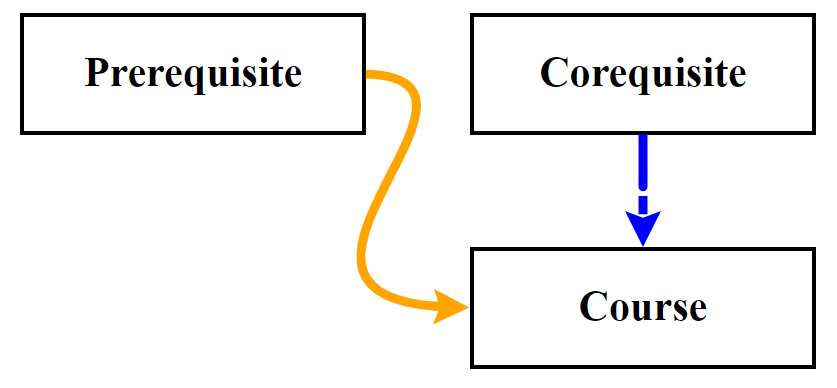
- Left click on a course to draw arrows between that course and its prerequisites and corequisites, as well as the courses it is a prerequisite and corequisite for.
- Right click on a course to have its Calendar description stay in place.
- Switch the ordering of course groups by toggling the buttons to the right of the selected plan. The selected course group will be displayed first (before the other course group).
- Switch between plans by toggling the buttons below "Plan".
- Highlight all courses in a category by left-clicking on one of the colored boxes to the right of the course group selector.
- To clear all selections, refresh the page.
Plan
Fall Term 1
CHEM 103
★ 4.3
(fi 6)(either term,
3-1s-3/2)
Atoms and molecules, states of matter, chemistry of the elements. Prerequisite: Chemistry 30, or equivalent. Note: Restricted to Engineering students only. Other students who take this course will receive *3.0.
Accreditation Units
ENGG 100
★ 1.1
(fi 2)(either term,
1.5-1.5-0)
An introduction to the Faculty of Engineering, the engineering profession, the skills required for academic success, and the fundamentals of leadership: study and life skills; time management and goal setting; interpersonal skills; career planning; engineering and society including elements of ethics, equity, concepts of sustainable development, environmental stewardship, and public safety.
Accreditation Units
ENGG 130
★ 4.0
(fi 6)(either term,
3-0-2)
Equilibrium of planar systems. Analysis of statically determinate trusses and frames. Friction. Centroids and centres of gravity. Forces and moments in beams. Second moments of area. Note: Students in all sections of this course will write a common final examination. Corequisite: MATH 100.
Accreditation Units
ENGL 199
★ 3.0
(fi 6)(either term,
3-0-0)
This course aims to develop the student's ability to provide effective written and oral information. It will focus on instruction in fundamental writing skills, including building effective sentences and paragraphs, and on learning to communicate clearly across a range of genres and media used in academic and professional contexts, including correspondence and presentations. Students will be introduced to the principles of information gathering, analysis, and citation. Note: Restricted to students in the Faculty of Engineering only.
Accreditation Units
MATH 100
★ 3.5
(fi 6)(either term,
3-0-1)
Review of numbers, inequalities, functions, analytic geometry; limits, continuity; derivatives and applications, Taylor polynomials; log, exp, and inverse trig functions. Integration, fundamental theorem of calculus substitution, trapezoidal and Simpson's rules. Prerequisites: Mathematics 30-1 and Mathematics 31. Notes: (1) Credit can be obtained in at most one of MATH 100, 113, 114, 117, 134, 144, 154, or SCI 100. (2) Students in all sections of this course will write a common final examination. (3) Restricted to Engineering students. Non-Engineering students who take this course will receive *3.0.
Accreditation Units
PHYS 130
★ 3.8
(fi 6)(either term,
3-0-3/2)
Geometrical optics, optical instruments, oscillations, waves, sound, interference, diffraction. Prerequisites: Mathematics 30-1, Mathematics 31, Physics 30. Corequisite: MATH 100 or 113 or 114 or 117 or 134 or 144 or equivalent. Restricted to Engineering students. Other students who take this course will receive *3.0.
Accreditation Units
Winter Term 2
CHEM 105
★ 3.8
(fi 6)(either term,
3-0-3/2)
Rates of reactions, thermodynamics and equilibrium, electrochemistry, modern applications of chemistry. Prerequisite: CHEM 103. Note: Restricted to Engineering students only. Other students who take this course will receive *3.0.
Accreditation Units
ENCMP 100
★ 3.8
(fi 6)(either term,
3-0-1.5)
Fundamentals of computer programming with emphasis on solving engineering problems. Structure and syntax of computer programs, variables, data types, data structures, control structures, functions, input/output operations, debugging, software development process.
Accreditation Units
ENGG 160
★ 2.0
(fi 4)(either term or Spring/Summer,
1-0-2)
Fundamental design process and theory in a multidisciplinary context. Importance, in engineering design, of communications; team work; the engineering disciplines, career fields; professional responsibilities of the engineer including elements of ethics, equity, concepts of sustainable development and environmental stewardship, public and worker safety and health considerations including the context of the Alberta Occupational Health and Safety Act. Corequisite ENGL 199. This course is delivered in a blended format.
Accreditation Units
EN PH 131
★ 4.3
(fi 6)(either term,
3-1s-3/2)
Kinematics and dynamics of particles; gravitation; work and energy; linear momentum; angular momentum; systems of particles; introduction to dynamics of rigid bodies. Prerequisites: MATH 100 or 117, and ENGG 130. Corequisite: MATH 101 or 118. Restricted to Engineering students. Other students who take this course will receive *3.0.
Accreditation Units
MATH 101
★ 3.5
(fi 6)(either term,
3-0-1)
Area between curves, techniques of integration. Applications of integration to planar areas and lengths, volumes and masses. First order ordinary differential equations: separable, linear, direction fields, Euler's method, applications. Infinite series, power series, Taylor expansions with remainder terms. Polar coordinates. Rectangular, spherical and cylindrical coordinates in 3-dimensional space. Parametric curves in the plane and space: graphing, arc length, curvature; normal binormal, tangent plane in 3- dimensional space. Volumes and surface areas of rotation. Prerequisite: MATH 100. Notes: (1) Credit can be obtained in at most one of MATH 101, 115, 118, 136, 146, 156 or SCI 100. (2) Students in all sections of this course will write a common final examination. (3) Restricted to Engineering students. Non-Engineering students who take this course will receive *3.0.
Accreditation Units
MATH 102
★ 3.5
(fi 6)(either term,
3-0-1)
Vectors and matrices, solution of linear equations, equations of lines and planes, determinants, matrix algebra, orthogonality and applications (Gram-Schmidt), eigenvalues and eigenvectors and applications, complex numbers. Prerequisite or corequisite: MATH 100. Notes: (1) Credit can be obtained in at most one of MATH 102, 125, or 127. (2) Students in all sections of this course will write a common final examination. (3) Restricted to Engineering students. Non-Engineering students who take this course will receive *3.0.
Accreditation Units
Fall Term 3
CIV E 270
★ 4.5
(fi 6)(either term or Spring/Summer,
3-0-3)
Plane stress and strain; stress-strain relationships; stresses and deformations resulting from axial and transverse loads; buckling of columns; torsion of circular sections; combined stress; statically indeterminate problems. Laboratory to demonstrate mechanical properties and verify assumptions of analysis. Prerequisites: ENGG 130 and MATH 101.
Accreditation Units
MATH 209
★ 3.5
(fi 6)(either term,
3-0-1)
Partial differentiation, derivatives of integrals. Multiple integration using rectangular, cylindrical, and spherical coordinates. Vector Field Theory. Prerequisite: MATH 101. Prerequisite or corequisite: MATH 102. Notes: (1) This course may not be taken for credit if credit has already been obtained in MATH 215 or 317. (2) Students in all sections of this course will write a common final examination. (3) Restricted to Engineering students. Non-Engineering students who take this course will receive *3.0.
Accreditation Units
STAT 235
★ 3.8
(fi 6)(either term or Spring/Summer,
3-0-1.5)
Descriptive data analysis. Calculus of Probability. Binomial, multinomial, Poisson, normal, beta, exponential, gamma, hypergeometric, and Weibull distributions. Sampling distributions. Estimation, testing hypotheses, goodness-of-fit tests, and one-way analysis of variance. Linear correlation and regression. Sampling. Quality control. Use of a microcomputer software package for statistical analyses in engineering applications. Prerequisite: MATH 100. Corequisite: MATH 101. Notes: (1) This course may not be taken for credit if credit has already been obtained in one of STAT 141, 151, 222, 265, 266; PSYCH 211, SCI 151 or SOC 210. (2) Intended for Engineering students. Other students who take this course will receive *3.0.
Accreditation Units
Course Group 2A
CH E 243
★ 3.5
(fi 6)(either term or Spring/Summer,
3-1s-0)
An introduction to the first and second laws of thermodynamics. Prerequisites: MATH 101.
Accreditation Units
MEC E 200
★ 2.0
(fi 4)(either term or Spring/Summer,
1-2s-0)
Introduction to the profession of mechanical engineering with special emphasis of industries in Alberta, including coverage of elements of ethics, equity, concepts of sustainable development and environmental stewardship, public and worker safety and health considerations including the context of the Alberta Occupational Health and Safety Act. Selected guest speakers on design problems in mechanical engineering. Communication skills including written and oral presentations.
Accreditation Units
MEC E 250
★ 3.5
(fi 6)(either term or Spring/Summer,
3-1s-0)
Moments of inertia. Kinematics and kinetics of rigid body motion, energy and momentum methods, impact, mechanical vibrations. Prerequisites: ENGG 130, EN PH 131 and MATH 101. There is a consolidated exam.
Accreditation Units
Winter Term 4
ECE 209
★ 3.8
(fi 6)(either term or Spring/Summer,
3-0-3/2)
Physical concepts of passive circuit elements, Kirchhoff's laws and DC circuit equations. Energy concepts, time domain analysis of AC circuits. Impedance, complex numbers and phasor algebra. AC power concepts, resonance, three phase circuits, introduction to machines. Credit may be obtained in only one of ECE 209, E E 239, ECE 202, or E E 240, unless approved by the Department.
Accreditation Units
MAT E 202
★ 3.5
(fi 6)(either term or Spring/Summer,
3-1.5s/2-)
An introduction to the science of materials relating their mechanical, thermal, electronic, and chemical properties to atomic, molecular, and crystal structure. Ceramic and metallic crystals, glasses, polymers, and composite materials. Multi-phase materials, phase transformations, and strengthening processes. Laboratories and seminars include mechanical properties of materials, microstructure, heat treatment of steel, and hands on design experiments. Prerequisite: CHEM 105 or consent of Department.
Accreditation Units
MATH 201
★ 3.5
(fi 6)(either term or Spring/Summer,
3-0-1)
First-order equations; second-order linear equations: reduction of order, variation of parameters; Laplace transform; linear systems; power series; solution by series; separation of variables for PDEs. Prerequisite or corequisite: MATH 209 or 214. Notes: (1) Open only to students in Engineering, Specialization Physics, and Specialization Geophysics. (2) Credit can be obtained in at most one of MATH 201, 334 or 336. (3) Students in all sections of this course will write a common final examination. Non-Engineering students who take this course will receive *3.0.
Accreditation Units
Course Group 2B
MEC E 230
★ 3.5
(fi 6)(either term or Spring/Summer,
3-1s-0)
Introduction to modes of heat transfer. One dimensional heat conduction. Heat transfer from surfaces. Introduction to fluid mechanics. Fluid properties. Fluid statics. Use of control volumes. Internal flows. Prerequisites: MATH 101, EN PH 131.
Accreditation Units
MEC E 260
★ 3.5
(fi 6)(either term or Spring/Summer,
2-0-3)
Design morphology, analysis and design of components, mechanical design with electric motors, computer-aided design introduction, design project. Prerequisite: ENGG 160. Corequisite: MEC E 265 and CIV E 270.
Accreditation Units
MEC E 265
★ 3.5
(fi 6)(either term or Spring/Summer,
2-0-3)
Engineering drawing and sketching, conventional drafting, computer-aided drawing in 2D and 3D, solid modelling, and computer-aided design.
Accreditation Units
Fall Term 5
Course Group 3A
MATH 300
★ 3.0
(fi 6)(either term or Spring/Summer,
3-0-0)
Derivation of the classical partial differential equations of applied mathematics, solutions using separation of variables. Fourier expansions and their applications to boundary value problems. Introduction to Fourier Transforms. Emphasis on building an appropriate mathematical model from a physical problem, solving the mathematical problem, and carefully interpreting the mathematical results in the context of the original physical problem. Prerequisites: MATH 201 and 209. Notes: (1) Open only to students in Engineering, Specialization Physics, and Specialization Geophysics. (2) Credit can be obtained in at most one of MATH 300 and 337. (3) Course cannot be taken for credit if credit has been obtained in ECE 341.
Accreditation Units
MEC E 300
★ 3.5
(fi 6)(either term or Spring/Summer,
3-1s-0)
Characterization and behavior of measuring systems. Statistics and analysis of measurement data; measurement techniques applied to fundamental mechanical engineering phenomena. Prerequisites: CIV E 270, ECE 209, STAT 235. Corequisite: MEC E 330 or MEC E 331.
Accreditation Units
MEC E 301
★ 2.5
(fi 6)(either term or Spring/Summer,
1-0-3)
Laboratory experiments in mechanical engineering measurement techniques, treatment of measurement data, introduction to engineering report writing. Corequisite: MEC E 300.
Accreditation Units
MEC E 331
★ 3.5
(fi 6)(either term or Spring/Summer,
3-0-1)
External flow, boundary layers, momentum theories, similitude, fluid metering, fluid friction, fluid friction in pipes, pipe networks. Prerequisites: MEC E 230, 250, MATH 209. Corequisite: CH E 243. Credit can only be granted for one of MEC E 330 or MEC E 331.
Accreditation Units
MEC E 371
★ 3.5
(fi 6)(either term or Spring/Summer,
3-1s-0)
Mechanisms of heat transfer, steady and unsteady heat conduction, numerical analysis, thermal radiation, free and forced convection, heat exchanger analysis and heat transfer with change of phase and mass transfer. Prerequisites: MEC E 230, CH E 243. Corequisites: MATH 300 and MEC E 331. Credit can only be granted for one of MEC E 370 or MEC E 371.
Accreditation Units
MEC E 380
★ 3.5
(fi 6)(either term or Spring/Summer,
3-1s-0)
Stress, strain, stress-strain relation, time-independent and time-dependent behavior, virtual work and energy theorems, deformations, indeterminate systems, matrix methods. Prerequisite: CIV E 270.
Accreditation Units
Winter Term 6
Course Group 3B
ENG M 310
★ 3.0
(fi 6)(either term or Spring/Summer,
3-0-0)
The application of the fundamentals of economics to engineering alternatives in planning, developing and managing industrial projects. Note: Credit cannot be obtained for more than one of ENGG 310, 401, ENG M 310 or 401.
Accreditation Units
OR
ENG M 401
★ 3.0
(fi 6)(either term,
3-0-0)
The application of the fundamentals of engineering economics, financial analysis and market assessment to engineering alternatives in the planning, development and ongoing management of industrial enterprises. The course covers the use of engineering, economic, financial and market assessment information in investment and business operation decisions in technology oriented companies. Note: Credit cannot be obtained for more than one of ENGG 310, ENGG 401, ENG M 310, or ENG M 401.
Accreditation Units
MEC E 340
★ 3.5
(fi 6)(either term or Spring/Summer,
3-0-1)
Review of thermodynamic principles. Applications to gas compressors, vapour and gas power cycles, heat pump cycles. Availability analysis. Psychrometrics. Combustion analysis. Prerequisite: CH E 243.
Accreditation Units
MEC E 360
★ 3.8
(fi 6)(either term or Spring/Summer,
3-0-1.5)
Design procedures, theories of failure, material selection, design for fatigue, creep and relaxation, selection of gears and bearings and application of computer-aided design software. Prerequisite: MEC E 260 and 265, MAT E 202 and CIV E 270. Corequisite: MEC E 362 or MEC E 350.
Accreditation Units
MEC E 362
★ 3.8
(fi 6)(either term or Spring/Summer,
3-0-1.5)
Velocities and acceleration in plane mechanisms, balancing of rotating and reciprocating machinery, gears and gear trains. Prerequisite: MEC E 250.
Accreditation Units
MEC E 390
★ 3.5
(fi 6)(either term or Spring/Summer,
3-0-1)
Application of numerical methods to mechanical engineering problems; topics include sources and definitions of error, root finding, solutions of linear and non-linear systems of equations, regression, interpolaton, numerical integration and differentiation, solution of initial value and boundary value ordinary differential equations. Applications include dynamics, solid mechanics, heat transfer and fluid flow. Prerequisites: MATH 102 and 201.
Accreditation Units
Complementary Elective
A complementary elective of the student's choice. Please consult the calendar for more information.
Fall Term 7
Program/Technical Elective
A program/technical elective of the student's choice. Please consult the calendar for more information.
Program/Technical Elective
A program/technical elective of the student's choice. Please consult the calendar for more information.
Course Group 4A
ENGG 404
★ 3.8
(fi 6)(either term or Spring/Summer,
3-3s/2-0)
Basic concepts of risk and consequences of loss incidents; risk management principles and practices; incident investigation, causation, root cause analysis; process safety management; the roles of government agencies, professional bodies and industry associations; workplace safety; risk-based decision-making processes; leadership and the human-factors side of risk management. The course focuses on the principles and practices of leadership towards the effective application and implementation of risk management in major organizations across all engineering disciplines. Industry virtual tours, case studies, seminars and team projects specific to the student's engineering program will be used to develop competencies and proficiencies in applying leadership and organizational effectiveness for successful risk management.
Accreditation Units
MEC E 430
★ 3.0
(fi 6)(either term or Spring/Summer,
3-0-0)
Navier-Stokes equations, introductory computational fluid dynamics, boundary layers, compressible fluid flow (variable area ducts, normal and oblique shock waves, Prantdl-Meyer expansions, adiabatic and isothermal pipe flow), two phase flow. Prerequisite: MEC E 330 or 331.
Accreditation Units
OR
MEC E 480
★ 3.0
(fi 6)(either term or Spring/Summer,
3-0-0)
Special topics for beams, torsion, pressure vessels, plane stress and strain, stability, fracture mechanics. Prerequisites: MEC E 360, 380, MATH 300.
Accreditation Units
MEC E 463
★ 4.0
(fi 6)(either term or Spring/Summer,
3-0-2)
Design and optimization of thermo-fluid systems, heating and ventilating equipment and load calculations, system design, piping networks, heat exchanger analysis and design, computer-aided design projects. Prerequisites: MEC E 330 or 331, 340, and 370 or 371.
Accreditation Units
Program/Technical Elective
A program/technical elective of the student's choice. Please consult the calendar for more information.
Winter Term 8
CH E 448
★ 4.0
(fi 6)(second term,
3-1s-3/3)
Introduction to systems modeling and transient response analysis with an emphasis on mechanical engineering applications; design and analysis of feedback systems; stability analysis; feedforward control; process control applications. Prerequisites: MATH 201 or equivalent, MATH 209, and MEC E 330 or MEC E 331. Corequisite: MEC E 370 or MEC E 371. Restricted to students registered in the Mechanical Engineering program. Credit may not be obtained in this course if previous credit has been obtained for CH E 446.
Accreditation Units
OR
MEC E 420
★ 3.8
(fi 6)(either term or Spring/Summer,
3-0-3/2)
Design of linear feedback control systems for command-following error, stability, and dynamic response specifications. PID, Root-locus, frequency response and design techniques. An introduction to structural design limitations. State Space methods. Examples emphasizing Mechanical Engineering systems. Some use of computer aided design with MATLAB/Simulink. Controls Lab - control of mechanical systems. Prerequisites: MEC E 390. Credit can only be granted for one of MEC E 420, ECE 362, CH E 448.
Accreditation Units
ENGG 400
★ 1.0
(fi 2)(either term,
1-0-0)
The technical and professional duties and responsibilities of the engineer; the ethics of the engineering profession; technical and professional organizations. The role of the engineer in the social environment including elements of equity, concepts of sustainable development and environmental stewardship, public and worker safety and health considerations including the context of the Alberta Occupational Health and Safety Act. Note: Restricted to fourth-year traditional and fifth-year co-op engineering students. Must be taken in last term of program.
Accreditation Units
Program/Technical Elective
A program/technical elective of the student's choice. Please consult the calendar for more information.
Course Group 4B
MEC E 403
★ 2.5
(fi 6)(either term or Spring/Summer,
1-0-3)
Selected laboratory experiments in applied mechanics and thermosciences. Prerequisites: MEC E 300, 301, 340 and 360.
Accreditation Units
MEC E 451
★ 3.5
(fi 6)(either term or Spring/Summer,
3-0-1)
Free and forced vibration of single degree of freedom systems with and without damping, vibration isolation, free vibration of multi degrees of freedom systems, vibration absorption, beam vibrations, sound waves, sound sources, subjective aspects of noise. Prerequisites: MEC E 250 and MATH 300.
Accreditation Units
MEC E 460
★ 4.5
(fi 6)(either term or Spring/Summer,
2-1s-4)
Feasibility study and detailed design of a project which requires students to exercise creative ability, to make assumptions and decisions based on synthesis of technical knowledge, and in general, devise new designs, rather than analyse existing ones. Prerequisites: MEC E 200, 330 or 331, 340, 360, 362, 370 or 371, 380 or MCTR 365. Corequisite: ENG M 310 (or ENG M 401).
Accreditation Units
ITS Elective
An ITS elective of the student's choice. Please consult the calendar for more information.
Minimum one from this list
MEC E 467
★ 4.5
(fi 6)(either term or Spring/Summer,
3-0-3)
Modeling and analysis of systems and processes that include technological decision making. Formulation and solution methods for systems including associated resource requirements and other system inputs. Numerical methods for simulation. Projects will involve simulation software to support analysis and design of engineering systems and processes. Prerequisites: MEC E 250 and 390. Note that credit cannot be obtained in both MEC E 467 and ENG M 541.
Accreditation Units
MEC E 468
★ 4.5
(fi 6)(either term or Spring/Summer,
3-0-3)
Computer modelling in mechanical engineering. Simulation of mechanisms. Stress analysis and heat transfer using commercial software. Emphasis is on numerical model design including testing and verification methods, and the critical interpretation of the computed results. Credit cannot be obtained in both MEC E 468 and 568. Prerequisites: MEC E 265, 362, 370 or 371, 380, 390.
Accreditation Units
MEC E 539
★ 4.5
(fi 6)(either term or Spring/Summer,
3-0-3)
Model selection and simplification, grid generation and grid independence, transient and advection terms treatment, turbulence modeling, verification and validation, best practices. Hands-on experience with commercial CFD codes to demonstrate the application of: theory, proper setup and analysis. Prerequisites: MEC E 390, and 331 or equivalent.
Accreditation Units
MEC E 563
★ 4.5
(fi 6)(either term or Spring/Summer,
3-0-3)
Application of finite element methods to mechanical engineering problems; topics include direct stiffness methods, assembly, constraints, solution techniques, post-processing, element types and the Galkerin procedure. Applications include beam truss and frame analysis, plane strain and stress problems, heat transfer and dynamic analysis Prerequisites: MATH 300, MEC E 360, 390.
Accreditation Units
ELECTIVES_A
ACCTG 300
★ 3.0
(fi 6)(either term,
3-0-0)
Provides a basic understanding of accounting: how accounting numbers are generated, the meaning of accounting reports, and how to use accounting reports to make decisions. Note: Not open to students registered in the Faculty of Business. Not for credit in the Bachelor of Commerce Program.
Accreditation Units
ACCTG 311
★ 3.0
(fi 6)(either term,
3-1.5s-0)
How to prepare and interpret financial statements that report to decision makers external to the enterprise, such as shareholders and creditors. Course includes principles and standards of balance sheet valuation, income measurement, financial disclosure and cash flow analysis that link preparation and use of such statements. Prerequisites: ECON 101 and 102.
Accreditation Units
B LAW 301
★ 3.0
(fi 6)(either term,
3-0-0)
Synoptic view of Canadian legal system, with emphasis on underlying considerations of social policy. While considering the nature, sources, philosophy, and policy objectives of the law, selected topics from the fields of tort and contract will be analyzed. Credit will be granted for only one of B LAW 301 and ENGG 420.
Accreditation Units
B LAW 422
★ 3.0
(fi 6)(either term,
3-0-0)
Introduction to the role of the corporation in the business and commercial life of Canada and Alberta, with emphasis on the small private company. Topics include characteristics of corporate existence, process of incorporation, forming a private company, relationship with third parties, distinction between management and ownership, duties of directors and officers, and shareholder rights. Prerequisite: B LAW 301 or ENGG 420.
Accreditation Units
B LAW 444
★ 3.0
(fi 6)(either term,
3-0-0)
An overview of current international business patterns and the laws surrounding such patterns, with an emphasis on what makes them different from domestic ones. A major force underlying the internationalization of the world economy has been the rapid, sustained growth of international business, both in the traditional form of international trade and in the newer forms of multinational, global and transnational business. This course is designed to provide the student with a basic understanding of the major rules governing cross-border commercial transaction in the contexts of both substantive and procedural law.
Accreditation Units
BIOCH 200
★ 3.0
(fi 6)(either term,
3-0-0)
An introduction to the fundamental principles of biochemistry. Protein structure and function; enzymes; lipids and the structure of biological membranes; nucleotides and the structure of nucleic acids; bioenergetics and the catabolism of carbohydrates. Prerequisites: CHEM 101 and CHEM 261 or 164, or SCI 100.
Accreditation Units
BIOL 107
★ 3.0
(fi 6)(either term,
3-1s-3)
An introduction to cell structure and function. Major topics include the molecules and structures that comprise prokaryotic and eukaryotic cells, the mechanisms by which energy is harvested and used by cells, how cells reproduce, and how information is stored and used within a cell via the processes of DNA replication, transcription, and translation. Prerequisites: Biology 30 and Chemistry 30. Note: BIOL 107 is not a prerequisite for BIOL 108. BIOL 107 and 108 can be taken in either term.
Accreditation Units
BIOL 108
★ 3.0
(fi 6)(either term,
3-1s-3)
Examines the major lineages of life on Earth. Overview of evolutionary principles and classification, the history of life, and the key adaptations of prokaryotes, protists, fungi, plants, and animals. Laboratories survey the diversity of biological form and function, and introduce students to data collection and scientific writing. Prerequisite: Biology 30. Note: BIOL 107 is not a prerequisite for BIOL 108. BIOL 107 and 108 can be taken in either term.
Accreditation Units
ELECTIVES_B
BIOL 207
★ 3.0
(fi 6)(either term,
3-1s-3)
The chromosomal and molecular basis for the transmission and function of genes. The construction of genetic and physical maps of genes and genomes. Strategies for the isolation of specific genes. Examples of regulatory mechanisms for the expression of the genetic material in both prokaryotes and eukaryotes. Prerequisite: BIOL 107 or SCI 100.
Accreditation Units
BME 320
★ 3.0
(fi 6)(first term,
3-0-0)
An introduction to the fundamental levels of organization of the human body highlighted in engineering terms. The first half of the course will consider the chemical, cellular, and tissue levels of organization. The second half of the course will be devoted to bone, joints, muscle, and neural tissue. Guest lectures will include engineers and medical scientists to discuss the relationship between recent advances in biomedical engineering and the underlying anatomy and physiology. This course is intended for students in the Faculty of Engineering. Students from other faculties must obtain the consent of the Department of Biomedical Engineering. Credit may be obtained for only BME 210 or 320.
Accreditation Units
BME 321
★ 3.0
(fi 6)(second term,
3-0-0)
An introduction to the organization of the human body at the level of the anatomical systems highlighted in engineering terms. Lectures will be devoted to the circulatory, respiratory, digestive, urinary, nervous and endocrine systems, and fluid, electrolyte and acid-base homeostasis. Guest lectures will include engineers and medical scientists to discuss the relationship between recent advances in biomedical engineering and the underlying anatomy and physiology. This course is intended for students in the Faculty of Engineering. Students from other faculties must obtain the consent of the Department of Biomedical Engineering. Credit may be obtained for only BME 211 or 321. Prerequisite: BME 320 or consent of Instructor.
Accreditation Units
BME 410
★ 3.0
(fi 6)(second term,
3-0-0)
Introduces the broad field of biomedical engineering while focusing on the quantitative methods and modelling in key areas that emphasize the similarities between biomedical and conventional engineering science. Practical numerical models of several body systems will be covered, with an emphasis on development, evaluation and validation of realistic physiological models using computational methods. Intended primarily for undergraduate students of the Engineering program. Students from other faculties must obtain the consent of the Department of Biomedical Engineering. Prerequisite BME 320.
Accreditation Units
BME 513
★ 3.0
(fi 6)(second term,
3-0-0)
Introduction to basic physical and technological aspects of medical imaging. Emphasis on computed transmission and emission tomography, magnetic resonance, and ultrasound imaging. These methods are developed and contrasted in terms of how imaging information is generated, detected, and processed and how different hardware configurations and other factors limit image quality. Relative diagnostic potential of the imaging methods is also discussed in relation to future prospects of each method.
Accreditation Units
BME 553
★ 3.0
(fi 6)(second term,
3-1s-0)
Introduction to rehabilitation techniques for assisting individuals with physical disabilities to reach, stand and walk. Biomechanics of intact and pathological movements and the use of assistive devices such as exoskeletal orthotics, neuroprosthetic devices and locomotor training are emphasized. Students are exposed to the concepts of biomechanical modeling, motion analysis, electrical stimulation, control systems, neuroregeneration, and pharmacology. Prerequisite: BME 320 and 321 or consent of Instructor.
Accreditation Units
BME 564
★ 3.0
(fi 6)(first term,
3-0-0)
Designed for graduate and advanced undergraduate students requiring a thorough grounding in the fundamentals of imaging by means of nuclear magnetic resonance, NMR. Topics include the principles of NMR as applied to imaging, image processing, imaging techniques for achieving specific types of contrast, image artefacts, and typical applications. Prerequisite: Consent of instructor.
Accreditation Units
CH E 582
★ 3.0
(fi 6)(either term,
3-1s-0)
Survey of materials intended for biological applications; biomaterials-related biological phenomena (protein adsorption, blood coagulation and cell adhesion); biomaterials for engineering of blood vessel, bone and skin tissues. Two fundamental engineering philosophies will be stressed: structure-function relationship and purposeful manipulation for a desired outcome. Prerequisite: BIOL 107 or BME 210 or CH E 484 or consent of Instructor.
Accreditation Units
ELECTIVES_C
CHEM 261
★ 3.0
(fi 6)(either term,
3-0-3)
The correlation of structure and chemical bonding in carbon compounds with the physical properties and chemical reactivity of organic molecules. Discussion will be based on functional groups with emphasis on hydrocarbons and derivatives that contain halogens, oxygen, sulfur, and the hydroxy group. Introduction to stereochemistry, three dimensional structure, reaction mechanisms, especially addition to double bonds, nucleophilic substitution and elimination reactions. Prerequisite CHEM 101 or 103. Note: Students who have obtained credit for CHEM 161 or 164 cannot take CHEM 261 for credit. Engineering students who take this course will receive *4.5.
Accreditation Units
CHEM 263
★ 3.0
(fi 6)(either term,
3-0-3)
Continuation of the structural and chemical properties of the basic functional groups of organic compounds including alkynes, aromatic compounds, aldehydes, ketones, carboxylic acids and their derivatives and amines. Illustration of these functional groups in natural products such as carbohydrates, amino acids and proteins, nucleic acids and lipids. Discussion of the application of spectroscopic methods for the structure determination in simple organic molecules. Prerequisites: CHEM 161 or 164 or 261 or SCI 100. Note: Students who have obtained credit for CHEM 163 cannot take CHEM 263 for credit.
Accreditation Units
ECE 405
★ 3.0
(fi 6)(first term,
3-0-0)
Introduction to the principles of biophysical instrumentation. Various sensors are examined including strain gages, inductive, capacitive, thermal, and piezoelectric sensors. Methods of measuring blood pressure are discussed. Origin of biopotentials; membrane and action potentials. Measurement of bioelectrical signals such as the ECG and EMG. Electrical safety, noise, impedance matching, and analog-to-digital conversion. Applications of electrodes, biochemical sensors, and lasers. Prerequisite: ECE 203 or E E 250 or consent of the Instructor. Credit may be obtained in only one of ECE 405 or EE BE 512.
Accreditation Units
ECE 440
★ 3.0
(fi 6)(either term,
3-0-3/2)
Extension of sampling theory and the Fourier transform to two dimensions, pixel operations including gray-level modification, algebraic and geometric transformations. The design of spatial filters for noise reduction, image sharpening and edge enhancement, and some discussion of interpolation techniques. An introduction to the concepts of image restoration from known degradations and the reconstruction of images from parallel and fan projections. Prerequisite: ECE 340 or E E 338 or consent of Instructor. Credit may be obtained in only one of EE BE 540 or ECE 440.
Accreditation Units
ECE 449
★ 3.0
(fi 6)(either term,
3-0-3/2)
Intelligent systems for automatic control and data analysis. The concepts of vagueness and uncertainty, approximate reasoning, fuzzy rule-based systems and fuzzy control. Strategies for learning and adaptation, supervised and reinforcement learning, self-organization and the selection of neural network architectures. Discussion of the principles of search and optimization, evolution and natural selection and genetic algorithms. Introduction to hybrid intelligence. Applications of intelligent systems for pattern recognition, classification, forecasting, decision support, and control. Credit may be obtained in only one of CMPE 449 or ECE 449.
Accreditation Units
ENGG 406
★ 3.0
(fi 6)(either term or Spring/Summer,
3-3s/2-0)
Basic concepts of risk and consequences of loss incidents; risk review methodologies and tools: hazard and operability (HAZOP), failure modes and effects analysis (FMEA), fire and explosion indices (F&EI),chemical exposure index (CEI), layers of protection analysis (LOPA) including hazard identification, risk analysis, risk assessment, loss prevention and control; process safety management; specific occupational health & safety code compliance requirements for professional engineers. Case studies and industrial tour(s) demonstrate the application of specialized tools and methodologies in complex industrial operations across all engineering disciplines. Seminars and team projects develop competencies and proficiencies in applying these specialized methodologies and tools towards proactive risk management. Requires payment of additional student instructional support fees. Refer to the Fees Payment Guide in the University Regulations and Information for Students section of the Calendar.
Accreditation Units
ENGG 420
★ 3.0
(fi 6)(either term,
3-0-0)
Contracts; specifications; tenders; bonds; construction contract forms; Public Works Act; Workers' Compensation Act; building trades; company law; the engineer as an expert witness; patents; trade marks; copyrights; negligence; arbitration. Note: Restricted enrolment. Registration approval by Dean's office only. Credit will not be granted for both ENGG 420 and B LAW 301.
Accreditation Units
ENG M 402
★ 3.0
(fi 6)(either term,
3-0-0)
Introduction to the conceptual and practical considerations in identifying and developing new products. The theory and practice of project management applied to the creation of new business activities and ventures will be discussed. Topics include project management, innovation and entrepreneurship, business planning, marketing, and mobilizing human and financial resources. These will be applied in the development of a business plan for a business concept. The course is intended to provide engineering and business students with an awareness of specific planning, budgeting and scheduling techniques that can be used to implement and monitor new business activities. This course is open to Business and Science students with consent of Instructor. Note: Credit cannot be obtained for both ENGG 402 and ENG M 402.
Accreditation Units
ELECTIVES_D
ENG M 406
★ 3.0
(fi 6)(either term,
3-0-0)
Assessing impact of technology on companies and society using marketing principles. How societal issues drive customer needs and how those needs are recognized and met. Topics include pre-engagement strategies (market research methods, customer contact process, customer/client adoption life cycle), engagement strategies (proposal preparation, contract development, and scheduling) and post-engagement strategies (winning contracts and developing long-term sound client relationships). Prerequisites: Open to all third or fourth year engineering students, or consent of instructor.
Accreditation Units
ENG M 408
★ 3.0
(fi 6)(either term,
3-0-3/2)
Manufacturing process modeling and system design; computer aided process planning; scheduling of manufacturing activities; computer aided manufacturing; integration for different machining processes; plastic parts and mold design; sheet metal parts and die design; robotics in manufacturing; welding process and control; Design considerations; Shop floor control; and engineering collaboration. Prerequisite: MEC E 265.
Accreditation Units
ENG M 501
★ 3.0
(fi 6)(either term,
3-0-0)
Production and operations management, analysis, and design of work, forecasting, inventory management including MRP, JIT, and Kanban, maintenance management, facility layout, operations scheduling, and project planning and management. Credit cannot be obtained in both ENG M 501 and MEC E 513. Prerequisites: one of ENGG 310, 401 or ENG M 310, 401 and STAT 235 or equivalent.
Accreditation Units
ENG M 508
★ 3.0
(fi 6)(either term,
3-0-0)
Concepts and value of energy management and conservation. Methodologies for energy management in energy intensive systems in various industries. Energy auditing methods and implementation. Energy accounting and economic analysis. Energy audits and maintenance. Exposure to software for energy auditing.
Accreditation Units
ENG M 510
★ 3.0
(fi 6)(either term,
3-0-0)
Quality engineering and management evolution, definitions, concepts and principles. Essential quality management theories and models. ISO 9000 principles models and applications. Seven quality engineering and management tools. Quality function deployment. Failure analysis. Quality costing. Statistical quality. Credit cannot be obtained in both ENG M 510 and MEC E 512. Prerequisites: STAT 235 or equivalent.
Accreditation Units
ENG M 514
★ 3.0
(fi 6)(either term,
3-0-0)
Concepts of reliability, failure rate, maintainability, and availability. Properties of various statistical distributions and their applications in reliability engineering. Failure data analysis techniques including probability plotting. Load and strength interference in mechanical component design. System reliability models and system reliability evaluation methods. Optimal system design considering reliability issues. Prerequisite: STAT 235 or equivalent.
Accreditation Units
ENG M 516
★ 3.0
(fi 6)(either term,
3-0-0)
Maintenance management of industrial assets. Preventative maintenance decisions. Spare parts provisioning. Predictive maintenance decisions. Reliability centered maintenance. Total productive maintenance. Case studies. Prerequisite: STAT 235 or equivalent.
Accreditation Units
ENG M 530
★ 3.0
(fi 6)(either term,
3-0-0)
Introduction to project management tools, techniques, templates, and methodologies. This course examines the eight knowledge areas of the Project Management Institute (PMI) which provide an integrated approach to managing engineering projects. Prerequisites: One of ENGG 310, 401 or ENG M 310, 401.
Accreditation Units
ELECTIVES_E
ENG M 540
★ 3.0
(fi 6)(either term,
3-0-0)
An introduction to optimization methods in solving engineering management problems. Both modeling techniques and algorithms will be covered. Topics include linear programming, formulation and modeling techniques, the simplex method, sensitivity analysis, duality, transportation and network problems, algorithmic and heuristic methods, integer programming, and/or non-linear programming. Credit cannot be obtained in both ENG M 540 and ENG M 640.
Accreditation Units
ENG M 558
★ 3.0
(fi 6)(either term,
3-0-0)
Fundamental methods for the analysis of human systems in industrial engineering. Human-machine interaction. Engineering of the workplace and the work environment. Motion and time study. Standards in ergonomics and work design.
Accreditation Units
FIN 301
★ 3.0
(fi 6)(either term,
3-1s-0)
Types of securities and basic methods of valuation. Valuation and selection of physical and intellectual assets. Operation of asset markets and market efficiency. Risk measures and risk reduction methods. Financing policy, including choices between debt and equity financing. Note: Students are expected to have basic familiarity with microcomputer applications. Prerequisite: STAT 151, SCI 151 or equivalent. Pre- or corequisite: MGTSC 312, ACCTG 300 or 311.
Accreditation Units
MARK 301
★ 3.0
(fi 6)(either term,
3-0-0)
Students are introduced to the marketing concept and the role of marketing within the overall business framework. The basic tools of marketing are introduced: market segmentation, positioning, product, price, distribution, and promotion, together with marketing research, consumer behavior, planning, and global marketing. A critical theme of the course is the need for the marketing mix to fit with the requirements of consumers, the competitive environment, company strengths, and community expectations. These issues are considered from strategic and tactical perspectives. Prerequisites: ECON 101 and 102, MATH 113 or equivalent.
Accreditation Units
MATH 225
★ 3.0
(fi 6)(either term,
3-0-0)
Vector spaces. Inner product spaces. Examples of n-space and the space of continuous functions. Gram-Schmidt process, QR factorization of a matrix and least squares. Linear transformations, change of basis, similarity and diagonalization. Orthogonal diagonalization, quadratic forms. Applications in a variety of fields, numerical methods. Prerequisites: A 100-level linear algebra course, and one of Mathematics 31 or a 100-level calculus course. Note: Credit can be obtained in at most one of MATH 225 or 227.
Accreditation Units
MATH 311
★ 3.0
(fi 6)(either term,
3-0-0)
Complex numbers. Complex series. Functions of a complex variable. Cauchy's theorem and contour integration. Residue Theorem and its applications. Prerequisite or corequisite: MATH 209 or 215.
Accreditation Units
MAT E 345
★ 3.0
(fi 6)(second term,
3-0-0)
The environments materials experience in service. Theory of corrosion. The eight forms of corrosion. Corrosion measurements, protection, coatings, materials selection, and designing for corrosion. High temperature oxidation and its control. Degradation of non-metallic materials. Prerequisites: MAT E 201 or 202, and MAT E 341.
Accreditation Units
MAT E 466
★ 3.0
(fi 6)(either term or Spring/Summer,
3-0-0)
An advanced treatment of selected Materials Engineering topics of current interest. Prerequisite: Consent of Department.
Accreditation Units
ELECTIVES_F
MAT E 495
★ 3.0
(fi 6)(either term or Spring/Summer,
3-1s-0)
Survey of nanostructured materials, including processing techniques, properties (mechanical, physical and chemical), characterization, and characterization tools. Introduction to biomedical applications of nanomaterials for diagnosis, therapy and medical implants. Credit may not be obtained in this course if previous credit has been obtained in MAT E 458. Prerequisite: CH E 243 or equivalent, or consent of instructor
Accreditation Units
MEC E 364
★ 3.0
(fi 6)(either term or Spring/Summer,
2-0-3)
Primary manufacturing processes including casting, forming, machining, powdered metallurgy and surface technology, interactions between design, materials (metals, polymers, ceramics, composites) and processes, selected field trips and laboratory activities. Requires payment of additional student instructional support fees. Refer to the Fees Payment Guide in the University Regulations and Information for Students section of the Calendar. Prerequisite: MEC E 260.
Accreditation Units
MEC E 409
★ 3.0
(fi 6)(either term or Spring/Summer,
2-0-4)
Selected group projects in experimental measurement and mechanical design. Two to four person groups develop planning, design, testing and report writing skills on projects in applied mechanics, thermosciences and engineering management. Prerequisites: MEC E 301 and ENG M 310 or 401.
Accreditation Units
MEC E 415
★ 3.0
(fi 6)(either term or Spring/Summer,
3-0-0)
Engineering analysis is used to examine the veracity of commonly held science and technology myths. Prerequisites: MEC E 330 or 331, 340, 370 or 371, 380, 390, MATH 300.
Accreditation Units
MEC E 430
★ 3.0
(fi 6)(either term or Spring/Summer,
3-0-0)
Navier-Stokes equations, introductory computational fluid dynamics, boundary layers, compressible fluid flow (variable area ducts, normal and oblique shock waves, Prantdl-Meyer expansions, adiabatic and isothermal pipe flow), two phase flow. Prerequisite: MEC E 330 or 331.
Accreditation Units
MEC E 439
★ 3.0
(fi 6)(either term or Spring/Summer,
3-0-0)
Use of turbomachines in ground based and flight applications, thermodynamic cycles for gas turbines and cogeneration, performance predictions of propellers, compressors and turbines, air-breathing combustion and emissions. Prerequisites: MEC E 330 or 331, 340, 370 or 371, and 430.
Accreditation Units
MEC E 443
★ 3.0
(fi 6)(either term or Spring/Summer,
3-0-0)
Sources, flow and overall efficiency of use of various energy forms in society, thermodynamic analysis of energy conversion devices such as thermoelectric and magnetohydrodynamic generators, solar and fuel cells, energy from fission and fusion reactors. Prerequisite: MEC E 340.
Accreditation Units
MEC E 453
★ 3.0
(fi 6)(either term or Spring/Summer,
3-0-0)
Acoustic waves, sound transmission through walls and structures, acoustics of large and small rooms, mechanisms of sound absorption. Design of silencers. Prerequisites: MEC E 250, 330 or 331 and MATH 300. Credit cannot be obtained in both MEC E 553 and 453.
Accreditation Units
ELECTIVES_G
MEC E 464
★ 4.0
(fi 2)(either term or Spring/Summer,
1-2s-4)
Design of machine components for ease of manufacture. Application of measurement, inspection, and reverse engineering techniques. Preparation of working drawings for manufacturing. Introduction to machining operations, including hands-on machine shop practice. Evaluation of design performance. Sections offered at an increased rate of fee assessment; refer to the Tuition and Fees page in the University Regulations sections of the Calendar. Prerequisites: MEC E 260, 265, 300, and 301.
Accreditation Units
MEC E 466
★ 4.0
(fi 6)(either term or Spring/Summer,
3-0-2)
Design and analysis of building systems for maintaining the indoor environment. Design of heating, ventilation and air conditioning systems through load calculations, equipment selection and specification. Prerequisites: MEC E 340, 370 or 371.
Accreditation Units
MEC E 467
★ 4.5
(fi 6)(either term or Spring/Summer,
3-0-3)
Modeling and analysis of systems and processes that include technological decision making. Formulation and solution methods for systems including associated resource requirements and other system inputs. Numerical methods for simulation. Projects will involve simulation software to support analysis and design of engineering systems and processes. Prerequisites: MEC E 250 and 390. Note that credit cannot be obtained in both MEC E 467 and ENG M 541.
Accreditation Units
MEC E 468
★ 4.5
(fi 6)(either term or Spring/Summer,
3-0-3)
Computer modelling in mechanical engineering. Simulation of mechanisms. Stress analysis and heat transfer using commercial software. Emphasis is on numerical model design including testing and verification methods, and the critical interpretation of the computed results. Credit cannot be obtained in both MEC E 468 and 568. Prerequisites: MEC E 265, 362, 370 or 371, 380, 390.
Accreditation Units
MEC E 469
★ 2.5
(fi 5)(either term or Spring/Summer,
1-0-3)
Advanced project in experimental measurement and mechanical designs in applied mechanics, thermosciences and engineering management. Prerequisite: MEC E 409.
Accreditation Units
MEC E 480
★ 3.0
(fi 6)(either term or Spring/Summer,
3-0-0)
Special topics for beams, torsion, pressure vessels, plane stress and strain, stability, fracture mechanics. Prerequisites: MEC E 360, 380, MATH 300.
Accreditation Units
MEC E 485
★ 3.0
(fi 6)(either term,
3-0-0)
Biomechanics; mechanical characterization of biological tissues using elastic and viscoelastic models. Rheology of blood and flow properties. Static and dynamic analyses of selected physiological systems. Application of biomaterials in external and internal prostheses. Prerequisites: BME 320 and 321; MEC E 300, 362, 380; and MEC E 330 or 331. Credit cannot be obtained in both MEC E 585 and 485.
Accreditation Units
MEC E 494
★ 0.5
(fi 1)(either term or Spring/Summer,
0-1s-0)
Introduction to methods of mechanical engineering research. Organizational seminars for the research project in the following term. Prerequisites: MEC E 330, 380, and consent of Department.
Accreditation Units
ELECTIVES_H
MEC E 495
★ 3.0
(fi 6)(either term or Spring/Summer,
0-0-6)
Mechanical Engineering undergraduate research project with a faculty member. Prerequisites: MEC E 494 and consent of Department.
Accreditation Units
MEC E 537
★ 3.0
(fi 6)(either term or Spring/Summer,
3-0-0)
Boundary layer flow, vorticity, circulation and aerodynamic lift, wing theory, aeronautical applications. Prerequisite: MEC E 330 or 331.
Accreditation Units
MEC E 539
★ 4.5
(fi 6)(either term or Spring/Summer,
3-0-3)
Model selection and simplification, grid generation and grid independence, transient and advection terms treatment, turbulence modeling, verification and validation, best practices. Hands-on experience with commercial CFD codes to demonstrate the application of: theory, proper setup and analysis. Prerequisites: MEC E 390, and 331 or equivalent.
Accreditation Units
MEC E 541
★ 3.0
(fi 6)(either term or Spring/Summer,
3-0-0)
History of basic cycles, combustion theory including ignition flame propagation and engine knock, cycle analysis with deviations from ideal cycles and performance characteristics, fuels, design and operation of carburation and injection processes, exhaust emissions measurements. Identification of design parameters and their effect on emissions. Prerequisite: MEC E 340.
Accreditation Units
MEC E 551
★ 3.0
(fi 6)(either term or Spring/Summer,
3-1s-0)
History and classification of robot manipulators, kinematics and dynamics, Singularity and Jacobian analysis, path/trajectory planning, open-loop and feedback control of robot manipulators. Some computer simulation and design using MATLAB/Simulink. Prerequisites: MEC E 250, 390 or consent of Instructor.
Accreditation Units
MEC E 563
★ 4.5
(fi 6)(either term or Spring/Summer,
3-0-3)
Application of finite element methods to mechanical engineering problems; topics include direct stiffness methods, assembly, constraints, solution techniques, post-processing, element types and the Galkerin procedure. Applications include beam truss and frame analysis, plane strain and stress problems, heat transfer and dynamic analysis Prerequisites: MATH 300, MEC E 360, 390.
Accreditation Units
MEC E 564
★ 3.0
(fi 6)(either term or Spring/Summer,
3-0-0)
Overview of micro-systems, common micro-systems and their working principles, mechanical modeling and simulation of MEMS, scaling laws in miniaturization, material for MEMS and micro-systems, mechanical design of micro devices, mechanical packaging of micro devices, overview on micro-systems fabrication processes. Corequisite: MEC E 563 or equivalent.
Accreditation Units
OM 352
★ 3.0
(fi 6)(either term,
3-0-1)
A problem-solving course which introduces the student to deterministic and stochastic models which are useful for production planning and operations management in business and government. Note: Students are expected to have basic familiarity with microcomputer applications. Prerequisite: MATH 113 and STAT 151 or SCI 151. Not to be taken by students with credit in MGTSC 352.
Accreditation Units
ELECTIVES_I
PET E 275
★ 3.8
(fi 6)(either term,
3-0-3/2)
Qualitative and quantitative phase behavior of petroleum reservoir fluids through the algebraic and numerical application of thermodynamic theory, equations of state, and empirical correlations. Determination of engineering PVT parameters. Oilfield waters. Introduction to mass transfer. Prerequisite: CHEM 105.
Accreditation Units
PET E 364
★ 4.3
(fi 6)(either term,
3-1s-3/2)
Rotary drilling systems, elements of rock mechanics, properties and field testing procedures of drilling fluids, drilling fluids hydraulics, drill bit hydraulics and mechanics, well control, factors affecting rate of penetration, drill string mechanics, fundamentals of directional drilling. Prerequisites: CH E 312 or equivalent and CIV E 270.
Accreditation Units
PET E 365
★ 3.5
(fi 6)(either term,
3-1s-0)
Theory and engineering applications of measurements of physical properties of the formation near the well bore; interpretation and use of the information in reservoir engineering. Prerequisite: PET E 275.
Accreditation Units
PET E 366
★ 3.0
(fi 6)(second term,
3-0-0)
Land units in Western Canada, types and characteristics of well completions, perforating, wellbore damage and simulation, combined inflow and well performance analysis, multiphase flow through conduits, oil well pumping, gas lift, surface facilities and flow measurement, applied mass transfer. Prerequisite: CH E 312.
Accreditation Units
PET E 444
★ 3.0
(fi 6)(either term,
3-0-0)
Topics include gas properties, reserves estimation, gas well deliverability, gas well testing, gas storage, surface facilities, and transmission. Production of unconventional gas reservoirs (coal beds, hydrates, tight sand and shale gas). Prerequisite: PET E 275.
Accreditation Units
PHYS 230
★ 3.0
(fi 6)(either term,
3-0-3/2)
Electric fields, Gauss' Law; electric potential; capacitance and dielectrics; electric current and resistance; magnetic fields, Ampere's Law; Faraday's Law; inductance; magnetic properties of matter. Prerequisites: PHYS 130 or 146, and MATH 100 or 113 or 114 or 117. Pre- or corequisite: MATH 101 or 115 or 118. For Science students only: SCI 100 may be used in lieu of PHYS 146, MATH 114 and 115. Note: Restricted to Engineering students. Other students who take this course will receive *3.0. Credit may normally be obtained for only one of PHYS 230 or 281.
Accreditation Units
SEM 301
★ 3.0
(fi 6)(either term,
3-0-0)
Provides an understanding of the behavior of individuals in organizations. Draws from psychology, sociology, organization theory and covers topics such as personality, motivation, leadership, communication, conflict, and group dynamics. Prerequisite: Not open to students in the Faculty of Business. Open only to students from other faculties where the course is a requirement. Not to be taken by students with credit in SEM 200, 201 or 310.
Accreditation Units
SEM 321
★ 3.0
(fi 6)(either term,
3-0-0)
Explores why organizations such as McDonalds, Northern Telecom, Bennetton, Wal-Mart and the University of Alberta use different patterns of organization. Examines the political and behavioral dynamics of management decision making. Prerequisite: SEM 201, 301 or 310. Open to third- and fourth-year students.
Accreditation Units
Fall Term 1
APSC 101
★ 3.5
(fi )(Fall,
x-x-x)
This course develops the ability to conceive, design, and implement solutions in an engineering context via team-based design projects. It develops complex problem solving, teaming, critical thinking, and communication skills, and provides guidance in incorporating safety, ethical, economic, and social factors in engineering problem solving. Examples and project topics are chosen to complement instruction in other first year courses.
Accreditation Units
APSC 102
★ 2.0
(fi )(Fall/Win,
x-x-x)
This course introduces concepts of planning and designing experiments to determine or measure particular system characteristics. The course content includes laboratory data collection, error analysis, data analysis and visualization, lab safety, occupational hazards, and the design of experimental investigation for simple systems.
Accreditation Units
APSC 111
★ 3.3
(fi )(Fall,
2.8-0-0.5)
This course is an introduction to Newtonian mechanics in the context of engineering applications. Lecture topics are: vectors, motion of a particle, particle dynamics, work and energy, statics and dynamics of rigid bodies, conservation of energy, momentum, and collisions.
Accreditation Units
APSC 131
★ 3.3
(fi )(Winter,
2.8-0-0.5)
This course introduces engineering materials and process thermodynamics, with particular emphasis on the central role of chemistry in society pursuit of the United Nations Sustainable Development Goals. The first unit focuses on structure / property relationships of engineering materials such as metals, semiconductors, ceramics, glasses and polymers. In addition to mechanical properties, specific attributes such as conductivity, photovoltaic activity, viscoelasticity and chemical stability are examined in the context of engineering design decisions. The pressure-volume-temperature dependences of liquid and gas phase properties are also studied. The second unit focuses on the 1st and 2nd laws of thermodynamics as they relate to engineering processes involving heat and work. State functions such as internal energy, enthalpy and entropy are used to define efficiency limitations in energy conversion devices such as engines and heat pumps.
Accreditation Units
APSC 143
★ 3.3
(fi )(Fall,
x-x-x)
This course introduces concepts, theory and practice of computer programming. Implementation uses microcomputers. The emphasis is on the design of correct and efficient algorithms and on programming style. Applications are made to engineering problems. NOTE: This course is only available to students in the MRE program, and by permission to other students.
Accreditation Units
APSC 151
★ 3.3
(fi )(Fall,
2.8-.0.5-0)
This course provides an introduction to the complex Earth System (the solid earth, hydrosphere, atmosphere, and biosphere) and our interactions with it. The science behind our exploration and understanding of our planet and its ongoing evolution is explored in combination with the engineering geology of geo-materials, geo-resources, geo-dynamics and geo-risk. The connection between the Earth System and human activity is explored in depth, including local and global-scale impacts of engineering works, geopolitics, and resource issues. Examples of the terrestrial sources of geo-materials used in engineering activities are highlighted along with the technical, social, economic and environmental challenges associated with their life cycle including sustainability, contamination, biodiversity loss, social impact and climate change.
Accreditation Units
APSC 171
★ 3.3
(fi )(Fall,
x-x-x)
Graphs and derivatives of vector-valued functions; related applications. Implicit derivatives and related rate applications. Fundamental Theorem of Calculus, Riemann integral; applications to problems involving areas, volumes, mass, charge, work, etc. Integration by substitution, by parts, and partial fractions. Introduction to second-order differential equations and complex numbers.
Accreditation Units
Winter Term 2
APSC 103
★ 3.5
(fi )(Winter,
x-x-x)
his client-based team design project develops skills including design, project management, technical communications, and professionalism in an experience emulating professional practice. Students work in teams to define problems, gather and identify appropriate information, work effectively with teammates, generate ideas, select ideas, and implement a solution to a problem presented by a client. Prerequisites: APSC 101.
Accreditation Units
APSC 199
★ 0.2
(fi )(Fall/Win/Sum,
x-x-x)
This course develops skills that are necessary to organize and present technical information in a professional context. At the end of the course students will demonstrate English proficiency in listening comprehension and written expression.
Accreditation Units
APSC 112
★ 3.3
(fi )(Winter,
2.8-0-0.5)
This course continues from APSC 111 to introduce electricity and further develop fundamental ideas of mechanics in the context of engineering applications. Lecture topics include: oscillations and waves, electric charge, electrical current and resistance, EMF, D.C. circuits and electrical measurements, electric field and potential, magnetic fields and their origin, and electromagnetic induction. Prerequisites: APSC 111 and APSC 171.
Accreditation Units
OR
APSC 114
★ 3.3
(fi )(Winter,
2.8-0-0.5)
This course continues from APSC 111 to introduce electricity and further develope fundamental ideas of mechanics in the context of engineering applications. Leture topics include: oscillations and waves, electric charge, electrical current and sestance, EMF, D.C. circuits and electrical measurements, electric field and potential, magnetic fields and their origin, and electromagnetic induction. Requirements: Prerequisites: APSC 111 and APSC 171.
Accreditation Units
APSC 132
★ 3.3
(fi )(Winter,
2.8-0-0.5)
This course introduces equilibrium thermodynamics, chemical process dynamics and electrochemistry in the context of sustainable engineering design. The first unit defines Gibbs energy as a means of describing the equilibrium state of multi-phase and reactive systems, including acid/base reactions in aqueous solution. The second unit focuses on the rate and mechanism of chemical reactions as well as the physical processes of heat and mass transfer. The third unit deals with principles of electrochemistry as they apply to corrosion and industrial galvanic/electrolytic cells. Prerequisites: APSC 131.
Accreditation Units
APSC 162
★ 2.5
(fi )(Fall,
1.5-1-0)
The principal objectives of the course are (1) to develop the student's ability to visualize and communicate three-dimensional shapes and (2) to acquire the skills needed to use computer-aided design software. Topics covered are orthographic projection, isometric sketching, auxiliary and section views as well as dimensioning and working drawings. Computer-aided design software is used to create solid models of the parts and assemblies as well as to generate dimensioned drawings. Students apply their learning in a project where they design their own version of a consumer product. Students learn by hands-on exercises in free-hand sketching and computer-based drawing.
Accreditation Units
APSC 172
★ 3.3
(fi )(Winter,
2.8-0-0.5)
This course continues calculus concepts from APSC 171, including space curves, speed, and velocity. Functions of several variables, partial derivatives, differentials, error estimates, gradient, maxima and minima. Double and triple integrals, polar and cylindrical coordinates; applications to mass, center of mass, moment. Series, power series; Taylor polynomial approximations, error analysis. Prerequisites: APSC 171.
Accreditation Units
APSC 174
★ 3.3
(fi )(Win/Sum,
2.8-0-0.5)
Systems of linear equations; real vectors spaces and subspaces; linear combinations and linear spans; linear dependence and linear independence; applications to systems of linear equations and their solution via Gaussian elimination; bases and dimension of real vector spaces; linear transformations, range, kernel and Rank-Nullity theorem; matrix representation of a linear transformation; composition of linear transformations and matrix multiplication; invertible matrices and determinants; eigenvalues and eigenvectors of square matrices. Applications of the course material to engineering systems are illustrated.
Accreditation Units
APSC 182
★ 1.7
(fi )(Fall/Win,
1.45-0-0.25)
Identification, visualization and quantification of forces on elements and forces within statically determinate engineering structures and systems. Two- and three-dimensional force equilibrium of rigid bodies; force distribution within engineering systems like simple trusses, frames and machines; internal shear forces and bending moments in force carrying elements; and engineering stress and strain.
Accreditation Units
Fall Term 3
MECH 202
★ 3.5
(fi )(Fall,
x-x-x)
This course will provide students with an introduction to vector calculus, analytical, and numerical solution methods for ordinary differential equations. The topics of the course will be presented through problems, models and applications relevant to the Mechanical Engineering Program. On completion of the course students will be able to: manipulate vectors; perform numerical integration; solve first- and higher-order ordinary differential equations analytically and numerically. Students will solve problems analytically and computationally in an active learning, tutorial environment. Prerequisites: APSC 111, APSC 142 or APSC 143 or MNTC 313, APSC 171, APSC 172 and APSC 174.
Accreditation Units
MECH 211
★ 3.5
(fi )(Fall,
3-0-0.5)
The objective of this course is to achieve a knowledge and understanding of a wide variety of manufacturing processes involving plastics and metals. This course forms the basis for improved product and machine design, and will assist the mechanical engineer to function in the areas of design, manufacturing and general engineering. Training in the use of machine and welding tools found in a modern job shop is a required activity practiced in the machine tool laboratory in MECH 212.
Accreditation Units
MECH 212
★ 1.0
(fi )(Second Year Common Core - 2022-2025,
0-1-0)
Training in the use of machine and welding tools found in a modern job shop is a required activity practiced in the machine tool laboratory in this course.
Accreditation Units
MECH 217
★ 4.25
(fi )(Fall,
3-1.25-0)
This course focusses on measurement theory and Arduino programming to put that theory into practice. Active lab modules provide hands-on practical experience making measurements, doing analysis, and drawing conclusions from them. On completion of the course, students will be able to: Install and test a micro controller system for data acquisition and control; Program in C to acquire and process digital and analog data; Apply transducers, acquisition systems, and procedures to measure pressure, strain, temperature and position; Apply statistical analysis, including uncertainty, for interpreting test results; Apply physical principles to describe static and dynamic system performance for pressure, strain, temperature and position measurements; Students will be expected to use mathematical and computational skills typically acquired in first year. Previous experience with C will be an asset, but is not required. Prerequisites: APSC 112.
Accreditation Units
MECH 221
★ 3.5
(fi )(Fall,
3-0-0.5)
Review of statics, forces and equilibrium, internal forces in simple structures and other material from first year. Further development of axial, torsion, shear and bending moment diagrams, and concepts of stress and strain. Introduction to mechanical properties of materials, centroids and moments of areas, axial stress, flexural stress, transverse shear stress, calculation of displacement by integration, combined loading, and stress transformation. This course is designed primarily for mechanical engineering students. Prerequisites: APSC 111, APSC 171, and APSC 182 or permission of instructor.
Accreditation Units
MECH 230
★ 3.5
(fi )(Fall,
3-0-0.5)
An introductory course in thermodynamics. Topics include: properties and behaviour of pure substances, concepts of heat, work and energy, the First and Second Laws of Thermodynamics, and the analysis of a variety of power and refrigeration cycles.
Accreditation Units
MECH 270
★ 3.5
(fi )(Fall,
3-0-0.5)
This course provides the student with a background in the basic structural concepts of materials and the relationships between processing, structure, properties and performance. The topics will range from atomic bonding and arrangements, through micro-and macro-structures and their influence on properties, to the processing techniques required to produce the desired structures. All current types of engineering materials, including metals, ceramics, polymers, composites and semiconductors are covered.
Accreditation Units
APSC 200
★ 4.0
(fi )(Fall/Win,
x-x-x)
In this course students will participate constructively on teams to create solutions to open-ended complex problems, using standard design methods and tools. This project-based course provides instruction primarily in the first 6 weeks of the semester focusing on problem scoping, creativity and idea generation, decision making incorporating technical, economic, societal, and environmental factors, safety, engineering codes and regulations, and engineering ethics. The final 6 weeks of the course centre around a design project delivered by each discipline. This course is integrated with APSC 293, and coordinated by the same instructor. Prerequisites: APSC 100 or APSC 103 , APSC 199 or have passed the English Proficiency Test. Corequisites: APSC 293.
Accreditation Units
Winter Term 4
APSC 293
★ 1.0
(fi )(Fall/Win/Sum,
x-x-x)
This course provides an introduction to effective engineering writing and speaking skills with the emphasis on professional correspondence, engineering reports, oral briefings, and formal oral presentations. These skills are developed in lectures and small group tutorials. This course is integrated with APSC 200, and coordinated by the same instructor. Prerequisites: APSC 100 or APSC 103. Corequisites: APSC 200 or APSC 202 or permission of instructor.
Accreditation Units
MECH 203
★ 3.5
(fi )(Winter,
x-x-x)
This course will introduce numerical and statistical methods for the solution of engineering problems, to complement those discussed in MECH 202. The topics of the course will be presented through problems, models and applications relevant to the Mechanical Engineering Program. On completion of the course students will be able to: solve linear systems of equations; analyze random processes; perform local optimization and hypothesis testing; interpolate and fit discrete data sequences. Students will solve problems analytically and computationally in an active learning, tutorial environment. The course will include a design project. Prerequisites: MECH 202.
Accreditation Units
MECH 210
★ 4.5
(fi )(Winter,
x-x-x)
This introductory course for mechanical engineering students begins with a review of the concepts of resistance, capacitance, and inductance. Circuit analysis techniques are then applied to characterize the behaviour of commonly used mechatronic circuits including devices such as transformers, diodes, solenoids, DC motors and actuators. Transistors are introduced in switching applications. Selection and testing of electric motors and drivers/controllers for stationary and mobile mechanical applications. Lab activities will focus on design, construction, and testing of microcontroller based mechatronic systems for practical applications, building on skills typically developed in MECH 217. Students will solve mechatronics problems analytically and computationally in an active learning, tutorial environment. Prerequisites: APSC 111, APSC 112, APSC 171, APSC 172, and APSC 174.
Accreditation Units
MECH 228
★ 3.5
(fi )(Winter,
x-x-x)
This course will cover the following topics in the field of dynamics. Kinematics of particles: planar and three-dimensional motion (rectilinear, curvilinear), choosing a coordinate system, conversions between systems, space curvilinear motion using vector derivatives, free and constrained paths, relative motion between particles. Kinetics of systems of particles: generalized Newton's Second Law, work and energy, impulse and momentum, conservation of energy and momentum, impact. Students will solve dynamics problems analytically and computationally in an active learning environment. Prerequisites: APSC 111, APSC 171.
Accreditation Units
MECH 241
★ 3.5
(fi )(Winter,
3-0-0.5)
An introductory course in fluid mechanics. Topics include properties of fluids, fluids at rest, manometers and other pressure measuring devices, dimensional analysis, the laws of conservation of mass and momentum, Bernoulli's equation for incompressible flow and the energy equation, flow measurements, elementary pipe flow problems including losses, pumps, etc. On completion of the course students will be able to: Explain Bernoulli based energy equations with reference to energy and hydraulic grade lines, static and dynamic pressure; Explain control volume and control mass analysis with reference to Eulerian and Lagrangian frames, applied forces and flows; Solve simple flow systems for velocity distributions using continuity and Navier Stokes equations with appropriate boundary conditions; Solve flow and force problems in an integral framework using Bernoulli, conservation of mass and momentum; Solve piping system performance problems using Bernoulli with friction, minor losses, pump and turbine performance curves; Calculate pressures and forces on submerged surfaces in a static fluid; Solve scaling problems using dimensionless groups. Prerequisites: APSC 111.
Accreditation Units
MECH 273
★ 1.0
(fi )(Winter,
0-1-0)
This course provides a hands-on exploration of some of the concepts introduced in MECH 270. This will include mechanical testing at room and elevated temperature as well as subsequent examination of microstructure. Results obtained will be related to the mechanisms discussed in MECH 270. Corequisites: MECH 270.
Accreditation Units
Fall Term 5
MECH 302
★ 3.5
(fi )(Fall,
x-x-x)
This course will introduce advanced numerical and statistical methods for the solution of engineering problems, to complement those discussed in MECH 202 and 203. The topics of the course will be presented through problems, models and applications relevant to the Mechanical Engineering Program. On completion of the course the students will be able to: perform spectral analysis, use Laplace transforms, perform multi-variate statistical analysis and global optimization, and implement Bayesian inference. Prerequisites: MECH 202, MECH 203.
Accreditation Units
MECH 310
★ 4.5
(fi )(Fall,
x-x-x)
Microcontroller based operation of programmable digital sensors, servo motors, stepper motors, and activation of pneumatic and hydraulic drivers. PLC control of sequential logic operations in mechanical systems. Introduction to frequency response of systems with FFT application for machine health monitoring. Industrial communication standards for local and internet-based information transfer; Internet of Things (IOT) concepts. Off grid systems, photovoltaics, and inverters. Lab activities will focus on design, construction, and testing of microcontroller based mechatronic systems for practical applications, building on skills developed in MECH 217 and MECH 210. Prerequisites: MECH 210.
Accreditation Units
MECH 321
★ 3.5
(fi )(Fall,
3-0-0.5)
This course continues the study of solid mechanics. On completion of the course students will be able to: Calculate the total normal and shear stress at a point and sketch the stress distributions on a cross-section of a structural component (such as a crank) experiencing 3D combined (axial, transverse and/or moment causing) loads and non-symmetric loads; Calculate the residual normal or shear stress at a point and sketch the stress distribution on a cross-section of a structural component that is experiencing axial, torsional and/or bending loads followed by unloading; Calculate the normal or shear stress at a point on a cross-section of a structural component that is under load (axial, torsional and/or bending) and is supported in a statically indeterminate configuration (using force balance equations together with compatibility equations derived from known boundary conditions); Calculate the normal or shear stress at a point on a cross-section of a structural component that is under load (axial, torsional and/or bending) and contains one or more locations of stress concentration; Calculate, using general equations and/or graphically using a Mohr's circle, the normal and shear stress and/or strain transformations at a point within a structural component under load as a function of the orientation relative to a fixed coordinate system and find the maximum in-plane normal and shear stress and/or strain; Calculate the deflections and angles of deflection at any point on a transversely loaded beam of uniform cross-section using the principle of superposition and the standard equations for single loads acting on simply supported beams; Solve for critical loads in terms of buckling for concentrically and eccentrically loaded columns; Calculate the optimum dimensions (design) for shafts and beams under combined 3D loading based on specified material failure criteria; Design mechanism or structural components to withstand all forces for given loads, maximum deflection tolerances, factor of safety and material properties. Prerequisites: MECH 221.
Accreditation Units
MECH 328
★ 3.5
(fi )(Fall,
3-0-0.5)
This course covers the kinematics and dynamics of rigid bodies in two and three dimensions, as well as an introduction to vibrations. Topics in dynamics include: mathematically rigorous kinematic analysis, Newton's laws, energy methods, impulse and momentum methods, mass moments of inertia, and gyroscopic motion. Topics in vibrations include: free and forced vibration of single-degree-of-freedom systems, undamped and damped systems, equivalent single degree of freedom system of continuous elements/systems using energy equivalence and equation of motion. Prerequisites: MECH 228 or ENPH 225.
Accreditation Units
APSC 221
★ 3.0
(fi )(Fall/Win/Sum,
3-0-0)
This course will provide the student in the Engineering program with the ability to appropriately incorporate selected economic and business practices into the practice of engineering. The practices covered include: business planning for the enterprise, enterprise economic analysis, project management process, project economic analysis, risk analysis and management, quality management and change management. Assignments and examples are based on situations from engineering based industries.
Accreditation Units
MECH 330
★ 3.5
(fi )(Fall,
3-0-0.5)
A continuation of MECH 230 with selected topics such as gas and vapour power cycles, refrigeration, mixtures of gases and vapours, combustion and available energy. Prerequisites: MECH 230 or ENPH 274, PHYS 274.
Accreditation Units
MECH 398
★ 2.0
(fi )(Fall,
x-x-x)
This is the first of two laboratory courses in the third year of the General Option of the Mechanical Engineering program. Lecture topics and course assignments are selected to provide the background required to undertake the laboratory work. Lab modules from MECH 396/MECH 397/MECH 399 completed but not counted for credit may be included for credit in this course. Prerequisites: Completion of 2nd year or permission of the instructor.
Accreditation Units
OR
MECH 396
★ 2.0
(fi )(Fall,
x-x-x)
This is the first of two laboratory courses in the third year of the Materials Option of the Mechanical Engineering program. Lecture topics and course assignments are selected to provide the background required to undertake the laboratory work. Prerequisites: Completion of 2nd year or permission of the instructor. Corequisites: MECH 370.
Accreditation Units
Winter Term 6
MECH 323
★ 4.5
(fi )(Winter,
3-1-0.5)
This course emphasizes the application of theoretical and engineering background taught in other courses, but also relies heavily on empirical approaches and simplifications of theory. Core material includes static and fatigue failure theories and the design/specification of selected machine elements. The course is centered around a major design project which is undertaken in groups. Prerequisites: APSC 200 or APSC 202, MECH 321.
Accreditation Units
MECH 346
★ 3.5
(fi )(Winter,
3-0-0.5)
An introductory course which covers conduction, convection and radiation modes of heat transfer. Both analytical and numerical analysis will be discussed, and concepts will be reinforced through tutorial and laboratory sessions. Latter topics will include combined modes of heat transfer and the design of heat exchangers. Prerequisites: MECH 230 or ENPH 274, PHYS 274 and MECH 241 or MECH 341.
Accreditation Units
MECH 350
★ 3.5
(fi )(Fall,
2.75-0.25-0.5)
An introduction to the basic principles of modelling, analysis and control of dynamic systems. Topics include: modes of control, principles of feedback, Laplace and transfer functions, transient response of first and second order systems, stability criteria, root locus, Bode and frequency response. After completion of this course a student will be able to design a control system by classical techniques and will have an awareness of modern techniques. Prerequisites: MTHE 225, MATH 225 or MECH 203, and MECH 328 or ENPH 211, PHYS 211 and ENPH 225, PHYS 225, or MTHE 235 and MECH 228.
Accreditation Units
MECH 341
★ 3.5
(fi )(Winter,
3-0-0.5)
A second course in fluid mechanics covering the differential form of conservation laws, boundary layer and external flows, compressible flows and the operation of rotational fluid machinery. On completion of the course students will be able to: Apply control volume analysis to mass, momentum and energy conservation; Apply differential form of mass and momentum conservation to the concept of flow field and its properties, including Navier Stokes equations; Apply stream function and velocity potential to the analysis of two-dimensional inviscid flows, and use the superposition principle to build complex flow fields from building block ingredients; Calculate drag and lift on solid bodies such as airfoils; Explain boundary layer flows, including the concept of various boundary layer thicknesses, shape factor, flow separation and the difference between laminar and turbulent boundary layers; Explain compressible flow features based on one-dimensional compressible subsonic and supersonic flows, with and without normal shock waves; Calculate design parameters of rotational fluid machinery, including centrifugal pumps and wind turbines. Prerequisites: MECH 241.
Accreditation Units
MECH 399
★ 2.0
(fi )(Winter,
x-x-x)
This is the second of two laboratory courses in the third year of the General Option of the Mechanical Engineering program. Lecture topics and course assignments are selected to provide the background required to undertake the laboratory work. Lab modules from MECH 396/MECH 397/MECH 398 completed but not counted for credit may be included for credit in this course. Prerequisites: Completion of 2nd year or permission of the instructor. Prerequisites: Completion of 2nd year or permission of the instructor.
Accreditation Units
OR
MECH 397
★ 2.0
(fi )(Winter,
x-x-x)
This is the second of two laboratory courses in the third year of the Materials Option of the Mechanical Engineering program. Lecture topics and course assignments are selected to provide the background required to undertake the laboratory work. Approximately half of the material is common with MECH 399. Prerequisites: Completion of 2nd year or permission of the instructor. Corequisites: MECH 371.
Accreditation Units
Fall Term 7
Complementary Elective
A complementary elective of the student's choice. Please consult the calendar for more information.
Complementary Elective
A complementary elective of the student's choice. Please consult the calendar for more information.
MECH 460
★ 4.0
(fi )(Fall,
x-x-x)
Students working in teams will be required to conceive and design a product, system or process using the knowledge and skills acquired in earlier courses. Elements of the design will include: specification of function, analysis, selection of materials and/or components, preparation of working drawings, cost analysis and tenders, and preparation of preliminary design report. A research project may be accepted as an engineering design project provided it can be clearly shown that the elements of conceive and design are fulfilled in the completion of the project. Lectures and Guest Speakers will focus on related professional skills and topics including engineering ethics, professional organizations and legislation, intellectual property and information systems in support of the project. Prerequisites: MECH 321, MECH 323, MECH 328, MECH 346 and MECH 350, or in final year of MECH program. Corequisites: MECH 464.
Accreditation Units
MECH 464
★ 1.5
(fi )(Fall,
0.75-0-0.75)
This course provides advanced instruction and practice in technical communication and project management for multidisciplinary engineering projects. Content includes request for proposals, project planning and proposal writing, quality function deployment, oral presentation skills, client communications and concise report writing. Course deliverables are closely tied to deliverables in Capstone design courses. Open to Mechanical and Materials Engineering students only. Corequisites: MECH 460 or permission of the instructor.
Accreditation Units
Program/Technical Elective
A program/technical elective of the student's choice. Please consult the calendar for more information.
Program/Technical Elective
A program/technical elective of the student's choice. Please consult the calendar for more information.
Program/Technical Elective
A program/technical elective of the student's choice. Please consult the calendar for more information.
Winter Term 8
Program/Technical Elective
A program/technical elective of the student's choice. Please consult the calendar for more information.
Program/Technical Elective
A program/technical elective of the student's choice. Please consult the calendar for more information.
Program/Technical Elective
A program/technical elective of the student's choice. Please consult the calendar for more information.
Program/Technical Elective
A program/technical elective of the student's choice. Please consult the calendar for more information.
Program/Technical Elective
A program/technical elective of the student's choice. Please consult the calendar for more information.
Program/Technical Elective
A program/technical elective of the student's choice. Please consult the calendar for more information.
Program/Technical Elective
A program/technical elective of the student's choice. Please consult the calendar for more information.
List 1
APSC 381
★ 3.5
(fi )(Winter,
x-x-x)
This multidisciplinary project-based course will provide students with a broad range of knowledge and skills for design and innovation. Topics span the breadth of the innovation process, including advanced topics such as risk analysis, FMEA, reliability, and elements of six sigma methodologies. Elements of project management, market and economic analysis, and other professional practice topics are interwoven. Students work in multidisciplinary teams on relevant and realistic projects, simulating the real-world engineering environment. Students must apply for registration in the course, and that permission by the instructor is needed. Given the course load, it is not advisable to take APSC 381 and APSC 401 at the same time. Prerequisites: Permission of the instructor
Accreditation Units
APSC 400
★ 7.0
(fi )(Fall/Win,
x-x-x)
Multidisciplinary teams of engineering, commerce, law, and/or science students, as appropriate, undertake consulting projects with industrial, government, and not-for-profit clients. Typical project types include Process Improvement, Feasibility & Design, Business Strategy/Marketing, Environmental, Start-ups, Blue-Sky, or a combination of topics which are selected based on prevailing industry trends. Following a phase of self-directed problem and scope definition, students will execute their projects in groups, guided by experienced professionals. Students will receive formal training in project management and participate in guest lectures by industry experts. Students interact regularly with clients at a technical and management level. The course concludes with a comprehensive report and presentation to the client. Participation in the course is by selection. Students must apply for admission into the course by providing a copy of their resume, unofficial transcript, and a cover letter substantiating their interest in the course. Prerequisites: Completion of 3rd year core courses and permission of the instructor.
Accreditation Units
APSC 401
★ 4.5
(fi )(Winter,
x-x-x)
Multidisciplinary teams of engineering, commerce, law, science, social science, and humanities students, as appropriate, undertake consulting projects with industrial, government, and not-for-profit clients. Typical project types include social innovation, process improvement, business strategy/marketing, environmental, start-ups, blue-sky, or a combination of topics which are selected based on societal and industry interests. This is a winter term course, but students will meet with their teams and client at the end of the fall term. Following a phase of self-directed problem and scope definition, students will execute their projects in groups, guided by experienced professionals. Students will receive formal training in project management, effective teaming, client interaction, and communication in professional environments. Students interact regularly with clients at a technical and management level. The course concludes with a comprehensive report and presentation to the client. Participation in the course is by selection. Students must apply for admission into the course by providing a copy of their resume, unofficial transcript, and a cover letter substantiating their interest in the course. This course is co-taught with instructors teaching the equivalent courses in other Faculties. Prerequisites: Completion of 3rd year core courses and permission of the instructor. Prerequisites: Completion of 3rd year core courses and permission of the instructor.
Accreditation Units
CHEE 490
★ 3.5
(fi )(Fall,
3-0-0.5)
The design and manufacture of polymer products is reviewed, with particular emphasis on material selection and processing technology. The engineering properties of elastomers, thermoplastics, adhesives, fibres and coatings are discussed in terms of processing characteristics and end-use performance. Industrial processing operations such as extrusion, molding, mixing and film manufacture are presented in detail. The design component of the course requires students to select appropriate materials and processing methods for an engineering application. Examples include medical catheters, engine gaskets, drug capsules and biodegradable packaging. Prerequisites: CHEE 223 or MECH 241, or permission of the department.
Accreditation Units
ELEC 280
★ 3.75
(fi )(Winter,
3-0.25-0.5)
A study of the fundamental aspects of electromagnetic fields. The following topics are covered: the Maxwell's equations and the 3-dimensional wave equation for transmission lines; vector analysis, including orthogonal coordinate systems, and the calculus of field quantities; electrostatic fields including the concepts of electric potential, capacitance, and current and current density; magnetostatic fields including inductance; time-varying fields and the complete form of Maxwell's equations; basic transmission line phenomena including steady-state sinusoidal behaviour and standing waves, transient performance and impedance matching. Prerequisites: APSC 112 or APSC 114, APSC 171, APSC 172, APSC 174.
Accreditation Units
ELEC 333
★ 4.25
(fi )(Winter,
3-0.75-0.5)
An introduction to the basic principles, operating characteristics, and design of electric machines. Topics to be studied include: three-phase circuits; magnetic circuits; transformers; steady state behaviours of dc generators and motors; rotating magnetic fields; steady state operation of induction machines and synchronous machines; introduction to fractional horsepower machines; speed control of electric motors. Prerequisites: ELEC 221.
Accreditation Units
MECH 330
★ 3.5
(fi )(Fall,
3-0-0.5)
A continuation of MECH 230 with selected topics such as gas and vapour power cycles, refrigeration, mixtures of gases and vapours, combustion and available energy. Prerequisites: MECH 230 or ENPH 274, PHYS 274.
Accreditation Units
MECH 341
★ 3.5
(fi )(Winter,
3-0-0.5)
A second course in fluid mechanics covering the differential form of conservation laws, boundary layer and external flows, compressible flows and the operation of rotational fluid machinery. On completion of the course students will be able to: Apply control volume analysis to mass, momentum and energy conservation; Apply differential form of mass and momentum conservation to the concept of flow field and its properties, including Navier Stokes equations; Apply stream function and velocity potential to the analysis of two-dimensional inviscid flows, and use the superposition principle to build complex flow fields from building block ingredients; Calculate drag and lift on solid bodies such as airfoils; Explain boundary layer flows, including the concept of various boundary layer thicknesses, shape factor, flow separation and the difference between laminar and turbulent boundary layers; Explain compressible flow features based on one-dimensional compressible subsonic and supersonic flows, with and without normal shock waves; Calculate design parameters of rotational fluid machinery, including centrifugal pumps and wind turbines. Prerequisites: MECH 241.
Accreditation Units
MECH 361
★ 3.5
(fi )(Winter,
x-x-x)
This course provides academic credit for 3rd year students who take a lead role in design and implementation of an engineering device of substantial complexity that is part of a student project. The student has to demonstrate significant involvement with the project during the Fall term and be recommended by an academic advisor in order to qualify and be approved by the course coordinator. Students who are permitted to take this course will be required to conceive, design, implement and operate a sub-system or complete competition entry using the knowledge and skills acquired in earlier courses. Successful course completion will consist of specification of function, analysis, selection of materials and/or components, preparation of working drawings, manufactured prototype, completed with a major report and poster presentation. The evaluation will be based on joint assessment by the project academic advisor and the course coordinator. Prerequisites: Completion of 2nd Year and permission of the course coordinator upon the recommendation by the academic advisor.
Accreditation Units
MECH 370
★ 3.5
(fi )(Fall,
3-0-0.5)
The basic mechanisms of mass transport and phase transformations in materials are developed from thermodynamic and kinetic principles. Topics include phase equilibria, diffusion, solidification and solid-state transformations. The application of these phenomena to materials processing methods, such as casting, forming, heat treatment and sintering is described. Prerequisites: MECH 270.
Accreditation Units
MECH 371
★ 3.5
(fi )(Winter,
3-0-0.5)
Fracture Mechanics are developed to explain crack propagation in materials and structures. This includes development of the strain energy release rate (GIC) and the critical stress intensity factor (KIC). Emphasis will be placed on developing the correlation between microstructure control and the resistance to crack propagation which this variable produces. Dislocation theory will be evoked to analyze the stress fields of point, line and plane defects. Plasticity and fracture will be detailed, which includes the time dependent aspects of such processes as static fatigue and creep fracture. Prerequisites: MECH 270 .
Accreditation Units
MECH 393
★ 3.5
(fi )(WInter,
3-0-0.5)
This course focuses on design, manufacturing and product management of various assistive technology devices to be used by community members, such as gaming or communication devices for children with motor control impairments, or ileostomy guides or pill dispensers for older persons, as well as various other external devices for persons with disabilities. Some aspects, such as the determination of the geometry and different sizes are product specific, while safety criteria, regulations, rational choice of alternatives, design procedures and product management are applicable when designing a much larger variety of products. Much of the theory will be based on examples of assistive devices for persons with disabilities.
Accreditation Units
MECH 394
★ 3.5
(fi )(Fall,
3-0-0.5)
This course addresses the fundamental principles of biomechanical engineering through four introductory modules, each dedicated to one topic: biology, biomechanics, biotransport, and mechatronics. Each module introduces the background and technical principles required to understand topics in biomechanical engineering. This course content emphasizes the multidisciplinary approaches needed to understand a problem from both biology and mechanical engineering perspectives and includes guest lectures given by biomechanical engineering experts with a goal of providing students with exposure to the current biomechanical engineering research landscape. Students are presumed to have sound background in mechanical measurement, solid mechanics, kinematics and dynamics typically acquired from MECH 217, 221, 228, 321 and 328. Prerequisites: MECH 217, MECH 221, MECH 228, or permission of instructor.
Accreditation Units
MECH 420
★ 3.5
(fi )(Winter,
3-0-0.5)
Considers mechanical vibration, the problems it presents and the means of dealing with it. Completes the treatment of systems with two degrees-of-freedom (introduced in MECH 328) and proceeds to systems with higher number of degrees-of-freedom. Co-ordinate systems, types of coupling, matrix formulation, vibration absorbers and dampers, specific and hysteretic damping, Rayleigh's method, torsional vibration, Holzer method, introduction to the finite element method, beam vibration. Prerequisites: MECH 328 or ENPH 211, PHYS 211 and ENPH 225 PHYS 225.
Accreditation Units
MECH 423
★ 3.5
(fi )(Winter,
3-0-0.5)
This course will deal with the practical engineering aspects of micro-machining technologies and microsystems. The contents will include: scaling issues, microfabrication technologies and production methods, classification and analysis of Microsystems (including microsensors, microactuators, RF switches, micromirrors, and other micromechanisms), the integration of devices into Microsystems (both assembly and interfacing). Micro-machining will be compared and contrasted to both micro-electronics and traditional macro-machining. The development and use of Microsystems simulation and design tools will be covered as well.
Accreditation Units
MECH 424
★ 3.5
(fi )(Fall,
3-0-0.5)
This course deals with sustainable product design and manufacture. Topics include: product Life Cycle Analysis issues; Streamlined Life Cycle Analysis and international Life Cycle Analysis standards; Energy, Global Warming Potential, Green House Gas and carbon emission issues (including energy needs in product design and manufacturing); Carbon footprint, basic chemistry of carbon emissions, international standards for carbon emissions signatures. Design topics include: product design for manufacture and assembly, design for disassembly and design for environment. Product end-of-life considerations include: recycling, remanufacture and reuse. Students will complete several open ended projects. Guest speakers will be included where possible. Prerequisites: MECH 323 or permission of the instructor.
Accreditation Units
MECH 430
★ 4.0
(fi )(Winter,
3-0-1)
This course is concerned with the technical, economic and environmental aspects of conventional and novel methods of energy supply and use. Emphasis will be placed on the analysis and design of thermal systems. Topics include: electric utility demand and supply; the analysis of thermal power generation systems including combined cycle and cogeneration plants; emission control; alternative energy systems. A group project related to the design of a thermal system will form a significant portion of this course. Prerequisites: MECH 330, or permission of the instructor.
Accreditation Units
MECH 435
★ 3.5
(fi )(Winter,
3-0.08-0.42)
This course covers all aspects of the design and operation of internal combustion engines. Principles of thermodynamics and fluid mechanics are used in the analysis of internal combustion engines. Course content includes discussions on both spark ignition and compression ignition (diesel) engines with special emphasis placed on new engine technologies. Intake, in-cylinder and exhaust flows are considered along with various aspects of combustion phenomenon relevant to engines. This course includes a laboratory involving engine performance measurements made using a dynamometer. Prerequisites: MECH 230 or CHEE 210.
Accreditation Units
MECH 437
★ 3.5
(fi )(Fall,
3-0-0.5)
Introduction to and history of various fuel cell systems. Fuel cell fundamentals including thermodynamics, electrode kinetics, fuel cell performance and transport issues. Systems covered include Polymer Electrolyte Membrane (PEMFC), Direct Methanol (DMFC), Alkaline (AFC), Solid Oxide (SOFC), and Molten Carbonate (MCFC). Fueling processing issues and combined heat and power systems. Overview of the current fuel cell industry.
Accreditation Units
MECH 439
★ 3.5
(fi )(Winter,
3-0-0.5)
Fluid mechanics and thermodynamics applied to turbomachines; dimensionless performance characteristics; momentum and energy equations; thermodynamics and efficiencies; cascade aerodynamics; compressors and turbines, reaction and stage loading; radial equilibrium; radial flow machines; application of generalized performance to choice of compressors; mechanical details and auxiliary systems. Prerequisites: MECH 330, MECH 341, or permission of the instructor.
Accreditation Units
MECH 441
★ 3.5
(fi )(Winter,
3-0-0.5)
Topics will include: Derivation of equations of motion for incompressible fluids; exact solutions for laminar flows; stability and transition; introduction to turbulence, including turbulent boundary layers, jets, wakes and mixing layers; drag reduction; introduction to the modelling of turbulence. Prerequisites: MECH 341.
Accreditation Units
MECH 444
★ 3.5
(fi )(Fall,
3-0-0.5)
This course provides an overview of, and hands-on experience in, the numerical modelling of fluid flows. Finite volume, finite difference and finite elements methods are introduced. Students are expected to gain critical insight into the capabilities and limitations of fluid flow models by numerically simulating various engineering flows and by doing a term project. Topics include: comparison of numerical, experimental and analytical methods in fluid mechanics, numerical grids and their generation, flow equations and their discretization, solution techniques, turbulence modelling and data presentation. Features of commercial codes are critically reviewed. Prerequisites: MTHE 272, MATH 272, or ENPH 213, PHYS 213, MECH 341.
Accreditation Units
MECH 448
★ 3.5
(fi )(Winter,
3-0-0.5)
Introduction and review of work done in earlier courses; basic equations for one-dimensional compressible flow; isentropic one-dimensional flow; steady and unsteady normal shock waves; oblique shock waves; steady and unsteady expansion waves; two-dimensional isentropic flow; nozzle flows; effects of friction and heat transfer; boundary layer flow; design of aircraft engine intake systems; design of supersonic wind-tunnels and shock tubes. Students are expected to have knowledge of fluid mechanics typically acquired in MECH 241, MECH 341. Those who have not taken these or similar courses will need to prepare through self study.
Accreditation Units
MECH 452
★ 5.0
(fi )(Fall,
2-2.5-0.5)
This is a course in mechatronic systems design. Mechatronics Engineering, an integration of computer, electrical and mechanical engineering, is studied in a series of workshops that focus on electronics, microcontrollers, programmable logic controllers and mobile robots. The lectures provide the theoretical background to the workshops, and include discussion of related industrial and commercial applications. The knowledge and experience gained in the lectures and workshops is applied to a team design project. Students will use their knowledge of electric circuits, microcontrollers and control systems typically acquired in MECH 210, MECH 217 and MECH 350. Prerequisites: Permission of the instructor.
Accreditation Units
MECH 455
★ 3.5
(fi )(Winter,
2-1.5-0)
The course will focus on the integration of facilities (machine tools, robotics) and the automation protocols required in the implementation of computer integrated manufacturing. Specific concepts addressed include flexible manufacturing systems (FMS); interfaces between computer aided design and computer aided manufacturing systems; islands of automation. Prerequisites: Must be registered in BSCE or BASC program.
Accreditation Units
MECH 456
★ 3.5
(fi )(Fourth Year: General Mechanical Engineering Electives,
3-0-0.5)
This course will cover the following topics in the field of robotics: historical development; robot components (sensors, actuators, and end effectors, and their selection criteria); basic categories of robots (serial and parallel manipulators, mobile robots); mobility/constraint analysis; workspace analysis; rigid body kinematics (homogeneous transformation, angle and axis of rotation, Euler angles); manipulator kinematics and motion trajectories (displacement and velocity analyses, differential relations, Jacobian matrix); non-redundant and redundant sensing/actuation of manipulators; manipulator statics (force and stiffness); singularities; and manipulator dynamics. Prerequisites: MECH 350 or MTHE 332, MATH 332 or ELEC 443 or permission of the instructor.
Accreditation Units
MECH 457
★ 4.0
(fi )(Winter,
3-1-0)
This elective course provides a comprehensive introduction to additive manufacturing (AM), with an emphasis on a scientific/technical approach to process/product design, as well as troubleshooting, for various industrial applications. The course includes an overview of AM techniques (including process configurations, processing conditions and the common machinery/instruments), followed by part design, process design & optimization in the context of AM and AM process modelling and control. Both polymer 3D printing and metal powder-based techniques will be covered. The theoretical course material will be complemented by a group-based practical/hands-on project using the existing AM facility within the department. Prerequisites: MECH 213 or MECH 211 and MECH 212, MECH 270, MECH 203.
Accreditation Units
MECH 461
★ 4.0
(fi )(Winter,
x-x-x)
This course provides an opportunity for students to work individually on an engineering research project with staff members of the Department. The topic is selected by the student in consultation with a Department supervising faculty member by the end of the Fall term. The projects are laboratory-based to be completed by the end of the Winter term with a major report and presentation of the work. Prerequisites: Completion of 3rd year and permission of the instructor.
Accreditation Units
MECH 462
★ 3.5
(fi )(Winter,
x-x-x)
This course is intended to enable team projects that started in MECH 460, to continue to the implement and operate phases of the design cycle. However, new projects can be the subject of MECH 462 as long as they meet the implement and operate objectives of the course. An engineering report is prepared and defended. The presentation is normally supported by a working prototype or physical mock-up of the design. Testing a process or system can replace the building of a prototype. Choices of available projects are limited and should be discussed with the instructor. Prerequisites: MECH 460.
Accreditation Units
MECH 465
★ 3.5
(fi )(Fall,
3-0.5-0)
Concept of computational design including the choice of the objective function, equality and inequality constraints, and analysis methods; one-dimensional search methods, sensitivity analysis, and the steepest descent method. The principles of the finite element method and its application to stress analysis of mechanical components. The prerequisite may be waived for students with a strong background in solid mechanics from other courses. Prerequisites: Must be registered in BSCE or BASC program.
Accreditation Units
MECH 480
★ 3.5
(fi )(Winter,
3-0-0.5)
A technical course on the principles of flight. Techniques for the quantitative prediction of the aerodynamic characteristics of the wing will be described. Extensions to account for real-world effects will be discussed. These results will be used to predict the airplane performance (range, climb rate, maximum speed, etc.) The concept aerodynamic stability will be introduced and discussed. Students are expected to know MATLAB proficiently and have fluids knowledge typically acquired in MECH 241 and MECH 341. Those who have not taken these or similar courses will need to prepare through self study. Prerequisites: Must be registered in BSCE or BASC program.
Accreditation Units
MECH 481
★ 3.5
(fi )(Fall,
3-0-0.5)
An introductory course on wind-turbine operation and aerodynamics. Topics include: the Betz limit; the Blade Element Momentum method; characteristics of the atmospheric boundary layer; unsteady aerodynamic theory; gusts and blade aeroelasticity; blade noise and health effects; and wind-park siting and planning. Extension of some of these topics to small wind turbines, run-of-the-river water turbines and off-grid systems will also be presented. Students are expected to have sufficient experience with fluid dynamics equivalent to MECH 341. Those who have not taken such a course will need to prepare through self-study. Prerequisites: Must be registered in BSCE or BASC program.
Accreditation Units
MECH 482
★ 3.5
(fi )(WInter,
3-0-0.5)
An introduction to the principles of noise control. Topics include: basic properties of sound and noise, the measurement of noise, effects of noise on people, description of sound fields, acoustics of rooms and enclosures, acoustical materials and structures, and noise source identification. A coherent approach to the solution of noise control problems is stressed throughout the course. Prerequisites: Must be registered in BSCE or BASC program.
Accreditation Units
List 1A
MECH 492
★ 3.5
(fi )(Fal,
3-0-0.5)
An introductory course on biological flows across a broad range of scales from flagellar motility to the beating heart. Topics range from the dynamics of classical biomedical flows such as the circulatory and respiratory systems. (e.g. wall compliance, pulsatility, and transition to turbulence) through to cellular-level motility and biopropulsion in general over a range of Reynolds numbers. Topics relating to comparative biology (e.g. allometry and evolutionary convergence) and common imaging techniques used for biological flows (e.g. acoustic, nuclear magnetic resonance, optical and x-ray techniques) will be covered as well. Students are expected to have sufficient experience with measurement science and fluid dynamics theory equivalent to MECH 217 and MECH 241. Those who have not taken such courses will need to prepare through self-study. Prerequisites: Must be registered in BSCE or BASC program.
Accreditation Units
List 1B
MECH 495
★ 3.5
(fi )(Fall,
3-0.5-0)
This course provides an overview of ergonomic problems that are addressed in engineering design; including biomechanical, physical and physiological issues. Case studies will range from the design of vehicle cockpits to process control rooms, from industrial manual materials handling tasks to human directed robots, and from domestic tools to biomechanical devices. Prerequisites: MECH 323 or permission of the instructor.
Accreditation Units
List 2
MECH 461
★ 4.0
(fi )(Winter,
x-x-x)
This course provides an opportunity for students to work individually on an engineering research project with staff members of the Department. The topic is selected by the student in consultation with a Department supervising faculty member by the end of the Fall term. The projects are laboratory-based to be completed by the end of the Winter term with a major report and presentation of the work. Prerequisites: Completion of 3rd year and permission of the instructor.
Accreditation Units
MECH 470
★ 3.5
(fi )(Fourth Year: Materials Engineering Electives,
3-0.5-0)
This course focuses on the elastic-plastic deformation of metals as it relates to the fabrication of stock materials, the manufacture of components and in-service material performance. Methods for describing and analyzing elastic-plastic behaviour, at both macroscopic and microscopic length-scales, are presented. Additional topics include the measurement and prediction of forming limits, the effects of deformation rate and temperature on plastic flow, and mechanisms of ductile failure. In the final portion of the course, the concept of microstructural design is introduced and then reinforced through a series of case studies. Prerequisites: MECH 371.
Accreditation Units
MECH 476
★ 3.5
(fi )(Fourth Year: Materials Engineering Electives,
3-0.5-0)
This course introduces the microstructure-property-processing relationships needed to understand the applicability of polymers and composites to engineering design. The courses start with an introduction to the structure and properties of different polymers. The mechanics of polymers are covered including elasticity, rubber elasticity, pressure dependent yield and viscoelasticity. The mechanics of composites depend not only on the matrix, but also on the reinforcing phase. While focussing on polymer composites, metal and ceramic-based composites will also be introduced. Topics covered will include the influence of the interface, mechanical and transport properties and design of composites. The final goal is to correlate constitutive relations describing the time-temperature dependence of mechanical properties of polymers and composites to microstructure and linking these relations to practical design. Prerequisites: MECH 370, MECH 371.
Accreditation Units
MECH 478
★ 3.5
(fi )(Fall,
3-0.5-0)
An introduction to the structure, properties and performance of biomaterials used for the construction of medical devices. Examples of biomaterials are bioactive ceramics, biodegradable polymers and advanced titanium-based alloys used for the construction of orthopedic implants. Topics covered will include surface and bulk properties of biomaterials and their impact on the clinical performance of implants. Discussion will focus on tissue-biomaterials interactions, biocompatibility and biodegradation. The course will also cover the current in-vitro and in-vivo testing methods for evaluating the long-term performance of biomaterials. Prerequisites: Must be registered in BSCE or BASC program.
Accreditation Units
MECH 479
★ 3.5
(fi )(Fourth Year: Materials Engineering Electives,
3-0-0.5)
The majority of conventional materials have grain or crystallite sizes ranging from micrometers to several millimeters. Capabilities now exist to synthesize materials with grains where one or more dimension is on the nanoscale (less than 100 nm). As the grain size decreases, there is a significant increase in the volume fraction of grain boundaries or interfaces. This characteristic strongly influences the chemical and physical properties of the materials. For example, nanostructured ceramics are tougher and stronger than coarser grained ceramics, while nanostructured metals exhibit increases in yield strength and elastic modulus. It has also been shown that other properties (e.g. electrical, optical and magnetic) are influenced by a fine grain structure. The goal of this course is to introduce the student to the impact of length scale, from millimeter to nanometer, on material properties, with a primary but not exclusive focus on mechanical properties. It will include discussions on synethesis approaches as well as examples of applications. Prerequisites: MECH 370, MECH 371.
Accreditation Units
MECH 483
★ 3.5
(fi )(Fourth Year: Materials Engineering Electives,
3-0-0.5)
A nuclear reactor presents a unique environment in which materials must perform. In addition to the high temperatures and stresses to which materials are subjected in conventional applications, nuclear materials are subjected to various kinds of radiation which affect their performance, and often this dictates a requirement for a unique property (for example, a low cross section for thermal neutron absorption) that is not relevant in conventional applications. The effects of the radiation may be direct (e.g., the displacement of atoms form their normal positions by fast neutrons or fission fragments), or indirect (e.g., a more aggressive chemical environment caused by radiolytic decomposition). This course describes materials and structures typically used in nuclear environments, their manufacture, the unique conditions to which they are subjected, the basic physical phenomena that affect their performance and the resulting design and operational requirements for reactor components. The course includes a field trips to components manufacturers and to Canada's national nuclear research laboratory. Prerequisites: MECH 370, MECH 371.
Accreditation Units
List 3
MECH 461
★ 4.0
(fi )(Winter,
x-x-x)
This course provides an opportunity for students to work individually on an engineering research project with staff members of the Department. The topic is selected by the student in consultation with a Department supervising faculty member by the end of the Fall term. The projects are laboratory-based to be completed by the end of the Winter term with a major report and presentation of the work. Prerequisites: Completion of 3rd year and permission of the instructor.
Accreditation Units
CHEE 380
★ 3.5
(fi )(Fall,
3-0-0.5)
Biochemical Engineering involves the application of Chemical Engineering principles and approaches to biologically based systems and processes. Biochemical Engineering is central to the area of environmental engineering, and to biotechnology processes which produce pharmaceuticals, fine chemicals and genetically engineered products. The course involves a systematic and quantitative description of medium formulation and sterilization, microbial kinetics and bioreactor design, product isolation and purification, and examples of current industrial practices and processes. Prerequisites: CHEE 221 or permission of the Chemical Engineering department.
Accreditation Units
CHEE 440
★ 3.5
(fi )(Winter,
3-0-0.5)
Pharmaceutics and the industrial manufacture of pharmaceutical dosage forms are introduced. Topics include the design and preparation of a successful dosage form with respect to the route of administration, and large-scale manufacture in a sterile and clean environment. Aspects of chemical kinetics, physical chemistry, physiology, cell biology, mass and heat transfer, and fluid dynamics will be described as they relate to the manufacture of effective dosage forms. This course applies engineering concepts, such as mass transfer, unit operations, thermodynamics, and basic chemistry and is recommended for students in their 3rd or 4th year of studies. Prerequisites: Must be registered in BSCE or BASC program.
Accreditation Units
CHEE 484
★ 3.5
(fi )(Winter,
3-0-0.5)
Bioremediation as an option to treat contaminated soils and ground water. Advantages and disadvantages of bioremediation compared to nonbiological processes. Factors affecting choice of in situ or ex situ processes. Assessment of biodegradability; biostimulation vs bioaugmentation; mineralization vs. partial degradation; factors affecting microbial activity (choice of electron acceptor, toxicity of pollutant, C/N/P ratio, co-substrates, soil humidity, pH and temperature); bioavailability of pollutant. Biodegradation of specific contaminants (e.g. diesel fuel, polychlorinated biphenyls, dyestuffs, aromatic and polyaromatic hydrocarbons) will be studied in detail. The design component of this course consists of learning design of appropriate laboratory and field experiments to obtain data on microbial degradation of an organic pollutant to be able to calculate bioremediation design parameters such as mass and delivery rate requirements of electron acceptors and nutrients and degradation rates in reactor and non-reactor based systems; and to be aware of limitations of these calculations. Prerequisites: Must be registered in BSCE or BASC program.
Accreditation Units
ELEC 408
★ 3.0
(fi )(Winter,
3-0-0)
This is an introductory course in biomedical signal and image processing. Topics include: biopotential generation and detection; the biomedical signals with a focus on the electrocardiogram and electroencephalogram; recording artifacts and signal compression; major medical imaging modalities; 2D and 3D image formation; image processing techniques including spatial and frequency-domain filtering, feature extraction and convolutional neural networks; applications in diagnostics, therapeutics, and interventions. Prerequisites: ELEC 224 or ELEC 323 or permission of the instructor.
Accreditation Units
MECH 465
★ 3.5
(fi )(Fall,
3-0.5-0)
Concept of computational design including the choice of the objective function, equality and inequality constraints, and analysis methods; one-dimensional search methods, sensitivity analysis, and the steepest descent method. The principles of the finite element method and its application to stress analysis of mechanical components. The prerequisite may be waived for students with a strong background in solid mechanics from other courses. Prerequisites: Must be registered in BSCE or BASC program.
Accreditation Units
MECH 478
★ 3.5
(fi )(Fall,
3-0.5-0)
An introduction to the structure, properties and performance of biomaterials used for the construction of medical devices. Examples of biomaterials are bioactive ceramics, biodegradable polymers and advanced titanium-based alloys used for the construction of orthopedic implants. Topics covered will include surface and bulk properties of biomaterials and their impact on the clinical performance of implants. Discussion will focus on tissue-biomaterials interactions, biocompatibility and biodegradation. The course will also cover the current in-vitro and in-vivo testing methods for evaluating the long-term performance of biomaterials. Prerequisites: Must be registered in BSCE or BASC program.
Accreditation Units
MECH 492
★ 3.5
(fi )(Fal,
3-0-0.5)
An introductory course on biological flows across a broad range of scales from flagellar motility to the beating heart. Topics range from the dynamics of classical biomedical flows such as the circulatory and respiratory systems. (e.g. wall compliance, pulsatility, and transition to turbulence) through to cellular-level motility and biopropulsion in general over a range of Reynolds numbers. Topics relating to comparative biology (e.g. allometry and evolutionary convergence) and common imaging techniques used for biological flows (e.g. acoustic, nuclear magnetic resonance, optical and x-ray techniques) will be covered as well. Students are expected to have sufficient experience with measurement science and fluid dynamics theory equivalent to MECH 217 and MECH 241. Those who have not taken such courses will need to prepare through self-study. Prerequisites: Must be registered in BSCE or BASC program.
Accreditation Units
MECH 494
★ 3.5
(fi )(Winter,
2-1-0.5)
In this course students will explore the application of classical mechanics to the analysis of human motion related to athletics, orthopaedics, and rehabilitation. The course covers the structure of human joints, including experimental and analytical techniques in the study of human joint kinematics; applications to the design of artificial joints and to clinical diagnosis and treatments. Students are introduced to the motion capabilities of the human body and how to develop and study kinematic models of the individual joints of the human body. Experimental methods used to collect kinematic data will be studied through interactive labs. Topics include defining body position and displacement, three dimensional representation of human motion, basic functional anatomy of individual joints, rigid body kinematics (homogeneous transformations, Euler angles, helical axis), intrajoint kinematics, joint modelling, articular surface motion. Three-dimensional kinematics of individual joints is emphasized from the perspective of total joint replacement design. Prerequisites: MECH 393 and MECH 394, or permission of instructor.
Accreditation Units
MECH 495
★ 3.5
(fi )(Fall,
3-0.5-0)
This course provides an overview of ergonomic problems that are addressed in engineering design; including biomechanical, physical and physiological issues. Case studies will range from the design of vehicle cockpits to process control rooms, from industrial manual materials handling tasks to human directed robots, and from domestic tools to biomechanical devices. Prerequisites: MECH 323 or permission of the instructor.
Accreditation Units
MECH 496
★ 3.5
(fi )(Fall,
2-1-0.5)
Develops approaches to musculoskeletal biomechanics, including experimental and analytical approaches to movement analysis, experimental instrumentation and devices, and biomechanical devices for musculoskeletal disorder rehabilitations. Analysis of the contribution of external loading, forces generated by muscles and constraints provided by other musculoskeletal structures to predict forces and stresses in musculoskeletal joints and tissues. Numerical and modelling approaches, including inverse dynamics, and optimization, and determination of segmental inertial properties. Biomechanical devices including upper limb and lower limb orthotics and prosthetics. Applications in orthopaedic engineering, movement assessment, ergonomics, joint injury and replacements, and biomechanical system design. Application of machine learning in biomechanics and human movement analysis. Students are presumed to have had a sound introduction to biomechanics, typically acquired from MECH 394. Prerequisites: MECH 328.
Accreditation Units
List 4
ANAT 100
★ 3.0
(fi )(Either term,
x-x-x)
This anatomy course is designed to introduce students to the basic structure and functional relationship of the human body. Through a series of weekly learning modules, students will learn about the basic language of Gross Anatomy and Histology in order to understand the working of various body systems. This course is also suitable for individuals who have a general interest in human anatomy.
Accreditation Units
APSC 250
★ 3.5
(fi )(Fall/Win/Sum,
x-x-x)
This course provides an introduction to biology and biochemistry, and their applications in cell-based engineering systems and processes. Students will obtain a basic background in biology, including the biology of bacteria, fungi, viruses and human cells. These concepts will be related to applications relevant to modern engineering and will be taught from a systems engineering perspective through the lens of societal need. This will include such applications as; bioremediation for the treatment of waste water, production of vaccines, biomedical and biomechanical devices, and regenerative medicine. While taught from an engineering perspective, the course would be relevant to any student interested in the application of biology, and is designed to provide relevant examples across multiple disciplines. The course assumes basic first year level science knowledge.
Accreditation Units
CHEE 340
★ 3.5
(fi )(Winter,
3-0-0.5)
This course will provide students with a fundamental understanding of cell biology, human physiology and the application of engineering principles (momentum and mass transfer, mechanics, materials) for the solution of medical problems. Topics include: Cell Biology, Anatomy and Physiology, Transport Phenomena in the Body, Biomechanics, Materials in Medicine, and Regenerative Medicine and Tissue Engineering.
Accreditation Units
CHEE 342
★ 3.5
(fi )(Fall,
3-0-0.5)
This course gives a broad perspective of the use of microbial systems to treat environmental pollutants and of microorganisms as potential environmental contaminants. Biogeochemical cycles and their applications to processes such as the desulphurization of coal and crude oil, biocorrosion, mineral (eg. uranium, copper and iron) leaching, the degradation of organic compounds, and nitrate removal from drinking water will be studied. Microbial waste disposal systems such as composting and soil bioremediation and the role of biotechnology in waste minimization will be examined. Microorganisms found in air, soil and water, their detection, enumeration and control will be discussed.
Accreditation Units
CHEE 371
★ 3.5
(fi )(Winter,
3-0-0.5)
Sources and characteristics of waste streams emanating from chemical and related industries are reviewed as the basis for developing appropriate abatement and treatment strategies. Treatment processes utilizing individual operations as well as integrated systems of physical, chemical and biological treatment are covered. Treatment process designs and sensitivity analyses of alternatives are undertaken for case studies involving industrial solid, liquid and gaseous wastes. Canadian guidelines and regulations are presented and implemented within the context of environmental and human health. Prerequisites: CHEE 221 or MINE 201, or permission of the Department.
Accreditation Units
CHEE 412
★ 3.5
(fi )(Winter,
3-0-0.5)
The transport phenomena approach is followed to study and analyze transport of momentum, energy and mass, with special focus on combined transport problems. Solutions are developed for problems involving steady-state and unsteady flows, isothermal and non-isothermal conditions, as well as non-Newtonian liquids. This course completes the students' intellectual training in the transport sciences culminating in their mastery of combined transport problems, including fluid flow with heat transfer, or mass transport with fluid flow, or heat transfer with mass transport. Prerequisites: CHEE 223, CHEE 224, CHEE 330, or permission of the department.
Accreditation Units
CHEE 363
★ 3.5
(fi )(Winter,
3-0-0.5)
This engineering science course covers aspects of technological applications of electrochemistry. It can be considered as overlap between electrical engineering, electrochemistry and chemical engineering. The course addresses the following 7 major topics of electrochemical engineering: 1) Introduction into Electrochemical Engineering and Systems: Characteristics, Charge Conservation, Faraday's Law; 2) Elements of Electrochemical Systems I. Electrolytes: Transport processes, electrolyte conductivity, pH and buffer solutions; 3) Elements of Electrochemical Systems II. Electrodes: Electrochemical Thermodynamics, Nernst Equation, Reference Electrodes, Cell Potential, Electrochemical Kinetics; 4) Electrical Double Layers: Theory & Models, Electrokinetic Phenomena; 5) Electrochemical Characterization Methods: Cyclic Voltammetry, Electrical Impedance Spectroscopy; 6) Electrochemical Energy Engineering: Batteries, Fuel Cells, Electrical & Electrochemical Capacitors; 7) Industrial Electrochemical Processes: Fundamentals, Reactor Design & Parameter, Chlor-Alkali Process, Electrochemical Extraction of Metals, Hall-Heroult Process. Prerequisites: CHEE 210, CHEE 270, CHEE 321, or permission of the department.
Accreditation Units
CIVL 371
★ 4.0
(fi )(Fall,
3-0.5-0.5)
This course introduces students to the fundamentals of groundwater systems with an emphasis on the engineering design of extraction systems for water supply, site dewatering, and parameter estimation tests. Source water protection methods will be discussed. Equations governing the flow of groundwater, flownets, and capture zones are presented. Detailed case histories are presented. Laboratories make extensive use of commercial grade software for surface and groundwater flow simulation. Prerequisites: MTHE 224 or MTHE 225 or MTHE 232.
Accreditation Units
CIVL 372
★ 4.0
(fi )(Winter,
3-1-0)
The focus of this course is to introduce water and wastewater engineering systems through active learning strategies and hands-on lab experiences. Students will have the opportunity to learn about environmental indicators/measurements/guidelines, reactors, engineered and natural systems, biological and chemical reactions, mass and energy balances, risk assessment, life cycle assessment, and environmental and human health impact assessment. These concepts will allow students to assess a variety of aspects of environmental engineering and design. Prerequisites: CIVL 210.
Accreditation Units
CIVL 471
★ 4.0
(fi )(Fall,
3-0-1)
This course deals with subsurface contamination by hazardous industrial liquids such as PCB oils, gasoline, jet fuel, chlorinated solvents and coal tars. The fundamentals of multiphase/multicomponent flow and transport in soil and groundwater are outlined followed by specific treatment of both dense and light non-aqueous phase liquids. The course will examine the subsurface distribution of these liquids, site characterization methods, indoor air intrusion, regulatory apsects, remediation technologies, and selected case histories. Prerequisites: CIVL 371, or GEOE 343.
Accreditation Units
CIVL 473
★ 4.0
(fi )(Winter,
3-0-1)
This course will present concepts and tools for designing and modelling large-scale water resources systems in urban catchments. Focus will be placed on the design and analysis of urban drainage systems and urban water supply/distribution systems at the catchment level. Hydrologic, hydraulic, and statistical modelling tools used in industry will be used to evaluate the performance of water resources systems. Topics will include: the urban water cycle, environmental considerations in master planning of drainage and water supply systems, climate change impacts on water resources systems, floodplain analysis and flood control, statistical analysis of rainfall and stochastic hydrology, continuous simulation modelling, planning and modelling of large-scale urban drainage systems, planning and modelling of large-scale water distribution systems, reliability analysis and water quality analysis of water distribution systems, and the master planning process for urban drainage and drinking water systems. Prerequisites: CIVL 350.
Accreditation Units
ELEC 271
★ 4.0
(fi )(Fourth Year: Multi-Disciplinary Engineering Electives,
3-0.5-0.5)
Boolean algebra applied to digital systems; logic gates; combinational logic design; electronic circuits for logic gates; arithmetic circuits; latches and flipflops, registers and counters; synchronous sequential logic and state machine design; implementation in programmable logic chips. Prerequisites: APSC 171, APSC 172, APSC 174.
Accreditation Units
ELEC 274
★ 4.0
(fi )(Fourth Year: Multi-Disciplinary Engineering Electives,
3-0.5-0.5)
Number and data representation. Logical structure of computers. Instruction set architecture. Instruction execution sequencing. Assembly-language programming. Input/output interfaces and programming. Processor datapath and control unit design. Semiconductor memory technology and memory hierarchy design. Prerequisites: APSC 142 or APSC 143 or MNTC 313, ELEC 271 or MTHE 217 (MATH 217) or permission of instructor.
Accreditation Units
ELEC 371
★ 4.0
(fi )(Fourth Year: Multi-Disciplinary Engineering Electives,
3-0.5-0.5)
Microprocessor bus organization and memory interfaces; parallel input/output interface design; assembly-language and high-level-language programming; interrupts and exceptions; timers; embedded systems organization and design considerations; integration in microcontrollers and programmable logic chips; interfacing with sensors and actuators; embedded system case studies. Prerequisites: ELEC 271, CISC 231 or ELEC 274.
Accreditation Units
MTHE 212
★ 3.5
(fi )(Fourth Year: Multi-Disciplinary Engineering Electives,
3-0-0.5)
Vector spaces, direct sums, linear transformations, eigenvalues, eigenvectors, inner product spaces, self-adjoint operators, positive operators, singular-value decomposition, minimal polynomials, Jordan canonical form, the projection theorem, applications to approximation and optimization problems. Prerequisites: APSC 174.
Accreditation Units
MTHE 337
★ 3.0
(fi )(Fourth Year: Multi-Disciplinary Engineering Electives,
3-0-00)
Some probability distributions, simulation, Markov chains, queuing theory, dynamic programming, inventory theory. Prerequisites: MTHE 351 or permission of the instructor.
Accreditation Units
MTHE 338
★ 3.5
(fi )(Fourth Year: Multi-Disciplinary Engineering Electives,
3-0-0.5)
Methods and theory for ordinary and partial differential equations; separation of variables in rectangular and cylindrical coordinate systems; sinusoidal and Bessel orthogonal functions; the wave, diffusion, and Laplace's equation; Sturm-Liouville theory; Fourier transform techniques. Prerequisites: MTHE 227 or MTHE 280, MTHE 237 or MTHE 225, or permission of the instructor.
Accreditation Units
MTHE 434
★ 3.5
(fi )(Fourth Year: Multi-Disciplinary Engineering Electives,
3-0-0.5)
Theory of convex sets and functions; separation theorems; primal-dual properties; geometric treatment of optimization problems; algorithmic procedures for solving constrained optimization programs; applications of optimization theory to machine learning. Prerequisites: MTHE 281, MTHE 212, or permission of the instructor.
Accreditation Units
MTHE 472
★ 3.5
(fi )(Fourth Year: Multi-Disciplinary Engineering Electives,
3-0-0.5)
This course concerns the optimization, control, and stabilization of dynamical systems under probabilistic uncertainty with applications in engineering systems and applied mathematics. Topics include: controlled and control-free Markov chains and stochastic stability; martingale methods for stability and stochastic learning; dynamic programming and optimal control for finite horizons, infinite horizons, and average cost problems; partially observed models, non-linear filtering and Kalman Filtering; linear programming and numerical methods; reinforcement learning and stochastic approximation methods; decentralized stochastic control, and continuous-time stochastic control. Prerequisites: MTHE 351 or permission of the instructor
Accreditation Units
MINE 431
★ 3.5
(fi )(Fourth Year: Multi-Disciplinary Engineering Electives,
3-0-1)
Life-cycle assessment (LCA) is an ISO standardized framework (ISO 14040/44) for comprehensively examining and assessing the environmental impacts associated with industrial products and systems. It has been widely used by businesses and governments to support decision-making for product design and development, ecolabelling, public policy and planning, and environmental impact assessment for new technology. This course introduces the concepts and procedures of LCA, and critically reviews empirical LCA studies at both the product and systems levels, with a special focus on material cycles (mining, processing, metallurgy, metals, manufacturing, end-use, and recycling). Case-study-based learning activities are incorporated to explore the appropriate use and limitations of LCA databases and software as a tool for sustainability assessment. Topics include: systems thinking of sustainability and sustainable development; greenhouse gas (GHG) and carbon footprint accounting; the ISO LCA framework and its requirements; methods of life-cycle inventory analysis; methods of life-cycle impact assessment; interpretation of LCA results; uncertainty and sensitivity in LCA; LCA applications in assessing low-carbon technologies and products; life-cycle cost analysis; social life-cycle assessment; life-cycle management and its contribution to the circular economy and SDGs. Prerequisites: APSC 132 or CHEM 112, and APSC 174 or MATH 121; open to third- or fourth-year students or permission of the department.
Accreditation Units
MINE 459
★ 4.0
(fi )(Fourth Year: Multi-Disciplinary Engineering Electives,
3-0-1)
This course covers the analytical techniques and tools which form the foundations required for application of the ISO 55000 series of standards for effective life-cycle management of physical assets, as well as the ISO 45000:2018 standard for occupational health and safety management systems. The course uses risk analysis as the primary lens to investigate and evaluate a broad range of industrial challenges, ranging from equipment reliability and maintenance planning strategies, through to identification and mitigation of workplace health and safety hazards. Methodologies covered include Failure Mode, Effects, and Criticality Analysis (FMECA), Reliability Centred Maintenance (RCM), Hazards and Operability Analysis (HAZOP), and Internal Responsibility Systems (IRS) for Safety Management. The role of legislation and regulations is addressed. Selected topics in industrial hygiene, including exposure limits, are also surveyed. Examples and case studies from a variety of industry sectors are used. Prerequisites: Must be registered in BSCE or BASC program.
Accreditation Units
ENPH 491
★ 3.5
(fi )(Fourth Year: Multi-Disciplinary Engineering Electives,
3-0-0.5)
The fundamental physics associated with a nuclear reactor. Emphasis will be on the interaction of neutrons, reactor kinetics and calculations required in reactor design. Topics discussed include: brief review of basic nuclear physics, neutron interactions and cross-sections, neutron diffusion, neutron moderation, theory of reactors, changes in reactivity, control of reactors. Prerequisites: 3rd or 4th year standing in Engineering Physics.
Accreditation Units
Fall Term 1
APS 100H1
★ 0.25
(fi )(Fall Session - Year 1,
1-0-1)
This course is designed to help students transition into first-year engineering studies and to develop and apply a greater understanding of the academic learning environment, the field of engineering, and how the fundamental mathematics and sciences are used in an engineering context. Topics covered include: study skills, time management, problem solving, successful teamwork, effective communications, exam preparation, stress management and wellness, undergraduate research, extra- and co-curricular involvement, engineering disciplines and career opportunities, and applications of math and science in engineering.
Accreditation Units
APS 110H1
★ 0.5
(fi )(Fall Session - Year 1,
3-1-1)
This course is structured around the principle of the structure-property relationship. This relationship refers to an understanding of the microstructure of a solid, that is, the nature of the bonds between atoms and the spatial arrangement of atoms, which permits the explanation of observed behaviour. Observed materials behaviour includes mechanical, electrical, magnetic, optical, and corrosive behaviour. Topics covered in this course include: structure of the atom, models of the atom, electronic configuration, the electromagnetic spectrum, band theory, atomic bonding, optical transparency of solids, magnetic properties, molecular bonding, hybridized orbitals, crystal systems, lattices and structures, crystallographic notation, imperfections in solids, reaction rates, activation energy, solid-state diffusion, materials thermodynamics, free energy, and phase equilibrium.
Accreditation Units
APS 111H1
★ 0.5
(fi )(Fall Session - Year 1,
3-1-1)
This course introduces and provides a framework for the design process. Students are introduced to communication as an integral component of engineering practice. The course is a vehicle for understanding problem solving and developing communications skills. This first course in the two Engineering Strategies and Practice course sequence introduces students to the process of engineering design, to strategies for successful team work, and to design for human factors, society and the environment. Students write team and individual technical reports.
Accreditation Units
CIV 100H1
★ 0.5
(fi )(Fall Session - Year 1,
3-0-2)
The principles of statics are applied to composition and resolution of forces, moments and couples. The equilibrium states of structures are examined. Throughout, the free body diagram concept is emphasized. Vector algebra is used where it is most useful, and stress blocks are introduced. Shear force diagrams, bending moment diagrams and stress-strain relationships for materials are discussed. Stress and deformation in axially loaded members and flexural members (beams) are also covered.
Accreditation Units
MAT 186H1
★ 0.5
(fi )(Fall Session - Year 1,
3-0-1)
Topics include: limits and continuity; differentiation; applications of the derivative - related rates problems, curve sketching, optimization problems, L'Hopital's rule; definite and indefinite integrals; the Fundamental Theorem of Calculus; applications of integration in geometry, mechanics and other engineering problems.
Accreditation Units
MAT 188H1
★ 0.5
(fi )(Fall Session - Year 1,
3-1-1)
This course covers systems of linear equations and Gaussian elimination, applications; vectors in Rn, independent sets and spanning sets; linear transformations, matrices, inverses; subspaces in Rn, basis and dimension; determinants; eigenvalues and diagonalization; systems of differential equations; dot products and orthogonal sets in Rn; projections and the Gram-Schmidt process; diagonalizing symmetric matrices; least squares approximation. Includes an introduction to numeric computation in a weekly laboratory.
Accreditation Units
Winter Term 2
APS 106H1
★ 0.5
(fi )(Winter Session - Year 1,
3-2-1)
An introduction to computer systems and software. Topics include the representation of information, algorithms, programming languages, operating systems and software engineering. Emphasis is on the design of algorithms and their implementation in software. Students will develop a competency in the Python programming language. Laboratory exercises will explore the concepts of both Structure-based and Object-Oriented programming using examples drawn from mathematics and engineering applications.
Accreditation Units
APS 112H1
★ 0.5
(fi )(Winter Session - Year 1,
2-2-0)
This course introduces and provides a framework for the design process, problem solving and project management. Students are introduced to communication as an integral component of engineering practice. The course is a vehicle for practicing team skills and developing communications skills. Building on the first course, this second course in the two Engineering Strategies and Practice course sequence introduces students to project management and to the design process in greater depth. Students work in teams on a term length design project. Students will write a series of technical reports and give a team based design project presentation.
Accreditation Units
ECE 110H1
★ 0.5
(fi )(Winter Session - Year 1,
3-1-2)
An overview of the physics of electricity and magnetism: Coulomb's law, Gauss' law, Ampere's law, Faraday's law. Physics of capacitors, resistors and inductors. An introduction to circuit analysis: resistive circuits, nodal and mesh analysis, 1st order RC and RL transient response and sinusoidal steady-state analysis.
Accreditation Units
MAT 187H1
★ 0.5
(fi )(Winter Session - Year 1,
3-0-1)
Topics include: techniques of integration, an introduction to mathematical modeling with differential equations, infinite sequences and series, Taylor series, parametric and polar curves, vector-valued functions, partial differentiation, and application to mechanics and other engineering problems. Prerequisite: APS 162H1 or MAT 186H1.
Accreditation Units
MIE 100H1
★ 0.5
(fi )(Winter Session - Year 1,
3-0-2)
This course on Newtonian mechanics considers the interactions which influence 2-D, curvilinear motion. These interactions are described in terms of the concepts of force, work, momentum and energy. Initially the focus is on the kinematics and kinetics of particles. Then, the kinematics and kinetics of systems of particles and solid bodies are examined. Finally, simple harmonic motion is discussed. The occurrence of dynamic motion in natural systems, such as planetary motion, is emphasized. Applications to engineered systems are also introduced.
Accreditation Units
MIE 191H1
★ 0.15
(fi )(Winter Session - Year 1,
1-0-0)
This is a seminar series that will preview the core fields in Mechanical and Industrial Engineering. Each seminar will be given by a professional in one of the major areas in MIE. The format will vary and may include application examples, challenges, case studies, career opportunities, etc. The purpose of the seminar series is to provide first year students with some understanding of the various options within the Department to enable them to make educated choices for second year. This course will be offered on a credit/no credit basis. Students who receive no credit for this course must re-take it in their 2S session. Students who have not received credit for this course at the end of their 2S session will not be permitted to register in session 3F.
Accreditation Units
Fall Term 3
MIE 230H1
★ 0.5
(fi )(Fall Session - Year 2,
3-0-2)
Introduction to complex analysis. Multivariate integration with application to calculation of volumes, centroids and moments. Vector calculus. Divergence, curl and gradient operators. Green's theorem. Gauss' theorem. Stokes' theorem. Integral transforms. Laplace transforms and Fourier series, integral and transform. Prerequisite: MAT 186H1, MAT 187H1.
Accreditation Units
MIE 231H1
★ 0.5
(fi )(Fall Session - Year 2,
3-2-2)
Use of data in engineering decision processes. Elements of probability theory. Discrete and continuous random variables. Standard distributions: binomial, Poisson, hypergeometric, exponential, normal etc. Expectation and variance. Random sampling and parameter estimation. Confidence intervals. Hypothesis testing. Goodness-of-fit tests. Regression and correlation. Statistical Process Control and quality assurance. Engineering applications in manufacturing, instrumentation and process control.
Accreditation Units
MIE 243H1
★ 0.5
(fi )(Fall Session - Year 2,
3-2-2)
Introduction to basic mechanical parts and mechanisms: gears, cams, bearings, linkages, actuators and motors, chain and belt drives, brakes and clutches, hydraulics and pneumatics. Tutorials on engineering drawing, sketching, and CAD/CAM in SolidWorks: views and drawing types, 2D sketching, 3D modeling and engineering drawing generation, modeling of assembly and motion analysis/animation. Conceptual design examples and mechanical engineering design process, including selection and applications of mechanisms. Dissection and reverse engineering of selected mechanical devices, mechanisms, and subsystems. Competitive group design project including technical report and 3D printing. Instruction and assessment of communication centered around course deliverables that will form part of an ongoing design portfolio.
Accreditation Units
MIE 270H1
★ 0.5
(fi )(Fall Session - Year 2,
3-0.75-1.5)
Corrosion and degradation of materials; Phase transformation and strengthening mechanisms; Mechanical failure, fatigue, creep, impact; Electrical, thermal, magnetic, optical properties of materials; Composite materials. Prerequisite: APS 110H1 or APS 164H1 or MSE 101H1.
Accreditation Units
Complementary Elective
A complementary elective of the student's choice. Please consult the calendar for more information.
Winter Term 4
MAT 234H1
★ 0.5
(fi )(Winter Session - Year 2,
3-0-1.5)
Ordinary differential equations. Classification. Equations of first order and first degree. Linear equations of order n. Equations of second order. Bessel's equation. Legendre's equation. Series solutions. Systems of simultaneous equations. Partial differential equations. Classification of types. The diffusion equation. Laplace's equation. The wave equation. Solution by separation of variables.
Accreditation Units
MIE 210H1
★ 0.5
(fi )(Winter Session - Year 2,
3-1.5-0.5)
This is a basic course in engineering thermodynamics. Topics covered include: properties and behaviour of pure substances; equation of states for ideal and real gases; compressibility factor; first and second laws of thermodynamics; control mass and control volume analyses; applications of first and second laws of thermodynamics to closed systems, open systems and simple thermal cycles. Prerequisite: MAT 186H1.
Accreditation Units
MIE 221H1
★ 0.5
(fi )(Winter Session - Year 2,
3-2-1)
Production Fundamentals: Metal casting; metal forming - rolling, forging, extrusion and drawing, and sheet-metal forming; plastic/ceramic/glass forming; metal removal - turning, drilling/ boring/reaming, milling, and grinding; non-traditional machining - ECM, EDM and laser cutting; welding; surface treatment; metrology. Environmental issues in manufacturing processes, recycling of materials. Automation Fundamentals: Automation in material processing and handling - NC, robotics and automatically-guided vehicles; flexible manufacturing - group technology, cellular manufacturing and FMS; and computer-aided design - geometric modelling, computer graphics, concurrent engineering and rapid prototyping. Instruction and assessment of communication centered around course deliverables that will form part of an ongoing design portfolio.
Accreditation Units
MIE 222H1
★ 0.5
(fi )(Winter Session - Year 2,
3-1.5-1.5)
Design of mechanical joints. Elasto-plastic torsion of circular sections. Elasto-plastic bending of beams. Residual stresses. Shearing stresses in beams. Analysis of plane stress and plane strain problems. Pressure vessels. Design of members using strength criteria. Deflection of beams. Statistically indeterminate structures.
Accreditation Units
Complementary Elective
A complementary elective of the student's choice. Please consult the calendar for more information.
Fall Term 5
MIE 258H1
★ 0.5
(fi )(Fall Session - Year 3,
3-0-1)
Engineering economic and accounting concepts needed in the design of engineering systems. Financial analysis topics include: financial statements, depreciation, income tax, and basic accounting techniques. Project analysis topics includes: time value of money, evaluation of cash flows, defining alternatives, analysis of independent projects, acceptance criteria, buy or lease, make or buy, replacement analysis, economic analysis in the public sector, project risk and uncertainty. Inflation concepts. Prerequisite: MIE 231H1 or MIE 236H1 or equivalent.
Accreditation Units
MIE 301H1
★ 0.5
(fi )(Fall Session - Year 3,
3-3-2)
Classifications of mechanisms, velocity, acceleration and force analysis, graphical and computer-oriented methods, gears, geartrains, cams, flywheels, mechanism dynamics. Instruction and assessment of engineering communication that will form part of an ongoing design portfolio. Prerequisite: MIE 100H1.
Accreditation Units
MIE 312H1
★ 0.5
(fi )(Fall Session - Year 3,
3-1-1)
Fluid statics, pressure measurement, forces on surfaces. Kinematics of flow, velocity field, streamlines. Conservation of mass. Fluid dynamics, momentum analysis, Euler and Bernoulli equations. Energy and head lines. Laminar flow. Flow at high Reynolds numbers, turbulence, the Moody diagram. External flows. Boundary layers. Lift and drag. Flow separation. Prerequisite: MIE 100H1, MAT 234H1, MIE 210H1.
Accreditation Units
MIE 342H1
★ 0.5
(fi )(Fall Session - Year 3,
3-1.5-1)
This course presents analysis of complex circuits and application of circuit principles to design circuits for mechanical engineering systems. Discussions will center around circuits and instrumentation. In-depth discussions will be given on a number of topics: (1) Mechatronics design applications of circuit principles; (2) Network theorems, node-voltage, mesh-current method, Thévenin equivalents; (3) Operational amplifier circuits; (4) 1st and 2nd order circuits; (5) Laplace transform, frequency response; (6) Passive and active filter design (low- and high-pass filters, bandpass and bandreject filters); (7) Interface/readout circuits for mechanical engineering systems, sensors, instrumentation; (8) Inductance, transformers, DC/AC machines; (9) Digital circuit and data sampling introduction. Prerequisite: MAT 186H1 or ESC 194H1, MAT 187H1 or ESC 195H1, ECE 110H1 or ECE 159H1.
Accreditation Units
CHE 353H1
★ 0.5
(fi )(Fall Session - Year 3,
2-0-2)
Using a quantitative, problem solving approach, this course will introduce basic concepts in cell biology and physiology. Various engineering modelling tools will be used to investigate aspects of cell growth and metabolism, transport across cell membranes, protein structure, homeostasis, nerve conduction and mechanical forces in biology.
Accreditation Units
OR
CIV 220H1
★ 0.5
(fi )(Fall Session - Year 3,
3-0-1)
Core Course in the Environmental Engineering Minor Basic concepts of ecology within the context of urban environments. Response of organisms, populations, dynamic predator-prey and competition processes, and ecosystems to human activities. Thermodynamic basis for food chains, energy flow, biodiversity and ecosystem stability. Biogeochemical cycles, habitat fragmentation and bioaccumulation. Introduction to industrial ecology and life cycle assessment principles. Urban metabolism and material flow analysis of cities. Response of receiving waters to pollution and introduction to waste water treatment. Emphasis is on identifying the environment/engineering interface and minimizing environmental impacts. Prerequisite: CHE 112H1.
Accreditation Units
OR
CIV 300H1
★ 0.5
(fi )(Fall Session - Year 3,
3-0-2)
Core Course in the Sustainable Energy Minor Various earth systems for energy transformation, storage and transport are explored. Geological, hydrological, biological, cosmological and oceanographic energy systems are considered in the context of the Earth as a dynamic system, including the variation of solar energy received by the planet and the redistribution of this energy through various radiative, latent and sensible heat transfer mechanisms. It considers the energy redistribution role of large scale atmospheric systems, of warm and cold ocean currents, the role of the polar regions, and the functioning of various hydrological systems. The contribution and influence of tectonic systems on the surface systems is briefly introduced, as well the important role of energy storage processes in physical and biological systems, including the accumulation of fossil fuel reserves.
Accreditation Units
Winter Term 6
MIE 313H1
★ 0.5
(fi )(Winter Session - Year 3,
3-1.5-2)
Exact and numerical analysis of steady and transient conduction in solids. Solutions of one-dimensional and multidimensional systems. Principles of convection and solutions under laminar and turbulent flow over flat plates and inside and over pipes. Free convection. Thermal radiation between multiple black and grey surfaces. Analysis of open-ended design problems for improving thermal transport in commercial products. Prerequisite: MAT 234H1, MIE 210H1, MIE 230H1, MIE 312H1 or equivalent.
Accreditation Units
MIE 315H1
★ 0.5
(fi )(Winter Session - Year 3,
3-0-1)
Life Cycle Assessment for the measurement of environmental impacts of existing products and processes. Design for Environment principles for the reduction of environmental impacts in new product and process designs. Functional, economic, and societal analysis taught for use in a major team-written project to compare and contrast two product or process alternatives for a client. Instruction and assessment of communication centered around course deliverables that will form part of an ongoing design portfolio.
Accreditation Units
MIE 334H1
★ 0.5
(fi )(Winter Session - Year 3,
3-0-1.5)
This introductory course to numerical methods includes the following topics: polynomial interpolation, numerical integration, solution of linear systems of equations, least squares fitting, solution of nonlinear equations, numerical differentiation, solution of ordinary differential equations, and solution of partial differential equations. Tutorial assignments using MATLAB will focus on engineering applications relevant to the background of students taking the course.
Accreditation Units
Program/Technical Elective
A program/technical elective of the student's choice. Please consult the calendar for more information.
Program/Technical Elective
A program/technical elective of the student's choice. Please consult the calendar for more information.
Fall Term 7
MIE 491Y1
★ 1.0
(fi )(Winter Session - Year 4,
0-0-4)
An experience in engineering practice through a significant design project whereby students teams meet specific client needs or the requirements of a recognized design competition through a creative, iterative, and open-ended design process. The project must include: The application of disciplinary knowledge and skills to conduct engineering analysis and design, The demonstration of engineering judgement in integrating economic, health, safety, environmental, social or other pertinent interdisciplinary factors, Elements of teamwork, project management and client interaction, and A demonstration of proof of the design concept.
Accreditation Units
Program/Technical Elective
A program/technical elective of the student's choice. Please consult the calendar for more information.
Program/Technical Elective
A program/technical elective of the student's choice. Please consult the calendar for more information.
Program/Technical Elective
A program/technical elective of the student's choice. Please consult the calendar for more information.
Complementary Elective
A complementary elective of the student's choice. Please consult the calendar for more information.
Winter Term 8
MIE 492Y1
★ 1.0
(fi )(Fall Session - Year 4,
0-0-4)
An experience in engineering practice through a significant design project whereby students teams meet specific client needs or the requirements of a recognized design competition through a creative, iterative, and open-ended design process. The project must include: The application of disciplinary knowledge and skills to conduct engineering analysis and design, The demonstration of engineering judgement in integrating economic, health, safety, environmental, social or other pertinent interdisciplinary factors, Elements of teamwork, project management and client interaction, and A demonstration of proof of the design concept.
Accreditation Units
Program/Technical Elective
A program/technical elective of the student's choice. Please consult the calendar for more information.
Program/Technical Elective
A program/technical elective of the student's choice. Please consult the calendar for more information.
Program/Technical Elective
A program/technical elective of the student's choice. Please consult the calendar for more information.
Complementary Elective
A complementary elective of the student's choice. Please consult the calendar for more information.
Stream Winter 6 (one of):
MIE 304H1
★ 0.5
(fi )(Winter Session - Year 3,
3-1-2)
Introduction to quality engineering. Quality standards and certification. TQM. Modeling processes with simulation. Making inferences about product quality from real or simulation output data. Introduction to statistical process control. Control charts for variables and attributes. Process capability analysis. Lot Acceptance Sampling. Prerequisite: MIE 231H1 or equivalent.
Accreditation Units
MIE 346H1
★ 0.5
(fi )(Winter Session - Year 3,
3-1.5-1)
A study of the fundamental behaviour of the major semiconductor devices (diodes, bipolar junction transistors and field effect transistors). Development of analysis and design methods for basic analog and digital electronic circuits and devices using analytical, computer and laboratory tools. Application of electronic circuits to instrumentation and mechatronic systems. Prerequisite: MIE 230H1, MAT 234H1, MIE 342H1.
Accreditation Units
MIE 320H1
★ 0.5
(fi )(Winter Session - Year 3,
3-2-2)
Three-dimensional stress transformation, strain energy, energy methods, finite element method, asymmetric and curved beams, superposition of beam solutions, beams on elastic foundations, buckling, fracture mechanics, yield criteria, stress concentration, plane stress and strain. Prerequisite: MIE 222H1.
Accreditation Units
MIE 311H1
★ 0.5
(fi )(Winter Session - Year 3,
3-3-0)
Engineering applications of thermodynamics in the analysis and design of heat engines and other thermal energy conversion processes within an environmental framework. Steam power plants, gas cycles in internal combustion engines, gas turbines and jet engines. Refrigeration, psychrometry and air conditioning. Fossil fuel combustion and advanced systems includes fuel cells. Prerequisite: MIE 210H1, MIE 313H1.
Accreditation Units
BME 331H1
★ 0.5
(fi )(Winter Session - Year 3,
3-1-1)
Introduces physiological concepts and selected physiological control systems present in the human body, and proposes quantitative modeling approaches for these systems. Topics covered will include (1) the endocrine system and its subsystems, including glucose regulation and the stress response, (2) the cardiovascular system and related aspects such as cardiac output, venous return, control of blood flow by the tissues, and nervous regulation of circulation, and (3) the nervous and musculoskeletal systems, including the control of voluntary motion. Linear control theory will be used to develop skills in system modeling and examine concepts of system response and system control in the context of a healthy human body.
Accreditation Units
OR
CHE 354H1
★ 0.5
(fi )(Winter Session - Year 3,
3-1-2)
This course will cover the principles of molecular and cellular biology as they apply to both prokaryotic and eukaryotic cells. Topics will include: metabolic conversion of carbohydrates, proteins, and lipids; nucleic acids; enzymology; structure and function relationships within cells; and motility and growth. Genetic analysis, immunohistochemistry, hybridomis, cloning, recombinant DNA and biotechnology will also be covered. This course will appeal to students interested in environmental microbiology, biomaterials and tissue engineering, and bioprocesses. Prerequisite: CHE 353H1.
Accreditation Units
Stream Fall 7 (two of):
MIE 422H1
★ 0.5
(fi )(Fall Session - Year 4,
2-3-0)
Introduction to Computer Integrated Manufactuing. Definitions, terminology. Organization of manufacturing systems. Introduction to NC machines. Introduction to robotics. Types of robot motion. Robot kinematics. Jacobians, singularities. Robot motion trajectories. Interpolation, spline fits. Robot joint control. Flexible manufacturing systems, justification. Robot cell design. Group technology. Design of group technology cell. Programmable logic controllers. Limited enrolment. Prerequisite: MIE 221H1 or equivalent.
Accreditation Units
MIE 404H1
★ 0.5
(fi )(Fall Session - Year 4,
3-3-2)
Analysis of stability, transient and steady state characteristics of dynamic systems. Characteristics of linear feedback systems. Design of control laws using the root locus method, frequency response methods and state space methods. Digital control systems. Application examples. Prerequisite: MIE 346H1.
Accreditation Units
MIE 442H1
★ 0.5
(fi )(Fall Session - Year 4,
3-1.5-3)
Introduction to the fundamental elements of mechanical design including the selection of engineering materials, load determination and failure analysis under static, impact, vibration and cyclic loads. Surface failure and fatigue under contact loads, lubrication and wear. Consideration is given to the characteristics and selection of machine elements such as bearings, shafts, power screws and couplings. Prerequisite: MIE 320H1.
Accreditation Units
MIE 515H1
★ 0.5
(fi )(Fall Session - Year 4,
3-0-1)
This course covers the basic principles, current technologies and applications of selected alternative energy systems. Specific topics include solar thermal systems, solar photovoltaic systems, wind, wave, and tidal energy, energy storage, and grid connections issues. Limited enrolment. Prerequisite: MIE 210H1, MIE 312H1 and MIE 313H1 or equivalent courses.
Accreditation Units
MIE 439H1
★ 0.5
(fi )(Fall Session - Year 4,
3-2-0)
Introduction to the application of the principles of mechanical engineering - principally solid mechanics and rheology - to living systems. Topics include cellular mechanics and hard and soft tissue mechanics, with consideration of both experimental approaches and analytical modelling. Applications of these topics to biomimetic and biomechanical design are emphasized through a major, integrative group project.
Accreditation Units
OR
MIE 458H1
★ 0.5
(fi )(Fall Session - Year 4,
3-0-1)
This course will teach students how to apply fundamental fluid mechanics to the study of biological systems. The course is divided into three modules, with the focus of the first two modules on the human circulatory and respiratory systems, respectively. Topics covered will include blood rheology, blood flow in the heart, arteries, veins and microcirculation, the mechanical properties of the heart as a pump; air flow in the lungs and airways, mass transfer across the walls of these systems, the fluid mechanics of the liquid-air interface of the alveoli, and artificial mechanical systems and devices for clinical aid. The third and final module will cover a range of other fluid problems in modern biology. Prerequisite: MIE 312H1 or equivalent.
Accreditation Units
Tech Elec Fall 7 (one of):
AER 307H1
★ 0.5
(fi )(Fall Session - Year 4,
3-0-1)
Review of fundamentals of fluid dynamics, potential-flow, Euler, and Navier-Stokes equations; incompressible flow over airfoils, incompressible flow over finite wings; compressibility effects; subsonic compressible flow over airfoils; supersonic flow; viscous flow; laminar layers and turbulent boundary layers and unsteady aerodynamics. Textbook: Anderson, J.D., Fundamentals of Aerodynamics, 3rd Edition, McGraw Hill, 2001. Prerequisite: AER 210H1 or MIE 312H1.
Accreditation Units
AER 525H1
★ 0.5
(fi )(Fall Session - Year 4,
3-1.5-1)
The course addresses fundamentals of analytical robotics as well as design and control of industrial robots and their instrumentation. Topics include forward, inverse, and differential kinematics, screw representation, statics, inverse and forward dynamics, motion and force control of robot manipulators, actuation schemes, task-based and workspace design, mobile manipulation, and sensors and instrumentation in robotic systems. A series of experiments in the Robotics Laboratory will illustrate the course subjects. Prerequisite: AER 301H1, AER 372H1.
Accreditation Units
BME 440H1
★ 0.5
(fi )(Fall Session - Year 4,
2-4-0)
Fundamental biomedical research technologies with specific focus on cellular and molecular methodologies. Examples include DNA and protein analysis and isolation, microscopy, cell culture and cellular assays. Combines both theoretical concepts and hand-on practical experience via lectures and wet labs, respectively. Specific applications as applied to biotechnology and medicine will also be outlined and discussed. Prerequisite: CHE 353H1.
Accreditation Units
BME 595H1
★ 0.5
(fi )(Fall Session - Year 4,
2-3-1)
An introductory course to medical imaging and is designed as a final year course for engineers. The main clinical imaging modalities are covered: magnetic resonance imaging, ultrasound imaging, x-ray and computed tomography, nuclear medicine, and clinical optical imaging. Emphasis is placed on the underlying physical and mathematical concepts behind each modality, and applications are discussed in the context of how different modalities complement one another in the clinical setting. Early year engineering concepts are extensively used, including: basic electromagnetics theory, fields and waves, signals and systems, digital signal processing, differential equations and calculus, and probability and random processes. The laboratories involve image reconstruction and analysis for the various imaging modalities and a live animal imaging session.
Accreditation Units
ECE 344H1
★ 0.5
(fi )(Winter Session - Year 4,
3-3-0)
Operating system structures, concurrency, synchronization, deadlock, CPU scheduling, memory management, file systems. The laboratory exercises will require implementation of part of an operating system. Prerequisite: ECE 244H1, ECE 243H1.
Accreditation Units
MIE 343H1
★ 0.5
(fi )(Fall Session - Year 4,
3-3-0)
The Biology of Work: anatomical and physiological factors underlying the design of equipment and work places. Biomechanical factors governing physical workload and motor performance. Circadian rhythms and shift work. Measurement and specification of heat, light, and sound with respect to design of the work environment. Prerequisite: MIE 231H1, MIE 236H1 or equivalent.
Accreditation Units
MIE 360H1
★ 0.5
(fi )(Fall Session - Year 4,
3-2-1)
Principles for developing, testing and using discrete event simulation models for system performance improvement. Simulation languages, generating random variables, verifying and validating simulation models. Statistical methods for analyzing simulation model outputs, and comparing alternative system designs. Fitting input distributions, including goodness of fit tests. Role of optimization in simulation studies. Prerequisite: MIE 231H1, MIE 236H1 or equivalent.
Accreditation Units
MIE 407H1
★ 0.5
(fi )(Fall Session - Year 4,
3-0-2)
This course covers the basic principles of the neutronic design and analysis of nuclear fission reactors with a focus on Generation IV nuclear systems. Topics include radioactivity, neutron interactions with matter, neutron diffusion and moderation, the fission chain reaction, the critical reactor equation, reactivity effects and reactor kinetics. Multigroup neutron diffusion calculations are demonstrated using fast-spectrum reactor designs. Prerequisite: MIE230H1 or equivalent.
Accreditation Units
MIE 410H1
★ 0.5
(fi )(Fall Session - Year 4,
2-0-1)
Finite Element Method (FEM) is a very powerful numerical tool that has a wide range of applications in a multitude of engineering disciplines; such as mechanical, aerospace, automotive, locomotive, nuclear, geotechnical, bioengineering, metallurgical and chemical engineering. Typical applications include: design optimisation, steady and transient thermal analysis/stress analysis, wave propagation, natural frequencies, mode shapes, crashworthiness analysis, nuclear reactor containment, dynamic analysis of motors, manufacturing process simulation, failure analysis, to name a few. The focus of this course is to provide seniors and graduate students with a fundamental understanding of the principles upon which FEM is based, how to correctly apply it to real engineering problems using a commercial code. Specifically, participants will learn the principles governing model generation, discretization of a continuum, element selection, applying the loads and the constraints to real world problems. Participants will also learn how to scrutinize their model predictions, and avoid the pitfalls of this essential design tool.
Accreditation Units
MIE 414H1
★ 0.5
(fi )(Fall Session - Year 4,
3-3-1)
This course builds upon the material introduced in Fluid Mechanics I and connects it to a wide range of modern technical applications of fluid flow. Applications include the design of pipe and microfluidic networks, transient flow phenomena, compressible flow and shocks, characteristics of pumps, open channel flow and an overview of flow measurement techniques. Lectures are complemented by laboratory experiments on topics such as centrifugal pumps, flow transients and fluid flow in microfluidic chips. Prerequisite: MIE 312H1.
Accreditation Units
MIE 440H1
★ 0.5
(fi )(Fall Session - Year 4,
2-2-1)
Recently developed methods applied at different stages of the design process include: Identification of unmet/underserved user needs through a modified definition of lead users (those who experience needs in advance of the mainstream population) including identifying/studying lead users, identifying which lead-user needs are relevant to the general population; Roles of function and affordance in successful products; Obstacles of fixation and cognitive bias to creativity; Concept generation methods including TRIZ/TIPS (Theory of Inventive Problem Solving, use of unrelated stimuli and analogy (e.g., from biology); Configuration design methods including design for transformation, design for assembly and end-of-life, e.g., reuse, repair and recycling. Hands-on experience of these topics in lectures, tutorials, and labs support successful application of the methods for the course project, as well as future design activities.
Accreditation Units
MIE 444H1
★ 0.5
(fi )(Fall Session - Year 4,
2-3-0)
This course provides students with the tools to design, model, analyze and control mechatronic systems (e.g. smart systems comprising electronic, mechanical, fluid and thermal components). This is done through the synergic combination of tools from mechanical and electrical engineering, computer science and information technology to design systems with built-in intelligence. The class provides techniques for the modeling of various system components into a unified approach and tools for the simulation of the performance of these systems. The class also presents the procedures and an analysis of the various components needed to design and control a mechatronic system including sensing, actuating, and I/O interfacing components. Prerequisite: MIE 342H1, MIE 346H1.
Accreditation Units
MIE 498H1
★ 0.5
(fi )(Winter Session - Year 4,
0-0-4)
An opportunity to conduct independent research under the supervision of a faculty member in MIE. Admission to the course requires the approval of a project proposal by the Undergraduate office. The proposal must: 1) Explain how the research project builds upon one or more aspects of engineering science introduced in the student's academic program, 2) provide an estimate of a level of effort not less than 130 productive hours of work per term, 3) specify a deliverable in each term to be submitted by the last day of lectures, 4) be signed by the supervisor, and 5) be received by the Undergraduate Office one week prior to the last add day. Note: Approval to register for the fourth-year thesis course (MIE498H1 or MIE498Y1) must be obtained from the Associate Chair - Undergraduate and is normally restricted to fourth year students with a cumulative grade point average of at least 2.7. Prerequisite: Approval to register for the fourth-year thesis course MIE 498H1 or MIE 498Y1 must be obtained from the Associate Chair - Undergraduate and is normally restricted to fourth year students with a cumulative grade point average of at least 2.7.
Accreditation Units
MIE 498Y1
★ 1.0
(fi )(Winter Session - Year 4,
0-0-4)
An opportunity to conduct independent research under the supervision of a faculty member in MIE. Admission to the course requires the approval of a project proposal by the Undergraduate office. The proposal must: 1) Explain how the research project builds upon one or more aspects of engineering science introduced in the student's academic program, 2) provide an estimate of a level of effort not less than 130 productive hours of work per term, 3) specify a deliverable in each term to be submitted by the last day of lectures, 4) be signed by the supervisor, and 5) be received by the Undergraduate Office one week prior to the last add day. Note: Approval to register for the fourth-year thesis course (MIE498H1 or MIE498Y1) must be obtained from the Associate Chair - Undergraduate and is normally restricted to fourth year students with a cumulative grade point average of at least 2.7. Prerequisite: Approval to register for the fourth-year thesis course MIE 498H1 or MIE 498Y1 must be obtained from the Associate Chair - Undergraduate and is normally restricted to fourth year students with a cumulative grade point average of at least 2.7.
Accreditation Units
MIE 507H1
★ 0.5
(fi )(Fall Session - Year 4,
3-0-2)
Introduction to the fundamentals of HVAC system operation and the relationship between these systems, building occupants and the building envelope. Fundamentals of psychrometrics, heat transfer and refrigeration; determination of heating and cooling loads driven by occupant requirements and the building envelope; heating and cooling equipment types and HVAC system configurations; controls and maintenance issues that influence performance; evaluation of various HVAC systems with respect to energy and indoor environmental quality performance.
Accreditation Units
MIE 516H1
★ 0.5
(fi )(Fall Session - Year 4,
3-0-1)
Introduction to combustion theory. Chemical equilibrium and the products of combustion. Combustion kinetics and types of combustion. Pollutant formation. Design of combustion systems for gaseous, liquid and solid fuels. The use of alternative fuels (hydrogen, biofuels, etc.) and their effect on combustion systems.
Accreditation Units
MIE 523H1
★ 0.5
(fi )(Fall Session - Year 4,
3-3-0)
An examination of the relation between behavioural science and the design of human-machine systems, with special attention to advanced control room design. Human limitations on perception, attention, memory and decision making, and the design of displays and intelligent machines to supplement them. The human operator in process control and the supervisory control of automated and robotic systems. Laboratory exercises to introduce techniques of evaluating human performance. Prerequisite: MIE 231H1, MIE 236H1, ECE 286H1 or equivalent required, MIE 237H1 or equivalent recommended.
Accreditation Units
MIE 563H1
★ 0.5
(fi )(Fall Session - Year 4,
3-0-2)
This course explores analytic and numerical solution techniques for heat/mass diffusion and vibration/wave equations. Emphasis is placed on intuitive derivation of these equations, and analytic solution techniques like separation of variations, eigenfunction expansions, Fourier analysis, integral transforms, coordinate transforms, and special functions. Numerical solutions are introduced via finite difference methods. A key learning outcome of this course is understanding the central role that analytic solutions play in developing intuition about engineering physics, and how this is a fundamental step in learning to verify, validate, and properly use advanced computational modelling tools. Prerequisite: MIE 230H1, MAT 234H1, MIE 334H1.
Accreditation Units
MSE 401H1
★ 0.5
(fi )(Fall Session - Year 4,
2-2-1)
This course presents approaches to composite and structural design, and optimization, for components and products. Tools for optimization, material property data analytics, and structural simulation will be used. We will apply advanced materials selection (and the CES materials database) to product and component design, and hybrid (composite) materials design. Composite mechanics theory and topology optimization will be developed for structural optimization. Finally, modern techniques including AI and machine learning will be presented for aspects of materials selection, composite design and structural optimization. Component design decisions will include both material properties and the capabilities of applicable fabrication processes, to identify the material and process which best satisfy the design requirements.
Accreditation Units
MSE 443H1
★ 0.5
(fi )(Fall Session - Year 4,
3-0-0)
This course is designed to provide an integrated approach to composite materials design, and provide a strong foundation for further studies and research on these materials. Topics include: structure, processing, and properties of composite materials; design of fillers reinforcements and matrices reinforcements, reinforcement forms, nanocomposites systems, manufacturing processes, testing and properties, micro and macromechanics modeling of composite systems; and new applications of composites in various sectors.
Accreditation Units
Tech Elec Winter 8
BME 520H1
★ 0.5
(fi )(Winter Session - Year 4,
2-2-1)
An introduction to current practices in modern radiology - the detection and assessment of various human diseases using specialized imaging tools (e.g., MRI, CT, ultrasound, and nuclear imaging) from the perspective of the end-user, the clinician. Course content will include lectures delivered by radiologists describing normal anatomy and physiology as well as tissue pathophysiology (i.e., disease). Visualization and characterization using medical imaging will be described, with core lecture material complemented by industry representative guest lectures where challenges and opportunities in the development of new medical imaging technologies for niche applications will be discussed. Prerequisite: BME 595H1.
Accreditation Units
CHE 475H1
★ 0.5
(fi )(Winter Session - Year 4,
3-0-1)
An overview on structure, processing and application of natural and biological materials, biomaterials for biomedical applications, and fibre-reinforced eco-composites based on renewable resources will be provided. Fundamental principles related to linear elasticity, linear viscoelasticity, dynamic mechanical response, composite reinforcement mechanics, and time-temperature correspondence will be introduced. Novel concepts in comparative biomechanics, biomimetic and bio-inspired material design, and materials' ecological and environmental impact will be discussed. In addition, key material processing methods and testing and characterization techniques will be presented. Structure-property relationships for materials broadly ranging from natural materials, including wood, bone, cell, and soft tissue, to synthetic composite materials for industrial and biomedical applications will be covered.
Accreditation Units
CIV 440H1
★ 0.5
(fi )(Winter Session - Year 4,
3-0-1)
Core Course in the Environmental Engineering Minor. The process and techniques for assessing and managing the impacts on and risks to humans and the ecosystem associated with engineered facilities, processes and products. Both biophysical and social impacts are addressed. Topics include: environmental assessment processes; environmental legislation; techniques for assessing impacts; engineering risk analysis; health risk assessment; risk management and communication; social impact assessment; cumulative impacts; environmental management systems; the process of considering alternative methods for preventing and controlling impacts; and stakeholder involvement and public participation. Examples are drawn from various engineering activities and facilities such as energy production, chemical production, treatment plants, highways and landfills.
Accreditation Units
ECE 344H1
★ 0.5
(fi )(Winter Session - Year 4,
3-3-0)
Operating system structures, concurrency, synchronization, deadlock, CPU scheduling, memory management, file systems. The laboratory exercises will require implementation of part of an operating system. Prerequisite: ECE 244H1, ECE 243H1.
Accreditation Units
MIE 402H1
★ 0.5
(fi )(Winter Session - Year 4,
3-1-2)
Fundamental concepts of vibration of mechanical systems. Free vibration single degree of freedom systems. Various types of damping. Forced vibrations. Vibration measuring instruments. Steady state and transient vibrations. Vibration of multi-degree of freedom systems. Vibration isolation. Modal analysis. Lagrange equations and Hamilton's principle. Vibration of continuous systems. Special topics. Prerequisite: MAT 186H1, MAT 187H1, MAT 188H1, MIE 100H1, MIE 222H1.
Accreditation Units
MIE 408H1
★ 0.5
(fi )(Winter Session - Year 4,
3-0-2)
This course covers the basic principles of the thermo-mechanical design and analysis of nuclear power reactors. Topics include reactor heat generation and removal, nuclear materials, diffusion of heat in fuel elements, thermal and mechanical stresses in fuel and reactor components, single-phase and two-phase fluid mechanics and heat transport in nuclear reactors, and core thermo-mechanical design. Prerequisite: MIE 407H1, MIE 222H1, MIE 312H1, MIE 313H1 or equivalents.
Accreditation Units
MIE 438H1
★ 0.5
(fi )(Winter Session - Year 4,
2-3-0)
Review (number systems, CPU architecture, instruction sets and subroutines); Interfacing Memory; Interfacing Techniques; Transistors and TTL/CMOS Logic; Mechanical Switches & LED Displays; Interfacing Analog, A/D & D/A Conversions; Stepper Motors & DC Motors; RISC Technology and Embedded Processors; DAS Systems; Embedded Microcontroller System Design; CPU-based Control.
Accreditation Units
MIE 441H1
★ 0.5
(fi )(Winter Session - Year 4,
3-2-0)
Problem definition and formulation for optimization, optimization models, and selected algorithms in optimization. Design for Tolerancing, Design for Manufacturing, and Design for Assembly. State of the art Computer Aided Design packages are introduced with case studies. Emphasis is placed on gaining practical skills by solving realistic design problems. Prerequisite: MIE 243H1, MIE 222H1 or equivalents.
Accreditation Units
MIE 443H1
★ 0.5
(fi )(Winter Session - Year 4,
2-5-0)
The course aims to raise practical design awareness, provide pertinent project engineering methodology, and generate a know-how core in integration of complex automation. This course has mainly practical content, and is integral and useful in the training and education of those students who plan to be employed in areas related to intelligent automation, as well as to the breadth of knowledge of all others. Although emphasis will be on robotic-based automation (mechatronics), the learning will be useful in all domains of system integration. This course will introduce students to the basics of integration, methodology of design, tools, and team project work. The course will be monitored based on projects from a selected list of topics. The lectures will be in format of tutorials as preparation and discussions on project related issues. A main goal is to bring the methods, means and spirit of the industrial design world to the class room. Emphasis will be on understanding the elements of integration, methodology and approaches, and will involve numerous case studies. Specifically the course will provide a practical step-by-step approach to integration: specifications, conceptual design, analysis, modeling, synthesis, simulation and bread-boarding, prototyping, integration, verification, installation and testing. Issues of project management, market, and economics will be addressed as well. Limited Enrolment. Prerequisite: MIE 346H1.
Accreditation Units
MIE 469H1
★ 0.5
(fi )(Winter Session - Year 4,
3-0-2)
An introduction to the life-cycle costing concept for equipment acquisition, operation, and replacement decision-making. Designing for reliability and determination of optimal maintenance and replacement policies for both capital equipment and components. Topics include: identification of an items failure distribution and reliability function, reliability of series, parallel, and redundant systems design configurations, time-to-repair and maintainability function, age and block replacement policies for components, the economic life model for capital equipment, provisioning of spare parts. Prerequisite: MIE 231H1, MIE 236H1 or equivalent, MIE 258H1.
Accreditation Units
MIE 498H1
★ 0.5
(fi )(Winter Session - Year 4,
0-0-4)
An opportunity to conduct independent research under the supervision of a faculty member in MIE. Admission to the course requires the approval of a project proposal by the Undergraduate office. The proposal must: 1) Explain how the research project builds upon one or more aspects of engineering science introduced in the student's academic program, 2) provide an estimate of a level of effort not less than 130 productive hours of work per term, 3) specify a deliverable in each term to be submitted by the last day of lectures, 4) be signed by the supervisor, and 5) be received by the Undergraduate Office one week prior to the last add day. Note: Approval to register for the fourth-year thesis course (MIE498H1 or MIE498Y1) must be obtained from the Associate Chair - Undergraduate and is normally restricted to fourth year students with a cumulative grade point average of at least 2.7. Prerequisite: Approval to register for the fourth-year thesis course MIE 498H1 or MIE 498Y1 must be obtained from the Associate Chair - Undergraduate and is normally restricted to fourth year students with a cumulative grade point average of at least 2.7.
Accreditation Units
MIE 498Y1
★ 1.0
(fi )(Winter Session - Year 4,
0-0-4)
An opportunity to conduct independent research under the supervision of a faculty member in MIE. Admission to the course requires the approval of a project proposal by the Undergraduate office. The proposal must: 1) Explain how the research project builds upon one or more aspects of engineering science introduced in the student's academic program, 2) provide an estimate of a level of effort not less than 130 productive hours of work per term, 3) specify a deliverable in each term to be submitted by the last day of lectures, 4) be signed by the supervisor, and 5) be received by the Undergraduate Office one week prior to the last add day. Note: Approval to register for the fourth-year thesis course (MIE498H1 or MIE498Y1) must be obtained from the Associate Chair - Undergraduate and is normally restricted to fourth year students with a cumulative grade point average of at least 2.7. Prerequisite: Approval to register for the fourth-year thesis course MIE 498H1 or MIE 498Y1 must be obtained from the Associate Chair - Undergraduate and is normally restricted to fourth year students with a cumulative grade point average of at least 2.7.
Accreditation Units
MIE 504H1
★ 0.5
(fi )(Winter Session - Year 4,
3-0-0)
The course is designed for Students with no or little Computational Fluid Dynamics (CFD) knowledge who want to learn CFD application to solve engineering problems. The course will provide a general perspective to the CFD and its application to fluid flow and heat transfer and it will teach the use of some of the popular CFD packages and provides them with the necessary tool to use CFD in specific applications. Students will also learn basics of CFD and will use that basic knowledge to learn Fluent Ansys CFD software. Most CFD packages have a variety of modules to deal with a specific type of flow. Students will be introduced to different modules and their specific applications. They will then be able to utilize the CFD package to simulate any particular problem. Ansys software will be the commercial package that will be used in this course. Ansys Fluent is the most common commercial CFD code available and most of the engineering companies use this code for their research & development and product analysis. Prerequisite: MIE 230H1, MAT 234H1, MIE 334H1.
Accreditation Units
MIE 505H1
★ 0.5
(fi )(Winter Session - Year 4,
3-3-0)
This course will cover the design, modeling, fabrication, and control of miniature robot and micro/nano-manipulation systems for graduate and upper level undergraduate students. Micro and Nano robotics is an interdisciplinary field which draws on aspects of microfabrication, robotics, medicine and materials science. In addition to basic background material, the course includes case studies of current micro/nano-systems, challenges and future trends, and potential applications. The course will focus on a team design project involving novel theoretical and/or experimental concepts for micro/nano-robotic systems with a team of students. Throughout the course, discussions and lab tours will be organized on selected topics.
Accreditation Units
MIE 506H1
★ 0.5
(fi )(Winter Session - Year 4,
3-1.5-1)
This course will present the fundamental basis of microelectromechanical systems (MEMS). Topics will include: micromachining/microfabrication techniques, micro sensing and actuation principles and design, MEMS modeling and simulation, and device characterization and packaging. Students will be required to complete a MEMS design term project, including design modeling, simulation, microfabrication process design, and photolithographic mask layout. Prerequisite: MIE 222H1, MIE 342H1.
Accreditation Units
MIE 517H1
★ 0.5
(fi )(Winter Session - Year 4,
3-0-1)
Thermodynamics and electrochemistry of fuel cell operation and testing; understanding of polarization curves and impedance spectroscopy; common fuel cell types, materials, components, and auxiliary systems; high and low temperature fuel cells and their applications in transportation and stationary power generation, including co-generation and combined heat and power systems; engineering system requirements resulting from basic fuel cell properties and characteristics.
Accreditation Units
MIE 519H1
★ 0.5
(fi )(Winter Session - Year 4,
3-0-0)
This course is designed to provide an integrated multidisciplinary approach to Advanced Manufacturing Engineering, and provide a strong foundation including fundamentals and applications of advanced manufacturing (AM). Topics include: additive manufacturing, 3D printing, micro- and nano-manufacturing, continuous & precision manufacturing, green and biological manufacturing. New applications of AM in sectors such as automotive, aerospace, biomedical, and electronics.
Accreditation Units
MIE 520H1
★ 0.5
(fi )(Winter Session - Year 4,
3-0-1)
Application of conservation relations and momentum balances, dimensional analysis and scaling, mass transfer, heat transfer, and fluid flow to biological systems, including: transport in the circulation, transport in porous media and tissues, transvascular transport, transport of gases between blood and tissues, and transport in organs and organisms. Prerequisite: MIE 312H1, AER 210H1, equivalent.
Accreditation Units
MIE 533H1
★ 0.5
(fi )(Winter Session - Year 4,
3-0-0)
The course is designed for students who are interested in more advanced studies of applying wave principles to engineering applications in the field of non-destructive testing (NDT) and imaging (NDI). Topics will cover: Review of principles and characteristics of sound and ultrasonic waves; thermal waves; optical (light) waves; photons: light waves behaving as particles; black body radiation, continuous wave and pulsed lasers. The course will focus on NDT and NDI applications in component inspection and medical diagnostics using ultrasonics, laser photothermal radiometry, thermography and dynamic infrared imaging.
Accreditation Units
MIE 540H1
★ 0.5
(fi )(Winter Session - Year 4,
3-0-1)
This course takes a 360° perspective on product design: beginning at the market need, evolving this need into a concept, and optimizing the concept. Students will gain an understanding of the steps involved and the tools utilized in developing new products. The course will integrate both business and engineering concepts seamlessly through examples, case studies and a final project. Some of the business concepts covered include: identifying customer needs, project management and the economics of product design. The engineering design tools include: developing product specifications, concept generation, concept selection, Product Functional Decomposition diagrams, orthogonal arrays, full and fractional factorials, noises, interactions, tolerance analysis and latitude studies. Specific emphasis will be placed on robust and tunable technology for product optimization. Prerequisite: MIE 231H1, MIE 236H1 or equivalent, MIE 243H1 or instructor's permission.
Accreditation Units
MIE 550H1
★ 0.5
(fi )(Winter Session - Year 4,
3-0-0)
This course observes: conservation of mass, momentum, energy and species; diffusive momentum, heat and mass transfer; dimensionless equations and numbers; laminar boundary layers; drag, heat transfer and mass transfer coefficients; transport analogies; simultaneous heat and mass transfer; as well as evaporative cooling, droplet evaporation and diffusion flames. Prerequisite: MIE 313H1.
Accreditation Units
Fall Term 1
APSC_BC 100
★ 3.0
(fi )(Either term,
1-0-2)
An introduction to the engineering profession including: roles and responsibilities of the engineer, the engineering disciplines, sustainability, an introduction to the engineering design process, introduction and application of the relevant foundational scientific principles, prototyping, engineering graphics, technical communication, and engineering ethics.
Accreditation Units
APSC_BC 160
★ 3.0
(fi )(Either term,
x-x-x)
Analysis and simulation, laboratory data acquisition and processing, measurement interfaces, engineering tools, computer systems organization, programming languages.
Accreditation Units
CHEM_BC 154
★ 3.0
(fi )(Either term,
x-x-x)
Chemical bonding, properties of matter. Chemical thermodynamics with applications to phase equilibria, aqueous equilibria and electrochemistry. Processes at surfaces. Prerequisites: CHEM_BC 12.
Accreditation Units
MATH_BC 100
★ 3.0
(fi )(Either term,
x-x-x)
Derivatives of elementary functions. Applications and modelling: graphing, optimization.
Accreditation Units
PHYS_BC 157
★ 3.0
(fi )(Either term,
x-x-x)
Heat, thermodynamics, oscillations, waves, and sound. Prerequisites: PHYS_BC 12, PHYS_BC 100. Corequisites: MATH_BC 100, MATH_BC 102, MATH_BC 104, MATH_BC 110, MATH_BC 120, MATH_BC 180, MATH_BC 184.
Accreditation Units
Complementary Elective
A complementary elective of the student's choice. Please consult the calendar for more information.
Winter Term 2
MATH_BC 101
★ 3.0
(fi )(Either term,
x-x-x)
The definite integral, integration techniques, applications, modelling, infinite series. Prerequisites: MATH_BC 100, MATH_BC 102, MATH_BC 104, MATH_BC 110, MATH_BC 120, MATH_BC 180, MATH_BC 184.
Accreditation Units
APSC_BC 101
★ 3.0
(fi )(Either term,
x-x-x)
An introduction to the engineering profession including: the engineering design process, sustainability, prototype testing, introduction and application of the relevant foundational scientific principles, team functioning, engineering graphics, and technical communication. Prerequisites: APSC_BC 100.
Accreditation Units
MATH_BC 152
★ 3.0
(fi )(Either term,
x-x-x)
2D and 3D geometry, vectors and matrices, eigenvalues and vibration, physical applications. Laboratories demonstrate computer solutions of large systems. Corequisites: MATH_BC 101.
Accreditation Units
PHYS_BC 158
★ 3.0
(fi )(Either term,
x-x-x)
Electricity and magnetism, DC and AC circuits, optics. Prerequisites: PHYS_BC 157. Corequisites: MATH_BC 101, MATH_BC 103, MATH_BC 105, MATH_BC 121.
Accreditation Units
PHYS_BC 159
★ 1.0
(fi )(Either term,
x-x-x)
A laboratory course with emphasis on experimental design, measurement and analysis techniques. Prerequisites: PHYS_BC 12, PHYS_BC 100. Corequisites: PHYS_BC 157, PHYS_BC 158.
Accreditation Units
PHYS_BC 170
★ 3.0
(fi )(Either term,
x-x-x)
Statics of particles, equilibrium or rigid bodies, rigid body statics and internal forces, trusses; kinematics: rectilinear motion; dynamics: Newton's second law, friction, impulse, momentum, work and energy. Prerequisites: PHYS_BC 12, PHYS_BC 100 and MATH_BC 100, MATH_BC 102, MATH_BC 104, MATH_BC 110, MATH_BC 120, MATH_BC 180, MATH_BC 184. Corequisites: MATH_BC 101, MATH_BC 103, MATH_BC 105, MATH_BC 121.
Accreditation Units
WRDS 150
★ 3.0
(fi )(Either term,
x-x-x)
Writing and reading in disciplines across the academy, focusing on practices that research disciplines share and those that differentiate them.
Accreditation Units
Fall Term 3
MATH_BC 254
★ 3.0
(fi )(Either term,
x-x-x)
Partial differentiation, extreme values, multiple integration, vector fields, line and surface integrals, the divergence and Stokes' theorems; applications to fluid mechanics: buoyancy, hydrostatic force, pipe flow, drag; applications to thermodynamics: work, entropy, heat transfer; numerical methods. Emphasis on mechanical engineering applications. Prerequisites: MATH_BC 101 and MATH_BC 152, MATH_BC 221, MATH_BC 223. Corequisites: MECH_BC 222, MECH_BC 225.
Accreditation Units
MECH_BC 220
★ 4.0
(fi )(Fall term,
x-x-x)
Engineering graphics, spatial visualization, CAD, equation solvers, machine shop practice, electronic circuit construction and troubleshooting, elements of engineering science. Prerequisites: APSC_BC 160, MATH_BC 101, MATH_BC 152, PHYS_BC 158, PHYS_BC 170 and APSC_BC 100, APSC_BC 150, APSC_BC 151 and BMEG_BC 102, PHYS_BC 159 and APSC_BC 176, ENGL_BC 112, WRDS 150. Corequisites: MECH_BC 221.
Accreditation Units
MECH_BC 221
★ 12.0
(fi )(Either term,
x-x-x)
Rigid body kinetics and kinematics, basic electrical circuits, work and power, stress and strain, torsion, bending, engineering materials, probability and statistics. This course includes the content of ELEC 203. Prerequisites: MATH_BC 101, MATH_BC 152, PHYS_BC 158, PHYS_BC 170 and BMEG_BC 102, PHYS_BC 159 and APSC_BC 176, ENGL_BC 112, WRDS 150. Corequisites: MECH_BC 220, MECH_BC 224.
Accreditation Units
MECH_BC 222
★ 6.0
(fi )(Either term,
x-x-x)
Fluid properties, equations of state. Pressure, buoyancy, hydrostatic forces. Conservation of mass, momentum, and energy. Work and heat; internal energy and enthalpy. Bernoulli's equation. Dimensional analysis, modelling. Turbulent flow in pipes; turbomachinery. Second law and the Carnot cycle; entropy; first and second law analysis of systems. Prerequisites: MECH_BC 220, MECH_BC 221. Corequisites: MECH_BC 223, MECH_BC 225.
Accreditation Units
Winter Term 4
MATH_BC 258
★ 3.0
(fi )(Either term,
x-x-x)
First-order equations; linear equations; linear systems; Laplace transforms; trajectory analysis of plane nonlinear systems; translational and rotational vibrations; applications to RLC circuit analysis; numerical and graphical methods. Emphasis on mechanical engineering applications. Prerequisites: MATH_BC 101 and MATH_BC 152, MATH_BC 221, MATH_BC 223. Corequisites: MECH_BC 221, MECH_BC 224.
Accreditation Units
MECH_BC 223
★ 7.0
(fi )(Winter term,
x-x-x)
Design methodology, synthesis and analysis. Design projects representing both mechanical mechanism design and thermofluid systems. Prerequisites: MECH_BC 220, MECH_BC 221. Corequisites: MECH_BC 222.
Accreditation Units
MECH_BC 224
★ 1.0
(fi )(Either term,
x-x-x)
Integration of the theory and practice of Mechanical Engineering to illustrate the commonality and conceptual connectivity of seemingly different technical areas. Emphasis on dynamics, solid mechanics, materials, electronics, and mathematics. Corequisites: MECH_BC 221.
Accreditation Units
MECH_BC 225
★ 1.0
(fi )(Either term,
x-x-x)
Integration of the theory and practice of Mechanical Engineering to illustrate the commonality and conceptual connectivity of seemingly different technical areas. Emphasis on thermodynamics, fluid mechanics, and mathematics. Corequisites: MECH_BC 222.
Accreditation Units
MECH_BC 226
★ 3.0
(fi )(Either term,
x-x-x)
Written and oral communication. Preparation of design reports, business correspondence, verbal, online, and visual presentation of technical material. Restricted to students in the second year of Mechanical Engineering. Prerequisites: ENGL_BC 112, WRDS 150, APSC_BC 176. Corequisites: MECH_BC 220, MECH_BC 221, MECH_BC 222, MECH_BC 223, MECH_BC 224, MECH_BC 225.
Accreditation Units
Fall Term 5
MECH_BC 305
★ 6.0
(fi )(Winter term,
3-0-3)
The use of probability and statistical methods for engineering applications. Mechanics of materials, heat transfer, and fluid dynamics. Instrumentation, data acquisition, and data manipulation using modern computational tools. Prerequisites: MECH_BC 220, MECH_BC 223, MECH_BC 224, MECH_BC 225.
Accreditation Units
MECH_BC 325
★ 4.0
(fi )(Fall term,
3-1.5-0)
Selection of flexible drives, bearings, fluid power system components, and couplings. Design of shafts, bolted joints and power screws. Design and selection of gears, gear trains, and mechanisms. Prerequisites: MECH_BC 223, MECH_BC 260. Corequisites: MECH_BC 360.
Accreditation Units
MECH_BC 327
★ 3.0
(fi )(Either term,
x-x-x)
Air standard and vapor cycles; first and second law of cycles. Exergy. Gas mixtures. Energy conservation. Equilibrium. Reacting systems. Application to thermofluid systems such as power plants. Prerequisites: MECH_BC 225, or CHBE_BC 241, ENPH_BC 257 and CIVL_BC 215, MECH_BC 280.
Accreditation Units
MECH_BC 328
★ 3.0
(fi )(Either term,
x-x-x)
Applying the design process, making educated assumptions and decisions, and working in teams to provide a new mechanical design. Weekly lecture discussing product development and various factors affecting the design. Prerequisites: MECH_BC 223.
Accreditation Units
MECH_BC 329
★ 3.0
(fi )(Either term,
x-x-x)
Selection of material properties for mechanical design. Metals and alloys, ceramics, polymers, composites and other hybrid materials. Prerequisites: MECH_BC 224 or APSC_BC 278, MECH_BC 260.
Accreditation Units
Winter Term 6
MECH_BC 360
★ 3.0
(fi )(Either term,
x-x-x)
Beam deflections, singularity functions; use of tabulated solutions; column buckling; Castigliano's theorem, statically indeterminate beams, bending of beams with asymmetric cross-sections, shear centre; principal stresses and stress invariants in three dimensions. Prerequisites: MECH_BC 224, MECH_BC 260.
Accreditation Units
MECH_BC 368
★ 3.0
(fi )(Either term,
x-x-x)
Industrial measurement needs including: architecture of electronic instrumentation systems; electrical representation of physical quantities; sensors and actuators; analog signal processing using linear and non-linear circuits; computer-based readout including programming for user-interface and data acquisition. Prerequisites: MECH_BC 220, MECH_BC 224, ELEC_BC 203 or ELEC_BC 203.
Accreditation Units
MECH_BC 375
★ 3.0
(fi )(Either term,
x-x-x)
Steady and transient conduction. Radiation heat transfer. Convective heat and mass transfer in pipes and from external surfaces. Design of heat exchangers. Prerequisites: MECH_BC 225 or CHBE_BC 241, ENPH_BC 257, PHYS_BC 203 and CHBE_BC 251, CIVL_BC 215, MECH_BC 280.
Accreditation Units
MECH_BC 380
★ 3.0
(fi )(Either term,
x-x-x)
Review of principles, compressible flow, potential flow, simple laminar viscous flow, boundary layers, flow around bluff bodies. Prerequisites: MECH_BC 225 or MATH_BC 255 and CHBE_BC 251, CIVL_BC 215, MECH_BC 280 and CHBE_BC 241, ENPH_BC 257, PHYS_BC 203.
Accreditation Units
MECH_BC 392
★ 2.0
(fi )(Either term,
x-x-x)
Manufacturing characteristics of materials and their control. Metal forming processes, plastic deformations, rolling, forging, drawing, extrusion, sheet metal forming. Machining processes and machine tools, turning, milling, drilling, grinding. Metal fabrication, welding and casting. An introduction to process planning.
Accreditation Units
Fall Term 7
APSC_BC 450
★ 2.0
(fi )(Either term,
x-x-x)
Legislation affecting the practice of engineering; ethical principles and responsibilities. Management of engineering enterprises; labour relations, safety and environmental legislation. Restricted to engineering undergraduate students in the final year of their program.
Accreditation Units
MECH_BC 426
★ 3.0
(fi )(Either term,
x-x-x)
Design of shafts and welded joints. Fatigue and fracture considerations in design: failure types, failure under static and dynamic loading, fatigue failure, crack initiation, and propagation. Introduction to the FEM in mechanical design. Students can only receive credit for one of MECH 326 or MECH 426. Prerequisites: MECH_BC 223, MECH_BC 260. Corequisites: MECH_BC 360.
Accreditation Units
ELEC_BC 344
★ 3.0
(fi )(Either term,
x-x-x)
Characteristics of semiconductor devices; analog circuits; force and torque production; motor principles and torque-speed characteristics; principles of power electronics. Not open to students in Electrical and Computer Engineering. Prerequisites: ELEC_BC 201, ELEC_BC 203, ELEC_BC 204, MECH_BC 221.
Accreditation Units
MECH_BC 431
★ 3.0
(fi )(Either term,
x-x-x)
Discounted cash flows. Sources of funds, cost of capital. Effects of depreciation, taxes, inflation. Evaluation and comparison of economic models for engineering projects. Replacement decisions. Public project analysis. Risk analysis. Project control, inventory analysis, simulation.
Accreditation Units
Program/Technical Elective
A program/technical elective of the student's choice. Please consult the calendar for more information.
Program/Technical Elective
A program/technical elective of the student's choice. Please consult the calendar for more information.
Winter Term 8
MECH_BC 457
★ 6.0
(fi )(Either term,
x-x-x)
A capstone design project designed to give students experience in the design/development of practical mechanical devices. Projects are provided by local industry and engineering research laboratories. Prerequisites: MECH_BC 325, MECH_BC 328, MECH_BC 360.
Accreditation Units
MECH_BC 463
★ 4.0
(fi )(Either term,
x-x-x)
Theory of vibration of mechanical systems. Undamped 1 degree of freedom vibration, forced vibrations and resonance, damping, multiple degree of freedom systems, mode shapes and orthogonality, continuous systems, vibration measuring instruments and frequency spectrum analysis. Prerequisites: MECH_BC 224, MECH_BC 260.
Accreditation Units
MECH_BC 466
★ 4.0
(fi )(Either term,
x-x-x)
Process and system characteristics; transient response; the closed loop; block diagrams and transfer functions; control actions; stability; Nyquist diagrams; Bode diagrams; root locus methods; frequency response; system compensation; nonlinear control systems; digital computer control. Laboratory experiments to support the lecture content. Recommended pre-requisite: MECH 463. Credit cannot be obtained for both MECH 466 and MECH 467. Prerequisites: MECH_BC 220, MECH_BC 221 or MATH_BC 255 and ELEC_BC 201, ELEC_BC 202, ELEC_BC 204, EECE_BC 251, EECE_BC 253 or ELEC_BC 204, ELEC_BC 221, ENPH_BC 270, MATH_BC 255.
Accreditation Units
Complementary Elective
A complementary elective of the student's choice. Please consult the calendar for more information.
Complementary Elective
A complementary elective of the student's choice. Please consult the calendar for more information.
Program/Technical Elective
A program/technical elective of the student's choice. Please consult the calendar for more information.
Group A
MECH_BC 327
★ 3.0
(fi )(Either term,
x-x-x)
Air standard and vapor cycles; first and second law of cycles. Exergy. Gas mixtures. Energy conservation. Equilibrium. Reacting systems. Application to thermofluid systems such as power plants. Prerequisites: MECH_BC 225, or CHBE_BC 241, ENPH_BC 257 and CIVL_BC 215, MECH_BC 280.
Accreditation Units
MECH_BC 329
★ 3.0
(fi )(Either term,
x-x-x)
Selection of material properties for mechanical design. Metals and alloys, ceramics, polymers, composites and other hybrid materials. Prerequisites: MECH_BC 224 or APSC_BC 278, MECH_BC 260.
Accreditation Units
MECH_BC 380
★ 3.0
(fi )(Either term,
x-x-x)
Review of principles, compressible flow, potential flow, simple laminar viscous flow, boundary layers, flow around bluff bodies. Prerequisites: MECH_BC 225 or MATH_BC 255 and CHBE_BC 251, CIVL_BC 215, MECH_BC 280 and CHBE_BC 241, ENPH_BC 257, PHYS_BC 203.
Accreditation Units
MECH_BC 386
★ 3.0
(fi )(Either term,
x-x-x)
Analysis of piping networks. Review of pumps, turbines and hydraulic motors. Flow measurement devices such as flow meters and transducers for measuring velocity and pressure. Multiphase flows. Introduction to turbulence, mixing and buoyancy driven flows. Prerequisites: MECH_BC 380.
Accreditation Units
MECH_BC 392
★ 2.0
(fi )(Either term,
x-x-x)
Manufacturing characteristics of materials and their control. Metal forming processes, plastic deformations, rolling, forging, drawing, extrusion, sheet metal forming. Machining processes and machine tools, turning, milling, drilling, grinding. Metal fabrication, welding and casting. An introduction to process planning.
Accreditation Units
MECH_BC 410D
★ 3.0
(fi )(Either term,
x-x-x)
Lectures and readings on specialized topics of current interest in Mechanical Engineering.
Accreditation Units
MECH_BC 426
★ 3.0
(fi )(Either term,
x-x-x)
Design of shafts and welded joints. Fatigue and fracture considerations in design: failure types, failure under static and dynamic loading, fatigue failure, crack initiation, and propagation. Introduction to the FEM in mechanical design. Students can only receive credit for one of MECH 326 or MECH 426. Prerequisites: MECH_BC 223, MECH_BC 260. Corequisites: MECH_BC 360.
Accreditation Units
MECH_BC 433
★ 3.0
(fi )(Either term,
x-x-x)
Review of principles, Navier-Stokes equations, biorheology, circulatory biofluid mechanics, synovial fluid in joints, biofluid dynamics of the human brain, respiratory biofluid mechanics, flow and pressure measurement techniques in human body. Prerequisites: MECH_BC 225 or MATH_BC 255, MATH_BC 256 and CHBE_BC 251, CIVL_BC 215, MECH_BC 280.
Accreditation Units
MECH_BC 435
★ 3.0
(fi )(Either term,
x-x-x)
Musculoskeletal anatomy. Muscle and joint loads. Muscle mechanics. Musculoskeletal dynamics. Gait. Tissue mechanics of tendon, ligament, articular cartilage, and bone. Biomaterials. Application examples in orthopaedics including joint replacement and fracture fixation. Prerequisites: MECH_BC 221 or APSC_BC 278, MECH_BC 260.
Accreditation Units
MECH_BC 436
★ 3.0
(fi )(Either term,
x-x-x)
ntroduction to injury biomechanics. Anatomy. Impact experiments. Multi-body dynamic simulation and finite element analysis. Skull, face, brain, spine, eye, pelvis, abdomen, and extremity injury. Anthropomorphic test devices, seat belts, airbags, child restraints, and helmets. Prerequisites: MECH_BC 224 or BMEG_BC 330 and MECH_BC 260.
Accreditation Units
Group B
MECH_BC 462
★ 3.0
(fi )(Either term,
x-x-x)
Theory and element selection. Virtual work and weighted residual formulation. Linear elastic analysis. Heat transfer analysis. Isoparametic elements. Development of computer programs for simple problems. Utilization of existing computer packages. Application to mechanical engineering problems. Prerequisites: MECH_BC 360, MECH_BC 375 or MECH_BC 360, MTRL_BC 264.
Accreditation Units
MECH_BC 469
★ 3.0
(fi )(Either term,
x-x-x)
Modelling of mechanical, electrical, fluid, and thermal systems; analytical models; model representations such as linear and bond graphs; response analysis; digital simulation.
Accreditation Units
MECH_BC 477
★ 3.0
(fi )(Either term,
x-x-x)
Cycle analysis of jet engines, thermodynamic cycles, mechanics and thermodynamics of combustion, components and the performance characteristics of chemical rockets. The detailed analysis of operating characteristics of turbojet, turbofan, turboprop, afterburning, and ramjet propulsion systems. Prerequisites: MECH_BC 327, MECH_BC 375, MECH_BC 380.
Accreditation Units
MECH_BC 478
★ 3.0
(fi )(Either term,
x-x-x)
Analysis of spark and compression ignition engines. Calculation of fuel economy, power, and emission. Practical and regulatory considerations in engine design. Engine emission and control systems. Recommended pre-requisite: MECH 327. Prerequisites: MECH_BC 225 or CHBE_BC 241, ENPH_BC 257 and CHBE_BC 251, CIVL_BC 215, MECH_BC 280.
Accreditation Units
MECH_BC 481
★ 3.0
(fi )(Either term,
x-x-x)
Analysis of airfoils and wings. Potential flow, thin airfoil theory, lifting line analysis of wings. Predicting viscous drag. Numerical methods for analysis and design of airfoils and wings. Use of wind tunnels for experimental study of aerodynamics. Prerequisites: MECH_BC 380.
Accreditation Units
MECH_BC 484
★ 3.0
(fi )(Either term,
x-x-x)
Aircraft performance, stability and control, loading and air worthiness. Detailed example. Corequisites: MECH_BC 481.
Accreditation Units
MECH_BC 485
★ 3.0
(fi )(Either term,
x-x-x)
Structural components of aircraft, introduction to the finite element method, bending and buckling of thin plates. Design of aircraft wing and fuselage structures, moments of inertia for complex shapes.
Accreditation Units
MECH_BC 488
★ 3.0
(fi )(Either term,
x-x-x)
Ship terminology, lines plans, ship hydrostatics, transverse and longitudinal stability of ships, dimensional analysis, ship resistance prediction; ship propulsion methods, propeller selection and design. Recommended prerequisites: One of MECH 380 or CIVL 315, or enrollment in the NAME MEng or NAME MEL program.
Accreditation Units
MECH_BC 489
★ 4.0
(fi )(Either term,
x-x-x)
Experimental uncertainty. Design of experiments. Test facilities. Temperature and pressure measurement techniques and instrumentation. Velocity and flow rate measurement techniques. Flow visualization. Case studies of industrial and research experimental practice. Prerequisites: MECH_BC 375, MECH_BC 380.
Accreditation Units
MECH_BC 491
★ 3.0
(fi )(Either term,
x-x-x)
NC programming and machining with interactive CAD/CAM systems. Curve and surface geometry for tool-path generation. Tool-path generation methodologies. Geometric modelling techniques for simulation and verification of manufacturing processes. Introduction to Computer-Aided Process Planning. Supplementary tutorial laboratory experiments. Corequisites: MECH_BC 392.
Accreditation Units
Group C
MECH_BC 359
★ 4.0
(fi )(Either term,
x-x-x)
Computational methods for solving mechanical engineering problems. Numerical computation of linear and nonlinear algebraic equations; interpolation and extrapolation; numerical integration and differentiation; numerical solution of differential equations. Prerequisites: MECH_BC 224, MECH_BC 225.
Accreditation Units
MECH_BC 410F
★ 3.0
(fi )(Either term,
x-x-x)
Lectures and readings on specialized topics of current interest in Mechanical Engineering.
Accreditation Units
MECH_BC 445
★ 3.0
(fi )(Either term,
x-x-x)
Energy system architecture and electrochemical energy conversion: fuel cell thermodynamics and electrochemistry; Proton Exchange Membrane Fuel Cells (PMFCs) and Solid Oxide Fuel Cells (SOFCSs); hydrogen production, storage, and distribution. Recommended pre-requisites: MECH 327 and MECH 375. Prerequisites: MECH_BC 225 or CHBE_BC 241, ENPH_BC 257 and CHBE_BC 251, CIVL_BC 215, MECH_BC 280.
Accreditation Units
MECH_BC 464
★ 3.0
(fi )(Either term,
x-x-x)
Definition and classification of industrial robotic devices. Selection and implementation issues. Workcell environments. Forward and inverse kinematics, dynamics, trajectory planning. Sensing and manipulation tasks. Control architectures. Recommended co-requisite: MECH 466 or MECH 467. Credit will be granted for only one of ELEC 442, EECE 571R, EECE 589 or MECH 464.
Accreditation Units
MECH_BC 468
★ 3.0
(fi )(Either term,
x-x-x)
Introduction to state space control methods for linear systems including modal control, controllability, observability, linear quadratic regulators, optimal control. Corequisites: MECH_BC 366 or MECH_BC 466.
Accreditation Units
MECH_BC 479
★ 3.0
(fi )(Either term,
x-x-x)
Techniques for numerical solution of ordinary and partial differential equations, including an introduction to the finite difference, finite volume and finite element approaches. Simulation of laminar and turbulent flows, including common turbulent models. Validation techniques. Prerequisite: MECH_BC 380.
Accreditation Units
MECH_BC 493
★ 3.0
(fi )(Either term,
x-x-x)
Research project directed by a faculty member in Mechanical Engineering.
Accreditation Units
MECH_BC 495
★ 3.0
(fi )(Either term,
x-x-x)
Organizational structure. Manufacturing systems and group technology. Classification and coding. Scheduling and sequencing of operations. Forecasting. Quality control for variables and attributes. Plant location. System reliability analysis. Advanced manufacturing automation concepts.
Accreditation Units
MECH_BC 496
★ 3.0
(fi )(Either term,
x-x-x)
Organization structures. Management styles. Cost systems and control. Financial statements; accounting procedures. Budgets and performance control. Project management. Human resources management.
Accreditation Units
Fall Term 1
ENGG_C 225
★ 3.0
(fi )(Fall,
4-3/2-0)
Current, voltage and power; Kirchhoff's current and voltage laws; capacitors; electricity and magnetism fundamentals applied to circuit elements and machines; inductors; topics in electrical circuits and systems; instrumentation; circuit design, DC and AC circuit analysis methods; DC and AC machines; first order circuits and transient analysis.
Accreditation Units
DENG_C 233
★ 3.0
(fi )(Fall,
3-2-0)
Fundamental programming constructs and data structures. Algorithm development and problem solving. Programming techniques to facilitate data analysis. Obtaining and cleaning data. Data validation. Data manipulation. Data visualization. Introduction to decision making using machine learning. Applications chosen from all engineering disciplines.
Accreditation Units
MATH_C 275
★ 3.0
(fi )(Either term,
3-1-1.5)
An extensive treatment of differential and integral calculus in a single variable, with an emphasis on applications. Differentiation: derivative laws, the mean value theorem, optimization, curve sketching and other applications. Integral calculus: the fundamental theorem of calculus, techniques of integration, improper integrals, and areas of planar regions. Infinite series: power series, Taylor’s theorem and Taylor series. Prerequisites: MATH_C 212; and Mathematics 31 or Mathematics 3 (offered by Continuing Education).
Accreditation Units
MATH_C 211
★ 3.0
(fi )(Fall,
3-1-0)
An introduction to systems of linear equations, vectors in Euclidean space and matrix algebra. Additional topics include linear transformations, determinants, complex numbers, eigenvalues, and applications. Prerequisites: MATH_C 212.
Accreditation Units
CHEM_C 209
★ 3.0
(fi )(Fall,
3-1-3/2)
Basic chemical concepts. Atomic and molecular structure. Chemical bonding. Chemical kinetics and equilibria. Acid-base and solubility equilibria. Oxidation-reduction phenomena and electrochemistry. The chemistry of water. The chemistry of energy sources. Basic environmental issues. Prerequisites: CHEM_C 212 or Chemistry 2 (offered by Continuing Education); and one of Mathematics 30-1 or Mathematics 2 (offered by Continuing Education); and admission to the Schulich School of Engineering.
Accreditation Units
Winter Term 2
ENGG_C 201
★ 3.0
(fi )(Winter,
3-1-3)
An introduction to the behaviour of fluids and solids; phase transformations, the phase rule and phase diagrams. Ideal and real gases; equations of state and their engineering applications; simple kinetic theory; transport properties of fluids. Liquid state; vapor pressure; shear behaviour; flow of fluids in pipelines. Solids; crystalline and non-crystalline structure; non-equilibrium solid phases; electrical and thermal conductivity; dislocations; stress and strain; creep; fracture.
Accreditation Units
ENGG_C 202
★ 3.0
(fi )(Winter,
3-1.5-0)
Force vectors; equilibrium of a particle in two and three dimensions; force system resultants; equilibrium of a rigid body in two and three dimensions; internal forces in trusses; frames, machines and beams; bending moment and shear force diagrams; friction; centre of gravity; centroids of areas; composite bodies.
Accreditation Units
MATH_C 277
★ 3.0
(fi )(Winter,
3-1-1.5)
An introduction to calculus of several real variables: curves and parametrizations, partial differentiation, the chain rule, implicit functions; integration in two and three variables and applications; optimization and Lagrange multipliers. Prerequisites: MATH_C 275; and MATH_C 211 or MATH_C 213.
Accreditation Units
PHYS_C 259
★ 3.0
(fi )(Winter,
4-2-0)
Electric and magnetic fields related to charges and current through Maxwell’s equations. Energy stored in fields, potential energy, and voltage. Conductors, insulators, and dielectrics. Resistance, capacitance, and inductance with applications to RC/RL circuits. Prerequisites: MATH_C 211; MATH_C 249, MATH_C 265, MATH_C 275; and admission to the Schulich School of Engineering.
Accreditation Units
ENGG_C 200
★ 3.0
(fi )(Winter,
3-1-3)
Introduction to engineering design with a focus on sustainability principles, data and design visualization, communications, systems thinking, entrepreneurship and project management concepts via team-based design projects.
Accreditation Units
Complementary Elective
A complementary elective of the student's choice. Please consult the calendar for more information.
Fall Term 3
MECH_C 101
★ 3.0
(fi )(Either term,
3-0-0)
Special topics in Mechanical and Manufacturing Engineering. Research and industry presentations, software training, informational sessions, and field trips as resources permit.
Accreditation Units
DENG_C 319
★ 3.0
(fi )(Either term,
3-1.5-0)
Presentation and description of data, introduction to probability theory, Bayes' theorem, discrete and continuous probability distributions, estimation, sampling distributions, tests of hypotheses on means, variances and proportions; Introduction to fundamental machine learning including linear regression, classification and correlation. Applications are chosen from engineering practice from all disciplines. Prerequisites: MATH_C 277 or MATH_C 331, ENGG_C 233, DENG_C 233 or DENG_C 440.
Accreditation Units
MATH_C 375
★ 3.0
(fi )(Either term,
3-1.5-0)
Definition, existence and uniqueness of solutions; first order and higher order equations and applications; Homogeneous systems; Laplace transform; partial differential equations of mathematical physics. Prerequisites: MATH_C 277, MATH_C 267 and MATH_C 177.
Accreditation Units
ENGG_C 349
★ 3.0
(fi )(Either term,
3-1.5-0)
Kinematics of particles and rigid bodies: rectilinear, curvilinear and general plane motion. Kinetics of particles and planar rigid bodies: Newton’s 2nd Law, Principle of Work and Energy, Principle of Impulse and Momentum. Introduction to three dimensional rigid body dynamics. Prerequisites: ENGG_C 202 or EENG_C 260 and MATH_C 277 or MATH_C 331.
Accreditation Units
PHYS_C 365
★ 3.0
(fi )(Either term,
3-3/2-0)
Wave motion as applied to acoustics and physical optics. Wave-particle duality applied to light and matter; electron energy levels of atoms and crystals. Prerequisites: MATH_C 277 and PHYS_C 259 and admission to a program in Engineering.
Accreditation Units
MECH_C 337
★ 3.0
(fi )(Either term,
3-2-0)
The application of computer tools to solve practical engineering problems; advanced engineering computing including algorithm development, debugging, and verification and interpretation of results; mathematical modelling using high-level programming languages and fundamentals of numerical analysis; introduction to data analysis using machine learning concepts. Prerequisites: DENG_C 233 or ENGG_C 233.
Accreditation Units
Winter Term 4
CHEM_C 379
★ 3.0
(fi )(Either term,
3-1-0)
An introduction to materials chemistry with industrial applications. Theories of chemical bonding and the relationship between chemical structure and observable properties. Chemical and physical properties of mixtures and interfaces. Structure and applications of polymers and soft materials. Prerequisites: CHEM_C 201, CHEM_C 209, CHEM_C 211, or ENGG_C 204 and CHEM_C 203 or CHEM_C 213.
Accreditation Units
MECH_C 341
★ 3.0
(fi )(Either term,
3-1.5-2/2)
Basic principles of mechanics of fluids. Fluid statics: forces on surfaces, buoyancy, stability. Continuity, energy and momentum equations applied to control-volume analysis. Dimensional analysis and physical similarity. Introduction to external flows and flow through pipes. Applications to a variety of problems in mechanical engineering. Prerequisites: ENGG_C 201 and DENG_C 349 and MATH_C 277.
Accreditation Units
ENGG_C 311
★ 3.0
(fi )(Either term,
3-1.5-3/2)
Energy, thermodynamic systems, properties and state, temperature and the zeroth law, equilibrium, properties of the pure substance, equations of state. Work, reversibility, heat, first law, specific heats, enthalpy, ideal gas, flow systems. Entropy and the second law, Carnot cycle, thermodynamic temperature scale, process efficiencies, cycles, calculation of entropy change, exergy analysis. Prerequisites: ENGG_C 201, ENGG_C 212 and MATH_C 275.
Accreditation Units
MECH_C 317
★ 3.0
(fi )(Either term,
3-1.5-3/2)
Review of axial-force, shear-force, bending moment and torque diagrams. Review of vector and matrix algebra. Kinematics of deformation and strain. Concept of stress. Constitutive equations. The states of plane stress and plane strain. Solutions to elementary elasticity problems – axial force, torsion, bending, shear force. Deflection of beams. Euler buckling. Yield criteria. Prerequisites: ENGG_C 202 and MATH_C 275.
Accreditation Units
DENG_C 407
★ 3.0
(fi )(Either term,
3-2-0)
Numerical computational procedures to solve engineering problems. Introduction to computational libraries that support matrix operations. Developing and implementing programs for: solution of linear and non-linear equations, curve fitting, solution of the algebraic eigenvalue problems, interpolation, differentiation, integration and solution of differential equations. The course will include the programming projects that address comprehensive engineering problems. Algorithm development and application labs. Prerequisites: ENGG_C 233 or DENG_C 233 and MATH_C 375.
Accreditation Units
MECH_C 339
★ 3.0
(fi )(Either term,
3-2-0)
Technical sketching. Orthographic projections. Multiviews, auxiliary views and section views. Dimensions and tolerances. Working drawings. Design applications. Computer-Aided Design (CAD) software is used for 3D modelling and 2D drawing. Prerequisites: DENG_C 233 or ENGG_C 233.
Accreditation Units
Fall Term 5
MECH_C 495
★ 3.0
(fi )(Either term,
3-1.5-1/2)
Control volume methodology for multi-dimensional systems as applied to conservation principles (mass, linear and angular momentum); Navier-Stokes equations applied to pipe and boundary layer flows; basic principles of potential flow theory and aerodynamics and an introduction to compressible flow (convergent-divergent channels and normal shocks). Prerequisites: ENGG_C 311 and MECH_C 341.
Accreditation Units
MECH_C 479
★ 3.0
(fi )(Either term,
3-1.5-2/2)
One-dimensional viscoelasticity. Review of Linear Algebra. Kinematics of the deformation, strain and compatibility. Balance equations, stress and equilibrium. Linear elastic constitutive equations. Initial and boundary conditions in linear elasticity. Solution to axi-symmetric and two-dimensional boundary value problems in elasticity. Failure criteria. Principle of virtual work and energy methods. The stiffness, Rayleigh-Ritz and finite element numerical methods in solid mechanics. Prerequisites: MECH_C 317 or ENGG_C 317.
Accreditation Units
MECH_C 471
★ 3.0
(fi )(Either term,
3-1-2/2)
Modes of heat transfer; conduction, convection, radiation. Conduction in plane walls and cylinders. Conduction-convection systems, fins. Principles of convection. Empirical and practical relations for forced convection heat transfer. Natural convection. Condensation and boiling heat transfer. Heat exchangers. The log-mean temperature difference method. Prerequisites: ENGG_C 311; and MECH_C 341.
Accreditation Units
MECH_C 461
★ 3.0
(fi )(Either term,
3-1-3/2)
Modelling, analysis, and design of dynamic systems, including mechanical, electrical, electromechanical, fluidic, thermal, and mixed systems. Transient and forced response of linear time-invariant systems. Performance analysis and design to meet specifications in the time and frequency domains. Application of feedback control to dynamic systems. Laboratory: programming and interfacing a microcontroller with sensors and actuators. Prerequisites: ENGG_C 225 and ENGG_C 349.
Accreditation Units
Complementary Elective
A complementary elective of the student's choice. Please consult the calendar for more information.
Winter Term 6
MECH_C 421
★ 3.0
(fi )(Either term,
3-1-3/2)
Fundamentals of materials science with emphasis on the structure of materials and structure/property relationships: atomistic models; equilibrium phase diagrams; kinetics and non-equilibrium transformation diagrams; thermal-mechanical processing; microstructure formation and control; ductility mechanisms; material selection; and an introduction to fracture. Prerequisite: ENGG_C 311.
Accreditation Units
MECH_C 485
★ 3.0
(fi )(Either term,
3-3/2-0)
Review of fundamentals; thermodynamic properties; flow and non-flow processes; Carnot cycle; Rankine cycle including reheat and regeneration. Engine gas cycles including simple gas turbines; gas turbines with reheat, intercooling and heat exchange. Reciprocating air compressors and expanders. Applications of humidity considerations; heat-pump and refrigeration cycles and their performance criteria. Combustion processes, chemical equilibrium, dissociation. Prerequisites: ENGG_C 311.
Accreditation Units
MECH_C 473
★ 3.0
(fi )(Either term,
3-1-0)
Basic mechanisms and linkages in machinery. Kinematics and kinetics of mechanisms. Cam design and dynamic analysis. Ordinary and planetary gear trains. Prerequisite: ENGG_C 349.
Accreditation Units
MECH_C 493
★ 3.0
(fi )(Either term,
3-1-0)
Introduction to the principles of machine component design. Design for stiffness, strength, and endurance. Surface contacts, wear, and lubrication. Tolerances and fits. Design and selection of mechanical elements such as shafts, bolted joints, welded joints, hydrodynamic bearings, ball and roller bearings, gears, belts, brakes, clutches, and springs. Prerequisites: ENGG_C 349 and MECH_C 317 or ENGG_C 317.
Accreditation Units
MENG_C 417
★ 3.0
(fi )(Either term,
3-3-0)
The role and characterization of manufacturing technology within the manufacturing enterprise. Overview of deformation processes, joining processes, consolidation processes, material-removal processes, and material alteration processes. Process selection and planning. Prerequisites: ENGG_C 200.
Accreditation Units
Complementary Elective
A complementary elective of the student's choice. Please consult the calendar for more information.
Fall Term 7
MECH_C 501
★ 3.0
(fi )(Either term,
0-4-0)
A team-based project course with the focus on the design process associated with mechanical and manufacturing engineering. The design process consists of the stages of conceptual design, design development and verification. Project management, teamwork and communication are emphasized for professional development.
Accreditation Units
MECH_C 585
★ 3.0
(fi )(Either term,
3-1-3/2)
Modelling of physical systems; feedback control; stability; performance specification in the time and frequency domains; root locus plots; Bode and Nyquist plots; Proportional/Integral/Derivative (PID) control and dynamic compensation. Prerequisite: MECH_C 461.
Accreditation Units
Program/Technical Elective
A program/technical elective of the student's choice. Please consult the calendar for more information.
Program/Technical Elective
A program/technical elective of the student's choice. Please consult the calendar for more information.
Complementary Elective
A complementary elective of the student's choice. Please consult the calendar for more information.
Winter Term 8
MECH_C 502
★ 3.0
(fi )(Either term,
0-4-0)
A continuation of the capstone design project, where student teams build on their design work in Part I. Prerequisite: ENGG_C 501.
Accreditation Units
MECH_C 599
★ 3.0
(fi )(Either term,
3-1-3/2)
Linear vibration theory: free and forced vibration of single- and multi- degree-of-freedom systems; damping in machines; vibration absorbers; experimental modal analysis. Balance of rotating machinery: sources of unbalance, rigid rotors, flexible rotors, critical speeds, balancing principles. Lagrange equations: application to mechanical systems. Prerequisites: MECH_C 473.
Accreditation Units
Program/Technical Elective
A program/technical elective of the student's choice. Please consult the calendar for more information.
Program/Technical Elective
A program/technical elective of the student's choice. Please consult the calendar for more information.
Complementary Elective
A complementary elective of the student's choice. Please consult the calendar for more information.
Complementary Elective
A complementary elective of the student's choice. Please consult the calendar for more information.
Technical Electives 1
BENG_C 509
★ 3.0
(fi )(Either term,
3-2-0)
Principles of various imaging modalities used in Biomedical engineering applications, including CT, MRI, ultrasound, PET, SPECT. Image processing operations: filtering, enhancement, feature extraction, pattern recognition and image reconstruction. Image registration and integration of different imaging modalities.
Accreditation Units
BENG_C 515
★ 3.0
(fi )(Either term,
3-0-0)
Concepts from systems theory, differential equations, and stochastic processes applied to physiological and biological systems. Experimental and computational approaches to the study of gene expression and gene networks. Use of quantitative model-based approaches for integrative analysis of physiological and biological functions. Case studies of applications to disease mechanisms and the drug discovery process. Prerequisite: MATH_C 375.
Accreditation Units
BENG_C 523
★ 3.0
(fi )(Either term,
3-2-0)
Introduction to musculoskeletal biomechanics, including experimental and analytical approaches to the analysis of movement, experimental instrumentation and devices, and joint dynamics. Review of linear algebra. Description of physical space, coordinate systems, optical measurement of marker position. Three-dimensional rigid body kinematics, extraction of the kinematical quantities from the experimental data. Three-dimensional rigid body dynamics, determination of segmental inertial properties, determination of the joint forces and moments, measurement of ground reaction forces, theorem of the impulse. Force sharing problem, method of the Lagrange multipliers, optimisation. Elements of muscle and cartilage mechanics, introduction to the analysis of healthy and pathologic gait. Laboratory experiences complement and reinforce the theory. Prerequisite: ENGG_C 349.
Accreditation Units
BENG_C 525
★ 3.0
(fi )(Either term,
3-2-0)
The structure and functional behaviour of complex tissues which make up the human musculoskeletal system (bone, cartilage, muscles, tendons, ligaments) and cardiovascular systems (heart, blood vessels) will be explained by applying basic principles of continuum mechanics. Introductory topics include: review of linear and tensor algebra, kinematics of continua, deformation gradient, deformation and strain tensors, balance equations and Cauchy stress tensor, stress power and measures of stress. Constitutive equations introduced as they apply to the study of biological tissues; anisotropy and inhomogeneity, fibre-reinforced behaviour. Laboratory experiences complement and reinforce the theory. Prerequisite: ENGG_C 349.
Accreditation Units
EENG_C 575
★ 3.0
(fi )(Either term,
3-1-0)
Current advanced topics in Energy and Environment.
Accreditation Units
ENGG_C 515
★ 3.0
(fi )(Either term,
3-1-0)
Covers the application of project management principles such as planning, scope development, design, procurement, construction, commissioning and start-up to engineering projects. Class reviews aspects of engineering projects and case studies.
Accreditation Units
MECH_C 505
★ 3.0
(fi )(Either term,
3-3/2-0)
Kinematics, statics, dynamics and control of robot arms. Robot actuators, drives, sensors, and vision. Applications of robots. Prerequisite: ENGG_C 349.
Accreditation Units
MECH_C 519
★ 3.0
(fi )(Either term,
3-2-0)
Advanced topics in Mechanical Engineering.
Accreditation Units
MECH_C 521
★ 3.0
(fi )(Either term,
3-3/2-0)
Fundamentals and applications of materials science to engineering design: welding metallurgy; deformation and strength behaviour of real materials; failure analysis; fibre reinforced composites; fracture mechanics; fatigue; and creep. Prerequisite: MECH_C 421.
Accreditation Units
MECH_C 547
★ 3.0
(fi )(Either term,
3-2-0)
One- and multi-dimensional problems in linear and steady heat conduction and elasticity. Emphasis on: strong and weak formulation of the boundary value problems (BVP) and their approximation by Galerkin’s method; fundamentals of finite element interpolation and construction of interpolation functions for a variety of multi-dimensional element shapes; existence and uniqueness of the solution; error estimates; finite element arrays and data structures employed in computer programs; numerical integration techniques; and mesh construction. Prerequisite: MECH_C 479.
Accreditation Units
MECH_C 561
★ 3.0
(fi )(Either term,
1-4-0)
A hands-on laboratory experience in the design and analysis of electro-mechanical components. Introduction to microprocessor-controlled electromechanical systems. Laboratory projects to configure, design, and implement a succession of mechatronic systems. Topics of lectures and labs include aliasing, quantization, electronic feedback, power amplifiers, digital logic, encoder interfacing, and motor control. Prerequisite: MECH_C 461.
Accreditation Units
Technical Electives 2
MECH_C 570
★ 3.0
(fi )(Either term,
3-2/2-0)
An introductory course in aerodynamics for engineers. Kinematics and dynamics of viscous and inviscid flow; airfoil dynamics including thin airfoil theory and lifting line theory, finite wings, panel methods and airfoil parameters. Boundary layer theory and boundary layer control as applied in aerodynamics. Introduction to computational fluid dynamics and experimental aerodynamics. Prerequisite: MECH_C 495.
Accreditation Units
MECH_C 571
★ 3.0
(fi )(Either term,
3-1-0)
Introduction to the interactions between structural dynamics (elastic and inertia forces) and aerodynamic forces. Concepts of static aeroelasticity (lift distribution, divergence and control effectiveness) and dynamic aeroelasticity (flutter) for fixed-wing aircraft. How to derive the equations of motion for complete aeroelastic systems, apply various methods of structural dynamics analysis and perform simplified analysis of static and dynamic aeroelastic phenomena. The elementary methods of incorporating aeroelastic phenomena in aircraft design and the importance of doing so from a practical point of view. Prerequisite: MECH_C 479.
Accreditation Units
MECH_C 572
★ 3.0
(fi )(Either term,
3-2-0)
An introduction to finite volume and finite element approximations; turbulence modelling, including Reynolds-Averaged Navier-Stokes (RANS), Large Eddy Simulation (LES), and Variational Multi-Scale (VMS) methods; time-marching schemes; linear and non-linear solvers; grid generation and adaptation; post-processing of the solution; and parallel computing (with the focus on MPI). Prerequisite: MECH_C 495.
Accreditation Units
MECH_C 573
★ 3.0
(fi )(Either term,
3-3/2-0)
Overview of high-performance lightweight materials used in structural applications, namely fibre-reinforced polymer composites. Considerations for material selection, manufacturing, characterization and testing. Failure analysis. Discussion of materials-processing-structure-property relationships. Applications to aerospace fabrication will be discussed. Practical skills to be developed through a laboratory component. Prerequisites: MENG_C 417, MECH_C 421 and MECH_C 479.
Accreditation Units
MECH_C 574
★ 3.0
(fi )(Either term,
3-1-3/2)
Introduction to propulsion for aerospace vehicles. Air-breathing and rocket propulsion systems analyzed using principles from thermodynamics, fluid mechanics, heat transfer, and combustion. Individual components such as intakes, compressors, combustors, heat exchangers, turbines, and nozzles will be introduced. Performance parameters, such as thermal and propulsive efficiencies, specific fuel consumption, thrust-to-weight ratio, specific impulse, total impulse, characteristic velocity will be used to assess various propulsion concepts. Prerequisites: MECH_C 485 and MECH_C 495.
Accreditation Units
MECH_C 583
★ 3.0
(fi )(Either term,
3-2-0)
Fundamentals of heating, ventilating, and air conditioning systems in buildings. Heating and cooling loads. Codes, regulations, and standards. System selection, generation equipment, heat exchangers, distribution and driving systems, terminal units, controls and accessories, and cost estimating. Energy efficiency and renewable energy applications. Elevators and escalators. Lifting devices. Sewage systems. Corequisites: MECH_C 471 and MECH_C 485.
Accreditation Units
MECH_C 587
★ 3.0
(fi )(Either term,
3-0-0)
Kinematics of deformation, concept of stress, balance of mass, linear momentum, angular momentum and energy. Thermodynamics of continua. Constitutive equations for viscous fluids and nonlinear elastic solids. Prerequisites: MECH_C 479 and MECH_C 495.
Accreditation Units
MECH_C 595
★ 3.0
(fi )(Either term,
3-1-3/2)
Fundamentals of one-dimensional gas dynamics. Isentropic and non-isentropic flows, applications of dynamical similarity to shock waves. Oblique shocks, supersonic nozzles, flows with friction or heat transfer. Introduction to computational fluid dynamics (CFD). Prerequisite: MECH_C 495.
Accreditation Units
MECH_C 597
★ 3.0
(fi )(Either term,
3-1-3/2)
Performance of turbomachines, machine selection, Reynolds number and scale effects. Two-dimensional flow in turbomachines, degree of reaction and vector diagrams; flow irreversibilities and loss coefficients; pump, compressor and turbine efficiencies. Design of pumps, fans, centrifugal compressors, axial-flow compressors, and axial-flow turbines. Combination of machines with pipes or ducts. Prerequisites: MECH_C 485 and MECH_C 495.
Accreditation Units
MENG_C 501
★ 3.0
(fi )(Either term,
3-2-0)
General modelling of production systems. Spreadsheet modelling for capacity analysis. Fundamentals of discrete-event simulation including: key concepts; simulation world views; the simulation study life cycle. Modelling and programming aspects of discrete-event simulation including: verification and validation; simulation animation; interfacing simulation software with other systems. Statistical aspects of discrete-event simulation including: random number and random variate generation; input process modelling; output analysis; variance reduction techniques. Applications of discrete-event simulation to the design and analysis of manufacturing systems. Prerequisites: DENG_C 319 or ENGG_C 319.
Accreditation Units
Technical Electives 3
MENG_C 503
★ 3.0
(fi )(Either term,
3-2-0)
Hardware and software for computer-aided design and manufacturing (CAD/CAM) systems. Geometric modelling, transformation and visualization. Modelling of freeform curves and surfaces. Programming for computer numerically controlled (CNC) machining. Integration of CAD/CAM systems, Applications in motion analysis, structure analysis, optimization, rapid prototyping, reverse engineering and virtual engineering. Prerequisite: MECH_C 339.
Accreditation Units
MENG_C 509
★ 3.0
(fi )(Either term,
3-2-0)
Manufacturing strategy and competitive manufacturing. Queuing theory and its application to manufacturing systems analysis (including rapid modelling tools). Linear programming and its application to manufacturing systems problems. Scheduling problems in manufacturing. Supply chain modelling and integration. Enterprise resource planning systems.
Accreditation Units
MENG_C 514
★ 3.0
(fi )(Either term,
3-2-0)
Fundamentals of integrated and competitive manufacturing. Manufacturing and operations strategy. Topics in production and operations management including: production planning and control systems; inventory management systems; process analysis and improvement; quality management systems.
Accreditation Units
MENG_C 517
★ 3.0
(fi )(Either term,
3-2-0)
Introduction to statistical Design of Experiments (DOE) techniques for efficient data collection, analysis and interpretation. Analysis of Variance (ANOVA), including blocking and nesting, in full and fractional factorial designs to understand sources of variation in performance. Robust design, including classical response surface and Taguchi techniques, to minimize effects of environmental factors on performance variability. Applications to product and process improvement. Prerequisites: DENG_C 319 or ENGG_C 319.
Accreditation Units
MENG_C 527
★ 3.0
(fi )(Either term,
3-2/2-0)
The project lifecycle. Project planning, scheduling, and control. Resource considerations. Cost estimating, planning, and performance. Project risk. Project personnel and organizational structures.
Accreditation Units
MENG_C 533
★ 3.0
(fi )(Either term,
3-2/2-0)
Concepts of digital control. Digital circuits. Logic Controller architecture, programming using digital logic concepts, and interfacing. I/O devices sensors and actuators. Applications to work cells and production lines.
Accreditation Units
PENG_C 521
★ 3.0
(fi )(Either term,
3-1-0)
Introduction to the physics of flow in porous media; overview of drilling operations; equipment; relevant processes and procedures; basic completion operation; environmental aspect of drilling and completion operations. Prerequisites: ENGG_C 311 and CHEM_C 317, ENGG_C 317 or MECH_C 341. Corequisites: PENG_C 429 or PENG_C 523.
Accreditation Units
PENG_C 555
★ 3.0
(fi )(Either term,
3-1-0)
Review of safety issues, blow outs, fire and other hazards, hydrate formation and decomposition, H2S and other toxic gases, safety standards, impact of petroleum operations on the environment, handling and safe transportation and disposal of petroleum wastes.
Accreditation Units
PENG_C 561
★ 3.0
(fi )(Either term,
3-1-0)
Classification of fuels. Origin, geology, production and processing of fossil fuels. Supply, consumption and demand for fuels - historical patterns and future trends. Thermodynamics and reaction kinetics of combustion. Physical and chemical properties and influence on fuel utilization. Ecological, efficiency, safety, economic considerations. Non-conventional fuels. Transportation and handling.
Accreditation Units
PENG_C 563
★ 3.0
(fi )(Either term,
3-1-0)
Electrochemical principle of corrosion reactions. Corrosion thermodynamics and kinetics. Electrochemical corrosion measurement techniques. Passivity and pitting corrosion. Crevice corrosion and galvanic corrosion. Environmentally assisted cracking. Corrosion control techniques including cathodic protection, coatings and inhibitors. Material selection for corrosion resistance.
Accreditation Units
Fall Term 1
ENGG_C 225
★ 3.0
(fi )(Fall,
4-3/2-0)
Current, voltage and power; Kirchhoff's current and voltage laws; capacitors; electricity and magnetism fundamentals applied to circuit elements and machines; inductors; topics in electrical circuits and systems; instrumentation; circuit design, DC and AC circuit analysis methods; DC and AC machines; first order circuits and transient analysis.
Accreditation Units
DENG_C 233
★ 3.0
(fi )(Fall,
3-2-0)
Fundamental programming constructs and data structures. Algorithm development and problem solving. Programming techniques to facilitate data analysis. Obtaining and cleaning data. Data validation. Data manipulation. Data visualization. Introduction to decision making using machine learning. Applications chosen from all engineering disciplines.
Accreditation Units
MATH_C 275
★ 3.0
(fi )(Either term,
3-1-1.5)
An extensive treatment of differential and integral calculus in a single variable, with an emphasis on applications. Differentiation: derivative laws, the mean value theorem, optimization, curve sketching and other applications. Integral calculus: the fundamental theorem of calculus, techniques of integration, improper integrals, and areas of planar regions. Infinite series: power series, Taylor’s theorem and Taylor series. Prerequisites: MATH_C 212; and Mathematics 31 or Mathematics 3 (offered by Continuing Education).
Accreditation Units
MATH_C 211
★ 3.0
(fi )(Fall,
3-1-0)
An introduction to systems of linear equations, vectors in Euclidean space and matrix algebra. Additional topics include linear transformations, determinants, complex numbers, eigenvalues, and applications. Prerequisites: MATH_C 212.
Accreditation Units
CHEM_C 209
★ 3.0
(fi )(Fall,
3-1-3/2)
Basic chemical concepts. Atomic and molecular structure. Chemical bonding. Chemical kinetics and equilibria. Acid-base and solubility equilibria. Oxidation-reduction phenomena and electrochemistry. The chemistry of water. The chemistry of energy sources. Basic environmental issues. Prerequisites: CHEM_C 212 or Chemistry 2 (offered by Continuing Education); and one of Mathematics 30-1 or Mathematics 2 (offered by Continuing Education); and admission to the Schulich School of Engineering.
Accreditation Units
Winter Term 2
ENGG_C 201
★ 3.0
(fi )(Winter,
3-1-3)
An introduction to the behaviour of fluids and solids; phase transformations, the phase rule and phase diagrams. Ideal and real gases; equations of state and their engineering applications; simple kinetic theory; transport properties of fluids. Liquid state; vapor pressure; shear behaviour; flow of fluids in pipelines. Solids; crystalline and non-crystalline structure; non-equilibrium solid phases; electrical and thermal conductivity; dislocations; stress and strain; creep; fracture.
Accreditation Units
ENGG_C 202
★ 3.0
(fi )(Winter,
3-1.5-0)
Force vectors; equilibrium of a particle in two and three dimensions; force system resultants; equilibrium of a rigid body in two and three dimensions; internal forces in trusses; frames, machines and beams; bending moment and shear force diagrams; friction; centre of gravity; centroids of areas; composite bodies.
Accreditation Units
MATH_C 277
★ 3.0
(fi )(Winter,
3-1-1.5)
An introduction to calculus of several real variables: curves and parametrizations, partial differentiation, the chain rule, implicit functions; integration in two and three variables and applications; optimization and Lagrange multipliers. Prerequisites: MATH_C 275; and MATH_C 211 or MATH_C 213.
Accreditation Units
PHYS_C 259
★ 3.0
(fi )(Winter,
4-2-0)
Electric and magnetic fields related to charges and current through Maxwell’s equations. Energy stored in fields, potential energy, and voltage. Conductors, insulators, and dielectrics. Resistance, capacitance, and inductance with applications to RC/RL circuits. Prerequisites: MATH_C 211; MATH_C 249, MATH_C 265, MATH_C 275; and admission to the Schulich School of Engineering.
Accreditation Units
ENGG_C 200
★ 3.0
(fi )(Winter,
3-1-3)
Introduction to engineering design with a focus on sustainability principles, data and design visualization, communications, systems thinking, entrepreneurship and project management concepts via team-based design projects.
Accreditation Units
Complementary Elective
A complementary elective of the student's choice. Please consult the calendar for more information.
Fall Term 3
DENG_C 319
★ 3.0
(fi )(Either term,
3-1.5-0)
Presentation and description of data, introduction to probability theory, Bayes' theorem, discrete and continuous probability distributions, estimation, sampling distributions, tests of hypotheses on means, variances and proportions; Introduction to fundamental machine learning including linear regression, classification and correlation. Applications are chosen from engineering practice from all disciplines. Prerequisites: MATH_C 277 or MATH_C 331, ENGG_C 233, DENG_C 233 or DENG_C 440.
Accreditation Units
MATH_C 375
★ 3.0
(fi )(Either term,
3-1.5-0)
Definition, existence and uniqueness of solutions; first order and higher order equations and applications; Homogeneous systems; Laplace transform; partial differential equations of mathematical physics. Prerequisites: MATH_C 277, MATH_C 267 and MATH_C 177.
Accreditation Units
ENGG_C 349
★ 3.0
(fi )(Either term,
3-1.5-0)
Kinematics of particles and rigid bodies: rectilinear, curvilinear and general plane motion. Kinetics of particles and planar rigid bodies: Newton’s 2nd Law, Principle of Work and Energy, Principle of Impulse and Momentum. Introduction to three dimensional rigid body dynamics. Prerequisites: ENGG_C 202 or EENG_C 260 and MATH_C 277 or MATH_C 331.
Accreditation Units
PHYS_C 365
★ 3.0
(fi )(Either term,
3-3/2-0)
Wave motion as applied to acoustics and physical optics. Wave-particle duality applied to light and matter; electron energy levels of atoms and crystals. Prerequisites: MATH_C 277 and PHYS_C 259 and admission to a program in Engineering.
Accreditation Units
MECH_C 337
★ 3.0
(fi )(Either term,
3-2-0)
The application of computer tools to solve practical engineering problems; advanced engineering computing including algorithm development, debugging, and verification and interpretation of results; mathematical modelling using high-level programming languages and fundamentals of numerical analysis; introduction to data analysis using machine learning concepts. Prerequisites: DENG_C 233 or ENGG_C 233.
Accreditation Units
BENG_C 301
★ 3.0
(fi )(Either term,
3-2-0)
Fundamentals of biological systems and the application of engineering principles to address challenges in human and animal health. The role of the biomedical engineer in society and in the current industrial landscape. Topics include pharmaceuticals and drug delivery, instrumentation and devices, physiological and biological measurements, biomechanics, imaging and diagnostics, the Canadian health-care system. Applications may include the cardiovascular, neural and musculo-skeletal systems.
Accreditation Units
Winter Term 4
MECH_C 341
★ 3.0
(fi )(Either term,
3-1.5-2/2)
Basic principles of mechanics of fluids. Fluid statics: forces on surfaces, buoyancy, stability. Continuity, energy and momentum equations applied to control-volume analysis. Dimensional analysis and physical similarity. Introduction to external flows and flow through pipes. Applications to a variety of problems in mechanical engineering. Prerequisites: ENGG_C 201 and DENG_C 349 and MATH_C 277.
Accreditation Units
ENGG_C 311
★ 3.0
(fi )(Either term,
3-1.5-3/2)
Energy, thermodynamic systems, properties and state, temperature and the zeroth law, equilibrium, properties of the pure substance, equations of state. Work, reversibility, heat, first law, specific heats, enthalpy, ideal gas, flow systems. Entropy and the second law, Carnot cycle, thermodynamic temperature scale, process efficiencies, cycles, calculation of entropy change, exergy analysis. Prerequisites: ENGG_C 201, ENGG_C 212 and MATH_C 275.
Accreditation Units
MECH_C 317
★ 3.0
(fi )(Either term,
3-1.5-3/2)
Review of axial-force, shear-force, bending moment and torque diagrams. Review of vector and matrix algebra. Kinematics of deformation and strain. Concept of stress. Constitutive equations. The states of plane stress and plane strain. Solutions to elementary elasticity problems – axial force, torsion, bending, shear force. Deflection of beams. Euler buckling. Yield criteria. Prerequisites: ENGG_C 202 and MATH_C 275.
Accreditation Units
DENG_C 407
★ 3.0
(fi )(Either term,
3-2-0)
Numerical computational procedures to solve engineering problems. Introduction to computational libraries that support matrix operations. Developing and implementing programs for: solution of linear and non-linear equations, curve fitting, solution of the algebraic eigenvalue problems, interpolation, differentiation, integration and solution of differential equations. The course will include the programming projects that address comprehensive engineering problems. Algorithm development and application labs. Prerequisites: ENGG_C 233 or DENG_C 233 and MATH_C 375.
Accreditation Units
MECH_C 339
★ 3.0
(fi )(Either term,
3-2-0)
Technical sketching. Orthographic projections. Multiviews, auxiliary views and section views. Dimensions and tolerances. Working drawings. Design applications. Computer-Aided Design (CAD) software is used for 3D modelling and 2D drawing. Prerequisites: DENG_C 233 or ENGG_C 233.
Accreditation Units
BENG_C 309
★ 3.0
(fi )(Either term,
3-3/2-0)
Physiological terminology and anatomical planes of reference; cell biology and physiology; includes structure and function of musculoskeletal, cardiovascular, nervous, gastrointestinal and respiratory tissues and systems; diseases and disorders of those systems; design constraints for bioengineering products.
Accreditation Units
Fall Term 5
MECH_C 101
★ 3.0
(fi )(Either term,
3-0-0)
Special topics in Mechanical and Manufacturing Engineering. Research and industry presentations, software training, informational sessions, and field trips as resources permit.
Accreditation Units
MECH_C 495
★ 3.0
(fi )(Either term,
3-1.5-1/2)
Control volume methodology for multi-dimensional systems as applied to conservation principles (mass, linear and angular momentum); Navier-Stokes equations applied to pipe and boundary layer flows; basic principles of potential flow theory and aerodynamics and an introduction to compressible flow (convergent-divergent channels and normal shocks). Prerequisites: ENGG_C 311 and MECH_C 341.
Accreditation Units
MECH_C 479
★ 3.0
(fi )(Either term,
3-1.5-2/2)
One-dimensional viscoelasticity. Review of Linear Algebra. Kinematics of the deformation, strain and compatibility. Balance equations, stress and equilibrium. Linear elastic constitutive equations. Initial and boundary conditions in linear elasticity. Solution to axi-symmetric and two-dimensional boundary value problems in elasticity. Failure criteria. Principle of virtual work and energy methods. The stiffness, Rayleigh-Ritz and finite element numerical methods in solid mechanics. Prerequisites: MECH_C 317 or ENGG_C 317.
Accreditation Units
MECH_C 471
★ 3.0
(fi )(Either term,
3-1-2/2)
Modes of heat transfer; conduction, convection, radiation. Conduction in plane walls and cylinders. Conduction-convection systems, fins. Principles of convection. Empirical and practical relations for forced convection heat transfer. Natural convection. Condensation and boiling heat transfer. Heat exchangers. The log-mean temperature difference method. Prerequisites: ENGG_C 311; and MECH_C 341.
Accreditation Units
MECH_C 461
★ 3.0
(fi )(Either term,
3-1-3/2)
Modelling, analysis, and design of dynamic systems, including mechanical, electrical, electromechanical, fluidic, thermal, and mixed systems. Transient and forced response of linear time-invariant systems. Performance analysis and design to meet specifications in the time and frequency domains. Application of feedback control to dynamic systems. Laboratory: programming and interfacing a microcontroller with sensors and actuators. Prerequisites: ENGG_C 225 and ENGG_C 349.
Accreditation Units
BENG_C 401
★ 3.0
(fi )(Either term,
3-1-0)
An introduction to the development of biomedical devices and technologies. Topics may include identifying biomedical needs, concept generation and prototyping, biologically inspired design, human factors related to design, regulatory issues, intellectual property protection, clinical trials, and commercialization considerations. Case studies may be drawn from cardiovascular, neural and musculoskeletal applications. Prerequisites: BENG_C 301.
Accreditation Units
Winter Term 6
MECH_C 421
★ 3.0
(fi )(Either term,
3-1-3/2)
Fundamentals of materials science with emphasis on the structure of materials and structure/property relationships: atomistic models; equilibrium phase diagrams; kinetics and non-equilibrium transformation diagrams; thermal-mechanical processing; microstructure formation and control; ductility mechanisms; material selection; and an introduction to fracture. Prerequisite: ENGG_C 311.
Accreditation Units
MECH_C 485
★ 3.0
(fi )(Either term,
3-3/2-0)
Review of fundamentals; thermodynamic properties; flow and non-flow processes; Carnot cycle; Rankine cycle including reheat and regeneration. Engine gas cycles including simple gas turbines; gas turbines with reheat, intercooling and heat exchange. Reciprocating air compressors and expanders. Applications of humidity considerations; heat-pump and refrigeration cycles and their performance criteria. Combustion processes, chemical equilibrium, dissociation. Prerequisites: ENGG_C 311.
Accreditation Units
MECH_C 473
★ 3.0
(fi )(Either term,
3-1-0)
Basic mechanisms and linkages in machinery. Kinematics and kinetics of mechanisms. Cam design and dynamic analysis. Ordinary and planetary gear trains. Prerequisite: ENGG_C 349.
Accreditation Units
MECH_C 493
★ 3.0
(fi )(Either term,
3-1-0)
Introduction to the principles of machine component design. Design for stiffness, strength, and endurance. Surface contacts, wear, and lubrication. Tolerances and fits. Design and selection of mechanical elements such as shafts, bolted joints, welded joints, hydrodynamic bearings, ball and roller bearings, gears, belts, brakes, clutches, and springs. Prerequisites: ENGG_C 349 and MECH_C 317 or ENGG_C 317.
Accreditation Units
MENG_C 417
★ 3.0
(fi )(Either term,
3-3-0)
The role and characterization of manufacturing technology within the manufacturing enterprise. Overview of deformation processes, joining processes, consolidation processes, material-removal processes, and material alteration processes. Process selection and planning. Prerequisites: ENGG_C 200.
Accreditation Units
BENG_C 415
★ 3.0
(fi )(Either term,
3-2-0)
Introduction to matrix and tensor manipulation with focus on computer programming aspects. Sensor systems and design of data collection strategies, with examples in relevant areas of biomedical engineering. Data curation and conditioning including outlier and anomaly pattern detection, noise removal and data reduction. Unsupervised clustering and association mining using machine learning techniques. Supervised classification using advanced machine learning techniques. Completion of a sensor- and data-oriented project in an area of biomedical engineering. Prerequisites: MATH_C 375.
Accreditation Units
Fall Term 7
MECH_C 501
★ 3.0
(fi )(Either term,
0-4-0)
A team-based project course with the focus on the design process associated with mechanical and manufacturing engineering. The design process consists of the stages of conceptual design, design development and verification. Project management, teamwork and communication are emphasized for professional development.
Accreditation Units
MECH_C 585
★ 3.0
(fi )(Either term,
3-1-3/2)
Modelling of physical systems; feedback control; stability; performance specification in the time and frequency domains; root locus plots; Bode and Nyquist plots; Proportional/Integral/Derivative (PID) control and dynamic compensation. Prerequisite: MECH_C 461.
Accreditation Units
Program/Technical Elective
A program/technical elective of the student's choice. Please consult the calendar for more information.
Program/Technical Elective
A program/technical elective of the student's choice. Please consult the calendar for more information.
Complementary Elective
A complementary elective of the student's choice. Please consult the calendar for more information.
Complementary Elective
A complementary elective of the student's choice. Please consult the calendar for more information.
Winter Term 8
MECH_C 502
★ 3.0
(fi )(Either term,
0-4-0)
A continuation of the capstone design project, where student teams build on their design work in Part I. Prerequisite: ENGG_C 501.
Accreditation Units
MECH_C 599
★ 3.0
(fi )(Either term,
3-1-3/2)
Linear vibration theory: free and forced vibration of single- and multi- degree-of-freedom systems; damping in machines; vibration absorbers; experimental modal analysis. Balance of rotating machinery: sources of unbalance, rigid rotors, flexible rotors, critical speeds, balancing principles. Lagrange equations: application to mechanical systems. Prerequisites: MECH_C 473.
Accreditation Units
Program/Technical Elective
A program/technical elective of the student's choice. Please consult the calendar for more information.
Program/Technical Elective
A program/technical elective of the student's choice. Please consult the calendar for more information.
Complementary Elective
A complementary elective of the student's choice. Please consult the calendar for more information.
Complementary Elective
A complementary elective of the student's choice. Please consult the calendar for more information.
Technical Electives 1
BENG_C 509
★ 3.0
(fi )(Either term,
3-2-0)
Principles of various imaging modalities used in Biomedical engineering applications, including CT, MRI, ultrasound, PET, SPECT. Image processing operations: filtering, enhancement, feature extraction, pattern recognition and image reconstruction. Image registration and integration of different imaging modalities.
Accreditation Units
BENG_C 515
★ 3.0
(fi )(Either term,
3-0-0)
Concepts from systems theory, differential equations, and stochastic processes applied to physiological and biological systems. Experimental and computational approaches to the study of gene expression and gene networks. Use of quantitative model-based approaches for integrative analysis of physiological and biological functions. Case studies of applications to disease mechanisms and the drug discovery process. Prerequisite: MATH_C 375.
Accreditation Units
BENG_C 523
★ 3.0
(fi )(Either term,
3-2-0)
Introduction to musculoskeletal biomechanics, including experimental and analytical approaches to the analysis of movement, experimental instrumentation and devices, and joint dynamics. Review of linear algebra. Description of physical space, coordinate systems, optical measurement of marker position. Three-dimensional rigid body kinematics, extraction of the kinematical quantities from the experimental data. Three-dimensional rigid body dynamics, determination of segmental inertial properties, determination of the joint forces and moments, measurement of ground reaction forces, theorem of the impulse. Force sharing problem, method of the Lagrange multipliers, optimisation. Elements of muscle and cartilage mechanics, introduction to the analysis of healthy and pathologic gait. Laboratory experiences complement and reinforce the theory. Prerequisite: ENGG_C 349.
Accreditation Units
BENG_C 525
★ 3.0
(fi )(Either term,
3-2-0)
The structure and functional behaviour of complex tissues which make up the human musculoskeletal system (bone, cartilage, muscles, tendons, ligaments) and cardiovascular systems (heart, blood vessels) will be explained by applying basic principles of continuum mechanics. Introductory topics include: review of linear and tensor algebra, kinematics of continua, deformation gradient, deformation and strain tensors, balance equations and Cauchy stress tensor, stress power and measures of stress. Constitutive equations introduced as they apply to the study of biological tissues; anisotropy and inhomogeneity, fibre-reinforced behaviour. Laboratory experiences complement and reinforce the theory. Prerequisite: ENGG_C 349.
Accreditation Units
EENG_C 575
★ 3.0
(fi )(Either term,
3-1-0)
Current advanced topics in Energy and Environment.
Accreditation Units
ENGG_C 515
★ 3.0
(fi )(Either term,
3-1-0)
Covers the application of project management principles such as planning, scope development, design, procurement, construction, commissioning and start-up to engineering projects. Class reviews aspects of engineering projects and case studies.
Accreditation Units
MECH_C 505
★ 3.0
(fi )(Either term,
3-3/2-0)
Kinematics, statics, dynamics and control of robot arms. Robot actuators, drives, sensors, and vision. Applications of robots. Prerequisite: ENGG_C 349.
Accreditation Units
MECH_C 519
★ 3.0
(fi )(Either term,
3-2-0)
Advanced topics in Mechanical Engineering.
Accreditation Units
MECH_C 521
★ 3.0
(fi )(Either term,
3-3/2-0)
Fundamentals and applications of materials science to engineering design: welding metallurgy; deformation and strength behaviour of real materials; failure analysis; fibre reinforced composites; fracture mechanics; fatigue; and creep. Prerequisite: MECH_C 421.
Accreditation Units
MECH_C 547
★ 3.0
(fi )(Either term,
3-2-0)
One- and multi-dimensional problems in linear and steady heat conduction and elasticity. Emphasis on: strong and weak formulation of the boundary value problems (BVP) and their approximation by Galerkin’s method; fundamentals of finite element interpolation and construction of interpolation functions for a variety of multi-dimensional element shapes; existence and uniqueness of the solution; error estimates; finite element arrays and data structures employed in computer programs; numerical integration techniques; and mesh construction. Prerequisite: MECH_C 479.
Accreditation Units
MECH_C 561
★ 3.0
(fi )(Either term,
1-4-0)
A hands-on laboratory experience in the design and analysis of electro-mechanical components. Introduction to microprocessor-controlled electromechanical systems. Laboratory projects to configure, design, and implement a succession of mechatronic systems. Topics of lectures and labs include aliasing, quantization, electronic feedback, power amplifiers, digital logic, encoder interfacing, and motor control. Prerequisite: MECH_C 461.
Accreditation Units
Technical Electives 2
MECH_C 570
★ 3.0
(fi )(Either term,
3-2/2-0)
An introductory course in aerodynamics for engineers. Kinematics and dynamics of viscous and inviscid flow; airfoil dynamics including thin airfoil theory and lifting line theory, finite wings, panel methods and airfoil parameters. Boundary layer theory and boundary layer control as applied in aerodynamics. Introduction to computational fluid dynamics and experimental aerodynamics. Prerequisite: MECH_C 495.
Accreditation Units
MECH_C 571
★ 3.0
(fi )(Either term,
3-1-0)
Introduction to the interactions between structural dynamics (elastic and inertia forces) and aerodynamic forces. Concepts of static aeroelasticity (lift distribution, divergence and control effectiveness) and dynamic aeroelasticity (flutter) for fixed-wing aircraft. How to derive the equations of motion for complete aeroelastic systems, apply various methods of structural dynamics analysis and perform simplified analysis of static and dynamic aeroelastic phenomena. The elementary methods of incorporating aeroelastic phenomena in aircraft design and the importance of doing so from a practical point of view. Prerequisite: MECH_C 479.
Accreditation Units
MECH_C 572
★ 3.0
(fi )(Either term,
3-2-0)
An introduction to finite volume and finite element approximations; turbulence modelling, including Reynolds-Averaged Navier-Stokes (RANS), Large Eddy Simulation (LES), and Variational Multi-Scale (VMS) methods; time-marching schemes; linear and non-linear solvers; grid generation and adaptation; post-processing of the solution; and parallel computing (with the focus on MPI). Prerequisite: MECH_C 495.
Accreditation Units
MECH_C 573
★ 3.0
(fi )(Either term,
3-3/2-0)
Overview of high-performance lightweight materials used in structural applications, namely fibre-reinforced polymer composites. Considerations for material selection, manufacturing, characterization and testing. Failure analysis. Discussion of materials-processing-structure-property relationships. Applications to aerospace fabrication will be discussed. Practical skills to be developed through a laboratory component. Prerequisites: MENG_C 417, MECH_C 421 and MECH_C 479.
Accreditation Units
MECH_C 574
★ 3.0
(fi )(Either term,
3-1-3/2)
Introduction to propulsion for aerospace vehicles. Air-breathing and rocket propulsion systems analyzed using principles from thermodynamics, fluid mechanics, heat transfer, and combustion. Individual components such as intakes, compressors, combustors, heat exchangers, turbines, and nozzles will be introduced. Performance parameters, such as thermal and propulsive efficiencies, specific fuel consumption, thrust-to-weight ratio, specific impulse, total impulse, characteristic velocity will be used to assess various propulsion concepts. Prerequisites: MECH_C 485 and MECH_C 495.
Accreditation Units
MECH_C 583
★ 3.0
(fi )(Either term,
3-2-0)
Fundamentals of heating, ventilating, and air conditioning systems in buildings. Heating and cooling loads. Codes, regulations, and standards. System selection, generation equipment, heat exchangers, distribution and driving systems, terminal units, controls and accessories, and cost estimating. Energy efficiency and renewable energy applications. Elevators and escalators. Lifting devices. Sewage systems. Corequisites: MECH_C 471 and MECH_C 485.
Accreditation Units
MECH_C 587
★ 3.0
(fi )(Either term,
3-0-0)
Kinematics of deformation, concept of stress, balance of mass, linear momentum, angular momentum and energy. Thermodynamics of continua. Constitutive equations for viscous fluids and nonlinear elastic solids. Prerequisites: MECH_C 479 and MECH_C 495.
Accreditation Units
MECH_C 595
★ 3.0
(fi )(Either term,
3-1-3/2)
Fundamentals of one-dimensional gas dynamics. Isentropic and non-isentropic flows, applications of dynamical similarity to shock waves. Oblique shocks, supersonic nozzles, flows with friction or heat transfer. Introduction to computational fluid dynamics (CFD). Prerequisite: MECH_C 495.
Accreditation Units
MECH_C 597
★ 3.0
(fi )(Either term,
3-1-3/2)
Performance of turbomachines, machine selection, Reynolds number and scale effects. Two-dimensional flow in turbomachines, degree of reaction and vector diagrams; flow irreversibilities and loss coefficients; pump, compressor and turbine efficiencies. Design of pumps, fans, centrifugal compressors, axial-flow compressors, and axial-flow turbines. Combination of machines with pipes or ducts. Prerequisites: MECH_C 485 and MECH_C 495.
Accreditation Units
MENG_C 501
★ 3.0
(fi )(Either term,
3-2-0)
General modelling of production systems. Spreadsheet modelling for capacity analysis. Fundamentals of discrete-event simulation including: key concepts; simulation world views; the simulation study life cycle. Modelling and programming aspects of discrete-event simulation including: verification and validation; simulation animation; interfacing simulation software with other systems. Statistical aspects of discrete-event simulation including: random number and random variate generation; input process modelling; output analysis; variance reduction techniques. Applications of discrete-event simulation to the design and analysis of manufacturing systems. Prerequisites: DENG_C 319 or ENGG_C 319.
Accreditation Units
Technical Electives 3
MENG_C 503
★ 3.0
(fi )(Either term,
3-2-0)
Hardware and software for computer-aided design and manufacturing (CAD/CAM) systems. Geometric modelling, transformation and visualization. Modelling of freeform curves and surfaces. Programming for computer numerically controlled (CNC) machining. Integration of CAD/CAM systems, Applications in motion analysis, structure analysis, optimization, rapid prototyping, reverse engineering and virtual engineering. Prerequisite: MECH_C 339.
Accreditation Units
MENG_C 509
★ 3.0
(fi )(Either term,
3-2-0)
Manufacturing strategy and competitive manufacturing. Queuing theory and its application to manufacturing systems analysis (including rapid modelling tools). Linear programming and its application to manufacturing systems problems. Scheduling problems in manufacturing. Supply chain modelling and integration. Enterprise resource planning systems.
Accreditation Units
MENG_C 514
★ 3.0
(fi )(Either term,
3-2-0)
Fundamentals of integrated and competitive manufacturing. Manufacturing and operations strategy. Topics in production and operations management including: production planning and control systems; inventory management systems; process analysis and improvement; quality management systems.
Accreditation Units
MENG_C 517
★ 3.0
(fi )(Either term,
3-2-0)
Introduction to statistical Design of Experiments (DOE) techniques for efficient data collection, analysis and interpretation. Analysis of Variance (ANOVA), including blocking and nesting, in full and fractional factorial designs to understand sources of variation in performance. Robust design, including classical response surface and Taguchi techniques, to minimize effects of environmental factors on performance variability. Applications to product and process improvement. Prerequisites: DENG_C 319 or ENGG_C 319.
Accreditation Units
MENG_C 527
★ 3.0
(fi )(Either term,
3-2/2-0)
The project lifecycle. Project planning, scheduling, and control. Resource considerations. Cost estimating, planning, and performance. Project risk. Project personnel and organizational structures.
Accreditation Units
MENG_C 533
★ 3.0
(fi )(Either term,
3-2/2-0)
Concepts of digital control. Digital circuits. Logic Controller architecture, programming using digital logic concepts, and interfacing. I/O devices sensors and actuators. Applications to work cells and production lines.
Accreditation Units
PENG_C 521
★ 3.0
(fi )(Either term,
3-1-0)
Introduction to the physics of flow in porous media; overview of drilling operations; equipment; relevant processes and procedures; basic completion operation; environmental aspect of drilling and completion operations. Prerequisites: ENGG_C 311 and CHEM_C 317, ENGG_C 317 or MECH_C 341. Corequisites: PENG_C 429 or PENG_C 523.
Accreditation Units
PENG_C 555
★ 3.0
(fi )(Either term,
3-1-0)
Review of safety issues, blow outs, fire and other hazards, hydrate formation and decomposition, H2S and other toxic gases, safety standards, impact of petroleum operations on the environment, handling and safe transportation and disposal of petroleum wastes.
Accreditation Units
PENG_C 561
★ 3.0
(fi )(Either term,
3-1-0)
Classification of fuels. Origin, geology, production and processing of fossil fuels. Supply, consumption and demand for fuels - historical patterns and future trends. Thermodynamics and reaction kinetics of combustion. Physical and chemical properties and influence on fuel utilization. Ecological, efficiency, safety, economic considerations. Non-conventional fuels. Transportation and handling.
Accreditation Units
PENG_C 563
★ 3.0
(fi )(Either term,
3-1-0)
Electrochemical principle of corrosion reactions. Corrosion thermodynamics and kinetics. Electrochemical corrosion measurement techniques. Passivity and pitting corrosion. Crevice corrosion and galvanic corrosion. Environmentally assisted cracking. Corrosion control techniques including cathodic protection, coatings and inhibitors. Material selection for corrosion resistance.
Accreditation Units
Fall Term 1
ENGG_C 225
★ 3.0
(fi )(Fall,
4-3/2-0)
Current, voltage and power; Kirchhoff's current and voltage laws; capacitors; electricity and magnetism fundamentals applied to circuit elements and machines; inductors; topics in electrical circuits and systems; instrumentation; circuit design, DC and AC circuit analysis methods; DC and AC machines; first order circuits and transient analysis.
Accreditation Units
DENG_C 233
★ 3.0
(fi )(Fall,
3-2-0)
Fundamental programming constructs and data structures. Algorithm development and problem solving. Programming techniques to facilitate data analysis. Obtaining and cleaning data. Data validation. Data manipulation. Data visualization. Introduction to decision making using machine learning. Applications chosen from all engineering disciplines.
Accreditation Units
MATH_C 275
★ 3.0
(fi )(Either term,
3-1-1.5)
An extensive treatment of differential and integral calculus in a single variable, with an emphasis on applications. Differentiation: derivative laws, the mean value theorem, optimization, curve sketching and other applications. Integral calculus: the fundamental theorem of calculus, techniques of integration, improper integrals, and areas of planar regions. Infinite series: power series, Taylor’s theorem and Taylor series. Prerequisites: MATH_C 212; and Mathematics 31 or Mathematics 3 (offered by Continuing Education).
Accreditation Units
MATH_C 211
★ 3.0
(fi )(Fall,
3-1-0)
An introduction to systems of linear equations, vectors in Euclidean space and matrix algebra. Additional topics include linear transformations, determinants, complex numbers, eigenvalues, and applications. Prerequisites: MATH_C 212.
Accreditation Units
CHEM_C 209
★ 3.0
(fi )(Fall,
3-1-3/2)
Basic chemical concepts. Atomic and molecular structure. Chemical bonding. Chemical kinetics and equilibria. Acid-base and solubility equilibria. Oxidation-reduction phenomena and electrochemistry. The chemistry of water. The chemistry of energy sources. Basic environmental issues. Prerequisites: CHEM_C 212 or Chemistry 2 (offered by Continuing Education); and one of Mathematics 30-1 or Mathematics 2 (offered by Continuing Education); and admission to the Schulich School of Engineering.
Accreditation Units
Winter Term 2
ENGG_C 201
★ 3.0
(fi )(Winter,
3-1-3)
An introduction to the behaviour of fluids and solids; phase transformations, the phase rule and phase diagrams. Ideal and real gases; equations of state and their engineering applications; simple kinetic theory; transport properties of fluids. Liquid state; vapor pressure; shear behaviour; flow of fluids in pipelines. Solids; crystalline and non-crystalline structure; non-equilibrium solid phases; electrical and thermal conductivity; dislocations; stress and strain; creep; fracture.
Accreditation Units
ENGG_C 202
★ 3.0
(fi )(Winter,
3-1.5-0)
Force vectors; equilibrium of a particle in two and three dimensions; force system resultants; equilibrium of a rigid body in two and three dimensions; internal forces in trusses; frames, machines and beams; bending moment and shear force diagrams; friction; centre of gravity; centroids of areas; composite bodies.
Accreditation Units
MATH_C 277
★ 3.0
(fi )(Winter,
3-1-1.5)
An introduction to calculus of several real variables: curves and parametrizations, partial differentiation, the chain rule, implicit functions; integration in two and three variables and applications; optimization and Lagrange multipliers. Prerequisites: MATH_C 275; and MATH_C 211 or MATH_C 213.
Accreditation Units
PHYS_C 259
★ 3.0
(fi )(Winter,
4-2-0)
Electric and magnetic fields related to charges and current through Maxwell’s equations. Energy stored in fields, potential energy, and voltage. Conductors, insulators, and dielectrics. Resistance, capacitance, and inductance with applications to RC/RL circuits. Prerequisites: MATH_C 211; MATH_C 249, MATH_C 265, MATH_C 275; and admission to the Schulich School of Engineering.
Accreditation Units
ENGG_C 200
★ 3.0
(fi )(Winter,
3-1-3)
Introduction to engineering design with a focus on sustainability principles, data and design visualization, communications, systems thinking, entrepreneurship and project management concepts via team-based design projects.
Accreditation Units
Complementary Elective
A complementary elective of the student's choice. Please consult the calendar for more information.
Fall Term 3
MECH_C 101
★ 3.0
(fi )(Either term,
3-0-0)
Special topics in Mechanical and Manufacturing Engineering. Research and industry presentations, software training, informational sessions, and field trips as resources permit.
Accreditation Units
DENG_C 319
★ 3.0
(fi )(Either term,
3-1.5-0)
Presentation and description of data, introduction to probability theory, Bayes' theorem, discrete and continuous probability distributions, estimation, sampling distributions, tests of hypotheses on means, variances and proportions; Introduction to fundamental machine learning including linear regression, classification and correlation. Applications are chosen from engineering practice from all disciplines. Prerequisites: MATH_C 277 or MATH_C 331, ENGG_C 233, DENG_C 233 or DENG_C 440.
Accreditation Units
MATH_C 375
★ 3.0
(fi )(Either term,
3-1.5-0)
Definition, existence and uniqueness of solutions; first order and higher order equations and applications; Homogeneous systems; Laplace transform; partial differential equations of mathematical physics. Prerequisites: MATH_C 277, MATH_C 267 and MATH_C 177.
Accreditation Units
ENGG_C 349
★ 3.0
(fi )(Either term,
3-1.5-0)
Kinematics of particles and rigid bodies: rectilinear, curvilinear and general plane motion. Kinetics of particles and planar rigid bodies: Newton’s 2nd Law, Principle of Work and Energy, Principle of Impulse and Momentum. Introduction to three dimensional rigid body dynamics. Prerequisites: ENGG_C 202 or EENG_C 260 and MATH_C 277 or MATH_C 331.
Accreditation Units
PHYS_C 365
★ 3.0
(fi )(Either term,
3-3/2-0)
Wave motion as applied to acoustics and physical optics. Wave-particle duality applied to light and matter; electron energy levels of atoms and crystals. Prerequisites: MATH_C 277 and PHYS_C 259 and admission to a program in Engineering.
Accreditation Units
ENGO_C 333
★ 3.0
(fi )(Either term,
3-2-0)
Review of procedural programming and introduction to object-based programming using high level compiled and interpreted languages. Binary and ASCII File I/O, use of function libraries and class libraries. Construction of simple classes. Inheritance and polymorphism. Programming for Geomatics Engineering applications. Visualization and data representation. Prerequisites: ENGG_C 233.
Accreditation Units
Winter Term 4
MECH_C 341
★ 3.0
(fi )(Either term,
3-1.5-2/2)
Basic principles of mechanics of fluids. Fluid statics: forces on surfaces, buoyancy, stability. Continuity, energy and momentum equations applied to control-volume analysis. Dimensional analysis and physical similarity. Introduction to external flows and flow through pipes. Applications to a variety of problems in mechanical engineering. Prerequisites: ENGG_C 201 and DENG_C 349 and MATH_C 277.
Accreditation Units
ENGG_C 311
★ 3.0
(fi )(Either term,
3-1.5-3/2)
Energy, thermodynamic systems, properties and state, temperature and the zeroth law, equilibrium, properties of the pure substance, equations of state. Work, reversibility, heat, first law, specific heats, enthalpy, ideal gas, flow systems. Entropy and the second law, Carnot cycle, thermodynamic temperature scale, process efficiencies, cycles, calculation of entropy change, exergy analysis. Prerequisites: ENGG_C 201, ENGG_C 212 and MATH_C 275.
Accreditation Units
MECH_C 317
★ 3.0
(fi )(Either term,
3-1.5-3/2)
Review of axial-force, shear-force, bending moment and torque diagrams. Review of vector and matrix algebra. Kinematics of deformation and strain. Concept of stress. Constitutive equations. The states of plane stress and plane strain. Solutions to elementary elasticity problems – axial force, torsion, bending, shear force. Deflection of beams. Euler buckling. Yield criteria. Prerequisites: ENGG_C 202 and MATH_C 275.
Accreditation Units
DENG_C 407
★ 3.0
(fi )(Either term,
3-2-0)
Numerical computational procedures to solve engineering problems. Introduction to computational libraries that support matrix operations. Developing and implementing programs for: solution of linear and non-linear equations, curve fitting, solution of the algebraic eigenvalue problems, interpolation, differentiation, integration and solution of differential equations. The course will include the programming projects that address comprehensive engineering problems. Algorithm development and application labs. Prerequisites: ENGG_C 233 or DENG_C 233 and MATH_C 375.
Accreditation Units
MECH_C 339
★ 3.0
(fi )(Either term,
3-2-0)
Technical sketching. Orthographic projections. Multiviews, auxiliary views and section views. Dimensions and tolerances. Working drawings. Design applications. Computer-Aided Design (CAD) software is used for 3D modelling and 2D drawing. Prerequisites: DENG_C 233 or ENGG_C 233.
Accreditation Units
ENEL_C 301
★ 3.0
(fi )(Either term,
2-3-0)
An introduction to essential elements of instrumentation and sensing technology. Topics include embedded system programming, basic inputs such as sensors, switches, and keyboards; basic outputs such as motors, relays, LEDs, displays, and speakers; associated circuitry for inputs and outputs; the basics of communications between devices; and power supplies such as linear, switching, and batteries. Topics will be reinforced through weekly hands-on labs. Prerequisites: ENGG_C 200, ENGG_C 225, CEMP_C 335, ENSF_C 337 or ENGO_C 333.
Accreditation Units
Fall Term 5
MECH_C 495
★ 3.0
(fi )(Either term,
3-1.5-1/2)
Control volume methodology for multi-dimensional systems as applied to conservation principles (mass, linear and angular momentum); Navier-Stokes equations applied to pipe and boundary layer flows; basic principles of potential flow theory and aerodynamics and an introduction to compressible flow (convergent-divergent channels and normal shocks). Prerequisites: ENGG_C 311 and MECH_C 341.
Accreditation Units
MECH_C 479
★ 3.0
(fi )(Either term,
3-1.5-2/2)
One-dimensional viscoelasticity. Review of Linear Algebra. Kinematics of the deformation, strain and compatibility. Balance equations, stress and equilibrium. Linear elastic constitutive equations. Initial and boundary conditions in linear elasticity. Solution to axi-symmetric and two-dimensional boundary value problems in elasticity. Failure criteria. Principle of virtual work and energy methods. The stiffness, Rayleigh-Ritz and finite element numerical methods in solid mechanics. Prerequisites: MECH_C 317 or ENGG_C 317.
Accreditation Units
MECH_C 471
★ 3.0
(fi )(Either term,
3-1-2/2)
Modes of heat transfer; conduction, convection, radiation. Conduction in plane walls and cylinders. Conduction-convection systems, fins. Principles of convection. Empirical and practical relations for forced convection heat transfer. Natural convection. Condensation and boiling heat transfer. Heat exchangers. The log-mean temperature difference method. Prerequisites: ENGG_C 311; and MECH_C 341.
Accreditation Units
MECH_C 461
★ 3.0
(fi )(Either term,
3-1-3/2)
Modelling, analysis, and design of dynamic systems, including mechanical, electrical, electromechanical, fluidic, thermal, and mixed systems. Transient and forced response of linear time-invariant systems. Performance analysis and design to meet specifications in the time and frequency domains. Application of feedback control to dynamic systems. Laboratory: programming and interfacing a microcontroller with sensors and actuators. Prerequisites: ENGG_C 225 and ENGG_C 349.
Accreditation Units
ENAE_C 410
★ 3.0
(fi )(Either term,
3-3-0)
Basics of aircraft performance. Topics include: equations of motion; forms of drag; thrust and power; aircraft configuration; weight estimates; and sizing. Teams will design, build and fly a remotely piloted aircraft designed to achieve a certain mission requirement. Students will present their designs with formal design reports and flight demonstrations. Prerequisites: ENEL_C 301.
Accreditation Units
Complementary Elective
A complementary elective of the student's choice. Please consult the calendar for more information.
Winter Term 6
MECH_C 421
★ 3.0
(fi )(Either term,
3-1-3/2)
Fundamentals of materials science with emphasis on the structure of materials and structure/property relationships: atomistic models; equilibrium phase diagrams; kinetics and non-equilibrium transformation diagrams; thermal-mechanical processing; microstructure formation and control; ductility mechanisms; material selection; and an introduction to fracture. Prerequisite: ENGG_C 311.
Accreditation Units
MECH_C 485
★ 3.0
(fi )(Either term,
3-3/2-0)
Review of fundamentals; thermodynamic properties; flow and non-flow processes; Carnot cycle; Rankine cycle including reheat and regeneration. Engine gas cycles including simple gas turbines; gas turbines with reheat, intercooling and heat exchange. Reciprocating air compressors and expanders. Applications of humidity considerations; heat-pump and refrigeration cycles and their performance criteria. Combustion processes, chemical equilibrium, dissociation. Prerequisites: ENGG_C 311.
Accreditation Units
MECH_C 473
★ 3.0
(fi )(Either term,
3-1-0)
Basic mechanisms and linkages in machinery. Kinematics and kinetics of mechanisms. Cam design and dynamic analysis. Ordinary and planetary gear trains. Prerequisite: ENGG_C 349.
Accreditation Units
MECH_C 493
★ 3.0
(fi )(Either term,
3-1-0)
Introduction to the principles of machine component design. Design for stiffness, strength, and endurance. Surface contacts, wear, and lubrication. Tolerances and fits. Design and selection of mechanical elements such as shafts, bolted joints, welded joints, hydrodynamic bearings, ball and roller bearings, gears, belts, brakes, clutches, and springs. Prerequisites: ENGG_C 349 and MECH_C 317 or ENGG_C 317.
Accreditation Units
MENG_C 417
★ 3.0
(fi )(Either term,
3-3-0)
The role and characterization of manufacturing technology within the manufacturing enterprise. Overview of deformation processes, joining processes, consolidation processes, material-removal processes, and material alteration processes. Process selection and planning. Prerequisites: ENGG_C 200.
Accreditation Units
ENAE_C 411
★ 3.0
(fi )(Either term,
3-1-0)
Introduction to avionics (aviation electronics) in modern aerospace vehicle systems. Impact on vehicle design and performance. Topics include: basic concepts of communication, navigation and surveillance (CNS); radio navigation systems; inertial navigation systems; principles of radar systems; and major communication networks. Students will attain a broad understanding of flight instrumentation, computer control of aircraft, flight control algorithms and system-level analysis. Issues of human-computer interaction will also be discussed. Prerequisites: ENEL_C 301.
Accreditation Units
Fall Term 7
ENGG_C 501
★ 3.0
(fi )(Either term,
0-4-0)
A team-based design course in which students apply the knowledge and skills acquired in earlier courses while refining their skills in teamwork and project management. Students work towards innovative, solutions to industry-sponsored design projects, and engage in individual critical reflection on their course activities, team performance, and on their growth as an engineering designer within their undergraduate program.
Accreditation Units
MECH_C 585
★ 3.0
(fi )(Either term,
3-1-3/2)
Modelling of physical systems; feedback control; stability; performance specification in the time and frequency domains; root locus plots; Bode and Nyquist plots; Proportional/Integral/Derivative (PID) control and dynamic compensation. Prerequisite: MECH_C 461.
Accreditation Units
Program/Technical Elective
A program/technical elective of the student's choice. Please consult the calendar for more information.
Complementary Elective
A complementary elective of the student's choice. Please consult the calendar for more information.
Complementary Elective
A complementary elective of the student's choice. Please consult the calendar for more information.
Winter Term 8
ENGG_C 502
★ 3.0
(fi )(Either term,
0-4-0)
A continuation of the capstone design project, where student teams build on their design work in Part I. Prerequisite: ENGG_C 501.
Accreditation Units
MECH_C 599
★ 3.0
(fi )(Either term,
3-1-3/2)
Linear vibration theory: free and forced vibration of single- and multi- degree-of-freedom systems; damping in machines; vibration absorbers; experimental modal analysis. Balance of rotating machinery: sources of unbalance, rigid rotors, flexible rotors, critical speeds, balancing principles. Lagrange equations: application to mechanical systems. Prerequisites: MECH_C 473.
Accreditation Units
Program/Technical Elective
A program/technical elective of the student's choice. Please consult the calendar for more information.
Program/Technical Elective
A program/technical elective of the student's choice. Please consult the calendar for more information.
Complementary Elective
A complementary elective of the student's choice. Please consult the calendar for more information.
Complementary Elective
A complementary elective of the student's choice. Please consult the calendar for more information.
Fall Term 1
ENGG_C 225
★ 3.0
(fi )(Fall,
4-3/2-0)
Current, voltage and power; Kirchhoff's current and voltage laws; capacitors; electricity and magnetism fundamentals applied to circuit elements and machines; inductors; topics in electrical circuits and systems; instrumentation; circuit design, DC and AC circuit analysis methods; DC and AC machines; first order circuits and transient analysis.
Accreditation Units
DENG_C 233
★ 3.0
(fi )(Fall,
3-2-0)
Fundamental programming constructs and data structures. Algorithm development and problem solving. Programming techniques to facilitate data analysis. Obtaining and cleaning data. Data validation. Data manipulation. Data visualization. Introduction to decision making using machine learning. Applications chosen from all engineering disciplines.
Accreditation Units
MATH_C 275
★ 3.0
(fi )(Either term,
3-1-1.5)
An extensive treatment of differential and integral calculus in a single variable, with an emphasis on applications. Differentiation: derivative laws, the mean value theorem, optimization, curve sketching and other applications. Integral calculus: the fundamental theorem of calculus, techniques of integration, improper integrals, and areas of planar regions. Infinite series: power series, Taylor’s theorem and Taylor series. Prerequisites: MATH_C 212; and Mathematics 31 or Mathematics 3 (offered by Continuing Education).
Accreditation Units
MATH_C 211
★ 3.0
(fi )(Fall,
3-1-0)
An introduction to systems of linear equations, vectors in Euclidean space and matrix algebra. Additional topics include linear transformations, determinants, complex numbers, eigenvalues, and applications. Prerequisites: MATH_C 212.
Accreditation Units
CHEM_C 209
★ 3.0
(fi )(Fall,
3-1-3/2)
Basic chemical concepts. Atomic and molecular structure. Chemical bonding. Chemical kinetics and equilibria. Acid-base and solubility equilibria. Oxidation-reduction phenomena and electrochemistry. The chemistry of water. The chemistry of energy sources. Basic environmental issues. Prerequisites: CHEM_C 212 or Chemistry 2 (offered by Continuing Education); and one of Mathematics 30-1 or Mathematics 2 (offered by Continuing Education); and admission to the Schulich School of Engineering.
Accreditation Units
Winter Term 2
ENGG_C 201
★ 3.0
(fi )(Winter,
3-1-3)
An introduction to the behaviour of fluids and solids; phase transformations, the phase rule and phase diagrams. Ideal and real gases; equations of state and their engineering applications; simple kinetic theory; transport properties of fluids. Liquid state; vapor pressure; shear behaviour; flow of fluids in pipelines. Solids; crystalline and non-crystalline structure; non-equilibrium solid phases; electrical and thermal conductivity; dislocations; stress and strain; creep; fracture.
Accreditation Units
ENGG_C 202
★ 3.0
(fi )(Winter,
3-1.5-0)
Force vectors; equilibrium of a particle in two and three dimensions; force system resultants; equilibrium of a rigid body in two and three dimensions; internal forces in trusses; frames, machines and beams; bending moment and shear force diagrams; friction; centre of gravity; centroids of areas; composite bodies.
Accreditation Units
MATH_C 277
★ 3.0
(fi )(Winter,
3-1-1.5)
An introduction to calculus of several real variables: curves and parametrizations, partial differentiation, the chain rule, implicit functions; integration in two and three variables and applications; optimization and Lagrange multipliers. Prerequisites: MATH_C 275; and MATH_C 211 or MATH_C 213.
Accreditation Units
PHYS_C 259
★ 3.0
(fi )(Winter,
4-2-0)
Electric and magnetic fields related to charges and current through Maxwell’s equations. Energy stored in fields, potential energy, and voltage. Conductors, insulators, and dielectrics. Resistance, capacitance, and inductance with applications to RC/RL circuits. Prerequisites: MATH_C 211; MATH_C 249, MATH_C 265, MATH_C 275; and admission to the Schulich School of Engineering.
Accreditation Units
ENGG_C 200
★ 3.0
(fi )(Winter,
3-1-3)
Introduction to engineering design with a focus on sustainability principles, data and design visualization, communications, systems thinking, entrepreneurship and project management concepts via team-based design projects.
Accreditation Units
Complementary Elective
A complementary elective of the student's choice. Please consult the calendar for more information.
Fall Term 3
DENG_C 319
★ 3.0
(fi )(Either term,
3-1.5-0)
Presentation and description of data, introduction to probability theory, Bayes' theorem, discrete and continuous probability distributions, estimation, sampling distributions, tests of hypotheses on means, variances and proportions; Introduction to fundamental machine learning including linear regression, classification and correlation. Applications are chosen from engineering practice from all disciplines. Prerequisites: MATH_C 277 or MATH_C 331, ENGG_C 233, DENG_C 233 or DENG_C 440.
Accreditation Units
MATH_C 375
★ 3.0
(fi )(Either term,
3-1.5-0)
Definition, existence and uniqueness of solutions; first order and higher order equations and applications; Homogeneous systems; Laplace transform; partial differential equations of mathematical physics. Prerequisites: MATH_C 277, MATH_C 267 and MATH_C 177.
Accreditation Units
ENGG_C 349
★ 3.0
(fi )(Either term,
3-1.5-0)
Kinematics of particles and rigid bodies: rectilinear, curvilinear and general plane motion. Kinetics of particles and planar rigid bodies: Newton’s 2nd Law, Principle of Work and Energy, Principle of Impulse and Momentum. Introduction to three dimensional rigid body dynamics. Prerequisites: ENGG_C 202 or EENG_C 260 and MATH_C 277 or MATH_C 331.
Accreditation Units
PHYS_C 365
★ 3.0
(fi )(Either term,
3-3/2-0)
Wave motion as applied to acoustics and physical optics. Wave-particle duality applied to light and matter; electron energy levels of atoms and crystals. Prerequisites: MATH_C 277 and PHYS_C 259 and admission to a program in Engineering.
Accreditation Units
MECH_C 337
★ 3.0
(fi )(Either term,
3-2-0)
The application of computer tools to solve practical engineering problems; advanced engineering computing including algorithm development, debugging, and verification and interpretation of results; mathematical modelling using high-level programming languages and fundamentals of numerical analysis; introduction to data analysis using machine learning concepts. Prerequisites: DENG_C 233 or ENGG_C 233.
Accreditation Units
ENSF_C 310
★ 3.0
(fi )(Either term,
3-2-0)
Introduction to design and implementation of software systems for engineering applications. Software design lifecycle. Source code management systems. Debugging and testing techniques. Illustration of common data structures and fundamental algorithms using a high-level language. Libraries for input/output. Software tools to facilitate data analysis and visualization. Prerequisites: ENGG_C 233, DENG_C 233.
Accreditation Units
Winter Term 4
MECH_C 341
★ 3.0
(fi )(Either term,
3-1.5-2/2)
Basic principles of mechanics of fluids. Fluid statics: forces on surfaces, buoyancy, stability. Continuity, energy and momentum equations applied to control-volume analysis. Dimensional analysis and physical similarity. Introduction to external flows and flow through pipes. Applications to a variety of problems in mechanical engineering. Prerequisites: ENGG_C 201 and DENG_C 349 and MATH_C 277.
Accreditation Units
ENGG_C 311
★ 3.0
(fi )(Either term,
3-1.5-3/2)
Energy, thermodynamic systems, properties and state, temperature and the zeroth law, equilibrium, properties of the pure substance, equations of state. Work, reversibility, heat, first law, specific heats, enthalpy, ideal gas, flow systems. Entropy and the second law, Carnot cycle, thermodynamic temperature scale, process efficiencies, cycles, calculation of entropy change, exergy analysis. Prerequisites: ENGG_C 201, ENGG_C 212 and MATH_C 275.
Accreditation Units
MECH_C 317
★ 3.0
(fi )(Either term,
3-1.5-3/2)
Review of axial-force, shear-force, bending moment and torque diagrams. Review of vector and matrix algebra. Kinematics of deformation and strain. Concept of stress. Constitutive equations. The states of plane stress and plane strain. Solutions to elementary elasticity problems – axial force, torsion, bending, shear force. Deflection of beams. Euler buckling. Yield criteria. Prerequisites: ENGG_C 202 and MATH_C 275.
Accreditation Units
DENG_C 407
★ 3.0
(fi )(Either term,
3-2-0)
Numerical computational procedures to solve engineering problems. Introduction to computational libraries that support matrix operations. Developing and implementing programs for: solution of linear and non-linear equations, curve fitting, solution of the algebraic eigenvalue problems, interpolation, differentiation, integration and solution of differential equations. The course will include the programming projects that address comprehensive engineering problems. Algorithm development and application labs. Prerequisites: ENGG_C 233 or DENG_C 233 and MATH_C 375.
Accreditation Units
MECH_C 339
★ 3.0
(fi )(Either term,
3-2-0)
Technical sketching. Orthographic projections. Multiviews, auxiliary views and section views. Dimensions and tolerances. Working drawings. Design applications. Computer-Aided Design (CAD) software is used for 3D modelling and 2D drawing. Prerequisites: DENG_C 233 or ENGG_C 233.
Accreditation Units
ENSF_C 311
★ 3.0
(fi )(Either term,
3-2-0)
Principles of software modeling and design. Key elements of object- oriented design. Advanced topics such as concurrent programming, socket programming, event-driven programming, and database programming. Systems integration techniques to build practical applications from engineering domains. Prerequisites: ENSF_C 310, ENGO_C 333, CENG_C 335, ENSF_C 337.
Accreditation Units
Fall Term 5
MECH_C 101
★ 3.0
(fi )(Either term,
3-0-0)
Special topics in Mechanical and Manufacturing Engineering. Research and industry presentations, software training, informational sessions, and field trips as resources permit.
Accreditation Units
MECH_C 495
★ 3.0
(fi )(Either term,
3-1.5-1/2)
Control volume methodology for multi-dimensional systems as applied to conservation principles (mass, linear and angular momentum); Navier-Stokes equations applied to pipe and boundary layer flows; basic principles of potential flow theory and aerodynamics and an introduction to compressible flow (convergent-divergent channels and normal shocks). Prerequisites: ENGG_C 311 and MECH_C 341.
Accreditation Units
MECH_C 479
★ 3.0
(fi )(Either term,
3-1.5-2/2)
One-dimensional viscoelasticity. Review of Linear Algebra. Kinematics of the deformation, strain and compatibility. Balance equations, stress and equilibrium. Linear elastic constitutive equations. Initial and boundary conditions in linear elasticity. Solution to axi-symmetric and two-dimensional boundary value problems in elasticity. Failure criteria. Principle of virtual work and energy methods. The stiffness, Rayleigh-Ritz and finite element numerical methods in solid mechanics. Prerequisites: MECH_C 317 or ENGG_C 317.
Accreditation Units
MECH_C 471
★ 3.0
(fi )(Either term,
3-1-2/2)
Modes of heat transfer; conduction, convection, radiation. Conduction in plane walls and cylinders. Conduction-convection systems, fins. Principles of convection. Empirical and practical relations for forced convection heat transfer. Natural convection. Condensation and boiling heat transfer. Heat exchangers. The log-mean temperature difference method. Prerequisites: ENGG_C 311; and MECH_C 341.
Accreditation Units
MECH_C 461
★ 3.0
(fi )(Either term,
3-1-3/2)
Modelling, analysis, and design of dynamic systems, including mechanical, electrical, electromechanical, fluidic, thermal, and mixed systems. Transient and forced response of linear time-invariant systems. Performance analysis and design to meet specifications in the time and frequency domains. Application of feedback control to dynamic systems. Laboratory: programming and interfacing a microcontroller with sensors and actuators. Prerequisites: ENGG_C 225 and ENGG_C 349.
Accreditation Units
ENSF_C 410
★ 3.0
(fi )(Either term,
3-2-0)
Techniques for extracting, cleaning, and visualizing data from engineering applications. Basic numerical computation techniques underlying learning algorithms. Fundamental supervised and unsupervised learning algorithms. Emphasis will be on designing practical applications that leverage existing software libraries and frameworks to solve problems in various engineering disciplines. Prerequisites: ENSF_C 310, ENSF_C 337, CENG_C 335, ENGO_C 333.
Accreditation Units
Winter Term 6
MECH_C 421
★ 3.0
(fi )(Either term,
3-1-3/2)
Fundamentals of materials science with emphasis on the structure of materials and structure/property relationships: atomistic models; equilibrium phase diagrams; kinetics and non-equilibrium transformation diagrams; thermal-mechanical processing; microstructure formation and control; ductility mechanisms; material selection; and an introduction to fracture. Prerequisite: ENGG_C 311.
Accreditation Units
MECH_C 485
★ 3.0
(fi )(Either term,
3-3/2-0)
Review of fundamentals; thermodynamic properties; flow and non-flow processes; Carnot cycle; Rankine cycle including reheat and regeneration. Engine gas cycles including simple gas turbines; gas turbines with reheat, intercooling and heat exchange. Reciprocating air compressors and expanders. Applications of humidity considerations; heat-pump and refrigeration cycles and their performance criteria. Combustion processes, chemical equilibrium, dissociation. Prerequisites: ENGG_C 311.
Accreditation Units
MECH_C 473
★ 3.0
(fi )(Either term,
3-1-0)
Basic mechanisms and linkages in machinery. Kinematics and kinetics of mechanisms. Cam design and dynamic analysis. Ordinary and planetary gear trains. Prerequisite: ENGG_C 349.
Accreditation Units
MECH_C 493
★ 3.0
(fi )(Either term,
3-1-0)
Introduction to the principles of machine component design. Design for stiffness, strength, and endurance. Surface contacts, wear, and lubrication. Tolerances and fits. Design and selection of mechanical elements such as shafts, bolted joints, welded joints, hydrodynamic bearings, ball and roller bearings, gears, belts, brakes, clutches, and springs. Prerequisites: ENGG_C 349 and MECH_C 317 or ENGG_C 317.
Accreditation Units
MENG_C 417
★ 3.0
(fi )(Either term,
3-3-0)
The role and characterization of manufacturing technology within the manufacturing enterprise. Overview of deformation processes, joining processes, consolidation processes, material-removal processes, and material alteration processes. Process selection and planning. Prerequisites: ENGG_C 200.
Accreditation Units
ENSF_C 411
★ 3.0
(fi )(Either term,
3-2-0)
Advanced supervised and unsupervised learning algorithms. Introduction to modern neural network architectures. Emphasis will be on designing practical applications that leverage existing software libraries and frameworks to solve engineering problems. Prerequisites: ENSF_C 410.
Accreditation Units
Fall Term 7
ENGG_C 501
★ 3.0
(fi )(Either term,
0-4-0)
A team-based design course in which students apply the knowledge and skills acquired in earlier courses while refining their skills in teamwork and project management. Students work towards innovative, solutions to industry-sponsored design projects, and engage in individual critical reflection on their course activities, team performance, and on their growth as an engineering designer within their undergraduate program.
Accreditation Units
MECH_C 585
★ 3.0
(fi )(Either term,
3-1-3/2)
Modelling of physical systems; feedback control; stability; performance specification in the time and frequency domains; root locus plots; Bode and Nyquist plots; Proportional/Integral/Derivative (PID) control and dynamic compensation. Prerequisite: MECH_C 461.
Accreditation Units
Program/Technical Elective
A program/technical elective of the student's choice. Please consult the calendar for more information.
ENSF_C 510
★ 3.0
(fi )(Either term,
3-2-0)
Fundamental principles related to the design of cyber-physical systems. Techniques to ensure reliability, performance, and security of cyber-physical systems. Emphasis will be on developing practical applications from engineering domains. Prerequisite: ENSF_C 311.
Accreditation Units
Complementary Elective
A complementary elective of the student's choice. Please consult the calendar for more information.
Complementary Elective
A complementary elective of the student's choice. Please consult the calendar for more information.
Winter Term 8
ENGG_C 502
★ 3.0
(fi )(Either term,
0-4-0)
A continuation of the capstone design project, where student teams build on their design work in Part I. Prerequisite: ENGG_C 501.
Accreditation Units
MECH_C 599
★ 3.0
(fi )(Either term,
3-1-3/2)
Linear vibration theory: free and forced vibration of single- and multi- degree-of-freedom systems; damping in machines; vibration absorbers; experimental modal analysis. Balance of rotating machinery: sources of unbalance, rigid rotors, flexible rotors, critical speeds, balancing principles. Lagrange equations: application to mechanical systems. Prerequisites: MECH_C 473.
Accreditation Units
ENSF_C 511
★ 3.0
(fi )(Either term,
3-2-0)
Fundamentals of Industrial Internet of Things (IIoT) Systems. Digital and software frameworks to support IIoT data analytics. Prerequisite: ENSF_C 510.
Accreditation Units
Complementary Elective
A complementary elective of the student's choice. Please consult the calendar for more information.
Complementary Elective
A complementary elective of the student's choice. Please consult the calendar for more information.
Complementary Elective
A complementary elective of the student's choice. Please consult the calendar for more information.
Fall Term 1
ENGG_C 225
★ 3.0
(fi )(Fall,
4-3/2-0)
Current, voltage and power; Kirchhoff's current and voltage laws; capacitors; electricity and magnetism fundamentals applied to circuit elements and machines; inductors; topics in electrical circuits and systems; instrumentation; circuit design, DC and AC circuit analysis methods; DC and AC machines; first order circuits and transient analysis.
Accreditation Units
DENG_C 233
★ 3.0
(fi )(Fall,
3-2-0)
Fundamental programming constructs and data structures. Algorithm development and problem solving. Programming techniques to facilitate data analysis. Obtaining and cleaning data. Data validation. Data manipulation. Data visualization. Introduction to decision making using machine learning. Applications chosen from all engineering disciplines.
Accreditation Units
MATH_C 275
★ 3.0
(fi )(Either term,
3-1-1.5)
An extensive treatment of differential and integral calculus in a single variable, with an emphasis on applications. Differentiation: derivative laws, the mean value theorem, optimization, curve sketching and other applications. Integral calculus: the fundamental theorem of calculus, techniques of integration, improper integrals, and areas of planar regions. Infinite series: power series, Taylor’s theorem and Taylor series. Prerequisites: MATH_C 212; and Mathematics 31 or Mathematics 3 (offered by Continuing Education).
Accreditation Units
MATH_C 211
★ 3.0
(fi )(Fall,
3-1-0)
An introduction to systems of linear equations, vectors in Euclidean space and matrix algebra. Additional topics include linear transformations, determinants, complex numbers, eigenvalues, and applications. Prerequisites: MATH_C 212.
Accreditation Units
CHEM_C 209
★ 3.0
(fi )(Fall,
3-1-3/2)
Basic chemical concepts. Atomic and molecular structure. Chemical bonding. Chemical kinetics and equilibria. Acid-base and solubility equilibria. Oxidation-reduction phenomena and electrochemistry. The chemistry of water. The chemistry of energy sources. Basic environmental issues. Prerequisites: CHEM_C 212 or Chemistry 2 (offered by Continuing Education); and one of Mathematics 30-1 or Mathematics 2 (offered by Continuing Education); and admission to the Schulich School of Engineering.
Accreditation Units
Winter Term 2
ENGG_C 201
★ 3.0
(fi )(Winter,
3-1-3)
An introduction to the behaviour of fluids and solids; phase transformations, the phase rule and phase diagrams. Ideal and real gases; equations of state and their engineering applications; simple kinetic theory; transport properties of fluids. Liquid state; vapor pressure; shear behaviour; flow of fluids in pipelines. Solids; crystalline and non-crystalline structure; non-equilibrium solid phases; electrical and thermal conductivity; dislocations; stress and strain; creep; fracture.
Accreditation Units
ENGG_C 202
★ 3.0
(fi )(Winter,
3-1.5-0)
Force vectors; equilibrium of a particle in two and three dimensions; force system resultants; equilibrium of a rigid body in two and three dimensions; internal forces in trusses; frames, machines and beams; bending moment and shear force diagrams; friction; centre of gravity; centroids of areas; composite bodies.
Accreditation Units
MATH_C 277
★ 3.0
(fi )(Winter,
3-1-1.5)
An introduction to calculus of several real variables: curves and parametrizations, partial differentiation, the chain rule, implicit functions; integration in two and three variables and applications; optimization and Lagrange multipliers. Prerequisites: MATH_C 275; and MATH_C 211 or MATH_C 213.
Accreditation Units
PHYS_C 259
★ 3.0
(fi )(Winter,
4-2-0)
Electric and magnetic fields related to charges and current through Maxwell’s equations. Energy stored in fields, potential energy, and voltage. Conductors, insulators, and dielectrics. Resistance, capacitance, and inductance with applications to RC/RL circuits. Prerequisites: MATH_C 211; MATH_C 249, MATH_C 265, MATH_C 275; and admission to the Schulich School of Engineering.
Accreditation Units
ENGG_C 200
★ 3.0
(fi )(Winter,
3-1-3)
Introduction to engineering design with a focus on sustainability principles, data and design visualization, communications, systems thinking, entrepreneurship and project management concepts via team-based design projects.
Accreditation Units
Complementary Elective
A complementary elective of the student's choice. Please consult the calendar for more information.
Fall Term 3
ENGG_C 311
★ 3.0
(fi )(Either term,
3-1.5-3/2)
Energy, thermodynamic systems, properties and state, temperature and the zeroth law, equilibrium, properties of the pure substance, equations of state. Work, reversibility, heat, first law, specific heats, enthalpy, ideal gas, flow systems. Entropy and the second law, Carnot cycle, thermodynamic temperature scale, process efficiencies, cycles, calculation of entropy change, exergy analysis. Prerequisites: ENGG_C 201, ENGG_C 212 and MATH_C 275.
Accreditation Units
DENG_C 319
★ 3.0
(fi )(Either term,
3-1.5-0)
Presentation and description of data, introduction to probability theory, Bayes' theorem, discrete and continuous probability distributions, estimation, sampling distributions, tests of hypotheses on means, variances and proportions; Introduction to fundamental machine learning including linear regression, classification and correlation. Applications are chosen from engineering practice from all disciplines. Prerequisites: MATH_C 277 or MATH_C 331, ENGG_C 233, DENG_C 233 or DENG_C 440.
Accreditation Units
MATH_C 375
★ 3.0
(fi )(Either term,
3-1.5-0)
Definition, existence and uniqueness of solutions; first order and higher order equations and applications; Homogeneous systems; Laplace transform; partial differential equations of mathematical physics. Prerequisites: MATH_C 277, MATH_C 267 and MATH_C 177.
Accreditation Units
ENGG_C 349
★ 3.0
(fi )(Either term,
3-1.5-0)
Kinematics of particles and rigid bodies: rectilinear, curvilinear and general plane motion. Kinetics of particles and planar rigid bodies: Newton’s 2nd Law, Principle of Work and Energy, Principle of Impulse and Momentum. Introduction to three dimensional rigid body dynamics. Prerequisites: ENGG_C 202 or EENG_C 260 and MATH_C 277 or MATH_C 331.
Accreditation Units
PHYS_C 365
★ 3.0
(fi )(Either term,
3-3/2-0)
Wave motion as applied to acoustics and physical optics. Wave-particle duality applied to light and matter; electron energy levels of atoms and crystals. Prerequisites: MATH_C 277 and PHYS_C 259 and admission to a program in Engineering.
Accreditation Units
ENGO_C 333
★ 3.0
(fi )(Either term,
3-2-0)
Review of procedural programming and introduction to object-based programming using high level compiled and interpreted languages. Binary and ASCII File I/O, use of function libraries and class libraries. Construction of simple classes. Inheritance and polymorphism. Programming for Geomatics Engineering applications. Visualization and data representation. Prerequisites: ENGG_C 233.
Accreditation Units
Winter Term 4
MECH_C 341
★ 3.0
(fi )(Either term,
3-1.5-2/2)
Basic principles of mechanics of fluids. Fluid statics: forces on surfaces, buoyancy, stability. Continuity, energy and momentum equations applied to control-volume analysis. Dimensional analysis and physical similarity. Introduction to external flows and flow through pipes. Applications to a variety of problems in mechanical engineering. Prerequisites: ENGG_C 201 and DENG_C 349 and MATH_C 277.
Accreditation Units
MECH_C 317
★ 3.0
(fi )(Either term,
3-1.5-3/2)
Review of axial-force, shear-force, bending moment and torque diagrams. Review of vector and matrix algebra. Kinematics of deformation and strain. Concept of stress. Constitutive equations. The states of plane stress and plane strain. Solutions to elementary elasticity problems – axial force, torsion, bending, shear force. Deflection of beams. Euler buckling. Yield criteria. Prerequisites: ENGG_C 202 and MATH_C 275.
Accreditation Units
DENG_C 407
★ 3.0
(fi )(Either term,
3-2-0)
Numerical computational procedures to solve engineering problems. Introduction to computational libraries that support matrix operations. Developing and implementing programs for: solution of linear and non-linear equations, curve fitting, solution of the algebraic eigenvalue problems, interpolation, differentiation, integration and solution of differential equations. The course will include the programming projects that address comprehensive engineering problems. Algorithm development and application labs. Prerequisites: ENGG_C 233 or DENG_C 233 and MATH_C 375.
Accreditation Units
MECH_C 339
★ 3.0
(fi )(Either term,
3-2-0)
Technical sketching. Orthographic projections. Multiviews, auxiliary views and section views. Dimensions and tolerances. Working drawings. Design applications. Computer-Aided Design (CAD) software is used for 3D modelling and 2D drawing. Prerequisites: DENG_C 233 or ENGG_C 233.
Accreditation Units
ENEL_C 327
★ 3.0
(fi )(Either term,
3-1.5-0)
Continuous-time systems. Impulse response and convolution. Fourier series and Fourier transform. Basics of discrete time signals. Sampling theory. Discrete convolution. Difference equations and the Z-transform. Discrete-time Fourier representations. Prerequisites: MATH_C 375.
Accreditation Units
ENEL_C 301
★ 3.0
(fi )(Either term,
2-3-0)
An introduction to essential elements of instrumentation and sensing technology. Topics include embedded system programming, basic inputs such as sensors, switches, and keyboards; basic outputs such as motors, relays, LEDs, displays, and speakers; associated circuitry for inputs and outputs; the basics of communications between devices; and power supplies such as linear, switching, and batteries. Topics will be reinforced through weekly hands-on labs. Prerequisites: ENGG_C 200, ENGG_C 225, CEMP_C 335, ENSF_C 337 or ENGO_C 333.
Accreditation Units
Fall Term 5
MECH_C 101
★ 3.0
(fi )(Either term,
3-0-0)
Special topics in Mechanical and Manufacturing Engineering. Research and industry presentations, software training, informational sessions, and field trips as resources permit.
Accreditation Units
MECH_C 495
★ 3.0
(fi )(Either term,
3-1.5-1/2)
Control volume methodology for multi-dimensional systems as applied to conservation principles (mass, linear and angular momentum); Navier-Stokes equations applied to pipe and boundary layer flows; basic principles of potential flow theory and aerodynamics and an introduction to compressible flow (convergent-divergent channels and normal shocks). Prerequisites: ENGG_C 311 and MECH_C 341.
Accreditation Units
MECH_C 479
★ 3.0
(fi )(Either term,
3-1.5-2/2)
One-dimensional viscoelasticity. Review of Linear Algebra. Kinematics of the deformation, strain and compatibility. Balance equations, stress and equilibrium. Linear elastic constitutive equations. Initial and boundary conditions in linear elasticity. Solution to axi-symmetric and two-dimensional boundary value problems in elasticity. Failure criteria. Principle of virtual work and energy methods. The stiffness, Rayleigh-Ritz and finite element numerical methods in solid mechanics. Prerequisites: MECH_C 317 or ENGG_C 317.
Accreditation Units
MECH_C 471
★ 3.0
(fi )(Either term,
3-1-2/2)
Modes of heat transfer; conduction, convection, radiation. Conduction in plane walls and cylinders. Conduction-convection systems, fins. Principles of convection. Empirical and practical relations for forced convection heat transfer. Natural convection. Condensation and boiling heat transfer. Heat exchangers. The log-mean temperature difference method. Prerequisites: ENGG_C 311; and MECH_C 341.
Accreditation Units
MECH_C 461
★ 3.0
(fi )(Either term,
3-1-3/2)
Modelling, analysis, and design of dynamic systems, including mechanical, electrical, electromechanical, fluidic, thermal, and mixed systems. Transient and forced response of linear time-invariant systems. Performance analysis and design to meet specifications in the time and frequency domains. Application of feedback control to dynamic systems. Laboratory: programming and interfacing a microcontroller with sensors and actuators. Prerequisites: ENGG_C 225 and ENGG_C 349.
Accreditation Units
Complementary Elective
A complementary elective of the student's choice. Please consult the calendar for more information.
Winter Term 6
MECH_C 421
★ 3.0
(fi )(Either term,
3-1-3/2)
Fundamentals of materials science with emphasis on the structure of materials and structure/property relationships: atomistic models; equilibrium phase diagrams; kinetics and non-equilibrium transformation diagrams; thermal-mechanical processing; microstructure formation and control; ductility mechanisms; material selection; and an introduction to fracture. Prerequisite: ENGG_C 311.
Accreditation Units
MECH_C 485
★ 3.0
(fi )(Either term,
3-3/2-0)
Review of fundamentals; thermodynamic properties; flow and non-flow processes; Carnot cycle; Rankine cycle including reheat and regeneration. Engine gas cycles including simple gas turbines; gas turbines with reheat, intercooling and heat exchange. Reciprocating air compressors and expanders. Applications of humidity considerations; heat-pump and refrigeration cycles and their performance criteria. Combustion processes, chemical equilibrium, dissociation. Prerequisites: ENGG_C 311.
Accreditation Units
MECH_C 473
★ 3.0
(fi )(Either term,
3-1-0)
Basic mechanisms and linkages in machinery. Kinematics and kinetics of mechanisms. Cam design and dynamic analysis. Ordinary and planetary gear trains. Prerequisite: ENGG_C 349.
Accreditation Units
MECH_C 493
★ 3.0
(fi )(Either term,
3-1-0)
Introduction to the principles of machine component design. Design for stiffness, strength, and endurance. Surface contacts, wear, and lubrication. Tolerances and fits. Design and selection of mechanical elements such as shafts, bolted joints, welded joints, hydrodynamic bearings, ball and roller bearings, gears, belts, brakes, clutches, and springs. Prerequisites: ENGG_C 349 and MECH_C 317 or ENGG_C 317.
Accreditation Units
MENG_C 417
★ 3.0
(fi )(Either term,
3-3-0)
The role and characterization of manufacturing technology within the manufacturing enterprise. Overview of deformation processes, joining processes, consolidation processes, material-removal processes, and material alteration processes. Process selection and planning. Prerequisites: ENGG_C 200.
Accreditation Units
Complementary Elective
A complementary elective of the student's choice. Please consult the calendar for more information.
Fall Term 7
MECH_C 501
★ 3.0
(fi )(Either term,
0-4-0)
A team-based project course with the focus on the design process associated with mechanical and manufacturing engineering. The design process consists of the stages of conceptual design, design development and verification. Project management, teamwork and communication are emphasized for professional development.
Accreditation Units
MECH_C 561
★ 3.0
(fi )(Either term,
1-4-0)
A hands-on laboratory experience in the design and analysis of electro-mechanical components. Introduction to microprocessor-controlled electromechanical systems. Laboratory projects to configure, design, and implement a succession of mechatronic systems. Topics of lectures and labs include aliasing, quantization, electronic feedback, power amplifiers, digital logic, encoder interfacing, and motor control. Prerequisite: MECH_C 461.
Accreditation Units
MECH_C 585
★ 3.0
(fi )(Either term,
3-1-3/2)
Modelling of physical systems; feedback control; stability; performance specification in the time and frequency domains; root locus plots; Bode and Nyquist plots; Proportional/Integral/Derivative (PID) control and dynamic compensation. Prerequisite: MECH_C 461.
Accreditation Units
Program/Technical Elective
A program/technical elective of the student's choice. Please consult the calendar for more information.
Complementary Elective
A complementary elective of the student's choice. Please consult the calendar for more information.
Complementary Elective
A complementary elective of the student's choice. Please consult the calendar for more information.
Winter Term 8
MECH_C 502
★ 3.0
(fi )(Either term,
0-4-0)
A continuation of the capstone design project, where student teams build on their design work in Part I. Prerequisite: ENGG_C 501.
Accreditation Units
MECH_C 562
★ 3.0
(fi )(Either term,
1-4-0)
More sophisticated and in-depth topics in mechatronic systems design explored through laboratory exercises, and complemented by selected lecture topics including practical control aspects of saturation and tuning and machine learning introduction. Prerequisite: MECH_C 561, MECH_C 585, ENEL_441 C.
Accreditation Units
MECH_C 599
★ 3.0
(fi )(Either term,
3-1-3/2)
Linear vibration theory: free and forced vibration of single- and multi- degree-of-freedom systems; damping in machines; vibration absorbers; experimental modal analysis. Balance of rotating machinery: sources of unbalance, rigid rotors, flexible rotors, critical speeds, balancing principles. Lagrange equations: application to mechanical systems. Prerequisites: MECH_C 473.
Accreditation Units
Program/Technical Elective
A program/technical elective of the student's choice. Please consult the calendar for more information.
Complementary Elective
A complementary elective of the student's choice. Please consult the calendar for more information.
Fall Term 1
ENGG_C 225
★ 3.0
(fi )(Fall,
4-3/2-0)
Current, voltage and power; Kirchhoff's current and voltage laws; capacitors; electricity and magnetism fundamentals applied to circuit elements and machines; inductors; topics in electrical circuits and systems; instrumentation; circuit design, DC and AC circuit analysis methods; DC and AC machines; first order circuits and transient analysis.
Accreditation Units
DENG_C 233
★ 3.0
(fi )(Fall,
3-2-0)
Fundamental programming constructs and data structures. Algorithm development and problem solving. Programming techniques to facilitate data analysis. Obtaining and cleaning data. Data validation. Data manipulation. Data visualization. Introduction to decision making using machine learning. Applications chosen from all engineering disciplines.
Accreditation Units
MATH_C 275
★ 3.0
(fi )(Either term,
3-1-1.5)
An extensive treatment of differential and integral calculus in a single variable, with an emphasis on applications. Differentiation: derivative laws, the mean value theorem, optimization, curve sketching and other applications. Integral calculus: the fundamental theorem of calculus, techniques of integration, improper integrals, and areas of planar regions. Infinite series: power series, Taylor’s theorem and Taylor series. Prerequisites: MATH_C 212; and Mathematics 31 or Mathematics 3 (offered by Continuing Education).
Accreditation Units
MATH_C 211
★ 3.0
(fi )(Fall,
3-1-0)
An introduction to systems of linear equations, vectors in Euclidean space and matrix algebra. Additional topics include linear transformations, determinants, complex numbers, eigenvalues, and applications. Prerequisites: MATH_C 212.
Accreditation Units
CHEM_C 209
★ 3.0
(fi )(Fall,
3-1-3/2)
Basic chemical concepts. Atomic and molecular structure. Chemical bonding. Chemical kinetics and equilibria. Acid-base and solubility equilibria. Oxidation-reduction phenomena and electrochemistry. The chemistry of water. The chemistry of energy sources. Basic environmental issues. Prerequisites: CHEM_C 212 or Chemistry 2 (offered by Continuing Education); and one of Mathematics 30-1 or Mathematics 2 (offered by Continuing Education); and admission to the Schulich School of Engineering.
Accreditation Units
Winter Term 2
ENGG_C 201
★ 3.0
(fi )(Winter,
3-1-3)
An introduction to the behaviour of fluids and solids; phase transformations, the phase rule and phase diagrams. Ideal and real gases; equations of state and their engineering applications; simple kinetic theory; transport properties of fluids. Liquid state; vapor pressure; shear behaviour; flow of fluids in pipelines. Solids; crystalline and non-crystalline structure; non-equilibrium solid phases; electrical and thermal conductivity; dislocations; stress and strain; creep; fracture.
Accreditation Units
ENGG_C 202
★ 3.0
(fi )(Winter,
3-1.5-0)
Force vectors; equilibrium of a particle in two and three dimensions; force system resultants; equilibrium of a rigid body in two and three dimensions; internal forces in trusses; frames, machines and beams; bending moment and shear force diagrams; friction; centre of gravity; centroids of areas; composite bodies.
Accreditation Units
MATH_C 277
★ 3.0
(fi )(Winter,
3-1-1.5)
An introduction to calculus of several real variables: curves and parametrizations, partial differentiation, the chain rule, implicit functions; integration in two and three variables and applications; optimization and Lagrange multipliers. Prerequisites: MATH_C 275; and MATH_C 211 or MATH_C 213.
Accreditation Units
PHYS_C 259
★ 3.0
(fi )(Winter,
4-2-0)
Electric and magnetic fields related to charges and current through Maxwell’s equations. Energy stored in fields, potential energy, and voltage. Conductors, insulators, and dielectrics. Resistance, capacitance, and inductance with applications to RC/RL circuits. Prerequisites: MATH_C 211; MATH_C 249, MATH_C 265, MATH_C 275; and admission to the Schulich School of Engineering.
Accreditation Units
ENGG_C 200
★ 3.0
(fi )(Winter,
3-1-3)
Introduction to engineering design with a focus on sustainability principles, data and design visualization, communications, systems thinking, entrepreneurship and project management concepts via team-based design projects.
Accreditation Units
Complementary Elective
A complementary elective of the student's choice. Please consult the calendar for more information.
Fall Term 3
MECH_C 101
★ 3.0
(fi )(Either term,
3-0-0)
Special topics in Mechanical and Manufacturing Engineering. Research and industry presentations, software training, informational sessions, and field trips as resources permit.
Accreditation Units
DENG_C 319
★ 3.0
(fi )(Either term,
3-1.5-0)
Presentation and description of data, introduction to probability theory, Bayes' theorem, discrete and continuous probability distributions, estimation, sampling distributions, tests of hypotheses on means, variances and proportions; Introduction to fundamental machine learning including linear regression, classification and correlation. Applications are chosen from engineering practice from all disciplines. Prerequisites: MATH_C 277 or MATH_C 331, ENGG_C 233, DENG_C 233 or DENG_C 440.
Accreditation Units
MATH_C 375
★ 3.0
(fi )(Either term,
3-1.5-0)
Definition, existence and uniqueness of solutions; first order and higher order equations and applications; Homogeneous systems; Laplace transform; partial differential equations of mathematical physics. Prerequisites: MATH_C 277, MATH_C 267 and MATH_C 177.
Accreditation Units
ENGG_C 349
★ 3.0
(fi )(Either term,
3-1.5-0)
Kinematics of particles and rigid bodies: rectilinear, curvilinear and general plane motion. Kinetics of particles and planar rigid bodies: Newton’s 2nd Law, Principle of Work and Energy, Principle of Impulse and Momentum. Introduction to three dimensional rigid body dynamics. Prerequisites: ENGG_C 202 or EENG_C 260 and MATH_C 277 or MATH_C 331.
Accreditation Units
PHYS_C 365
★ 3.0
(fi )(Either term,
3-3/2-0)
Wave motion as applied to acoustics and physical optics. Wave-particle duality applied to light and matter; electron energy levels of atoms and crystals. Prerequisites: MATH_C 277 and PHYS_C 259 and admission to a program in Engineering.
Accreditation Units
MECH_C 337
★ 3.0
(fi )(Either term,
3-2-0)
The application of computer tools to solve practical engineering problems; advanced engineering computing including algorithm development, debugging, and verification and interpretation of results; mathematical modelling using high-level programming languages and fundamentals of numerical analysis; introduction to data analysis using machine learning concepts. Prerequisites: DENG_C 233 or ENGG_C 233.
Accreditation Units
Winter Term 4
CHEM_C 379
★ 3.0
(fi )(Either term,
3-1-0)
An introduction to materials chemistry with industrial applications. Theories of chemical bonding and the relationship between chemical structure and observable properties. Chemical and physical properties of mixtures and interfaces. Structure and applications of polymers and soft materials. Prerequisites: CHEM_C 201, CHEM_C 209, CHEM_C 211, or ENGG_C 204 and CHEM_C 203 or CHEM_C 213.
Accreditation Units
MECH_C 341
★ 3.0
(fi )(Either term,
3-1.5-2/2)
Basic principles of mechanics of fluids. Fluid statics: forces on surfaces, buoyancy, stability. Continuity, energy and momentum equations applied to control-volume analysis. Dimensional analysis and physical similarity. Introduction to external flows and flow through pipes. Applications to a variety of problems in mechanical engineering. Prerequisites: ENGG_C 201 and DENG_C 349 and MATH_C 277.
Accreditation Units
ENGG_C 311
★ 3.0
(fi )(Either term,
3-1.5-3/2)
Energy, thermodynamic systems, properties and state, temperature and the zeroth law, equilibrium, properties of the pure substance, equations of state. Work, reversibility, heat, first law, specific heats, enthalpy, ideal gas, flow systems. Entropy and the second law, Carnot cycle, thermodynamic temperature scale, process efficiencies, cycles, calculation of entropy change, exergy analysis. Prerequisites: ENGG_C 201, ENGG_C 212 and MATH_C 275.
Accreditation Units
MECH_C 317
★ 3.0
(fi )(Either term,
3-1.5-3/2)
Review of axial-force, shear-force, bending moment and torque diagrams. Review of vector and matrix algebra. Kinematics of deformation and strain. Concept of stress. Constitutive equations. The states of plane stress and plane strain. Solutions to elementary elasticity problems – axial force, torsion, bending, shear force. Deflection of beams. Euler buckling. Yield criteria. Prerequisites: ENGG_C 202 and MATH_C 275.
Accreditation Units
DENG_C 407
★ 3.0
(fi )(Either term,
3-2-0)
Numerical computational procedures to solve engineering problems. Introduction to computational libraries that support matrix operations. Developing and implementing programs for: solution of linear and non-linear equations, curve fitting, solution of the algebraic eigenvalue problems, interpolation, differentiation, integration and solution of differential equations. The course will include the programming projects that address comprehensive engineering problems. Algorithm development and application labs. Prerequisites: ENGG_C 233 or DENG_C 233 and MATH_C 375.
Accreditation Units
MECH_C 339
★ 3.0
(fi )(Either term,
3-2-0)
Technical sketching. Orthographic projections. Multiviews, auxiliary views and section views. Dimensions and tolerances. Working drawings. Design applications. Computer-Aided Design (CAD) software is used for 3D modelling and 2D drawing. Prerequisites: DENG_C 233 or ENGG_C 233.
Accreditation Units
Fall Term 5
MECH_C 495
★ 3.0
(fi )(Either term,
3-1.5-1/2)
Control volume methodology for multi-dimensional systems as applied to conservation principles (mass, linear and angular momentum); Navier-Stokes equations applied to pipe and boundary layer flows; basic principles of potential flow theory and aerodynamics and an introduction to compressible flow (convergent-divergent channels and normal shocks). Prerequisites: ENGG_C 311 and MECH_C 341.
Accreditation Units
MECH_C 479
★ 3.0
(fi )(Either term,
3-1.5-2/2)
One-dimensional viscoelasticity. Review of Linear Algebra. Kinematics of the deformation, strain and compatibility. Balance equations, stress and equilibrium. Linear elastic constitutive equations. Initial and boundary conditions in linear elasticity. Solution to axi-symmetric and two-dimensional boundary value problems in elasticity. Failure criteria. Principle of virtual work and energy methods. The stiffness, Rayleigh-Ritz and finite element numerical methods in solid mechanics. Prerequisites: MECH_C 317 or ENGG_C 317.
Accreditation Units
MECH_C 471
★ 3.0
(fi )(Either term,
3-1-2/2)
Modes of heat transfer; conduction, convection, radiation. Conduction in plane walls and cylinders. Conduction-convection systems, fins. Principles of convection. Empirical and practical relations for forced convection heat transfer. Natural convection. Condensation and boiling heat transfer. Heat exchangers. The log-mean temperature difference method. Prerequisites: ENGG_C 311; and MECH_C 341.
Accreditation Units
MECH_C 461
★ 3.0
(fi )(Either term,
3-1-3/2)
Modelling, analysis, and design of dynamic systems, including mechanical, electrical, electromechanical, fluidic, thermal, and mixed systems. Transient and forced response of linear time-invariant systems. Performance analysis and design to meet specifications in the time and frequency domains. Application of feedback control to dynamic systems. Laboratory: programming and interfacing a microcontroller with sensors and actuators. Prerequisites: ENGG_C 225 and ENGG_C 349.
Accreditation Units
Complementary Elective
A complementary elective of the student's choice. Please consult the calendar for more information.
Winter Term 6
MECH_C 421
★ 3.0
(fi )(Either term,
3-1-3/2)
Fundamentals of materials science with emphasis on the structure of materials and structure/property relationships: atomistic models; equilibrium phase diagrams; kinetics and non-equilibrium transformation diagrams; thermal-mechanical processing; microstructure formation and control; ductility mechanisms; material selection; and an introduction to fracture. Prerequisite: ENGG_C 311.
Accreditation Units
MECH_C 485
★ 3.0
(fi )(Either term,
3-3/2-0)
Review of fundamentals; thermodynamic properties; flow and non-flow processes; Carnot cycle; Rankine cycle including reheat and regeneration. Engine gas cycles including simple gas turbines; gas turbines with reheat, intercooling and heat exchange. Reciprocating air compressors and expanders. Applications of humidity considerations; heat-pump and refrigeration cycles and their performance criteria. Combustion processes, chemical equilibrium, dissociation. Prerequisites: ENGG_C 311.
Accreditation Units
MECH_C 473
★ 3.0
(fi )(Either term,
3-1-0)
Basic mechanisms and linkages in machinery. Kinematics and kinetics of mechanisms. Cam design and dynamic analysis. Ordinary and planetary gear trains. Prerequisite: ENGG_C 349.
Accreditation Units
MECH_C 493
★ 3.0
(fi )(Either term,
3-1-0)
Introduction to the principles of machine component design. Design for stiffness, strength, and endurance. Surface contacts, wear, and lubrication. Tolerances and fits. Design and selection of mechanical elements such as shafts, bolted joints, welded joints, hydrodynamic bearings, ball and roller bearings, gears, belts, brakes, clutches, and springs. Prerequisites: ENGG_C 349 and MECH_C 317 or ENGG_C 317.
Accreditation Units
MENG_C 417
★ 3.0
(fi )(Either term,
3-3-0)
The role and characterization of manufacturing technology within the manufacturing enterprise. Overview of deformation processes, joining processes, consolidation processes, material-removal processes, and material alteration processes. Process selection and planning. Prerequisites: ENGG_C 200.
Accreditation Units
Complementary Elective
A complementary elective of the student's choice. Please consult the calendar for more information.
Fall Term 7
MECH_C 501
★ 3.0
(fi )(Either term,
0-4-0)
A team-based project course with the focus on the design process associated with mechanical and manufacturing engineering. The design process consists of the stages of conceptual design, design development and verification. Project management, teamwork and communication are emphasized for professional development.
Accreditation Units
MECH_C 585
★ 3.0
(fi )(Either term,
3-1-3/2)
Modelling of physical systems; feedback control; stability; performance specification in the time and frequency domains; root locus plots; Bode and Nyquist plots; Proportional/Integral/Derivative (PID) control and dynamic compensation. Prerequisite: MECH_C 461.
Accreditation Units
PENG_C 523
★ 3.0
(fi )(Either term,
3-1-0)
Basic concepts of fluid flow in porous media; important reservoir rock and fluid properties affecting productivity; reserve estimation using volumetric and material balance methods in gas, gas-condensate and oil reservoirs; discussion of different reservoir drive mechanisms; aquifer models; decline analysis; Darcy's Law and single phase flow through porous media. Introduction to well testing, solution of radial diffusivity equation corresponding to infinite-acting and pseudo-steady state flow of slightly compressible fluids and real gases. Prerequisites: ENGG_C 311 and CHEM_C 331, MECH_C 341.
Accreditation Units
Program/Technical Elective
A program/technical elective of the student's choice. Please consult the calendar for more information.
Program/Technical Elective
A program/technical elective of the student's choice. Please consult the calendar for more information.
Complementary Elective
A complementary elective of the student's choice. Please consult the calendar for more information.
Winter Term 8
MECH_C 502
★ 3.0
(fi )(Either term,
0-4-0)
A continuation of the capstone design project, where student teams build on their design work in Part I. Prerequisite: ENGG_C 501.
Accreditation Units
MECH_C 599
★ 3.0
(fi )(Either term,
3-1-3/2)
Linear vibration theory: free and forced vibration of single- and multi- degree-of-freedom systems; damping in machines; vibration absorbers; experimental modal analysis. Balance of rotating machinery: sources of unbalance, rigid rotors, flexible rotors, critical speeds, balancing principles. Lagrange equations: application to mechanical systems. Prerequisites: MECH_C 473.
Accreditation Units
Program/Technical Elective
A program/technical elective of the student's choice. Please consult the calendar for more information.
Complementary Elective
A complementary elective of the student's choice. Please consult the calendar for more information.
Complementary Elective
A complementary elective of the student's choice. Please consult the calendar for more information.
Fall Term 1
ENGG_C 225
★ 3.0
(fi )(Fall,
4-3/2-0)
Current, voltage and power; Kirchhoff's current and voltage laws; capacitors; electricity and magnetism fundamentals applied to circuit elements and machines; inductors; topics in electrical circuits and systems; instrumentation; circuit design, DC and AC circuit analysis methods; DC and AC machines; first order circuits and transient analysis.
Accreditation Units
DENG_C 233
★ 3.0
(fi )(Fall,
3-2-0)
Fundamental programming constructs and data structures. Algorithm development and problem solving. Programming techniques to facilitate data analysis. Obtaining and cleaning data. Data validation. Data manipulation. Data visualization. Introduction to decision making using machine learning. Applications chosen from all engineering disciplines.
Accreditation Units
MATH_C 275
★ 3.0
(fi )(Either term,
3-1-1.5)
An extensive treatment of differential and integral calculus in a single variable, with an emphasis on applications. Differentiation: derivative laws, the mean value theorem, optimization, curve sketching and other applications. Integral calculus: the fundamental theorem of calculus, techniques of integration, improper integrals, and areas of planar regions. Infinite series: power series, Taylor’s theorem and Taylor series. Prerequisites: MATH_C 212; and Mathematics 31 or Mathematics 3 (offered by Continuing Education).
Accreditation Units
MATH_C 211
★ 3.0
(fi )(Fall,
3-1-0)
An introduction to systems of linear equations, vectors in Euclidean space and matrix algebra. Additional topics include linear transformations, determinants, complex numbers, eigenvalues, and applications. Prerequisites: MATH_C 212.
Accreditation Units
CHEM_C 209
★ 3.0
(fi )(Fall,
3-1-3/2)
Basic chemical concepts. Atomic and molecular structure. Chemical bonding. Chemical kinetics and equilibria. Acid-base and solubility equilibria. Oxidation-reduction phenomena and electrochemistry. The chemistry of water. The chemistry of energy sources. Basic environmental issues. Prerequisites: CHEM_C 212 or Chemistry 2 (offered by Continuing Education); and one of Mathematics 30-1 or Mathematics 2 (offered by Continuing Education); and admission to the Schulich School of Engineering.
Accreditation Units
Winter Term 2
ENGG_C 201
★ 3.0
(fi )(Winter,
3-1-3)
An introduction to the behaviour of fluids and solids; phase transformations, the phase rule and phase diagrams. Ideal and real gases; equations of state and their engineering applications; simple kinetic theory; transport properties of fluids. Liquid state; vapor pressure; shear behaviour; flow of fluids in pipelines. Solids; crystalline and non-crystalline structure; non-equilibrium solid phases; electrical and thermal conductivity; dislocations; stress and strain; creep; fracture.
Accreditation Units
ENGG_C 202
★ 3.0
(fi )(Winter,
3-1.5-0)
Force vectors; equilibrium of a particle in two and three dimensions; force system resultants; equilibrium of a rigid body in two and three dimensions; internal forces in trusses; frames, machines and beams; bending moment and shear force diagrams; friction; centre of gravity; centroids of areas; composite bodies.
Accreditation Units
MATH_C 277
★ 3.0
(fi )(Winter,
3-1-1.5)
An introduction to calculus of several real variables: curves and parametrizations, partial differentiation, the chain rule, implicit functions; integration in two and three variables and applications; optimization and Lagrange multipliers. Prerequisites: MATH_C 275; and MATH_C 211 or MATH_C 213.
Accreditation Units
PHYS_C 259
★ 3.0
(fi )(Winter,
4-2-0)
Electric and magnetic fields related to charges and current through Maxwell’s equations. Energy stored in fields, potential energy, and voltage. Conductors, insulators, and dielectrics. Resistance, capacitance, and inductance with applications to RC/RL circuits. Prerequisites: MATH_C 211; MATH_C 249, MATH_C 265, MATH_C 275; and admission to the Schulich School of Engineering.
Accreditation Units
ENGG_C 200
★ 3.0
(fi )(Winter,
3-1-3)
Introduction to engineering design with a focus on sustainability principles, data and design visualization, communications, systems thinking, entrepreneurship and project management concepts via team-based design projects.
Accreditation Units
Complementary Elective
A complementary elective of the student's choice. Please consult the calendar for more information.
Fall Term 3
MECH_C 101
★ 3.0
(fi )(Either term,
3-0-0)
Special topics in Mechanical and Manufacturing Engineering. Research and industry presentations, software training, informational sessions, and field trips as resources permit.
Accreditation Units
DENG_C 319
★ 3.0
(fi )(Either term,
3-1.5-0)
Presentation and description of data, introduction to probability theory, Bayes' theorem, discrete and continuous probability distributions, estimation, sampling distributions, tests of hypotheses on means, variances and proportions; Introduction to fundamental machine learning including linear regression, classification and correlation. Applications are chosen from engineering practice from all disciplines. Prerequisites: MATH_C 277 or MATH_C 331, ENGG_C 233, DENG_C 233 or DENG_C 440.
Accreditation Units
MATH_C 375
★ 3.0
(fi )(Either term,
3-1.5-0)
Definition, existence and uniqueness of solutions; first order and higher order equations and applications; Homogeneous systems; Laplace transform; partial differential equations of mathematical physics. Prerequisites: MATH_C 277, MATH_C 267 and MATH_C 177.
Accreditation Units
ENGG_C 349
★ 3.0
(fi )(Either term,
3-1.5-0)
Kinematics of particles and rigid bodies: rectilinear, curvilinear and general plane motion. Kinetics of particles and planar rigid bodies: Newton’s 2nd Law, Principle of Work and Energy, Principle of Impulse and Momentum. Introduction to three dimensional rigid body dynamics. Prerequisites: ENGG_C 202 or EENG_C 260 and MATH_C 277 or MATH_C 331.
Accreditation Units
PHYS_C 365
★ 3.0
(fi )(Either term,
3-3/2-0)
Wave motion as applied to acoustics and physical optics. Wave-particle duality applied to light and matter; electron energy levels of atoms and crystals. Prerequisites: MATH_C 277 and PHYS_C 259 and admission to a program in Engineering.
Accreditation Units
MECH_C 337
★ 3.0
(fi )(Either term,
3-2-0)
The application of computer tools to solve practical engineering problems; advanced engineering computing including algorithm development, debugging, and verification and interpretation of results; mathematical modelling using high-level programming languages and fundamentals of numerical analysis; introduction to data analysis using machine learning concepts. Prerequisites: DENG_C 233 or ENGG_C 233.
Accreditation Units
Winter Term 4
CHEM_C 379
★ 3.0
(fi )(Either term,
3-1-0)
An introduction to materials chemistry with industrial applications. Theories of chemical bonding and the relationship between chemical structure and observable properties. Chemical and physical properties of mixtures and interfaces. Structure and applications of polymers and soft materials. Prerequisites: CHEM_C 201, CHEM_C 209, CHEM_C 211, or ENGG_C 204 and CHEM_C 203 or CHEM_C 213.
Accreditation Units
MECH_C 341
★ 3.0
(fi )(Either term,
3-1.5-2/2)
Basic principles of mechanics of fluids. Fluid statics: forces on surfaces, buoyancy, stability. Continuity, energy and momentum equations applied to control-volume analysis. Dimensional analysis and physical similarity. Introduction to external flows and flow through pipes. Applications to a variety of problems in mechanical engineering. Prerequisites: ENGG_C 201 and DENG_C 349 and MATH_C 277.
Accreditation Units
ENGG_C 311
★ 3.0
(fi )(Either term,
3-1.5-3/2)
Energy, thermodynamic systems, properties and state, temperature and the zeroth law, equilibrium, properties of the pure substance, equations of state. Work, reversibility, heat, first law, specific heats, enthalpy, ideal gas, flow systems. Entropy and the second law, Carnot cycle, thermodynamic temperature scale, process efficiencies, cycles, calculation of entropy change, exergy analysis. Prerequisites: ENGG_C 201, ENGG_C 212 and MATH_C 275.
Accreditation Units
MECH_C 317
★ 3.0
(fi )(Either term,
3-1.5-3/2)
Review of axial-force, shear-force, bending moment and torque diagrams. Review of vector and matrix algebra. Kinematics of deformation and strain. Concept of stress. Constitutive equations. The states of plane stress and plane strain. Solutions to elementary elasticity problems – axial force, torsion, bending, shear force. Deflection of beams. Euler buckling. Yield criteria. Prerequisites: ENGG_C 202 and MATH_C 275.
Accreditation Units
DENG_C 407
★ 3.0
(fi )(Either term,
3-2-0)
Numerical computational procedures to solve engineering problems. Introduction to computational libraries that support matrix operations. Developing and implementing programs for: solution of linear and non-linear equations, curve fitting, solution of the algebraic eigenvalue problems, interpolation, differentiation, integration and solution of differential equations. The course will include the programming projects that address comprehensive engineering problems. Algorithm development and application labs. Prerequisites: ENGG_C 233 or DENG_C 233 and MATH_C 375.
Accreditation Units
MECH_C 339
★ 3.0
(fi )(Either term,
3-2-0)
Technical sketching. Orthographic projections. Multiviews, auxiliary views and section views. Dimensions and tolerances. Working drawings. Design applications. Computer-Aided Design (CAD) software is used for 3D modelling and 2D drawing. Prerequisites: DENG_C 233 or ENGG_C 233.
Accreditation Units
Fall Term 5
MECH_C 495
★ 3.0
(fi )(Either term,
3-1.5-1/2)
Control volume methodology for multi-dimensional systems as applied to conservation principles (mass, linear and angular momentum); Navier-Stokes equations applied to pipe and boundary layer flows; basic principles of potential flow theory and aerodynamics and an introduction to compressible flow (convergent-divergent channels and normal shocks). Prerequisites: ENGG_C 311 and MECH_C 341.
Accreditation Units
MECH_C 479
★ 3.0
(fi )(Either term,
3-1.5-2/2)
One-dimensional viscoelasticity. Review of Linear Algebra. Kinematics of the deformation, strain and compatibility. Balance equations, stress and equilibrium. Linear elastic constitutive equations. Initial and boundary conditions in linear elasticity. Solution to axi-symmetric and two-dimensional boundary value problems in elasticity. Failure criteria. Principle of virtual work and energy methods. The stiffness, Rayleigh-Ritz and finite element numerical methods in solid mechanics. Prerequisites: MECH_C 317 or ENGG_C 317.
Accreditation Units
MECH_C 471
★ 3.0
(fi )(Either term,
3-1-2/2)
Modes of heat transfer; conduction, convection, radiation. Conduction in plane walls and cylinders. Conduction-convection systems, fins. Principles of convection. Empirical and practical relations for forced convection heat transfer. Natural convection. Condensation and boiling heat transfer. Heat exchangers. The log-mean temperature difference method. Prerequisites: ENGG_C 311; and MECH_C 341.
Accreditation Units
MECH_C 461
★ 3.0
(fi )(Either term,
3-1-3/2)
Modelling, analysis, and design of dynamic systems, including mechanical, electrical, electromechanical, fluidic, thermal, and mixed systems. Transient and forced response of linear time-invariant systems. Performance analysis and design to meet specifications in the time and frequency domains. Application of feedback control to dynamic systems. Laboratory: programming and interfacing a microcontroller with sensors and actuators. Prerequisites: ENGG_C 225 and ENGG_C 349.
Accreditation Units
Complementary Elective
A complementary elective of the student's choice. Please consult the calendar for more information.
Winter Term 6
MECH_C 421
★ 3.0
(fi )(Either term,
3-1-3/2)
Fundamentals of materials science with emphasis on the structure of materials and structure/property relationships: atomistic models; equilibrium phase diagrams; kinetics and non-equilibrium transformation diagrams; thermal-mechanical processing; microstructure formation and control; ductility mechanisms; material selection; and an introduction to fracture. Prerequisite: ENGG_C 311.
Accreditation Units
MECH_C 485
★ 3.0
(fi )(Either term,
3-3/2-0)
Review of fundamentals; thermodynamic properties; flow and non-flow processes; Carnot cycle; Rankine cycle including reheat and regeneration. Engine gas cycles including simple gas turbines; gas turbines with reheat, intercooling and heat exchange. Reciprocating air compressors and expanders. Applications of humidity considerations; heat-pump and refrigeration cycles and their performance criteria. Combustion processes, chemical equilibrium, dissociation. Prerequisites: ENGG_C 311.
Accreditation Units
MECH_C 473
★ 3.0
(fi )(Either term,
3-1-0)
Basic mechanisms and linkages in machinery. Kinematics and kinetics of mechanisms. Cam design and dynamic analysis. Ordinary and planetary gear trains. Prerequisite: ENGG_C 349.
Accreditation Units
MECH_C 493
★ 3.0
(fi )(Either term,
3-1-0)
Introduction to the principles of machine component design. Design for stiffness, strength, and endurance. Surface contacts, wear, and lubrication. Tolerances and fits. Design and selection of mechanical elements such as shafts, bolted joints, welded joints, hydrodynamic bearings, ball and roller bearings, gears, belts, brakes, clutches, and springs. Prerequisites: ENGG_C 349 and MECH_C 317 or ENGG_C 317.
Accreditation Units
MENG_C 417
★ 3.0
(fi )(Either term,
3-3-0)
The role and characterization of manufacturing technology within the manufacturing enterprise. Overview of deformation processes, joining processes, consolidation processes, material-removal processes, and material alteration processes. Process selection and planning. Prerequisites: ENGG_C 200.
Accreditation Units
Complementary Elective
A complementary elective of the student's choice. Please consult the calendar for more information.
Fall Term 7
MECH_C 501
★ 3.0
(fi )(Either term,
0-4-0)
A team-based project course with the focus on the design process associated with mechanical and manufacturing engineering. The design process consists of the stages of conceptual design, design development and verification. Project management, teamwork and communication are emphasized for professional development.
Accreditation Units
MECH_C 585
★ 3.0
(fi )(Either term,
3-1-3/2)
Modelling of physical systems; feedback control; stability; performance specification in the time and frequency domains; root locus plots; Bode and Nyquist plots; Proportional/Integral/Derivative (PID) control and dynamic compensation. Prerequisite: MECH_C 461.
Accreditation Units
MENG_C 514
★ 3.0
(fi )(Either term,
3-2-0)
Fundamentals of integrated and competitive manufacturing. Manufacturing and operations strategy. Topics in production and operations management including: production planning and control systems; inventory management systems; process analysis and improvement; quality management systems.
Accreditation Units
Program/Technical Elective
A program/technical elective of the student's choice. Please consult the calendar for more information.
Program/Technical Elective
A program/technical elective of the student's choice. Please consult the calendar for more information.
Complementary Elective
A complementary elective of the student's choice. Please consult the calendar for more information.
Winter Term 8
MECH_C 502
★ 3.0
(fi )(Either term,
0-4-0)
A continuation of the capstone design project, where student teams build on their design work in Part I. Prerequisite: ENGG_C 501.
Accreditation Units
MECH_C 599
★ 3.0
(fi )(Either term,
3-1-3/2)
Linear vibration theory: free and forced vibration of single- and multi- degree-of-freedom systems; damping in machines; vibration absorbers; experimental modal analysis. Balance of rotating machinery: sources of unbalance, rigid rotors, flexible rotors, critical speeds, balancing principles. Lagrange equations: application to mechanical systems. Prerequisites: MECH_C 473.
Accreditation Units
Program/Technical Elective
A program/technical elective of the student's choice. Please consult the calendar for more information.
Complementary Elective
A complementary elective of the student's choice. Please consult the calendar for more information.
Complementary Elective
A complementary elective of the student's choice. Please consult the calendar for more information.
Complementary Elective
A complementary elective of the student's choice. Please consult the calendar for more information.
Fall Term 1
MATHS 1011
★ 3.0
(fi )(Either term,
0-2-3)
0 Lectures - 2 Tutorials - 3 Comp Lab & Workshop. This course, together with MATHS 1012 Mathematics IB, provides an introduction to the basic concepts and techniques of calculus and linear algebra, emphasising their inter-relationships and applications to engineering, the sciences and financial areas, introduces students to the use of computers in mathematics, and develops problem solving skills with both theoretical and practical problems. Topics covered are - Calculus: Functions of one variable, differentiation and its applications, the definite integral, techniques of integration. Algebra: Systems of linear equations, subspaces, matrices, optimisation, determinants, applications of linear algebra.
Accreditation Units
ENG 1001
★ 3.0
(fi )(Either term,
1-0-5)
1 Lecture, 0 Tutorials, 5 Computer Labs and Workshop. As a student engineer, you are part of the engineering profession. In this course, you will develop your identity as a modern engineer who will collaboratively contribute to sustainable and equitable communities. This course will broadly introduce the engineering profession and highlight the socio-technical and interdisciplinary nature of engineering. The themes of the course will enable students to: distinguish and practise professional conduct; communicate and interact in a style appropriate to academic and professional contexts, including oral, written, and graphical styles; explain the engineering method from problem formulation through the complete life cycle; generate and assess ideas and solution alternatives for engineering problem solving; critically evaluate proposed engineering solutions in terms of sustainability, economic, environmental and social considerations; and apply basic project management strategies and processes. These themes will be explored through a variety of team and project-based learning activities. Restrictions: Not available for non-English language background international students doing an Engineering degree with an English language score for admission or via a Foundation Studies Program. Engineering students falling into this category should enrol in ENG 101.
Accreditation Units
CEME 1004
★ 3.0
(fi )(First Semester,
0-0-4)
0 Lecture - 0 Tutorials - 4 Labs and Workshop. This course familiarises students with the principles of static equilibrium by applying Newton's laws of motion to solve engineering problems. Emphasis is placed on drawing free body diagrams and self checking strategies. Topics include introduction to forces; 2D equilibrium of particles and rigid bodies; centre of gravity and centroids; distributed loading and hydrostatics; friction; analysis of truss structures; and shear force and bending moment diagrams.
Accreditation Units
ELEC ENG 1101
★ 3.0
(fi )(First Semester,
1-0-5)
1 Lecture, 0 Tutorials, 5 Comp Labs and Workshp. This course develops a basic understanding of the fundamentals and principles of analog and digital circuits and electronic devices. This understanding is a critical step towards being able to design new electronic circuits or use them appropriately as part of a larger engineering system. Hence the course seeks to develop foundational concepts and skills, but does so through a series of application-oriented topics such as the design of DC power supplies, speed control of electric motors, audio amplification and simple digital control. Learning opportunities include: online presentations with integrated practice exercises; tutorials in which small teams work together to explore, discuss, analyse and explain electronic circuits; and practicals in which theory is put to practical application. Important topics covered include: the key electrical variables and the application of fundamental circuit laws and theorems to DC and AC resistive circuits; power supply applications of diodes and switch-mode transistors; the operating principles of DC, induction and synchronous machines; analysis of simple operational and single-MOSET amplifiers; Boolean logic and binary arithmetic; and combinational and sequential logic circuits. The course is designed to be a broad introduction to electronic systems for students from diverse engineering disciplines. Completing the course will provide the necessary foundation to understand the role, capabilities and constraints of electronics in contemporary engineering systems.
Accreditation Units
Winter Term 2
MATHS 1012
★ 3.0
(fi )(Either term,
0-1-4)
0 Lecture, 1 Tutorial, 4 Comp Labs and Workshop. This course, together with MATHS 1011 Mathematics IA, provides an introduction to the basic concepts and techniques of calculus and linear algebra, emphasising their inter-relationships and applications to engineering, the sciences and financial areas, introduces students to the use of computers in mathematics, and develops problem solving skills with both theoretical and practical problems. Topics covered are: Calculus: Differential equations, sequences and series, power series, calculus in two variables. Algebra: Subspaces, rank theorem, linear transformations, orthogonality, eigenvalues and eigenvectors, applications of linear algebra. Prerequisites: MATHS 1011.
Accreditation Units
ENG 1002
★ 3.0
(fi )(Either term,
0-2-4)
0 Lectures, 2 Tutorials, 4 Workshop. All modern engineering projects use programming for data analysis and problem solving. This course introduces the fundamental concepts of procedural programming using the MATLAB programming environment. Programming topics include: MATLAB syntax and semantics; data types, control structures, and functions; working with files and data; and the mechanics of running, testing, and debugging code. Problem-solving topics include: the role of algorithms in the problem-solving process; implementation strategies for algorithms; and the concept and properties of algorithms. This course continues with a C module, which introduces low-level programming concepts including memory and pointers, used for microprocessor programming in later years. Core course for students in BMech, BEE, BCS, BSoftware, BMaCompSc, BMaSc, and BMaSc(Adv) and double degrees with these primary Programs. Course is available as an elective to students in other programs.
Accreditation Units
CHEM ENG 1009
★ 3.0
(fi )(Second Semester,
0-1-3)
0 Lecture, 1 Tutorial, 3 Workshop. This course provides students with a basic understanding of the underlying science and the engineering performance of various materials used in engineering applications. Understanding structure and property relationship of materials. Lecture topics covered include: atomic structure, imperfections in solids, diffusion in solids, mechanical properties of metals, dislocations and strengthening mechanisms, failure mechanisms, phase diagrams and phase transformations in metals, structures and properties of ceramics/polymers/composites, applications and processing of ceramics/polymers/composites, and the standards for materials selection.
Accreditation Units
MECH ENG 1007
★ 3.0
(fi )(Second Semester,
2-2-1.5)
2 Lectures, 2 Tutorials, 1.5 Lab. This course teaches students how to apply Newtonian physics to analyse relatively simple physical mechanisms. - with some emphasis on commonly encountered engineering applications. It follows on from the Statics course, but considers systems that are not in equilibrium i.e. with velocity and acceleration. Some of the topics covered are pure kinematics (a mathematical description of motion only), while others are kinetic (determine motion in problems involving the concepts of force and energy). The course is restricted to 2-D (planar) mechanisms. Prerequisites: MATHS 1011 or MATHS 1013.
Accreditation Units
Fall Term 3
MATHS 2106
★ 3.0
(fi )(Either term,
0-3-1)
0 Lecture, 3 Tutorials, 1 Workshop. Mathematical models are used to understand, predict and optimise engineering systems. Many of these systems are deterministic and are modelled using differential equations. This course provides an introduction to differential equations and their applications in engineering. The following topics are covered: Linear ordinary differential equations of second and higher order, series solutions, Fourier series, Laplace transforms, partial differential equations, Fourier transforms. Prerequisites: MATHS 1012.
Accreditation Units
MECH ENG 2100
★ 3.0
(fi )(Third Semester,
0-0-7)
0 Lecture, 0 Tutorial, 7 Labs and Workshop.This course is an introduction to engineering design. It will also look at design of some specific mechanical sub-systems. Students will also learn effective communication skills by means of engineering reports and graphical communication. The course is divided into two major components: In Design for Function a number of power transmitting sub-systems, commonly used in mechanical design will be looked at. Students will design such sub-systems using both first principles and according to standard processes. Students will learn such fundamental aspects of design as using sources of design information; accuracy of engineering quantities; material selection; fabrication methods, and tolerances and fits. In Design Graphics students? graphical communication skills, including manual and computer aided drawing skills, are developed. This builds on existing knowledge learned in previous courses. Design graphics fundamentals are reviewed and extended, with hands-on training in the form of multiple assessments using state-of-the-art Computer Aided Design (CAD) software.
Accreditation Units
MECH ENG 2021
★ 3.0
(fi )(Third Semester,
0-2-5)
0 Lecture, 2 Tutorials, 5 Labs. This course has two components: In Thermodynamics I students are introduced to engineering thermodynamics, dealing with the application of the first and second laws of thermodynamics to the thermodynamic performance analysis of typical thermo-mechanical plant components, using condensable vapours or gases as the working fluid. The course includes energy and entropy balance for closed and open systems. In Fluid Mechanics students are introduced to basic fluid mechanics including: kinematics and dynamics of fluid flows; conservation laws applied to fluid flow; Euler, Bernoulli, Navier-Stokes equations; dimensional analysis; differential and integral flow analysis; flow visualisation and other experimental techniques.
Accreditation Units
MECH ENG 2020
★ 3.0
(fi )(2nd Year,
0-2-2)
0 LEcture, 2 Tutorials, 2 Workshop. Extend the fundamental understanding of the structure - property relationship of materials introduced in previous courses; mechanical behaviour, testing and manufacturing properties of metals and alloys; strengthening of materials (alloying, heat-treatment); manufacturing processes, design considerations and economics for forming and shaping engineering materials (casting, forging, rolling, extrusion, drawing, sheet-metal forming and machining). Available to Bachelor of Engineering (Honours) (Mechanical) & associated double degree students only.
Accreditation Units
Winter Term 4
MATHS 2107
★ 3.0
(fi )(Either term,
0-1-4)
0 Lecture, 1 Tutorial, 4 Comp Labs. Statistics and data analysis are an essential part of a modern engineer's toolkit. So are numerical methods for solving a variety of mathematical problems that arise in engineering practice. The course provides an introduction to probability and statistics; inference for population means, multiple population means and categorical variables; and linear regression. The course also covers interpolation methods, numerical integration, linear systems and factorisations, iterative solutions of linear and nonlinear systems, and numerical methods in ordinary differential equations. Applications in engineering are emphasised throughout. Prerequisite: MATHS 1012 and (ENG 1002 or ENG 1003 or COMP SCI 1012 or COMP SCI 1101 or COMP SCI 1102 or COMP SCI 1201 or MECH ENG 1100 or MECH ENG 1102 or MECH ENG 1103 or MECH ENG 1104 or MECH ENG 1105 or C&ENVENG 1012).
Accreditation Units
MECH ENG 2002
★ 3.0
(fi )(Either term,
0-3-2)
0 Lecture, 3 Tutorials, 2 Labs. Concept of stress and strain, characterisation of stress-strain curves and failure of metals, plastics and wood, Hooke's law in tension/compression and shear, axially loaded members, Saint-Venant's principle, non-linear deformation, statically indeterminate structures, thermal stresses, torsion of circular bars and tubes, bending, stresses in beams, combined loading, deflection of beams, buckling instability, analysis of stress and strain, Mohr's circle, generalized Hooke's law, strain energy, energy methods, elementary theories of plasticity and failure, intro to design of columns, shafts, pressure vessels, welded joints, fasteners and springs and Finite Element Analysis.
Accreditation Units
MECH ENG 2019
★ 3.0
(fi )(Either term,
0-0-4)
0 Lecture, 0 Tutorials, 4 Computer Labs and Workshop. Students will be introduced to various applications of feedback control systems and develop fundamentals associated with modelling, analysis, design and simulation of automatic control systems. This course also aims to introduce the basic concepts of machine dynamics and their engineering applications, and deals with the analysis, kinematic design and application of a variety of mechanisms.
Accreditation Units
MECH ENG 2101
★ 3.0
(fi )(Either term,
1-0-3)
Lecture 1, 0 Tutorial, 3 Labs. To provide an introduction to the application of mechatronic engineering. To give framework of knowledge that allows students to develop an interdisciplinary understanding and integrated approach to practical and applied engineering problems. Small group practical sessions will be used to provide important hands-on experience with electro-pneumatic system and PLC based projects. The course emphasises how to use the philosophy of mechatronics to design and analyse commonly used electro-pneumatic actuators, solid mechanical and temperature sensors, programmable logic controllers, digital systems, and measurement systems. Student-centred learning method is used to encourage students to learn actively whenever and wherever you choose to.
Accreditation Units
Fall Term 5
ENG 3005
★ 3.0
(fi )(Either term,
2-0-4)
2 Lectures, 0 Tutorial, 4 Comp Labs, Workshop and Project. This course will develop your ability to execute and deliver engineering projects in research and industry. The foundations of project management are covered: precise definition of objectives; planning, executing and monitoring projects; risk and failure analysis; and project management methodologies. Techniques for advanced engineering practice will be developed: critical review of literature and research gap analysis; data and information literacy; written, oral, and graphical communication; document preparation and version control; reproducibility, verification, and validation of engineering models. This course will also cover research ethics. Students will work in groups to develop a project plan and literature review for a research project as a precursor to the engineering honours project.
Accreditation Units
MECH ENG 3102
★ 3.0
(fi )(Fifth Semester,
0-2-2)
0 Lecture, 2 Tutorials, 2 Labs. This course is an introduction to Heat transfer and the further study of Thermodynamics. The Heat transfer part of the course covers the mechanisms and basic calculations of 3 heat transfer modes: conduction, convection and radiation, and Heat exchanger design and performance estimation calculations. The Thermodynamics part of the course mainly introduce the applications of thermodynamic principles in variouse cycles, including Vapour power cycles; Gas power cycles and refrigeration cycles; This part also covers some advanced topics in thermodynamics, eg. Exergy analysis, non-reacting mixtures and psychrometry, and reacting processes and combustion. At the end of the course students are expected to have the knowledge to be able to assist design, assess and compare different heat transfer and thermodynamic systems, factoring in economic impacts.
Accreditation Units
MECH ENG 3026
★ 3.0
(fi )(Either term,
0-2-2)
0 Lecture, 2 Tutorials, 2 Labs. This course teaches the fundamentals for the analysis of materials and structures in engineering with a specific focus on aircraft and space structures. The lectures are split into two parallel modules: Solid Mechanics and Materials. The Solid Mechanics module covers general material relating to the analysis of stresses, strains, deformation, and strength in solid materials and simple components. Specific topics include stress and strain tensors, elasticity, plasticity, elementary solutions of theories of elasticity and plasticity, principles of minimum potential energy, and finite element modelling. The second module, Materials is focused on the application of materials in design of aerospace components and structures. Topics covered include the application of monolithic materials; metals, polymers and ceramics and composite materials (Metal matrix ?MMC?s, Polymer matrix- PMC?s and ceramic matrix ? CMC?s). For composite materials, design, fabrication, properties and applications are discussed. BE(Mechanical & Aerospace) and associated double degree students only
Accreditation Units
Program/Technical Elective
A program/technical elective of the student's choice. Please consult the calendar for more information.
Winter Term 6
ENG 3004
★ 3.0
(fi )(Either term,
2-0-4)
2 LEctures, 0 Tutorial, 4 Project. Good engineering solutions require consideration of systems thinking, including elements such as stakeholder requirements, life cycle management, and design documentation. This course will show how to apply a systems engineering approach to all of the elements of a universal engineering project: the consideration of the various stages of design, which include problem identification, concept generation, concept selection and design embodiment; and the fundamentals of good design practice, including aesthetics, ergonomics and safety. This course provides graphical, written and spoken language development in professional engineering industry contexts, as well as an awareness of the importance of career planning. Industry concerns such as ethical practice, sustainability, and environmental impact are strongly emphasised. Prerequisites: At least 48 units at Levels I and II of the Program.
Accreditation Units
MECH ENG 3111
★ 3.0
(fi )(Either term,
0-2-4)
0 LEcture, 2 Tutorials, 4 Comp Labs. Acoustics and vibrations are one of the core pillars of the mechanical engineering discipline, with applications that range from civil structures, architectural and environmental systems, and all forms of mechanical systems including transport vehicles and aircraft. This course introduces the fundamental concepts of acoustics, including characterisation and quantification of sound sources, exposure to noise, and noise control, mitigation, and psychoacoustics. Vibration systems are covered in detail from lumped parameter models through to continuous and multi-degree of freedom systems. Design of vibration control devices, such as vibration isolators and vibration absorbers, is also considered. A strong emphasis is placed on frequency response characteristics for both acoustics and vibration applications, including practical exposure to spectral analysis and its application to predictive maintenance using machine condition monitoring. Prerequisites: MECH ENG 1007, MECH ENG 2019.
Accreditation Units
MECH ENG 3101
★ 3.0
(fi )(Either term,
4-0-3)
4 Lectures, 0 Tutorial, 3 Lab. The aim of this course is to introduce students to the fundamentals and practical aspects of incompressible and compressible flows and the design and operation of flow systems, including pipe networks, automobiles and flight vehicles. The course content includes: flow of inviscid and viscous fluids; laminar and turbulent flow in pipes and boundary layers; losses in pipe systems; lift and drag forces on moving bodies, aerofoil theory; incompressible-flow machines; fundamentals of compressible flow; 1-D compressible pipe flow; compressible flow nozzles; Rayleigh flow; Fanno flow; external compressible flow around bodies including transonic and supersonic vehicles; design considerations; experimental techniques. Prerequisites: MECH ENG 2021.
Accreditation Units
Program/Technical Elective
A program/technical elective of the student's choice. Please consult the calendar for more information.
Fall Term 7
ENG 4001A
★ 3.0
(fi )(Either term,
0-0-3)
The Research Project is the capstone experience for the Bachelor of Engineering (Honours). In this two-semester course, students work in small groups to solve authentic engineering problems with an emphasis on professional project management and communication. Academic supervisors in each engineering school provide offerings ranging in style from detailed design-build-test projects, industry-focused projects, or research-orientated projects. Projects involve technical components including theoretical analyses, simulations, and experiments. Assessments include formal oral and written deliverables at a graduate standard. Research Project Part A and Part B must be undertaken in consecutive semesters and acceptable progress is required in Part A before continuing in Part B. Prerequisites: ENG 3005.
Accreditation Units
MECH ENG 4118
★ 3.0
(fi )(Either term,
0-0-4)
0 Lecture, 0 Tutorial, 4 Comp Labs, Workshop. The course will equip students with the necessary knowledge to use finite element analysis to solve problems related to solid mechanics, dynamics, heat-transfer and acoustics. FEA is a design/research tool that is extensively used in industry and research institutions. Students will also gain hands-on experience in using finite element analysis software ANSYS to solve realistic engineering problems. Prerequisites: MATHS 1011, MATHS 1012, MECH ENG 1007, MECH ENG 2002 and CEME 1004 or C&ENVENG 1010) and (MATHS 2201 or MATHS 2106, MATHS 2202 or MATHS 2107.
Accreditation Units
MECH ENG 4111
★ 3.0
(fi )(Either term,
0-0-4)
0 Lecture, 0 Tutorial, 4 Comp Labs. The course will equip the students with the necessary knowledge to use computational techniques to solve problems related to flow mechanics. In particular, students will have hands-on experience in using computational fluid dynamics to solve engineering problems. Governing equations, discretisation schemes, numerical methods, turbulence modelling, mesh quality and independence test, numerical errors, and boundary conditions will be introduced in the course.
Accreditation Units
MECH ENG 4121
★ 3.0
(fi )(Either term,
2-2-0)
2 Lectures, 2 Tutorials /Seminars, 0 Lab. To introduce students to various tools that can be used to select the appropriate material and fabrication route for a given application. Examination of various failure modes to identify failure mechanism in real life examples. Apply material selection and failure analysis techniques to failure prevention. Reviews of available materials, manufacturing processes and mechanical behaviour of materials including fracture, fatigue, creep, corrosion and wear are also included in this course. In addition the effect of materials' production and fabrication on the environment is discussed briefly.
Accreditation Units
Winter Term 8
ENG 4001B
★ 3.0
(fi )(Either term,
0-0-3)
The Research Project is the capstone experience for the Bachelor of Engineering (Honours). In this two-semester course, students work in small groups to solve authentic engineering problems with an emphasis on professional project management and communication. Academic supervisors in each engineering school provide offerings ranging in style from detailed design-build-test projects, industry-focused projects, or research-orientated projects. Projects involve technical components including theoretical analyses, simulations, and experiments. Assessments include formal oral and written deliverables at a graduate standard. Research Project Part A and Part B must be undertaken in consecutive semesters and acceptable progress is required in Part A before continuing in Part B.
Accreditation Units
Program/Technical Elective
A program/technical elective of the student's choice. Please consult the calendar for more information.
Program/Technical Elective
A program/technical elective of the student's choice. Please consult the calendar for more information.
Program/Technical Elective
A program/technical elective of the student's choice. Please consult the calendar for more information.
2 YEAR ELECTIVES
MECH ENG 2020
★ 3.0
(fi )(2nd Year,
0-2-2)
0 LEcture, 2 Tutorials, 2 Workshop. Extend the fundamental understanding of the structure - property relationship of materials introduced in previous courses; mechanical behaviour, testing and manufacturing properties of metals and alloys; strengthening of materials (alloying, heat-treatment); manufacturing processes, design considerations and economics for forming and shaping engineering materials (casting, forging, rolling, extrusion, drawing, sheet-metal forming and machining). Available to Bachelor of Engineering (Honours) (Mechanical) & associated double degree students only.
Accreditation Units
3 YEAR ELECTIVES
MECH ENG 3026
★ 3.0
(fi )(Either term,
0-2-2)
0 Lecture, 2 Tutorials, 2 Labs. This course teaches the fundamentals for the analysis of materials and structures in engineering with a specific focus on aircraft and space structures. The lectures are split into two parallel modules: Solid Mechanics and Materials. The Solid Mechanics module covers general material relating to the analysis of stresses, strains, deformation, and strength in solid materials and simple components. Specific topics include stress and strain tensors, elasticity, plasticity, elementary solutions of theories of elasticity and plasticity, principles of minimum potential energy, and finite element modelling. The second module, Materials is focused on the application of materials in design of aerospace components and structures. Topics covered include the application of monolithic materials; metals, polymers and ceramics and composite materials (Metal matrix ?MMC?s, Polymer matrix- PMC?s and ceramic matrix ? CMC?s). For composite materials, design, fabrication, properties and applications are discussed. BE(Mechanical & Aerospace) and associated double degree students only
Accreditation Units
MECH ENG 3100
★ 3.0
(fi )(3d Year,
0-0-4)
0 Lecture, 0 Tutorial, 4 Labs and Workshop. This is an introductory course to Aeronautical Engineering. In this course you will learn about Aircraft types, Atmosphere Properties, Aircraft Geometries, Forces and Moments, Aerodynamics, Flight Performance, Stability and Control, Thrust, Aircraft Loads, and Helicopter Aerodynamics. The assumed knowledge for this course includes fluid mechanics and thermodynamics in particular understanding of laminar and turbulent flow, control volume analysis, different types of engines, and different types of thermodynamic cycles. The material is presented in a combination of lectures, tutorials and hands-on laboratory sessions. (Mechanical & Aerospace) and associated double degree students only.
Accreditation Units
MECH ENG 3103
★ 3.0
(fi )(3d Year,
0-4-0)
0 LEcture, 4 Tutorials, 0 Lab. Manufacturing engineering and quality engineering are core systems used by organisations in the process of developing new products and getting them into production. Topics include: technological and manufacturing paradigms and the process of innovation, supporting systems, methodologies and techniques comprising design for manufacture and assembly, failure mode effect analysis, process control plans, statistical process control, and 8D problem solving. A number of subject-matter experts from industry will present specific manufacturing and quality engineering systems and techniques, together with specific case studies to illustrate their application.
Accreditation Units
MECH ENG 3106
★ 3.0
(fi )(3d Year,
0-0-4)
0 LEcture. 0 Tutorial, 4 Labs. This course will equip students with advanced knowledge in programmable logic controller (PLC) technology to solve problems related to mechatronic systems. Small-group projects and practicals will be used to provide important hands-on experience to solve mechatronic engineering problems. Students will also gain a modern and practical understanding on remote control via human-machine interface (HMI) based on the supervisory control and data acquisition (SCADA) technology. Student-centred learning method is used to encourage students to learn actively whenever and wherever you choose to. Available to Bachelor of Engineering (Honours) (Mechanical), Bachelor of Engineering (Honours) (Mining) & associated double degree students only.
Accreditation Units
MECH ENG 3032
★ 3.0
(fi )(3d Year,
0-0-4)
0 LEcture. 0 Tutorial, 4 Labs. The focus of this course is on the programming and use of micro-controllers in mechatronics applications. Assuming basic knowledge of the C programming language, the material is presented in a combination of lectures, tutorials and hands-on laboratory sessions. The build process of micro-controller software is examined in detail thereby providing the language for understanding compiler handbooks, on-line publications and micro-controller datasheets. The newly developed skills are then applied in a number of practical case studies covering typical mechatronics applications including servo-mechanisms, sensor interfacing, real-time issues and inter-platform communication. Emphasis will be laid on the confident use of the C programming language using a variety of programming environments. Fault finding techniques will be introduced, ranging from low-level in-circuit debugging to source-level debugging on simulators and evaluation boards. Small-group projects and case studies will be used to provide important hands-on experience with micro-controller based projects.
Accreditation Units
MECH ENG 3103
★ 3.0
(fi )(3d Year,
0-4-0)
0 LEcture, 4 Tutorials, 0 Lab. Manufacturing engineering and quality engineering are core systems used by organisations in the process of developing new products and getting them into production. Topics include: technological and manufacturing paradigms and the process of innovation, supporting systems, methodologies and techniques comprising design for manufacture and assembly, failure mode effect analysis, process control plans, statistical process control, and 8D problem solving. A number of subject-matter experts from industry will present specific manufacturing and quality engineering systems and techniques, together with specific case studies to illustrate their application.
Accreditation Units
MECH ENG 3104
★ 3.0
(fi )(3d Year,
0-2-2.5)
0 LEcture, 2 Tutorials, 2.5 Lab. The aim of the course is to introduce the students to the basic theories and design criteria of space vehicles. Historical developments in space flight are explained as are the basic rocket equations, as well as the principles of rocket staging and its optimisation. The course includes orbital and trajectory theory, where two-body motion, manoeuvres and special trajectories are described. Numerical integration will be introduced. Individual subsystems are covered in detail. A section about rocket propulsion focuses on performance, propulsion requirements and various propellant systems (monopropellant, bipropellant, solid, cold gas and electrical and electromagnetic propulsion systems). Also covered are environmental control and life support systems, electrical power subsystems, communications and thermal control systems.
Accreditation Units
ELEC ENG 2106
★ 3.0
(fi )(3d Year,
0-0-4)
0 Lecture, 0 Tutorial, 4 Lab and Workshop. The first half of the course covers calculus in several variables, vectors, curves, surfaces, gradients, line integrals, surface integrals, vector fields, Green's and Stokes's theorems, cylindrical and spherical coordinates. The second half of the course builds on the first half and provides the foundations of electromagnetic theory for applications in electrical and electronic engineering. Topics include electrostatics, Gauss's law, magnetostatics, Ampere's law, electric and magnetic fields in materials. Prerequisites: MATHS 1012.
Accreditation Units
ELEC ENG 3112
★ 3.0
(fi )(3d Year,
4-0-0)
4 Lectures, 0 Tutorial, 0 Lab. This course introduces power electronics and electric drive systems. It includes the following topics. Characteristics of power electronic devices and their switching performance, power losses and thermal design. Classes of power converters: rectifiers; AC-AC converters; DC-DC converters, inverters. Voltage and current source converters. Hard and soft-switching and resonant circuits. Power supplies (uninterruptible, switched mode). Advanced energy-efficient motor drives: review of motor theory, power electronic control principles, vector and servo drives (stepper, DC, induction, brushless PM and switch-reluctance). Modulation methods. Theory motor and drive selection and application. System design, implementation and control, and computer interfacing. Electromagnetic interference. Prerequisites: ELEC ENG 1101, ELEC ENG 2105.
Accreditation Units
ENG 3305
★ 3.0
(fi )(3d Year,
0-0-4)
0 Lecture, 0 Tutorial, 4 Workshop. This course offers an introduction to how human limitations and capabilities affect the design of objects and systems. Starting with fundamental aspects of Human Factors such as ergonomics and human perception and extending into considerations of how limitations and variability in human cognitive abilities affect decisions regarding the design of systems and processes relating to such areas as personnel selection, occupational safety, and human-computer interactions. This course is a core for students completing a major in defence systems as part of their Bachelor of Engineering (Hons) program as well as students enrolled in the Bachelor of Technology (Defence Industries) program.
Accreditation Units
ENTREP 3900
★ 3.0
(fi )(3d Year,
0-3-0)
0 LEcture, 3 Seminars, 0 Lab.Assessing viability of your ideas in a systematic manner is an integral requirement for any career path, not only if you want to embark an entrepreneurial career. Evidence suggests that your time at University is one of the best times to gain this experience. The eChallenge is a course designed to offer you a chance to perceive ideas from the perspective of pain experienced by or gain obtained by customers, develop innovative solutions using creative strategies, test ideas by interacting with customers, mentors and industry practitioners, and finally pitch ideas to a panel of investors from industry. Building your network during the industry interactions is an added benefit. Added to this, the course offers a range of cash and in-kind prizes, with winners announced at a black-tie awards dinner for all participants with industry veterans and investors. The course is the first step into entrepreneurship for many who have gone on to great entrepreneurial endeavours, as well as an enriching personal learning experience for all. For more information, go to: www.adelaide.edu.au/echallenge.
Accreditation Units
4 YEAR ELECTIVES
MECH ENG 4064
★ 3.0
(fi )(4th Year,
0-4-0)
0 Lecture, 3 Tutorials, 0 Lab. This course introduces students to the mechanical aspects (primarily fluid mechanics and thermodynamics) of renewable power technology and generation. The course focuses on the fundamental and applied sciences related to wind power, hydropower, ocean (wave and tidal) power, solar-thermal and geo-thermal heating, solar thermal powered cooling, heat storage and solar PV systems, as well as broader issues related to technology implementation. At the end of the course students are expected to have the knowledge to be able to help design, assess and compare different sustainable power generation systems, factoring in economic and environmental impacts.
Accreditation Units
MECH ENG 4080
★ 3.0
(fi )(4th Year,
0-0-4)
0 LEcture, 0 Tutorial, 4 Labs. This hands-on course addresses how to control complex dynamic systems using modern state-space techniques. This involves time domain descriptions of dynamic systems using state-space system models. The characteristics responsible for the dynamic response (poles, zeros, eigenvalues) are presented. Control laws using state-space methods are introduced, including specification of controller characteristics, pole placement, and optimal (LQR) control. State observers are presented, including observer design using both pole placement and optimal (Kalman) observers. The implementation of state space controllers and Kalman filters in digital systems is also covered. The learning objectives of the course are achieved using various assessments, including weekly laboratories in which students design control systems for a series of experimental apparatus.
Accreditation Units
MECH ENG 4104
★ 3.0
(fi )(4th Year,
2-2-3)
2 Lectures, 2 Tutorials, 3 Labs. This course builds on the concepts learned in core thermofluid courses and extends these to provide practical interpretive and predictive methods. The syllabus begins with a practical and theoretical overview of modern flow measurement techniques, turbulence theory and potential flow theory, followed by methods used to interpret velocity and flow data such as flow topology. These are applied to fundamental flow cases such as free shear flow then specific applications of these flow cases are given through the study of internal flow systems and external flows around air, ground and sea-going vehicles. These include wind tunnels, race cars, high-performance yachts, swimmers, sports balls, cars, birds and fish.
Accreditation Units
MECH ENG 4106
★ 3.0
(fi )(4th Year,
0-2-2)
0 Lecture, 2 Tutorials, 2 Labs. Introduction to air-breathing (gas turbines, ramjets, ducted rockets, scramjets) jet propulsion systems. Prediction of thrust, combustion reactions, specific fuel consumption and operating performance. Aerothermodynamics of inlets, combustors, nozzles, compressors, turbines. Review of space propulsion systems. Introduction to alternative future space propulsion systems. Chemical rocket and jet engine combustion including thermochemistry, chemical kinetics and the combustion chamber and instabilities. Jet engine noise and emissions. Overview of jet engine systems such as thrust reversal, internal air, starting and ignition, controls and instrumentation, power plant testing and installation, maintenance.
Accreditation Units
MECH ENG 4111
★ 3.0
(fi )(Either term,
0-0-4)
0 Lecture, 0 Tutorial, 4 Comp Labs. The course will equip the students with the necessary knowledge to use computational techniques to solve problems related to flow mechanics. In particular, students will have hands-on experience in using computational fluid dynamics to solve engineering problems. Governing equations, discretisation schemes, numerical methods, turbulence modelling, mesh quality and independence test, numerical errors, and boundary conditions will be introduced in the course.
Accreditation Units
MECH ENG 4112
★ 3.0
(fi )(4th Year,
0-2-4)
o Lecture, 2 Tutorials, 4 Labs. The course covers the basics of thermal energy technologies that are common for combustion and fuels, with an emphasis on high temperature production processes. The Paris Agreement requires elimination of global, energy-based greenhouse gas (GHG) emissions by 2050, and this will demand a staggering transformation since 80% of current energy systems rely on the combustion of fossil fuels. This move to increasing fractions of renewable energy, including renewable hydrogen, biomass, waste and concentrated solar thermal, is driven by the need to mitigate GHG emissions and is expected to take around 50 years. The deployment of carbon capture, utilisation and storage (CCUS) technology alongside existing fossil fuel energy production is also expected. Managing these changes brings many technical challenges, since any change in fuel composition or energy mix will influence the design of the combustion system, fuel consumption and pollutant emissions. The course will equip participants with the knowledge and skills necessary to address these challenges. It covers the understanding, analysis and design of modern combustion systems to account for fuel properties, maximise output and minimise air pollution. Combustion involves both mixing of the fuel and oxidant and the subsequent chemical reactions. The course therefore involves consideration of both combustion aerodynamics and fuel properties. It covers fuel selection, alternative and waste fuels, the design principles involved in reducing pollutant emissions, modelling, applications of combustion for power generation and minerals processing, hybridising combustion with concentrated solar thermal energy and fuel upgrading using solar thermal energy.
Accreditation Units
MECH ENG 4118
★ 3.0
(fi )(Either term,
0-0-4)
0 Lecture, 0 Tutorial, 4 Comp Labs, Workshop. The course will equip students with the necessary knowledge to use finite element analysis to solve problems related to solid mechanics, dynamics, heat-transfer and acoustics. FEA is a design/research tool that is extensively used in industry and research institutions. Students will also gain hands-on experience in using finite element analysis software ANSYS to solve realistic engineering problems. Prerequisites: MATHS 1011, MATHS 1012, MECH ENG 1007, MECH ENG 2002 and CEME 1004 or C&ENVENG 1010) and (MATHS 2201 or MATHS 2106, MATHS 2202 or MATHS 2107.
Accreditation Units
MECH ENG 4121
★ 3.0
(fi )(Either term,
2-2-0)
2 Lectures, 2 Tutorials /Seminars, 0 Lab. To introduce students to various tools that can be used to select the appropriate material and fabrication route for a given application. Examination of various failure modes to identify failure mechanism in real life examples. Apply material selection and failure analysis techniques to failure prevention. Reviews of available materials, manufacturing processes and mechanical behaviour of materials including fracture, fatigue, creep, corrosion and wear are also included in this course. In addition the effect of materials' production and fabrication on the environment is discussed briefly.
Accreditation Units
MECH ENG 4124
★ 3.0
(fi )(4th Year,
2-1-2)
2 LEctures, 1 Tutorial, 2 Workshop. This course focuses on robotic manipulators and is supplemented by advanced robotics topics. Robotic manipulator course topics include: classification of robotic systems; transformation of coordinates; kinematics and inverse kinematics; Jacobians and robot dynamics; trajectory generation; modelling; and, control. Advanced robotics topics may include: safety issues; wheeled mobile robots; machine vision basics; robot plume tracing, mobile robot trajectory generation; robotics in mining; kalman filtering; robotic arm calibration; and other new robotics related developments.
Accreditation Units
ENG 4010
★ 3.0
(fi )(4th Year,
0-0-3)
Students will understand what makes defence leadership stand apart from others and why it is a critical component of a nation's defence capability. A successful military leader demonstrates commitment to the welfare of individual soldiers while also understanding that accomplishment of the assigned mission objectives may require high degrees of personal risk not found in typical professions. This course will examine the historic qualities defining military leadership on the battlefields of old and study its relevance to the increasingly electronic modern equivalent. Important texts will be sampled and central themes examined via case study and guest lecture. Designed for those seeking a career within the defence sector, students will learn how to interact within the defence leadership environment.
Accreditation Units
MECH ENG 4100
★ 3.0
(fi )(4th Year,
0-1-3)
Lecture 0, Tutorial 1, Labs 3. The course will provide content that will enable you to: (1) Understand and use the core theory of flight dynamics, turbulence and signal processing to solve real engineering problems; (2) Understand and use control theory for solving theoretical and practical problems; and (3) Use theory presented in this course to solve practical flight dynamics and handling problems of aircraft.
Accreditation Units
MECH ENG 4101
★ 3.0
(fi )(4th Year,
0-0-6)
0 Lecture, 0 Tutorial, 6 Comp Labs and Workshop. What exactly was Grandma's hip replaced with? How does my skeleton reinvent itself continuously? How are my car's occupant safety features evaluated? What is an ACL and why does it rupture? Engineering biomechanics is involved in every movement we make, and is critical to many areas of medicine and safety. This course will explore the function, structure and mechanics of tissues in the musculoskeletal system (e.g. bone, tendon, cartilage, etc.), the function and design principles of orthopaedic implants and artificial joints, and the fundamentals of injury biomechanics. In each of these areas, the experimental, analytical and computational research methods used to study function, dysfunction and trauma will be discussed. Learning opportunities will include hands-on laboratory activities, facility visits and demonstrations. Contemporary examples and case studies will be used to explore new and emerging orthopaedic and injury biomechanics technologies.
Accreditation Units
MECH ENG 4102
★ 3.0
(fi )(4th Year,
0-0-4)
0 Lecture, 0 Tutorial, 4 Workshop and Comp Labs. This course covers a variety of advanced topics in automatic control system design with a focus on PID control. Major topics include: system identification for low-order systems, frequency domain analysis of stability and sensitivity, and PID tuning laws and their derivation. Techniques used to analyse and accommodate uncertainty and disturbances in practical systems are taught. Matlab/Simulink is the programming environment used to design and analyse the control systems both theoretically and using hands-on control system apparatus in the lab. Students attend weekly face-to-face laboratory sessions to learn control systems by building them from scratch with a variety of apparatus. Remote students undertake equivalent modules in a virtual Matlab environment.
Accreditation Units
MECH ENG 4105
★ 3.0
(fi )(4th Year,
2-0-2)
2 Lectures, 0 Tutorial, 2 Labs. Students will be introduced to the vibrations of complex systems including multi-degree-of-freedom and continuous systems. System modelling via the use of energy analysis and its application to complex vibrating systems will be discussed. The fundamentals of vibrations of continuous systems such as strings, beams and plates will be explained. Nonlinearities in vibration behaviour of mechanical systems will be analysed and the fundamentals of flow-induced vibrations and dynamics of Micro- Electro-Mechanical Systems (MEMS) will be explained.
Accreditation Units
MECH ENG 4107
★ 3.0
(fi )(4th Year,
0-2-2.5)
0 Lecture, 2 Tutorials, 2.5 Labs. This course is a practical introduction to design of air conditioning systems. It looks at such aspects of design as vapour compression cycles; heat transfer in two-phase flow; types, selection and operation of refrigeration plant; psychrometrics; climatic data and its use; load estimation and analysis; constant and variable air volume systems; human comfort and health; cooling and dehumidifying coils; controls; fans and duct systems; system balancing and stimulation; energy efficiency in buildings.
Accreditation Units
MECH ENG 4108
★ 3.0
(fi )(4th Year,
0-0-4)
0 Lecture, 0 Tutorial, 4 Labs. This a specialised course dedicated to Aircraft Design. In this course you will learn about Aircraft design methodology, Technical task preparation, team working, Aircraft design organisation, Aircraft weight calculation, mission fuel weight, Sensitivity analysis, Standard requirements, First estimation of aircraft design parameters, Sizing, Drag polar estimation at low speed, Matching diagram, Aircraft three view and drawings, Overall configuration design, Fuselage design, Propulsion system selection and integration, Wing design considerations, Empennage design considerations, Landing gear design and integration, Weight and balance analysis, Stability and control analysis. The material is presented in a combination of lectures, tutorials, hands-on laboratory sessions, and a group design project.
Accreditation Units
ENG 4020
★ 3.0
(fi )(4th Year,
0-0-4)
0 Lecture, 0 Tutorial, 4 Workshop and Comp Labs.Most interesting engineering interventions occur in complicated and complex systems. These systems display emergent behaviour that cannot always be foreseen or forecast. This course will build upon fundamental systems engineering knowledge, exploring the theory of complex systems and introducing structured systems engineering methodologies to help understand and manage systems design and evolution in this environment. Topics may include system of systems engineering, decision theory, optimisation for design, queueing theory, network design and advanced model-based systems engineering. Prerequisites: ENG 3004.
Accreditation Units
ENG 4021
★ 3.0
(fi )(4th Year,
0-0-4)
0 Lecture, 0 Tutorial, 4 Workshop. The role of engineers in response to humanitarian crises emergencies and disasters as well as development fields is highly complex. This course is a non-discipline-specific course that introduces students to the humanitarian/development continuum, and the roles engineers play in supporting these fields. At the end of the course, students will be expected understand and apply knowledge related to the Humanitarian Charter, UN/partner organisation response structure, application of Sphere standards to disaster responses, and a general understanding of critical topics such as Water, Sanitation and Hygiene (WASH); logistics and supply chain management; ICT; security; Information Management; and planning, including Disaster Risk Reduction, and Monitoring and Evaluating actions. Students will be able to apply this knowledge across the humanitarian/development continuum. Restrictions: Must have completed a minimum of 24 units at 2nd year, and 12 units in 3rd year.
Accreditation Units
SUMMER
MECH ENG 4115
★ 3.0
(fi )(Summer,
0-0-12)
0 Lecture, 0 Tutorial, 12 Workshop and Labs.The fundamentals of sound wave description and propagation, noise control techniques, the hearing mechanism, acoustic instrumentation, noise criteria, psychoacoustics, sound source types and radiated sound fields, outdoor sound propagation, sound power measurement techniques, sound in enclosed spaces, sound transmission loss, acoustic enclosures, acoustic barriers, pipe lagging and reactive and dissipative mufflers. Prerequisites: MECH ENG 3028 or MECH ENG 3111, and 6 units of Level II Applied Maths courses.
Accreditation Units
MECH ENG 4126
★ 3.0
(fi )(Summer,
8-8-8)
Intensive - 10 days. This course presents the concepts behind welding and joining technology. These include welding and joining techniques, equipment and consumables, weldability of engineering materials, economics, standards, health and safety, testing and repair. The concepts are then applied to the design and fabrication of engineering components, process plant and structures. The importance of selecting the correct welding process and parameters for a particular application will be demonstrated by investigating several case studies. Since a weld/joint can have a profound effect on the performance of a component depending on the in-service conditions it experiences, the influence of service environment will be investigated. At the end of the course students should have the concepts to assist in the selection of processes and parameters to make appropriately designed, sound joints, fit for service in the operating environment.
Accreditation Units