
Welcome to the University of Alberta's Engineering Program Plan Visualizer.
On this page, you will find all of the information found on the University Calendar, presented in an easier to understand format.
There are some features you should be aware of:
- Hover over a course to see its Calendar description pop-up.
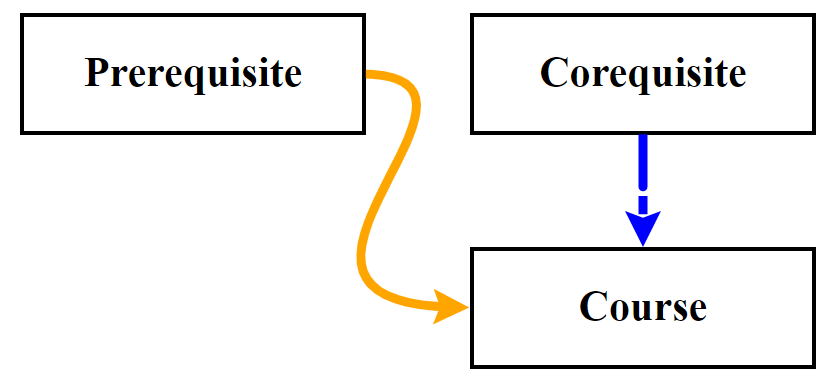
- Left click on a course to draw arrows between that course and its prerequisites and corequisites, as well as the courses it is a prerequisite and corequisite for.
- Right click on a course to have its Calendar description stay in place.
- Switch the ordering of course groups by toggling the buttons to the right of the selected plan. The selected course group will be displayed first (before the other course group).
- Switch between plans by toggling the buttons below "Plan".
- Highlight all courses in a category by left-clicking on one of the colored boxes to the right of the course group selector.
- To clear all selections, refresh the page.
Plan
Mec E 500s
MEC E 510s
MEC E 520s
MEC E 530s
MEC E 537
★ 3.0
(fi 6)(either term or Spring/Summer,
3-0-0)
Boundary layer flow, vorticity, circulation and aerodynamic lift, wing theory, aeronautical applications. Prerequisite: MEC E 330 or 331.
Accreditation Units
MEC E 539
★ 4.5
(fi 6)(either term or Spring/Summer,
3-0-3)
Model selection and simplification, grid generation and grid independence, transient and advection terms treatment, turbulence modeling, verification and validation, best practices. Hands-on experience with commercial CFD codes to demonstrate the application of: theory, proper setup and analysis. Prerequisites: MEC E 390, and 331 or equivalent.
Accreditation Units
MEC E 540s
MEC E 541
★ 3.0
(fi 6)(either term or Spring/Summer,
3-0-0)
History of basic cycles, combustion theory including ignition flame propagation and engine knock, cycle analysis with deviations from ideal cycles and performance characteristics, fuels, design and operation of carburation and injection processes, exhaust emissions measurements. Identification of design parameters and their effect on emissions. Prerequisite: MEC E 340.
Accreditation Units
MEC E 550s
MEC E 551
★ 3.8
(fi 8)(either term or spring/summer,
3-1s-0)
History and classification of robot manipulators, kinematics and dynamics, Singularity and Jacobian analysis, path/trajectory planning, open-loop and feedback control of robot manipulators. Some computer simulation and design using MATLAB/Simulink. Prerequisites: MEC E 250, 390 or consent of Instructor.
Accreditation Units
MEC E 560s
MEC E 563
★ 4.5
(fi 6)(either term or Spring/Summer,
3-0-3)
Application of finite element methods to mechanical engineering problems; topics include direct stiffness methods, assembly, constraints, solution techniques, post-processing, element types and the Galkerin procedure. Applications include beam truss and frame analysis, plane strain and stress problems, heat transfer and dynamic analysis Prerequisites: MATH 300, MEC E 360, 390.
Accreditation Units
MEC E 564
★ 3.8
(fi 8)(either term or spring/summer,
3-0-0)
Overview of micro-systems, common micro-systems and their working principles, mechanical modeling and simulation of MEMS, scaling laws in miniaturization, material for MEMS and micro-systems, mechanical design of micro devices, mechanical packaging of micro devices, overview on micro-systems fabrication processes. Corequisite: MEC E 563 or equivalent.
Accreditation Units
MEC E 569
★ 3.0
(fi 6)(either term or Spring/Summer,
3-0-0)
Introduction to composite materials. Mechanical characterization and strength theories of a lamina. Micro-mechanical analysis of a lamina. Macro-mechanical analysis of laminates. Failure analysis and design of laminates. Prerequisite: MEC E 380.
Accreditation Units
MEC E 570s
MEC E 580s
MEC E 590s
Mec E 600s
MEC E 606
★ 3.0
(fi 6)(either term,
3-0-0)
Fundamentals of optics and optoelectronics for applications in measurement systems used in fluid mechanics including PIV, PLIF, LDA, and particle sizing. Design and development of measurement systems. Prerequisites: Consent of instructor.
Accreditation Units
MEC E 607
★ 3.0
(fi 6)(either term,
3-0-0)
Light propagation in media; thermal and mechanical perturbations to media and effects on light propagation; topics in photo-elasticity including the relationships between stress/strain and optical properties, birefringence and polarization; waveguides and common structures in opto-mechanical sensing systems including waveguide interferometers, intensity modulators, Bragg structures; strain-optic models used in analyzing micro-optical mechanical systems. Coverage of application areas: structural health monitoring, biomedical technologies, diagnostics.
Accreditation Units
MEC E 610s
MEC E 610
★ 3.0
(fi 6)(either term,
3-0-0)
Development of control-oriented dynamic models using machine learning techniques. Optimal, adaptive and model predictive control techniques that are solved using methods of machine learning including support vector machines, neural networks, reinforcement learning and other methods of machine learning. Applications in broad linear and nonlinear engineering systems.
Accreditation Units
MEC E 614
★ 3.0
(fi 6)(either term,
3-0-0)
Mathematical preliminaries (discrete time systems). Stability and transient response of Iterative Learning Control (ILC). Design of ILC in both the time and frequency domain. Convergence and design of repetitive control.
Accreditation Units
MEC E 615
★ 3.0
(fi 6)(either term,
3-0-0)
Introduction to control methods applied to systems governed by partial differential equations. The focus will be on fluid and solid mechanics applications with boundary actuation.
Accreditation Units
MEC E 620s
MEC E 620
★ 3.0
(fi 6)(either term,
3-0-0)
Chemical reactions, chemical equilibrium and flame temperatures. Flame propagation and explosion theories. Detonations. Air pollution from combustion sources.
Accreditation Units
MEC E 630s
MEC E 630
★ 3.0
(fi 6)(either term,
3-0-0)
Kinematics of fluid motion, fundamental fluid equations and concepts, laminar boundary layers, potential flow, stability and transition, introduction to turbulence.
Accreditation Units
MEC E 632
★ 3.0
(fi 6)(either term,
3-0-0)
Governing equations of turbulent flow. Statistical and phenomenological theories of turbulent transport of momentum, heat and mass in wall-bounded and free flows. Computational techniques, empirical data and applications. Prerequisite: MEC E 630 or equivalent or consent of Instructor.
Accreditation Units
MEC E 633
★ 3.0
(fi 6)(either term,
3-0-0)
Microparticle terminology and definitions, synthesis of structured microparticles, analytical methods for micro- and nanoparticles, applications of particle engineering.
Accreditation Units
MEC E 635
★ 3.0
(fi 6)(either term,
3-0-0)
Introduction to pharmaceutical aerosol delivery to the lung. Particle size distributions. Motion of a single aerosol particle in a fluid. Particle size changes due to evaporation or condensation. Fluid dynamics and particle deposition in the respiratory tract. Jet nebulizers. Dry powder inhalers. Metered dose propellant inhalers. Prerequisite: MEC E 330 or 331 or equivalent or consent of Instructor.
Accreditation Units
MEC E 636
★ 3.0
(fi 6)(either term,
3-0-0)
Transport of passive and active scalars. Plumes and environmental convection with applications to air pollution. Gravity currents and intrusions. Surface gravity waves. Flow in porous media. Darcy's law with applications to groundwater flow and oil recovery. Turbulent boundary layers in the natural environment.
Accreditation Units
MEC E 637
★ 3.0
(fi 6)(either term,
3-0-0)
Colloidal Systems; Colloidal Interactions; Hydrodynamics; Analysis of Complex Fluid flows; Thin Films; Flow in Porous Media; Microfluidics; Selected applications: Coagulation, flocculation and particle deposition; Sedimentation; Separation technologies such as deep bed filtration, membrane filtration, and chromatography; Microfluidic applications involving complex fluids; Colloid applications involving complex fluids; Colloid facilitated transport. Prerequisite/Corequisite; MEC E 430, 630, or approval of instructor.
Accreditation Units
MEC E 638
★ 3.0
(fi 6)(either term,
3-0-0)
Vortex dynamics approach to large-scale structures in turbulent flows. Vortex motion equations, conservation laws, and modelling using discrete vortices. Prerequisite: a senior undergraduate course in fluid mechanics or consent of Instructor.
Accreditation Units
MEC E 640s
MEC E 641
★ 3.0
(fi 6)(either term,
3-0-0)
Study of thermal comfort, indoor air quality, and HVAC systems of buildings. Application of the basic HVAC principles as well as a range of technologies and analysis techniques for designing healthy and comfortable indoor environments. Investigation procedures and methods to identify indoor air quality problems as well as the techniques to prevent or mitigate indoor air problems.
Accreditation Units
MEC E 643
★ 3.0
(fi 6)(either term,
3-0-0)
Principles of renewable energy systems such as solar, wind, tidal, biomass, geothermal, and fuel cells. Environmental aspects of implementation of renewable energy e.g. hydro and nuclear energy sources. Energy conservation and conventional fossil fuel sources. New technologies and trends in renewable energy. Concept of sustainability and sustainable design for energy systems. Elementary economics of implementation of renewable energy sources and related policy and social issues. Prerequisites: consent of instructor.
Accreditation Units
MEC E 644
★ 3.0
(fi 6)(either term,
3-0-0)
Formation, characterization, modelling and applications of polymeric and composite nanofibers. Emphasis on nanofibers produced using electrospinning.
Accreditation Units
MEC E 645
★ 3.0
(fi 6)(either term,
3-0-0)
Introduction to the thermodynamics of electrochemical systems such as batteries and fuel cells. Analysis of the main physical process in electrochemical systems: electrode kinetics, mass transport, and charge transport. Introduction to fuel cells and fuel cell systems.
Accreditation Units
MEC E 646
★ 3.0
(fi 6)(either term,
3-0-0)
Interfacial forces and fluid flow, surface energy and spreading, interfacial tension, interfacial rheology, bulk, elastic and viscous modulus, liquid foam structure and stability, electrokinetic flows, electrowetting, solid-vapor and liquid-fluid interface characterization for interfacial forces. Prerequisite: MEC E 430 equivalent, 630, or approval of instructor.
Accreditation Units
MEC E 650s
MEC E 650
★ 3.0
(fi 6)(either term,
3-0-0)
Principle of virtual work; Lagrange's equations of motion for holonomic and non-holonomic systems; Hamilton's principle; application to gyroscopes, stabilizers, etc.
Accreditation Units
MEC E 651
★ 3.0
(fi 6)(either term,
3-0-0)
Introduction to advanced robotics including mobile robots, redundant manipulators, walking robots, aerial and marine autonomous vehicles. Kinematic and dynamic models for advanced robots. Linear and nonlinear control theory overview with applications to advanced robots.
Accreditation Units
MEC E 652
★ 3.0
(fi 6)(either term,
3-0-0)
Introduction to theoretical and technical aspects of robot perception. Topics may include autonomous navigation, accurate localization, state estimation, and motion planning for robot and vehicle applications. Deep learning based visual feature detection and classification, various actuation systems for path tracking and stabilization in autonomous driving, Safety of the Intended Functionality and health monitoring of the control loop in automated driving will also be covered.
Accreditation Units
MEC E 653
★ 3.0
(fi 6)(either term,
3-0-0)
Practical application of processing techniques to the measurement, filtering and analysis of mechanical system signals; topics include: signal classification, A/D conversion, spectral analysis, digital filtering and real-time signal processing.
Accreditation Units
MEC E 655
★ 3.0
(fi 6)(either term,
3-0-0)
Review of free and forced vibrations of single and multi- degree of freedom systems, transient vibrations, normal mode analysis, Lagrangian mechanics and approximate methods, continuous systems, transfer matrices and periodic structures.
Accreditation Units
MEC E 656
★ 3.0
(fi 6)(either term,
3-0-0)
Introduction to advanced structures, dynamic elasticity equations and concepts, wave propagation in flexural structures, active control of wave propagation and vibration.
Accreditation Units
MEC E 660s
MEC E 662
★ 3.0
(fi 6)(either term,
3-0-0)
Microfabrication technologies, MEMS and microfluidics using polymers and plastics, introduction to soft-lithography, choosing polymers for microfabricated products, functional polymers and composites, characterization and testing of microstructured polymers, packaging and bonding of polymers.
Accreditation Units
MEC E 663
★ 3.0
(fi 6)(either term,
3-0-0)
Introduction of the basic theory and applications of the finite element method. Applications will focus on linear partial differential equations in solid mechanics, fluid mechanics and thermal science.
Accreditation Units
MEC E 664
★ 3.0
(fi 6)(either term,
3-0-0)
Advanced topics dealing with MEMS technologies, transduction mechanisms, and microfabricated sensors and actuators. Sensors for acceleration, rotation rate, pressure, and different micro actuators. MEMS in microfluidics and biomedical applications. Chemical, gas, and biosensors. Prerequisite: MEC E 563 and consent of Instructor. Not open to students with credit in MEC E 564.
Accreditation Units
MEC E 668
★ 3.0
(fi 6)(either term,
3-0-0)
Introduction to Experimental Design, with particular emphasis on mechanical engineering. Randomized factorial and fractional factorial experiments. Fitting regression models and optimization. Applications to analytical and computer models.
Accreditation Units
MEC E 669
★ 3.0
(fi 6)(either term,
3-0-0)
Multifunctional Polymer-based Composites (MFPC) manufacturing processes, micro- and nanoscale characterization; Modeling strategies for MFPC properties (continuum, atomistic, multiscale); Characteristics and synergistic effects of MFPC with hard and soft inclusions; Modeling, characterization and properties of MFPC with electrically conductive fillers, for enhanced thermal conductivity, with magnetic properties, for EMF shielding/reflection, with increased diffusion barrier properties. Prerequisites: MEC E 563, 569 or consent of instructor.
Accreditation Units
MEC E 670s
MEC E 671
★ 3.0
(fi 6)(either term,
3-0-0)
Formulation of the basic governing equations in rectangular, cylindrical and spherical coordinates. Consideration of linear and nonlinear problems. Topics include: conduction with energy generation, transpiration cooling, conduction in non-stationary systems, phase transformation, and heat transfer in living tissue. Exact analytic solutions. Application of the integral method and perturbation solutions. Prerequisites: MEC E 370 or 371 and MATH 300, or equivalent.
Accreditation Units
MEC E 680s
MEC E 680
★ 3.0
(fi 6)(either term,
3-0-0)
Introduction to cartesian tensor algebra and calculus; analysis of finite deformation and kinematics of motion; transport theorems and balance laws; analysis of stress; continuum thermodynamics, constitutive equations and material symmetry with application to solids and fluids.
Accreditation Units
MEC E 681
★ 3.0
(fi 6)(either term,
3-0-0)
Extension, torsion and flexure of beams; two-dimensional problems; complex variable methods; integral transform methods; variational methods.
Accreditation Units
MEC E 682
★ 3.0
(fi 6)(either term,
3-0-0)
Surface forces, van der Waals forces, electrostatic forces, Poisson-Boltzmann equation, capillary forces, adhesion contact mechanics, surface energy, tip-surface interaction, adhesion of micro-cantilevers, microbeam arrays, carbon nanotubes, dissipation in MEMS/NEMS, fluid flow with slip, mechanical models for cells, biomembranes, cellular filaments, microtubules, molecular dynamics (MD) simulation. Prerequisite: MEC E 380 or consent of instructor.
Accreditation Units
MEC E 683
★ 3.0
(fi 6)(either term,
3-0-0)
Review of classical mechanics and thermodynamics concepts; introduction to principles of statistical mechanics; concepts of ensembles and ensemble average; probability function and partition function in different ensembles; calculation of thermodynamic quantities from statistical mechanics; applications to polymer elasticity, cell mechanics, fracture mechanics and theories of electrolytic solutions; Monte-Carlo and Molecular Dynamics simulations in different ensembles. Prerequisites: Consent of instructor.
Accreditation Units
MEC E 685
★ 3.0
(fi 6)(either term,
3-0-0)
Basic concepts of linear and nonlinear fracture mechanics: linear and nonlinear stationary crack-tip stress, strain and displacement fields; energy balance and energy release rates; fracture resistance concepts-static and dynamic fracture toughness; criteria for crack growth; fracture control methodology and applications.
Accreditation Units
MEC E 686
★ 3.0
(fi 6)(either term,
3-0-0)
Biomedical technologies for motion measurement; Three-dimensional kinematics analysis of multi-segment body; Biomedical technologies for pressure, force and moment measurement; Three-dimensional kinetics analysis of multi-segment body; Energy, work, power assessment for motion; Muscle activity measurement and analysis; Biomechanical data analytics: signal processing, dynamical system analysis.
Accreditation Units
MEC E 687
★ 3.0
(fi 6)(either term,
3-0-0)
Elastic waves, plastic waves, shock waves and stress wave propagation in solids. Low velocity impact on fibre composite materials and failure criteria. High velocity impact mechanisms and fracture criteria. Impact penetration mechanics. Dynamic deformation and fracture of materials. Prerequisite: MEC E 480 or consent of Instructor.
Accreditation Units
MEC E 690s
MEC E 690
★ 3.0
(fi 6)(either term,
3-0-0)
Methods of applied mathematics with particular emphasis on the analysis of analytical models arising in engineering science. At least three topics will be covered from the following: well-posedness of mathematical models in engineering science; generalized functions with applications to the solution of initial and boundary value problems; complex variable analysis with applications to partial differential equations; asymptotic analysis; calculus of variations; integral equations with applications; introductory functional analysis with applications.
Accreditation Units
MEC E 691
★ 3.0
(fi 6)(either term,
3-0-0)
Advanced data processing techniques. Statistics for data analysis. Measurement techniques based on electromagnetic interactions and other transduction methods.
Accreditation Units
MEC E 692
★ 3.0
(fi 6)(either term,
3-0-0)
Interpolation, numerical differentiation (finite differences), numerical integration, numerical solution of ordinary differential equations, numerical solution of partial differential equations, discrete transform methods.
Accreditation Units
MEC E 694
★ 3.0
(fi 6)(either term,
3-0-0)
Introduction to intelligent agents and environments. Examples of application of computational intelligence in engineering. Solving problems by searching. Learning through optimization. Feature selection and dimension reduction for managing real-world data. Application of learning in classification and function approximation. Data clustering. Fuzzy logic and fuzzy inference systems.
Accreditation Units
MEC E 700s
MEC E 788
★ 3.0
(fi 6)(either term,
3-0-0)
Accreditation Units
MEC E 900s
MEC E 900
★ 6.0
(fi 12)(variable,
unassigned)
Detailed Engineering report in the student's major area of interest.
Accreditation Units
MEC E 910
★ 3.0
(fi 6)(variable,
unassigned)
Detailed Engineering Report in the student's major area of interest.
Accreditation Units
ENG M 300s
ENG M 310
★ 3.0
(fi 6)(either term or Spring/Summer,
3-0-0)
The application of the fundamentals of economics to engineering alternatives in planning, developing and managing industrial projects. Note: Credit cannot be obtained for more than one of ENGG 310, 401, ENG M 310 or 401.
Accreditation Units
ENG M 400s
ENG M 401
★ 3.0
(fi 6)(either term,
3-0-0)
The application of the fundamentals of engineering economics, financial analysis and market assessment to engineering alternatives in the planning, development and ongoing management of industrial enterprises. The course covers the use of engineering, economic, financial and market assessment information in investment and business operation decisions in technology oriented companies. Note: Credit cannot be obtained for more than one of ENGG 310, ENGG 401, ENG M 310, or ENG M 401.
Accreditation Units
ENG M 402
★ 3.8
(fi 8)(either term or spring/summer,
3-0-0)
Introduction to the conceptual and practical considerations in identifying and developing new products. The theory and practice of project management applied to the creation of new business activities and ventures will be discussed. Topics include project management, innovation and entrepreneurship, business planning, marketing, and mobilizing human and financial resources. These will be applied in the development of a business plan for a business concept. The course is intended to provide engineering and business students with an awareness of specific planning, budgeting and scheduling techniques that can be used to implement and monitor new business activities. This course is open to Business and Science students with consent of Instructor. Note: Credit cannot be obtained for both ENGG 402 and ENG M 402.
Accreditation Units
ENG M 405
★ 3.0
(fi 6)(either term,
3-0-0)
The role of engineering and management in achieving the objectives of technology oriented enterprises, and the impact of technology on society. The course covers alternate forms of organization, key differences between management of a one time project and an ongoing operation, the impact of work on society, individual variations in personality and management style and the implications for managing, and specific issues in human resource and quality management. Note: Credit cannot be obtained for both ENGG 405 and ENG M 405.
Accreditation Units
ENG M 408
★ 3.8
(fi 8)(either term or spring/summer,
3-0-3/2)
Manufacturing process modeling and system design; computer aided process planning; scheduling of manufacturing activities; computer aided manufacturing; integration for different machining processes; plastic parts and mold design; sheet metal parts and die design; robotics in manufacturing; welding process and control; Design considerations; Shop floor control; and engineering collaboration. Prerequisite: MEC E 265.
Accreditation Units
ENG M 500s
ENG M 501
★ 3.8
(fi 8)(either term or spring/summer,
3-0-0)
Production and operations management, analysis, and design of work, forecasting, inventory management including MRP, JIT, and Kanban, maintenance management, facility layout, operations scheduling, and project planning and management. Credit cannot be obtained in both ENG M 501 and MEC E 513. Prerequisites: one of ENGG 310, 401 or ENG M 310, 401 and STAT 235 or equivalent.
Accreditation Units
ENG M 508
★ 3.8
(fi 8)(either term or spring/summer,
3-0-0)
Concepts and value of energy management and conservation. Methodologies for energy management in energy intensive systems in various industries. Energy auditing methods and implementation. Energy accounting and economic analysis. Energy audits and maintenance. Exposure to software for energy auditing.
Accreditation Units
ENG M 512
★ 3.0
(fi 6)(either term,
3-0-0)
Quality engineering and management definitions, concepts and principles. Essential quality management theories and models. ISO 9000 principles, models and applications. ISO 10000 augmentative standards. Seven quality engineering and management tools. Quality function deployment. Failure analysis. Statistical quality.
Accreditation Units
ENG M 514
★ 3.8
(fi 8)(either term or spring/summer,
3-0-0)
Concepts of reliability, failure rate, maintainability, and availability. Properties of various statistical distributions and their applications in reliability engineering. Failure data analysis techniques including probability plotting. Load and strength interference in mechanical component design. System reliability models and system reliability evaluation methods. Optimal system design considering reliability issues. Prerequisite: STAT 235 or equivalent.
Accreditation Units
ENG M 516
★ 3.8
(fi 8)(either term or spring/summer,
3-0-0)
Maintenance management of industrial assets. Preventative maintenance decisions. Spare parts provisioning. Predictive maintenance decisions. Reliability centered maintenance. Total productive maintenance. Case studies. Prerequisite: STAT 235 or equivalent.
Accreditation Units
ENG M 530
★ 3.8
(fi 8)(either term or spring/summer,
3-0-0)
Introduction to project management tools, techniques, templates, and methodologies. This course examines the eight knowledge areas of the Project Management Institute (PMI) which provide an integrated approach to managing engineering projects. Prerequisites: One of ENGG 310, 401 or ENG M 310, 401.
Accreditation Units
ENG M 540
★ 3.8
(fi 8)(either term or spring/summer,
3-0-0)
An introduction to optimization methods in solving engineering management problems. Both modeling techniques and algorithms will be covered. Topics include linear programming, formulation and modeling techniques, the simplex method, sensitivity analysis, duality, transportation and network problems, algorithmic and heuristic methods, integer programming, and/or non-linear programming. Credit cannot be obtained in both ENG M 540 and ENG M 640.
Accreditation Units
ENG M 558
★ 3.8
(fi 8)(either term or spring/summer,
3-0-0)
Fundamental methods for the analysis of human systems in industrial engineering. Human-machine interaction. Engineering of the workplace and the work environment. Motion and time study. Standards in ergonomics and work design.
Accreditation Units
ENG M 600s
ENG M 605
★ 3.0
(fi 6)(either term,
3-0-0)
Computer-aided engineering software modeling and implementation methodology; Feature-based product modeling development; Feature-based manufacturing process modeling; Engineering data integration; Production system engineering; System integration in production engineering; Advanced product and process engineering informatics with networked collaboration.
Accreditation Units
ENG M 607
★ 3.0
(fi 6)(either term,
3-0-0)
Overview of lean manufacturing concepts, tools and techniques. Identifying waste. Value stream mapping, push vs. pull systems data analysis tools, cell layout design, operator balance charts, 5S, set up time reduction, work in process minimization, standardized work, visual management, and optimized floor space. Introduction to six sigma tools.
Accreditation Units
ENG M 610s
ENG M 611
★ 3.0
(fi 6)(either term,
3-0-0)
Design, development and use of international assurance and management standards in manufacturing, service and energy industries. Creation of standardized systems for quality, environmental, safety, security, responsibility, risk and other aspects of the organization. Modeling of integration frameworks and methodologies. Auditing, maintenance and improvement of integrated management systems.
Accreditation Units
ENG M 612
★ 3.0
(fi 6)(either term,
3-0-0)
Current theory and practice of quality management systems. Modeling of systems and supporting technologies for performance management and improvement. ISO 9000 and 10000 standards, business excellence models and performance measurement. Application of quality assurance schemes in manufacturing, service and not-profit organizations. Design, implementation and improvement of assurance systems using auditing and self-assessment models. Auditing standards and self-assessment guidelines.
Accreditation Units
ENG M 620s
ENG M 620
★ 3.0
(fi 6)(either term,
3-0-0)
Advanced topics in engineering economics, including operating and capital budgets, financial statement use by engineering managers, replacement analysis, cost of capital and leasing, risk-based financial decision-making for technology investment using real options valuation.
Accreditation Units
ENG M 630s
ENG M 632
★ 3.0
(fi 6)(either term,
3-0-0)
An in-depth study of the risk management framework as adopted by Project Management Institute. Responsibilities and risks encountered while managing any project. Identification and quantification of risk in design and execution of projects, strategies to handle risk, and issues related to decision making in the face of uncertainty.
Accreditation Units
ENG M 640s
ENG M 641
★ 3.0
(fi 6)(either term,
3-0-0)
Engineering Applications of Integer linear programming, solution techniques, solver applications, modeling and (re)formulation, valid inequalities and redundant constraints, Lagrangian relaxation, decomposition techniques, column generation, meta-heuristic approaches. Prerequisites: ENG M 540 or equivalent.
Accreditation Units
ENG M 646
★ 3.0
(fi 6)(either term,
3-0-0)
The applications of optimization techniques in solving engineering problems. Linear programming, non-linear programming, dynamic programming, integer programming, stochastic programming, genetic algorithms, heuristic methods, queuing theory, and new optimization methods. Credit may not be obtained in more than one of ENG M 640, MEC E 612, and ENG M 646. Prerequisite: ENG M 540 or consent of Instructor.
Accreditation Units
ENG M 650s
ENG M 655
★ 3.0
(fi 6)(either term,
3-0-0)
This course reviews current thinking on personality theory (using Carver and Scheier's model of seven theoretical perspectives on personality), and looks at the implications for managing that arise from each theoretical perspective. In particular, managing in technical settings with a diverse range of skill types and levels frequently calls for diversity in management approaches that reflect the inherent diversity in the people being managed. The Myers Briggs Type Indicator, widely used in business settings, is reviewed in greater detail. Management styles and the nature of management thinking and decision making are discussed.
Accreditation Units
ENG M 660s
ENG M 665
★ 3.0
(fi 6)(either term,
3-0-0)
Intellectual property in the context of technology transfer and commercialization. Key topics include intellectual property, product development, valuation of technology, capturing value, and securing the deal. Considerations in identifying and developing new products, exploitation of intellectual property as a corporate strategy, the impact of intellectual property in new company formation and growth.
Accreditation Units
ENG M 670s
ENG M 670
★ 3.0
(fi 6)(either term,
3-0-0)
Accreditation Units
ENG M 680s
ENG M 680
★ 3.0
(fi 6)(either term,
3-0-0)
Accreditation Units
ENG M 690s
ENG M 690
★ 3.0
(fi 6)(either term,
3-0-0)
Students will learn technical communication skills, including an efficient writing process, effective use of language and grammar, research and referencing sources, creating clear figures and graphics, formatting various types of written documents relevant to the engineering profession, effective team communication, and visual/oral presentations.
Accreditation Units
Fall Term 1
CHEM 103
★ 4.3
(fi 6)(either term,
3-1s-3/2)
Atoms and molecules, states of matter, chemistry of the elements. Prerequisite: Chemistry 30, or equivalent. Note: Restricted to Engineering students only. Other students who take this course will receive *3.0.
Accreditation Units
ENGG 100
★ 1.1
(fi 2)(either term,
.75-.75s-0)
An introduction to the Faculty of Engineering, the engineering profession, the skills required for academic success, and the fundamentals of leadership: study and life skills; time management and goal setting; interpersonal skills; career planning; engineering and society including elements of ethics, equity, concepts of sustainable development, environmental stewardship, and public safety.
Accreditation Units
ENGG 130
★ 4.0
(fi 6)(either term,
3-0-2)
Equilibrium of planar systems. Analysis of statically determinate trusses and frames. Friction. Centroids and centres of gravity. Forces and moments in beams. Second moments of area. Note: Students in all sections of this course will write a common final examination. Corequisite: MATH 100.
Accreditation Units
ENGL 199
★ 3.0
(fi 6)(either term,
3-0-0)
This course aims to develop the student's ability to provide effective written and oral information. It will focus on instruction in fundamental writing skills, including building effective sentences and paragraphs, and on learning to communicate clearly across a range of genres and media used in academic and professional contexts, including correspondence and presentations. Students will be introduced to the principles of information gathering, analysis, and citation. Note: Restricted to students in the Faculty of Engineering only.
Accreditation Units
MATH 100
★ 3.5
(fi 6)(either term,
3-0-1)
Review of numbers, inequalities, functions, analytic geometry; limits, continuity; derivatives and applications, Taylor polynomials; log, exp, and inverse trig functions. Integration, fundamental theorem of calculus substitution, trapezoidal and Simpson's rules. Prerequisites: Mathematics 30-1 and Mathematics 31. Notes: (1) Credit can be obtained in at most one of MATH 100, 113, 114, 117, 134, 144, 154, or SCI 100. (2) Students in all sections of this course will write a common final examination. (3) Restricted to Engineering students. Non-Engineering students who take this course will receive *3.0.
Accreditation Units
PHYS 130
★ 3.8
(fi 6)(either term,
3-0-3/2)
Geometrical optics, optical instruments, oscillations, waves, sound, interference, diffraction. Prerequisites: Mathematics 30-1, Mathematics 31, Physics 30. Corequisite: MATH 100 or 113 or 114 or 117 or 134 or 144 or equivalent. Restricted to Engineering students. Other students who take this course will receive *3.0.
Accreditation Units
Winter Term 2
CHEM 105
★ 3.8
(fi 6)(either term,
3-0-3/2)
Rates of reactions, thermodynamics and equilibrium, electrochemistry, modern applications of chemistry. Prerequisite: CHEM 103. Note: Restricted to Engineering students only. Other students who take this course will receive *3.0.
Accreditation Units
ENCMP 100
★ 3.8
(fi 6)(either term,
3-0-1.5)
Fundamentals of computer programming with emphasis on solving engineering problems. Structure and syntax of computer programs, variables, data types, data structures, control structures, functions, input/output operations, debugging, software development process.
Accreditation Units
ENGG 160
★ 2.0
(fi 4)(either term or Spring/Summer,
1-0-2)
Fundamental design process and theory in a multidisciplinary context. Importance, in engineering design, of communications; team work; the engineering disciplines, career fields; professional responsibilities of the engineer including elements of ethics, equity, concepts of sustainable development and environmental stewardship, public and worker safety and health considerations including the context of the Alberta Occupational Health and Safety Act. Corequisite ENGL 199. This course is delivered in a blended format.
Accreditation Units
EN PH 131
★ 4.3
(fi 6)(either term,
3-1s-3/2)
Kinematics and dynamics of particles; gravitation; work and energy; linear momentum; angular momentum; systems of particles; introduction to dynamics of rigid bodies. Prerequisites: MATH 100 or 117, and ENGG 130. Corequisite: MATH 101 or 118. Restricted to Engineering students. Other students who take this course will receive *3.0.
Accreditation Units
MATH 101
★ 3.5
(fi 6)(either term,
3-0-1)
Area between curves, techniques of integration. Applications of integration to planar areas and lengths, volumes and masses. First order ordinary differential equations: separable, linear, direction fields, Euler's method, applications. Infinite series, power series, Taylor expansions with remainder terms. Polar coordinates. Rectangular, spherical and cylindrical coordinates in 3-dimensional space. Parametric curves in the plane and space: graphing, arc length, curvature; normal binormal, tangent plane in 3- dimensional space. Volumes and surface areas of rotation. Prerequisite: MATH 100. Notes: (1) Credit can be obtained in at most one of MATH 101, 115, 118, 136, 146, 156 or SCI 100. (2) Students in all sections of this course will write a common final examination. (3) Restricted to Engineering students. Non-Engineering students who take this course will receive *3.0.
Accreditation Units
MATH 102
★ 3.5
(fi 6)(either term,
3-0-1)
Vectors and matrices, solution of linear equations, equations of lines and planes, determinants, matrix algebra, orthogonality and applications (Gram-Schmidt), eigenvalues and eigenvectors and applications, complex numbers. Prerequisite or corequisite: MATH 100. Notes: (1) Credit can be obtained in at most one of MATH 102, 125, or 127. (2) Students in all sections of this course will write a common final examination. (3) Restricted to Engineering students. Non-Engineering students who take this course will receive *3.0.
Accreditation Units
Fall Term 3
CIV E 270
★ 4.5
(fi 6)(either term or Spring/Summer,
3-0-3)
Plane stress and strain; stress-strain relationships; stresses and deformations resulting from axial and transverse loads; buckling of columns; torsion of circular sections; combined stress; statically indeterminate problems. Laboratory to demonstrate mechanical properties and verify assumptions of analysis. Prerequisites: ENGG 130 and MATH 101.
Accreditation Units
MATH 209
★ 3.5
(fi 6)(either term,
3-0-1)
Partial differentiation, derivatives of integrals. Multiple integration using rectangular, cylindrical, and spherical coordinates. Vector Field Theory. Prerequisite: MATH 101. Prerequisite or corequisite: MATH 102. Notes: (1) This course may not be taken for credit if credit has already been obtained in MATH 215 or 317. (2) Students in all sections of this course will write a common final examination. (3) Restricted to Engineering students. Non-Engineering students who take this course will receive *3.0.
Accreditation Units
STAT 235
★ 3.8
(fi 6)(either term or Spring/Summer,
3-0-1.5)
Descriptive data analysis. Calculus of Probability. Binomial, multinomial, Poisson, normal, beta, exponential, gamma, hypergeometric, and Weibull distributions. Sampling distributions. Estimation, testing hypotheses, goodness-of-fit tests, and one-way analysis of variance. Linear correlation and regression. Sampling. Quality control. Use of a microcomputer software package for statistical analyses in engineering applications. Prerequisite: MATH 100. Corequisite: MATH 101. Notes: (1) This course may not be taken for credit if credit has already been obtained in one of STAT 141, 151, 222, 265, 266; PSYCH 211, SCI 151 or SOC 210. (2) Intended for Engineering students. Other students who take this course will receive *3.0.
Accreditation Units
Course Group 2A
CH E 243
★ 3.5
(fi 6)(either term or Spring/Summer,
3-1s-0)
An introduction to the first and second laws of thermodynamics. Prerequisites: MATH 101.
Accreditation Units
MEC E 200
★ 2.0
(fi 4)(either term or Spring/Summer,
1-2s-0)
Introduction to the profession of mechanical engineering with special emphasis of industries in Alberta, including coverage of elements of ethics, equity, concepts of sustainable development and environmental stewardship, public and worker safety and health considerations including the context of the Alberta Occupational Health and Safety Act. Selected guest speakers on design problems in mechanical engineering. Communication skills including written and oral presentations.
Accreditation Units
MEC E 250
★ 3.5
(fi 6)(either term or Spring/Summer,
3-1s-0)
Moments of inertia. Kinematics and kinetics of rigid body motion, energy and momentum methods, impact, mechanical vibrations. Prerequisites: ENGG 130, EN PH 131 and MATH 101. There is a consolidated exam.
Accreditation Units
Winter Term 4
ECE 209
★ 3.8
(fi 6)(either term or Spring/Summer,
3-0-3/2)
Physical concepts of passive circuit elements, Kirchhoff's laws and DC circuit equations. Energy concepts, time domain analysis of AC circuits. Impedance, complex numbers and phasor algebra. AC power concepts, resonance, three phase circuits, introduction to machines. Credit may be obtained in only one of ECE 209, E E 239, ECE 202, or E E 240, unless approved by the Department.
Accreditation Units
MAT E 202
★ 3.5
(fi 6)(either term or Spring/Summer,
3-1.5s/2-)
An introduction to the science of materials relating their mechanical, thermal, electronic, and chemical properties to atomic, molecular, and crystal structure. Ceramic and metallic crystals, glasses, polymers, and composite materials. Multi-phase materials, phase transformations, and strengthening processes. Laboratories and seminars include mechanical properties of materials, microstructure, heat treatment of steel, and hands on design experiments. Prerequisite: CHEM 105 or consent of Department.
Accreditation Units
MATH 201
★ 3.5
(fi 6)(either term or Spring/Summer,
3-0-1)
First-order equations; second-order linear equations: reduction of order, variation of parameters; Laplace transform; linear systems; power series; solution by series; separation of variables for PDEs. Prerequisite or corequisite: MATH 209 or 214. Notes: (1) Open only to students in Engineering, Specialization Physics, and Specialization Geophysics. (2) Credit can be obtained in at most one of MATH 201, 334 or 336. (3) Students in all sections of this course will write a common final examination. Non-Engineering students who take this course will receive *3.0.
Accreditation Units
Course Group 2B
MEC E 230
★ 3.5
(fi 6)(either term or Spring/Summer,
3-1s-0)
Introduction to modes of heat transfer. One dimensional heat conduction. Heat transfer from surfaces. Introduction to fluid mechanics. Fluid properties. Fluid statics. Use of control volumes. Internal flows. Prerequisites: MATH 101, EN PH 131.
Accreditation Units
MEC E 260
★ 3.5
(fi 6)(either term or Spring/Summer,
2-0-3)
Design morphology, analysis and design of components, mechanical design with electric motors, computer-aided design introduction, design project. Prerequisite: ENGG 160. Corequisite: MEC E 265 and CIV E 270.
Accreditation Units
MEC E 265
★ 3.5
(fi 6)(either term or Spring/Summer,
2-0-3)
Engineering drawing and sketching, conventional drafting, computer-aided drawing in 2D and 3D, solid modelling, and computer-aided design.
Accreditation Units
Fall Term 5
Course Group 3A
MATH 300
★ 3.0
(fi 6)(either term or Spring/Summer,
3-0-0)
Derivation of the classical partial differential equations of applied mathematics, solutions using separation of variables. Fourier expansions and their applications to boundary value problems. Introduction to Fourier Transforms. Emphasis on building an appropriate mathematical model from a physical problem, solving the mathematical problem, and carefully interpreting the mathematical results in the context of the original physical problem. Prerequisites: MATH 201 and 209. Notes: (1) Open only to students in Engineering, Specialization Physics, and Specialization Geophysics. (2) Credit can be obtained in at most one of MATH 300 and 337. (3) Course cannot be taken for credit if credit has been obtained in ECE 341.
Accreditation Units
MEC E 300
★ 3.5
(fi 6)(either term or Spring/Summer,
3-1s-0)
Characterization and behavior of measuring systems. Statistics and analysis of measurement data; measurement techniques applied to fundamental mechanical engineering phenomena. Prerequisites: CIV E 270, ECE 209, STAT 235. Corequisite: MEC E 330 or MEC E 331.
Accreditation Units
MEC E 301
★ 2.5
(fi 6)(either term or Spring/Summer,
1-0-3)
Laboratory experiments in mechanical engineering measurement techniques, treatment of measurement data, introduction to engineering report writing. Corequisite: MEC E 300.
Accreditation Units
MEC E 331
★ 3.5
(fi 6)(either term or Spring/Summer,
3-0-1)
External flow, boundary layers, momentum theories, similitude, fluid metering, fluid friction, fluid friction in pipes, pipe networks. Prerequisites: MEC E 230, 250, MATH 209. Corequisite: CH E 243. Credit can only be granted for one of MEC E 330 or MEC E 331.
Accreditation Units
MEC E 371
★ 3.5
(fi 6)(either term or Spring/Summer,
3-1s-0)
Mechanisms of heat transfer, steady and unsteady heat conduction, numerical analysis, thermal radiation, free and forced convection, heat exchanger analysis and heat transfer with change of phase and mass transfer. Prerequisites: MEC E 230, CH E 243. Corequisites: MATH 300 and MEC E 331. Credit can only be granted for one of MEC E 370 or MEC E 371.
Accreditation Units
MEC E 380
★ 3.5
(fi 6)(either term or Spring/Summer,
3-1s-0)
Stress, strain, stress-strain relation, time-independent and time-dependent behavior, virtual work and energy theorems, deformations, indeterminate systems, matrix methods. Prerequisite: CIV E 270.
Accreditation Units
Winter Term 6
Course Group 3B
ENG M 310
★ 3.0
(fi 6)(either term or Spring/Summer,
3-0-0)
The application of the fundamentals of economics to engineering alternatives in planning, developing and managing industrial projects. Note: Credit cannot be obtained for more than one of ENGG 310, 401, ENG M 310 or 401.
Accreditation Units
OR
ENG M 401
★ 3.0
(fi 6)(either term,
3-0-0)
The application of the fundamentals of engineering economics, financial analysis and market assessment to engineering alternatives in the planning, development and ongoing management of industrial enterprises. The course covers the use of engineering, economic, financial and market assessment information in investment and business operation decisions in technology oriented companies. Note: Credit cannot be obtained for more than one of ENGG 310, ENGG 401, ENG M 310, or ENG M 401.
Accreditation Units
MEC E 340
★ 3.5
(fi 6)(either term or Spring/Summer,
3-0-1)
Review of thermodynamic principles. Applications to gas compressors, vapour and gas power cycles, heat pump cycles. Availability analysis. Psychrometrics. Combustion analysis. Prerequisite: CH E 243.
Accreditation Units
MEC E 360
★ 3.8
(fi 6)(either term or Spring/Summer,
3-0-1.5)
Design procedures, theories of failure, material selection, design for fatigue, creep and relaxation, selection of gears and bearings and application of computer-aided design software. Prerequisite: MEC E 260 and 265, MAT E 202 and CIV E 270. Corequisite: MEC E 362.
Accreditation Units
MEC E 362
★ 3.8
(fi 6)(either term or Spring/Summer,
3-0-1.5)
Velocities and acceleration in plane mechanisms, balancing of rotating and reciprocating machinery, gears and gear trains. Prerequisite: MEC E 250.
Accreditation Units
MEC E 390
★ 3.5
(fi 6)(either term or Spring/Summer,
3-0-1)
Application of numerical methods to mechanical engineering problems; topics include sources and definitions of error, root finding, solutions of linear and non-linear systems of equations, regression, interpolaton, numerical integration and differentiation, solution of initial value and boundary value ordinary differential equations. Applications include dynamics, solid mechanics, heat transfer and fluid flow. Prerequisites: MATH 102 and 201.
Accreditation Units
Complementary Elective
A complementary elective of the student's choice. Please consult the calendar for more information.
Fall Term 7
Program/Technical Elective
A program/technical elective of the student's choice. Please consult the calendar for more information.
Program/Technical Elective
A program/technical elective of the student's choice. Please consult the calendar for more information.
Course Group 4A
ENGG 404
★ 3.8
(fi 6)(either term or Spring/Summer,
3-3s/2-0)
Basic concepts of risk and consequences of loss incidents; risk management principles and practices; incident investigation, causation, root cause analysis; process safety management; the roles of government agencies, professional bodies and industry associations; workplace safety; risk-based decision-making processes; leadership and the human-factors side of risk management. The course focuses on the principles and practices of leadership towards the effective application and implementation of risk management in major organizations across all engineering disciplines. Industry virtual tours, case studies, seminars and team projects specific to the student's engineering program will be used to develop competencies and proficiencies in applying leadership and organizational effectiveness for successful risk management.
Accreditation Units
MEC E 430
★ 3.0
(fi 6)(either term or Spring/Summer,
3-0-0)
Navier-Stokes equations, introductory computational fluid dynamics, boundary layers, compressible fluid flow (variable area ducts, normal and oblique shock waves, Prantdl-Meyer expansions, adiabatic and isothermal pipe flow), two phase flow. Prerequisite: MEC E 330 or 331.
Accreditation Units
OR
MEC E 480
★ 3.0
(fi 6)(either term or Spring/Summer,
3-0-0)
Special topics for beams, torsion, pressure vessels, plane stress and strain, stability, fracture mechanics. Prerequisites: MEC E 360, 380, MATH 300.
Accreditation Units
MEC E 463
★ 4.0
(fi 6)(either term or Spring/Summer,
3-0-2)
Design and optimization of thermo-fluid systems, heating and ventilating equipment and load calculations, system design, piping networks, heat exchanger analysis and design, computer-aided design projects. Prerequisites: MEC E 330 or 331, 340, and 370 or 371.
Accreditation Units
Program/Technical Elective
A program/technical elective of the student's choice. Please consult the calendar for more information.
Winter Term 8
CH E 448
★ 4.0
(fi 6)(second term,
3-1s-3/3)
Introduction to systems modeling and transient response analysis with an emphasis on mechanical engineering applications; design and analysis of feedback systems; stability analysis; feedforward control; process control applications. Prerequisites: MATH 201 or equivalent, MATH 209, and MEC E 330 or MEC E 331. Corequisite: MEC E 370 or MEC E 371. Restricted to students registered in the Mechanical Engineering program. Credit may not be obtained in this course if previous credit has been obtained for CH E 446.
Accreditation Units
OR
MEC E 420
★ 3.8
(fi 6)(either term or Spring/Summer,
3-0-3/2)
Design of linear feedback control systems for command-following error, stability, and dynamic response specifications. PID, Root-locus, frequency response and design techniques. An introduction to structural design limitations. Examples emphasizing Mechanical Engineering systems. Some use of computer aided design with MATLAB/Simulink. Controls Lab - control of mechanical systems. Prerequisites: MEC E 390. Credit can only be granted for one of MEC E 420, ECE 362, CH E 448.
Accreditation Units
ENGG 400
★ 1.0
(fi 2)(either term,
1-0-0)
The technical and professional duties and responsibilities of the engineer; the ethics of the engineering profession; technical and professional organizations. The role of the engineer in the social environment including elements of equity, concepts of sustainable development and environmental stewardship, public and worker safety and health considerations including the context of the Alberta Occupational Health and Safety Act. Note: Restricted to fourth-year traditional and fifth-year co-op engineering students. Must be taken in last term of program.
Accreditation Units
Program/Technical Elective
A program/technical elective of the student's choice. Please consult the calendar for more information.
Course Group 4B
MEC E 403
★ 2.5
(fi 6)(either term or Spring/Summer,
1-0-3)
Selected laboratory experiments in applied mechanics and thermosciences. Prerequisites: MEC E 300, 301, 340 and 360.
Accreditation Units
MEC E 451
★ 3.5
(fi 6)(either term or Spring/Summer,
3-0-1)
Free and forced vibration of single degree of freedom systems with and without damping, vibration isolation, free vibration of multi degrees of freedom systems, vibration absorption, beam vibrations, sound waves, sound sources, subjective aspects of noise. Prerequisites: MEC E 250 and MATH 300.
Accreditation Units
MEC E 460
★ 4.5
(fi 6)(either term or Spring/Summer,
2-1s-4)
Feasibility study and detailed design of a project which requires students to exercise creative ability, to make assumptions and decisions based on synthesis of technical knowledge, and in general, devise new designs, rather than analyse existing ones. Prerequisites: MEC E 200, 330 or 331, 340, 360, 362, 370 or 371, 380. Corequisite: ENG M 310 (or ENG M 401).
Accreditation Units
ITS Elective
An ITS elective of the student's choice. Please consult the calendar for more information.
Minimum one from this list
MEC E 467
★ 4.5
(fi 6)(either term or Spring/Summer,
3-0-3)
Modeling and analysis of systems and processes that include technological decision making. Formulation and solution methods for systems including associated resource requirements and other system inputs. Numerical methods for simulation. Projects will involve simulation software to support analysis and design of engineering systems and processes. Prerequisites: MEC E 250 and 390. Note that credit cannot be obtained in both MEC E 467 and ENG M 541.
Accreditation Units
MEC E 468
★ 4.5
(fi 6)(either term or Spring/Summer,
3-0-3)
Computer modelling in mechanical engineering. Simulation of mechanisms. Stress analysis and heat transfer using commercial software. Emphasis is on numerical model design including testing and verification methods, and the critical interpretation of the computed results. Credit cannot be obtained in both MEC E 468 and 568. Prerequisites: MEC E 265, 362, 370 or 371, 380, 390.
Accreditation Units
MEC E 539
★ 4.5
(fi 6)(either term or Spring/Summer,
3-0-3)
Model selection and simplification, grid generation and grid independence, transient and advection terms treatment, turbulence modeling, verification and validation, best practices. Hands-on experience with commercial CFD codes to demonstrate the application of: theory, proper setup and analysis. Prerequisites: MEC E 390, and 331 or equivalent.
Accreditation Units
MEC E 563
★ 4.5
(fi 6)(either term or Spring/Summer,
3-0-3)
Application of finite element methods to mechanical engineering problems; topics include direct stiffness methods, assembly, constraints, solution techniques, post-processing, element types and the Galkerin procedure. Applications include beam truss and frame analysis, plane strain and stress problems, heat transfer and dynamic analysis Prerequisites: MATH 300, MEC E 360, 390.
Accreditation Units
ELECTIVES_A
ACCTG 300
★ 3.8
(fi 8)(either term or spring/summer,
3-0-0)
Provides a basic understanding of accounting: how accounting numbers are generated, the meaning of accounting reports, and how to use accounting reports to make decisions. Note: Not open to students registered in the Faculty of Business. Not for credit in the Bachelor of Commerce Program.
Accreditation Units
ACCTG 311
★ 3.8
(fi 8)(either term or spring/summer,
3-1.5s-0)
How to prepare and interpret financial statements that report to decision makers external to the enterprise, such as shareholders and creditors. Course includes principles and standards of balance sheet valuation, income measurement, financial disclosure and cash flow analysis that link preparation and use of such statements. Prerequisites: ECON 101 and 102.
Accreditation Units
B LAW 301
★ 3.8
(fi 8)(either term or spring/summer,
3-0-0)
Synoptic view of Canadian legal system, with emphasis on underlying considerations of social policy. While considering the nature, sources, philosophy, and policy objectives of the law, selected topics from the fields of tort and contract will be analyzed. Credit will be granted for only one of B LAW 301 and ENGG 420.
Accreditation Units
B LAW 422
★ 3.8
(fi 8)(either term or spring/summer,
3-0-0)
Introduction to the role of the corporation in the business and commercial life of Canada and Alberta, with emphasis on the small private company. Topics include characteristics of corporate existence, process of incorporation, forming a private company, relationship with third parties, distinction between management and ownership, duties of directors and officers, and shareholder rights. Prerequisite: B LAW 301 or ENGG 420.
Accreditation Units
B LAW 444
★ 3.8
(fi 8)(either term or spring/summer,
3-0-0)
An overview of current international business patterns and the laws surrounding such patterns, with an emphasis on what makes them different from domestic ones. A major force underlying the internationalization of the world economy has been the rapid, sustained growth of international business, both in the traditional form of international trade and in the newer forms of multinational, global and transnational business. This course is designed to provide the student with a basic understanding of the major rules governing cross-border commercial transaction in the contexts of both substantive and procedural law.
Accreditation Units
BIOCH 200
★ 3.8
(fi 8)(either term or spring/summer,
3-0-0)
An introduction to the fundamental principles of biochemistry. Protein structure and function; enzymes; lipids and the structure of biological membranes; nucleotides and the structure of nucleic acids; bioenergetics and the catabolism of carbohydrates. Prerequisites: CHEM 101 and CHEM 261 or 164, or SCI 100.
Accreditation Units
BIOL 107
★ 3.8
(fi 8)(either term or spring/summer,
3-1s-3)
An introduction to cell structure and function. Major topics include the molecules and structures that comprise prokaryotic and eukaryotic cells, the mechanisms by which energy is harvested and used by cells, how cells reproduce, and how information is stored and used within a cell via the processes of DNA replication, transcription, and translation. Prerequisites: Biology 30 and Chemistry 30. Note: BIOL 107 is not a prerequisite for BIOL 108. BIOL 107 and 108 can be taken in either term.
Accreditation Units
BIOL 108
★ 3.8
(fi 8)(either term or spring/summer,
3-1s-3)
Examines the major lineages of life on Earth. Overview of evolutionary principles and classification, the history of life, and the key adaptations of prokaryotes, protists, fungi, plants, and animals. Laboratories survey the diversity of biological form and function, and introduce students to data collection and scientific writing. Prerequisite: Biology 30. Note: BIOL 107 is not a prerequisite for BIOL 108. BIOL 107 and 108 can be taken in either term.
Accreditation Units
ELECTIVES_B
BIOL 207
★ 3.8
(fi 8)(either term or spring/summer,
3-1s-3)
The chromosomal and molecular basis for the transmission and function of genes. The construction of genetic and physical maps of genes and genomes. Strategies for the isolation of specific genes. Examples of regulatory mechanisms for the expression of the genetic material in both prokaryotes and eukaryotes. Prerequisite: BIOL 107 or SCI 100.
Accreditation Units
BME 320
★ 3.8
(fi 8)(either term or spring/summer,
3-0-0)
An introduction to the fundamental levels of organization of the human body highlighted in engineering terms. The first half of the course will consider the chemical, cellular, and tissue levels of organization. The second half of the course will be devoted to bone, joints, muscle, and neural tissue. Guest lectures will include engineers and medical scientists to discuss the relationship between recent advances in biomedical engineering and the underlying anatomy and physiology. This course is intended for students in the Faculty of Engineering. Students from other faculties must obtain the consent of the Department of Biomedical Engineering. Credit may be obtained for only BME 210 or 320.
Accreditation Units
BME 321
★ 3.8
(fi 8)(either term or spring/summer,
3-0-0)
An introduction to the organization of the human body at the level of the anatomical systems highlighted in engineering terms. Lectures will be devoted to the circulatory, respiratory, digestive, urinary, nervous and endocrine systems, and fluid, electrolyte and acid-base homeostasis. Guest lectures will include engineers and medical scientists to discuss the relationship between recent advances in biomedical engineering and the underlying anatomy and physiology. This course is intended for students in the Faculty of Engineering. Students from other faculties must obtain the consent of the Department of Biomedical Engineering. Credit may be obtained for only BME 211 or 321. Prerequisite: BME 320 or consent of Instructor.
Accreditation Units
BME 410
★ 3.8
(fi 8)(either term or spring/summer,
3-0-0)
Introduces the broad field of biomedical engineering while focusing on the quantitative methods and modelling in key areas that emphasize the similarities between biomedical and conventional engineering science. Practical numerical models of several body systems will be covered, with an emphasis on development, evaluation and validation of realistic physiological models using computational methods. Intended primarily for undergraduate students of the Engineering program. Students from other faculties must obtain the consent of the Department of Biomedical Engineering. Prerequisite BME 320.
Accreditation Units
BME 513
★ 3.8
(fi 8)(either term or spring/summer,
3-0-0)
Introduction to basic physical and technological aspects of medical imaging. Emphasis on computed transmission and emission tomography, magnetic resonance, and ultrasound imaging. These methods are developed and contrasted in terms of how imaging information is generated, detected, and processed and how different hardware configurations and other factors limit image quality. Relative diagnostic potential of the imaging methods is also discussed in relation to future prospects of each method.
Accreditation Units
BME 553
★ 3.8
(fi 8)(either term or spring/summer,
3-1s-0)
Introduction to rehabilitation techniques for assisting individuals with physical disabilities to reach, stand and walk. Biomechanics of intact and pathological movements and the use of assistive devices such as exoskeletal orthotics, neuroprosthetic devices and locomotor training are emphasized. Students are exposed to the concepts of biomechanical modeling, motion analysis, electrical stimulation, control systems, neuroregeneration, and pharmacology. Prerequisite: BME 320 and 321 or consent of Instructor.
Accreditation Units
BME 564
★ 3.8
(fi 8)(either term or spring/summer,
3-0-0)
Designed for graduate and advanced undergraduate students requiring a thorough grounding in the fundamentals of imaging by means of nuclear magnetic resonance, NMR. Topics include the principles of NMR as applied to imaging, image processing, imaging techniques for achieving specific types of contrast, image artefacts, and typical applications. Prerequisite: Consent of instructor.
Accreditation Units
CH E 582
★ 3.8
(fi 8)(either term or spring/summer,
3-1s-0)
Survey of materials intended for biological applications; biomaterials-related biological phenomena (protein adsorption, blood coagulation and cell adhesion); biomaterials for engineering of blood vessel, bone and skin tissues. Two fundamental engineering philosophies will be stressed: structure-function relationship and purposeful manipulation for a desired outcome. Prerequisite: BIOL 107 or BME 210 or CH E 484 or consent of Instructor.
Accreditation Units
ELECTIVES_C
CHEM 261
★ 3.8
(fi 8)(either term or spring/summer,
3-0-3)
The correlation of structure and chemical bonding in carbon compounds with the physical properties and chemical reactivity of organic molecules. Discussion will be based on functional groups with emphasis on hydrocarbons and derivatives that contain halogens, oxygen, sulfur, and the hydroxy group. Introduction to stereochemistry, three dimensional structure, reaction mechanisms, especially addition to double bonds, nucleophilic substitution and elimination reactions. Prerequisite CHEM 101 or 103. Note: Students who have obtained credit for CHEM 161 or 164 cannot take CHEM 261 for credit. Engineering students who take this course will receive *4.5.
Accreditation Units
CHEM 263
★ 3.8
(fi 8)(either term or spring/summer,
3-0-3)
Continuation of the structural and chemical properties of the basic functional groups of organic compounds including alkynes, aromatic compounds, aldehydes, ketones, carboxylic acids and their derivatives and amines. Illustration of these functional groups in natural products such as carbohydrates, amino acids and proteins, nucleic acids and lipids. Discussion of the application of spectroscopic methods for the structure determination in simple organic molecules. Prerequisites: CHEM 161 or 164 or 261 or SCI 100. Note: Students who have obtained credit for CHEM 163 cannot take CHEM 263 for credit.
Accreditation Units
ECE 405
★ 3.8
(fi 8)(either term or spring/summer,
3-0-0)
Introduction to the principles of biophysical instrumentation. Various sensors are examined including strain gages, inductive, capacitive, thermal, and piezoelectric sensors. Methods of measuring blood pressure are discussed. Origin of biopotentials; membrane and action potentials. Measurement of bioelectrical signals such as the ECG and EMG. Electrical safety, noise, impedance matching, and analog-to-digital conversion. Applications of electrodes, biochemical sensors, and lasers. Prerequisite: ECE 203 or E E 250 or consent of the Instructor. Credit may be obtained in only one of ECE 405 or EE BE 512.
Accreditation Units
ECE 440
★ 3.8
(fi 8)(either term or spring/summer,
3-0-3/2)
Extension of sampling theory and the Fourier transform to two dimensions, pixel operations including gray-level modification, algebraic and geometric transformations. The design of spatial filters for noise reduction, image sharpening and edge enhancement, and some discussion of interpolation techniques. An introduction to the concepts of image restoration from known degradations and the reconstruction of images from parallel and fan projections. Prerequisite: ECE 340 or E E 338 or consent of Instructor. Credit may be obtained in only one of EE BE 540 or ECE 440.
Accreditation Units
ECE 449
★ 3.8
(fi 8)(either term or spring/summer,
3-0-3/2)
Intelligent systems for automatic control and data analysis. The concepts of vagueness and uncertainty, approximate reasoning, fuzzy rule-based systems and fuzzy control. Strategies for learning and adaptation, supervised and reinforcement learning, self-organization and the selection of neural network architectures. Discussion of the principles of search and optimization, evolution and natural selection and genetic algorithms. Introduction to hybrid intelligence. Applications of intelligent systems for pattern recognition, classification, forecasting, decision support, and control. Credit may be obtained in only one of CMPE 449 or ECE 449.
Accreditation Units
ENGG 406
★ 3.8
(fi 8)(either term or spring/summer,
3-3s/2-0)
Basic concepts of risk and consequences of loss incidents; risk review methodologies and tools: hazard and operability (HAZOP), failure modes and effects analysis (FMEA), fire and explosion indices (F&EI),chemical exposure index (CEI), layers of protection analysis (LOPA) including hazard identification, risk analysis, risk assessment, loss prevention and control; process safety management; specific occupational health & safety code compliance requirements for professional engineers. Case studies and industrial tour(s) demonstrate the application of specialized tools and methodologies in complex industrial operations across all engineering disciplines. Seminars and team projects develop competencies and proficiencies in applying these specialized methodologies and tools towards proactive risk management. Requires payment of additional student instructional support fees. Refer to the Fees Payment Guide in the University Regulations and Information for Students section of the Calendar.
Accreditation Units
ENGG 420
★ 3.8
(fi 8)(either term or spring/summer,
3-0-0)
Contracts; specifications; tenders; bonds; construction contract forms; Public Works Act; Workers' Compensation Act; building trades; company law; the engineer as an expert witness; patents; trade marks; copyrights; negligence; arbitration. Note: Restricted enrolment. Registration approval by Dean's office only. Credit will not be granted for both ENGG 420 and B LAW 301.
Accreditation Units
ENG M 402
★ 3.8
(fi 8)(either term or spring/summer,
3-0-0)
Introduction to the conceptual and practical considerations in identifying and developing new products. The theory and practice of project management applied to the creation of new business activities and ventures will be discussed. Topics include project management, innovation and entrepreneurship, business planning, marketing, and mobilizing human and financial resources. These will be applied in the development of a business plan for a business concept. The course is intended to provide engineering and business students with an awareness of specific planning, budgeting and scheduling techniques that can be used to implement and monitor new business activities. This course is open to Business and Science students with consent of Instructor. Note: Credit cannot be obtained for both ENGG 402 and ENG M 402.
Accreditation Units
ELECTIVES_D
ENG M 406
★ 3.8
(fi 8)(either term or spring/summer,
3-0-0)
Assessing impact of technology on companies and society using marketing principles. How societal issues drive customer needs and how those needs are recognized and met. Topics include pre-engagement strategies (market research methods, customer contact process, customer/client adoption life cycle), engagement strategies (proposal preparation, contract development, and scheduling) and post-engagement strategies (winning contracts and developing long-term sound client relationships). Prerequisites: Open to all third or fourth year engineering students, or consent of instructor.
Accreditation Units
ENG M 408
★ 3.8
(fi 8)(either term or spring/summer,
3-0-3/2)
Manufacturing process modeling and system design; computer aided process planning; scheduling of manufacturing activities; computer aided manufacturing; integration for different machining processes; plastic parts and mold design; sheet metal parts and die design; robotics in manufacturing; welding process and control; Design considerations; Shop floor control; and engineering collaboration. Prerequisite: MEC E 265.
Accreditation Units
ENG M 501
★ 3.8
(fi 8)(either term or spring/summer,
3-0-0)
Production and operations management, analysis, and design of work, forecasting, inventory management including MRP, JIT, and Kanban, maintenance management, facility layout, operations scheduling, and project planning and management. Credit cannot be obtained in both ENG M 501 and MEC E 513. Prerequisites: one of ENGG 310, 401 or ENG M 310, 401 and STAT 235 or equivalent.
Accreditation Units
ENG M 508
★ 3.8
(fi 8)(either term or spring/summer,
3-0-0)
Concepts and value of energy management and conservation. Methodologies for energy management in energy intensive systems in various industries. Energy auditing methods and implementation. Energy accounting and economic analysis. Energy audits and maintenance. Exposure to software for energy auditing.
Accreditation Units
ENG M 510
★ 3.8
(fi 8)(either term or spring/summer,
3-0-0)
Quality engineering and management evolution, definitions, concepts and principles. Essential quality management theories and models. ISO 9000 principles models and applications. Seven quality engineering and management tools. Quality function deployment. Failure analysis. Quality costing. Statistical quality. Credit cannot be obtained in both ENG M 510 and MEC E 512. Prerequisites: STAT 235 or equivalent.
Accreditation Units
ENG M 514
★ 3.8
(fi 8)(either term or spring/summer,
3-0-0)
Concepts of reliability, failure rate, maintainability, and availability. Properties of various statistical distributions and their applications in reliability engineering. Failure data analysis techniques including probability plotting. Load and strength interference in mechanical component design. System reliability models and system reliability evaluation methods. Optimal system design considering reliability issues. Prerequisite: STAT 235 or equivalent.
Accreditation Units
ENG M 516
★ 3.8
(fi 8)(either term or spring/summer,
3-0-0)
Maintenance management of industrial assets. Preventative maintenance decisions. Spare parts provisioning. Predictive maintenance decisions. Reliability centered maintenance. Total productive maintenance. Case studies. Prerequisite: STAT 235 or equivalent.
Accreditation Units
ENG M 530
★ 3.8
(fi 8)(either term or spring/summer,
3-0-0)
Introduction to project management tools, techniques, templates, and methodologies. This course examines the eight knowledge areas of the Project Management Institute (PMI) which provide an integrated approach to managing engineering projects. Prerequisites: One of ENGG 310, 401 or ENG M 310, 401.
Accreditation Units
ELECTIVES_E
ENG M 540
★ 3.8
(fi 8)(either term or spring/summer,
3-0-0)
An introduction to optimization methods in solving engineering management problems. Both modeling techniques and algorithms will be covered. Topics include linear programming, formulation and modeling techniques, the simplex method, sensitivity analysis, duality, transportation and network problems, algorithmic and heuristic methods, integer programming, and/or non-linear programming. Credit cannot be obtained in both ENG M 540 and ENG M 640.
Accreditation Units
ENG M 558
★ 3.8
(fi 8)(either term or spring/summer,
3-0-0)
Fundamental methods for the analysis of human systems in industrial engineering. Human-machine interaction. Engineering of the workplace and the work environment. Motion and time study. Standards in ergonomics and work design.
Accreditation Units
FIN 301
★ 3.8
(fi 8)(either term or spring/summer,
3-1s-0)
Types of securities and basic methods of valuation. Valuation and selection of physical and intellectual assets. Operation of asset markets and market efficiency. Risk measures and risk reduction methods. Financing policy, including choices between debt and equity financing. Note: Students are expected to have basic familiarity with microcomputer applications. Prerequisite: STAT 151, SCI 151 or equivalent. Pre- or corequisite: MGTSC 312, ACCTG 300 or 311.
Accreditation Units
MARK 301
★ 3.8
(fi 8)(either term or spring/summer,
3-0-0)
Students are introduced to the marketing concept and the role of marketing within the overall business framework. The basic tools of marketing are introduced: market segmentation, positioning, product, price, distribution, and promotion, together with marketing research, consumer behavior, planning, and global marketing. A critical theme of the course is the need for the marketing mix to fit with the requirements of consumers, the competitive environment, company strengths, and community expectations. These issues are considered from strategic and tactical perspectives. Prerequisites: ECON 101 and 102, MATH 113 or equivalent.
Accreditation Units
MATH 225
★ 3.8
(fi 8)(either term or spring/summer,
3-0-0)
Vector spaces. Inner product spaces. Examples of n-space and the space of continuous functions. Gram-Schmidt process, QR factorization of a matrix and least squares. Linear transformations, change of basis, similarity and diagonalization. Orthogonal diagonalization, quadratic forms. Applications in a variety of fields, numerical methods. Prerequisites: A 100-level linear algebra course, and one of Mathematics 31 or a 100-level calculus course. Note: Credit can be obtained in at most one of MATH 225 or 227.
Accreditation Units
MATH 311
★ 3.8
(fi 8)(either term or spring/summer,
3-0-0)
Complex numbers. Complex series. Functions of a complex variable. Cauchy's theorem and contour integration. Residue Theorem and its applications. Prerequisite or corequisite: MATH 209 or 215.
Accreditation Units
MAT E 345
★ 3.8
(fi 8)(either term or spring/summer,
3-0-0)
The environments materials experience in service. Theory of corrosion. The eight forms of corrosion. Corrosion measurements, protection, coatings, materials selection, and designing for corrosion. High temperature oxidation and its control. Degradation of non-metallic materials. Prerequisites: MAT E 201 or 202, and MAT E 341.
Accreditation Units
MAT E 466
★ 3.8
(fi 8)(either term or spring/summer,
3-0-0)
An advanced treatment of selected Materials Engineering topics of current interest. Prerequisite: Consent of Department.
Accreditation Units
ELECTIVES_F
MAT E 495
★ 3.8
(fi 8)(either term or spring/summer,
3-1s-0)
Survey of nanostructured materials, including processing techniques, properties (mechanical, physical and chemical), characterization, and characterization tools. Introduction to biomedical applications of nanomaterials for diagnosis, therapy and medical implants. Credit may not be obtained in this course if previous credit has been obtained in MAT E 458. Prerequisite: CH E 243 or equivalent, or consent of instructor
Accreditation Units
MEC E 364
★ 3.8
(fi 8)(either term or spring/summer,
2-0-3)
Primary manufacturing processes including casting, forming, machining, powdered metallurgy and surface technology, interactions between design, materials (metals, polymers, ceramics, composites) and processes, selected field trips and laboratory activities. Requires payment of additional student instructional support fees. Refer to the Fees Payment Guide in the University Regulations and Information for Students section of the Calendar. Prerequisite: MEC E 260.
Accreditation Units
MEC E 409
★ 3.8
(fi 8)(either term or spring/summer,
2-0-4)
Selected group projects in experimental measurement and mechanical design. Two to four person groups develop planning, design, testing and report writing skills on projects in applied mechanics, thermosciences and engineering management. Prerequisites: MEC E 301 and ENG M 310 or 401.
Accreditation Units
MEC E 415
★ 3.8
(fi 8)(either term or spring/summer,
3-0-0)
Engineering analysis is used to examine the veracity of commonly held science and technology myths. Prerequisites: MEC E 330 or 331, 340, 370 or 371, 380, 390, MATH 300.
Accreditation Units
MEC E 430
★ 3.0
(fi 6)(either term or Spring/Summer,
3-0-0)
Navier-Stokes equations, introductory computational fluid dynamics, boundary layers, compressible fluid flow (variable area ducts, normal and oblique shock waves, Prantdl-Meyer expansions, adiabatic and isothermal pipe flow), two phase flow. Prerequisite: MEC E 330 or 331.
Accreditation Units
MEC E 439
★ 3.8
(fi 8)(either term or spring/summer,
3-0-0)
Use of turbomachines in ground based and flight applications, thermodynamic cycles for gas turbines and cogeneration, performance predictions of propellers, compressors and turbines, air-breathing combustion and emissions. Prerequisites: MEC E 330 or 331, 340, 370 or 371, and 430.
Accreditation Units
MEC E 443
★ 3.0
(fi 6)(either term or Spring/Summer,
3-0-0)
Sources, flow and overall efficiency of use of various energy forms in society, thermodynamic analysis of energy conversion devices such as thermoelectric and magnetohydrodynamic generators, solar and fuel cells, energy from fission and fusion reactors. Prerequisite: MEC E 340.
Accreditation Units
MEC E 453
★ 3.8
(fi 8)(either term or spring/summer,
3-0-0)
Acoustic waves, sound transmission through walls and structures, acoustics of large and small rooms, mechanisms of sound absorption. Design of silencers. Prerequisites: MEC E 250, 330 or 331 and MATH 300. Credit cannot be obtained in both MEC E 553 and 453.
Accreditation Units
ELECTIVES_G
MEC E 464
★ 4.0
(fi 2)(either term or Spring/Summer,
1-2s-4)
Design of machine components for ease of manufacture. Application of measurement, inspection, and reverse engineering techniques. Preparation of working drawings for manufacturing. Introduction to machining operations, including hands-on machine shop practice. Evaluation of design performance. Sections offered at an increased rate of fee assessment; refer to the Tuition and Fees page in the University Regulations sections of the Calendar. Prerequisites: MEC E 260, 265, 300, and 301.
Accreditation Units
MEC E 466
★ 4.0
(fi 6)(either term or Spring/Summer,
3-0-2)
Design and analysis of building systems for maintaining the indoor environment. Design of heating, ventilation and air conditioning systems through load calculations, equipment selection and specification. Prerequisites: MEC E 340, 370 or 371.
Accreditation Units
MEC E 467
★ 4.5
(fi 6)(either term or Spring/Summer,
3-0-3)
Modeling and analysis of systems and processes that include technological decision making. Formulation and solution methods for systems including associated resource requirements and other system inputs. Numerical methods for simulation. Projects will involve simulation software to support analysis and design of engineering systems and processes. Prerequisites: MEC E 250 and 390. Note that credit cannot be obtained in both MEC E 467 and ENG M 541.
Accreditation Units
MEC E 468
★ 4.5
(fi 6)(either term or Spring/Summer,
3-0-3)
Computer modelling in mechanical engineering. Simulation of mechanisms. Stress analysis and heat transfer using commercial software. Emphasis is on numerical model design including testing and verification methods, and the critical interpretation of the computed results. Credit cannot be obtained in both MEC E 468 and 568. Prerequisites: MEC E 265, 362, 370 or 371, 380, 390.
Accreditation Units
MEC E 469
★ 2.5
(fi 5)(either term or Spring/Summer,
1-0-3)
Advanced project in experimental measurement and mechanical designs in applied mechanics, thermosciences and engineering management. Prerequisite: MEC E 409.
Accreditation Units
MEC E 480
★ 3.0
(fi 6)(either term or Spring/Summer,
3-0-0)
Special topics for beams, torsion, pressure vessels, plane stress and strain, stability, fracture mechanics. Prerequisites: MEC E 360, 380, MATH 300.
Accreditation Units
MEC E 485
★ 3.0
(fi 6)(either term,
3-0-0)
Biomechanics; mechanical characterization of biological tissues using elastic and viscoelastic models. Rheology of blood and flow properties. Static and dynamic analyses of selected physiological systems. Application of biomaterials in external and internal prostheses. Prerequisites: BME 320 and 321; MEC E 300, 362, 380; and MEC E 330 or 331. Credit cannot be obtained in both MEC E 585 and 485.
Accreditation Units
MEC E 494
★ 0.5
(fi 1)(either term or Spring/Summer,
0-1s-0)
Introduction to methods of mechanical engineering research. Organizational seminars for the research project in the following term. Prerequisites: MEC E 330, 380, and consent of Department.
Accreditation Units
ELECTIVES_H
MEC E 495
★ 3.0
(fi 6)(either term or Spring/Summer,
0-0-6)
Mechanical Engineering undergraduate research project with a faculty member. Prerequisites: MEC E 494 and consent of Department.
Accreditation Units
MEC E 537
★ 3.0
(fi 6)(either term or Spring/Summer,
3-0-0)
Boundary layer flow, vorticity, circulation and aerodynamic lift, wing theory, aeronautical applications. Prerequisite: MEC E 330 or 331.
Accreditation Units
MEC E 539
★ 4.5
(fi 6)(either term or Spring/Summer,
3-0-3)
Model selection and simplification, grid generation and grid independence, transient and advection terms treatment, turbulence modeling, verification and validation, best practices. Hands-on experience with commercial CFD codes to demonstrate the application of: theory, proper setup and analysis. Prerequisites: MEC E 390, and 331 or equivalent.
Accreditation Units
MEC E 541
★ 3.0
(fi 6)(either term or Spring/Summer,
3-0-0)
History of basic cycles, combustion theory including ignition flame propagation and engine knock, cycle analysis with deviations from ideal cycles and performance characteristics, fuels, design and operation of carburation and injection processes, exhaust emissions measurements. Identification of design parameters and their effect on emissions. Prerequisite: MEC E 340.
Accreditation Units
MEC E 551
★ 3.8
(fi 8)(either term or spring/summer,
3-1s-0)
History and classification of robot manipulators, kinematics and dynamics, Singularity and Jacobian analysis, path/trajectory planning, open-loop and feedback control of robot manipulators. Some computer simulation and design using MATLAB/Simulink. Prerequisites: MEC E 250, 390 or consent of Instructor.
Accreditation Units
MEC E 563
★ 4.5
(fi 6)(either term or Spring/Summer,
3-0-3)
Application of finite element methods to mechanical engineering problems; topics include direct stiffness methods, assembly, constraints, solution techniques, post-processing, element types and the Galkerin procedure. Applications include beam truss and frame analysis, plane strain and stress problems, heat transfer and dynamic analysis Prerequisites: MATH 300, MEC E 360, 390.
Accreditation Units
MEC E 564
★ 3.8
(fi 8)(either term or spring/summer,
3-0-0)
Overview of micro-systems, common micro-systems and their working principles, mechanical modeling and simulation of MEMS, scaling laws in miniaturization, material for MEMS and micro-systems, mechanical design of micro devices, mechanical packaging of micro devices, overview on micro-systems fabrication processes. Corequisite: MEC E 563 or equivalent.
Accreditation Units
OM 352
★ 3.8
(fi 8)(either term or spring/summer,
3-0-1)
A problem-solving course which introduces the student to deterministic and stochastic models which are useful for production planning and operations management in business and government. Note: Students are expected to have basic familiarity with microcomputer applications. Prerequisite: MATH 113 and STAT 151 or SCI 151. Not to be taken by students with credit in MGTSC 352.
Accreditation Units
ELECTIVES_I
PET E 275
★ 3.8
(fi 6)(either term,
3-0-3/2)
Qualitative and quantitative phase behavior of petroleum reservoir fluids through the algebraic and numerical application of thermodynamic theory, equations of state, and empirical correlations. Determination of engineering PVT parameters. Oilfield waters. Introduction to mass transfer. Prerequisite: CHEM 105.
Accreditation Units
PET E 364
★ 4.3
(fi 6)(either term,
3-1s-3/2)
Rotary drilling systems, elements of rock mechanics, properties and field testing procedures of drilling fluids, drilling fluids hydraulics, drill bit hydraulics and mechanics, well control, factors affecting rate of penetration, drill string mechanics, fundamentals of directional drilling. Prerequisites: CH E 312 or equivalent and CIV E 270.
Accreditation Units
PET E 365
★ 3.5
(fi 6)(either term,
3-1s-0)
Theory and engineering applications of measurements of physical properties of the formation near the well bore; interpretation and use of the information in reservoir engineering. Prerequisite: PET E 275.
Accreditation Units
PET E 366
★ 3.0
(fi 6)(second term,
3-0-0)
Land units in Western Canada, types and characteristics of well completions, perforating, wellbore damage and simulation, combined inflow and well performance analysis, multiphase flow through conduits, oil well pumping, gas lift, surface facilities and flow measurement, applied mass transfer. Prerequisite: CH E 312.
Accreditation Units
PET E 444
★ 3.0
(fi 6)(either term,
3-0-0)
Topics include gas properties, reserves estimation, gas well deliverability, gas well testing, gas storage, surface facilities, and transmission. Production of unconventional gas reservoirs (coal beds, hydrates, tight sand and shale gas). Prerequisite: PET E 275.
Accreditation Units
PHYS 230
★ 3.8
(fi 8)(either term or spring/summer,
3-0-3/2)
Electric fields, Gauss' Law; electric potential; capacitance and dielectrics; electric current and resistance; magnetic fields, Ampere's Law; Faraday's Law; inductance; magnetic properties of matter. Prerequisites: PHYS 130 or 146, and MATH 100 or 113 or 114 or 117. Pre- or corequisite: MATH 101 or 115 or 118. For Science students only: SCI 100 may be used in lieu of PHYS 146, MATH 114 and 115. Note: Restricted to Engineering students. Other students who take this course will receive *3.0. Credit may normally be obtained for only one of PHYS 230 or 281.
Accreditation Units
SEM 301
★ 3.8
(fi 8)(either term or spring/summer,
3-0-0)
Provides an understanding of the behavior of individuals in organizations. Draws from psychology, sociology, organization theory and covers topics such as personality, motivation, leadership, communication, conflict, and group dynamics. Prerequisite: Not open to students in the Faculty of Business. Open only to students from other faculties where the course is a requirement. Not to be taken by students with credit in SEM 200, 201 or 310.
Accreditation Units
SEM 321
★ 3.8
(fi 8)(either term or spring/summer,
3-0-0)
Explores why organizations such as McDonalds, Northern Telecom, Bennetton, Wal-Mart and the University of Alberta use different patterns of organization. Examines the political and behavioral dynamics of management decision making. Prerequisite: SEM 201, 301 or 310. Open to third- and fourth-year students.
Accreditation Units