
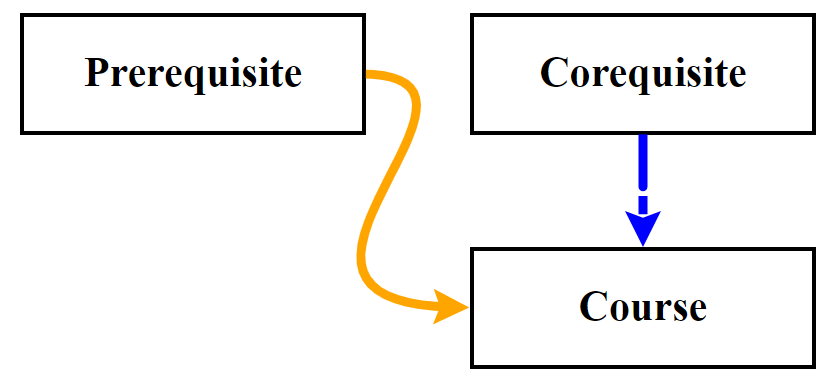
Plan
Graduate Attributes
Categories
Fall Term 1
CHEM 103
★ 4.3
(fi 6)(either term,
3-1s-3/2)
Atoms and molecules, states of matter, chemistry of the elements. Prerequisite: Chemistry 30, or equivalent. Note: Restricted to Engineering students only. Other students who take this course will receive 3 units.
Accreditation Units
Math and Natural Sciences: 53.5 Units
Graduate Attributes
| KB | PA | IN | DE | ET | TW | CS | PR | IS | EE | EP | LL |
|---|---|---|---|---|---|---|---|---|---|---|---|
| I | I |
ENGG 100
★ 1.1
(fi 2)(either term,
.75-.75s-0)
An introduction to the Faculty of Engineering, the engineering profession, the skills required for academic success, and the fundamentals of leadership: study and life skills; time management and goal setting; interpersonal skills; career planning; engineering and society including elements of ethics, equity, concepts of sustainable development, environmental stewardship, and public safety.
Accreditation Units
Graduate Attributes
| KB | PA | IN | DE | ET | TW | CS | PR | IS | EE | EP | LL |
|---|---|---|---|---|---|---|---|---|---|---|---|
| I | I | I | I |
ENGG 130
★ 4.0
(fi 6)(either term,
3-0-2)
Equilibrium of planar systems. Analysis of statically determinate trusses and frames. Friction. Centroids and centres of gravity. Forces and moments in beams. Second moments of area. Note: Students in all sections of this course will write a common final examination. Corequisite: MATH 100.
Accreditation Units
Engineering Science and Engineering Design: 50.4 Units
Graduate Attributes
| KB | PA | IN | DE | ET | TW | CS | PR | IS | EE | EP | LL |
|---|---|---|---|---|---|---|---|---|---|---|---|
| I | I |
ENGL 199
★ 3.0
(fi 6)(either term,
3-0-0)
This course aims to develop the student's ability to provide effective written and oral information. It will focus on instruction in fundamental writing skills, including building effective sentences and paragraphs, and on learning to communicate clearly across a range of genres and media used in academic and professional contexts, including correspondence and presentations. Students will be introduced to the principles of information gathering, analysis, and citation. Note: Restricted to students in the Faculty of Engineering only.
Accreditation Units
Graduate Attributes
| KB | PA | IN | DE | ET | TW | CS | PR | IS | EE | EP | LL |
|---|---|---|---|---|---|---|---|---|---|---|---|
| I | D |
MATH 100
★ 3.5
(fi 6)(either term,
3-0-1)
Review of numbers, inequalities, functions, analytic geometry; limits, continuity; derivatives and applications, Taylor polynomials; log, exp, and inverse trig functions. Integration, fundamental theorem of calculus substitution, trapezoidal and Simpson's rules. Prerequisites: Mathematics 30-1 and Mathematics 31. Notes: (1) Credit can be obtained in at most one of MATH 100, 113, 114, 117, 134, 144, 154, or SCI 100. (2) Students in all sections of this course will write a common final examination. (3) Restricted to Engineering students. Non-Engineering students who take this course will receive 3 units.
Accreditation Units
Math and Natural Sciences: 44.1 Units
Graduate Attributes
| KB | PA | IN | DE | ET | TW | CS | PR | IS | EE | EP | LL |
|---|---|---|---|---|---|---|---|---|---|---|---|
| I | I |
PHYS 130
★ 3.8
(fi 6)(either term,
3-0-3/2)
Geometrical optics, optical instruments, oscillations, waves, sound, interference, diffraction. Prerequisites: Mathematics 30-1, Mathematics 31, Physics 30. Corequisite: MATH 100 or 113 or 114 or 117 or 134 or 144 or equivalent. Restricted to Engineering students. Other students who take this course will receive 3 units.
Accreditation Units
Math and Natural Sciences: 47.2 Units
Graduate Attributes
| KB | PA | IN | DE | ET | TW | CS | PR | IS | EE | EP | LL |
|---|---|---|---|---|---|---|---|---|---|---|---|
| I | I |
Winter Term 2
CHEM 105
★ 3.8
(fi 6)(either term,
3-0-3/2)
Rates of reactions, thermodynamics and equilibrium, coordination chemistry, electrochemistry, modern applications of chemistry. Prerequisite: CHEM 103 or 101. Note: Restricted to Engineering students only. Other students who take this course will receive 3 units.
Accreditation Units
Math and Natural Sciences: 47.2 Units
Graduate Attributes
| KB | PA | IN | DE | ET | TW | CS | PR | IS | EE | EP | LL |
|---|---|---|---|---|---|---|---|---|---|---|---|
| I | D |
ENCMP 100
★ 3.8
(fi 6)(either term,
3-0-1.5)
Fundamentals of computer programming with emphasis on solving engineering problems. Structure and syntax of computer programs, variables, data types, data structures, control structures, functions, input/output operations, debugging, software development process.
Accreditation Units
Engineering Design: 21.3 Units
Engineering Science and Engineering Design: 47.2 Units
Graduate Attributes
| KB | PA | IN | DE | ET | TW | CS | PR | IS | EE | EP | LL |
|---|---|---|---|---|---|---|---|---|---|---|---|
| I | I | I | I | I | I | I | I |
ENGG 160
★ 2.0
(fi 4)(either term or Spring/Summer,
1-0-2)
Fundamental design process and theory in a multidisciplinary context. Importance, in engineering design, of communications; team work; the engineering disciplines, career fields; professional responsibilities of the engineer including elements of ethics, equity, concepts of sustainable development and environmental stewardship, public and worker safety and health considerations including the context of the Alberta Occupational Health and Safety Act. Corequisite ENGL 199. This course is delivered in a blended format.
Accreditation Units
Engineering Design: 12.6 Units
Engineering Science and Engineering Design: 12.6 Units
Graduate Attributes
| KB | PA | IN | DE | ET | TW | CS | PR | IS | EE | EP | LL |
|---|---|---|---|---|---|---|---|---|---|---|---|
| I | I | I | I | I | I | I |
EN PH 131
★ 4.3
(fi 6)(either term,
3-1s-3/2)
Kinematics and dynamics of particles; gravitation; work and energy; linear momentum; angular momentum; systems of particles; introduction to dynamics of rigid bodies. Prerequisites: MATH 100 or 117, and ENGG 130. Corequisite: MATH 101 or 118. Restricted to Engineering students. Other students who take this course will receive 3 units.
Accreditation Units
Math and Natural Sciences: 26.8 Units
Engineering Science: 26.8 Units
Engineering Science and Engineering Design: 26.8 Units
Graduate Attributes
| KB | PA | IN | DE | ET | TW | CS | PR | IS | EE | EP | LL |
|---|---|---|---|---|---|---|---|---|---|---|---|
| I | I | I |
MATH 101
★ 3.5
(fi 6)(either term,
3-0-1)
Area between curves, techniques of integration. Applications of integration to planar areas and lengths, volumes and masses. First order ordinary differential equations: separable, linear, direction fields, Euler's method, applications. Infinite series, power series, Taylor expansions with remainder terms. Polar coordinates. Rectangular, spherical and cylindrical coordinates in 3-dimensional space. Parametric curves in the plane and space: graphing, arc length, curvature; normal binormal, tangent plane in 3- dimensional space. Volumes and surface areas of rotation. Prerequisite: MATH 100. Notes: (1) Credit can be obtained in at most one of MATH 101, 115, 118, 136, 146, 156 or SCI 100. (2) Students in all sections of this course will write a common final examination. (3) Restricted to Engineering students. Non-Engineering students who take this course will receive 3 units.
Accreditation Units
Math and Natural Sciences: 44.1 Units
Graduate Attributes
| KB | PA | IN | DE | ET | TW | CS | PR | IS | EE | EP | LL |
|---|---|---|---|---|---|---|---|---|---|---|---|
| D | I |
MATH 102
★ 3.5
(fi 6)(either term,
3-0-1)
Vectors and matrices, solution of linear equations, equations of lines and planes, determinants, matrix algebra, orthogonality and applications (Gram-Schmidt), eigenvalues and eigenvectors and applications, complex numbers. Prerequisite or corequisite: MATH 100. Notes: (1) Credit can be obtained in at most one of MATH 102, 125, or 127. (2) Students in all sections of this course will write a common final examination. (3) Restricted to Engineering students. Non-Engineering students who take this course will receive 3 units.
Accreditation Units
Math and Natural Sciences: 44.1 Units
Graduate Attributes
| KB | PA | IN | DE | ET | TW | CS | PR | IS | EE | EP | LL |
|---|---|---|---|---|---|---|---|---|---|---|---|
| D |
Fall Term 3
CMPUT 274
★ 3.0
(fi 6)(either term,
0-6l-0)
This is part 1 of an intensive problem-based introduction to Computing Science. In part 1, the key concepts of procedural programming, basic algorithm design and analysis (lists, queues, trees, sorting, searching) are learned by solving a series of problems using Python. Development is done using the Linux operating system. Prerequisite: Math 30-1. Note: this course is taught in studio-style, where lectures and labs are blended into 3 hour sessions, twice a week. Enrollment is limited by the capacity of the combined lecture/lab facilities. Python or prior computing background is strongly recommended. Credit cannot be obtained for both CMPUT 174 and CMPUT 274. Credit cannot be obtained for both CMPUT 175 and CMPUT 274.
Accreditation Units
Engineering Science and Engineering Design: 37.8 Units
Graduate Attributes
| KB | PA | IN | DE | ET | TW | CS | PR | IS | EE | EP | LL |
|---|---|---|---|---|---|---|---|---|---|---|---|
| D | I | I | D | D |
ECE 202
★ 4.3
(fi 6)(first term,
3-1s-3/2)
Circuit element definitions. Circuit laws: Ohm's, KVL, KCL. Resistive voltage and current dividers. Basic loop and nodal analysis. Dependent sources. Circuit theorems: linearity, superposition, maximum power transfer, Thevenin, Norton. Time domain behavior of inductance and capacitance, energy storage. Sinusoidal signals, complex numbers, phasor and impedance concepts. Magnetically coupled networks. Single phase power and power factor. Prerequisites: MATH 101, 102. Credit may be obtained in only one of ECE 202, E E 240, ECE 209 or E E 239, unless approved by the Department.
Accreditation Units
Engineering Design: 13.4 Units
Engineering Science and Engineering Design: 53.5 Units
Graduate Attributes
| KB | PA | IN | DE | ET | TW | CS | PR | IS | EE | EP | LL |
|---|---|---|---|---|---|---|---|---|---|---|---|
| I | I | I | I | I |
ECE 210
★ 3.8
(fi 6)(either term,
3-0-3/2)
Boolean algebra, truth tables, Karnaugh maps. Switching devices and their symbology with an introduction to NAND and NOR logic. Number systems, codes, minimization procedures, synthesis of combinational networks. Synchronous sequential circuits, flip-flops, counters. Arithmetic circuits. Introduction to computer-aided design and simulation tools for digital design and implementation. Requires payment of additional student instructional support fees. Refer to the Tuition and Fees page in the University Regulations section of the Calendar. Credit may be obtained in only one of ECE 210, E E 280 or CMPUT 329.
Accreditation Units
Engineering Design: 35.4 Units
Engineering Science and Engineering Design: 47.2 Units
Graduate Attributes
| KB | PA | IN | DE | ET | TW | CS | PR | IS | EE | EP | LL |
|---|---|---|---|---|---|---|---|---|---|---|---|
| D | D | D | D | D | D |
MATH 201
★ 3.5
(fi 6)(either term or Spring/Summer,
3-0-1)
First-order equations; second-order linear equations: reduction of order, variation of parameters; Laplace transform; linear systems; power series; solution by series; separation of variables for PDEs. Prerequisite or corequisite: MATH 209 or 214. Notes: (1) Open only to students in Engineering and Specialization Geophysics. (2) Credit can be obtained in at most one of MATH 201, MATH 334, MATH 336, or MA PH 251. (3) Students in all sections of this course will write a common final examination. Non-Engineering students who take this course will receive 3 units.
Accreditation Units
Math and Natural Sciences: 44.1 Units
Graduate Attributes
| KB | PA | IN | DE | ET | TW | CS | PR | IS | EE | EP | LL |
|---|---|---|---|---|---|---|---|---|---|---|---|
| D | D |
MATH 209
★ 3.5
(fi 6)(either term,
3-0-1)
Partial differentiation, derivatives of integrals. Multiple integration using rectangular, cylindrical, and spherical coordinates. Vector Field Theory. Prerequisite: MATH 101. Prerequisite or corequisite: MATH 102. Notes: (1) This course may not be taken for credit if credit has already been obtained in MATH 215, MATH 315, MATH 317 or MA PH 351. (2) Students in all sections of this course will write a common final examination. (3) Restricted to Engineering students. Non-Engineering students who take this course will receive 3 units.
Accreditation Units
Math and Natural Sciences: 44.1 Units
Graduate Attributes
| KB | PA | IN | DE | ET | TW | CS | PR | IS | EE | EP | LL |
|---|---|---|---|---|---|---|---|---|---|---|---|
| D | D |
COMP E
★ 3.0
(fi 6)(either term or Spring/Summer,
3-0-0)
Choose a Complementary Studies Elective from the approved list.
Accreditation Units
Winter Term 4
CMPUT 272
★ 3.0
(fi 6)(either term,
3-3s-0)
An introduction to the tools of set theory, logic, and induction, and their use in the practice of reasoning about algorithms and programs. Basic set theory; the notion of a function; counting; propositional and predicate logic and their proof systems; inductive definitions and proofs by induction; program specification and correctness. Prerequisites: CMPUT 101, 174, 175, 274, SCI 100, or ENCMP 100.
Accreditation Units
Math and Natural Sciences: 56.7 Units
Graduate Attributes
| KB | PA | IN | DE | ET | TW | CS | PR | IS | EE | EP | LL |
|---|---|---|---|---|---|---|---|---|---|---|---|
| D | D | I | D |
CMPUT 275
★ 3.0
(fi 6)(either term,
0-6l-0)
This is part 2 of an intensive introduction to Computing Science. Part 2 expands to add object-oriented programming, with C++, and more complex algorithms and data structures such as shortest paths in graphs; divide and conquer and dynamic programming; and recursion. Prerequisite: CMPUT 274. Note: this course is taught in studio-style, where lectures and labs are blended into 3 hour sessions, twice a week. Enrollment is limited by the capacity of the combined lecture/lab facilities. Credit cannot be obtained for both CMPUT 175 and CMPUT 275. Credit cannot be obtained for both CMPUT 201 and CMPUT 275.
Accreditation Units
Engineering Science and Engineering Design: 37.8 Units
Graduate Attributes
| KB | PA | IN | DE | ET | TW | CS | PR | IS | EE | EP | LL |
|---|---|---|---|---|---|---|---|---|---|---|---|
| A | A | D |
ECE 203
★ 4.3
(fi 6)(second term or Spring/Summer,
3-1s-3/2)
Nonlinear circuit analysis. Diodes: ideal and simple and models, single phase rectifiers. Ideal and finite gain op-amps. Treatment of RLC circuits in the time domain, frequency domain and s-plane. Two port networks. Prerequisites: ECE 202 or E E 240. Corequisite: ECE 240 or E E 238. Credit may be obtained in only one of ECE 203 or E E 250.
Accreditation Units
Engineering Design: 13.4 Units
Engineering Science and Engineering Design: 53.5 Units
Graduate Attributes
| KB | PA | IN | DE | ET | TW | CS | PR | IS | EE | EP | LL |
|---|---|---|---|---|---|---|---|---|---|---|---|
| D | D | D | I | I |
ECE 212
★ 3.8
(fi 6)(either term or Spring/Summer,
3-0-3/2)
Microcomputer architecture, assembly language programming, sub-routine handling, memory and input/output system and interrupt concepts. Prerequisite: ECE 210 or E E 280 or CMPUT 329. Credit may be obtained in only one of ECE 212, E E 380 or CMPUT 229.
Accreditation Units
Engineering Design: 11.8 Units
Engineering Science and Engineering Design: 47.2 Units
Graduate Attributes
| KB | PA | IN | DE | ET | TW | CS | PR | IS | EE | EP | LL |
|---|---|---|---|---|---|---|---|---|---|---|---|
| D | A | D | D | A | D | D |
ECE 240
★ 3.5
(fi 6)(either term,
3-1s-0)
Introduction to linear systems and signal classification. Delta function and convolution. Fourier series expansion. Fourier transform and its properties. Laplace transform. Analysis of linear time invariant (LTI) systems using the Laplace transform. Prerequisites: ECE 202 or E E 240, MATH 201. Credit may be obtained in only one of ECE 240 or E E 238.
Accreditation Units
Engineering Design: 11.0 Units
Engineering Science and Engineering Design: 44.1 Units
Graduate Attributes
| KB | PA | IN | DE | ET | TW | CS | PR | IS | EE | EP | LL |
|---|---|---|---|---|---|---|---|---|---|---|---|
| D | D |
PHYS 230
★ 3.8
(fi 6)(either term,
3-0-3/2)
Electric fields, Gauss' Law; electric potential; capacitance and dielectrics; electric current and resistance; magnetic fields, Ampere's Law; Faraday's Law; inductance; magnetic properties of matter. Prerequisites: PHYS 130 or 144 or 146, and MATH 100 or 114 or 117 or 144. Corequisite: MATH 101 or 115 or 118. Note: Restricted to Engineering students. Other students who take this course will receive 3 units. Credit can normally be obtained for only one of PHYS 181, 230, or 281.
Accreditation Units
Math and Natural Sciences: 47.2 Units
Graduate Attributes
| KB | PA | IN | DE | ET | TW | CS | PR | IS | EE | EP | LL |
|---|---|---|---|---|---|---|---|---|---|---|---|
| D | D | D | I |
Fall Term 5
ECE 302
★ 4.3
(fi 6)(either term,
3-1s-3/2)
PN junction semiconductor basics, charge flow and diode equation. Zener diodes. BJT and MOSFET devices and operating regions. Amplifier basics: biasing, gain, input and output resistance, analysis and design. Large signal effects. Requires payment of additional student instructional support fees. Refer to the Tuition and Fees page in the University Regulations section of the Calendar. Prerequisite: ECE 203 or E E 250. Credit may be obtained in only one of ECE 302 or E E 340.
Accreditation Units
Engineering Design: 24.1 Units
Engineering Science and Engineering Design: 53.5 Units
Graduate Attributes
| KB | PA | IN | DE | ET | TW | CS | PR | IS | EE | EP | LL |
|---|---|---|---|---|---|---|---|---|---|---|---|
| D | D | A | D | A | D | D | D |
ECE 311
★ 3.0
(fi 6)(either term,
3-0-0)
Survey of modern computer architecture and design concepts. Benchmarks, instruction set design and encoding. Pipelined and superscalar processors. Techniques for exposing and exploiting instruction-level parallelism. Performance of cache and virtual memory hierarchies. Input/output subsystem design. Prerequisite: ECE 212 or E E 380 or CMPUT 229. Credit may be obtained in only one of ECE 311, CMPE 382 or CMPUT 429.
Accreditation Units
Engineering Design: 12.6 Units
Engineering Science and Engineering Design: 37.8 Units
Graduate Attributes
| KB | PA | IN | DE | ET | TW | CS | PR | IS | EE | EP | LL |
|---|---|---|---|---|---|---|---|---|---|---|---|
| D | D | D |
ECE 325
★ 3.8
(fi 6)(either term,
3-0-3/2)
Software engineering principles of object-oriented design: basic data structures, classes and objects, creation tactics, inheritance, composition, polymorphism, interfaces, compilation and execution. Programming Objectives: introduction to advanced data structures, inner classes, and reflection. Exception handling and unit testing. Prerequisite: CMPUT 275.
Accreditation Units
Engineering Design: 23.6 Units
Engineering Science and Engineering Design: 47.2 Units
Graduate Attributes
| KB | PA | IN | DE | ET | TW | CS | PR | IS | EE | EP | LL |
|---|---|---|---|---|---|---|---|---|---|---|---|
| A | A | D | A | A |
ECE 340
★ 3.8
(fi 6)(either term,
3-0-3/2)
Discrete time signals and systems; Sampled signals and sampling theorem, aliasing, A/D converter; Z-transform, stability analysis; Discrete-time Fourier transform; Discrete Fourier transform, leakage, spectral analysis; Digital filter design, filter structure. Prerequisite: ECE 240 or E E 238. Credit may be obtained in only one of ECE 340 or E E 338.
Accreditation Units
Engineering Design: 11.8 Units
Engineering Science and Engineering Design: 47.2 Units
Graduate Attributes
| KB | PA | IN | DE | ET | TW | CS | PR | IS | EE | EP | LL |
|---|---|---|---|---|---|---|---|---|---|---|---|
| A | A | D | D | D | I |
TECH EE-1
★ 3.0
(fi 6)(either term or Spring/Summer,
3-0-0)
Choose a Group I (Interdisciplinary) Technical Elective from the approved list.
Accreditation Units
ENG M 310
★ 3.0
(fi 6)(either term or Spring/Summer,
3-0-0)
The application of the fundamentals of economics to engineering alternatives in planning, developing and managing industrial projects. Note: Credit cannot be obtained for more than one of ENGG 310, 401, ENG M 310 or 401.
Accreditation Units
OR
ENG M 401
★ 3.0
(fi 6)(either term,
3-0-0)
The application of the fundamentals of engineering economics, financial analysis and market assessment to engineering alternatives in the planning, development and ongoing management of industrial enterprises. The course covers the use of engineering, economic, financial and market assessment information in investment and business operation decisions in technology oriented companies. Note: Credit cannot be obtained for more than one of ENGG 310, ENGG 401, ENG M 310, or ENG M 401.
Accreditation Units
Graduate Attributes
| KB | PA | IN | DE | ET | TW | CS | PR | IS | EE | EP | LL |
|---|---|---|---|---|---|---|---|---|---|---|---|
| I | I | D |
Winter Term 6
CMPUT 291
★ 3.0
(fi 6)(either term,
3-0-1.5)
Basic concepts in computer data organization and information processing; entity-relationship model; relational model; SQL and other relational query languages; storage architecture; physical organization of data; access methods for relational data. Programming experience (e.g., Python) is required for the course project. Prerequisites: CMPUT 175 or 274, and 272. Corequisite: one of CMPUT 201 or 275. Credit may be obtained in only one of CMPUT 291, BTM 415, or MIS 415.
Accreditation Units
Engineering Design: 18.9 Units
Engineering Science and Engineering Design: 56.7 Units
Graduate Attributes
| KB | PA | IN | DE | ET | TW | CS | PR | IS | EE | EP | LL |
|---|---|---|---|---|---|---|---|---|---|---|---|
| D | I | I | D | A |
CMPUT 379
★ 3.0
(fi 6)(either term,
3-0-3)
Introduction to the structure, components, and concepts behind modern general-purpose operating systems. Processes: process state transitions; operations on processes; interrupt processing; multiprocessor considerations; resource allocation; synchronization; critical sections and events; semaphores; deadlock: avoidance, detection, and recovery; memory management; virtual memory; paging and segmentation; page replacement strategies; working sets; demand paging; process scheduling; scheduling algorithms; file system functions; file organization; space allocation; virtual machines. Prerequisites: CMPUT 201 and 204, or 275; one of CMPUT 229, E E 380 or ECE 212.
Accreditation Units
Engineering Design: 18.9 Units
Engineering Science and Engineering Design: 56.7 Units
Graduate Attributes
| KB | PA | IN | DE | ET | TW | CS | PR | IS | EE | EP | LL |
|---|---|---|---|---|---|---|---|---|---|---|---|
| A | I | D | D | D |
ECE 315
★ 3.8
(fi 6)(either term,
3-0-3/2)
Design and use of digital interfaces, including memory, serial, parallel, synchronous and asynchronous interfaces. Hardware implementations of interrupts, buses, input/output devices and direct memory access. Multitasking software architecture, real-time preemptive multitasking kernels. Data structures and mechanisms for flow control. Computer communications interfaces, interfacing of microcontroller to peripheral devices such as stepper motors. Requires payment of additional student instructional support fees. Refer to the Tuition and Fees page in the University Regulations section of the Calendar. Prerequisite: ECE 212 or E E 380 or CMPUT 229, and 275 or permission of the Instructor. Credit may be obtained in only one of CMPE 401 or ECE 315.
Accreditation Units
Engineering Design: 21.3 Units
Engineering Science and Engineering Design: 47.2 Units
Graduate Attributes
| KB | PA | IN | DE | ET | TW | CS | PR | IS | EE | EP | LL |
|---|---|---|---|---|---|---|---|---|---|---|---|
| D | D | D | D | D | D | A | D |
COMP E
★ 3.0
(fi 6)(either term or Spring/Summer,
3-0-0)
Choose a Complementary Studies Elective from the approved list.
Accreditation Units
TECH EE-2
★ 3.0
(fi 6)(either term or Spring/Summer,
3-0-0)
Choose from the Group II Technical Electives. The Group II Technical Electives for the Electrical Engineering program require students to complete a total of six single-term courses distributed across three distinct priority tiers, while strictly adhering to specific constraints. To satisfy these requirements, at least three courses must be selected from Tier 1, at most two courses may be taken from Tier 2, and any remaining electives can be chosen from Tier 3. Additionally, students must ensure they do not take both ECE 408 and ECE 409, as completing both courses is prohibited.
Accreditation Units
ITS E
★ 3.0
(fi 6)(either term or Spring/Summer,
3-0-0)
Choose a Impact of Technology on Society from the approved list.
Accreditation Units
Fall Term 7
CMPUT 301
★ 3.0
(fi 6)(either term,
3-0-3)
Object-oriented design and analysis, with interactive applications as the primary example. Topics include: software process; revision control; Unified Modeling Language (UML); requirements; software architecture, design patterns, frameworks, design guidelines; unit testing; refactoring; software tools. Prerequisite: CMPUT 201 or CMPUT 275. Credit may be obtained in only one of CMPUT 301, BTM 419, or MIS 419.
Accreditation Units
Engineering Design: 18.9 Units
Engineering Science and Engineering Design: 56.7 Units
Graduate Attributes
| KB | PA | IN | DE | ET | TW | CS | PR | IS | EE | EP | LL |
|---|---|---|---|---|---|---|---|---|---|---|---|
| A | D | I | A | I | I | I |
ECE 304
★ 4.3
(fi 6)(either term,
3-1s-3/2)
MOS digital circuits, logic gates, threshold voltages. MOS logic families: design and simulation. CMOS timing: propagation delay, rise and fall times. Storage elements, memory, I/O and interfacing. Prerequisites: ECE 210 or E E 280 or CMPUT 329, and ECE 302 or E E 340. Credit may be obtained in only one of ECE 304 or E E 351.
Accreditation Units
Engineering Design: 24.1 Units
Engineering Science and Engineering Design: 53.5 Units
Graduate Attributes
| KB | PA | IN | DE | ET | TW | CS | PR | IS | EE | EP | LL |
|---|---|---|---|---|---|---|---|---|---|---|---|
| A | A | D | D |
ECE 342
★ 3.5
(fi 6)(either term or Spring/Summer,
3-1s-0)
Deterministic and probabilistic models. Basics of probability theory: random experiments, axioms of probability, conditional probability and independence. Discrete and continuous random variables: cumulative distribution and probability density functions, functions of a random variable, expected values, transform methods. Pairs of random variables: independence, joint cdf and pdf, conditional probability and expectation, functions of a pair of random variables, jointly Gaussian random variables. Sums of random variables: the central limit theorem; basic types of random processes, wide sense stationary processes, autocorrelation and crosscorrelation, power spectrum, white noise. Prerequisite: MATH 209. Credit may be obtained in only one of ECE 342 or E E 387.
Accreditation Units
Math and Natural Sciences: 19.8 Units
Engineering Science: 24.3 Units
Engineering Science and Engineering Design: 24.3 Units
Graduate Attributes
| KB | PA | IN | DE | ET | TW | CS | PR | IS | EE | EP | LL |
|---|---|---|---|---|---|---|---|---|---|---|---|
| A | D | I | I | I |
ECE 410
★ 3.8
(fi 6)(either term,
3-0-3/2)
Review of classical logic design methods. Introduction to the hardware description language VHDL. Logic simulation principles. Digital system design. Digital system testing and design for testability. Arithmetic circuits. State-of-the-art computer-aided design tools and FPGAs are used to design and implement logic circuits. Corequisite: ECE 304 or E E 351. Credit may be obtained in only one of CMPE 480 or ECE 410.
Accreditation Units
Engineering Design: 35.4 Units
Engineering Science and Engineering Design: 47.2 Units
Graduate Attributes
| KB | PA | IN | DE | ET | TW | CS | PR | IS | EE | EP | LL |
|---|---|---|---|---|---|---|---|---|---|---|---|
| A | D | D | D | A | D | I | D |
ENGG 404
★ 3.8
(fi 6)(either term or Spring/Summer,
3-3s/2-0)
Basic concepts of risk and consequences of loss incidents; risk management principles and practices; incident investigation, causation, root cause analysis; process safety management; the roles of government agencies, professional bodies and industry associations; workplace safety; risk-based decision-making processes; leadership and the human-factors side of risk management. The course focuses on the principles and practices of leadership towards the effective application and implementation of risk management in major organizations across all engineering disciplines. Industry virtual tours, case studies, seminars and team projects specific to the student's engineering program will be used to develop competencies and proficiencies in applying leadership and organizational effectiveness for successful risk management.
Accreditation Units
Graduate Attributes
| KB | PA | IN | DE | ET | TW | CS | PR | IS | EE | EP | LL |
|---|---|---|---|---|---|---|---|---|---|---|---|
| D | D | D | A | A | D | D |
TECH EE-2
★ 3.0
(fi 6)(either term or Spring/Summer,
3-0-0)
Choose from the Group II Technical Electives. The Group II Technical Electives for the Electrical Engineering program require students to complete a total of six single-term courses distributed across three distinct priority tiers, while strictly adhering to specific constraints. To satisfy these requirements, at least three courses must be selected from Tier 1, at most two courses may be taken from Tier 2, and any remaining electives can be chosen from Tier 3. Additionally, students must ensure they do not take both ECE 408 and ECE 409, as completing both courses is prohibited.
Accreditation Units
Winter Term 8
ECE 420
★ 3.8
(fi 6)(either term,
3-0-3/2)
Overview of parallel/distributed computing including concepts and terminology. Principles of programming with shared memory and synchronization methods. Multithread programming with Pthreads and OpenMP. Message passing computing: the Message Passing Interface library. Design and performance of parallel algorithms. Prerequisites: CMPUT 275 and 379.
Accreditation Units
Engineering Design: 23.6 Units
Engineering Science and Engineering Design: 47.2 Units
Graduate Attributes
| KB | PA | IN | DE | ET | TW | CS | PR | IS | EE | EP | LL |
|---|---|---|---|---|---|---|---|---|---|---|---|
| A | I | D | A | D |
ECE 487
★ 3.0
(fi 6)(either term,
3-0-0)
Network topologies. Layered architectures and the Open Systems Interconnection (OSI) reference model. Peer-to-peer protocols, medium access control protocols, and local area network standards. Packet switched networks and routing, the TCP/IP suite of protocols. Credit may be obtained in only one of ECE 487, CMPUT 313 or CMPE 487.
Accreditation Units
Engineering Design: 9.4 Units
Engineering Science and Engineering Design: 37.8 Units
Graduate Attributes
| KB | PA | IN | DE | ET | TW | CS | PR | IS | EE | EP | LL |
|---|---|---|---|---|---|---|---|---|---|---|---|
| A | A | I | D |
ECE 492
★ 4.0
(fi 6)(either term,
3/3-0-6)
Design of microprocessor systems, input/output systems, programmable timers, address decoding and interrupt circuitry. This course has a major laboratory component and requires the design and implementation of a microprocessor-based system. Prerequisites: ECE 315 or CMPE 401, and ECE 410 or CMPE 480. Credit may be obtained in only one of CMPE 450, 490, or ECE 492.
Accreditation Units
Engineering Science and Engineering Design: 50.4 Units
Graduate Attributes
| KB | PA | IN | DE | ET | TW | CS | PR | IS | EE | EP | LL |
|---|---|---|---|---|---|---|---|---|---|---|---|
| D | I | A | A | A | A | I | A | A | A |
ENGG 400
★ 1.0
(fi 2)(either term,
1-0-0)
The technical and professional duties and responsibilities of the engineer; the ethics of the engineering profession; technical and professional organizations. The role of the engineer in the social environment including elements of equity, concepts of sustainable development and environmental stewardship, public and worker safety and health considerations including the context of the Alberta Occupational Health and Safety Act. Note: Restricted to fourth-year traditional and fifth-year co-op engineering students. Must be taken in last term of program.
Accreditation Units
Graduate Attributes
| KB | PA | IN | DE | ET | TW | CS | PR | IS | EE | EP | LL |
|---|---|---|---|---|---|---|---|---|---|---|---|
| D | A | D | A | A |
TECH EE-1
★ 3.0
(fi 6)(either term or Spring/Summer,
3-0-0)
Choose a Group I (Interdisciplinary) Technical Elective from the approved list.
Accreditation Units
TECH EE-2
★ 3.0
(fi 6)(either term or Spring/Summer,
3-0-0)
Choose from the Group II Technical Electives. The Group II Technical Electives for the Electrical Engineering program require students to complete a total of six single-term courses distributed across three distinct priority tiers, while strictly adhering to specific constraints. To satisfy these requirements, at least three courses must be selected from Tier 1, at most two courses may be taken from Tier 2, and any remaining electives can be chosen from Tier 3. Additionally, students must ensure they do not take both ECE 408 and ECE 409, as completing both courses is prohibited.
Accreditation Units
| M: | 297.0 | / | 195 | ✅ |
| NS: | 221.9 | / | 195 | ✅ |
| CS: | 198.4 | / | 225 | ❌ |
| ES: | 1709.1 | / | 225 | ✅ |
| ED: | 965.3 | / | 225 | ✅ |
| M+NS: | 518.9 | / | 420 | ✅ |
| ES+ED: | 2674.4 | / | 900 | ✅ |
| Total: | 3391.7 | / | 1850 | ✅ |
TOTAL
Group 1 Electives (x2)
CH E 243
★ 3.5
(fi 6)(either term or Spring/Summer,
3-1s-0)
An introduction to the first and second laws of thermodynamics. Prerequisites: MATH 101.
Accreditation Units
Engineering Science and Engineering Design: 44.1 Units
Graduate Attributes
| KB | PA | IN | DE | ET | TW | CS | PR | IS | EE | EP | LL |
|---|---|---|---|---|---|---|---|---|---|---|---|
| I | I | I |
MAT E 201
★ 3.0
(fi 6)(either term,
3-0-0)
An introduction to the science of materials from the standpoint of the relationships between atomic, molecular and crystal structure to material properties. Atomic bonding, crystal structure and crystal imperfections. Structures of metallic, non-metallic and composite materials. Diffusion, electrochemical and corrosion properties; strengthening mechanisms, mechanical properties and failure; electrical conductors, semiconductors, and dielectrics; thermal, magnetic, and optical properties. Prerequisite: CHEM 105 or consent of Department.
Accreditation Units
Engineering Science and Engineering Design: 37.8 Units
Graduate Attributes
| KB | PA | IN | DE | ET | TW | CS | PR | IS | EE | EP | LL |
|---|---|---|---|---|---|---|---|---|---|---|---|
| D | D | I | I | I |
MEC E 250
★ 3.5
(fi 6)(either term or Spring/Summer,
3-1s-0)
Moments of inertia. Kinematics and kinetics of rigid body motion, energy and momentum methods, impact, mechanical vibrations. Prerequisites: ENGG 130, EN PH 131 and MATH 101. There is a consolidated exam.
Accreditation Units
Engineering Science and Engineering Design: 44.1 Units
Graduate Attributes
| KB | PA | IN | DE | ET | TW | CS | PR | IS | EE | EP | LL |
|---|---|---|---|---|---|---|---|---|---|---|---|
| D | D | I | I | I | I |
Group 2A Electives (x3)
CMPUT 250
★ 3.0
(fi 6)(either term,
3-0-3)
An interdisciplinary course for students in Science, Arts, and other faculties. The focus is on games as interactive entertainment, their role in society, and how they are made. Teams composed of students with diverse backgrounds (e.g. English, Art and Design, and Computing Science) follow the entire creative process: from concept, through pitch, to delivery, of a short narrative-based game using a commercial game engine. To achieve the required mix of backgrounds and experience, students must apply to be considered for this course. See the Department web site for the online form. Prerequisite: Second-year standing.
Accreditation Units
Engineering Design: 28.3 Units
Engineering Science and Engineering Design: 56.7 Units
CMPUT 304
★ 3.0
(fi 6)(either term,
3-1s-0)
The second course of a two-course sequence on algorithm design. Emphasis on principles of algorithm design. Categories of algorithms such as divide-and-conquer, greedy algorithms, dynamic programming; analysis of algorithms; limits of algorithm design; NP-completeness; heuristic algorithms. Prerequisites: CMPUT 204; one of STAT 151, 161, 181, 235, 265, SCI 151, or MATH 181; and one of MATH 102, 125, 126, or 127.
Accreditation Units
Engineering Science and Engineering Design: 37.8 Units
CMPUT 307
★ 3.0
(fi 6)(either term,
3-0-3)
An introductory course on the theory and applications of computer based 3D modeling and animation. The course will cover a selection of topics from overview of tools supporting modeling and animation, automatically generating 3D models, and animation of skeleton based models through algorithms and software. Applications of 3D modeling and animation in games, virtual/augmented environments, movies, and emerging video transmission algorithms will be discussed. Prerequisites: CMPUT 206, or CMPUT 204 and one of MATH 225 or 227.
Accreditation Units
Engineering Design: 28.3 Units
Engineering Science and Engineering Design: 56.7 Units
CMPUT 312
★ 3.0
(fi 6)(either term,
3-0-3)
Algorithms and software paradigms for robot programming; mathematical modeling of robot arms and rovers including kinematics, and an introduction to dynamics and control; sensors, motors and their modeling; basics of image processing and machine vision; vision-guided motion control. Prerequisite: CMPUT 201 and CMPUT 204, or CMPUT 275; and permission of the Department. Corequisite: CMPUT 340 or CMPUT 418, or ECE 240.
Accreditation Units
CMPUT 325
★ 3.0
(fi 6)(either term,
3-0-3)
A study of the theory, run-time structure, and implementation of selected non-procedural programming languages. Languages will be selected from the domains of functional, and logic-based languages. Prerequisites: CMPUT 201 and 204, or 275; and one of MATH 102, 125, 126, or 127.
Accreditation Units
Engineering Design: 18.9 Units
Engineering Science and Engineering Design: 56.7 Units
CMPUT 350
★ 3.0
(fi 6)(either term,
3-0-3)
This course focuses on building efficient video game engines using C++. Programming-specific topics include object-oriented programming, memory management, data efficiency, and the Standard Template Library. These topics are applied to design 2D game engines with object-oriented and/or entity-component system (ECS) methods. These engines are built upon concepts such as sprites, cameras, object collisions, and shaders. Student projects give hands-on experience directly applicable to the video games industry. Prerequisites: CMPUT 201 or CMPUT 275, and CMPUT 204.
Accreditation Units
Engineering Design: 28.3 Units
Engineering Science and Engineering Design: 56.7 Units
CMPUT 365
★ 3.0
(fi 6)(either term,
3-0-0)
This course provides an introduction to reinforcement learning, which focuses on the study and design of learning agents that interact with a complex, uncertain world to achieve a goal. The course will cover multi- armed bandits, Markov decision processes, reinforcement learning, planning, and function approximation (online supervised learning). The course will take an information-processing approach to the study of intelligence and briefly touch on perspectives from psychology, neuroscience, and philosophy. The course will use the University of Alberta MOOC on Reinforcement Learning. Any student who understands the material in this course will understand the foundations of much of modern probabilistic artificial intelligence (AI) and be prepared to take more advanced courses, or to apply AI tools and ideas to real-world problems. Prerequisites: CMPUT 175 or 275; one of CMPUT 267, 466, or STAT 265.
Accreditation Units
CMPUT 366
★ 3.0
(fi 6)(either term,
3-0-3)
This course provides an introduction to search and planning in artificial intelligence. The course covers deterministic single-agent and multi-agent problems. Students will learn how to model real-world problems as state-space search problems and how to solve such problems. The course covers algorithms for solving deterministic shortest path problems with factored and non-factored states, combinatorial optimization problems, constraint satisfaction problems, and multi- agent problems. Prerequisites: CMPUT 204 or 275, and CMPUT 272.
Accreditation Units
Engineering Design: 18.9 Units
Engineering Science and Engineering Design: 56.7 Units
CMPUT 391
★ 3.0
(fi 6)(either term,
3-0-3)
This course covers the implementation of RDBMSs and some non- relational data models, along with their query languages. Topics: compilation, execution, and optimization of SQL queries; concurrent execution of transactions; indexing; advanced constructs in SQL; semi-structured data models and query languages; distributed and parallel databases; NoSQL and cloud-based database systems. Prerequisites: CMPUT 201 and 204, or 275; and CMPUT 291.
Accreditation Units
Engineering Design: 18.9 Units
Engineering Science and Engineering Design: 56.7 Units
CMPUT 411
★ 3.0
(fi 6)(either term,
3-0-3)
2D and 3D transformation; 3D modeling and viewing; illumination models and shading methods; texture mapping; ray tracing. Prerequisites: CMPUT 204 or CMPUT 275; and CMPUT 340.
Accreditation Units
Engineering Design: 18.9 Units
Engineering Science and Engineering Design: 56.7 Units
CMPUT 415
★ 3.0
(fi 6)(either term,
3-0-3)
Compilers, interpreters, lexical analysis, syntax analysis, syntax- directed translation, symbol tables, type checking, flow analysis, code generation, code optimization. Prerequisites: one of CMPUT 229, E E 380, or ECE 212, and any 300-level Computing Science course.
Accreditation Units
Engineering Design: 37.8 Units
Engineering Science and Engineering Design: 56.7 Units
Group 2B Electives (x3)
CMPUT 428
★ 3.0
(fi 6)(either term,
3-0-3)
Introduction to the geometry and photometry of the 3D to 2D image formation process for the purpose of computing scene properties from camera images. Computing and analyzing motion in image sequences. Recognition of objects (what) and spatial relationships (where) from images and tracking of these in video sequences. Prerequisites: CMPUT 201 or 275; one of CMPUT 340, 418, or ECE 240; one of MATH 101, 115, 118, 136, 146 or 156; one of MATH 102, 125, 126, or 127; and permission of the Department.
Accreditation Units
CMPUT 466
★ 3.0
(fi 6)(either term,
3-0-3)
Learning is essential for many real-world tasks, including recognition, diagnosis, forecasting and data-mining. This course provides a broad overview of topics in machine learning, from foundational methods for regression, classification and dimensionality reduction to more complex modeling with neural networks. It will also provide the formal foundations for understanding when learning is possible and practical. This single course is an alternative to the more in-depth two-course sequence on machine learning with CMPUT 267 and CMPUT 467. Prerequisites: CMPUT 204 or CMPUT 275; any 300-level Computing Science course; MATH 102, 125, 126, or 127; one of MATH 115, 118, 136, 146, or 156; and one of STAT 151, 161, 181, 235, 265, SCI 151, or MATH 181. Credit cannot be obtained in CMPUT 466 if credit has already been obtained for CMPUT 467.
Accreditation Units
Engineering Design: 22.7 Units
Engineering Science and Engineering Design: 56.7 Units
ECE 303
★ 4.3
(fi 6)(either term or Spring/Summer,
3-1s-3/2)
Differential amplifiers. Frequency response: active device high-frequency behaviour and circuit models; amplifier circuits and design. Feedback: concepts and structure; feedback topologies and amplifiers; open- and closed-loop response. Operational amplifiers: behaviour, circuit analysis and design. Requires payment of additional student instructional support fees. Refer to the Tuition and Fees page in the University Regulations section of the Calendar. Prerequisite: ECE 302 or E E 340. Credit may be obtained in only one of ECE 303 or E E 350.
Accreditation Units
Engineering Design: 24.1 Units
Engineering Science and Engineering Design: 53.5 Units
Graduate Attributes
| KB | PA | IN | DE | ET | TW | CS | PR | IS | EE | EP | LL |
|---|---|---|---|---|---|---|---|---|---|---|---|
| A | D | D | D | D | D | D | I |
ECE 321
★ 3.5
(fi 6)(either term,
2-0-3)
Software quality attributes. Software requirements. Requirements elicitation via interviewing, workshops, prototyping, and use case analysis. Vision document and Software Requirement Specification document standards. Formal software specification methods including operational and descriptive models. Design by contract. Verification and validation of requirements. Prerequisite: CMPUT 275. Credit may be obtained in only one of CMPE 310 or ECE 321.
Accreditation Units
Engineering Design: 30.9 Units
Engineering Science and Engineering Design: 44.1 Units
Graduate Attributes
| KB | PA | IN | DE | ET | TW | CS | PR | IS | EE | EP | LL |
|---|---|---|---|---|---|---|---|---|---|---|---|
| D | D | D | D | D |
ECE 322
★ 3.8
(fi 6)(either term,
3-0-3/2)
From software requirements specification to software testing. Risk analysis and metrics for software testing. Software testing process, including test planning, design, implementation, execution, and evaluation. Test design via white box and black box approaches; coverage-based testing techniques. Unit, integration, and system testing. Acceptance tests. Software maintenance and regression testing. Prerequisite: CMPUT 275. Credit may be obtained in only one of CMPE 320 or ECE 322.
Accreditation Units
Engineering Design: 21.3 Units
Engineering Science and Engineering Design: 47.2 Units
Graduate Attributes
| KB | PA | IN | DE | ET | TW | CS | PR | IS | EE | EP | LL |
|---|---|---|---|---|---|---|---|---|---|---|---|
| A | A | A | D | D | D | A |
ECE 360
★ 3.8
(fi 6)(either term,
3-0-3/2)
Linear system models. Time response and stability. Block diagrams and signal flow graphs. Feedback control system characteristics. Dynamic compensation. Root locus analysis and design. Frequency response analysis and design. Prerequisites: ECE 203 or E E 250, and ECE 240 or E E 238. Credit may be obtained in only one of ECE 360, ECE 362, E E 357, E E 462 or E E 469.
Accreditation Units
ECE 380
★ 3.8
(fi 6)(either term or Spring/Summer,
3-0-3/2)
Basics of analog communication: amplitude, angle, and analog pulse modulation; modulators and demodulators; frequency multiplexing. Basics of digital communication: sampling, quantization, pulse code modulation, time division multiplexing, binary signal formats. Prerequisite: ECE 240 or E E 238. Credit may be obtained in only one of ECE 380 or E E 390.
Accreditation Units
Engineering Design: 11.8 Units
Engineering Science and Engineering Design: 47.2 Units
Graduate Attributes
| KB | PA | IN | DE | ET | TW | CS | PR | IS | EE | EP | LL |
|---|---|---|---|---|---|---|---|---|---|---|---|
| D | D | D | D | D | I |
ECE 402
★ 4.5
(fi 6)(either term,
3-0-3)
Introduction to radio communications systems. Frequency selective circuits and transformers. Parallel resonant circuits including transformers. Double-tuned circuits. Impedance matching. Oscillators. Conditions for oscillation. Amplitude limitation mechanisms. Phase stability. Crystal oscillators. Mixers. Diode-ring mixers. Square-law mixers. BJT mixers. Intermodulation distortion. Modulators and demodulators. Average envelope detectors. FM demodulators. High frequency amplifiers and automatic gain control. Broadband techniques. Neutralization. Phase-lock loops. Phase detectors. Voltage-controlled oscillators. Loop filters. Phase-locked loop applications. Power amplifiers. Prerequisite: ECE 303 or E E 350. Corequisite: ECE 360 or ECE 362 or E E 357 or E E 462. Credit may be obtained in only one of ECE 402 or E E 451.
Accreditation Units
Engineering Design: 31.2 Units
Engineering Science and Engineering Design: 56.7 Units
Graduate Attributes
| KB | PA | IN | DE | ET | TW | CS | PR | IS | EE | EP | LL |
|---|---|---|---|---|---|---|---|---|---|---|---|
| A | D | I | I | D |
ECE 403
★ 3.8
(fi 6)(either term,
3-0-3/2)
Very Large Scale Integration (VLSI) design techniques and their application. Electrical characteristics of MOSFET devices and CMOS circuits. Use of CAD tools for simulation and integrated circuit layout. Modeling delays, advanced digital logic circuit techniques, memory. Prerequisite: ECE 304 or E E 351; corequisite: ECE 410 or CMPE 480. Credit may be obtained in only one of ECE 403 or E E 453.
Accreditation Units
Engineering Design: 28.3 Units
Engineering Science and Engineering Design: 47.2 Units
Graduate Attributes
| KB | PA | IN | DE | ET | TW | CS | PR | IS | EE | EP | LL |
|---|---|---|---|---|---|---|---|---|---|---|---|
| A | D | I | A | A | I | I | I | I | I |
ECE 405
★ 3.0
(fi 6)(first term,
3-0-0)
Introduction to the principles of biophysical instrumentation. Various sensors are examined including strain gauges, inductive, capacitive, thermal, and piezoelectric sensors. Methods of measuring blood pressure are discussed. Origin of biopotentials; membrane and action potentials. Measurement of bioelectrical signals such as the ECG and EMG. Electrical safety, noise, impedance matching, and analog-to-digital conversion. Applications of electrodes, biochemical sensors, and lasers. Prerequisite: ECE 203 or E E 250 or consent of the Instructor. Credit may be obtained in only one of ECE 405 or EE BE 512.
Accreditation Units
Engineering Design: 9.4 Units
Engineering Science and Engineering Design: 37.8 Units
Graduate Attributes
| KB | PA | IN | DE | ET | TW | CS | PR | IS | EE | EP | LL |
|---|---|---|---|---|---|---|---|---|---|---|---|
| D | D | D | D | I | I | D | I | I | D |
Group 2C Electives (x3)
ECE 406
★ 3.0
(fi 6)(first term,
3-0-0)
This course is intended to enable individuals or a small group of students to study topics in their particular field of interest under the supervision of a member of the Department of Electrical and Computer Engineering or the Department of Computing Science or other appropriate departments.
Accreditation Units
Engineering Science and Engineering Design: 37.8 Units
OR
ECE 407
★ 3.0
(fi 6)(second term,
3-0-0)
This course is intended to enable individuals or a small group of students to study topics in their particular field of interest under the supervision of a member of the Department of Electrical and Computer Engineering or the Department of Computing Science or other appropriate departments.
Accreditation Units
Engineering Science and Engineering Design: 37.8 Units
ECE 412
★ 3.0
(fi 6)(either term,
3-0-0)
Defects in manufacturing, failure mechanisms, and fault modeling. Reliability and availability theory. Static and dynamic redundancy and repair. Error correcting codes and self-checking systems. Roll-back strategies. Fault-tolerant computers and network architecture. Prerequisite: ECE 342. Credit may be obtained in only one of CMPE 425 or ECE 412.
Accreditation Units
Engineering Science and Engineering Design: 37.8 Units
Graduate Attributes
| KB | PA | IN | DE | ET | TW | CS | PR | IS | EE | EP | LL |
|---|---|---|---|---|---|---|---|---|---|---|---|
| A | A | I | D | D | D | I |
ECE 421
★ 3.5
(fi 6)(either term,
2-0-3)
Advanced programming concepts. Programming language as a vehicle for discussion about programming concepts such as productivity, components and re-use, traditional vs. scripting approaches. Object oriented construction, systems programming, concurrent programming, Graphical User Interface (GUI) programming, distributed programming, and dynamic programming. Prerequisites: ECE 322 or CMPE 320, ECE 325, CMPUT 301 and CMPUT 379. Credit may be obtained in only one of CMPE 410 or ECE 421.
Accreditation Units
Engineering Design: 24.3 Units
Engineering Science and Engineering Design: 44.1 Units
Graduate Attributes
| KB | PA | IN | DE | ET | TW | CS | PR | IS | EE | EP | LL |
|---|---|---|---|---|---|---|---|---|---|---|---|
| A | A | D | A | D | D |
ECE 422
★ 3.0
(fi 6)(either term,
3-0-0)
Causes and consequences of computer system failure. Structure of fault-tolerant computer systems. Methods for protecting software and data against computer failure. Quantification of system reliability. Introduction to formal methods for safety-critical systems. Computer and computer network security. Prerequisite: CMPUT 301. Corequisite: ECE 487. Credit may be obtained in only one of CMPE 420 or ECE 422.
Accreditation Units
Engineering Design: 17.0 Units
Engineering Science and Engineering Design: 37.8 Units
Graduate Attributes
| KB | PA | IN | DE | ET | TW | CS | PR | IS | EE | EP | LL |
|---|---|---|---|---|---|---|---|---|---|---|---|
| A | A | D | A | D | A |
ECE 423
★ 3.8
(fi 6)(either term,
3-0-3/2)
Topics include distributed communication models (e.g., sockets, remote procedure calls, distributed shared memory), distributed synchronization (clock synchronization, logical clocks, distributed mutex), distributed file systems, replication, consistency models, fault tolerance, QoS and performance, scheduling, concurrency, agreement and commitment, Paxos-based consensus, MapReduce and NoSQL datastores, cloud infrastructures and microservices. Prerequisites: CMPUT 379 and (ECE 487 or CMPUT 313).
Accreditation Units
ECE 440
★ 3.8
(fi 6)(either term,
3-0-3/2)
Extension of sampling theory and the Fourier transform to two dimensions, pixel operations including gray-level modification, algebraic and geometric transformations. The design of spatial filters for noise reduction, image sharpening and edge enhancement, and some discussion of interpolation techniques. An introduction to the concepts of image restoration from known degradations and the reconstruction of images from parallel and fan projections. Prerequisite: ECE 340 or E E 338 or consent of Instructor. Credit may be obtained in only one of EE BE 540 or ECE 440.
Accreditation Units
Engineering Design: 14.2 Units
Engineering Science and Engineering Design: 47.2 Units
Graduate Attributes
| KB | PA | IN | DE | ET | TW | CS | PR | IS | EE | EP | LL |
|---|---|---|---|---|---|---|---|---|---|---|---|
| A | A | D | D |
ECE 442
★ 3.8
(fi 6)(either term,
3-0-3/2)
Human visual/audio perception and multimedia data representations. Basic multimedia processing concepts, multimedia compression and communications. Machine learning tools for multimedia signal processing, including principle component analysis and Gaussian mixture modeling. Applications to human-computer interaction, visual-audio, and visual-text processing. Prerequisites: ECE 220 or CMPUT 275, ECE 342, MATH 102 or equivalent knowledge. Credit may be obtained in only one of ECE 442 or E E 442.
Accreditation Units
Engineering Design: 23.6 Units
Engineering Science and Engineering Design: 47.2 Units
Graduate Attributes
| KB | PA | IN | DE | ET | TW | CS | PR | IS | EE | EP | LL |
|---|---|---|---|---|---|---|---|---|---|---|---|
| A | D | D | A | D | I |
ECE 447
★ 3.5
(fi 6)(either term,
3-1s-0)
The course introduces basic concepts and techniques of data analysis and machine learning. Topics include: data preprocessing techniques, decision trees, nearest neighbor algorithms, linear and logistic regressions, clustering, dimensionality reduction, model evaluation, deployment methods, and emerging topics. Prerequisites: ECE 220 or CMPUT 275, and ECE 342 or STAT 235, or consent of instructor.
Accreditation Units
ECE 449
★ 3.8
(fi 6)(either term,
3-0-3/2)
Intelligent systems for automatic control and data analysis. The concepts of vagueness and uncertainty, approximate reasoning, fuzzy rule-based systems and fuzzy control. Strategies for learning and adaptation, supervised and reinforcement learning, self-organization and the selection of neural network architectures. Discussion of the principles of search and optimization, evolution and natural selection and genetic algorithms. Introduction to hybrid intelligence. Applications of intelligent systems for pattern recognition, classification, forecasting, decision support, and control. Credit may be obtained in only one of CMPE 449 or ECE 449.
Accreditation Units
Engineering Design: 23.6 Units
Engineering Science and Engineering Design: 47.2 Units
Graduate Attributes
| KB | PA | IN | DE | ET | TW | CS | PR | IS | EE | EP | LL |
|---|---|---|---|---|---|---|---|---|---|---|---|
| A | A | I | D | A | I | D |
Group 2D Electives (x3)
ECE 449
★ 3.8
(fi 6)(either term,
3-0-3/2)
Intelligent systems for automatic control and data analysis. The concepts of vagueness and uncertainty, approximate reasoning, fuzzy rule-based systems and fuzzy control. Strategies for learning and adaptation, supervised and reinforcement learning, self-organization and the selection of neural network architectures. Discussion of the principles of search and optimization, evolution and natural selection and genetic algorithms. Introduction to hybrid intelligence. Applications of intelligent systems for pattern recognition, classification, forecasting, decision support, and control. Credit may be obtained in only one of CMPE 449 or ECE 449.
Accreditation Units
Engineering Design: 23.6 Units
Engineering Science and Engineering Design: 47.2 Units
Graduate Attributes
| KB | PA | IN | DE | ET | TW | CS | PR | IS | EE | EP | LL |
|---|---|---|---|---|---|---|---|---|---|---|---|
| A | A | I | D | A | I | D |
ECE 450
★ 3.8
(fi 6)(either term,
3-0-3/2)
Semiconductor device physics, device scaling trends, advanced MOSFET fabrication and the associated quantum mechanical framework in nanoscale systems. Semiconductor devices as a system of elemental components. Quantum phenomena in the evaluation of semiconductor devices. Impact of new materials such as high-k gate dielectrics, copper damascene processing and diffusion barriers on device performance. Choice of channel materials and strain condition for ultrascaled logic devices, RF and power electronic devices. Prerequisite: ECE 302 or E E 340. Credit may be obtained in only one of ECE 450 or E E 450.
Accreditation Units
Engineering Design: 15.8 Units
Engineering Science and Engineering Design: 47.2 Units
Graduate Attributes
| KB | PA | IN | DE | ET | TW | CS | PR | IS | EE | EP | LL |
|---|---|---|---|---|---|---|---|---|---|---|---|
| A | D | I | D | D | D | I | D |
ECE 455
★ 3.0
(fi 6)(either term,
3-0-0)
Microfluidic and nanobiotechnological devices. Fabrication techniques for devices: self-assembly, lithographic technologies. Applications of nanobiotechnology in computing, electronics, human health, environment and manufacture. Prerequisites: MATH 201 or PHYS 230. Credit may be obtained in only one of ECE 455 or E E 455.
Accreditation Units
Engineering Design: 12.6 Units
Engineering Science and Engineering Design: 37.8 Units
Graduate Attributes
| KB | PA | IN | DE | ET | TW | CS | PR | IS | EE | EP | LL |
|---|---|---|---|---|---|---|---|---|---|---|---|
| A | A | D | I |
ECE 456
★ 3.0
(fi 6)(either term,
3-0-0)
Fundamental concepts related to current flow in nanoelectronic devices. Energy level diagram and the Fermi function. Single-energy-level model for current flow and associated effects, such as the quantum of conductance, Coulomb blockade, and single electron charging. The Schroedinger equation and quantum mechanics for applications in nanoelectronics. Matrix-equation approach for numerical band structure calculations of transistor channel materials. k-space, Brillouin zones, and density of states. Subbands for quantum wells, wires, dots, and carbon nanotubes. Current flow in nanowires and ballistic nanotransistors, including minimum possible channel resistance, quantum capacitance, and the transistor equivalent circuit under ballistic operation. Prerequisite: ECE 302 or E E 340. Credit may be obtained in only one of ECE 456 or E E 456.
Accreditation Units
Engineering Design: 9.4 Units
Engineering Science and Engineering Design: 37.8 Units
Graduate Attributes
| KB | PA | IN | DE | ET | TW | CS | PR | IS | EE | EP | LL |
|---|---|---|---|---|---|---|---|---|---|---|---|
| A | D | I | I | I | I | I |
ECE 475
★ 3.0
(fi 6)(either term,
3-0-0)
Basic optical properties of crystalline and amorphous semiconductor materials: energy band diagrams, optical constants. Recombination and light emission in semiconductors. Light emitting diodes: spectral characteristics, materials, and applications. Stimulated emission and laser oscillation conditions in semiconductors. Laser diodes: modal and spectral properties, steady state rate equations, materials and structures. Light absorption, optical to electrical energy conversion. Photovoltaic cells: fill factors and efficiency, temperature effects, alternative materials and structures. Prerequisite: ECE 302 or E E 340. Credit may be obtained in only one of ECE 475 or E E 475.
Accreditation Units
Engineering Design: 11.3 Units
Engineering Science and Engineering Design: 37.8 Units
Graduate Attributes
| KB | PA | IN | DE | ET | TW | CS | PR | IS | EE | EP | LL |
|---|---|---|---|---|---|---|---|---|---|---|---|
| A | A | I |
Fall Term 1
CHEM 103
★ 4.3
(fi 6)(either term,
3-1s-3/2)
Atoms and molecules, states of matter, chemistry of the elements. Prerequisite: Chemistry 30, or equivalent. Note: Restricted to Engineering students only. Other students who take this course will receive 3 units.
Accreditation Units
Math and Natural Sciences: 53.5 Units
Graduate Attributes
| KB | PA | IN | DE | ET | TW | CS | PR | IS | EE | EP | LL |
|---|---|---|---|---|---|---|---|---|---|---|---|
| I | I |
ENGG 100
★ 1.1
(fi 2)(either term,
.75-.75s-0)
An introduction to the Faculty of Engineering, the engineering profession, the skills required for academic success, and the fundamentals of leadership: study and life skills; time management and goal setting; interpersonal skills; career planning; engineering and society including elements of ethics, equity, concepts of sustainable development, environmental stewardship, and public safety.
Accreditation Units
Graduate Attributes
| KB | PA | IN | DE | ET | TW | CS | PR | IS | EE | EP | LL |
|---|---|---|---|---|---|---|---|---|---|---|---|
| I | I | I | I |
ENGG 130
★ 4.0
(fi 6)(either term,
3-0-2)
Equilibrium of planar systems. Analysis of statically determinate trusses and frames. Friction. Centroids and centres of gravity. Forces and moments in beams. Second moments of area. Note: Students in all sections of this course will write a common final examination. Corequisite: MATH 100.
Accreditation Units
Engineering Science and Engineering Design: 50.4 Units
Graduate Attributes
| KB | PA | IN | DE | ET | TW | CS | PR | IS | EE | EP | LL |
|---|---|---|---|---|---|---|---|---|---|---|---|
| I | I |
ENGL 199
★ 3.0
(fi 6)(either term,
3-0-0)
This course aims to develop the student's ability to provide effective written and oral information. It will focus on instruction in fundamental writing skills, including building effective sentences and paragraphs, and on learning to communicate clearly across a range of genres and media used in academic and professional contexts, including correspondence and presentations. Students will be introduced to the principles of information gathering, analysis, and citation. Note: Restricted to students in the Faculty of Engineering only.
Accreditation Units
Graduate Attributes
| KB | PA | IN | DE | ET | TW | CS | PR | IS | EE | EP | LL |
|---|---|---|---|---|---|---|---|---|---|---|---|
| I | D |
MATH 100
★ 3.5
(fi 6)(either term,
3-0-1)
Review of numbers, inequalities, functions, analytic geometry; limits, continuity; derivatives and applications, Taylor polynomials; log, exp, and inverse trig functions. Integration, fundamental theorem of calculus substitution, trapezoidal and Simpson's rules. Prerequisites: Mathematics 30-1 and Mathematics 31. Notes: (1) Credit can be obtained in at most one of MATH 100, 113, 114, 117, 134, 144, 154, or SCI 100. (2) Students in all sections of this course will write a common final examination. (3) Restricted to Engineering students. Non-Engineering students who take this course will receive 3 units.
Accreditation Units
Math and Natural Sciences: 44.1 Units
Graduate Attributes
| KB | PA | IN | DE | ET | TW | CS | PR | IS | EE | EP | LL |
|---|---|---|---|---|---|---|---|---|---|---|---|
| I | I |
PHYS 130
★ 3.8
(fi 6)(either term,
3-0-3/2)
Geometrical optics, optical instruments, oscillations, waves, sound, interference, diffraction. Prerequisites: Mathematics 30-1, Mathematics 31, Physics 30. Corequisite: MATH 100 or 113 or 114 or 117 or 134 or 144 or equivalent. Restricted to Engineering students. Other students who take this course will receive 3 units.
Accreditation Units
Math and Natural Sciences: 47.2 Units
Graduate Attributes
| KB | PA | IN | DE | ET | TW | CS | PR | IS | EE | EP | LL |
|---|---|---|---|---|---|---|---|---|---|---|---|
| I | I |
Winter Term 2
CHEM 105
★ 3.8
(fi 6)(either term,
3-0-3/2)
Rates of reactions, thermodynamics and equilibrium, coordination chemistry, electrochemistry, modern applications of chemistry. Prerequisite: CHEM 103 or 101. Note: Restricted to Engineering students only. Other students who take this course will receive 3 units.
Accreditation Units
Math and Natural Sciences: 47.2 Units
Graduate Attributes
| KB | PA | IN | DE | ET | TW | CS | PR | IS | EE | EP | LL |
|---|---|---|---|---|---|---|---|---|---|---|---|
| I | D |
ENCMP 100
★ 3.8
(fi 6)(either term,
3-0-1.5)
Fundamentals of computer programming with emphasis on solving engineering problems. Structure and syntax of computer programs, variables, data types, data structures, control structures, functions, input/output operations, debugging, software development process.
Accreditation Units
Engineering Design: 21.3 Units
Engineering Science and Engineering Design: 47.2 Units
Graduate Attributes
| KB | PA | IN | DE | ET | TW | CS | PR | IS | EE | EP | LL |
|---|---|---|---|---|---|---|---|---|---|---|---|
| I | I | I | I | I | I | I | I |
ENGG 160
★ 2.0
(fi 4)(either term or Spring/Summer,
1-0-2)
Fundamental design process and theory in a multidisciplinary context. Importance, in engineering design, of communications; team work; the engineering disciplines, career fields; professional responsibilities of the engineer including elements of ethics, equity, concepts of sustainable development and environmental stewardship, public and worker safety and health considerations including the context of the Alberta Occupational Health and Safety Act. Corequisite ENGL 199. This course is delivered in a blended format.
Accreditation Units
Engineering Design: 12.6 Units
Engineering Science and Engineering Design: 12.6 Units
Graduate Attributes
| KB | PA | IN | DE | ET | TW | CS | PR | IS | EE | EP | LL |
|---|---|---|---|---|---|---|---|---|---|---|---|
| I | I | I | I | I | I | I |
EN PH 131
★ 4.3
(fi 6)(either term,
3-1s-3/2)
Kinematics and dynamics of particles; gravitation; work and energy; linear momentum; angular momentum; systems of particles; introduction to dynamics of rigid bodies. Prerequisites: MATH 100 or 117, and ENGG 130. Corequisite: MATH 101 or 118. Restricted to Engineering students. Other students who take this course will receive 3 units.
Accreditation Units
Math and Natural Sciences: 26.8 Units
Engineering Science: 26.8 Units
Engineering Science and Engineering Design: 26.8 Units
Graduate Attributes
| KB | PA | IN | DE | ET | TW | CS | PR | IS | EE | EP | LL |
|---|---|---|---|---|---|---|---|---|---|---|---|
| I | I | I |
MATH 101
★ 3.5
(fi 6)(either term,
3-0-1)
Area between curves, techniques of integration. Applications of integration to planar areas and lengths, volumes and masses. First order ordinary differential equations: separable, linear, direction fields, Euler's method, applications. Infinite series, power series, Taylor expansions with remainder terms. Polar coordinates. Rectangular, spherical and cylindrical coordinates in 3-dimensional space. Parametric curves in the plane and space: graphing, arc length, curvature; normal binormal, tangent plane in 3- dimensional space. Volumes and surface areas of rotation. Prerequisite: MATH 100. Notes: (1) Credit can be obtained in at most one of MATH 101, 115, 118, 136, 146, 156 or SCI 100. (2) Students in all sections of this course will write a common final examination. (3) Restricted to Engineering students. Non-Engineering students who take this course will receive 3 units.
Accreditation Units
Math and Natural Sciences: 44.1 Units
Graduate Attributes
| KB | PA | IN | DE | ET | TW | CS | PR | IS | EE | EP | LL |
|---|---|---|---|---|---|---|---|---|---|---|---|
| D | I |
MATH 102
★ 3.5
(fi 6)(either term,
3-0-1)
Vectors and matrices, solution of linear equations, equations of lines and planes, determinants, matrix algebra, orthogonality and applications (Gram-Schmidt), eigenvalues and eigenvectors and applications, complex numbers. Prerequisite or corequisite: MATH 100. Notes: (1) Credit can be obtained in at most one of MATH 102, 125, or 127. (2) Students in all sections of this course will write a common final examination. (3) Restricted to Engineering students. Non-Engineering students who take this course will receive 3 units.
Accreditation Units
Math and Natural Sciences: 44.1 Units
Graduate Attributes
| KB | PA | IN | DE | ET | TW | CS | PR | IS | EE | EP | LL |
|---|---|---|---|---|---|---|---|---|---|---|---|
| D |
Fall Term 3
CMPUT 274
★ 3.0
(fi 6)(either term,
0-6l-0)
This is part 1 of an intensive problem-based introduction to Computing Science. In part 1, the key concepts of procedural programming, basic algorithm design and analysis (lists, queues, trees, sorting, searching) are learned by solving a series of problems using Python. Development is done using the Linux operating system. Prerequisite: Math 30-1. Note: this course is taught in studio-style, where lectures and labs are blended into 3 hour sessions, twice a week. Enrollment is limited by the capacity of the combined lecture/lab facilities. Python or prior computing background is strongly recommended. Credit cannot be obtained for both CMPUT 174 and CMPUT 274. Credit cannot be obtained for both CMPUT 175 and CMPUT 274.
Accreditation Units
Engineering Science and Engineering Design: 37.8 Units
Graduate Attributes
| KB | PA | IN | DE | ET | TW | CS | PR | IS | EE | EP | LL |
|---|---|---|---|---|---|---|---|---|---|---|---|
| D | I | I | D | D |
ECE 202
★ 4.3
(fi 6)(first term,
3-1s-3/2)
Circuit element definitions. Circuit laws: Ohm's, KVL, KCL. Resistive voltage and current dividers. Basic loop and nodal analysis. Dependent sources. Circuit theorems: linearity, superposition, maximum power transfer, Thevenin, Norton. Time domain behavior of inductance and capacitance, energy storage. Sinusoidal signals, complex numbers, phasor and impedance concepts. Magnetically coupled networks. Single phase power and power factor. Prerequisites: MATH 101, 102. Credit may be obtained in only one of ECE 202, E E 240, ECE 209 or E E 239, unless approved by the Department.
Accreditation Units
Engineering Design: 13.4 Units
Engineering Science and Engineering Design: 53.5 Units
Graduate Attributes
| KB | PA | IN | DE | ET | TW | CS | PR | IS | EE | EP | LL |
|---|---|---|---|---|---|---|---|---|---|---|---|
| I | I | I | I | I |
ECE 210
★ 3.8
(fi 6)(either term,
3-0-3/2)
Boolean algebra, truth tables, Karnaugh maps. Switching devices and their symbology with an introduction to NAND and NOR logic. Number systems, codes, minimization procedures, synthesis of combinational networks. Synchronous sequential circuits, flip-flops, counters. Arithmetic circuits. Introduction to computer-aided design and simulation tools for digital design and implementation. Requires payment of additional student instructional support fees. Refer to the Tuition and Fees page in the University Regulations section of the Calendar. Credit may be obtained in only one of ECE 210, E E 280 or CMPUT 329.
Accreditation Units
Engineering Design: 35.4 Units
Engineering Science and Engineering Design: 47.2 Units
Graduate Attributes
| KB | PA | IN | DE | ET | TW | CS | PR | IS | EE | EP | LL |
|---|---|---|---|---|---|---|---|---|---|---|---|
| D | D | D | D | D | D |
MATH 201
★ 3.5
(fi 6)(either term or Spring/Summer,
3-0-1)
First-order equations; second-order linear equations: reduction of order, variation of parameters; Laplace transform; linear systems; power series; solution by series; separation of variables for PDEs. Prerequisite or corequisite: MATH 209 or 214. Notes: (1) Open only to students in Engineering and Specialization Geophysics. (2) Credit can be obtained in at most one of MATH 201, MATH 334, MATH 336, or MA PH 251. (3) Students in all sections of this course will write a common final examination. Non-Engineering students who take this course will receive 3 units.
Accreditation Units
Math and Natural Sciences: 44.1 Units
Graduate Attributes
| KB | PA | IN | DE | ET | TW | CS | PR | IS | EE | EP | LL |
|---|---|---|---|---|---|---|---|---|---|---|---|
| D | D |
MATH 209
★ 3.5
(fi 6)(either term,
3-0-1)
Partial differentiation, derivatives of integrals. Multiple integration using rectangular, cylindrical, and spherical coordinates. Vector Field Theory. Prerequisite: MATH 101. Prerequisite or corequisite: MATH 102. Notes: (1) This course may not be taken for credit if credit has already been obtained in MATH 215, MATH 315, MATH 317 or MA PH 351. (2) Students in all sections of this course will write a common final examination. (3) Restricted to Engineering students. Non-Engineering students who take this course will receive 3 units.
Accreditation Units
Math and Natural Sciences: 44.1 Units
Graduate Attributes
| KB | PA | IN | DE | ET | TW | CS | PR | IS | EE | EP | LL |
|---|---|---|---|---|---|---|---|---|---|---|---|
| D | D |
COMP E
★ 3.0
(fi 6)(either term or Spring/Summer,
3-0-0)
Choose a Complementary Studies Elective from the approved list.
Accreditation Units
Winter Term 4
CMPUT 272
★ 3.0
(fi 6)(either term,
3-3s-0)
An introduction to the tools of set theory, logic, and induction, and their use in the practice of reasoning about algorithms and programs. Basic set theory; the notion of a function; counting; propositional and predicate logic and their proof systems; inductive definitions and proofs by induction; program specification and correctness. Prerequisites: CMPUT 101, 174, 175, 274, SCI 100, or ENCMP 100.
Accreditation Units
Math and Natural Sciences: 56.7 Units
Graduate Attributes
| KB | PA | IN | DE | ET | TW | CS | PR | IS | EE | EP | LL |
|---|---|---|---|---|---|---|---|---|---|---|---|
| D | D | I | D |
CMPUT 275
★ 3.0
(fi 6)(either term,
0-6l-0)
This is part 2 of an intensive introduction to Computing Science. Part 2 expands to add object-oriented programming, with C++, and more complex algorithms and data structures such as shortest paths in graphs; divide and conquer and dynamic programming; and recursion. Prerequisite: CMPUT 274. Note: this course is taught in studio-style, where lectures and labs are blended into 3 hour sessions, twice a week. Enrollment is limited by the capacity of the combined lecture/lab facilities. Credit cannot be obtained for both CMPUT 175 and CMPUT 275. Credit cannot be obtained for both CMPUT 201 and CMPUT 275.
Accreditation Units
Engineering Science and Engineering Design: 37.8 Units
Graduate Attributes
| KB | PA | IN | DE | ET | TW | CS | PR | IS | EE | EP | LL |
|---|---|---|---|---|---|---|---|---|---|---|---|
| A | A | D |
ECE 203
★ 4.3
(fi 6)(second term or Spring/Summer,
3-1s-3/2)
Nonlinear circuit analysis. Diodes: ideal and simple and models, single phase rectifiers. Ideal and finite gain op-amps. Treatment of RLC circuits in the time domain, frequency domain and s-plane. Two port networks. Prerequisites: ECE 202 or E E 240. Corequisite: ECE 240 or E E 238. Credit may be obtained in only one of ECE 203 or E E 250.
Accreditation Units
Engineering Design: 13.4 Units
Engineering Science and Engineering Design: 53.5 Units
Graduate Attributes
| KB | PA | IN | DE | ET | TW | CS | PR | IS | EE | EP | LL |
|---|---|---|---|---|---|---|---|---|---|---|---|
| D | D | D | I | I |
ECE 212
★ 3.8
(fi 6)(either term or Spring/Summer,
3-0-3/2)
Microcomputer architecture, assembly language programming, sub-routine handling, memory and input/output system and interrupt concepts. Prerequisite: ECE 210 or E E 280 or CMPUT 329. Credit may be obtained in only one of ECE 212, E E 380 or CMPUT 229.
Accreditation Units
Engineering Design: 11.8 Units
Engineering Science and Engineering Design: 47.2 Units
Graduate Attributes
| KB | PA | IN | DE | ET | TW | CS | PR | IS | EE | EP | LL |
|---|---|---|---|---|---|---|---|---|---|---|---|
| D | A | D | D | A | D | D |
ECE 240
★ 3.5
(fi 6)(either term,
3-1s-0)
Introduction to linear systems and signal classification. Delta function and convolution. Fourier series expansion. Fourier transform and its properties. Laplace transform. Analysis of linear time invariant (LTI) systems using the Laplace transform. Prerequisites: ECE 202 or E E 240, MATH 201. Credit may be obtained in only one of ECE 240 or E E 238.
Accreditation Units
Engineering Design: 11.0 Units
Engineering Science and Engineering Design: 44.1 Units
Graduate Attributes
| KB | PA | IN | DE | ET | TW | CS | PR | IS | EE | EP | LL |
|---|---|---|---|---|---|---|---|---|---|---|---|
| D | D |
PHYS 230
★ 3.8
(fi 6)(either term,
3-0-3/2)
Electric fields, Gauss' Law; electric potential; capacitance and dielectrics; electric current and resistance; magnetic fields, Ampere's Law; Faraday's Law; inductance; magnetic properties of matter. Prerequisites: PHYS 130 or 144 or 146, and MATH 100 or 114 or 117 or 144. Corequisite: MATH 101 or 115 or 118. Note: Restricted to Engineering students. Other students who take this course will receive 3 units. Credit can normally be obtained for only one of PHYS 181, 230, or 281.
Accreditation Units
Math and Natural Sciences: 47.2 Units
Graduate Attributes
| KB | PA | IN | DE | ET | TW | CS | PR | IS | EE | EP | LL |
|---|---|---|---|---|---|---|---|---|---|---|---|
| D | D | D | I |
Fall Term 5
ECE 302
★ 4.3
(fi 6)(either term,
3-1s-3/2)
PN junction semiconductor basics, charge flow and diode equation. Zener diodes. BJT and MOSFET devices and operating regions. Amplifier basics: biasing, gain, input and output resistance, analysis and design. Large signal effects. Requires payment of additional student instructional support fees. Refer to the Tuition and Fees page in the University Regulations section of the Calendar. Prerequisite: ECE 203 or E E 250. Credit may be obtained in only one of ECE 302 or E E 340.
Accreditation Units
Engineering Design: 24.1 Units
Engineering Science and Engineering Design: 53.5 Units
Graduate Attributes
| KB | PA | IN | DE | ET | TW | CS | PR | IS | EE | EP | LL |
|---|---|---|---|---|---|---|---|---|---|---|---|
| D | D | A | D | A | D | D | D |
ECE 311
★ 3.0
(fi 6)(either term,
3-0-0)
Survey of modern computer architecture and design concepts. Benchmarks, instruction set design and encoding. Pipelined and superscalar processors. Techniques for exposing and exploiting instruction-level parallelism. Performance of cache and virtual memory hierarchies. Input/output subsystem design. Prerequisite: ECE 212 or E E 380 or CMPUT 229. Credit may be obtained in only one of ECE 311, CMPE 382 or CMPUT 429.
Accreditation Units
Engineering Design: 12.6 Units
Engineering Science and Engineering Design: 37.8 Units
Graduate Attributes
| KB | PA | IN | DE | ET | TW | CS | PR | IS | EE | EP | LL |
|---|---|---|---|---|---|---|---|---|---|---|---|
| D | D | D |
ECE 325
★ 3.8
(fi 6)(either term,
3-0-3/2)
Software engineering principles of object-oriented design: basic data structures, classes and objects, creation tactics, inheritance, composition, polymorphism, interfaces, compilation and execution. Programming Objectives: introduction to advanced data structures, inner classes, and reflection. Exception handling and unit testing. Prerequisite: CMPUT 275.
Accreditation Units
Engineering Design: 23.6 Units
Engineering Science and Engineering Design: 47.2 Units
Graduate Attributes
| KB | PA | IN | DE | ET | TW | CS | PR | IS | EE | EP | LL |
|---|---|---|---|---|---|---|---|---|---|---|---|
| A | A | D | A | A |
ECE 342
★ 3.5
(fi 6)(either term or Spring/Summer,
3-1s-0)
Deterministic and probabilistic models. Basics of probability theory: random experiments, axioms of probability, conditional probability and independence. Discrete and continuous random variables: cumulative distribution and probability density functions, functions of a random variable, expected values, transform methods. Pairs of random variables: independence, joint cdf and pdf, conditional probability and expectation, functions of a pair of random variables, jointly Gaussian random variables. Sums of random variables: the central limit theorem; basic types of random processes, wide sense stationary processes, autocorrelation and crosscorrelation, power spectrum, white noise. Prerequisite: MATH 209. Credit may be obtained in only one of ECE 342 or E E 387.
Accreditation Units
Math and Natural Sciences: 19.8 Units
Engineering Science: 24.3 Units
Engineering Science and Engineering Design: 24.3 Units
Graduate Attributes
| KB | PA | IN | DE | ET | TW | CS | PR | IS | EE | EP | LL |
|---|---|---|---|---|---|---|---|---|---|---|---|
| A | D | I | I | I |
COMP E
★ 3.0
(fi 6)(either term or Spring/Summer,
3-0-0)
Choose a Complementary Studies Elective from the approved list.
Accreditation Units
TECH EE-1
★ 3.0
(fi 6)(either term or Spring/Summer,
3-0-0)
Choose a Group I (Interdisciplinary) Technical Elective from the approved list.
Accreditation Units
Winter Term 6
CMPUT 291
★ 3.0
(fi 6)(either term,
3-0-1.5)
Basic concepts in computer data organization and information processing; entity-relationship model; relational model; SQL and other relational query languages; storage architecture; physical organization of data; access methods for relational data. Programming experience (e.g., Python) is required for the course project. Prerequisites: CMPUT 175 or 274, and 272. Corequisite: one of CMPUT 201 or 275. Credit may be obtained in only one of CMPUT 291, BTM 415, or MIS 415.
Accreditation Units
Engineering Design: 18.9 Units
Engineering Science and Engineering Design: 56.7 Units
Graduate Attributes
| KB | PA | IN | DE | ET | TW | CS | PR | IS | EE | EP | LL |
|---|---|---|---|---|---|---|---|---|---|---|---|
| D | I | I | D | A |
ECE 315
★ 3.8
(fi 6)(either term,
3-0-3/2)
Design and use of digital interfaces, including memory, serial, parallel, synchronous and asynchronous interfaces. Hardware implementations of interrupts, buses, input/output devices and direct memory access. Multitasking software architecture, real-time preemptive multitasking kernels. Data structures and mechanisms for flow control. Computer communications interfaces, interfacing of microcontroller to peripheral devices such as stepper motors. Requires payment of additional student instructional support fees. Refer to the Tuition and Fees page in the University Regulations section of the Calendar. Prerequisite: ECE 212 or E E 380 or CMPUT 229, and 275 or permission of the Instructor. Credit may be obtained in only one of CMPE 401 or ECE 315.
Accreditation Units
Engineering Design: 21.3 Units
Engineering Science and Engineering Design: 47.2 Units
Graduate Attributes
| KB | PA | IN | DE | ET | TW | CS | PR | IS | EE | EP | LL |
|---|---|---|---|---|---|---|---|---|---|---|---|
| D | D | D | D | D | D | A | D |
ECE 412
★ 3.0
(fi 6)(either term,
3-0-0)
Defects in manufacturing, failure mechanisms, and fault modeling. Reliability and availability theory. Static and dynamic redundancy and repair. Error correcting codes and self-checking systems. Roll-back strategies. Fault-tolerant computers and network architecture. Prerequisite: ECE 342. Credit may be obtained in only one of CMPE 425 or ECE 412.
Accreditation Units
Engineering Science and Engineering Design: 37.8 Units
Graduate Attributes
| KB | PA | IN | DE | ET | TW | CS | PR | IS | EE | EP | LL |
|---|---|---|---|---|---|---|---|---|---|---|---|
| A | A | I | D | D | D | I |
ECE 450
★ 3.8
(fi 6)(either term,
3-0-3/2)
Semiconductor device physics, device scaling trends, advanced MOSFET fabrication and the associated quantum mechanical framework in nanoscale systems. Semiconductor devices as a system of elemental components. Quantum phenomena in the evaluation of semiconductor devices. Impact of new materials such as high-k gate dielectrics, copper damascene processing and diffusion barriers on device performance. Choice of channel materials and strain condition for ultrascaled logic devices, RF and power electronic devices. Prerequisite: ECE 302 or E E 340. Credit may be obtained in only one of ECE 450 or E E 450.
Accreditation Units
Engineering Design: 15.8 Units
Engineering Science and Engineering Design: 47.2 Units
Graduate Attributes
| KB | PA | IN | DE | ET | TW | CS | PR | IS | EE | EP | LL |
|---|---|---|---|---|---|---|---|---|---|---|---|
| A | D | I | D | D | D | I | D |
ITS E
★ 3.0
(fi 6)(either term or Spring/Summer,
3-0-0)
Choose a Impact of Technology on Society from the approved list.
Accreditation Units
Fall Term 7
CMPUT 301
★ 3.0
(fi 6)(either term,
3-0-3)
Object-oriented design and analysis, with interactive applications as the primary example. Topics include: software process; revision control; Unified Modeling Language (UML); requirements; software architecture, design patterns, frameworks, design guidelines; unit testing; refactoring; software tools. Prerequisite: CMPUT 201 or CMPUT 275. Credit may be obtained in only one of CMPUT 301, BTM 419, or MIS 419.
Accreditation Units
Engineering Design: 18.9 Units
Engineering Science and Engineering Design: 56.7 Units
Graduate Attributes
| KB | PA | IN | DE | ET | TW | CS | PR | IS | EE | EP | LL |
|---|---|---|---|---|---|---|---|---|---|---|---|
| A | D | I | A | I | I | I |
ECE 304
★ 4.3
(fi 6)(either term,
3-1s-3/2)
MOS digital circuits, logic gates, threshold voltages. MOS logic families: design and simulation. CMOS timing: propagation delay, rise and fall times. Storage elements, memory, I/O and interfacing. Prerequisites: ECE 210 or E E 280 or CMPUT 329, and ECE 302 or E E 340. Credit may be obtained in only one of ECE 304 or E E 351.
Accreditation Units
Engineering Design: 24.1 Units
Engineering Science and Engineering Design: 53.5 Units
Graduate Attributes
| KB | PA | IN | DE | ET | TW | CS | PR | IS | EE | EP | LL |
|---|---|---|---|---|---|---|---|---|---|---|---|
| A | A | D | D |
ECE 410
★ 3.8
(fi 6)(either term,
3-0-3/2)
Review of classical logic design methods. Introduction to the hardware description language VHDL. Logic simulation principles. Digital system design. Digital system testing and design for testability. Arithmetic circuits. State-of-the-art computer-aided design tools and FPGAs are used to design and implement logic circuits. Corequisite: ECE 304 or E E 351. Credit may be obtained in only one of CMPE 480 or ECE 410.
Accreditation Units
Engineering Design: 35.4 Units
Engineering Science and Engineering Design: 47.2 Units
Graduate Attributes
| KB | PA | IN | DE | ET | TW | CS | PR | IS | EE | EP | LL |
|---|---|---|---|---|---|---|---|---|---|---|---|
| A | D | D | D | A | D | I | D |
ENG M 310
★ 3.0
(fi 6)(either term or Spring/Summer,
3-0-0)
The application of the fundamentals of economics to engineering alternatives in planning, developing and managing industrial projects. Note: Credit cannot be obtained for more than one of ENGG 310, 401, ENG M 310 or 401.
Accreditation Units
OR
ENG M 401
★ 3.0
(fi 6)(either term,
3-0-0)
The application of the fundamentals of engineering economics, financial analysis and market assessment to engineering alternatives in the planning, development and ongoing management of industrial enterprises. The course covers the use of engineering, economic, financial and market assessment information in investment and business operation decisions in technology oriented companies. Note: Credit cannot be obtained for more than one of ENGG 310, ENGG 401, ENG M 310, or ENG M 401.
Accreditation Units
Graduate Attributes
| KB | PA | IN | DE | ET | TW | CS | PR | IS | EE | EP | LL |
|---|---|---|---|---|---|---|---|---|---|---|---|
| I | I | D |
ENGG 404
★ 3.8
(fi 6)(either term or Spring/Summer,
3-3s/2-0)
Basic concepts of risk and consequences of loss incidents; risk management principles and practices; incident investigation, causation, root cause analysis; process safety management; the roles of government agencies, professional bodies and industry associations; workplace safety; risk-based decision-making processes; leadership and the human-factors side of risk management. The course focuses on the principles and practices of leadership towards the effective application and implementation of risk management in major organizations across all engineering disciplines. Industry virtual tours, case studies, seminars and team projects specific to the student's engineering program will be used to develop competencies and proficiencies in applying leadership and organizational effectiveness for successful risk management.
Accreditation Units
Graduate Attributes
| KB | PA | IN | DE | ET | TW | CS | PR | IS | EE | EP | LL |
|---|---|---|---|---|---|---|---|---|---|---|---|
| D | D | D | A | A | D | D |
TECH EE-2
★ 3.0
(fi 6)(either term or Spring/Summer,
3-0-0)
Choose from the Group II Technical Electives. The Group II Technical Electives for the Electrical Engineering program require students to complete a total of six single-term courses distributed across three distinct priority tiers, while strictly adhering to specific constraints. To satisfy these requirements, at least three courses must be selected from Tier 1, at most two courses may be taken from Tier 2, and any remaining electives can be chosen from Tier 3. Additionally, students must ensure they do not take both ECE 408 and ECE 409, as completing both courses is prohibited.
Accreditation Units
Winter Term 8
ECE 403
★ 3.8
(fi 6)(either term,
3-0-3/2)
Very Large Scale Integration (VLSI) design techniques and their application. Electrical characteristics of MOSFET devices and CMOS circuits. Use of CAD tools for simulation and integrated circuit layout. Modeling delays, advanced digital logic circuit techniques, memory. Prerequisite: ECE 304 or E E 351; corequisite: ECE 410 or CMPE 480. Credit may be obtained in only one of ECE 403 or E E 453.
Accreditation Units
Engineering Design: 28.3 Units
Engineering Science and Engineering Design: 47.2 Units
Graduate Attributes
| KB | PA | IN | DE | ET | TW | CS | PR | IS | EE | EP | LL |
|---|---|---|---|---|---|---|---|---|---|---|---|
| A | D | I | A | A | I | I | I | I | I |
ECE 457
★ 4.0
(fi 6)(either term,
3-0-2)
Microfabrication processes for CMOS, bipolar, MEMS, and microfluidics devices. Laboratory safety. Deposition processes of oxidation, evaporation and sputtering. Lithography, wet and dry etch, and device characterization. Note: Consent of Department required. Credit may be obtained in only one of ECE 457 or E E 457.
Accreditation Units
Engineering Design: 16.8 Units
Engineering Science and Engineering Design: 50.4 Units
Graduate Attributes
| KB | PA | IN | DE | ET | TW | CS | PR | IS | EE | EP | LL |
|---|---|---|---|---|---|---|---|---|---|---|---|
| D | I | D | D | A | D | I | I |
ECE 475
★ 3.0
(fi 6)(either term,
3-0-0)
Basic optical properties of crystalline and amorphous semiconductor materials: energy band diagrams, optical constants. Recombination and light emission in semiconductors. Light emitting diodes: spectral characteristics, materials, and applications. Stimulated emission and laser oscillation conditions in semiconductors. Laser diodes: modal and spectral properties, steady state rate equations, materials and structures. Light absorption, optical to electrical energy conversion. Photovoltaic cells: fill factors and efficiency, temperature effects, alternative materials and structures. Prerequisite: ECE 302 or E E 340. Credit may be obtained in only one of ECE 475 or E E 475.
Accreditation Units
Engineering Design: 11.3 Units
Engineering Science and Engineering Design: 37.8 Units
Graduate Attributes
| KB | PA | IN | DE | ET | TW | CS | PR | IS | EE | EP | LL |
|---|---|---|---|---|---|---|---|---|---|---|---|
| A | A | I |
ECE 492
★ 4.0
(fi 6)(either term,
3/3-0-6)
Design of microprocessor systems, input/output systems, programmable timers, address decoding and interrupt circuitry. This course has a major laboratory component and requires the design and implementation of a microprocessor-based system. Prerequisites: ECE 315 or CMPE 401, and ECE 410 or CMPE 480. Credit may be obtained in only one of CMPE 450, 490, or ECE 492.
Accreditation Units
Engineering Science and Engineering Design: 50.4 Units
Graduate Attributes
| KB | PA | IN | DE | ET | TW | CS | PR | IS | EE | EP | LL |
|---|---|---|---|---|---|---|---|---|---|---|---|
| D | I | A | A | A | A | I | A | A | A |
ENGG 400
★ 1.0
(fi 2)(either term,
1-0-0)
The technical and professional duties and responsibilities of the engineer; the ethics of the engineering profession; technical and professional organizations. The role of the engineer in the social environment including elements of equity, concepts of sustainable development and environmental stewardship, public and worker safety and health considerations including the context of the Alberta Occupational Health and Safety Act. Note: Restricted to fourth-year traditional and fifth-year co-op engineering students. Must be taken in last term of program.
Accreditation Units
Graduate Attributes
| KB | PA | IN | DE | ET | TW | CS | PR | IS | EE | EP | LL |
|---|---|---|---|---|---|---|---|---|---|---|---|
| D | A | D | A | A |
TECH EE-1
★ 3.0
(fi 6)(either term or Spring/Summer,
3-0-0)
Choose a Group I (Interdisciplinary) Technical Elective from the approved list.
Accreditation Units
TECH EE-2
★ 3.0
(fi 6)(either term or Spring/Summer,
3-0-0)
Choose from the Group II Technical Electives. The Group II Technical Electives for the Electrical Engineering program require students to complete a total of six single-term courses distributed across three distinct priority tiers, while strictly adhering to specific constraints. To satisfy these requirements, at least three courses must be selected from Tier 1, at most two courses may be taken from Tier 2, and any remaining electives can be chosen from Tier 3. Additionally, students must ensure they do not take both ECE 408 and ECE 409, as completing both courses is prohibited.
Accreditation Units
| M: | 297.0 | / | 195 | ✅ |
| NS: | 246.2 | / | 195 | ✅ |
| CS: | 198.4 | / | 225 | ❌ |
| ES: | 1252.5 | / | 225 | ✅ |
| ED: | 566.4 | / | 225 | ✅ |
| M+NS: | 543.2 | / | 420 | ✅ |
| ES+ED: | 1818.9 | / | 900 | ✅ |
| Total: | 2560.5 | / | 1850 | ✅ |
TOTAL
Group 1 Electives (x2)
CH E 243
★ 3.5
(fi 6)(either term or Spring/Summer,
3-1s-0)
An introduction to the first and second laws of thermodynamics. Prerequisites: MATH 101.
Accreditation Units
Engineering Science and Engineering Design: 44.1 Units
Graduate Attributes
| KB | PA | IN | DE | ET | TW | CS | PR | IS | EE | EP | LL |
|---|---|---|---|---|---|---|---|---|---|---|---|
| I | I | I |
MAT E 201
★ 3.0
(fi 6)(either term,
3-0-0)
An introduction to the science of materials from the standpoint of the relationships between atomic, molecular and crystal structure to material properties. Atomic bonding, crystal structure and crystal imperfections. Structures of metallic, non-metallic and composite materials. Diffusion, electrochemical and corrosion properties; strengthening mechanisms, mechanical properties and failure; electrical conductors, semiconductors, and dielectrics; thermal, magnetic, and optical properties. Prerequisite: CHEM 105 or consent of Department.
Accreditation Units
Engineering Science and Engineering Design: 37.8 Units
Graduate Attributes
| KB | PA | IN | DE | ET | TW | CS | PR | IS | EE | EP | LL |
|---|---|---|---|---|---|---|---|---|---|---|---|
| D | D | I | I | I |
MEC E 250
★ 3.5
(fi 6)(either term or Spring/Summer,
3-1s-0)
Moments of inertia. Kinematics and kinetics of rigid body motion, energy and momentum methods, impact, mechanical vibrations. Prerequisites: ENGG 130, EN PH 131 and MATH 101. There is a consolidated exam.
Accreditation Units
Engineering Science and Engineering Design: 44.1 Units
Graduate Attributes
| KB | PA | IN | DE | ET | TW | CS | PR | IS | EE | EP | LL |
|---|---|---|---|---|---|---|---|---|---|---|---|
| D | D | I | I | I | I |
Group 2A Electives (x2)
CMPUT 312
★ 3.0
(fi 6)(either term,
3-0-3)
Algorithms and software paradigms for robot programming; mathematical modeling of robot arms and rovers including kinematics, and an introduction to dynamics and control; sensors, motors and their modeling; basics of image processing and machine vision; vision-guided motion control. Prerequisite: CMPUT 201 and CMPUT 204, or CMPUT 275; and permission of the Department. Corequisite: CMPUT 340 or CMPUT 418, or ECE 240.
Accreditation Units
CMPUT 313
★ 3.0
(fi 6)(either term,
3-0-3)
Introduction to computer communication networks; protocols for error and flow control; wired and wireless medium access protocols; routing and congestion control; internet architecture and protocols; multimedia transmission; recent advances in networking. Prerequisites: CMPUT 201 and 204, or 275; and one of STAT 151, 161, 181, 235, 265, SCI 151, or MATH 181. Corequisite: CMPUT 379.
Accreditation Units
Engineering Design: 18.9 Units
Engineering Science and Engineering Design: 56.7 Units
CMPUT 365
★ 3.0
(fi 6)(either term,
3-0-0)
This course provides an introduction to reinforcement learning, which focuses on the study and design of learning agents that interact with a complex, uncertain world to achieve a goal. The course will cover multi- armed bandits, Markov decision processes, reinforcement learning, planning, and function approximation (online supervised learning). The course will take an information-processing approach to the study of intelligence and briefly touch on perspectives from psychology, neuroscience, and philosophy. The course will use the University of Alberta MOOC on Reinforcement Learning. Any student who understands the material in this course will understand the foundations of much of modern probabilistic artificial intelligence (AI) and be prepared to take more advanced courses, or to apply AI tools and ideas to real-world problems. Prerequisites: CMPUT 175 or 275; one of CMPUT 267, 466, or STAT 265.
Accreditation Units
CMPUT 379
★ 3.0
(fi 6)(either term,
3-0-3)
Introduction to the structure, components, and concepts behind modern general-purpose operating systems. Processes: process state transitions; operations on processes; interrupt processing; multiprocessor considerations; resource allocation; synchronization; critical sections and events; semaphores; deadlock: avoidance, detection, and recovery; memory management; virtual memory; paging and segmentation; page replacement strategies; working sets; demand paging; process scheduling; scheduling algorithms; file system functions; file organization; space allocation; virtual machines. Prerequisites: CMPUT 201 and 204, or 275; one of CMPUT 229, E E 380 or ECE 212.
Accreditation Units
Engineering Design: 18.9 Units
Engineering Science and Engineering Design: 56.7 Units
Graduate Attributes
| KB | PA | IN | DE | ET | TW | CS | PR | IS | EE | EP | LL |
|---|---|---|---|---|---|---|---|---|---|---|---|
| A | I | D | D | D |
CMPUT 428
★ 3.0
(fi 6)(either term,
3-0-3)
Introduction to the geometry and photometry of the 3D to 2D image formation process for the purpose of computing scene properties from camera images. Computing and analyzing motion in image sequences. Recognition of objects (what) and spatial relationships (where) from images and tracking of these in video sequences. Prerequisites: CMPUT 201 or 275; one of CMPUT 340, 418, or ECE 240; one of MATH 101, 115, 118, 136, 146 or 156; one of MATH 102, 125, 126, or 127; and permission of the Department.
Accreditation Units
ECE 340
★ 3.8
(fi 6)(either term,
3-0-3/2)
Discrete time signals and systems; Sampled signals and sampling theorem, aliasing, A/D converter; Z-transform, stability analysis; Discrete-time Fourier transform; Discrete Fourier transform, leakage, spectral analysis; Digital filter design, filter structure. Prerequisite: ECE 240 or E E 238. Credit may be obtained in only one of ECE 340 or E E 338.
Accreditation Units
Engineering Design: 11.8 Units
Engineering Science and Engineering Design: 47.2 Units
Graduate Attributes
| KB | PA | IN | DE | ET | TW | CS | PR | IS | EE | EP | LL |
|---|---|---|---|---|---|---|---|---|---|---|---|
| A | A | D | D | D | I |
ECE 370
★ 3.5
(fi 6)(either term,
3-1s-0)
Review of vector calculus, electrostatics, and magnetostatics. Electric and magnetic fields in material media, including polarization mechanisms and general boundary conditions. Solutions to static field problems. Maxwell's equations and waves in free space, dielectrics and conducting media. Reflection and refraction, standing waves. Prerequisites: MATH 102, 209 and PHYS 230. Credit may be obtained in only one of ECE 370 or E E 315.
Accreditation Units
Math and Natural Sciences: 24.3 Units
Engineering Science: 19.8 Units
Engineering Science and Engineering Design: 19.8 Units
Graduate Attributes
| KB | PA | IN | DE | ET | TW | CS | PR | IS | EE | EP | LL |
|---|---|---|---|---|---|---|---|---|---|---|---|
| A | D |
ECE 380
★ 3.8
(fi 6)(either term or Spring/Summer,
3-0-3/2)
Basics of analog communication: amplitude, angle, and analog pulse modulation; modulators and demodulators; frequency multiplexing. Basics of digital communication: sampling, quantization, pulse code modulation, time division multiplexing, binary signal formats. Prerequisite: ECE 240 or E E 238. Credit may be obtained in only one of ECE 380 or E E 390.
Accreditation Units
Engineering Design: 11.8 Units
Engineering Science and Engineering Design: 47.2 Units
Graduate Attributes
| KB | PA | IN | DE | ET | TW | CS | PR | IS | EE | EP | LL |
|---|---|---|---|---|---|---|---|---|---|---|---|
| D | D | D | D | D | I |
ECE 406
★ 3.0
(fi 6)(first term,
3-0-0)
This course is intended to enable individuals or a small group of students to study topics in their particular field of interest under the supervision of a member of the Department of Electrical and Computer Engineering or the Department of Computing Science or other appropriate departments.
Accreditation Units
Engineering Science and Engineering Design: 37.8 Units
OR
ECE 407
★ 3.0
(fi 6)(second term,
3-0-0)
This course is intended to enable individuals or a small group of students to study topics in their particular field of interest under the supervision of a member of the Department of Electrical and Computer Engineering or the Department of Computing Science or other appropriate departments.
Accreditation Units
Engineering Science and Engineering Design: 37.8 Units
ECE 422
★ 3.0
(fi 6)(either term,
3-0-0)
Causes and consequences of computer system failure. Structure of fault-tolerant computer systems. Methods for protecting software and data against computer failure. Quantification of system reliability. Introduction to formal methods for safety-critical systems. Computer and computer network security. Prerequisite: CMPUT 301. Corequisite: ECE 487. Credit may be obtained in only one of CMPE 420 or ECE 422.
Accreditation Units
Engineering Design: 17.0 Units
Engineering Science and Engineering Design: 37.8 Units
Graduate Attributes
| KB | PA | IN | DE | ET | TW | CS | PR | IS | EE | EP | LL |
|---|---|---|---|---|---|---|---|---|---|---|---|
| A | A | D | A | D | A |
ECE 423
★ 3.8
(fi 6)(either term,
3-0-3/2)
Topics include distributed communication models (e.g., sockets, remote procedure calls, distributed shared memory), distributed synchronization (clock synchronization, logical clocks, distributed mutex), distributed file systems, replication, consistency models, fault tolerance, QoS and performance, scheduling, concurrency, agreement and commitment, Paxos-based consensus, MapReduce and NoSQL datastores, cloud infrastructures and microservices. Prerequisites: CMPUT 379 and (ECE 487 or CMPUT 313).
Accreditation Units
ECE 447
★ 3.5
(fi 6)(either term,
3-1s-0)
The course introduces basic concepts and techniques of data analysis and machine learning. Topics include: data preprocessing techniques, decision trees, nearest neighbor algorithms, linear and logistic regressions, clustering, dimensionality reduction, model evaluation, deployment methods, and emerging topics. Prerequisites: ECE 220 or CMPUT 275, and ECE 342 or STAT 235, or consent of instructor.
Accreditation Units
Group 2B Electives (x2)
ECE 449
★ 3.8
(fi 6)(either term,
3-0-3/2)
Intelligent systems for automatic control and data analysis. The concepts of vagueness and uncertainty, approximate reasoning, fuzzy rule-based systems and fuzzy control. Strategies for learning and adaptation, supervised and reinforcement learning, self-organization and the selection of neural network architectures. Discussion of the principles of search and optimization, evolution and natural selection and genetic algorithms. Introduction to hybrid intelligence. Applications of intelligent systems for pattern recognition, classification, forecasting, decision support, and control. Credit may be obtained in only one of CMPE 449 or ECE 449.
Accreditation Units
Engineering Design: 23.6 Units
Engineering Science and Engineering Design: 47.2 Units
Graduate Attributes
| KB | PA | IN | DE | ET | TW | CS | PR | IS | EE | EP | LL |
|---|---|---|---|---|---|---|---|---|---|---|---|
| A | A | I | D | A | I | D |
ECE 452
★ 3.0
(fi 6)(either term,
3-0-0)
Introduction to advanced numerical methods such as finite-difference, finite-element and spectral-domain techniques for solving partial differential equations. Simulations of systems involving multiphysics, such as electron and thermal transport, electrodynamics, MEMS, and process simulation, graphical methods for 3D visualization of simulation data. Examples from applied areas of electrical engineering to demonstrate computational methods for understanding complex physical phenomena and for simulating and modelling devices and systems. Prerequisites: ECE 341 or MATH 309 or MATH 311. Credit may be obtained in only one of ECE 452 or E E 445.
Accreditation Units
Engineering Design: 12.6 Units
Engineering Science and Engineering Design: 37.8 Units
Graduate Attributes
| KB | PA | IN | DE | ET | TW | CS | PR | IS | EE | EP | LL |
|---|---|---|---|---|---|---|---|---|---|---|---|
| A | D | D | D |
ECE 455
★ 3.0
(fi 6)(either term,
3-0-0)
Microfluidic and nanobiotechnological devices. Fabrication techniques for devices: self-assembly, lithographic technologies. Applications of nanobiotechnology in computing, electronics, human health, environment and manufacture. Prerequisites: MATH 201 or PHYS 230. Credit may be obtained in only one of ECE 455 or E E 455.
Accreditation Units
Engineering Design: 12.6 Units
Engineering Science and Engineering Design: 37.8 Units
Graduate Attributes
| KB | PA | IN | DE | ET | TW | CS | PR | IS | EE | EP | LL |
|---|---|---|---|---|---|---|---|---|---|---|---|
| A | A | D | I |
ECE 456
★ 3.0
(fi 6)(either term,
3-0-0)
Fundamental concepts related to current flow in nanoelectronic devices. Energy level diagram and the Fermi function. Single-energy-level model for current flow and associated effects, such as the quantum of conductance, Coulomb blockade, and single electron charging. The Schroedinger equation and quantum mechanics for applications in nanoelectronics. Matrix-equation approach for numerical band structure calculations of transistor channel materials. k-space, Brillouin zones, and density of states. Subbands for quantum wells, wires, dots, and carbon nanotubes. Current flow in nanowires and ballistic nanotransistors, including minimum possible channel resistance, quantum capacitance, and the transistor equivalent circuit under ballistic operation. Prerequisite: ECE 302 or E E 340. Credit may be obtained in only one of ECE 456 or E E 456.
Accreditation Units
Engineering Design: 9.4 Units
Engineering Science and Engineering Design: 37.8 Units
Graduate Attributes
| KB | PA | IN | DE | ET | TW | CS | PR | IS | EE | EP | LL |
|---|---|---|---|---|---|---|---|---|---|---|---|
| A | D | I | I | I | I | I |
ECE 487
★ 3.0
(fi 6)(either term,
3-0-0)
Network topologies. Layered architectures and the Open Systems Interconnection (OSI) reference model. Peer-to-peer protocols, medium access control protocols, and local area network standards. Packet switched networks and routing, the TCP/IP suite of protocols. Credit may be obtained in only one of ECE 487, CMPUT 313 or CMPE 487.
Accreditation Units
Engineering Design: 9.4 Units
Engineering Science and Engineering Design: 37.8 Units
Graduate Attributes
| KB | PA | IN | DE | ET | TW | CS | PR | IS | EE | EP | LL |
|---|---|---|---|---|---|---|---|---|---|---|---|
| A | A | I | D |
Fall Term 1
CHEM 103
★ 4.3
(fi 6)(either term,
3-1s-3/2)
Atoms and molecules, states of matter, chemistry of the elements. Prerequisite: Chemistry 30, or equivalent. Note: Restricted to Engineering students only. Other students who take this course will receive 3 units.
Accreditation Units
Math and Natural Sciences: 53.5 Units
Graduate Attributes
| KB | PA | IN | DE | ET | TW | CS | PR | IS | EE | EP | LL |
|---|---|---|---|---|---|---|---|---|---|---|---|
| I | I |
ENGG 100
★ 1.1
(fi 2)(either term,
.75-.75s-0)
An introduction to the Faculty of Engineering, the engineering profession, the skills required for academic success, and the fundamentals of leadership: study and life skills; time management and goal setting; interpersonal skills; career planning; engineering and society including elements of ethics, equity, concepts of sustainable development, environmental stewardship, and public safety.
Accreditation Units
Graduate Attributes
| KB | PA | IN | DE | ET | TW | CS | PR | IS | EE | EP | LL |
|---|---|---|---|---|---|---|---|---|---|---|---|
| I | I | I | I |
ENGG 130
★ 4.0
(fi 6)(either term,
3-0-2)
Equilibrium of planar systems. Analysis of statically determinate trusses and frames. Friction. Centroids and centres of gravity. Forces and moments in beams. Second moments of area. Note: Students in all sections of this course will write a common final examination. Corequisite: MATH 100.
Accreditation Units
Engineering Science and Engineering Design: 50.4 Units
Graduate Attributes
| KB | PA | IN | DE | ET | TW | CS | PR | IS | EE | EP | LL |
|---|---|---|---|---|---|---|---|---|---|---|---|
| I | I |
ENGL 199
★ 3.0
(fi 6)(either term,
3-0-0)
This course aims to develop the student's ability to provide effective written and oral information. It will focus on instruction in fundamental writing skills, including building effective sentences and paragraphs, and on learning to communicate clearly across a range of genres and media used in academic and professional contexts, including correspondence and presentations. Students will be introduced to the principles of information gathering, analysis, and citation. Note: Restricted to students in the Faculty of Engineering only.
Accreditation Units
Graduate Attributes
| KB | PA | IN | DE | ET | TW | CS | PR | IS | EE | EP | LL |
|---|---|---|---|---|---|---|---|---|---|---|---|
| I | D |
MATH 100
★ 3.5
(fi 6)(either term,
3-0-1)
Review of numbers, inequalities, functions, analytic geometry; limits, continuity; derivatives and applications, Taylor polynomials; log, exp, and inverse trig functions. Integration, fundamental theorem of calculus substitution, trapezoidal and Simpson's rules. Prerequisites: Mathematics 30-1 and Mathematics 31. Notes: (1) Credit can be obtained in at most one of MATH 100, 113, 114, 117, 134, 144, 154, or SCI 100. (2) Students in all sections of this course will write a common final examination. (3) Restricted to Engineering students. Non-Engineering students who take this course will receive 3 units.
Accreditation Units
Math and Natural Sciences: 44.1 Units
Graduate Attributes
| KB | PA | IN | DE | ET | TW | CS | PR | IS | EE | EP | LL |
|---|---|---|---|---|---|---|---|---|---|---|---|
| I | I |
PHYS 130
★ 3.8
(fi 6)(either term,
3-0-3/2)
Geometrical optics, optical instruments, oscillations, waves, sound, interference, diffraction. Prerequisites: Mathematics 30-1, Mathematics 31, Physics 30. Corequisite: MATH 100 or 113 or 114 or 117 or 134 or 144 or equivalent. Restricted to Engineering students. Other students who take this course will receive 3 units.
Accreditation Units
Math and Natural Sciences: 47.2 Units
Graduate Attributes
| KB | PA | IN | DE | ET | TW | CS | PR | IS | EE | EP | LL |
|---|---|---|---|---|---|---|---|---|---|---|---|
| I | I |
Winter Term 2
CHEM 105
★ 3.8
(fi 6)(either term,
3-0-3/2)
Rates of reactions, thermodynamics and equilibrium, coordination chemistry, electrochemistry, modern applications of chemistry. Prerequisite: CHEM 103 or 101. Note: Restricted to Engineering students only. Other students who take this course will receive 3 units.
Accreditation Units
Math and Natural Sciences: 47.2 Units
Graduate Attributes
| KB | PA | IN | DE | ET | TW | CS | PR | IS | EE | EP | LL |
|---|---|---|---|---|---|---|---|---|---|---|---|
| I | D |
ENCMP 100
★ 3.8
(fi 6)(either term,
3-0-1.5)
Fundamentals of computer programming with emphasis on solving engineering problems. Structure and syntax of computer programs, variables, data types, data structures, control structures, functions, input/output operations, debugging, software development process.
Accreditation Units
Engineering Design: 21.3 Units
Engineering Science and Engineering Design: 47.2 Units
Graduate Attributes
| KB | PA | IN | DE | ET | TW | CS | PR | IS | EE | EP | LL |
|---|---|---|---|---|---|---|---|---|---|---|---|
| I | I | I | I | I | I | I | I |
ENGG 160
★ 2.0
(fi 4)(either term or Spring/Summer,
1-0-2)
Fundamental design process and theory in a multidisciplinary context. Importance, in engineering design, of communications; team work; the engineering disciplines, career fields; professional responsibilities of the engineer including elements of ethics, equity, concepts of sustainable development and environmental stewardship, public and worker safety and health considerations including the context of the Alberta Occupational Health and Safety Act. Corequisite ENGL 199. This course is delivered in a blended format.
Accreditation Units
Engineering Design: 12.6 Units
Engineering Science and Engineering Design: 12.6 Units
Graduate Attributes
| KB | PA | IN | DE | ET | TW | CS | PR | IS | EE | EP | LL |
|---|---|---|---|---|---|---|---|---|---|---|---|
| I | I | I | I | I | I | I |
EN PH 131
★ 4.3
(fi 6)(either term,
3-1s-3/2)
Kinematics and dynamics of particles; gravitation; work and energy; linear momentum; angular momentum; systems of particles; introduction to dynamics of rigid bodies. Prerequisites: MATH 100 or 117, and ENGG 130. Corequisite: MATH 101 or 118. Restricted to Engineering students. Other students who take this course will receive 3 units.
Accreditation Units
Math and Natural Sciences: 26.8 Units
Engineering Science: 26.8 Units
Engineering Science and Engineering Design: 26.8 Units
Graduate Attributes
| KB | PA | IN | DE | ET | TW | CS | PR | IS | EE | EP | LL |
|---|---|---|---|---|---|---|---|---|---|---|---|
| I | I | I |
MATH 101
★ 3.5
(fi 6)(either term,
3-0-1)
Area between curves, techniques of integration. Applications of integration to planar areas and lengths, volumes and masses. First order ordinary differential equations: separable, linear, direction fields, Euler's method, applications. Infinite series, power series, Taylor expansions with remainder terms. Polar coordinates. Rectangular, spherical and cylindrical coordinates in 3-dimensional space. Parametric curves in the plane and space: graphing, arc length, curvature; normal binormal, tangent plane in 3- dimensional space. Volumes and surface areas of rotation. Prerequisite: MATH 100. Notes: (1) Credit can be obtained in at most one of MATH 101, 115, 118, 136, 146, 156 or SCI 100. (2) Students in all sections of this course will write a common final examination. (3) Restricted to Engineering students. Non-Engineering students who take this course will receive 3 units.
Accreditation Units
Math and Natural Sciences: 44.1 Units
Graduate Attributes
| KB | PA | IN | DE | ET | TW | CS | PR | IS | EE | EP | LL |
|---|---|---|---|---|---|---|---|---|---|---|---|
| D | I |
MATH 102
★ 3.5
(fi 6)(either term,
3-0-1)
Vectors and matrices, solution of linear equations, equations of lines and planes, determinants, matrix algebra, orthogonality and applications (Gram-Schmidt), eigenvalues and eigenvectors and applications, complex numbers. Prerequisite or corequisite: MATH 100. Notes: (1) Credit can be obtained in at most one of MATH 102, 125, or 127. (2) Students in all sections of this course will write a common final examination. (3) Restricted to Engineering students. Non-Engineering students who take this course will receive 3 units.
Accreditation Units
Math and Natural Sciences: 44.1 Units
Graduate Attributes
| KB | PA | IN | DE | ET | TW | CS | PR | IS | EE | EP | LL |
|---|---|---|---|---|---|---|---|---|---|---|---|
| D |
Fall Term 3
CMPUT 274
★ 3.0
(fi 6)(either term,
0-6l-0)
This is part 1 of an intensive problem-based introduction to Computing Science. In part 1, the key concepts of procedural programming, basic algorithm design and analysis (lists, queues, trees, sorting, searching) are learned by solving a series of problems using Python. Development is done using the Linux operating system. Prerequisite: Math 30-1. Note: this course is taught in studio-style, where lectures and labs are blended into 3 hour sessions, twice a week. Enrollment is limited by the capacity of the combined lecture/lab facilities. Python or prior computing background is strongly recommended. Credit cannot be obtained for both CMPUT 174 and CMPUT 274. Credit cannot be obtained for both CMPUT 175 and CMPUT 274.
Accreditation Units
Engineering Science and Engineering Design: 37.8 Units
Graduate Attributes
| KB | PA | IN | DE | ET | TW | CS | PR | IS | EE | EP | LL |
|---|---|---|---|---|---|---|---|---|---|---|---|
| D | I | I | D | D |
ECE 202
★ 4.3
(fi 6)(first term,
3-1s-3/2)
Circuit element definitions. Circuit laws: Ohm's, KVL, KCL. Resistive voltage and current dividers. Basic loop and nodal analysis. Dependent sources. Circuit theorems: linearity, superposition, maximum power transfer, Thevenin, Norton. Time domain behavior of inductance and capacitance, energy storage. Sinusoidal signals, complex numbers, phasor and impedance concepts. Magnetically coupled networks. Single phase power and power factor. Prerequisites: MATH 101, 102. Credit may be obtained in only one of ECE 202, E E 240, ECE 209 or E E 239, unless approved by the Department.
Accreditation Units
Engineering Design: 13.4 Units
Engineering Science and Engineering Design: 53.5 Units
Graduate Attributes
| KB | PA | IN | DE | ET | TW | CS | PR | IS | EE | EP | LL |
|---|---|---|---|---|---|---|---|---|---|---|---|
| I | I | I | I | I |
ECE 210
★ 3.8
(fi 6)(either term,
3-0-3/2)
Boolean algebra, truth tables, Karnaugh maps. Switching devices and their symbology with an introduction to NAND and NOR logic. Number systems, codes, minimization procedures, synthesis of combinational networks. Synchronous sequential circuits, flip-flops, counters. Arithmetic circuits. Introduction to computer-aided design and simulation tools for digital design and implementation. Requires payment of additional student instructional support fees. Refer to the Tuition and Fees page in the University Regulations section of the Calendar. Credit may be obtained in only one of ECE 210, E E 280 or CMPUT 329.
Accreditation Units
Engineering Design: 35.4 Units
Engineering Science and Engineering Design: 47.2 Units
Graduate Attributes
| KB | PA | IN | DE | ET | TW | CS | PR | IS | EE | EP | LL |
|---|---|---|---|---|---|---|---|---|---|---|---|
| D | D | D | D | D | D |
ENGG 299
★ 1.5
(fi 2)(first term,
1-1s-0)
An examination of the history, philosophy and objectives of Cooperative Education; introduction to the operation of the Cooperative Education Program; self-assessment of transferable skills and work values; preparation of the resume; practice of job interview skills; goal setting on the job; ethics; human rights; and public and worker safety and health considerations including the context of the Alberta Occupational Health and Safety Act. Note: This course is only open to students registered in the Cooperative Education Program and must be taken prior to a student's first work placement.
Accreditation Units
MATH 201
★ 3.5
(fi 6)(either term or Spring/Summer,
3-0-1)
First-order equations; second-order linear equations: reduction of order, variation of parameters; Laplace transform; linear systems; power series; solution by series; separation of variables for PDEs. Prerequisite or corequisite: MATH 209 or 214. Notes: (1) Open only to students in Engineering and Specialization Geophysics. (2) Credit can be obtained in at most one of MATH 201, MATH 334, MATH 336, or MA PH 251. (3) Students in all sections of this course will write a common final examination. Non-Engineering students who take this course will receive 3 units.
Accreditation Units
Math and Natural Sciences: 44.1 Units
Graduate Attributes
| KB | PA | IN | DE | ET | TW | CS | PR | IS | EE | EP | LL |
|---|---|---|---|---|---|---|---|---|---|---|---|
| D | D |
MATH 209
★ 3.5
(fi 6)(either term,
3-0-1)
Partial differentiation, derivatives of integrals. Multiple integration using rectangular, cylindrical, and spherical coordinates. Vector Field Theory. Prerequisite: MATH 101. Prerequisite or corequisite: MATH 102. Notes: (1) This course may not be taken for credit if credit has already been obtained in MATH 215, MATH 315, MATH 317 or MA PH 351. (2) Students in all sections of this course will write a common final examination. (3) Restricted to Engineering students. Non-Engineering students who take this course will receive 3 units.
Accreditation Units
Math and Natural Sciences: 44.1 Units
Graduate Attributes
| KB | PA | IN | DE | ET | TW | CS | PR | IS | EE | EP | LL |
|---|---|---|---|---|---|---|---|---|---|---|---|
| D | D |
Winter Term 4
CMPUT 272
★ 3.0
(fi 6)(either term,
3-3s-0)
An introduction to the tools of set theory, logic, and induction, and their use in the practice of reasoning about algorithms and programs. Basic set theory; the notion of a function; counting; propositional and predicate logic and their proof systems; inductive definitions and proofs by induction; program specification and correctness. Prerequisites: CMPUT 101, 174, 175, 274, SCI 100, or ENCMP 100.
Accreditation Units
Math and Natural Sciences: 56.7 Units
Graduate Attributes
| KB | PA | IN | DE | ET | TW | CS | PR | IS | EE | EP | LL |
|---|---|---|---|---|---|---|---|---|---|---|---|
| D | D | I | D |
CMPUT 275
★ 3.0
(fi 6)(either term,
0-6l-0)
This is part 2 of an intensive introduction to Computing Science. Part 2 expands to add object-oriented programming, with C++, and more complex algorithms and data structures such as shortest paths in graphs; divide and conquer and dynamic programming; and recursion. Prerequisite: CMPUT 274. Note: this course is taught in studio-style, where lectures and labs are blended into 3 hour sessions, twice a week. Enrollment is limited by the capacity of the combined lecture/lab facilities. Credit cannot be obtained for both CMPUT 175 and CMPUT 275. Credit cannot be obtained for both CMPUT 201 and CMPUT 275.
Accreditation Units
Engineering Science and Engineering Design: 37.8 Units
Graduate Attributes
| KB | PA | IN | DE | ET | TW | CS | PR | IS | EE | EP | LL |
|---|---|---|---|---|---|---|---|---|---|---|---|
| A | A | D |
ECE 203
★ 4.3
(fi 6)(second term or Spring/Summer,
3-1s-3/2)
Nonlinear circuit analysis. Diodes: ideal and simple and models, single phase rectifiers. Ideal and finite gain op-amps. Treatment of RLC circuits in the time domain, frequency domain and s-plane. Two port networks. Prerequisites: ECE 202 or E E 240. Corequisite: ECE 240 or E E 238. Credit may be obtained in only one of ECE 203 or E E 250.
Accreditation Units
Engineering Design: 13.4 Units
Engineering Science and Engineering Design: 53.5 Units
Graduate Attributes
| KB | PA | IN | DE | ET | TW | CS | PR | IS | EE | EP | LL |
|---|---|---|---|---|---|---|---|---|---|---|---|
| D | D | D | I | I |
ECE 212
★ 3.8
(fi 6)(either term or Spring/Summer,
3-0-3/2)
Microcomputer architecture, assembly language programming, sub-routine handling, memory and input/output system and interrupt concepts. Prerequisite: ECE 210 or E E 280 or CMPUT 329. Credit may be obtained in only one of ECE 212, E E 380 or CMPUT 229.
Accreditation Units
Engineering Design: 11.8 Units
Engineering Science and Engineering Design: 47.2 Units
Graduate Attributes
| KB | PA | IN | DE | ET | TW | CS | PR | IS | EE | EP | LL |
|---|---|---|---|---|---|---|---|---|---|---|---|
| D | A | D | D | A | D | D |
ECE 240
★ 3.5
(fi 6)(either term,
3-1s-0)
Introduction to linear systems and signal classification. Delta function and convolution. Fourier series expansion. Fourier transform and its properties. Laplace transform. Analysis of linear time invariant (LTI) systems using the Laplace transform. Prerequisites: ECE 202 or E E 240, MATH 201. Credit may be obtained in only one of ECE 240 or E E 238.
Accreditation Units
Engineering Design: 11.0 Units
Engineering Science and Engineering Design: 44.1 Units
Graduate Attributes
| KB | PA | IN | DE | ET | TW | CS | PR | IS | EE | EP | LL |
|---|---|---|---|---|---|---|---|---|---|---|---|
| D | D |
PHYS 230
★ 3.8
(fi 6)(either term,
3-0-3/2)
Electric fields, Gauss' Law; electric potential; capacitance and dielectrics; electric current and resistance; magnetic fields, Ampere's Law; Faraday's Law; inductance; magnetic properties of matter. Prerequisites: PHYS 130 or 144 or 146, and MATH 100 or 114 or 117 or 144. Corequisite: MATH 101 or 115 or 118. Note: Restricted to Engineering students. Other students who take this course will receive 3 units. Credit can normally be obtained for only one of PHYS 181, 230, or 281.
Accreditation Units
Math and Natural Sciences: 47.2 Units
Graduate Attributes
| KB | PA | IN | DE | ET | TW | CS | PR | IS | EE | EP | LL |
|---|---|---|---|---|---|---|---|---|---|---|---|
| D | D | D | I |
Summer Co-op Term 1
WKEXP 901
★ 0.5
(fi 7)(either term or Spring/Summer,
unassigned)
A four-month work placement for Engineering students registered in the Cooperative Education Program. This work experience will provide the student with exposure to the practical application of engineering and the general work environment. Evaluation will be based on the employer's performance appraisal, the student's work term report, and the student's ability to learn from the experiences of the work term. Prerequisite: ENGG 299.
Accreditation Units
Fall Term 5
CMPUT 291
★ 3.0
(fi 6)(either term,
3-0-1.5)
Basic concepts in computer data organization and information processing; entity-relationship model; relational model; SQL and other relational query languages; storage architecture; physical organization of data; access methods for relational data. Programming experience (e.g., Python) is required for the course project. Prerequisites: CMPUT 175 or 274, and 272. Corequisite: one of CMPUT 201 or 275. Credit may be obtained in only one of CMPUT 291, BTM 415, or MIS 415.
Accreditation Units
Engineering Design: 18.9 Units
Engineering Science and Engineering Design: 56.7 Units
Graduate Attributes
| KB | PA | IN | DE | ET | TW | CS | PR | IS | EE | EP | LL |
|---|---|---|---|---|---|---|---|---|---|---|---|
| D | I | I | D | A |
ECE 302
★ 4.3
(fi 6)(either term,
3-1s-3/2)
PN junction semiconductor basics, charge flow and diode equation. Zener diodes. BJT and MOSFET devices and operating regions. Amplifier basics: biasing, gain, input and output resistance, analysis and design. Large signal effects. Requires payment of additional student instructional support fees. Refer to the Tuition and Fees page in the University Regulations section of the Calendar. Prerequisite: ECE 203 or E E 250. Credit may be obtained in only one of ECE 302 or E E 340.
Accreditation Units
Engineering Design: 24.1 Units
Engineering Science and Engineering Design: 53.5 Units
Graduate Attributes
| KB | PA | IN | DE | ET | TW | CS | PR | IS | EE | EP | LL |
|---|---|---|---|---|---|---|---|---|---|---|---|
| D | D | A | D | A | D | D | D |
ECE 311
★ 3.0
(fi 6)(either term,
3-0-0)
Survey of modern computer architecture and design concepts. Benchmarks, instruction set design and encoding. Pipelined and superscalar processors. Techniques for exposing and exploiting instruction-level parallelism. Performance of cache and virtual memory hierarchies. Input/output subsystem design. Prerequisite: ECE 212 or E E 380 or CMPUT 229. Credit may be obtained in only one of ECE 311, CMPE 382 or CMPUT 429.
Accreditation Units
Engineering Design: 12.6 Units
Engineering Science and Engineering Design: 37.8 Units
Graduate Attributes
| KB | PA | IN | DE | ET | TW | CS | PR | IS | EE | EP | LL |
|---|---|---|---|---|---|---|---|---|---|---|---|
| D | D | D |
ECE 325
★ 3.8
(fi 6)(either term,
3-0-3/2)
Software engineering principles of object-oriented design: basic data structures, classes and objects, creation tactics, inheritance, composition, polymorphism, interfaces, compilation and execution. Programming Objectives: introduction to advanced data structures, inner classes, and reflection. Exception handling and unit testing. Prerequisite: CMPUT 275.
Accreditation Units
Engineering Design: 23.6 Units
Engineering Science and Engineering Design: 47.2 Units
Graduate Attributes
| KB | PA | IN | DE | ET | TW | CS | PR | IS | EE | EP | LL |
|---|---|---|---|---|---|---|---|---|---|---|---|
| A | A | D | A | A |
ECE 340
★ 3.8
(fi 6)(either term,
3-0-3/2)
Discrete time signals and systems; Sampled signals and sampling theorem, aliasing, A/D converter; Z-transform, stability analysis; Discrete-time Fourier transform; Discrete Fourier transform, leakage, spectral analysis; Digital filter design, filter structure. Prerequisite: ECE 240 or E E 238. Credit may be obtained in only one of ECE 340 or E E 338.
Accreditation Units
Engineering Design: 11.8 Units
Engineering Science and Engineering Design: 47.2 Units
Graduate Attributes
| KB | PA | IN | DE | ET | TW | CS | PR | IS | EE | EP | LL |
|---|---|---|---|---|---|---|---|---|---|---|---|
| A | A | D | D | D | I |
TECH EE-1
★ 3.0
(fi 6)(either term or Spring/Summer,
3-0-0)
Choose a Group I (Interdisciplinary) Technical Elective from the approved list.
Accreditation Units
Winter Co-op Term 2
WKEXP 902
★ 0.5
(fi 7)(either term or Spring/Summer,
unassigned)
A four-month work placement for Engineering students registered in the Cooperative Education Program. This work experience will provide the student with exposure to the practical application of engineering and the general work environment. Evaluation will be based on the employer's performance appraisal, the student's work term report, and the student's ability to learn from the experiences of the work term. Prerequisite: WKEXP 901.
Accreditation Units
Summer Co-op Term 3
WKEXP 903
★ 0.5
(fi 7)(either term or Spring/Summer,
unassigned)
A four-month work placement for Engineering students registered in the Cooperative Education Program. This work experience will provide students with personal involvement in the practice of their engineering discipline commensurate with their level of academic preparation. Evaluation will be based on the employer's performance appraisal, the student's work term report, and the student's ability to learn from the experiences of the work term. Prerequisite: WKEXP 902.
Accreditation Units
Fall Term 6
CMPUT 379
★ 3.0
(fi 6)(either term,
3-0-3)
Introduction to the structure, components, and concepts behind modern general-purpose operating systems. Processes: process state transitions; operations on processes; interrupt processing; multiprocessor considerations; resource allocation; synchronization; critical sections and events; semaphores; deadlock: avoidance, detection, and recovery; memory management; virtual memory; paging and segmentation; page replacement strategies; working sets; demand paging; process scheduling; scheduling algorithms; file system functions; file organization; space allocation; virtual machines. Prerequisites: CMPUT 201 and 204, or 275; one of CMPUT 229, E E 380 or ECE 212.
Accreditation Units
Engineering Design: 18.9 Units
Engineering Science and Engineering Design: 56.7 Units
Graduate Attributes
| KB | PA | IN | DE | ET | TW | CS | PR | IS | EE | EP | LL |
|---|---|---|---|---|---|---|---|---|---|---|---|
| A | I | D | D | D |
ECE 304
★ 4.3
(fi 6)(either term,
3-1s-3/2)
MOS digital circuits, logic gates, threshold voltages. MOS logic families: design and simulation. CMOS timing: propagation delay, rise and fall times. Storage elements, memory, I/O and interfacing. Prerequisites: ECE 210 or E E 280 or CMPUT 329, and ECE 302 or E E 340. Credit may be obtained in only one of ECE 304 or E E 351.
Accreditation Units
Engineering Design: 24.1 Units
Engineering Science and Engineering Design: 53.5 Units
Graduate Attributes
| KB | PA | IN | DE | ET | TW | CS | PR | IS | EE | EP | LL |
|---|---|---|---|---|---|---|---|---|---|---|---|
| A | A | D | D |
ECE 342
★ 3.5
(fi 6)(either term or Spring/Summer,
3-1s-0)
Deterministic and probabilistic models. Basics of probability theory: random experiments, axioms of probability, conditional probability and independence. Discrete and continuous random variables: cumulative distribution and probability density functions, functions of a random variable, expected values, transform methods. Pairs of random variables: independence, joint cdf and pdf, conditional probability and expectation, functions of a pair of random variables, jointly Gaussian random variables. Sums of random variables: the central limit theorem; basic types of random processes, wide sense stationary processes, autocorrelation and crosscorrelation, power spectrum, white noise. Prerequisite: MATH 209. Credit may be obtained in only one of ECE 342 or E E 387.
Accreditation Units
Math and Natural Sciences: 19.8 Units
Engineering Science: 24.3 Units
Engineering Science and Engineering Design: 24.3 Units
Graduate Attributes
| KB | PA | IN | DE | ET | TW | CS | PR | IS | EE | EP | LL |
|---|---|---|---|---|---|---|---|---|---|---|---|
| A | D | I | I | I |
ECE 410
★ 3.8
(fi 6)(either term,
3-0-3/2)
Review of classical logic design methods. Introduction to the hardware description language VHDL. Logic simulation principles. Digital system design. Digital system testing and design for testability. Arithmetic circuits. State-of-the-art computer-aided design tools and FPGAs are used to design and implement logic circuits. Corequisite: ECE 304 or E E 351. Credit may be obtained in only one of CMPE 480 or ECE 410.
Accreditation Units
Engineering Design: 35.4 Units
Engineering Science and Engineering Design: 47.2 Units
Graduate Attributes
| KB | PA | IN | DE | ET | TW | CS | PR | IS | EE | EP | LL |
|---|---|---|---|---|---|---|---|---|---|---|---|
| A | D | D | D | A | D | I | D |
COMP E
★ 3.0
(fi 6)(either term or Spring/Summer,
3-0-0)
Choose a Complementary Studies Elective from the approved list.
Accreditation Units
TECH EE-2
★ 3.0
(fi 6)(either term or Spring/Summer,
3-0-0)
Choose from the Group II Technical Electives. The Group II Technical Electives for the Electrical Engineering program require students to complete a total of six single-term courses distributed across three distinct priority tiers, while strictly adhering to specific constraints. To satisfy these requirements, at least three courses must be selected from Tier 1, at most two courses may be taken from Tier 2, and any remaining electives can be chosen from Tier 3. Additionally, students must ensure they do not take both ECE 408 and ECE 409, as completing both courses is prohibited.
Accreditation Units
Winter Term 7
CMPUT 301
★ 3.0
(fi 6)(either term,
3-0-3)
Object-oriented design and analysis, with interactive applications as the primary example. Topics include: software process; revision control; Unified Modeling Language (UML); requirements; software architecture, design patterns, frameworks, design guidelines; unit testing; refactoring; software tools. Prerequisite: CMPUT 201 or CMPUT 275. Credit may be obtained in only one of CMPUT 301, BTM 419, or MIS 419.
Accreditation Units
Engineering Design: 18.9 Units
Engineering Science and Engineering Design: 56.7 Units
Graduate Attributes
| KB | PA | IN | DE | ET | TW | CS | PR | IS | EE | EP | LL |
|---|---|---|---|---|---|---|---|---|---|---|---|
| A | D | I | A | I | I | I |
ECE 315
★ 3.8
(fi 6)(either term,
3-0-3/2)
Design and use of digital interfaces, including memory, serial, parallel, synchronous and asynchronous interfaces. Hardware implementations of interrupts, buses, input/output devices and direct memory access. Multitasking software architecture, real-time preemptive multitasking kernels. Data structures and mechanisms for flow control. Computer communications interfaces, interfacing of microcontroller to peripheral devices such as stepper motors. Requires payment of additional student instructional support fees. Refer to the Tuition and Fees page in the University Regulations section of the Calendar. Prerequisite: ECE 212 or E E 380 or CMPUT 229, and 275 or permission of the Instructor. Credit may be obtained in only one of CMPE 401 or ECE 315.
Accreditation Units
Engineering Design: 21.3 Units
Engineering Science and Engineering Design: 47.2 Units
Graduate Attributes
| KB | PA | IN | DE | ET | TW | CS | PR | IS | EE | EP | LL |
|---|---|---|---|---|---|---|---|---|---|---|---|
| D | D | D | D | D | D | A | D |
ECE 420
★ 3.8
(fi 6)(either term,
3-0-3/2)
Overview of parallel/distributed computing including concepts and terminology. Principles of programming with shared memory and synchronization methods. Multithread programming with Pthreads and OpenMP. Message passing computing: the Message Passing Interface library. Design and performance of parallel algorithms. Prerequisites: CMPUT 275 and 379.
Accreditation Units
Engineering Design: 23.6 Units
Engineering Science and Engineering Design: 47.2 Units
Graduate Attributes
| KB | PA | IN | DE | ET | TW | CS | PR | IS | EE | EP | LL |
|---|---|---|---|---|---|---|---|---|---|---|---|
| A | I | D | A | D |
Comp. Elec.
A complementary elective of the student's choice. Please consult the calendar for more information.
ITS E
★ 3.0
(fi 6)(either term or Spring/Summer,
3-0-0)
Choose a Impact of Technology on Society from the approved list.
Accreditation Units
TECH EE-1
★ 3.0
(fi 6)(either term or Spring/Summer,
3-0-0)
Choose a Group I (Interdisciplinary) Technical Elective from the approved list.
Accreditation Units
Summer Co-op Term 4
WKEXP 904
★ 0.5
(fi 7)(either term or Spring/Summer,
unassigned)
A four-month work placement for Engineering students registered in the Cooperative Education Program. This work experience will provide students with personal involvement in the practice of their engineering discipline commensurate with their level of academic preparation. Evaluation will be based on the employer's performance appraisal, the student's work term report, and the student's ability to learn from the experiences of the work term. Prerequisite: WKEXP 903.
Accreditation Units
Fall Co-op Term 5
WKEXP 905
★ 3.0
(fi 7)(either term or Spring/Summer,
unassigned)
A four-month work placement for Engineering students registered in the Cooperative Education Program. This work experience will provide students with personal involvement in the practice of their engineering discipline commensurate with their level of academic preparation. Evaluation will be based on the employer's performance appraisal, the student's work term report, and the student's ability to learn from the experiences of the work term. Prerequisite: WKEXP 904.
Accreditation Units
Winter Term 8
ECE 487
★ 3.0
(fi 6)(either term,
3-0-0)
Network topologies. Layered architectures and the Open Systems Interconnection (OSI) reference model. Peer-to-peer protocols, medium access control protocols, and local area network standards. Packet switched networks and routing, the TCP/IP suite of protocols. Credit may be obtained in only one of ECE 487, CMPUT 313 or CMPE 487.
Accreditation Units
Engineering Design: 9.4 Units
Engineering Science and Engineering Design: 37.8 Units
Graduate Attributes
| KB | PA | IN | DE | ET | TW | CS | PR | IS | EE | EP | LL |
|---|---|---|---|---|---|---|---|---|---|---|---|
| A | A | I | D |
ECE 492
★ 4.0
(fi 6)(either term,
3/3-0-6)
Design of microprocessor systems, input/output systems, programmable timers, address decoding and interrupt circuitry. This course has a major laboratory component and requires the design and implementation of a microprocessor-based system. Prerequisites: ECE 315 or CMPE 401, and ECE 410 or CMPE 480. Credit may be obtained in only one of CMPE 450, 490, or ECE 492.
Accreditation Units
Engineering Science and Engineering Design: 50.4 Units
Graduate Attributes
| KB | PA | IN | DE | ET | TW | CS | PR | IS | EE | EP | LL |
|---|---|---|---|---|---|---|---|---|---|---|---|
| D | I | A | A | A | A | I | A | A | A |
ENG M 310
★ 3.0
(fi 6)(either term or Spring/Summer,
3-0-0)
The application of the fundamentals of economics to engineering alternatives in planning, developing and managing industrial projects. Note: Credit cannot be obtained for more than one of ENGG 310, 401, ENG M 310 or 401.
Accreditation Units
OR
ENG M 401
★ 3.0
(fi 6)(either term,
3-0-0)
The application of the fundamentals of engineering economics, financial analysis and market assessment to engineering alternatives in the planning, development and ongoing management of industrial enterprises. The course covers the use of engineering, economic, financial and market assessment information in investment and business operation decisions in technology oriented companies. Note: Credit cannot be obtained for more than one of ENGG 310, ENGG 401, ENG M 310, or ENG M 401.
Accreditation Units
Graduate Attributes
| KB | PA | IN | DE | ET | TW | CS | PR | IS | EE | EP | LL |
|---|---|---|---|---|---|---|---|---|---|---|---|
| I | I | D |
ENGG 400
★ 1.0
(fi 2)(either term,
1-0-0)
The technical and professional duties and responsibilities of the engineer; the ethics of the engineering profession; technical and professional organizations. The role of the engineer in the social environment including elements of equity, concepts of sustainable development and environmental stewardship, public and worker safety and health considerations including the context of the Alberta Occupational Health and Safety Act. Note: Restricted to fourth-year traditional and fifth-year co-op engineering students. Must be taken in last term of program.
Accreditation Units
Graduate Attributes
| KB | PA | IN | DE | ET | TW | CS | PR | IS | EE | EP | LL |
|---|---|---|---|---|---|---|---|---|---|---|---|
| D | A | D | A | A |
ENGG 404
★ 3.8
(fi 6)(either term or Spring/Summer,
3-3s/2-0)
Basic concepts of risk and consequences of loss incidents; risk management principles and practices; incident investigation, causation, root cause analysis; process safety management; the roles of government agencies, professional bodies and industry associations; workplace safety; risk-based decision-making processes; leadership and the human-factors side of risk management. The course focuses on the principles and practices of leadership towards the effective application and implementation of risk management in major organizations across all engineering disciplines. Industry virtual tours, case studies, seminars and team projects specific to the student's engineering program will be used to develop competencies and proficiencies in applying leadership and organizational effectiveness for successful risk management.
Accreditation Units
Graduate Attributes
| KB | PA | IN | DE | ET | TW | CS | PR | IS | EE | EP | LL |
|---|---|---|---|---|---|---|---|---|---|---|---|
| D | D | D | A | A | D | D |
TECH EE-2
★ 3.0
(fi 6)(either term or Spring/Summer,
3-0-0)
Choose from the Group II Technical Electives. The Group II Technical Electives for the Electrical Engineering program require students to complete a total of six single-term courses distributed across three distinct priority tiers, while strictly adhering to specific constraints. To satisfy these requirements, at least three courses must be selected from Tier 1, at most two courses may be taken from Tier 2, and any remaining electives can be chosen from Tier 3. Additionally, students must ensure they do not take both ECE 408 and ECE 409, as completing both courses is prohibited.
Accreditation Units
TECH EE-2
★ 3.0
(fi 6)(either term or Spring/Summer,
3-0-0)
Choose from the Group II Technical Electives. The Group II Technical Electives for the Electrical Engineering program require students to complete a total of six single-term courses distributed across three distinct priority tiers, while strictly adhering to specific constraints. To satisfy these requirements, at least three courses must be selected from Tier 1, at most two courses may be taken from Tier 2, and any remaining electives can be chosen from Tier 3. Additionally, students must ensure they do not take both ECE 408 and ECE 409, as completing both courses is prohibited.
Accreditation Units
| M: | 297.0 | / | 195 | ✅ |
| NS: | 221.9 | / | 195 | ✅ |
| CS: | 198.4 | / | 225 | ❌ |
| ES: | 1709.1 | / | 225 | ✅ |
| ED: | 965.3 | / | 225 | ✅ |
| M+NS: | 518.9 | / | 420 | ✅ |
| ES+ED: | 2674.4 | / | 900 | ✅ |
| Total: | 3391.7 | / | 1850 | ✅ |
TOTAL
Group 1 Electives (x2)
CH E 243
★ 3.5
(fi 6)(either term or Spring/Summer,
3-1s-0)
An introduction to the first and second laws of thermodynamics. Prerequisites: MATH 101.
Accreditation Units
Engineering Science and Engineering Design: 44.1 Units
Graduate Attributes
| KB | PA | IN | DE | ET | TW | CS | PR | IS | EE | EP | LL |
|---|---|---|---|---|---|---|---|---|---|---|---|
| I | I | I |
MAT E 201
★ 3.0
(fi 6)(either term,
3-0-0)
An introduction to the science of materials from the standpoint of the relationships between atomic, molecular and crystal structure to material properties. Atomic bonding, crystal structure and crystal imperfections. Structures of metallic, non-metallic and composite materials. Diffusion, electrochemical and corrosion properties; strengthening mechanisms, mechanical properties and failure; electrical conductors, semiconductors, and dielectrics; thermal, magnetic, and optical properties. Prerequisite: CHEM 105 or consent of Department.
Accreditation Units
Engineering Science and Engineering Design: 37.8 Units
Graduate Attributes
| KB | PA | IN | DE | ET | TW | CS | PR | IS | EE | EP | LL |
|---|---|---|---|---|---|---|---|---|---|---|---|
| D | D | I | I | I |
MEC E 250
★ 3.5
(fi 6)(either term or Spring/Summer,
3-1s-0)
Moments of inertia. Kinematics and kinetics of rigid body motion, energy and momentum methods, impact, mechanical vibrations. Prerequisites: ENGG 130, EN PH 131 and MATH 101. There is a consolidated exam.
Accreditation Units
Engineering Science and Engineering Design: 44.1 Units
Graduate Attributes
| KB | PA | IN | DE | ET | TW | CS | PR | IS | EE | EP | LL |
|---|---|---|---|---|---|---|---|---|---|---|---|
| D | D | I | I | I | I |
Group 2A Electives (x3)
CMPUT 250
★ 3.0
(fi 6)(either term,
3-0-3)
An interdisciplinary course for students in Science, Arts, and other faculties. The focus is on games as interactive entertainment, their role in society, and how they are made. Teams composed of students with diverse backgrounds (e.g. English, Art and Design, and Computing Science) follow the entire creative process: from concept, through pitch, to delivery, of a short narrative-based game using a commercial game engine. To achieve the required mix of backgrounds and experience, students must apply to be considered for this course. See the Department web site for the online form. Prerequisite: Second-year standing.
Accreditation Units
Engineering Design: 28.3 Units
Engineering Science and Engineering Design: 56.7 Units
CMPUT 304
★ 3.0
(fi 6)(either term,
3-1s-0)
The second course of a two-course sequence on algorithm design. Emphasis on principles of algorithm design. Categories of algorithms such as divide-and-conquer, greedy algorithms, dynamic programming; analysis of algorithms; limits of algorithm design; NP-completeness; heuristic algorithms. Prerequisites: CMPUT 204; one of STAT 151, 161, 181, 235, 265, SCI 151, or MATH 181; and one of MATH 102, 125, 126, or 127.
Accreditation Units
Engineering Science and Engineering Design: 37.8 Units
CMPUT 307
★ 3.0
(fi 6)(either term,
3-0-3)
An introductory course on the theory and applications of computer based 3D modeling and animation. The course will cover a selection of topics from overview of tools supporting modeling and animation, automatically generating 3D models, and animation of skeleton based models through algorithms and software. Applications of 3D modeling and animation in games, virtual/augmented environments, movies, and emerging video transmission algorithms will be discussed. Prerequisites: CMPUT 206, or CMPUT 204 and one of MATH 225 or 227.
Accreditation Units
Engineering Design: 28.3 Units
Engineering Science and Engineering Design: 56.7 Units
CMPUT 312
★ 3.0
(fi 6)(either term,
3-0-3)
Algorithms and software paradigms for robot programming; mathematical modeling of robot arms and rovers including kinematics, and an introduction to dynamics and control; sensors, motors and their modeling; basics of image processing and machine vision; vision-guided motion control. Prerequisite: CMPUT 201 and CMPUT 204, or CMPUT 275; and permission of the Department. Corequisite: CMPUT 340 or CMPUT 418, or ECE 240.
Accreditation Units
CMPUT 325
★ 3.0
(fi 6)(either term,
3-0-3)
A study of the theory, run-time structure, and implementation of selected non-procedural programming languages. Languages will be selected from the domains of functional, and logic-based languages. Prerequisites: CMPUT 201 and 204, or 275; and one of MATH 102, 125, 126, or 127.
Accreditation Units
Engineering Design: 18.9 Units
Engineering Science and Engineering Design: 56.7 Units
CMPUT 350
★ 3.0
(fi 6)(either term,
3-0-3)
This course focuses on building efficient video game engines using C++. Programming-specific topics include object-oriented programming, memory management, data efficiency, and the Standard Template Library. These topics are applied to design 2D game engines with object-oriented and/or entity-component system (ECS) methods. These engines are built upon concepts such as sprites, cameras, object collisions, and shaders. Student projects give hands-on experience directly applicable to the video games industry. Prerequisites: CMPUT 201 or CMPUT 275, and CMPUT 204.
Accreditation Units
Engineering Design: 28.3 Units
Engineering Science and Engineering Design: 56.7 Units
CMPUT 365
★ 3.0
(fi 6)(either term,
3-0-0)
This course provides an introduction to reinforcement learning, which focuses on the study and design of learning agents that interact with a complex, uncertain world to achieve a goal. The course will cover multi- armed bandits, Markov decision processes, reinforcement learning, planning, and function approximation (online supervised learning). The course will take an information-processing approach to the study of intelligence and briefly touch on perspectives from psychology, neuroscience, and philosophy. The course will use the University of Alberta MOOC on Reinforcement Learning. Any student who understands the material in this course will understand the foundations of much of modern probabilistic artificial intelligence (AI) and be prepared to take more advanced courses, or to apply AI tools and ideas to real-world problems. Prerequisites: CMPUT 175 or 275; one of CMPUT 267, 466, or STAT 265.
Accreditation Units
CMPUT 366
★ 3.0
(fi 6)(either term,
3-0-3)
This course provides an introduction to search and planning in artificial intelligence. The course covers deterministic single-agent and multi-agent problems. Students will learn how to model real-world problems as state-space search problems and how to solve such problems. The course covers algorithms for solving deterministic shortest path problems with factored and non-factored states, combinatorial optimization problems, constraint satisfaction problems, and multi- agent problems. Prerequisites: CMPUT 204 or 275, and CMPUT 272.
Accreditation Units
Engineering Design: 18.9 Units
Engineering Science and Engineering Design: 56.7 Units
CMPUT 391
★ 3.0
(fi 6)(either term,
3-0-3)
This course covers the implementation of RDBMSs and some non- relational data models, along with their query languages. Topics: compilation, execution, and optimization of SQL queries; concurrent execution of transactions; indexing; advanced constructs in SQL; semi-structured data models and query languages; distributed and parallel databases; NoSQL and cloud-based database systems. Prerequisites: CMPUT 201 and 204, or 275; and CMPUT 291.
Accreditation Units
Engineering Design: 18.9 Units
Engineering Science and Engineering Design: 56.7 Units
CMPUT 411
★ 3.0
(fi 6)(either term,
3-0-3)
2D and 3D transformation; 3D modeling and viewing; illumination models and shading methods; texture mapping; ray tracing. Prerequisites: CMPUT 204 or CMPUT 275; and CMPUT 340.
Accreditation Units
Engineering Design: 18.9 Units
Engineering Science and Engineering Design: 56.7 Units
CMPUT 415
★ 3.0
(fi 6)(either term,
3-0-3)
Compilers, interpreters, lexical analysis, syntax analysis, syntax- directed translation, symbol tables, type checking, flow analysis, code generation, code optimization. Prerequisites: one of CMPUT 229, E E 380, or ECE 212, and any 300-level Computing Science course.
Accreditation Units
Engineering Design: 37.8 Units
Engineering Science and Engineering Design: 56.7 Units
Group 2B Electives (x3)
CMPUT 428
★ 3.0
(fi 6)(either term,
3-0-3)
Introduction to the geometry and photometry of the 3D to 2D image formation process for the purpose of computing scene properties from camera images. Computing and analyzing motion in image sequences. Recognition of objects (what) and spatial relationships (where) from images and tracking of these in video sequences. Prerequisites: CMPUT 201 or 275; one of CMPUT 340, 418, or ECE 240; one of MATH 101, 115, 118, 136, 146 or 156; one of MATH 102, 125, 126, or 127; and permission of the Department.
Accreditation Units
CMPUT 466
★ 3.0
(fi 6)(either term,
3-0-3)
Learning is essential for many real-world tasks, including recognition, diagnosis, forecasting and data-mining. This course provides a broad overview of topics in machine learning, from foundational methods for regression, classification and dimensionality reduction to more complex modeling with neural networks. It will also provide the formal foundations for understanding when learning is possible and practical. This single course is an alternative to the more in-depth two-course sequence on machine learning with CMPUT 267 and CMPUT 467. Prerequisites: CMPUT 204 or CMPUT 275; any 300-level Computing Science course; MATH 102, 125, 126, or 127; one of MATH 115, 118, 136, 146, or 156; and one of STAT 151, 161, 181, 235, 265, SCI 151, or MATH 181. Credit cannot be obtained in CMPUT 466 if credit has already been obtained for CMPUT 467.
Accreditation Units
Engineering Design: 22.7 Units
Engineering Science and Engineering Design: 56.7 Units
ECE 303
★ 4.3
(fi 6)(either term or Spring/Summer,
3-1s-3/2)
Differential amplifiers. Frequency response: active device high-frequency behaviour and circuit models; amplifier circuits and design. Feedback: concepts and structure; feedback topologies and amplifiers; open- and closed-loop response. Operational amplifiers: behaviour, circuit analysis and design. Requires payment of additional student instructional support fees. Refer to the Tuition and Fees page in the University Regulations section of the Calendar. Prerequisite: ECE 302 or E E 340. Credit may be obtained in only one of ECE 303 or E E 350.
Accreditation Units
Engineering Design: 24.1 Units
Engineering Science and Engineering Design: 53.5 Units
Graduate Attributes
| KB | PA | IN | DE | ET | TW | CS | PR | IS | EE | EP | LL |
|---|---|---|---|---|---|---|---|---|---|---|---|
| A | D | D | D | D | D | D | I |
ECE 321
★ 3.5
(fi 6)(either term,
2-0-3)
Software quality attributes. Software requirements. Requirements elicitation via interviewing, workshops, prototyping, and use case analysis. Vision document and Software Requirement Specification document standards. Formal software specification methods including operational and descriptive models. Design by contract. Verification and validation of requirements. Prerequisite: CMPUT 275. Credit may be obtained in only one of CMPE 310 or ECE 321.
Accreditation Units
Engineering Design: 30.9 Units
Engineering Science and Engineering Design: 44.1 Units
Graduate Attributes
| KB | PA | IN | DE | ET | TW | CS | PR | IS | EE | EP | LL |
|---|---|---|---|---|---|---|---|---|---|---|---|
| D | D | D | D | D |
ECE 322
★ 3.8
(fi 6)(either term,
3-0-3/2)
From software requirements specification to software testing. Risk analysis and metrics for software testing. Software testing process, including test planning, design, implementation, execution, and evaluation. Test design via white box and black box approaches; coverage-based testing techniques. Unit, integration, and system testing. Acceptance tests. Software maintenance and regression testing. Prerequisite: CMPUT 275. Credit may be obtained in only one of CMPE 320 or ECE 322.
Accreditation Units
Engineering Design: 21.3 Units
Engineering Science and Engineering Design: 47.2 Units
Graduate Attributes
| KB | PA | IN | DE | ET | TW | CS | PR | IS | EE | EP | LL |
|---|---|---|---|---|---|---|---|---|---|---|---|
| A | A | A | D | D | D | A |
ECE 360
★ 3.8
(fi 6)(either term,
3-0-3/2)
Linear system models. Time response and stability. Block diagrams and signal flow graphs. Feedback control system characteristics. Dynamic compensation. Root locus analysis and design. Frequency response analysis and design. Prerequisites: ECE 203 or E E 250, and ECE 240 or E E 238. Credit may be obtained in only one of ECE 360, ECE 362, E E 357, E E 462 or E E 469.
Accreditation Units
ECE 380
★ 3.8
(fi 6)(either term or Spring/Summer,
3-0-3/2)
Basics of analog communication: amplitude, angle, and analog pulse modulation; modulators and demodulators; frequency multiplexing. Basics of digital communication: sampling, quantization, pulse code modulation, time division multiplexing, binary signal formats. Prerequisite: ECE 240 or E E 238. Credit may be obtained in only one of ECE 380 or E E 390.
Accreditation Units
Engineering Design: 11.8 Units
Engineering Science and Engineering Design: 47.2 Units
Graduate Attributes
| KB | PA | IN | DE | ET | TW | CS | PR | IS | EE | EP | LL |
|---|---|---|---|---|---|---|---|---|---|---|---|
| D | D | D | D | D | I |
ECE 402
★ 4.5
(fi 6)(either term,
3-0-3)
Introduction to radio communications systems. Frequency selective circuits and transformers. Parallel resonant circuits including transformers. Double-tuned circuits. Impedance matching. Oscillators. Conditions for oscillation. Amplitude limitation mechanisms. Phase stability. Crystal oscillators. Mixers. Diode-ring mixers. Square-law mixers. BJT mixers. Intermodulation distortion. Modulators and demodulators. Average envelope detectors. FM demodulators. High frequency amplifiers and automatic gain control. Broadband techniques. Neutralization. Phase-lock loops. Phase detectors. Voltage-controlled oscillators. Loop filters. Phase-locked loop applications. Power amplifiers. Prerequisite: ECE 303 or E E 350. Corequisite: ECE 360 or ECE 362 or E E 357 or E E 462. Credit may be obtained in only one of ECE 402 or E E 451.
Accreditation Units
Engineering Design: 31.2 Units
Engineering Science and Engineering Design: 56.7 Units
Graduate Attributes
| KB | PA | IN | DE | ET | TW | CS | PR | IS | EE | EP | LL |
|---|---|---|---|---|---|---|---|---|---|---|---|
| A | D | I | I | D |
ECE 403
★ 3.8
(fi 6)(either term,
3-0-3/2)
Very Large Scale Integration (VLSI) design techniques and their application. Electrical characteristics of MOSFET devices and CMOS circuits. Use of CAD tools for simulation and integrated circuit layout. Modeling delays, advanced digital logic circuit techniques, memory. Prerequisite: ECE 304 or E E 351; corequisite: ECE 410 or CMPE 480. Credit may be obtained in only one of ECE 403 or E E 453.
Accreditation Units
Engineering Design: 28.3 Units
Engineering Science and Engineering Design: 47.2 Units
Graduate Attributes
| KB | PA | IN | DE | ET | TW | CS | PR | IS | EE | EP | LL |
|---|---|---|---|---|---|---|---|---|---|---|---|
| A | D | I | A | A | I | I | I | I | I |
ECE 405
★ 3.0
(fi 6)(first term,
3-0-0)
Introduction to the principles of biophysical instrumentation. Various sensors are examined including strain gauges, inductive, capacitive, thermal, and piezoelectric sensors. Methods of measuring blood pressure are discussed. Origin of biopotentials; membrane and action potentials. Measurement of bioelectrical signals such as the ECG and EMG. Electrical safety, noise, impedance matching, and analog-to-digital conversion. Applications of electrodes, biochemical sensors, and lasers. Prerequisite: ECE 203 or E E 250 or consent of the Instructor. Credit may be obtained in only one of ECE 405 or EE BE 512.
Accreditation Units
Engineering Design: 9.4 Units
Engineering Science and Engineering Design: 37.8 Units
Graduate Attributes
| KB | PA | IN | DE | ET | TW | CS | PR | IS | EE | EP | LL |
|---|---|---|---|---|---|---|---|---|---|---|---|
| D | D | D | D | I | I | D | I | I | D |
Group 2C Electives (x3)
ECE 406
★ 3.0
(fi 6)(first term,
3-0-0)
This course is intended to enable individuals or a small group of students to study topics in their particular field of interest under the supervision of a member of the Department of Electrical and Computer Engineering or the Department of Computing Science or other appropriate departments.
Accreditation Units
Engineering Science and Engineering Design: 37.8 Units
OR
ECE 407
★ 3.0
(fi 6)(second term,
3-0-0)
This course is intended to enable individuals or a small group of students to study topics in their particular field of interest under the supervision of a member of the Department of Electrical and Computer Engineering or the Department of Computing Science or other appropriate departments.
Accreditation Units
Engineering Science and Engineering Design: 37.8 Units
ECE 412
★ 3.0
(fi 6)(either term,
3-0-0)
Defects in manufacturing, failure mechanisms, and fault modeling. Reliability and availability theory. Static and dynamic redundancy and repair. Error correcting codes and self-checking systems. Roll-back strategies. Fault-tolerant computers and network architecture. Prerequisite: ECE 342. Credit may be obtained in only one of CMPE 425 or ECE 412.
Accreditation Units
Engineering Science and Engineering Design: 37.8 Units
Graduate Attributes
| KB | PA | IN | DE | ET | TW | CS | PR | IS | EE | EP | LL |
|---|---|---|---|---|---|---|---|---|---|---|---|
| A | A | I | D | D | D | I |
ECE 421
★ 3.5
(fi 6)(either term,
2-0-3)
Advanced programming concepts. Programming language as a vehicle for discussion about programming concepts such as productivity, components and re-use, traditional vs. scripting approaches. Object oriented construction, systems programming, concurrent programming, Graphical User Interface (GUI) programming, distributed programming, and dynamic programming. Prerequisites: ECE 322 or CMPE 320, ECE 325, CMPUT 301 and CMPUT 379. Credit may be obtained in only one of CMPE 410 or ECE 421.
Accreditation Units
Engineering Design: 24.3 Units
Engineering Science and Engineering Design: 44.1 Units
Graduate Attributes
| KB | PA | IN | DE | ET | TW | CS | PR | IS | EE | EP | LL |
|---|---|---|---|---|---|---|---|---|---|---|---|
| A | A | D | A | D | D |
ECE 422
★ 3.0
(fi 6)(either term,
3-0-0)
Causes and consequences of computer system failure. Structure of fault-tolerant computer systems. Methods for protecting software and data against computer failure. Quantification of system reliability. Introduction to formal methods for safety-critical systems. Computer and computer network security. Prerequisite: CMPUT 301. Corequisite: ECE 487. Credit may be obtained in only one of CMPE 420 or ECE 422.
Accreditation Units
Engineering Design: 17.0 Units
Engineering Science and Engineering Design: 37.8 Units
Graduate Attributes
| KB | PA | IN | DE | ET | TW | CS | PR | IS | EE | EP | LL |
|---|---|---|---|---|---|---|---|---|---|---|---|
| A | A | D | A | D | A |
ECE 423
★ 3.8
(fi 6)(either term,
3-0-3/2)
Topics include distributed communication models (e.g., sockets, remote procedure calls, distributed shared memory), distributed synchronization (clock synchronization, logical clocks, distributed mutex), distributed file systems, replication, consistency models, fault tolerance, QoS and performance, scheduling, concurrency, agreement and commitment, Paxos-based consensus, MapReduce and NoSQL datastores, cloud infrastructures and microservices. Prerequisites: CMPUT 379 and (ECE 487 or CMPUT 313).
Accreditation Units
ECE 440
★ 3.8
(fi 6)(either term,
3-0-3/2)
Extension of sampling theory and the Fourier transform to two dimensions, pixel operations including gray-level modification, algebraic and geometric transformations. The design of spatial filters for noise reduction, image sharpening and edge enhancement, and some discussion of interpolation techniques. An introduction to the concepts of image restoration from known degradations and the reconstruction of images from parallel and fan projections. Prerequisite: ECE 340 or E E 338 or consent of Instructor. Credit may be obtained in only one of EE BE 540 or ECE 440.
Accreditation Units
Engineering Design: 14.2 Units
Engineering Science and Engineering Design: 47.2 Units
Graduate Attributes
| KB | PA | IN | DE | ET | TW | CS | PR | IS | EE | EP | LL |
|---|---|---|---|---|---|---|---|---|---|---|---|
| A | A | D | D |
ECE 442
★ 3.8
(fi 6)(either term,
3-0-3/2)
Human visual/audio perception and multimedia data representations. Basic multimedia processing concepts, multimedia compression and communications. Machine learning tools for multimedia signal processing, including principle component analysis and Gaussian mixture modeling. Applications to human-computer interaction, visual-audio, and visual-text processing. Prerequisites: ECE 220 or CMPUT 275, ECE 342, MATH 102 or equivalent knowledge. Credit may be obtained in only one of ECE 442 or E E 442.
Accreditation Units
Engineering Design: 23.6 Units
Engineering Science and Engineering Design: 47.2 Units
Graduate Attributes
| KB | PA | IN | DE | ET | TW | CS | PR | IS | EE | EP | LL |
|---|---|---|---|---|---|---|---|---|---|---|---|
| A | D | D | A | D | I |
ECE 447
★ 3.5
(fi 6)(either term,
3-1s-0)
The course introduces basic concepts and techniques of data analysis and machine learning. Topics include: data preprocessing techniques, decision trees, nearest neighbor algorithms, linear and logistic regressions, clustering, dimensionality reduction, model evaluation, deployment methods, and emerging topics. Prerequisites: ECE 220 or CMPUT 275, and ECE 342 or STAT 235, or consent of instructor.
Accreditation Units
ECE 449
★ 3.8
(fi 6)(either term,
3-0-3/2)
Intelligent systems for automatic control and data analysis. The concepts of vagueness and uncertainty, approximate reasoning, fuzzy rule-based systems and fuzzy control. Strategies for learning and adaptation, supervised and reinforcement learning, self-organization and the selection of neural network architectures. Discussion of the principles of search and optimization, evolution and natural selection and genetic algorithms. Introduction to hybrid intelligence. Applications of intelligent systems for pattern recognition, classification, forecasting, decision support, and control. Credit may be obtained in only one of CMPE 449 or ECE 449.
Accreditation Units
Engineering Design: 23.6 Units
Engineering Science and Engineering Design: 47.2 Units
Graduate Attributes
| KB | PA | IN | DE | ET | TW | CS | PR | IS | EE | EP | LL |
|---|---|---|---|---|---|---|---|---|---|---|---|
| A | A | I | D | A | I | D |
Group 2D Electives (x3)
ECE 449
★ 3.8
(fi 6)(either term,
3-0-3/2)
Intelligent systems for automatic control and data analysis. The concepts of vagueness and uncertainty, approximate reasoning, fuzzy rule-based systems and fuzzy control. Strategies for learning and adaptation, supervised and reinforcement learning, self-organization and the selection of neural network architectures. Discussion of the principles of search and optimization, evolution and natural selection and genetic algorithms. Introduction to hybrid intelligence. Applications of intelligent systems for pattern recognition, classification, forecasting, decision support, and control. Credit may be obtained in only one of CMPE 449 or ECE 449.
Accreditation Units
Engineering Design: 23.6 Units
Engineering Science and Engineering Design: 47.2 Units
Graduate Attributes
| KB | PA | IN | DE | ET | TW | CS | PR | IS | EE | EP | LL |
|---|---|---|---|---|---|---|---|---|---|---|---|
| A | A | I | D | A | I | D |
ECE 450
★ 3.8
(fi 6)(either term,
3-0-3/2)
Semiconductor device physics, device scaling trends, advanced MOSFET fabrication and the associated quantum mechanical framework in nanoscale systems. Semiconductor devices as a system of elemental components. Quantum phenomena in the evaluation of semiconductor devices. Impact of new materials such as high-k gate dielectrics, copper damascene processing and diffusion barriers on device performance. Choice of channel materials and strain condition for ultrascaled logic devices, RF and power electronic devices. Prerequisite: ECE 302 or E E 340. Credit may be obtained in only one of ECE 450 or E E 450.
Accreditation Units
Engineering Design: 15.8 Units
Engineering Science and Engineering Design: 47.2 Units
Graduate Attributes
| KB | PA | IN | DE | ET | TW | CS | PR | IS | EE | EP | LL |
|---|---|---|---|---|---|---|---|---|---|---|---|
| A | D | I | D | D | D | I | D |
ECE 455
★ 3.0
(fi 6)(either term,
3-0-0)
Microfluidic and nanobiotechnological devices. Fabrication techniques for devices: self-assembly, lithographic technologies. Applications of nanobiotechnology in computing, electronics, human health, environment and manufacture. Prerequisites: MATH 201 or PHYS 230. Credit may be obtained in only one of ECE 455 or E E 455.
Accreditation Units
Engineering Design: 12.6 Units
Engineering Science and Engineering Design: 37.8 Units
Graduate Attributes
| KB | PA | IN | DE | ET | TW | CS | PR | IS | EE | EP | LL |
|---|---|---|---|---|---|---|---|---|---|---|---|
| A | A | D | I |
ECE 456
★ 3.0
(fi 6)(either term,
3-0-0)
Fundamental concepts related to current flow in nanoelectronic devices. Energy level diagram and the Fermi function. Single-energy-level model for current flow and associated effects, such as the quantum of conductance, Coulomb blockade, and single electron charging. The Schroedinger equation and quantum mechanics for applications in nanoelectronics. Matrix-equation approach for numerical band structure calculations of transistor channel materials. k-space, Brillouin zones, and density of states. Subbands for quantum wells, wires, dots, and carbon nanotubes. Current flow in nanowires and ballistic nanotransistors, including minimum possible channel resistance, quantum capacitance, and the transistor equivalent circuit under ballistic operation. Prerequisite: ECE 302 or E E 340. Credit may be obtained in only one of ECE 456 or E E 456.
Accreditation Units
Engineering Design: 9.4 Units
Engineering Science and Engineering Design: 37.8 Units
Graduate Attributes
| KB | PA | IN | DE | ET | TW | CS | PR | IS | EE | EP | LL |
|---|---|---|---|---|---|---|---|---|---|---|---|
| A | D | I | I | I | I | I |
ECE 475
★ 3.0
(fi 6)(either term,
3-0-0)
Basic optical properties of crystalline and amorphous semiconductor materials: energy band diagrams, optical constants. Recombination and light emission in semiconductors. Light emitting diodes: spectral characteristics, materials, and applications. Stimulated emission and laser oscillation conditions in semiconductors. Laser diodes: modal and spectral properties, steady state rate equations, materials and structures. Light absorption, optical to electrical energy conversion. Photovoltaic cells: fill factors and efficiency, temperature effects, alternative materials and structures. Prerequisite: ECE 302 or E E 340. Credit may be obtained in only one of ECE 475 or E E 475.
Accreditation Units
Engineering Design: 11.3 Units
Engineering Science and Engineering Design: 37.8 Units
Graduate Attributes
| KB | PA | IN | DE | ET | TW | CS | PR | IS | EE | EP | LL |
|---|---|---|---|---|---|---|---|---|---|---|---|
| A | A | I |
Fall Term 1
CHEM 103
★ 4.3
(fi 6)(either term,
3-1s-3/2)
Atoms and molecules, states of matter, chemistry of the elements. Prerequisite: Chemistry 30, or equivalent. Note: Restricted to Engineering students only. Other students who take this course will receive 3 units.
Accreditation Units
Math and Natural Sciences: 53.5 Units
Graduate Attributes
| KB | PA | IN | DE | ET | TW | CS | PR | IS | EE | EP | LL |
|---|---|---|---|---|---|---|---|---|---|---|---|
| I | I |
ENGG 100
★ 1.1
(fi 2)(either term,
.75-.75s-0)
An introduction to the Faculty of Engineering, the engineering profession, the skills required for academic success, and the fundamentals of leadership: study and life skills; time management and goal setting; interpersonal skills; career planning; engineering and society including elements of ethics, equity, concepts of sustainable development, environmental stewardship, and public safety.
Accreditation Units
Graduate Attributes
| KB | PA | IN | DE | ET | TW | CS | PR | IS | EE | EP | LL |
|---|---|---|---|---|---|---|---|---|---|---|---|
| I | I | I | I |
ENGG 130
★ 4.0
(fi 6)(either term,
3-0-2)
Equilibrium of planar systems. Analysis of statically determinate trusses and frames. Friction. Centroids and centres of gravity. Forces and moments in beams. Second moments of area. Note: Students in all sections of this course will write a common final examination. Corequisite: MATH 100.
Accreditation Units
Engineering Science and Engineering Design: 50.4 Units
Graduate Attributes
| KB | PA | IN | DE | ET | TW | CS | PR | IS | EE | EP | LL |
|---|---|---|---|---|---|---|---|---|---|---|---|
| I | I |
ENGL 199
★ 3.0
(fi 6)(either term,
3-0-0)
This course aims to develop the student's ability to provide effective written and oral information. It will focus on instruction in fundamental writing skills, including building effective sentences and paragraphs, and on learning to communicate clearly across a range of genres and media used in academic and professional contexts, including correspondence and presentations. Students will be introduced to the principles of information gathering, analysis, and citation. Note: Restricted to students in the Faculty of Engineering only.
Accreditation Units
Graduate Attributes
| KB | PA | IN | DE | ET | TW | CS | PR | IS | EE | EP | LL |
|---|---|---|---|---|---|---|---|---|---|---|---|
| I | D |
MATH 100
★ 3.5
(fi 6)(either term,
3-0-1)
Review of numbers, inequalities, functions, analytic geometry; limits, continuity; derivatives and applications, Taylor polynomials; log, exp, and inverse trig functions. Integration, fundamental theorem of calculus substitution, trapezoidal and Simpson's rules. Prerequisites: Mathematics 30-1 and Mathematics 31. Notes: (1) Credit can be obtained in at most one of MATH 100, 113, 114, 117, 134, 144, 154, or SCI 100. (2) Students in all sections of this course will write a common final examination. (3) Restricted to Engineering students. Non-Engineering students who take this course will receive 3 units.
Accreditation Units
Math and Natural Sciences: 44.1 Units
Graduate Attributes
| KB | PA | IN | DE | ET | TW | CS | PR | IS | EE | EP | LL |
|---|---|---|---|---|---|---|---|---|---|---|---|
| I | I |
PHYS 130
★ 3.8
(fi 6)(either term,
3-0-3/2)
Geometrical optics, optical instruments, oscillations, waves, sound, interference, diffraction. Prerequisites: Mathematics 30-1, Mathematics 31, Physics 30. Corequisite: MATH 100 or 113 or 114 or 117 or 134 or 144 or equivalent. Restricted to Engineering students. Other students who take this course will receive 3 units.
Accreditation Units
Math and Natural Sciences: 47.2 Units
Graduate Attributes
| KB | PA | IN | DE | ET | TW | CS | PR | IS | EE | EP | LL |
|---|---|---|---|---|---|---|---|---|---|---|---|
| I | I |
Winter Term 2
CHEM 105
★ 3.8
(fi 6)(either term,
3-0-3/2)
Rates of reactions, thermodynamics and equilibrium, coordination chemistry, electrochemistry, modern applications of chemistry. Prerequisite: CHEM 103 or 101. Note: Restricted to Engineering students only. Other students who take this course will receive 3 units.
Accreditation Units
Math and Natural Sciences: 47.2 Units
Graduate Attributes
| KB | PA | IN | DE | ET | TW | CS | PR | IS | EE | EP | LL |
|---|---|---|---|---|---|---|---|---|---|---|---|
| I | D |
ENCMP 100
★ 3.8
(fi 6)(either term,
3-0-1.5)
Fundamentals of computer programming with emphasis on solving engineering problems. Structure and syntax of computer programs, variables, data types, data structures, control structures, functions, input/output operations, debugging, software development process.
Accreditation Units
Engineering Design: 21.3 Units
Engineering Science and Engineering Design: 47.2 Units
Graduate Attributes
| KB | PA | IN | DE | ET | TW | CS | PR | IS | EE | EP | LL |
|---|---|---|---|---|---|---|---|---|---|---|---|
| I | I | I | I | I | I | I | I |
ENGG 160
★ 2.0
(fi 4)(either term or Spring/Summer,
1-0-2)
Fundamental design process and theory in a multidisciplinary context. Importance, in engineering design, of communications; team work; the engineering disciplines, career fields; professional responsibilities of the engineer including elements of ethics, equity, concepts of sustainable development and environmental stewardship, public and worker safety and health considerations including the context of the Alberta Occupational Health and Safety Act. Corequisite ENGL 199. This course is delivered in a blended format.
Accreditation Units
Engineering Design: 12.6 Units
Engineering Science and Engineering Design: 12.6 Units
Graduate Attributes
| KB | PA | IN | DE | ET | TW | CS | PR | IS | EE | EP | LL |
|---|---|---|---|---|---|---|---|---|---|---|---|
| I | I | I | I | I | I | I |
EN PH 131
★ 4.3
(fi 6)(either term,
3-1s-3/2)
Kinematics and dynamics of particles; gravitation; work and energy; linear momentum; angular momentum; systems of particles; introduction to dynamics of rigid bodies. Prerequisites: MATH 100 or 117, and ENGG 130. Corequisite: MATH 101 or 118. Restricted to Engineering students. Other students who take this course will receive 3 units.
Accreditation Units
Math and Natural Sciences: 26.8 Units
Engineering Science: 26.8 Units
Engineering Science and Engineering Design: 26.8 Units
Graduate Attributes
| KB | PA | IN | DE | ET | TW | CS | PR | IS | EE | EP | LL |
|---|---|---|---|---|---|---|---|---|---|---|---|
| I | I | I |
MATH 101
★ 3.5
(fi 6)(either term,
3-0-1)
Area between curves, techniques of integration. Applications of integration to planar areas and lengths, volumes and masses. First order ordinary differential equations: separable, linear, direction fields, Euler's method, applications. Infinite series, power series, Taylor expansions with remainder terms. Polar coordinates. Rectangular, spherical and cylindrical coordinates in 3-dimensional space. Parametric curves in the plane and space: graphing, arc length, curvature; normal binormal, tangent plane in 3- dimensional space. Volumes and surface areas of rotation. Prerequisite: MATH 100. Notes: (1) Credit can be obtained in at most one of MATH 101, 115, 118, 136, 146, 156 or SCI 100. (2) Students in all sections of this course will write a common final examination. (3) Restricted to Engineering students. Non-Engineering students who take this course will receive 3 units.
Accreditation Units
Math and Natural Sciences: 44.1 Units
Graduate Attributes
| KB | PA | IN | DE | ET | TW | CS | PR | IS | EE | EP | LL |
|---|---|---|---|---|---|---|---|---|---|---|---|
| D | I |
MATH 102
★ 3.5
(fi 6)(either term,
3-0-1)
Vectors and matrices, solution of linear equations, equations of lines and planes, determinants, matrix algebra, orthogonality and applications (Gram-Schmidt), eigenvalues and eigenvectors and applications, complex numbers. Prerequisite or corequisite: MATH 100. Notes: (1) Credit can be obtained in at most one of MATH 102, 125, or 127. (2) Students in all sections of this course will write a common final examination. (3) Restricted to Engineering students. Non-Engineering students who take this course will receive 3 units.
Accreditation Units
Math and Natural Sciences: 44.1 Units
Graduate Attributes
| KB | PA | IN | DE | ET | TW | CS | PR | IS | EE | EP | LL |
|---|---|---|---|---|---|---|---|---|---|---|---|
| D |
Fall Term 3
CMPUT 274
★ 3.0
(fi 6)(either term,
0-6l-0)
This is part 1 of an intensive problem-based introduction to Computing Science. In part 1, the key concepts of procedural programming, basic algorithm design and analysis (lists, queues, trees, sorting, searching) are learned by solving a series of problems using Python. Development is done using the Linux operating system. Prerequisite: Math 30-1. Note: this course is taught in studio-style, where lectures and labs are blended into 3 hour sessions, twice a week. Enrollment is limited by the capacity of the combined lecture/lab facilities. Python or prior computing background is strongly recommended. Credit cannot be obtained for both CMPUT 174 and CMPUT 274. Credit cannot be obtained for both CMPUT 175 and CMPUT 274.
Accreditation Units
Engineering Science and Engineering Design: 37.8 Units
Graduate Attributes
| KB | PA | IN | DE | ET | TW | CS | PR | IS | EE | EP | LL |
|---|---|---|---|---|---|---|---|---|---|---|---|
| D | I | I | D | D |
ECE 202
★ 4.3
(fi 6)(first term,
3-1s-3/2)
Circuit element definitions. Circuit laws: Ohm's, KVL, KCL. Resistive voltage and current dividers. Basic loop and nodal analysis. Dependent sources. Circuit theorems: linearity, superposition, maximum power transfer, Thevenin, Norton. Time domain behavior of inductance and capacitance, energy storage. Sinusoidal signals, complex numbers, phasor and impedance concepts. Magnetically coupled networks. Single phase power and power factor. Prerequisites: MATH 101, 102. Credit may be obtained in only one of ECE 202, E E 240, ECE 209 or E E 239, unless approved by the Department.
Accreditation Units
Engineering Design: 13.4 Units
Engineering Science and Engineering Design: 53.5 Units
Graduate Attributes
| KB | PA | IN | DE | ET | TW | CS | PR | IS | EE | EP | LL |
|---|---|---|---|---|---|---|---|---|---|---|---|
| I | I | I | I | I |
ECE 210
★ 3.8
(fi 6)(either term,
3-0-3/2)
Boolean algebra, truth tables, Karnaugh maps. Switching devices and their symbology with an introduction to NAND and NOR logic. Number systems, codes, minimization procedures, synthesis of combinational networks. Synchronous sequential circuits, flip-flops, counters. Arithmetic circuits. Introduction to computer-aided design and simulation tools for digital design and implementation. Requires payment of additional student instructional support fees. Refer to the Tuition and Fees page in the University Regulations section of the Calendar. Credit may be obtained in only one of ECE 210, E E 280 or CMPUT 329.
Accreditation Units
Engineering Design: 35.4 Units
Engineering Science and Engineering Design: 47.2 Units
Graduate Attributes
| KB | PA | IN | DE | ET | TW | CS | PR | IS | EE | EP | LL |
|---|---|---|---|---|---|---|---|---|---|---|---|
| D | D | D | D | D | D |
ENGG 299
★ 1.5
(fi 2)(first term,
1-1s-0)
An examination of the history, philosophy and objectives of Cooperative Education; introduction to the operation of the Cooperative Education Program; self-assessment of transferable skills and work values; preparation of the resume; practice of job interview skills; goal setting on the job; ethics; human rights; and public and worker safety and health considerations including the context of the Alberta Occupational Health and Safety Act. Note: This course is only open to students registered in the Cooperative Education Program and must be taken prior to a student's first work placement.
Accreditation Units
MATH 201
★ 3.5
(fi 6)(either term or Spring/Summer,
3-0-1)
First-order equations; second-order linear equations: reduction of order, variation of parameters; Laplace transform; linear systems; power series; solution by series; separation of variables for PDEs. Prerequisite or corequisite: MATH 209 or 214. Notes: (1) Open only to students in Engineering and Specialization Geophysics. (2) Credit can be obtained in at most one of MATH 201, MATH 334, MATH 336, or MA PH 251. (3) Students in all sections of this course will write a common final examination. Non-Engineering students who take this course will receive 3 units.
Accreditation Units
Math and Natural Sciences: 44.1 Units
Graduate Attributes
| KB | PA | IN | DE | ET | TW | CS | PR | IS | EE | EP | LL |
|---|---|---|---|---|---|---|---|---|---|---|---|
| D | D |
MATH 209
★ 3.5
(fi 6)(either term,
3-0-1)
Partial differentiation, derivatives of integrals. Multiple integration using rectangular, cylindrical, and spherical coordinates. Vector Field Theory. Prerequisite: MATH 101. Prerequisite or corequisite: MATH 102. Notes: (1) This course may not be taken for credit if credit has already been obtained in MATH 215, MATH 315, MATH 317 or MA PH 351. (2) Students in all sections of this course will write a common final examination. (3) Restricted to Engineering students. Non-Engineering students who take this course will receive 3 units.
Accreditation Units
Math and Natural Sciences: 44.1 Units
Graduate Attributes
| KB | PA | IN | DE | ET | TW | CS | PR | IS | EE | EP | LL |
|---|---|---|---|---|---|---|---|---|---|---|---|
| D | D |
Winter Term 4
CMPUT 272
★ 3.0
(fi 6)(either term,
3-3s-0)
An introduction to the tools of set theory, logic, and induction, and their use in the practice of reasoning about algorithms and programs. Basic set theory; the notion of a function; counting; propositional and predicate logic and their proof systems; inductive definitions and proofs by induction; program specification and correctness. Prerequisites: CMPUT 101, 174, 175, 274, SCI 100, or ENCMP 100.
Accreditation Units
Math and Natural Sciences: 56.7 Units
Graduate Attributes
| KB | PA | IN | DE | ET | TW | CS | PR | IS | EE | EP | LL |
|---|---|---|---|---|---|---|---|---|---|---|---|
| D | D | I | D |
CMPUT 275
★ 3.0
(fi 6)(either term,
0-6l-0)
This is part 2 of an intensive introduction to Computing Science. Part 2 expands to add object-oriented programming, with C++, and more complex algorithms and data structures such as shortest paths in graphs; divide and conquer and dynamic programming; and recursion. Prerequisite: CMPUT 274. Note: this course is taught in studio-style, where lectures and labs are blended into 3 hour sessions, twice a week. Enrollment is limited by the capacity of the combined lecture/lab facilities. Credit cannot be obtained for both CMPUT 175 and CMPUT 275. Credit cannot be obtained for both CMPUT 201 and CMPUT 275.
Accreditation Units
Engineering Science and Engineering Design: 37.8 Units
Graduate Attributes
| KB | PA | IN | DE | ET | TW | CS | PR | IS | EE | EP | LL |
|---|---|---|---|---|---|---|---|---|---|---|---|
| A | A | D |
ECE 203
★ 4.3
(fi 6)(second term or Spring/Summer,
3-1s-3/2)
Nonlinear circuit analysis. Diodes: ideal and simple and models, single phase rectifiers. Ideal and finite gain op-amps. Treatment of RLC circuits in the time domain, frequency domain and s-plane. Two port networks. Prerequisites: ECE 202 or E E 240. Corequisite: ECE 240 or E E 238. Credit may be obtained in only one of ECE 203 or E E 250.
Accreditation Units
Engineering Design: 13.4 Units
Engineering Science and Engineering Design: 53.5 Units
Graduate Attributes
| KB | PA | IN | DE | ET | TW | CS | PR | IS | EE | EP | LL |
|---|---|---|---|---|---|---|---|---|---|---|---|
| D | D | D | I | I |
ECE 212
★ 3.8
(fi 6)(either term or Spring/Summer,
3-0-3/2)
Microcomputer architecture, assembly language programming, sub-routine handling, memory and input/output system and interrupt concepts. Prerequisite: ECE 210 or E E 280 or CMPUT 329. Credit may be obtained in only one of ECE 212, E E 380 or CMPUT 229.
Accreditation Units
Engineering Design: 11.8 Units
Engineering Science and Engineering Design: 47.2 Units
Graduate Attributes
| KB | PA | IN | DE | ET | TW | CS | PR | IS | EE | EP | LL |
|---|---|---|---|---|---|---|---|---|---|---|---|
| D | A | D | D | A | D | D |
ECE 240
★ 3.5
(fi 6)(either term,
3-1s-0)
Introduction to linear systems and signal classification. Delta function and convolution. Fourier series expansion. Fourier transform and its properties. Laplace transform. Analysis of linear time invariant (LTI) systems using the Laplace transform. Prerequisites: ECE 202 or E E 240, MATH 201. Credit may be obtained in only one of ECE 240 or E E 238.
Accreditation Units
Engineering Design: 11.0 Units
Engineering Science and Engineering Design: 44.1 Units
Graduate Attributes
| KB | PA | IN | DE | ET | TW | CS | PR | IS | EE | EP | LL |
|---|---|---|---|---|---|---|---|---|---|---|---|
| D | D |
PHYS 230
★ 3.8
(fi 6)(either term,
3-0-3/2)
Electric fields, Gauss' Law; electric potential; capacitance and dielectrics; electric current and resistance; magnetic fields, Ampere's Law; Faraday's Law; inductance; magnetic properties of matter. Prerequisites: PHYS 130 or 144 or 146, and MATH 100 or 114 or 117 or 144. Corequisite: MATH 101 or 115 or 118. Note: Restricted to Engineering students. Other students who take this course will receive 3 units. Credit can normally be obtained for only one of PHYS 181, 230, or 281.
Accreditation Units
Math and Natural Sciences: 47.2 Units
Graduate Attributes
| KB | PA | IN | DE | ET | TW | CS | PR | IS | EE | EP | LL |
|---|---|---|---|---|---|---|---|---|---|---|---|
| D | D | D | I |
Summer Co-op Term 1
WKEXP 901
★ 0.5
(fi 7)(either term or Spring/Summer,
unassigned)
A four-month work placement for Engineering students registered in the Cooperative Education Program. This work experience will provide the student with exposure to the practical application of engineering and the general work environment. Evaluation will be based on the employer's performance appraisal, the student's work term report, and the student's ability to learn from the experiences of the work term. Prerequisite: ENGG 299.
Accreditation Units
Fall Term 5
ECE 302
★ 4.3
(fi 6)(either term,
3-1s-3/2)
PN junction semiconductor basics, charge flow and diode equation. Zener diodes. BJT and MOSFET devices and operating regions. Amplifier basics: biasing, gain, input and output resistance, analysis and design. Large signal effects. Requires payment of additional student instructional support fees. Refer to the Tuition and Fees page in the University Regulations section of the Calendar. Prerequisite: ECE 203 or E E 250. Credit may be obtained in only one of ECE 302 or E E 340.
Accreditation Units
Engineering Design: 24.1 Units
Engineering Science and Engineering Design: 53.5 Units
Graduate Attributes
| KB | PA | IN | DE | ET | TW | CS | PR | IS | EE | EP | LL |
|---|---|---|---|---|---|---|---|---|---|---|---|
| D | D | A | D | A | D | D | D |
ECE 311
★ 3.0
(fi 6)(either term,
3-0-0)
Survey of modern computer architecture and design concepts. Benchmarks, instruction set design and encoding. Pipelined and superscalar processors. Techniques for exposing and exploiting instruction-level parallelism. Performance of cache and virtual memory hierarchies. Input/output subsystem design. Prerequisite: ECE 212 or E E 380 or CMPUT 229. Credit may be obtained in only one of ECE 311, CMPE 382 or CMPUT 429.
Accreditation Units
Engineering Design: 12.6 Units
Engineering Science and Engineering Design: 37.8 Units
Graduate Attributes
| KB | PA | IN | DE | ET | TW | CS | PR | IS | EE | EP | LL |
|---|---|---|---|---|---|---|---|---|---|---|---|
| D | D | D |
ECE 325
★ 3.8
(fi 6)(either term,
3-0-3/2)
Software engineering principles of object-oriented design: basic data structures, classes and objects, creation tactics, inheritance, composition, polymorphism, interfaces, compilation and execution. Programming Objectives: introduction to advanced data structures, inner classes, and reflection. Exception handling and unit testing. Prerequisite: CMPUT 275.
Accreditation Units
Engineering Design: 23.6 Units
Engineering Science and Engineering Design: 47.2 Units
Graduate Attributes
| KB | PA | IN | DE | ET | TW | CS | PR | IS | EE | EP | LL |
|---|---|---|---|---|---|---|---|---|---|---|---|
| A | A | D | A | A |
COMP E
★ 3.0
(fi 6)(either term or Spring/Summer,
3-0-0)
Choose a Complementary Studies Elective from the approved list.
Accreditation Units
COMP E
★ 3.0
(fi 6)(either term or Spring/Summer,
3-0-0)
Choose a Complementary Studies Elective from the approved list.
Accreditation Units
TECH EE-1
★ 3.0
(fi 6)(either term or Spring/Summer,
3-0-0)
Choose a Group I (Interdisciplinary) Technical Elective from the approved list.
Accreditation Units
Winter Co-op Term 2
WKEXP 902
★ 0.5
(fi 7)(either term or Spring/Summer,
unassigned)
A four-month work placement for Engineering students registered in the Cooperative Education Program. This work experience will provide the student with exposure to the practical application of engineering and the general work environment. Evaluation will be based on the employer's performance appraisal, the student's work term report, and the student's ability to learn from the experiences of the work term. Prerequisite: WKEXP 901.
Accreditation Units
Summer Co-op Term 3
WKEXP 903
★ 0.5
(fi 7)(either term or Spring/Summer,
unassigned)
A four-month work placement for Engineering students registered in the Cooperative Education Program. This work experience will provide students with personal involvement in the practice of their engineering discipline commensurate with their level of academic preparation. Evaluation will be based on the employer's performance appraisal, the student's work term report, and the student's ability to learn from the experiences of the work term. Prerequisite: WKEXP 902.
Accreditation Units
Fall Term 6
CMPUT 291
★ 3.0
(fi 6)(either term,
3-0-1.5)
Basic concepts in computer data organization and information processing; entity-relationship model; relational model; SQL and other relational query languages; storage architecture; physical organization of data; access methods for relational data. Programming experience (e.g., Python) is required for the course project. Prerequisites: CMPUT 175 or 274, and 272. Corequisite: one of CMPUT 201 or 275. Credit may be obtained in only one of CMPUT 291, BTM 415, or MIS 415.
Accreditation Units
Engineering Design: 18.9 Units
Engineering Science and Engineering Design: 56.7 Units
Graduate Attributes
| KB | PA | IN | DE | ET | TW | CS | PR | IS | EE | EP | LL |
|---|---|---|---|---|---|---|---|---|---|---|---|
| D | I | I | D | A |
ECE 304
★ 4.3
(fi 6)(either term,
3-1s-3/2)
MOS digital circuits, logic gates, threshold voltages. MOS logic families: design and simulation. CMOS timing: propagation delay, rise and fall times. Storage elements, memory, I/O and interfacing. Prerequisites: ECE 210 or E E 280 or CMPUT 329, and ECE 302 or E E 340. Credit may be obtained in only one of ECE 304 or E E 351.
Accreditation Units
Engineering Design: 24.1 Units
Engineering Science and Engineering Design: 53.5 Units
Graduate Attributes
| KB | PA | IN | DE | ET | TW | CS | PR | IS | EE | EP | LL |
|---|---|---|---|---|---|---|---|---|---|---|---|
| A | A | D | D |
ECE 342
★ 3.5
(fi 6)(either term or Spring/Summer,
3-1s-0)
Deterministic and probabilistic models. Basics of probability theory: random experiments, axioms of probability, conditional probability and independence. Discrete and continuous random variables: cumulative distribution and probability density functions, functions of a random variable, expected values, transform methods. Pairs of random variables: independence, joint cdf and pdf, conditional probability and expectation, functions of a pair of random variables, jointly Gaussian random variables. Sums of random variables: the central limit theorem; basic types of random processes, wide sense stationary processes, autocorrelation and crosscorrelation, power spectrum, white noise. Prerequisite: MATH 209. Credit may be obtained in only one of ECE 342 or E E 387.
Accreditation Units
Math and Natural Sciences: 19.8 Units
Engineering Science: 24.3 Units
Engineering Science and Engineering Design: 24.3 Units
Graduate Attributes
| KB | PA | IN | DE | ET | TW | CS | PR | IS | EE | EP | LL |
|---|---|---|---|---|---|---|---|---|---|---|---|
| A | D | I | I | I |
ECE 410
★ 3.8
(fi 6)(either term,
3-0-3/2)
Review of classical logic design methods. Introduction to the hardware description language VHDL. Logic simulation principles. Digital system design. Digital system testing and design for testability. Arithmetic circuits. State-of-the-art computer-aided design tools and FPGAs are used to design and implement logic circuits. Corequisite: ECE 304 or E E 351. Credit may be obtained in only one of CMPE 480 or ECE 410.
Accreditation Units
Engineering Design: 35.4 Units
Engineering Science and Engineering Design: 47.2 Units
Graduate Attributes
| KB | PA | IN | DE | ET | TW | CS | PR | IS | EE | EP | LL |
|---|---|---|---|---|---|---|---|---|---|---|---|
| A | D | D | D | A | D | I | D |
ENGG 404
★ 3.8
(fi 6)(either term or Spring/Summer,
3-3s/2-0)
Basic concepts of risk and consequences of loss incidents; risk management principles and practices; incident investigation, causation, root cause analysis; process safety management; the roles of government agencies, professional bodies and industry associations; workplace safety; risk-based decision-making processes; leadership and the human-factors side of risk management. The course focuses on the principles and practices of leadership towards the effective application and implementation of risk management in major organizations across all engineering disciplines. Industry virtual tours, case studies, seminars and team projects specific to the student's engineering program will be used to develop competencies and proficiencies in applying leadership and organizational effectiveness for successful risk management.
Accreditation Units
Graduate Attributes
| KB | PA | IN | DE | ET | TW | CS | PR | IS | EE | EP | LL |
|---|---|---|---|---|---|---|---|---|---|---|---|
| D | D | D | A | A | D | D |
TECH EE-2
★ 3.0
(fi 6)(either term or Spring/Summer,
3-0-0)
Choose from the Group II Technical Electives. The Group II Technical Electives for the Electrical Engineering program require students to complete a total of six single-term courses distributed across three distinct priority tiers, while strictly adhering to specific constraints. To satisfy these requirements, at least three courses must be selected from Tier 1, at most two courses may be taken from Tier 2, and any remaining electives can be chosen from Tier 3. Additionally, students must ensure they do not take both ECE 408 and ECE 409, as completing both courses is prohibited.
Accreditation Units
Winter Term 7
CMPUT 301
★ 3.0
(fi 6)(either term,
3-0-3)
Object-oriented design and analysis, with interactive applications as the primary example. Topics include: software process; revision control; Unified Modeling Language (UML); requirements; software architecture, design patterns, frameworks, design guidelines; unit testing; refactoring; software tools. Prerequisite: CMPUT 201 or CMPUT 275. Credit may be obtained in only one of CMPUT 301, BTM 419, or MIS 419.
Accreditation Units
Engineering Design: 18.9 Units
Engineering Science and Engineering Design: 56.7 Units
Graduate Attributes
| KB | PA | IN | DE | ET | TW | CS | PR | IS | EE | EP | LL |
|---|---|---|---|---|---|---|---|---|---|---|---|
| A | D | I | A | I | I | I |
ECE 315
★ 3.8
(fi 6)(either term,
3-0-3/2)
Design and use of digital interfaces, including memory, serial, parallel, synchronous and asynchronous interfaces. Hardware implementations of interrupts, buses, input/output devices and direct memory access. Multitasking software architecture, real-time preemptive multitasking kernels. Data structures and mechanisms for flow control. Computer communications interfaces, interfacing of microcontroller to peripheral devices such as stepper motors. Requires payment of additional student instructional support fees. Refer to the Tuition and Fees page in the University Regulations section of the Calendar. Prerequisite: ECE 212 or E E 380 or CMPUT 229, and 275 or permission of the Instructor. Credit may be obtained in only one of CMPE 401 or ECE 315.
Accreditation Units
Engineering Design: 21.3 Units
Engineering Science and Engineering Design: 47.2 Units
Graduate Attributes
| KB | PA | IN | DE | ET | TW | CS | PR | IS | EE | EP | LL |
|---|---|---|---|---|---|---|---|---|---|---|---|
| D | D | D | D | D | D | A | D |
ECE 403
★ 3.8
(fi 6)(either term,
3-0-3/2)
Very Large Scale Integration (VLSI) design techniques and their application. Electrical characteristics of MOSFET devices and CMOS circuits. Use of CAD tools for simulation and integrated circuit layout. Modeling delays, advanced digital logic circuit techniques, memory. Prerequisite: ECE 304 or E E 351; corequisite: ECE 410 or CMPE 480. Credit may be obtained in only one of ECE 403 or E E 453.
Accreditation Units
Engineering Design: 28.3 Units
Engineering Science and Engineering Design: 47.2 Units
Graduate Attributes
| KB | PA | IN | DE | ET | TW | CS | PR | IS | EE | EP | LL |
|---|---|---|---|---|---|---|---|---|---|---|---|
| A | D | I | A | A | I | I | I | I | I |
ECE 450
★ 3.8
(fi 6)(either term,
3-0-3/2)
Semiconductor device physics, device scaling trends, advanced MOSFET fabrication and the associated quantum mechanical framework in nanoscale systems. Semiconductor devices as a system of elemental components. Quantum phenomena in the evaluation of semiconductor devices. Impact of new materials such as high-k gate dielectrics, copper damascene processing and diffusion barriers on device performance. Choice of channel materials and strain condition for ultrascaled logic devices, RF and power electronic devices. Prerequisite: ECE 302 or E E 340. Credit may be obtained in only one of ECE 450 or E E 450.
Accreditation Units
Engineering Design: 15.8 Units
Engineering Science and Engineering Design: 47.2 Units
Graduate Attributes
| KB | PA | IN | DE | ET | TW | CS | PR | IS | EE | EP | LL |
|---|---|---|---|---|---|---|---|---|---|---|---|
| A | D | I | D | D | D | I | D |
ECE 475
★ 3.0
(fi 6)(either term,
3-0-0)
Basic optical properties of crystalline and amorphous semiconductor materials: energy band diagrams, optical constants. Recombination and light emission in semiconductors. Light emitting diodes: spectral characteristics, materials, and applications. Stimulated emission and laser oscillation conditions in semiconductors. Laser diodes: modal and spectral properties, steady state rate equations, materials and structures. Light absorption, optical to electrical energy conversion. Photovoltaic cells: fill factors and efficiency, temperature effects, alternative materials and structures. Prerequisite: ECE 302 or E E 340. Credit may be obtained in only one of ECE 475 or E E 475.
Accreditation Units
Engineering Design: 11.3 Units
Engineering Science and Engineering Design: 37.8 Units
Graduate Attributes
| KB | PA | IN | DE | ET | TW | CS | PR | IS | EE | EP | LL |
|---|---|---|---|---|---|---|---|---|---|---|---|
| A | A | I |
ENG M 310
★ 3.0
(fi 6)(either term or Spring/Summer,
3-0-0)
The application of the fundamentals of economics to engineering alternatives in planning, developing and managing industrial projects. Note: Credit cannot be obtained for more than one of ENGG 310, 401, ENG M 310 or 401.
Accreditation Units
OR
ENG M 401
★ 3.0
(fi 6)(either term,
3-0-0)
The application of the fundamentals of engineering economics, financial analysis and market assessment to engineering alternatives in the planning, development and ongoing management of industrial enterprises. The course covers the use of engineering, economic, financial and market assessment information in investment and business operation decisions in technology oriented companies. Note: Credit cannot be obtained for more than one of ENGG 310, ENGG 401, ENG M 310, or ENG M 401.
Accreditation Units
Graduate Attributes
| KB | PA | IN | DE | ET | TW | CS | PR | IS | EE | EP | LL |
|---|---|---|---|---|---|---|---|---|---|---|---|
| I | I | D |
Summer Co-op Term 5
WKEXP 904
★ 0.5
(fi 7)(either term or Spring/Summer,
unassigned)
A four-month work placement for Engineering students registered in the Cooperative Education Program. This work experience will provide students with personal involvement in the practice of their engineering discipline commensurate with their level of academic preparation. Evaluation will be based on the employer's performance appraisal, the student's work term report, and the student's ability to learn from the experiences of the work term. Prerequisite: WKEXP 903.
Accreditation Units
Fall Co-op Term 5
WKEXP 905
★ 3.0
(fi 7)(either term or Spring/Summer,
unassigned)
A four-month work placement for Engineering students registered in the Cooperative Education Program. This work experience will provide students with personal involvement in the practice of their engineering discipline commensurate with their level of academic preparation. Evaluation will be based on the employer's performance appraisal, the student's work term report, and the student's ability to learn from the experiences of the work term. Prerequisite: WKEXP 904.
Accreditation Units
Winter Temr 8
ECE 412
★ 3.0
(fi 6)(either term,
3-0-0)
Defects in manufacturing, failure mechanisms, and fault modeling. Reliability and availability theory. Static and dynamic redundancy and repair. Error correcting codes and self-checking systems. Roll-back strategies. Fault-tolerant computers and network architecture. Prerequisite: ECE 342. Credit may be obtained in only one of CMPE 425 or ECE 412.
Accreditation Units
Engineering Science and Engineering Design: 37.8 Units
Graduate Attributes
| KB | PA | IN | DE | ET | TW | CS | PR | IS | EE | EP | LL |
|---|---|---|---|---|---|---|---|---|---|---|---|
| A | A | I | D | D | D | I |
ECE 457
★ 4.0
(fi 6)(either term,
3-0-2)
Microfabrication processes for CMOS, bipolar, MEMS, and microfluidics devices. Laboratory safety. Deposition processes of oxidation, evaporation and sputtering. Lithography, wet and dry etch, and device characterization. Note: Consent of Department required. Credit may be obtained in only one of ECE 457 or E E 457.
Accreditation Units
Engineering Design: 16.8 Units
Engineering Science and Engineering Design: 50.4 Units
Graduate Attributes
| KB | PA | IN | DE | ET | TW | CS | PR | IS | EE | EP | LL |
|---|---|---|---|---|---|---|---|---|---|---|---|
| D | I | D | D | A | D | I | I |
ECE 492
★ 4.0
(fi 6)(either term,
3/3-0-6)
Design of microprocessor systems, input/output systems, programmable timers, address decoding and interrupt circuitry. This course has a major laboratory component and requires the design and implementation of a microprocessor-based system. Prerequisites: ECE 315 or CMPE 401, and ECE 410 or CMPE 480. Credit may be obtained in only one of CMPE 450, 490, or ECE 492.
Accreditation Units
Engineering Science and Engineering Design: 50.4 Units
Graduate Attributes
| KB | PA | IN | DE | ET | TW | CS | PR | IS | EE | EP | LL |
|---|---|---|---|---|---|---|---|---|---|---|---|
| D | I | A | A | A | A | I | A | A | A |
ENGG 400
★ 1.0
(fi 2)(either term,
1-0-0)
The technical and professional duties and responsibilities of the engineer; the ethics of the engineering profession; technical and professional organizations. The role of the engineer in the social environment including elements of equity, concepts of sustainable development and environmental stewardship, public and worker safety and health considerations including the context of the Alberta Occupational Health and Safety Act. Note: Restricted to fourth-year traditional and fifth-year co-op engineering students. Must be taken in last term of program.
Accreditation Units
Graduate Attributes
| KB | PA | IN | DE | ET | TW | CS | PR | IS | EE | EP | LL |
|---|---|---|---|---|---|---|---|---|---|---|---|
| D | A | D | A | A |
TECH EE-1
★ 3.0
(fi 6)(either term or Spring/Summer,
3-0-0)
Choose a Group I (Interdisciplinary) Technical Elective from the approved list.
Accreditation Units
TECH EE-2
★ 3.0
(fi 6)(either term or Spring/Summer,
3-0-0)
Choose from the Group II Technical Electives. The Group II Technical Electives for the Electrical Engineering program require students to complete a total of six single-term courses distributed across three distinct priority tiers, while strictly adhering to specific constraints. To satisfy these requirements, at least three courses must be selected from Tier 1, at most two courses may be taken from Tier 2, and any remaining electives can be chosen from Tier 3. Additionally, students must ensure they do not take both ECE 408 and ECE 409, as completing both courses is prohibited.
Accreditation Units
ITS E
★ 3.0
(fi 6)(either term or Spring/Summer,
3-0-0)
Choose a Impact of Technology on Society from the approved list.
Accreditation Units
| M: | 297.0 | / | 195 | ✅ |
| NS: | 246.2 | / | 195 | ✅ |
| CS: | 198.4 | / | 225 | ❌ |
| ES: | 1252.5 | / | 225 | ✅ |
| ED: | 566.4 | / | 225 | ✅ |
| M+NS: | 543.2 | / | 420 | ✅ |
| ES+ED: | 1818.9 | / | 900 | ✅ |
| Total: | 2560.5 | / | 1850 | ✅ |
TOTAL
Group 1 Electives (x2)
CH E 243
★ 3.5
(fi 6)(either term or Spring/Summer,
3-1s-0)
An introduction to the first and second laws of thermodynamics. Prerequisites: MATH 101.
Accreditation Units
Engineering Science and Engineering Design: 44.1 Units
Graduate Attributes
| KB | PA | IN | DE | ET | TW | CS | PR | IS | EE | EP | LL |
|---|---|---|---|---|---|---|---|---|---|---|---|
| I | I | I |
MAT E 201
★ 3.0
(fi 6)(either term,
3-0-0)
An introduction to the science of materials from the standpoint of the relationships between atomic, molecular and crystal structure to material properties. Atomic bonding, crystal structure and crystal imperfections. Structures of metallic, non-metallic and composite materials. Diffusion, electrochemical and corrosion properties; strengthening mechanisms, mechanical properties and failure; electrical conductors, semiconductors, and dielectrics; thermal, magnetic, and optical properties. Prerequisite: CHEM 105 or consent of Department.
Accreditation Units
Engineering Science and Engineering Design: 37.8 Units
Graduate Attributes
| KB | PA | IN | DE | ET | TW | CS | PR | IS | EE | EP | LL |
|---|---|---|---|---|---|---|---|---|---|---|---|
| D | D | I | I | I |
MEC E 250
★ 3.5
(fi 6)(either term or Spring/Summer,
3-1s-0)
Moments of inertia. Kinematics and kinetics of rigid body motion, energy and momentum methods, impact, mechanical vibrations. Prerequisites: ENGG 130, EN PH 131 and MATH 101. There is a consolidated exam.
Accreditation Units
Engineering Science and Engineering Design: 44.1 Units
Graduate Attributes
| KB | PA | IN | DE | ET | TW | CS | PR | IS | EE | EP | LL |
|---|---|---|---|---|---|---|---|---|---|---|---|
| D | D | I | I | I | I |
Group 2A Electives (x2)
CMPUT 312
★ 3.0
(fi 6)(either term,
3-0-3)
Algorithms and software paradigms for robot programming; mathematical modeling of robot arms and rovers including kinematics, and an introduction to dynamics and control; sensors, motors and their modeling; basics of image processing and machine vision; vision-guided motion control. Prerequisite: CMPUT 201 and CMPUT 204, or CMPUT 275; and permission of the Department. Corequisite: CMPUT 340 or CMPUT 418, or ECE 240.
Accreditation Units
CMPUT 313
★ 3.0
(fi 6)(either term,
3-0-3)
Introduction to computer communication networks; protocols for error and flow control; wired and wireless medium access protocols; routing and congestion control; internet architecture and protocols; multimedia transmission; recent advances in networking. Prerequisites: CMPUT 201 and 204, or 275; and one of STAT 151, 161, 181, 235, 265, SCI 151, or MATH 181. Corequisite: CMPUT 379.
Accreditation Units
Engineering Design: 18.9 Units
Engineering Science and Engineering Design: 56.7 Units
CMPUT 365
★ 3.0
(fi 6)(either term,
3-0-0)
This course provides an introduction to reinforcement learning, which focuses on the study and design of learning agents that interact with a complex, uncertain world to achieve a goal. The course will cover multi- armed bandits, Markov decision processes, reinforcement learning, planning, and function approximation (online supervised learning). The course will take an information-processing approach to the study of intelligence and briefly touch on perspectives from psychology, neuroscience, and philosophy. The course will use the University of Alberta MOOC on Reinforcement Learning. Any student who understands the material in this course will understand the foundations of much of modern probabilistic artificial intelligence (AI) and be prepared to take more advanced courses, or to apply AI tools and ideas to real-world problems. Prerequisites: CMPUT 175 or 275; one of CMPUT 267, 466, or STAT 265.
Accreditation Units
CMPUT 379
★ 3.0
(fi 6)(either term,
3-0-3)
Introduction to the structure, components, and concepts behind modern general-purpose operating systems. Processes: process state transitions; operations on processes; interrupt processing; multiprocessor considerations; resource allocation; synchronization; critical sections and events; semaphores; deadlock: avoidance, detection, and recovery; memory management; virtual memory; paging and segmentation; page replacement strategies; working sets; demand paging; process scheduling; scheduling algorithms; file system functions; file organization; space allocation; virtual machines. Prerequisites: CMPUT 201 and 204, or 275; one of CMPUT 229, E E 380 or ECE 212.
Accreditation Units
Engineering Design: 18.9 Units
Engineering Science and Engineering Design: 56.7 Units
Graduate Attributes
| KB | PA | IN | DE | ET | TW | CS | PR | IS | EE | EP | LL |
|---|---|---|---|---|---|---|---|---|---|---|---|
| A | I | D | D | D |
CMPUT 428
★ 3.0
(fi 6)(either term,
3-0-3)
Introduction to the geometry and photometry of the 3D to 2D image formation process for the purpose of computing scene properties from camera images. Computing and analyzing motion in image sequences. Recognition of objects (what) and spatial relationships (where) from images and tracking of these in video sequences. Prerequisites: CMPUT 201 or 275; one of CMPUT 340, 418, or ECE 240; one of MATH 101, 115, 118, 136, 146 or 156; one of MATH 102, 125, 126, or 127; and permission of the Department.
Accreditation Units
ECE 340
★ 3.8
(fi 6)(either term,
3-0-3/2)
Discrete time signals and systems; Sampled signals and sampling theorem, aliasing, A/D converter; Z-transform, stability analysis; Discrete-time Fourier transform; Discrete Fourier transform, leakage, spectral analysis; Digital filter design, filter structure. Prerequisite: ECE 240 or E E 238. Credit may be obtained in only one of ECE 340 or E E 338.
Accreditation Units
Engineering Design: 11.8 Units
Engineering Science and Engineering Design: 47.2 Units
Graduate Attributes
| KB | PA | IN | DE | ET | TW | CS | PR | IS | EE | EP | LL |
|---|---|---|---|---|---|---|---|---|---|---|---|
| A | A | D | D | D | I |
ECE 370
★ 3.5
(fi 6)(either term,
3-1s-0)
Review of vector calculus, electrostatics, and magnetostatics. Electric and magnetic fields in material media, including polarization mechanisms and general boundary conditions. Solutions to static field problems. Maxwell's equations and waves in free space, dielectrics and conducting media. Reflection and refraction, standing waves. Prerequisites: MATH 102, 209 and PHYS 230. Credit may be obtained in only one of ECE 370 or E E 315.
Accreditation Units
Math and Natural Sciences: 24.3 Units
Engineering Science: 19.8 Units
Engineering Science and Engineering Design: 19.8 Units
Graduate Attributes
| KB | PA | IN | DE | ET | TW | CS | PR | IS | EE | EP | LL |
|---|---|---|---|---|---|---|---|---|---|---|---|
| A | D |
ECE 380
★ 3.8
(fi 6)(either term or Spring/Summer,
3-0-3/2)
Basics of analog communication: amplitude, angle, and analog pulse modulation; modulators and demodulators; frequency multiplexing. Basics of digital communication: sampling, quantization, pulse code modulation, time division multiplexing, binary signal formats. Prerequisite: ECE 240 or E E 238. Credit may be obtained in only one of ECE 380 or E E 390.
Accreditation Units
Engineering Design: 11.8 Units
Engineering Science and Engineering Design: 47.2 Units
Graduate Attributes
| KB | PA | IN | DE | ET | TW | CS | PR | IS | EE | EP | LL |
|---|---|---|---|---|---|---|---|---|---|---|---|
| D | D | D | D | D | I |
ECE 406
★ 3.0
(fi 6)(first term,
3-0-0)
This course is intended to enable individuals or a small group of students to study topics in their particular field of interest under the supervision of a member of the Department of Electrical and Computer Engineering or the Department of Computing Science or other appropriate departments.
Accreditation Units
Engineering Science and Engineering Design: 37.8 Units
OR
ECE 407
★ 3.0
(fi 6)(second term,
3-0-0)
This course is intended to enable individuals or a small group of students to study topics in their particular field of interest under the supervision of a member of the Department of Electrical and Computer Engineering or the Department of Computing Science or other appropriate departments.
Accreditation Units
Engineering Science and Engineering Design: 37.8 Units
ECE 422
★ 3.0
(fi 6)(either term,
3-0-0)
Causes and consequences of computer system failure. Structure of fault-tolerant computer systems. Methods for protecting software and data against computer failure. Quantification of system reliability. Introduction to formal methods for safety-critical systems. Computer and computer network security. Prerequisite: CMPUT 301. Corequisite: ECE 487. Credit may be obtained in only one of CMPE 420 or ECE 422.
Accreditation Units
Engineering Design: 17.0 Units
Engineering Science and Engineering Design: 37.8 Units
Graduate Attributes
| KB | PA | IN | DE | ET | TW | CS | PR | IS | EE | EP | LL |
|---|---|---|---|---|---|---|---|---|---|---|---|
| A | A | D | A | D | A |
ECE 423
★ 3.8
(fi 6)(either term,
3-0-3/2)
Topics include distributed communication models (e.g., sockets, remote procedure calls, distributed shared memory), distributed synchronization (clock synchronization, logical clocks, distributed mutex), distributed file systems, replication, consistency models, fault tolerance, QoS and performance, scheduling, concurrency, agreement and commitment, Paxos-based consensus, MapReduce and NoSQL datastores, cloud infrastructures and microservices. Prerequisites: CMPUT 379 and (ECE 487 or CMPUT 313).
Accreditation Units
ECE 447
★ 3.5
(fi 6)(either term,
3-1s-0)
The course introduces basic concepts and techniques of data analysis and machine learning. Topics include: data preprocessing techniques, decision trees, nearest neighbor algorithms, linear and logistic regressions, clustering, dimensionality reduction, model evaluation, deployment methods, and emerging topics. Prerequisites: ECE 220 or CMPUT 275, and ECE 342 or STAT 235, or consent of instructor.
Accreditation Units
Group 2B Electives (x2)
ECE 449
★ 3.8
(fi 6)(either term,
3-0-3/2)
Intelligent systems for automatic control and data analysis. The concepts of vagueness and uncertainty, approximate reasoning, fuzzy rule-based systems and fuzzy control. Strategies for learning and adaptation, supervised and reinforcement learning, self-organization and the selection of neural network architectures. Discussion of the principles of search and optimization, evolution and natural selection and genetic algorithms. Introduction to hybrid intelligence. Applications of intelligent systems for pattern recognition, classification, forecasting, decision support, and control. Credit may be obtained in only one of CMPE 449 or ECE 449.
Accreditation Units
Engineering Design: 23.6 Units
Engineering Science and Engineering Design: 47.2 Units
Graduate Attributes
| KB | PA | IN | DE | ET | TW | CS | PR | IS | EE | EP | LL |
|---|---|---|---|---|---|---|---|---|---|---|---|
| A | A | I | D | A | I | D |
ECE 452
★ 3.0
(fi 6)(either term,
3-0-0)
Introduction to advanced numerical methods such as finite-difference, finite-element and spectral-domain techniques for solving partial differential equations. Simulations of systems involving multiphysics, such as electron and thermal transport, electrodynamics, MEMS, and process simulation, graphical methods for 3D visualization of simulation data. Examples from applied areas of electrical engineering to demonstrate computational methods for understanding complex physical phenomena and for simulating and modelling devices and systems. Prerequisites: ECE 341 or MATH 309 or MATH 311. Credit may be obtained in only one of ECE 452 or E E 445.
Accreditation Units
Engineering Design: 12.6 Units
Engineering Science and Engineering Design: 37.8 Units
Graduate Attributes
| KB | PA | IN | DE | ET | TW | CS | PR | IS | EE | EP | LL |
|---|---|---|---|---|---|---|---|---|---|---|---|
| A | D | D | D |
ECE 455
★ 3.0
(fi 6)(either term,
3-0-0)
Microfluidic and nanobiotechnological devices. Fabrication techniques for devices: self-assembly, lithographic technologies. Applications of nanobiotechnology in computing, electronics, human health, environment and manufacture. Prerequisites: MATH 201 or PHYS 230. Credit may be obtained in only one of ECE 455 or E E 455.
Accreditation Units
Engineering Design: 12.6 Units
Engineering Science and Engineering Design: 37.8 Units
Graduate Attributes
| KB | PA | IN | DE | ET | TW | CS | PR | IS | EE | EP | LL |
|---|---|---|---|---|---|---|---|---|---|---|---|
| A | A | D | I |
ECE 456
★ 3.0
(fi 6)(either term,
3-0-0)
Fundamental concepts related to current flow in nanoelectronic devices. Energy level diagram and the Fermi function. Single-energy-level model for current flow and associated effects, such as the quantum of conductance, Coulomb blockade, and single electron charging. The Schroedinger equation and quantum mechanics for applications in nanoelectronics. Matrix-equation approach for numerical band structure calculations of transistor channel materials. k-space, Brillouin zones, and density of states. Subbands for quantum wells, wires, dots, and carbon nanotubes. Current flow in nanowires and ballistic nanotransistors, including minimum possible channel resistance, quantum capacitance, and the transistor equivalent circuit under ballistic operation. Prerequisite: ECE 302 or E E 340. Credit may be obtained in only one of ECE 456 or E E 456.
Accreditation Units
Engineering Design: 9.4 Units
Engineering Science and Engineering Design: 37.8 Units
Graduate Attributes
| KB | PA | IN | DE | ET | TW | CS | PR | IS | EE | EP | LL |
|---|---|---|---|---|---|---|---|---|---|---|---|
| A | D | I | I | I | I | I |
ECE 487
★ 3.0
(fi 6)(either term,
3-0-0)
Network topologies. Layered architectures and the Open Systems Interconnection (OSI) reference model. Peer-to-peer protocols, medium access control protocols, and local area network standards. Packet switched networks and routing, the TCP/IP suite of protocols. Credit may be obtained in only one of ECE 487, CMPUT 313 or CMPE 487.
Accreditation Units
Engineering Design: 9.4 Units
Engineering Science and Engineering Design: 37.8 Units
Graduate Attributes
| KB | PA | IN | DE | ET | TW | CS | PR | IS | EE | EP | LL |
|---|---|---|---|---|---|---|---|---|---|---|---|
| A | A | I | D |
Fall Term 1
CHEM 103
★ 4.3
(fi 6)(either term,
3-1s-3/2)
Atoms and molecules, states of matter, chemistry of the elements. Prerequisite: Chemistry 30, or equivalent. Note: Restricted to Engineering students only. Other students who take this course will receive 3 units.
Accreditation Units
Math and Natural Sciences: 53.5 Units
Graduate Attributes
| KB | PA | IN | DE | ET | TW | CS | PR | IS | EE | EP | LL |
|---|---|---|---|---|---|---|---|---|---|---|---|
| I | I |
ENGG 100
★ 1.1
(fi 2)(either term,
.75-.75s-0)
An introduction to the Faculty of Engineering, the engineering profession, the skills required for academic success, and the fundamentals of leadership: study and life skills; time management and goal setting; interpersonal skills; career planning; engineering and society including elements of ethics, equity, concepts of sustainable development, environmental stewardship, and public safety.
Accreditation Units
Graduate Attributes
| KB | PA | IN | DE | ET | TW | CS | PR | IS | EE | EP | LL |
|---|---|---|---|---|---|---|---|---|---|---|---|
| I | I | I | I |
ENGG 130
★ 4.0
(fi 6)(either term,
3-0-2)
Equilibrium of planar systems. Analysis of statically determinate trusses and frames. Friction. Centroids and centres of gravity. Forces and moments in beams. Second moments of area. Note: Students in all sections of this course will write a common final examination. Corequisite: MATH 100.
Accreditation Units
Engineering Science and Engineering Design: 50.4 Units
Graduate Attributes
| KB | PA | IN | DE | ET | TW | CS | PR | IS | EE | EP | LL |
|---|---|---|---|---|---|---|---|---|---|---|---|
| I | I |
ENGL 199
★ 3.0
(fi 6)(either term,
3-0-0)
This course aims to develop the student's ability to provide effective written and oral information. It will focus on instruction in fundamental writing skills, including building effective sentences and paragraphs, and on learning to communicate clearly across a range of genres and media used in academic and professional contexts, including correspondence and presentations. Students will be introduced to the principles of information gathering, analysis, and citation. Note: Restricted to students in the Faculty of Engineering only.
Accreditation Units
Graduate Attributes
| KB | PA | IN | DE | ET | TW | CS | PR | IS | EE | EP | LL |
|---|---|---|---|---|---|---|---|---|---|---|---|
| I | D |
MATH 100
★ 3.5
(fi 6)(either term,
3-0-1)
Review of numbers, inequalities, functions, analytic geometry; limits, continuity; derivatives and applications, Taylor polynomials; log, exp, and inverse trig functions. Integration, fundamental theorem of calculus substitution, trapezoidal and Simpson's rules. Prerequisites: Mathematics 30-1 and Mathematics 31. Notes: (1) Credit can be obtained in at most one of MATH 100, 113, 114, 117, 134, 144, 154, or SCI 100. (2) Students in all sections of this course will write a common final examination. (3) Restricted to Engineering students. Non-Engineering students who take this course will receive 3 units.
Accreditation Units
Math and Natural Sciences: 44.1 Units
Graduate Attributes
| KB | PA | IN | DE | ET | TW | CS | PR | IS | EE | EP | LL |
|---|---|---|---|---|---|---|---|---|---|---|---|
| I | I |
PHYS 130
★ 3.8
(fi 6)(either term,
3-0-3/2)
Geometrical optics, optical instruments, oscillations, waves, sound, interference, diffraction. Prerequisites: Mathematics 30-1, Mathematics 31, Physics 30. Corequisite: MATH 100 or 113 or 114 or 117 or 134 or 144 or equivalent. Restricted to Engineering students. Other students who take this course will receive 3 units.
Accreditation Units
Math and Natural Sciences: 47.2 Units
Graduate Attributes
| KB | PA | IN | DE | ET | TW | CS | PR | IS | EE | EP | LL |
|---|---|---|---|---|---|---|---|---|---|---|---|
| I | I |
Winter Term 2
CHEM 105
★ 3.8
(fi 6)(either term,
3-0-3/2)
Rates of reactions, thermodynamics and equilibrium, coordination chemistry, electrochemistry, modern applications of chemistry. Prerequisite: CHEM 103 or 101. Note: Restricted to Engineering students only. Other students who take this course will receive 3 units.
Accreditation Units
Math and Natural Sciences: 47.2 Units
Graduate Attributes
| KB | PA | IN | DE | ET | TW | CS | PR | IS | EE | EP | LL |
|---|---|---|---|---|---|---|---|---|---|---|---|
| I | D |
ENCMP 100
★ 3.8
(fi 6)(either term,
3-0-1.5)
Fundamentals of computer programming with emphasis on solving engineering problems. Structure and syntax of computer programs, variables, data types, data structures, control structures, functions, input/output operations, debugging, software development process.
Accreditation Units
Engineering Design: 21.3 Units
Engineering Science and Engineering Design: 47.2 Units
Graduate Attributes
| KB | PA | IN | DE | ET | TW | CS | PR | IS | EE | EP | LL |
|---|---|---|---|---|---|---|---|---|---|---|---|
| I | I | I | I | I | I | I | I |
ENGG 160
★ 2.0
(fi 4)(either term or Spring/Summer,
1-0-2)
Fundamental design process and theory in a multidisciplinary context. Importance, in engineering design, of communications; team work; the engineering disciplines, career fields; professional responsibilities of the engineer including elements of ethics, equity, concepts of sustainable development and environmental stewardship, public and worker safety and health considerations including the context of the Alberta Occupational Health and Safety Act. Corequisite ENGL 199. This course is delivered in a blended format.
Accreditation Units
Engineering Design: 12.6 Units
Engineering Science and Engineering Design: 12.6 Units
Graduate Attributes
| KB | PA | IN | DE | ET | TW | CS | PR | IS | EE | EP | LL |
|---|---|---|---|---|---|---|---|---|---|---|---|
| I | I | I | I | I | I | I |
EN PH 131
★ 4.3
(fi 6)(either term,
3-1s-3/2)
Kinematics and dynamics of particles; gravitation; work and energy; linear momentum; angular momentum; systems of particles; introduction to dynamics of rigid bodies. Prerequisites: MATH 100 or 117, and ENGG 130. Corequisite: MATH 101 or 118. Restricted to Engineering students. Other students who take this course will receive 3 units.
Accreditation Units
Math and Natural Sciences: 26.8 Units
Engineering Science: 26.8 Units
Engineering Science and Engineering Design: 26.8 Units
Graduate Attributes
| KB | PA | IN | DE | ET | TW | CS | PR | IS | EE | EP | LL |
|---|---|---|---|---|---|---|---|---|---|---|---|
| I | I | I |
MATH 101
★ 3.5
(fi 6)(either term,
3-0-1)
Area between curves, techniques of integration. Applications of integration to planar areas and lengths, volumes and masses. First order ordinary differential equations: separable, linear, direction fields, Euler's method, applications. Infinite series, power series, Taylor expansions with remainder terms. Polar coordinates. Rectangular, spherical and cylindrical coordinates in 3-dimensional space. Parametric curves in the plane and space: graphing, arc length, curvature; normal binormal, tangent plane in 3- dimensional space. Volumes and surface areas of rotation. Prerequisite: MATH 100. Notes: (1) Credit can be obtained in at most one of MATH 101, 115, 118, 136, 146, 156 or SCI 100. (2) Students in all sections of this course will write a common final examination. (3) Restricted to Engineering students. Non-Engineering students who take this course will receive 3 units.
Accreditation Units
Math and Natural Sciences: 44.1 Units
Graduate Attributes
| KB | PA | IN | DE | ET | TW | CS | PR | IS | EE | EP | LL |
|---|---|---|---|---|---|---|---|---|---|---|---|
| D | I |
MATH 102
★ 3.5
(fi 6)(either term,
3-0-1)
Vectors and matrices, solution of linear equations, equations of lines and planes, determinants, matrix algebra, orthogonality and applications (Gram-Schmidt), eigenvalues and eigenvectors and applications, complex numbers. Prerequisite or corequisite: MATH 100. Notes: (1) Credit can be obtained in at most one of MATH 102, 125, or 127. (2) Students in all sections of this course will write a common final examination. (3) Restricted to Engineering students. Non-Engineering students who take this course will receive 3 units.
Accreditation Units
Math and Natural Sciences: 44.1 Units
Graduate Attributes
| KB | PA | IN | DE | ET | TW | CS | PR | IS | EE | EP | LL |
|---|---|---|---|---|---|---|---|---|---|---|---|
| D |
Fall Term 3
CMPUT 274
★ 3.0
(fi 6)(either term,
0-6l-0)
This is part 1 of an intensive problem-based introduction to Computing Science. In part 1, the key concepts of procedural programming, basic algorithm design and analysis (lists, queues, trees, sorting, searching) are learned by solving a series of problems using Python. Development is done using the Linux operating system. Prerequisite: Math 30-1. Note: this course is taught in studio-style, where lectures and labs are blended into 3 hour sessions, twice a week. Enrollment is limited by the capacity of the combined lecture/lab facilities. Python or prior computing background is strongly recommended. Credit cannot be obtained for both CMPUT 174 and CMPUT 274. Credit cannot be obtained for both CMPUT 175 and CMPUT 274.
Accreditation Units
Engineering Science and Engineering Design: 37.8 Units
Graduate Attributes
| KB | PA | IN | DE | ET | TW | CS | PR | IS | EE | EP | LL |
|---|---|---|---|---|---|---|---|---|---|---|---|
| D | I | I | D | D |
ECE 202
★ 4.3
(fi 6)(first term,
3-1s-3/2)
Circuit element definitions. Circuit laws: Ohm's, KVL, KCL. Resistive voltage and current dividers. Basic loop and nodal analysis. Dependent sources. Circuit theorems: linearity, superposition, maximum power transfer, Thevenin, Norton. Time domain behavior of inductance and capacitance, energy storage. Sinusoidal signals, complex numbers, phasor and impedance concepts. Magnetically coupled networks. Single phase power and power factor. Prerequisites: MATH 101, 102. Credit may be obtained in only one of ECE 202, E E 240, ECE 209 or E E 239, unless approved by the Department.
Accreditation Units
Engineering Design: 13.4 Units
Engineering Science and Engineering Design: 53.5 Units
Graduate Attributes
| KB | PA | IN | DE | ET | TW | CS | PR | IS | EE | EP | LL |
|---|---|---|---|---|---|---|---|---|---|---|---|
| I | I | I | I | I |
ECE 210
★ 3.8
(fi 6)(either term,
3-0-3/2)
Boolean algebra, truth tables, Karnaugh maps. Switching devices and their symbology with an introduction to NAND and NOR logic. Number systems, codes, minimization procedures, synthesis of combinational networks. Synchronous sequential circuits, flip-flops, counters. Arithmetic circuits. Introduction to computer-aided design and simulation tools for digital design and implementation. Requires payment of additional student instructional support fees. Refer to the Tuition and Fees page in the University Regulations section of the Calendar. Credit may be obtained in only one of ECE 210, E E 280 or CMPUT 329.
Accreditation Units
Engineering Design: 35.4 Units
Engineering Science and Engineering Design: 47.2 Units
Graduate Attributes
| KB | PA | IN | DE | ET | TW | CS | PR | IS | EE | EP | LL |
|---|---|---|---|---|---|---|---|---|---|---|---|
| D | D | D | D | D | D |
ENGG 299
★ 1.5
(fi 2)(first term,
1-1s-0)
An examination of the history, philosophy and objectives of Cooperative Education; introduction to the operation of the Cooperative Education Program; self-assessment of transferable skills and work values; preparation of the resume; practice of job interview skills; goal setting on the job; ethics; human rights; and public and worker safety and health considerations including the context of the Alberta Occupational Health and Safety Act. Note: This course is only open to students registered in the Cooperative Education Program and must be taken prior to a student's first work placement.
Accreditation Units
MATH 201
★ 3.5
(fi 6)(either term or Spring/Summer,
3-0-1)
First-order equations; second-order linear equations: reduction of order, variation of parameters; Laplace transform; linear systems; power series; solution by series; separation of variables for PDEs. Prerequisite or corequisite: MATH 209 or 214. Notes: (1) Open only to students in Engineering and Specialization Geophysics. (2) Credit can be obtained in at most one of MATH 201, MATH 334, MATH 336, or MA PH 251. (3) Students in all sections of this course will write a common final examination. Non-Engineering students who take this course will receive 3 units.
Accreditation Units
Math and Natural Sciences: 44.1 Units
Graduate Attributes
| KB | PA | IN | DE | ET | TW | CS | PR | IS | EE | EP | LL |
|---|---|---|---|---|---|---|---|---|---|---|---|
| D | D |
MATH 209
★ 3.5
(fi 6)(either term,
3-0-1)
Partial differentiation, derivatives of integrals. Multiple integration using rectangular, cylindrical, and spherical coordinates. Vector Field Theory. Prerequisite: MATH 101. Prerequisite or corequisite: MATH 102. Notes: (1) This course may not be taken for credit if credit has already been obtained in MATH 215, MATH 315, MATH 317 or MA PH 351. (2) Students in all sections of this course will write a common final examination. (3) Restricted to Engineering students. Non-Engineering students who take this course will receive 3 units.
Accreditation Units
Math and Natural Sciences: 44.1 Units
Graduate Attributes
| KB | PA | IN | DE | ET | TW | CS | PR | IS | EE | EP | LL |
|---|---|---|---|---|---|---|---|---|---|---|---|
| D | D |
Winter Term 4
CMPUT 272
★ 3.0
(fi 6)(either term,
3-3s-0)
An introduction to the tools of set theory, logic, and induction, and their use in the practice of reasoning about algorithms and programs. Basic set theory; the notion of a function; counting; propositional and predicate logic and their proof systems; inductive definitions and proofs by induction; program specification and correctness. Prerequisites: CMPUT 101, 174, 175, 274, SCI 100, or ENCMP 100.
Accreditation Units
Math and Natural Sciences: 56.7 Units
Graduate Attributes
| KB | PA | IN | DE | ET | TW | CS | PR | IS | EE | EP | LL |
|---|---|---|---|---|---|---|---|---|---|---|---|
| D | D | I | D |
CMPUT 275
★ 3.0
(fi 6)(either term,
0-6l-0)
This is part 2 of an intensive introduction to Computing Science. Part 2 expands to add object-oriented programming, with C++, and more complex algorithms and data structures such as shortest paths in graphs; divide and conquer and dynamic programming; and recursion. Prerequisite: CMPUT 274. Note: this course is taught in studio-style, where lectures and labs are blended into 3 hour sessions, twice a week. Enrollment is limited by the capacity of the combined lecture/lab facilities. Credit cannot be obtained for both CMPUT 175 and CMPUT 275. Credit cannot be obtained for both CMPUT 201 and CMPUT 275.
Accreditation Units
Engineering Science and Engineering Design: 37.8 Units
Graduate Attributes
| KB | PA | IN | DE | ET | TW | CS | PR | IS | EE | EP | LL |
|---|---|---|---|---|---|---|---|---|---|---|---|
| A | A | D |
ECE 212
★ 3.8
(fi 6)(either term or Spring/Summer,
3-0-3/2)
Microcomputer architecture, assembly language programming, sub-routine handling, memory and input/output system and interrupt concepts. Prerequisite: ECE 210 or E E 280 or CMPUT 329. Credit may be obtained in only one of ECE 212, E E 380 or CMPUT 229.
Accreditation Units
Engineering Design: 11.8 Units
Engineering Science and Engineering Design: 47.2 Units
Graduate Attributes
| KB | PA | IN | DE | ET | TW | CS | PR | IS | EE | EP | LL |
|---|---|---|---|---|---|---|---|---|---|---|---|
| D | A | D | D | A | D | D |
ECE 240
★ 3.5
(fi 6)(either term,
3-1s-0)
Introduction to linear systems and signal classification. Delta function and convolution. Fourier series expansion. Fourier transform and its properties. Laplace transform. Analysis of linear time invariant (LTI) systems using the Laplace transform. Prerequisites: ECE 202 or E E 240, MATH 201. Credit may be obtained in only one of ECE 240 or E E 238.
Accreditation Units
Engineering Design: 11.0 Units
Engineering Science and Engineering Design: 44.1 Units
Graduate Attributes
| KB | PA | IN | DE | ET | TW | CS | PR | IS | EE | EP | LL |
|---|---|---|---|---|---|---|---|---|---|---|---|
| D | D |
PHYS 230
★ 3.8
(fi 6)(either term,
3-0-3/2)
Electric fields, Gauss' Law; electric potential; capacitance and dielectrics; electric current and resistance; magnetic fields, Ampere's Law; Faraday's Law; inductance; magnetic properties of matter. Prerequisites: PHYS 130 or 144 or 146, and MATH 100 or 114 or 117 or 144. Corequisite: MATH 101 or 115 or 118. Note: Restricted to Engineering students. Other students who take this course will receive 3 units. Credit can normally be obtained for only one of PHYS 181, 230, or 281.
Accreditation Units
Math and Natural Sciences: 47.2 Units
Graduate Attributes
| KB | PA | IN | DE | ET | TW | CS | PR | IS | EE | EP | LL |
|---|---|---|---|---|---|---|---|---|---|---|---|
| D | D | D | I |
COMP E
★ 3.0
(fi 6)(either term or Spring/Summer,
3-0-0)
Choose a Complementary Studies Elective from the approved list.
Accreditation Units
Summer Co-op Term 1
WKEXP 901
★ 0.5
(fi 7)(either term or Spring/Summer,
unassigned)
A four-month work placement for Engineering students registered in the Cooperative Education Program. This work experience will provide the student with exposure to the practical application of engineering and the general work environment. Evaluation will be based on the employer's performance appraisal, the student's work term report, and the student's ability to learn from the experiences of the work term. Prerequisite: ENGG 299.
Accreditation Units
Fall Term 5
ECE 311
★ 3.0
(fi 6)(either term,
3-0-0)
Survey of modern computer architecture and design concepts. Benchmarks, instruction set design and encoding. Pipelined and superscalar processors. Techniques for exposing and exploiting instruction-level parallelism. Performance of cache and virtual memory hierarchies. Input/output subsystem design. Prerequisite: ECE 212 or E E 380 or CMPUT 229. Credit may be obtained in only one of ECE 311, CMPE 382 or CMPUT 429.
Accreditation Units
Engineering Design: 12.6 Units
Engineering Science and Engineering Design: 37.8 Units
Graduate Attributes
| KB | PA | IN | DE | ET | TW | CS | PR | IS | EE | EP | LL |
|---|---|---|---|---|---|---|---|---|---|---|---|
| D | D | D |
ECE 321
★ 3.5
(fi 6)(either term,
2-0-3)
Software quality attributes. Software requirements. Requirements elicitation via interviewing, workshops, prototyping, and use case analysis. Vision document and Software Requirement Specification document standards. Formal software specification methods including operational and descriptive models. Design by contract. Verification and validation of requirements. Prerequisite: CMPUT 275. Credit may be obtained in only one of CMPE 310 or ECE 321.
Accreditation Units
Engineering Design: 30.9 Units
Engineering Science and Engineering Design: 44.1 Units
Graduate Attributes
| KB | PA | IN | DE | ET | TW | CS | PR | IS | EE | EP | LL |
|---|---|---|---|---|---|---|---|---|---|---|---|
| D | D | D | D | D |
ECE 325
★ 3.8
(fi 6)(either term,
3-0-3/2)
Software engineering principles of object-oriented design: basic data structures, classes and objects, creation tactics, inheritance, composition, polymorphism, interfaces, compilation and execution. Programming Objectives: introduction to advanced data structures, inner classes, and reflection. Exception handling and unit testing. Prerequisite: CMPUT 275.
Accreditation Units
Engineering Design: 23.6 Units
Engineering Science and Engineering Design: 47.2 Units
Graduate Attributes
| KB | PA | IN | DE | ET | TW | CS | PR | IS | EE | EP | LL |
|---|---|---|---|---|---|---|---|---|---|---|---|
| A | A | D | A | A |
STAT 235
★ 3.8
(fi 6)(either term or Spring/Summer,
3-0-1.5)
Descriptive data analysis. Calculus of Probability. Binomial, multinomial, Poisson, normal, beta, exponential, gamma, hypergeometric, and Weibull distributions. Sampling distributions. Estimation, testing hypotheses, goodness-of-fit tests, and one-way analysis of variance. Linear correlation and regression. Sampling. Quality control. Use of a microcomputer software package for statistical analyses in engineering applications. Prerequisite: MATH 100. Corequisite: MATH 101. Notes: (1) This course may not be taken for credit if credit has already been obtained in one of STAT 151, 161, 222, 265, 266, 276, 281; KIN 109, PEDS 109, PSYCH 211, PTHER 352, SCI 151 or SOC 320. (2) Intended for Engineering students. (2) Intended for Engineering students. Other students who take this course will receive 3.0 units.
Accreditation Units
Math and Natural Sciences: 47.2 Units
Graduate Attributes
| KB | PA | IN | DE | ET | TW | CS | PR | IS | EE | EP | LL |
|---|---|---|---|---|---|---|---|---|---|---|---|
| D | D | I |
TECH EE-1
★ 3.0
(fi 6)(either term or Spring/Summer,
3-0-0)
Choose a Group I (Interdisciplinary) Technical Elective from the approved list.
Accreditation Units
COMP E
★ 3.0
(fi 6)(either term or Spring/Summer,
3-0-0)
Choose a Complementary Studies Elective from the approved list.
Accreditation Units
Winter Co-op Term 2
WKEXP 902
★ 0.5
(fi 7)(either term or Spring/Summer,
unassigned)
A four-month work placement for Engineering students registered in the Cooperative Education Program. This work experience will provide the student with exposure to the practical application of engineering and the general work environment. Evaluation will be based on the employer's performance appraisal, the student's work term report, and the student's ability to learn from the experiences of the work term. Prerequisite: WKEXP 901.
Accreditation Units
Summer Co-op Term 3
WKEXP 903
★ 0.5
(fi 7)(either term or Spring/Summer,
unassigned)
A four-month work placement for Engineering students registered in the Cooperative Education Program. This work experience will provide students with personal involvement in the practice of their engineering discipline commensurate with their level of academic preparation. Evaluation will be based on the employer's performance appraisal, the student's work term report, and the student's ability to learn from the experiences of the work term. Prerequisite: WKEXP 902.
Accreditation Units
Fall Term 6
CMPUT 291
★ 3.0
(fi 6)(either term,
3-0-1.5)
Basic concepts in computer data organization and information processing; entity-relationship model; relational model; SQL and other relational query languages; storage architecture; physical organization of data; access methods for relational data. Programming experience (e.g., Python) is required for the course project. Prerequisites: CMPUT 175 or 274, and 272. Corequisite: one of CMPUT 201 or 275. Credit may be obtained in only one of CMPUT 291, BTM 415, or MIS 415.
Accreditation Units
Engineering Design: 18.9 Units
Engineering Science and Engineering Design: 56.7 Units
Graduate Attributes
| KB | PA | IN | DE | ET | TW | CS | PR | IS | EE | EP | LL |
|---|---|---|---|---|---|---|---|---|---|---|---|
| D | I | I | D | A |
CMPUT 301
★ 3.0
(fi 6)(either term,
3-0-3)
Object-oriented design and analysis, with interactive applications as the primary example. Topics include: software process; revision control; Unified Modeling Language (UML); requirements; software architecture, design patterns, frameworks, design guidelines; unit testing; refactoring; software tools. Prerequisite: CMPUT 201 or CMPUT 275. Credit may be obtained in only one of CMPUT 301, BTM 419, or MIS 419.
Accreditation Units
Engineering Design: 18.9 Units
Engineering Science and Engineering Design: 56.7 Units
Graduate Attributes
| KB | PA | IN | DE | ET | TW | CS | PR | IS | EE | EP | LL |
|---|---|---|---|---|---|---|---|---|---|---|---|
| A | D | I | A | I | I | I |
CMPUT 379
★ 3.0
(fi 6)(either term,
3-0-3)
Introduction to the structure, components, and concepts behind modern general-purpose operating systems. Processes: process state transitions; operations on processes; interrupt processing; multiprocessor considerations; resource allocation; synchronization; critical sections and events; semaphores; deadlock: avoidance, detection, and recovery; memory management; virtual memory; paging and segmentation; page replacement strategies; working sets; demand paging; process scheduling; scheduling algorithms; file system functions; file organization; space allocation; virtual machines. Prerequisites: CMPUT 201 and 204, or 275; one of CMPUT 229, E E 380 or ECE 212.
Accreditation Units
Engineering Design: 18.9 Units
Engineering Science and Engineering Design: 56.7 Units
Graduate Attributes
| KB | PA | IN | DE | ET | TW | CS | PR | IS | EE | EP | LL |
|---|---|---|---|---|---|---|---|---|---|---|---|
| A | I | D | D | D |
ECE 322
★ 3.8
(fi 6)(either term,
3-0-3/2)
From software requirements specification to software testing. Risk analysis and metrics for software testing. Software testing process, including test planning, design, implementation, execution, and evaluation. Test design via white box and black box approaches; coverage-based testing techniques. Unit, integration, and system testing. Acceptance tests. Software maintenance and regression testing. Prerequisite: CMPUT 275. Credit may be obtained in only one of CMPE 320 or ECE 322.
Accreditation Units
Engineering Design: 21.3 Units
Engineering Science and Engineering Design: 47.2 Units
Graduate Attributes
| KB | PA | IN | DE | ET | TW | CS | PR | IS | EE | EP | LL |
|---|---|---|---|---|---|---|---|---|---|---|---|
| A | A | A | D | D | D | A |
TECH EE-2
★ 3.0
(fi 6)(either term or Spring/Summer,
3-0-0)
Choose from the Group II Technical Electives. The Group II Technical Electives for the Electrical Engineering program require students to complete a total of six single-term courses distributed across three distinct priority tiers, while strictly adhering to specific constraints. To satisfy these requirements, at least three courses must be selected from Tier 1, at most two courses may be taken from Tier 2, and any remaining electives can be chosen from Tier 3. Additionally, students must ensure they do not take both ECE 408 and ECE 409, as completing both courses is prohibited.
Accreditation Units
TECH EE-2
★ 3.0
(fi 6)(either term or Spring/Summer,
3-0-0)
Choose from the Group II Technical Electives. The Group II Technical Electives for the Electrical Engineering program require students to complete a total of six single-term courses distributed across three distinct priority tiers, while strictly adhering to specific constraints. To satisfy these requirements, at least three courses must be selected from Tier 1, at most two courses may be taken from Tier 2, and any remaining electives can be chosen from Tier 3. Additionally, students must ensure they do not take both ECE 408 and ECE 409, as completing both courses is prohibited.
Accreditation Units
Winter Term 7
ECE 315
★ 3.8
(fi 6)(either term,
3-0-3/2)
Design and use of digital interfaces, including memory, serial, parallel, synchronous and asynchronous interfaces. Hardware implementations of interrupts, buses, input/output devices and direct memory access. Multitasking software architecture, real-time preemptive multitasking kernels. Data structures and mechanisms for flow control. Computer communications interfaces, interfacing of microcontroller to peripheral devices such as stepper motors. Requires payment of additional student instructional support fees. Refer to the Tuition and Fees page in the University Regulations section of the Calendar. Prerequisite: ECE 212 or E E 380 or CMPUT 229, and 275 or permission of the Instructor. Credit may be obtained in only one of CMPE 401 or ECE 315.
Accreditation Units
Engineering Design: 21.3 Units
Engineering Science and Engineering Design: 47.2 Units
Graduate Attributes
| KB | PA | IN | DE | ET | TW | CS | PR | IS | EE | EP | LL |
|---|---|---|---|---|---|---|---|---|---|---|---|
| D | D | D | D | D | D | A | D |
ECE 421
★ 3.5
(fi 6)(either term,
2-0-3)
Advanced programming concepts. Programming language as a vehicle for discussion about programming concepts such as productivity, components and re-use, traditional vs. scripting approaches. Object oriented construction, systems programming, concurrent programming, Graphical User Interface (GUI) programming, distributed programming, and dynamic programming. Prerequisites: ECE 322 or CMPE 320, ECE 325, CMPUT 301 and CMPUT 379. Credit may be obtained in only one of CMPE 410 or ECE 421.
Accreditation Units
Engineering Design: 24.3 Units
Engineering Science and Engineering Design: 44.1 Units
Graduate Attributes
| KB | PA | IN | DE | ET | TW | CS | PR | IS | EE | EP | LL |
|---|---|---|---|---|---|---|---|---|---|---|---|
| A | A | D | A | D | D |
ECE 487
★ 3.0
(fi 6)(either term,
3-0-0)
Network topologies. Layered architectures and the Open Systems Interconnection (OSI) reference model. Peer-to-peer protocols, medium access control protocols, and local area network standards. Packet switched networks and routing, the TCP/IP suite of protocols. Credit may be obtained in only one of ECE 487, CMPUT 313 or CMPE 487.
Accreditation Units
Engineering Design: 9.4 Units
Engineering Science and Engineering Design: 37.8 Units
Graduate Attributes
| KB | PA | IN | DE | ET | TW | CS | PR | IS | EE | EP | LL |
|---|---|---|---|---|---|---|---|---|---|---|---|
| A | A | I | D |
ENGG 404
★ 3.8
(fi 6)(either term or Spring/Summer,
3-3s/2-0)
Basic concepts of risk and consequences of loss incidents; risk management principles and practices; incident investigation, causation, root cause analysis; process safety management; the roles of government agencies, professional bodies and industry associations; workplace safety; risk-based decision-making processes; leadership and the human-factors side of risk management. The course focuses on the principles and practices of leadership towards the effective application and implementation of risk management in major organizations across all engineering disciplines. Industry virtual tours, case studies, seminars and team projects specific to the student's engineering program will be used to develop competencies and proficiencies in applying leadership and organizational effectiveness for successful risk management.
Accreditation Units
Graduate Attributes
| KB | PA | IN | DE | ET | TW | CS | PR | IS | EE | EP | LL |
|---|---|---|---|---|---|---|---|---|---|---|---|
| D | D | D | A | A | D | D |
TECH EE-1
★ 3.0
(fi 6)(either term or Spring/Summer,
3-0-0)
Choose a Group I (Interdisciplinary) Technical Elective from the approved list.
Accreditation Units
ITS E
★ 3.0
(fi 6)(either term or Spring/Summer,
3-0-0)
Choose a Impact of Technology on Society from the approved list.
Accreditation Units
Summer Co-op Term 4
WKEXP 904
★ 0.5
(fi 7)(either term or Spring/Summer,
unassigned)
A four-month work placement for Engineering students registered in the Cooperative Education Program. This work experience will provide students with personal involvement in the practice of their engineering discipline commensurate with their level of academic preparation. Evaluation will be based on the employer's performance appraisal, the student's work term report, and the student's ability to learn from the experiences of the work term. Prerequisite: WKEXP 903.
Accreditation Units
Fall Co-op Term 5
WKEXP 905
★ 3.0
(fi 7)(either term or Spring/Summer,
unassigned)
A four-month work placement for Engineering students registered in the Cooperative Education Program. This work experience will provide students with personal involvement in the practice of their engineering discipline commensurate with their level of academic preparation. Evaluation will be based on the employer's performance appraisal, the student's work term report, and the student's ability to learn from the experiences of the work term. Prerequisite: WKEXP 904.
Accreditation Units
Winter Term 8
ECE 420
★ 3.8
(fi 6)(either term,
3-0-3/2)
Overview of parallel/distributed computing including concepts and terminology. Principles of programming with shared memory and synchronization methods. Multithread programming with Pthreads and OpenMP. Message passing computing: the Message Passing Interface library. Design and performance of parallel algorithms. Prerequisites: CMPUT 275 and 379.
Accreditation Units
Engineering Design: 23.6 Units
Engineering Science and Engineering Design: 47.2 Units
Graduate Attributes
| KB | PA | IN | DE | ET | TW | CS | PR | IS | EE | EP | LL |
|---|---|---|---|---|---|---|---|---|---|---|---|
| A | I | D | A | D |
ECE 422
★ 3.0
(fi 6)(either term,
3-0-0)
Causes and consequences of computer system failure. Structure of fault-tolerant computer systems. Methods for protecting software and data against computer failure. Quantification of system reliability. Introduction to formal methods for safety-critical systems. Computer and computer network security. Prerequisite: CMPUT 301. Corequisite: ECE 487. Credit may be obtained in only one of CMPE 420 or ECE 422.
Accreditation Units
Engineering Design: 17.0 Units
Engineering Science and Engineering Design: 37.8 Units
Graduate Attributes
| KB | PA | IN | DE | ET | TW | CS | PR | IS | EE | EP | LL |
|---|---|---|---|---|---|---|---|---|---|---|---|
| A | A | D | A | D | A |
ECE 493
★ 4.0
(fi 6)(either term,
1-0-6)
Design of software systems from concept to working prototype. Applying software engineering techniques. Working in small groups under constraints commonly experienced in industry. Exposing each team member to the design, implementation, documentation, and testing phases of the project. Managing software development projects. Provides a capstone experience in software development processes. Prerequisite: ECE 421 or CMPE 410. Credit may be obtained in only one of CMPE 440 or ECE 493.
Accreditation Units
Engineering Science and Engineering Design: 50.4 Units
Graduate Attributes
| KB | PA | IN | DE | ET | TW | CS | PR | IS | EE | EP | LL |
|---|---|---|---|---|---|---|---|---|---|---|---|
| A | A | A |
ENG M 310
★ 3.0
(fi 6)(either term or Spring/Summer,
3-0-0)
The application of the fundamentals of economics to engineering alternatives in planning, developing and managing industrial projects. Note: Credit cannot be obtained for more than one of ENGG 310, 401, ENG M 310 or 401.
Accreditation Units
OR
ENG M 401
★ 3.0
(fi 6)(either term,
3-0-0)
The application of the fundamentals of engineering economics, financial analysis and market assessment to engineering alternatives in the planning, development and ongoing management of industrial enterprises. The course covers the use of engineering, economic, financial and market assessment information in investment and business operation decisions in technology oriented companies. Note: Credit cannot be obtained for more than one of ENGG 310, ENGG 401, ENG M 310, or ENG M 401.
Accreditation Units
Graduate Attributes
| KB | PA | IN | DE | ET | TW | CS | PR | IS | EE | EP | LL |
|---|---|---|---|---|---|---|---|---|---|---|---|
| I | I | D |
ENGG 400
★ 1.0
(fi 2)(either term,
1-0-0)
The technical and professional duties and responsibilities of the engineer; the ethics of the engineering profession; technical and professional organizations. The role of the engineer in the social environment including elements of equity, concepts of sustainable development and environmental stewardship, public and worker safety and health considerations including the context of the Alberta Occupational Health and Safety Act. Note: Restricted to fourth-year traditional and fifth-year co-op engineering students. Must be taken in last term of program.
Accreditation Units
Graduate Attributes
| KB | PA | IN | DE | ET | TW | CS | PR | IS | EE | EP | LL |
|---|---|---|---|---|---|---|---|---|---|---|---|
| D | A | D | A | A |
TECH EE-2
★ 3.0
(fi 6)(either term or Spring/Summer,
3-0-0)
Choose from the Group II Technical Electives. The Group II Technical Electives for the Electrical Engineering program require students to complete a total of six single-term courses distributed across three distinct priority tiers, while strictly adhering to specific constraints. To satisfy these requirements, at least three courses must be selected from Tier 1, at most two courses may be taken from Tier 2, and any remaining electives can be chosen from Tier 3. Additionally, students must ensure they do not take both ECE 408 and ECE 409, as completing both courses is prohibited.
Accreditation Units
TECH EE-2
★ 3.0
(fi 6)(either term or Spring/Summer,
3-0-0)
Choose from the Group II Technical Electives. The Group II Technical Electives for the Electrical Engineering program require students to complete a total of six single-term courses distributed across three distinct priority tiers, while strictly adhering to specific constraints. To satisfy these requirements, at least three courses must be selected from Tier 1, at most two courses may be taken from Tier 2, and any remaining electives can be chosen from Tier 3. Additionally, students must ensure they do not take both ECE 408 and ECE 409, as completing both courses is prohibited.
Accreditation Units
| M: | 324.4 | / | 195 | ✅ |
| NS: | 246.2 | / | 195 | ✅ |
| CS: | 198.4 | / | 225 | ❌ |
| ES: | 1336.6 | / | 225 | ✅ |
| ED: | 712.8 | / | 225 | ✅ |
| M+NS: | 570.6 | / | 420 | ✅ |
| ES+ED: | 2049.4 | / | 900 | ✅ |
| Total: | 2818.4 | / | 1850 | ✅ |
TOTAL
Group 1 Electives (x2)
CH E 243
★ 3.5
(fi 6)(either term or Spring/Summer,
3-1s-0)
An introduction to the first and second laws of thermodynamics. Prerequisites: MATH 101.
Accreditation Units
Engineering Science and Engineering Design: 44.1 Units
Graduate Attributes
| KB | PA | IN | DE | ET | TW | CS | PR | IS | EE | EP | LL |
|---|---|---|---|---|---|---|---|---|---|---|---|
| I | I | I |
MAT E 201
★ 3.0
(fi 6)(either term,
3-0-0)
An introduction to the science of materials from the standpoint of the relationships between atomic, molecular and crystal structure to material properties. Atomic bonding, crystal structure and crystal imperfections. Structures of metallic, non-metallic and composite materials. Diffusion, electrochemical and corrosion properties; strengthening mechanisms, mechanical properties and failure; electrical conductors, semiconductors, and dielectrics; thermal, magnetic, and optical properties. Prerequisite: CHEM 105 or consent of Department.
Accreditation Units
Engineering Science and Engineering Design: 37.8 Units
Graduate Attributes
| KB | PA | IN | DE | ET | TW | CS | PR | IS | EE | EP | LL |
|---|---|---|---|---|---|---|---|---|---|---|---|
| D | D | I | I | I |
MEC E 250
★ 3.5
(fi 6)(either term or Spring/Summer,
3-1s-0)
Moments of inertia. Kinematics and kinetics of rigid body motion, energy and momentum methods, impact, mechanical vibrations. Prerequisites: ENGG 130, EN PH 131 and MATH 101. There is a consolidated exam.
Accreditation Units
Engineering Science and Engineering Design: 44.1 Units
Graduate Attributes
| KB | PA | IN | DE | ET | TW | CS | PR | IS | EE | EP | LL |
|---|---|---|---|---|---|---|---|---|---|---|---|
| D | D | I | I | I | I |
Group 2A Electives (x4)
CMPUT 250
★ 3.0
(fi 6)(either term,
3-0-3)
An interdisciplinary course for students in Science, Arts, and other faculties. The focus is on games as interactive entertainment, their role in society, and how they are made. Teams composed of students with diverse backgrounds (e.g. English, Art and Design, and Computing Science) follow the entire creative process: from concept, through pitch, to delivery, of a short narrative-based game using a commercial game engine. To achieve the required mix of backgrounds and experience, students must apply to be considered for this course. See the Department web site for the online form. Prerequisite: Second-year standing.
Accreditation Units
Engineering Design: 28.3 Units
Engineering Science and Engineering Design: 56.7 Units
CMPUT 304
★ 3.0
(fi 6)(either term,
3-1s-0)
The second course of a two-course sequence on algorithm design. Emphasis on principles of algorithm design. Categories of algorithms such as divide-and-conquer, greedy algorithms, dynamic programming; analysis of algorithms; limits of algorithm design; NP-completeness; heuristic algorithms. Prerequisites: CMPUT 204; one of STAT 151, 161, 181, 235, 265, SCI 151, or MATH 181; and one of MATH 102, 125, 126, or 127.
Accreditation Units
Engineering Science and Engineering Design: 37.8 Units
CMPUT 307
★ 3.0
(fi 6)(either term,
3-0-3)
An introductory course on the theory and applications of computer based 3D modeling and animation. The course will cover a selection of topics from overview of tools supporting modeling and animation, automatically generating 3D models, and animation of skeleton based models through algorithms and software. Applications of 3D modeling and animation in games, virtual/augmented environments, movies, and emerging video transmission algorithms will be discussed. Prerequisites: CMPUT 206, or CMPUT 204 and one of MATH 225 or 227.
Accreditation Units
Engineering Design: 28.3 Units
Engineering Science and Engineering Design: 56.7 Units
CMPUT 312
★ 3.0
(fi 6)(either term,
3-0-3)
Algorithms and software paradigms for robot programming; mathematical modeling of robot arms and rovers including kinematics, and an introduction to dynamics and control; sensors, motors and their modeling; basics of image processing and machine vision; vision-guided motion control. Prerequisite: CMPUT 201 and CMPUT 204, or CMPUT 275; and permission of the Department. Corequisite: CMPUT 340 or CMPUT 418, or ECE 240.
Accreditation Units
CMPUT 325
★ 3.0
(fi 6)(either term,
3-0-3)
A study of the theory, run-time structure, and implementation of selected non-procedural programming languages. Languages will be selected from the domains of functional, and logic-based languages. Prerequisites: CMPUT 201 and 204, or 275; and one of MATH 102, 125, 126, or 127.
Accreditation Units
Engineering Design: 18.9 Units
Engineering Science and Engineering Design: 56.7 Units
CMPUT 350
★ 3.0
(fi 6)(either term,
3-0-3)
This course focuses on building efficient video game engines using C++. Programming-specific topics include object-oriented programming, memory management, data efficiency, and the Standard Template Library. These topics are applied to design 2D game engines with object-oriented and/or entity-component system (ECS) methods. These engines are built upon concepts such as sprites, cameras, object collisions, and shaders. Student projects give hands-on experience directly applicable to the video games industry. Prerequisites: CMPUT 201 or CMPUT 275, and CMPUT 204.
Accreditation Units
Engineering Design: 28.3 Units
Engineering Science and Engineering Design: 56.7 Units
CMPUT 365
★ 3.0
(fi 6)(either term,
3-0-0)
This course provides an introduction to reinforcement learning, which focuses on the study and design of learning agents that interact with a complex, uncertain world to achieve a goal. The course will cover multi- armed bandits, Markov decision processes, reinforcement learning, planning, and function approximation (online supervised learning). The course will take an information-processing approach to the study of intelligence and briefly touch on perspectives from psychology, neuroscience, and philosophy. The course will use the University of Alberta MOOC on Reinforcement Learning. Any student who understands the material in this course will understand the foundations of much of modern probabilistic artificial intelligence (AI) and be prepared to take more advanced courses, or to apply AI tools and ideas to real-world problems. Prerequisites: CMPUT 175 or 275; one of CMPUT 267, 466, or STAT 265.
Accreditation Units
CMPUT 366
★ 3.0
(fi 6)(either term,
3-0-3)
This course provides an introduction to search and planning in artificial intelligence. The course covers deterministic single-agent and multi-agent problems. Students will learn how to model real-world problems as state-space search problems and how to solve such problems. The course covers algorithms for solving deterministic shortest path problems with factored and non-factored states, combinatorial optimization problems, constraint satisfaction problems, and multi- agent problems. Prerequisites: CMPUT 204 or 275, and CMPUT 272.
Accreditation Units
Engineering Design: 18.9 Units
Engineering Science and Engineering Design: 56.7 Units
CMPUT 391
★ 3.0
(fi 6)(either term,
3-0-3)
This course covers the implementation of RDBMSs and some non- relational data models, along with their query languages. Topics: compilation, execution, and optimization of SQL queries; concurrent execution of transactions; indexing; advanced constructs in SQL; semi-structured data models and query languages; distributed and parallel databases; NoSQL and cloud-based database systems. Prerequisites: CMPUT 201 and 204, or 275; and CMPUT 291.
Accreditation Units
Engineering Design: 18.9 Units
Engineering Science and Engineering Design: 56.7 Units
CMPUT 404
★ 3.0
(fi 6)(either term,
3-0-3)
Introduction to modern web architecture, from user-facing applications to machine-facing web-services. Topics include: the evolution of the Internet, relevant technologies and protocols, the architecture of modern web-based information systems, web data exchange and serialization, and service-oriented middleware. Prerequisites: CMPUT 291 and 301.
Accreditation Units
CMPUT 411
★ 3.0
(fi 6)(either term,
3-0-3)
2D and 3D transformation; 3D modeling and viewing; illumination models and shading methods; texture mapping; ray tracing. Prerequisites: CMPUT 204 or CMPUT 275; and CMPUT 340.
Accreditation Units
Engineering Design: 18.9 Units
Engineering Science and Engineering Design: 56.7 Units
Group 2B Electives (x4)
CMPUT 415
★ 3.0
(fi 6)(either term,
3-0-3)
Compilers, interpreters, lexical analysis, syntax analysis, syntax- directed translation, symbol tables, type checking, flow analysis, code generation, code optimization. Prerequisites: one of CMPUT 229, E E 380, or ECE 212, and any 300-level Computing Science course.
Accreditation Units
Engineering Design: 37.8 Units
Engineering Science and Engineering Design: 56.7 Units
CMPUT 428
★ 3.0
(fi 6)(either term,
3-0-3)
Introduction to the geometry and photometry of the 3D to 2D image formation process for the purpose of computing scene properties from camera images. Computing and analyzing motion in image sequences. Recognition of objects (what) and spatial relationships (where) from images and tracking of these in video sequences. Prerequisites: CMPUT 201 or 275; one of CMPUT 340, 418, or ECE 240; one of MATH 101, 115, 118, 136, 146 or 156; one of MATH 102, 125, 126, or 127; and permission of the Department.
Accreditation Units
CMPUT 466
★ 3.0
(fi 6)(either term,
3-0-3)
Learning is essential for many real-world tasks, including recognition, diagnosis, forecasting and data-mining. This course provides a broad overview of topics in machine learning, from foundational methods for regression, classification and dimensionality reduction to more complex modeling with neural networks. It will also provide the formal foundations for understanding when learning is possible and practical. This single course is an alternative to the more in-depth two-course sequence on machine learning with CMPUT 267 and CMPUT 467. Prerequisites: CMPUT 204 or CMPUT 275; any 300-level Computing Science course; MATH 102, 125, 126, or 127; one of MATH 115, 118, 136, 146, or 156; and one of STAT 151, 161, 181, 235, 265, SCI 151, or MATH 181. Credit cannot be obtained in CMPUT 466 if credit has already been obtained for CMPUT 467.
Accreditation Units
Engineering Design: 22.7 Units
Engineering Science and Engineering Design: 56.7 Units
ECE 360
★ 3.8
(fi 6)(either term,
3-0-3/2)
Linear system models. Time response and stability. Block diagrams and signal flow graphs. Feedback control system characteristics. Dynamic compensation. Root locus analysis and design. Frequency response analysis and design. Prerequisites: ECE 203 or E E 250, and ECE 240 or E E 238. Credit may be obtained in only one of ECE 360, ECE 362, E E 357, E E 462 or E E 469.
Accreditation Units
ECE 370
★ 3.5
(fi 6)(either term,
3-1s-0)
Review of vector calculus, electrostatics, and magnetostatics. Electric and magnetic fields in material media, including polarization mechanisms and general boundary conditions. Solutions to static field problems. Maxwell's equations and waves in free space, dielectrics and conducting media. Reflection and refraction, standing waves. Prerequisites: MATH 102, 209 and PHYS 230. Credit may be obtained in only one of ECE 370 or E E 315.
Accreditation Units
Math and Natural Sciences: 24.3 Units
Engineering Science: 19.8 Units
Engineering Science and Engineering Design: 19.8 Units
Graduate Attributes
| KB | PA | IN | DE | ET | TW | CS | PR | IS | EE | EP | LL |
|---|---|---|---|---|---|---|---|---|---|---|---|
| A | D |
ECE 380
★ 3.8
(fi 6)(either term or Spring/Summer,
3-0-3/2)
Basics of analog communication: amplitude, angle, and analog pulse modulation; modulators and demodulators; frequency multiplexing. Basics of digital communication: sampling, quantization, pulse code modulation, time division multiplexing, binary signal formats. Prerequisite: ECE 240 or E E 238. Credit may be obtained in only one of ECE 380 or E E 390.
Accreditation Units
Engineering Design: 11.8 Units
Engineering Science and Engineering Design: 47.2 Units
Graduate Attributes
| KB | PA | IN | DE | ET | TW | CS | PR | IS | EE | EP | LL |
|---|---|---|---|---|---|---|---|---|---|---|---|
| D | D | D | D | D | I |
ECE 405
★ 3.0
(fi 6)(first term,
3-0-0)
Introduction to the principles of biophysical instrumentation. Various sensors are examined including strain gauges, inductive, capacitive, thermal, and piezoelectric sensors. Methods of measuring blood pressure are discussed. Origin of biopotentials; membrane and action potentials. Measurement of bioelectrical signals such as the ECG and EMG. Electrical safety, noise, impedance matching, and analog-to-digital conversion. Applications of electrodes, biochemical sensors, and lasers. Prerequisite: ECE 203 or E E 250 or consent of the Instructor. Credit may be obtained in only one of ECE 405 or EE BE 512.
Accreditation Units
Engineering Design: 9.4 Units
Engineering Science and Engineering Design: 37.8 Units
Graduate Attributes
| KB | PA | IN | DE | ET | TW | CS | PR | IS | EE | EP | LL |
|---|---|---|---|---|---|---|---|---|---|---|---|
| D | D | D | D | I | I | D | I | I | D |
ECE 406
★ 3.0
(fi 6)(first term,
3-0-0)
This course is intended to enable individuals or a small group of students to study topics in their particular field of interest under the supervision of a member of the Department of Electrical and Computer Engineering or the Department of Computing Science or other appropriate departments.
Accreditation Units
Engineering Science and Engineering Design: 37.8 Units
OR
ECE 407
★ 3.0
(fi 6)(second term,
3-0-0)
This course is intended to enable individuals or a small group of students to study topics in their particular field of interest under the supervision of a member of the Department of Electrical and Computer Engineering or the Department of Computing Science or other appropriate departments.
Accreditation Units
Engineering Science and Engineering Design: 37.8 Units
ECE 423
★ 3.8
(fi 6)(either term,
3-0-3/2)
Topics include distributed communication models (e.g., sockets, remote procedure calls, distributed shared memory), distributed synchronization (clock synchronization, logical clocks, distributed mutex), distributed file systems, replication, consistency models, fault tolerance, QoS and performance, scheduling, concurrency, agreement and commitment, Paxos-based consensus, MapReduce and NoSQL datastores, cloud infrastructures and microservices. Prerequisites: CMPUT 379 and (ECE 487 or CMPUT 313).
Accreditation Units
ECE 440
★ 3.8
(fi 6)(either term,
3-0-3/2)
Extension of sampling theory and the Fourier transform to two dimensions, pixel operations including gray-level modification, algebraic and geometric transformations. The design of spatial filters for noise reduction, image sharpening and edge enhancement, and some discussion of interpolation techniques. An introduction to the concepts of image restoration from known degradations and the reconstruction of images from parallel and fan projections. Prerequisite: ECE 340 or E E 338 or consent of Instructor. Credit may be obtained in only one of EE BE 540 or ECE 440.
Accreditation Units
Engineering Design: 14.2 Units
Engineering Science and Engineering Design: 47.2 Units
Graduate Attributes
| KB | PA | IN | DE | ET | TW | CS | PR | IS | EE | EP | LL |
|---|---|---|---|---|---|---|---|---|---|---|---|
| A | A | D | D |
Group 2C Electives (x4)
ECE 442
★ 3.8
(fi 6)(either term,
3-0-3/2)
Human visual/audio perception and multimedia data representations. Basic multimedia processing concepts, multimedia compression and communications. Machine learning tools for multimedia signal processing, including principle component analysis and Gaussian mixture modeling. Applications to human-computer interaction, visual-audio, and visual-text processing. Prerequisites: ECE 220 or CMPUT 275, ECE 342, MATH 102 or equivalent knowledge. Credit may be obtained in only one of ECE 442 or E E 442.
Accreditation Units
Engineering Design: 23.6 Units
Engineering Science and Engineering Design: 47.2 Units
Graduate Attributes
| KB | PA | IN | DE | ET | TW | CS | PR | IS | EE | EP | LL |
|---|---|---|---|---|---|---|---|---|---|---|---|
| A | D | D | A | D | I |
ECE 447
★ 3.5
(fi 6)(either term,
3-1s-0)
The course introduces basic concepts and techniques of data analysis and machine learning. Topics include: data preprocessing techniques, decision trees, nearest neighbor algorithms, linear and logistic regressions, clustering, dimensionality reduction, model evaluation, deployment methods, and emerging topics. Prerequisites: ECE 220 or CMPUT 275, and ECE 342 or STAT 235, or consent of instructor.
Accreditation Units
ECE 449
★ 3.8
(fi 6)(either term,
3-0-3/2)
Intelligent systems for automatic control and data analysis. The concepts of vagueness and uncertainty, approximate reasoning, fuzzy rule-based systems and fuzzy control. Strategies for learning and adaptation, supervised and reinforcement learning, self-organization and the selection of neural network architectures. Discussion of the principles of search and optimization, evolution and natural selection and genetic algorithms. Introduction to hybrid intelligence. Applications of intelligent systems for pattern recognition, classification, forecasting, decision support, and control. Credit may be obtained in only one of CMPE 449 or ECE 449.
Accreditation Units
Engineering Design: 23.6 Units
Engineering Science and Engineering Design: 47.2 Units
Graduate Attributes
| KB | PA | IN | DE | ET | TW | CS | PR | IS | EE | EP | LL |
|---|---|---|---|---|---|---|---|---|---|---|---|
| A | A | I | D | A | I | D |
ECE 455
★ 3.0
(fi 6)(either term,
3-0-0)
Microfluidic and nanobiotechnological devices. Fabrication techniques for devices: self-assembly, lithographic technologies. Applications of nanobiotechnology in computing, electronics, human health, environment and manufacture. Prerequisites: MATH 201 or PHYS 230. Credit may be obtained in only one of ECE 455 or E E 455.
Accreditation Units
Engineering Design: 12.6 Units
Engineering Science and Engineering Design: 37.8 Units
Graduate Attributes
| KB | PA | IN | DE | ET | TW | CS | PR | IS | EE | EP | LL |
|---|---|---|---|---|---|---|---|---|---|---|---|
| A | A | D | I |