
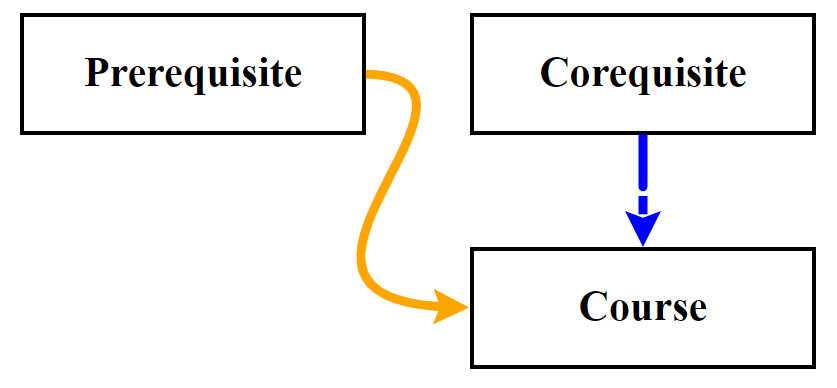
Plan
Graduate Attributes
Categories
Fall Term 1
CHEM 103
★ 4.3
(fi 6)(either term,
3-1s-3/2)
Atoms and molecules, states of matter, chemistry of the elements. Prerequisite: Chemistry 30, or equivalent. Note: Restricted to Engineering students only. Other students who take this course will receive 3 units.
Accreditation Units
Math and Natural Sciences: 53.5 Units
Graduate Attributes
| KB | PA | IN | DE | ET | TW | CS | PR | IS | EE | EP | LL |
|---|---|---|---|---|---|---|---|---|---|---|---|
| I | I |
ENGG 100
★ 1.1
(fi 2)(either term,
.75-.75s-0)
An introduction to the Faculty of Engineering, the engineering profession, the skills required for academic success, and the fundamentals of leadership: study and life skills; time management and goal setting; interpersonal skills; career planning; engineering and society including elements of ethics, equity, concepts of sustainable development, environmental stewardship, and public safety.
Accreditation Units
Graduate Attributes
| KB | PA | IN | DE | ET | TW | CS | PR | IS | EE | EP | LL |
|---|---|---|---|---|---|---|---|---|---|---|---|
| I | I | I | I |
ENGG 130
★ 4.0
(fi 6)(either term,
3-0-2)
Equilibrium of planar systems. Analysis of statically determinate trusses and frames. Friction. Centroids and centres of gravity. Forces and moments in beams. Second moments of area. Note: Students in all sections of this course will write a common final examination. Corequisite: MATH 100.
Accreditation Units
Engineering Science and Engineering Design: 50.4 Units
Graduate Attributes
| KB | PA | IN | DE | ET | TW | CS | PR | IS | EE | EP | LL |
|---|---|---|---|---|---|---|---|---|---|---|---|
| I | I |
ENGL 199
★ 3.0
(fi 6)(either term,
3-0-0)
This course aims to develop the student's ability to provide effective written and oral information. It will focus on instruction in fundamental writing skills, including building effective sentences and paragraphs, and on learning to communicate clearly across a range of genres and media used in academic and professional contexts, including correspondence and presentations. Students will be introduced to the principles of information gathering, analysis, and citation. Note: Restricted to students in the Faculty of Engineering only.
Accreditation Units
Graduate Attributes
| KB | PA | IN | DE | ET | TW | CS | PR | IS | EE | EP | LL |
|---|---|---|---|---|---|---|---|---|---|---|---|
| I | D |
MATH 100
★ 3.5
(fi 6)(either term,
3-0-1)
Review of numbers, inequalities, functions, analytic geometry; limits, continuity; derivatives and applications, Taylor polynomials; log, exp, and inverse trig functions. Integration, fundamental theorem of calculus substitution, trapezoidal and Simpson's rules. Prerequisites: Mathematics 30-1 and Mathematics 31. Notes: (1) Credit can be obtained in at most one of MATH 100, 113, 114, 117, 134, 144, 154, or SCI 100. (2) Students in all sections of this course will write a common final examination. (3) Restricted to Engineering students. Non-Engineering students who take this course will receive 3 units.
Accreditation Units
Math and Natural Sciences: 44.1 Units
Graduate Attributes
| KB | PA | IN | DE | ET | TW | CS | PR | IS | EE | EP | LL |
|---|---|---|---|---|---|---|---|---|---|---|---|
| I | I |
PHYS 130
★ 3.8
(fi 6)(either term,
3-0-3/2)
Geometrical optics, optical instruments, oscillations, waves, sound, interference, diffraction. Prerequisites: Mathematics 30-1, Mathematics 31, Physics 30. Corequisite: MATH 100 or 113 or 114 or 117 or 134 or 144 or equivalent. Restricted to Engineering students. Other students who take this course will receive 3 units.
Accreditation Units
Math and Natural Sciences: 47.2 Units
Graduate Attributes
| KB | PA | IN | DE | ET | TW | CS | PR | IS | EE | EP | LL |
|---|---|---|---|---|---|---|---|---|---|---|---|
| I | I |
Winter Term 2
CHEM 105
★ 3.8
(fi 6)(either term,
3-0-3/2)
Rates of reactions, thermodynamics and equilibrium, coordination chemistry, electrochemistry, modern applications of chemistry. Prerequisite: CHEM 103 or 101. Note: Restricted to Engineering students only. Other students who take this course will receive 3 units.
Accreditation Units
Math and Natural Sciences: 47.2 Units
Graduate Attributes
| KB | PA | IN | DE | ET | TW | CS | PR | IS | EE | EP | LL |
|---|---|---|---|---|---|---|---|---|---|---|---|
| I | D |
ENCMP 100
★ 3.8
(fi 6)(either term,
3-0-1.5)
Fundamentals of computer programming with emphasis on solving engineering problems. Structure and syntax of computer programs, variables, data types, data structures, control structures, functions, input/output operations, debugging, software development process.
Accreditation Units
Engineering Design: 21.3 Units
Engineering Science and Engineering Design: 47.2 Units
Graduate Attributes
| KB | PA | IN | DE | ET | TW | CS | PR | IS | EE | EP | LL |
|---|---|---|---|---|---|---|---|---|---|---|---|
| I | I | I | I | I | I | I | I |
ENGG 160
★ 2.0
(fi 4)(either term or Spring/Summer,
1-0-2)
Fundamental design process and theory in a multidisciplinary context. Importance, in engineering design, of communications; team work; the engineering disciplines, career fields; professional responsibilities of the engineer including elements of ethics, equity, concepts of sustainable development and environmental stewardship, public and worker safety and health considerations including the context of the Alberta Occupational Health and Safety Act. Corequisite ENGL 199. This course is delivered in a blended format.
Accreditation Units
Engineering Design: 12.6 Units
Engineering Science and Engineering Design: 12.6 Units
Graduate Attributes
| KB | PA | IN | DE | ET | TW | CS | PR | IS | EE | EP | LL |
|---|---|---|---|---|---|---|---|---|---|---|---|
| I | I | I | I | I | I | I |
EN PH 131
★ 4.3
(fi 6)(either term,
3-1s-3/2)
Kinematics and dynamics of particles; gravitation; work and energy; linear momentum; angular momentum; systems of particles; introduction to dynamics of rigid bodies. Prerequisites: MATH 100 or 117, and ENGG 130. Corequisite: MATH 101 or 118. Restricted to Engineering students. Other students who take this course will receive 3 units.
Accreditation Units
Math and Natural Sciences: 26.8 Units
Engineering Science: 26.8 Units
Engineering Science and Engineering Design: 26.8 Units
Graduate Attributes
| KB | PA | IN | DE | ET | TW | CS | PR | IS | EE | EP | LL |
|---|---|---|---|---|---|---|---|---|---|---|---|
| I | I | I |
MATH 101
★ 3.5
(fi 6)(either term,
3-0-1)
Area between curves, techniques of integration. Applications of integration to planar areas and lengths, volumes and masses. First order ordinary differential equations: separable, linear, direction fields, Euler's method, applications. Infinite series, power series, Taylor expansions with remainder terms. Polar coordinates. Rectangular, spherical and cylindrical coordinates in 3-dimensional space. Parametric curves in the plane and space: graphing, arc length, curvature; normal binormal, tangent plane in 3- dimensional space. Volumes and surface areas of rotation. Prerequisite: MATH 100. Notes: (1) Credit can be obtained in at most one of MATH 101, 115, 118, 136, 146, 156 or SCI 100. (2) Students in all sections of this course will write a common final examination. (3) Restricted to Engineering students. Non-Engineering students who take this course will receive 3 units.
Accreditation Units
Math and Natural Sciences: 44.1 Units
Graduate Attributes
| KB | PA | IN | DE | ET | TW | CS | PR | IS | EE | EP | LL |
|---|---|---|---|---|---|---|---|---|---|---|---|
| D | I |
MATH 102
★ 3.5
(fi 6)(either term,
3-0-1)
Vectors and matrices, solution of linear equations, equations of lines and planes, determinants, matrix algebra, orthogonality and applications (Gram-Schmidt), eigenvalues and eigenvectors and applications, complex numbers. Prerequisite or corequisite: MATH 100. Notes: (1) Credit can be obtained in at most one of MATH 102, 125, or 127. (2) Students in all sections of this course will write a common final examination. (3) Restricted to Engineering students. Non-Engineering students who take this course will receive 3 units.
Accreditation Units
Math and Natural Sciences: 44.1 Units
Graduate Attributes
| KB | PA | IN | DE | ET | TW | CS | PR | IS | EE | EP | LL |
|---|---|---|---|---|---|---|---|---|---|---|---|
| D |
Fall Term 3
CIV E 265
★ 3.5
(fi 6)(either term,
2-0-3)
Multiview representation, pictorial views of three-dimensional objects. Computer-aided graphics using AutoCAD.
Accreditation Units
Engineering Science and Engineering Design: 44.1 Units
Graduate Attributes
| KB | PA | IN | DE | ET | TW | CS | PR | IS | EE | EP | LL |
|---|---|---|---|---|---|---|---|---|---|---|---|
| D | D |
CIV E 270
★ 4.5
(fi 6)(either term or Spring/Summer,
3-0-3)
Plane stress and strain; stress-strain relationships; stresses and deformations resulting from axial and transverse loads; buckling of columns; torsion of circular sections; combined stress; statically indeterminate problems. Laboratory to demonstrate mechanical properties and verify assumptions of analysis. Prerequisites: ENGG 130 and MATH 101.
Accreditation Units
Engineering Science and Engineering Design: 56.7 Units
Graduate Attributes
| KB | PA | IN | DE | ET | TW | CS | PR | IS | EE | EP | LL |
|---|---|---|---|---|---|---|---|---|---|---|---|
| I | D |
EAS 210
★ 4.5
(fi 6)(first term,
3-0-3)
Rock-forming minerals, origins of igneous, metamorphic and sedimentary rocks; economic minerals and ore deposits; rock weathering and soil formation, mass-wasting, groundwater, deformation of the earth's crust. Laboratories on identification of minerals and rocks and the interpretation of topographic and geologic maps and aerial photography. Prerequisite: Any 100-level Science course. Not available to students with credit in EAS 101, 105, or SCI 100. Intended for students in Engineering programs. Restricted to students in Engineering programs. [Faculty of Science]
Accreditation Units
Math and Natural Sciences: 56.7 Units
MAT E 202
★ 3.5
(fi 6)(either term or Spring/Summer,
3-1.5s/2-)
An introduction to the science of materials relating their mechanical, thermal, electronic, and chemical properties to atomic, molecular, and crystal structure. Ceramic and metallic crystals, glasses, polymers, and composite materials. Multi-phase materials, phase transformations, and strengthening processes. Laboratories and seminars include mechanical properties of materials, microstructure, heat treatment of steel, and hands on design experiments. Prerequisite: CHEM 105 or consent of Department.
Accreditation Units
Engineering Science and Engineering Design: 47.2 Units
Graduate Attributes
| KB | PA | IN | DE | ET | TW | CS | PR | IS | EE | EP | LL |
|---|---|---|---|---|---|---|---|---|---|---|---|
| D | D | D | I | I | I |
MATH 209
★ 3.5
(fi 6)(either term,
3-0-1)
Partial differentiation, derivatives of integrals. Multiple integration using rectangular, cylindrical, and spherical coordinates. Vector Field Theory. Prerequisite: MATH 101. Prerequisite or corequisite: MATH 102. Notes: (1) This course may not be taken for credit if credit has already been obtained in MATH 215, MATH 315, MATH 317 or MA PH 351. (2) Students in all sections of this course will write a common final examination. (3) Restricted to Engineering students. Non-Engineering students who take this course will receive 3 units.
Accreditation Units
Math and Natural Sciences: 44.1 Units
Graduate Attributes
| KB | PA | IN | DE | ET | TW | CS | PR | IS | EE | EP | LL |
|---|---|---|---|---|---|---|---|---|---|---|---|
| D | D |
Winter Term 4
CIV E 221
★ 3.8
(fi 6)(second term,
3-0-3/2)
Basic mechanisms of chemistry, biology, and physics relevant to environmental engineering processes. Principles of equilibrium reactions and kinetics, mass transfer and material balances, microbial growth and kinetics, water, energy, and nutrient cycles. Applications to environmental engineering systems as biological degradation, mass and energy movement through the environment, and design of water and wastewater treatment systems. Prerequisites: CHEM 103 and CHEM 105.
Accreditation Units
Engineering Science and Engineering Design: 47.2 Units
CIV E 240
★ 2.0
(fi 6)(second term,
1-2s-0)
Written and oral communications in civil engineering; lectures and practice on presentation of oral and written reports, including technical proposals; progress reports; field inspection reports; consulting reports; and coverage of elements of ethics, equity, concepts of sustainable development and environmental stewardship, public and worker safety and health considerations including the context of the Alberta Occupational Health and Safety Act. Seminars and practice in developing effective search strategies for technical information. A written report must be submitted by each student.
Accreditation Units
Graduate Attributes
| KB | PA | IN | DE | ET | TW | CS | PR | IS | EE | EP | LL |
|---|---|---|---|---|---|---|---|---|---|---|---|
| D | I | D | D |
CIV E 250
★ 4.5
(fi 6)(either term or Spring/Summer,
3-0-3)
Basic surveying concepts and instrumentation, measurement errors, coordinate systems, leveling, traversing, layout surveys, earthwork volumes, conventional, and digital mapping, GIS concepts, aerial photography, and GPS. Prerequisites: MATH 101 and 102.
Accreditation Units
Engineering Science and Engineering Design: 56.7 Units
Graduate Attributes
| KB | PA | IN | DE | ET | TW | CS | PR | IS | EE | EP | LL |
|---|---|---|---|---|---|---|---|---|---|---|---|
| D |
CIV E 251
★ 1.5
(fi 3)(second term or Spring/Summer,
1 week)
Practical exercises in field methods; project type of assignments; field astronomy; electronic distance measuring instruments. Prerequisite: CIV E 250.
Accreditation Units
Engineering Science and Engineering Design: 19.3 Units
Graduate Attributes
| KB | PA | IN | DE | ET | TW | CS | PR | IS | EE | EP | LL |
|---|---|---|---|---|---|---|---|---|---|---|---|
| A | D |
CIV E 295
★ 4.0
(fi 6)(second term,
3-0-2)
Application of numerical methods to civil engineering problems. Prerequisites: ENCMP 100 and MATH 102.
Accreditation Units
Math and Natural Sciences: 25.2 Units
Engineering Science: 25.2 Units
Engineering Science and Engineering Design: 25.2 Units
Graduate Attributes
| KB | PA | IN | DE | ET | TW | CS | PR | IS | EE | EP | LL |
|---|---|---|---|---|---|---|---|---|---|---|---|
| D |
MATH 201
★ 3.5
(fi 6)(either term or Spring/Summer,
3-0-1)
First-order equations; second-order linear equations: reduction of order, variation of parameters; Laplace transform; linear systems; power series; solution by series; separation of variables for PDEs. Prerequisite or corequisite: MATH 209 or 214. Notes: (1) Open only to students in Engineering and Specialization Geophysics. (2) Credit can be obtained in at most one of MATH 201, MATH 334, MATH 336, or MA PH 251. (3) Students in all sections of this course will write a common final examination. Non-Engineering students who take this course will receive 3 units.
Accreditation Units
Math and Natural Sciences: 44.1 Units
Graduate Attributes
| KB | PA | IN | DE | ET | TW | CS | PR | IS | EE | EP | LL |
|---|---|---|---|---|---|---|---|---|---|---|---|
| D | D |
STAT 235
★ 3.8
(fi 6)(either term or Spring/Summer,
3-0-1.5)
Descriptive data analysis. Calculus of Probability. Binomial, multinomial, Poisson, normal, beta, exponential, gamma, hypergeometric, and Weibull distributions. Sampling distributions. Estimation, testing hypotheses, goodness-of-fit tests, and one-way analysis of variance. Linear correlation and regression. Sampling. Quality control. Use of a microcomputer software package for statistical analyses in engineering applications. Prerequisite: MATH 100. Corequisite: MATH 101. Notes: (1) This course may not be taken for credit if credit has already been obtained in one of STAT 151, 161, 222, 265, 266, 276, 281; KIN 109, PEDS 109, PSYCH 211, PTHER 352, SCI 151 or SOC 320. (2) Intended for Engineering students. (2) Intended for Engineering students. Other students who take this course will receive 3.0 units.
Accreditation Units
Math and Natural Sciences: 47.2 Units
Graduate Attributes
| KB | PA | IN | DE | ET | TW | CS | PR | IS | EE | EP | LL |
|---|---|---|---|---|---|---|---|---|---|---|---|
| D | D | I |
Fall Term 5
CIV E 330
★ 3.5
(fi 6)(either term,
3-1s-0)
Fluid properties; dimensional analysis; hydrostatics; fundamental equations of fluid motion; laminar, turbulent and inviscid flows; boundary layers and flow around immersed bodies; elementary building aerodynamics. Prerequisite: MATH 209. Corequisite: MATH 201.
Accreditation Units
Engineering Science and Engineering Design: 44.1 Units
CIV E 372
★ 4.0
(fi 6)(either term,
3-2s-0)
Introduction to structural loads; deformations of statically determinate beams, trusses and frames; influence lines; analysis of statically indeterminate structures by consistent deformations, slope deflection and moment distribution; direct stiffness analysis. Prerequisite: CIV E 270.
Accreditation Units
Engineering Design: 12.6 Units
Engineering Science and Engineering Design: 50.4 Units
Graduate Attributes
| KB | PA | IN | DE | ET | TW | CS | PR | IS | EE | EP | LL |
|---|---|---|---|---|---|---|---|---|---|---|---|
| A | D |
CIV E 391
★ 4.5
(fi 6)(either term,
3-0-3)
Classification of soils. Properties of Portland cement concrete related to micro- and macro-structure and constituent materials. Properties of bituminous materials and design of bituminous mixes. Prerequisite: MAT E 202 or ENV E 220.
Accreditation Units
Engineering Science and Engineering Design: 56.7 Units
CIV E 395
★ 3.5
(fi 6)(either term,
3-0-2/2)
The formulation of partial differential equations for modeling civil engineering problems. Introduction to analytical and numerical solution techniques. Prerequisites: MATH 201, MATH 209 and CIV E 295.
Accreditation Units
Math and Natural Sciences: 19.8 Units
Engineering Science: 24.3 Units
Engineering Science and Engineering Design: 24.3 Units
Graduate Attributes
| KB | PA | IN | DE | ET | TW | CS | PR | IS | EE | EP | LL |
|---|---|---|---|---|---|---|---|---|---|---|---|
| A | A |
CIV E 398
★ 3.5
(fi 6)(first term,
3-1s-0)
Stress, strain and displacements in two and three dimensions. Constitutive equations. Governing equations of elasticity and simple solutions. Strain energy and virtual work. Theories of failure. Prerequisites: CIV E 270 and MATH 209.
Accreditation Units
Engineering Science and Engineering Design: 44.1 Units
Graduate Attributes
| KB | PA | IN | DE | ET | TW | CS | PR | IS | EE | EP | LL |
|---|---|---|---|---|---|---|---|---|---|---|---|
| A |
CIV E 251
★ 1.5
(fi 3)(second term or Spring/Summer,
1 week)
Practical exercises in field methods; project type of assignments; field astronomy; electronic distance measuring instruments. Prerequisite: CIV E 250.
Accreditation Units
Engineering Science and Engineering Design: 19.3 Units
Graduate Attributes
| KB | PA | IN | DE | ET | TW | CS | PR | IS | EE | EP | LL |
|---|---|---|---|---|---|---|---|---|---|---|---|
| A | D |
COMP E
★ 3.0
(fi 6)(either term or Spring/Summer,
3-0-0)
Choose a Complementary Studies Elective from the approved list.
Accreditation Units
Winter Term 6
CIV E 303
★ 3.8
(fi 6)(either term,
3-0-3/2)
Planning and scheduling; theories and techniques of project management.
Accreditation Units
Engineering Science: 14.2 Units
Engineering Science and Engineering Design: 14.2 Units
Graduate Attributes
| KB | PA | IN | DE | ET | TW | CS | PR | IS | EE | EP | LL |
|---|---|---|---|---|---|---|---|---|---|---|---|
| A | A |
CIV E 315
★ 4.0
(fi 6)(either term,
3-0-2)
Transportation systems and their elements. Principles of transportation planning. Traffic volume, capacity, speed, density, and safety. Fundamentals of traffic control. Principles of highway planning. Highway and terrain. Vehicular motion. Horizontal and vertical geometric design. Cost/benefit analysis in highway design. Earthwork and mass diagram. Flexible and rigid pavement design. Prerequisite: CIV E 250.
Accreditation Units
Engineering Design: 25.2 Units
Engineering Science and Engineering Design: 50.4 Units
Graduate Attributes
| KB | PA | IN | DE | ET | TW | CS | PR | IS | EE | EP | LL |
|---|---|---|---|---|---|---|---|---|---|---|---|
| D |
CIV E 321
★ 3.8
(fi 6)(either term,
3-0-3/2)
Introduction modeling environmental processes to predict the movement of water and fate of contaminants in the hydrologic cycle. Principles of mass transfer, conservation of mass, environmental transformations, nutrient enrichment and depletion are developed. Introduction to storm events, rainfall, runoff, stream discharge and stormwater management. Applications of modeling results to the quantification of risk using examples from hydrology, water pollution and health protection and development of environmental regulations. Prerequisite: CIV E 221. Corequisite: CIV E 330.
Accreditation Units
Engineering Science and Engineering Design: 47.2 Units
CIV E 331
★ 3.8
(fi 6)(either term,
3-0-3/2)
Introduction to applied hydraulics; control volume methods, open channel hydraulics, pipe systems, pumps, distribution and collection system hydraulics and design. Prerequisite: CIV E 330. Corequisite: either CIV E 221 or ENV E 325.
Accreditation Units
Engineering Design: 11.8 Units
Engineering Science and Engineering Design: 47.2 Units
Graduate Attributes
| KB | PA | IN | DE | ET | TW | CS | PR | IS | EE | EP | LL |
|---|---|---|---|---|---|---|---|---|---|---|---|
| D | A |
CIV E 374
★ 4.5
(fi 6)(either term,
3-0-3)
Introduction to limit states design, common framing systems, design loads, and load path evaluation. Behaviour and design of steel members and connections. Prerequisite: CIV E 372.
Accreditation Units
Engineering Design: 36.9 Units
Engineering Science and Engineering Design: 56.7 Units
Graduate Attributes
| KB | PA | IN | DE | ET | TW | CS | PR | IS | EE | EP | LL |
|---|---|---|---|---|---|---|---|---|---|---|---|
| D | D |
CIV E 381
★ 4.5
(fi 6)(either term or Spring/Summer,
3-0-3)
Compaction; site investigation; theories of water seepage; effective stress principles; settlement; strength and mechanical properties; introduction to retaining structures, foundation, and slope stability. Prerequisite: EAS 210.
Accreditation Units
Engineering Design: 14.2 Units
Engineering Science and Engineering Design: 56.7 Units
Graduate Attributes
| KB | PA | IN | DE | ET | TW | CS | PR | IS | EE | EP | LL |
|---|---|---|---|---|---|---|---|---|---|---|---|
| D | A |
Fall Term 7
TECH E
★ 3.0
(fi 6)(either term or Spring/Summer,
3-0-0)
Choose a Technical Elective from the approved list.
Accreditation Units
TECH E
★ 3.0
(fi 6)(either term or Spring/Summer,
3-0-0)
Choose a Technical Elective from the approved list.
Accreditation Units
CIV E 460
★ 3.8
(fi 6)(first term,
3-0-3/2)
First phase of an open-ended capstone design project encompassing a number of civil engineering disciplines. Develop a preliminary design for a project; prepare regular team reports, design memos, engineering drawings and presentations; and present findings during a seminar. Note: Restricted to fourth-year traditional and fifth-year co-op civil and environmental engineering students. Prerequisites: CIV E 303, 315, 321, 331, 374, and 381. Students must take CIV E 461 in the following winter term after CIV E 460 to have CIV E 460 counted as a program and technical elective; otherwise it will be counted as an extra to degree course.
Accreditation Units
Engineering Science and Engineering Design: 47.2 Units
Graduate Attributes
| KB | PA | IN | DE | ET | TW | CS | PR | IS | EE | EP | LL |
|---|---|---|---|---|---|---|---|---|---|---|---|
| A | A | A | A | A | A |
ENGG 404
★ 3.8
(fi 6)(either term or Spring/Summer,
3-3s/2-0)
Basic concepts of risk and consequences of loss incidents; risk management principles and practices; incident investigation, causation, root cause analysis; process safety management; the roles of government agencies, professional bodies and industry associations; workplace safety; risk-based decision-making processes; leadership and the human-factors side of risk management. The course focuses on the principles and practices of leadership towards the effective application and implementation of risk management in major organizations across all engineering disciplines. Industry virtual tours, case studies, seminars and team projects specific to the student's engineering program will be used to develop competencies and proficiencies in applying leadership and organizational effectiveness for successful risk management.
Accreditation Units
Graduate Attributes
| KB | PA | IN | DE | ET | TW | CS | PR | IS | EE | EP | LL |
|---|---|---|---|---|---|---|---|---|---|---|---|
| D | D | D | A | A | D | D |
ECE 209
★ 3.8
(fi 6)(either term or Spring/Summer,
3-0-3/2)
Physical concepts of passive circuit elements, Kirchhoff's laws and DC circuit equations. Energy concepts, time domain analysis of AC circuits. Impedance, complex numbers and phasor algebra. AC power concepts, resonance, three phase circuits, introduction to machines. Credit may be obtained in only one of ECE 209, E E 239, ECE 202, or E E 240, unless approved by the Department.
Accreditation Units
Engineering Design: 11.8 Units
Engineering Science and Engineering Design: 47.2 Units
OR
MEC E 250
★ 3.5
(fi 6)(either term or Spring/Summer,
3-1s-0)
Moments of inertia. Kinematics and kinetics of rigid body motion, energy and momentum methods, impact, mechanical vibrations. Prerequisites: ENGG 130, EN PH 131 and MATH 101. There is a consolidated exam.
Accreditation Units
Engineering Science and Engineering Design: 44.1 Units
Graduate Attributes
| KB | PA | IN | DE | ET | TW | CS | PR | IS | EE | EP | LL |
|---|---|---|---|---|---|---|---|---|---|---|---|
| D | D | I | I | I | I |
OR
CH E 243
★ 3.5
(fi 6)(either term or Spring/Summer,
3-1s-0)
An introduction to the first and second laws of thermodynamics. Prerequisites: MATH 101.
Accreditation Units
Engineering Science and Engineering Design: 44.1 Units
Graduate Attributes
| KB | PA | IN | DE | ET | TW | CS | PR | IS | EE | EP | LL |
|---|---|---|---|---|---|---|---|---|---|---|---|
| I | I | I |
Winter Term 8
ENG M 310
★ 3.0
(fi 6)(either term or Spring/Summer,
3-0-0)
The application of the fundamentals of economics to engineering alternatives in planning, developing and managing industrial projects. Note: Credit cannot be obtained for more than one of ENGG 310, 401, ENG M 310 or 401.
Accreditation Units
OR
ENG M 401
★ 3.0
(fi 6)(either term,
3-0-0)
The application of the fundamentals of engineering economics, financial analysis and market assessment to engineering alternatives in the planning, development and ongoing management of industrial enterprises. The course covers the use of engineering, economic, financial and market assessment information in investment and business operation decisions in technology oriented companies. Note: Credit cannot be obtained for more than one of ENGG 310, ENGG 401, ENG M 310, or ENG M 401.
Accreditation Units
Graduate Attributes
| KB | PA | IN | DE | ET | TW | CS | PR | IS | EE | EP | LL |
|---|---|---|---|---|---|---|---|---|---|---|---|
| I | I | D |
ENGG 400
★ 1.0
(fi 2)(either term,
1-0-0)
The technical and professional duties and responsibilities of the engineer; the ethics of the engineering profession; technical and professional organizations. The role of the engineer in the social environment including elements of equity, concepts of sustainable development and environmental stewardship, public and worker safety and health considerations including the context of the Alberta Occupational Health and Safety Act. Note: Restricted to fourth-year traditional and fifth-year co-op engineering students. Must be taken in last term of program.
Accreditation Units
Graduate Attributes
| KB | PA | IN | DE | ET | TW | CS | PR | IS | EE | EP | LL |
|---|---|---|---|---|---|---|---|---|---|---|---|
| D | A | D | A | A |
ENGG 420
★ 3.0
(fi 6)(either term,
3-0-0)
Contracts; specifications; tenders; bonds; construction contract forms; Public Works Act; building trades; company law; the engineer as an expert witness; patents; trademarks; copyrights; negligence; arbitration. Note: Restricted enrolment. Credit will not be granted for both ENGG 420 and B LAW 301.
Accreditation Units
Graduate Attributes
| KB | PA | IN | DE | ET | TW | CS | PR | IS | EE | EP | LL |
|---|---|---|---|---|---|---|---|---|---|---|---|
| I | D | D |
CIV E 461
★ 4.5
(fi 6)(second term,
3-0-3)
Second phase of an open-ended capstone design project encompassing a number of civil engineering disciplines. Develop a detailed design; prepare regular team reports, design memos, engineering drawings and presentations; and present findings during a seminar. Prerequisite: CIV E 460. Note: Restricted to fourth-year traditional and fifth-year co-op civil and environmental engineering students.
Accreditation Units
Engineering Science and Engineering Design: 56.7 Units
Graduate Attributes
| KB | PA | IN | DE | ET | TW | CS | PR | IS | EE | EP | LL |
|---|---|---|---|---|---|---|---|---|---|---|---|
| A | A | A | A | A | A |
TECH E
★ 3.0
(fi 6)(either term or Spring/Summer,
3-0-0)
Choose a Technical Elective from the approved list.
Accreditation Units
ITS E
★ 3.0
(fi 6)(either term or Spring/Summer,
3-0-0)
Choose a Impact of Technology on Society from the approved list.
Accreditation Units
| M: | 312.7 | / | 195 | ✅ |
| NS: | 231.4 | / | 195 | ✅ |
| CS: | 311.0 | / | 225 | ✅ |
| ES: | 1027.4 | / | 225 | ✅ |
| ED: | 763.7 | / | 225 | ✅ |
| M+NS: | 544.1 | / | 420 | ✅ |
| ES+ED: | 1791.1 | / | 900 | ✅ |
| Total: | 2646.2 | / | 1850 | ✅ |
TOTAL
Group 1 Electives (x2)
CIV E 406
★ 3.8
(fi 6)(either term,
3-0-3/2)
Introduction to elements of construction, planning, scheduling, and cost estimating. Familiarization with quantity take-off, estimate preparation, cost recovery, resource allocation, project scheduling, risk analysis, and bid preparation. Prerequisite: CIV E 303.
Accreditation Units
Engineering Science: 18.9 Units
Engineering Design: 11.8 Units
Engineering Science and Engineering Design: 30.7 Units
Graduate Attributes
| KB | PA | IN | DE | ET | TW | CS | PR | IS | EE | EP | LL |
|---|---|---|---|---|---|---|---|---|---|---|---|
| A | A | A | A | A | A |
CIV E 411
★ 3.8
(fi 6)(first term,
3-0-3/2)
The course provides an in-depth understanding of transportation planning and traffic operations concepts and methods. These include: travel demand analysis; data collection methods and data analysis; urban transportation planning and modeling techniques; traffic flow fundamentals and characteristics; and operations of surface roadway networks and controls (intersections). Emerging topics in transportation engineering for future careers will be discussed. Prerequisite: CIV E 315, STAT 235.
Accreditation Units
Engineering Design: 23.6 Units
Engineering Science and Engineering Design: 47.2 Units
Graduate Attributes
| KB | PA | IN | DE | ET | TW | CS | PR | IS | EE | EP | LL |
|---|---|---|---|---|---|---|---|---|---|---|---|
| A | A | A | A | A | A |
CIV E 431
★ 3.8
(fi 6)(either term,
3-0-3/2)
Hydrotechnical analysis, including: advanced open channel hydraulics; advanced surface water hydrology; groundwater and well hydraulics; and environmental hydraulics. Prerequisites: CIV E 321, 331.
Accreditation Units
Engineering Design: 23.6 Units
Engineering Science and Engineering Design: 47.2 Units
Graduate Attributes
| KB | PA | IN | DE | ET | TW | CS | PR | IS | EE | EP | LL |
|---|---|---|---|---|---|---|---|---|---|---|---|
| A | A | A | A | A | A |
CIV E 474
★ 3.8
(fi 6)(either term,
3-0-3/2)
Behaviour and design of reinforced concrete structures. Topics include: flexure and shear in reinforced concrete beam elements, reinforcement detailing, one and two-way slab design, columns, footings, and walls. Prerequisite: CIV E 374.
Accreditation Units
Engineering Design: 31.6 Units
Engineering Science and Engineering Design: 47.3 Units
Graduate Attributes
| KB | PA | IN | DE | ET | TW | CS | PR | IS | EE | EP | LL |
|---|---|---|---|---|---|---|---|---|---|---|---|
| A | A | A | A | A | A |
CIV E 481
★ 3.8
(fi 6)(either term,
3-0-3/2)
Site investigation; strength of soils; geosynthetics for soil improvement; design of excavations and earth pressures on retaining structures; stability of natural slopes and their improvement; design of cuts and embankments; foundation design, stability and settlement; pile foundations; frost action and permafrost. Prerequisite: CIV E 381.
Accreditation Units
Engineering Design: 35.4 Units
Engineering Science and Engineering Design: 47.2 Units
Graduate Attributes
| KB | PA | IN | DE | ET | TW | CS | PR | IS | EE | EP | LL |
|---|---|---|---|---|---|---|---|---|---|---|---|
| A | A | D | A | A | A |
ENV E 421
★ 3.8
(fi 6)(either term,
3-0-3/2)
Detailed and advanced design of water supply systems, sewerage, and storm drains. Rates of flow and hydraulics of networks and sewers, rainfall-runoff analysis, storm water storage, and loads on conduits. Extensive computer simulation of systems. Prerequisites: CIV E 331.
Accreditation Units
Engineering Science and Engineering Design: 47.2 Units
Graduate Attributes
| KB | PA | IN | DE | ET | TW | CS | PR | IS | EE | EP | LL |
|---|---|---|---|---|---|---|---|---|---|---|---|
| A | A | D | A | A | A |
Group 2 Electives (x1)
CIV E 409
★ 4.5
(fi 6)(either term,
3-0-3)
Principles of building, heavy and bridge construction; wood and formwork design, stability during construction, economics of equipment selection, movement of material on construction sites, safety, and constructability issues. Students work in teams on a design project. Prerequisites: CIV E 303 and 372. Note: Restricted to fourth-year traditional and fifth-year co-op engineering students, or by consent of the Department.
Accreditation Units
Engineering Science and Engineering Design: 56.7 Units
Graduate Attributes
| KB | PA | IN | DE | ET | TW | CS | PR | IS | EE | EP | LL |
|---|---|---|---|---|---|---|---|---|---|---|---|
| A | A | A | A | D | A | A |
CIV E 419
★ 4.5
(fi 6)(second term,
3-0-3)
Design and analysis of transportation systems and facilities, including development, planning processes, data collection, and procedures for future advancements. The course covers specialized transportation design topics and introduces spatial analysis techniques to support the evaluation and design of practical solutions. Students work in teams on a design project. Prerequisite: CIV E 411. Note: Restricted to fourth-year traditional and fifth-year co-op engineering students.
Accreditation Units
Engineering Science and Engineering Design: 56.7 Units
Graduate Attributes
| KB | PA | IN | DE | ET | TW | CS | PR | IS | EE | EP | LL |
|---|---|---|---|---|---|---|---|---|---|---|---|
| A | A | A | A | A | D | D |
CIV E 429
★ 4.5
(fi 6)(second term,
3-0-3)
Fundamentals of municipal planning and design of water supply, water and wastewater treatment, storm water management, or wastewater collection and management systems. Course includes design projects, field trips, and presentations. Students work in teams on a design project. Prerequisites: CIV E 321 and ENV E 421. Note: Restricted to fourth-year traditional and fifth-year co-op engineering students.
Accreditation Units
Engineering Science and Engineering Design: 56.7 Units
Graduate Attributes
| KB | PA | IN | DE | ET | TW | CS | PR | IS | EE | EP | LL |
|---|---|---|---|---|---|---|---|---|---|---|---|
| A | A | A | A | A | D | D |
CIV E 439
★ 4.5
(fi 6)(second term,
3-0-3)
Design of hydraulic structures and river engineering works, including: dams, spillways, energy dissipators, bridges, culverts, erosion protection and river training works. Students work in teams on a design project. Prerequisite: CIV E 431. Note: Restricted to fourth-year traditional and fifth-year co-op engineering students.
Accreditation Units
Engineering Science and Engineering Design: 56.7 Units
Graduate Attributes
| KB | PA | IN | DE | ET | TW | CS | PR | IS | EE | EP | LL |
|---|---|---|---|---|---|---|---|---|---|---|---|
| A | A | A | A | A | A | A |
CIV E 479
★ 4.5
(fi 6)(second term,
3-0-3)
Detailed design of a structure which requires students, working in teams, to exercise creativity, to make design assumptions and to complete the structural design based on a synthesis of technical knowledge acquired in this and other structural engineering courses. Course lectures focus on seismic load calculation; design of concrete, reinforced masonry and timber elements; bridge design; and advanced structural steel design. Prerequisite: CIV E 474. Note: Restricted to fourth-year traditional and fifth-year co-op engineering students.
Accreditation Units
Engineering Science and Engineering Design: 56.7 Units
Graduate Attributes
| KB | PA | IN | DE | ET | TW | CS | PR | IS | EE | EP | LL |
|---|---|---|---|---|---|---|---|---|---|---|---|
| A | A | A | A | A | D | D |
CIV E 489
★ 4.5
(fi 6)(second term,
3-0-3)
Evaluation of site conditions. Design and analysis of shallow and deep foundations and retaining structures. Slope stability of embankments and cuts including foundation excavations. Students work in teams on a design project. Prerequisite: CIV E 481. Note: Restricted to fourth-year traditional and fifth-year co-op engineering students.
Accreditation Units
Engineering Science and Engineering Design: 56.7 Units
Graduate Attributes
| KB | PA | IN | DE | ET | TW | CS | PR | IS | EE | EP | LL |
|---|---|---|---|---|---|---|---|---|---|---|---|
| A | A | A | A | A | A | A |
Fall Term 1
CHEM 103
★ 4.3
(fi 6)(either term,
3-1s-3/2)
Atoms and molecules, states of matter, chemistry of the elements. Prerequisite: Chemistry 30, or equivalent. Note: Restricted to Engineering students only. Other students who take this course will receive 3 units.
Accreditation Units
Math and Natural Sciences: 53.5 Units
Graduate Attributes
| KB | PA | IN | DE | ET | TW | CS | PR | IS | EE | EP | LL |
|---|---|---|---|---|---|---|---|---|---|---|---|
| I | I |
ENGG 100
★ 1.1
(fi 2)(either term,
.75-.75s-0)
An introduction to the Faculty of Engineering, the engineering profession, the skills required for academic success, and the fundamentals of leadership: study and life skills; time management and goal setting; interpersonal skills; career planning; engineering and society including elements of ethics, equity, concepts of sustainable development, environmental stewardship, and public safety.
Accreditation Units
Graduate Attributes
| KB | PA | IN | DE | ET | TW | CS | PR | IS | EE | EP | LL |
|---|---|---|---|---|---|---|---|---|---|---|---|
| I | I | I | I |
ENGG 130
★ 4.0
(fi 6)(either term,
3-0-2)
Equilibrium of planar systems. Analysis of statically determinate trusses and frames. Friction. Centroids and centres of gravity. Forces and moments in beams. Second moments of area. Note: Students in all sections of this course will write a common final examination. Corequisite: MATH 100.
Accreditation Units
Engineering Science and Engineering Design: 50.4 Units
Graduate Attributes
| KB | PA | IN | DE | ET | TW | CS | PR | IS | EE | EP | LL |
|---|---|---|---|---|---|---|---|---|---|---|---|
| I | I |
ENGL 199
★ 3.0
(fi 6)(either term,
3-0-0)
This course aims to develop the student's ability to provide effective written and oral information. It will focus on instruction in fundamental writing skills, including building effective sentences and paragraphs, and on learning to communicate clearly across a range of genres and media used in academic and professional contexts, including correspondence and presentations. Students will be introduced to the principles of information gathering, analysis, and citation. Note: Restricted to students in the Faculty of Engineering only.
Accreditation Units
Graduate Attributes
| KB | PA | IN | DE | ET | TW | CS | PR | IS | EE | EP | LL |
|---|---|---|---|---|---|---|---|---|---|---|---|
| I | D |
MATH 100
★ 3.5
(fi 6)(either term,
3-0-1)
Review of numbers, inequalities, functions, analytic geometry; limits, continuity; derivatives and applications, Taylor polynomials; log, exp, and inverse trig functions. Integration, fundamental theorem of calculus substitution, trapezoidal and Simpson's rules. Prerequisites: Mathematics 30-1 and Mathematics 31. Notes: (1) Credit can be obtained in at most one of MATH 100, 113, 114, 117, 134, 144, 154, or SCI 100. (2) Students in all sections of this course will write a common final examination. (3) Restricted to Engineering students. Non-Engineering students who take this course will receive 3 units.
Accreditation Units
Math and Natural Sciences: 44.1 Units
Graduate Attributes
| KB | PA | IN | DE | ET | TW | CS | PR | IS | EE | EP | LL |
|---|---|---|---|---|---|---|---|---|---|---|---|
| I | I |
PHYS 130
★ 3.8
(fi 6)(either term,
3-0-3/2)
Geometrical optics, optical instruments, oscillations, waves, sound, interference, diffraction. Prerequisites: Mathematics 30-1, Mathematics 31, Physics 30. Corequisite: MATH 100 or 113 or 114 or 117 or 134 or 144 or equivalent. Restricted to Engineering students. Other students who take this course will receive 3 units.
Accreditation Units
Math and Natural Sciences: 47.2 Units
Graduate Attributes
| KB | PA | IN | DE | ET | TW | CS | PR | IS | EE | EP | LL |
|---|---|---|---|---|---|---|---|---|---|---|---|
| I | I |
Winter Term 2
CHEM 105
★ 3.8
(fi 6)(either term,
3-0-3/2)
Rates of reactions, thermodynamics and equilibrium, coordination chemistry, electrochemistry, modern applications of chemistry. Prerequisite: CHEM 103 or 101. Note: Restricted to Engineering students only. Other students who take this course will receive 3 units.
Accreditation Units
Math and Natural Sciences: 47.2 Units
Graduate Attributes
| KB | PA | IN | DE | ET | TW | CS | PR | IS | EE | EP | LL |
|---|---|---|---|---|---|---|---|---|---|---|---|
| I | D |
ENCMP 100
★ 3.8
(fi 6)(either term,
3-0-1.5)
Fundamentals of computer programming with emphasis on solving engineering problems. Structure and syntax of computer programs, variables, data types, data structures, control structures, functions, input/output operations, debugging, software development process.
Accreditation Units
Engineering Design: 21.3 Units
Engineering Science and Engineering Design: 47.2 Units
Graduate Attributes
| KB | PA | IN | DE | ET | TW | CS | PR | IS | EE | EP | LL |
|---|---|---|---|---|---|---|---|---|---|---|---|
| I | I | I | I | I | I | I | I |
ENGG 160
★ 2.0
(fi 4)(either term or Spring/Summer,
1-0-2)
Fundamental design process and theory in a multidisciplinary context. Importance, in engineering design, of communications; team work; the engineering disciplines, career fields; professional responsibilities of the engineer including elements of ethics, equity, concepts of sustainable development and environmental stewardship, public and worker safety and health considerations including the context of the Alberta Occupational Health and Safety Act. Corequisite ENGL 199. This course is delivered in a blended format.
Accreditation Units
Engineering Design: 12.6 Units
Engineering Science and Engineering Design: 12.6 Units
Graduate Attributes
| KB | PA | IN | DE | ET | TW | CS | PR | IS | EE | EP | LL |
|---|---|---|---|---|---|---|---|---|---|---|---|
| I | I | I | I | I | I | I |
EN PH 131
★ 4.3
(fi 6)(either term,
3-1s-3/2)
Kinematics and dynamics of particles; gravitation; work and energy; linear momentum; angular momentum; systems of particles; introduction to dynamics of rigid bodies. Prerequisites: MATH 100 or 117, and ENGG 130. Corequisite: MATH 101 or 118. Restricted to Engineering students. Other students who take this course will receive 3 units.
Accreditation Units
Math and Natural Sciences: 26.8 Units
Engineering Science: 26.8 Units
Engineering Science and Engineering Design: 26.8 Units
Graduate Attributes
| KB | PA | IN | DE | ET | TW | CS | PR | IS | EE | EP | LL |
|---|---|---|---|---|---|---|---|---|---|---|---|
| I | I | I |
MATH 101
★ 3.5
(fi 6)(either term,
3-0-1)
Area between curves, techniques of integration. Applications of integration to planar areas and lengths, volumes and masses. First order ordinary differential equations: separable, linear, direction fields, Euler's method, applications. Infinite series, power series, Taylor expansions with remainder terms. Polar coordinates. Rectangular, spherical and cylindrical coordinates in 3-dimensional space. Parametric curves in the plane and space: graphing, arc length, curvature; normal binormal, tangent plane in 3- dimensional space. Volumes and surface areas of rotation. Prerequisite: MATH 100. Notes: (1) Credit can be obtained in at most one of MATH 101, 115, 118, 136, 146, 156 or SCI 100. (2) Students in all sections of this course will write a common final examination. (3) Restricted to Engineering students. Non-Engineering students who take this course will receive 3 units.
Accreditation Units
Math and Natural Sciences: 44.1 Units
Graduate Attributes
| KB | PA | IN | DE | ET | TW | CS | PR | IS | EE | EP | LL |
|---|---|---|---|---|---|---|---|---|---|---|---|
| D | I |
MATH 102
★ 3.5
(fi 6)(either term,
3-0-1)
Vectors and matrices, solution of linear equations, equations of lines and planes, determinants, matrix algebra, orthogonality and applications (Gram-Schmidt), eigenvalues and eigenvectors and applications, complex numbers. Prerequisite or corequisite: MATH 100. Notes: (1) Credit can be obtained in at most one of MATH 102, 125, or 127. (2) Students in all sections of this course will write a common final examination. (3) Restricted to Engineering students. Non-Engineering students who take this course will receive 3 units.
Accreditation Units
Math and Natural Sciences: 44.1 Units
Graduate Attributes
| KB | PA | IN | DE | ET | TW | CS | PR | IS | EE | EP | LL |
|---|---|---|---|---|---|---|---|---|---|---|---|
| D |
Fall Term 3
CIV E 265
★ 3.5
(fi 6)(either term,
2-0-3)
Multiview representation, pictorial views of three-dimensional objects. Computer-aided graphics using AutoCAD.
Accreditation Units
Engineering Science and Engineering Design: 44.1 Units
Graduate Attributes
| KB | PA | IN | DE | ET | TW | CS | PR | IS | EE | EP | LL |
|---|---|---|---|---|---|---|---|---|---|---|---|
| D | D |
CIV E 270
★ 4.5
(fi 6)(either term or Spring/Summer,
3-0-3)
Plane stress and strain; stress-strain relationships; stresses and deformations resulting from axial and transverse loads; buckling of columns; torsion of circular sections; combined stress; statically indeterminate problems. Laboratory to demonstrate mechanical properties and verify assumptions of analysis. Prerequisites: ENGG 130 and MATH 101.
Accreditation Units
Engineering Science and Engineering Design: 56.7 Units
Graduate Attributes
| KB | PA | IN | DE | ET | TW | CS | PR | IS | EE | EP | LL |
|---|---|---|---|---|---|---|---|---|---|---|---|
| I | D |
EAS 210
★ 4.5
(fi 6)(first term,
3-0-3)
Rock-forming minerals, origins of igneous, metamorphic and sedimentary rocks; economic minerals and ore deposits; rock weathering and soil formation, mass-wasting, groundwater, deformation of the earth's crust. Laboratories on identification of minerals and rocks and the interpretation of topographic and geologic maps and aerial photography. Prerequisite: Any 100-level Science course. Not available to students with credit in EAS 101, 105, or SCI 100. Intended for students in Engineering programs. Restricted to students in Engineering programs. [Faculty of Science]
Accreditation Units
Math and Natural Sciences: 56.7 Units
ENV E 220
★ 3.8
(fi 6)(either term,
3-0-3/2)
Survey of basic principles in analytical, inorganic, and organic chemistry with emphasis on environmental engineering applications. Laboratory measurements related to water quality. Prerequisite: CHEM 105.
Accreditation Units
Math and Natural Sciences: 11.8 Units
Engineering Science: 35.4 Units
Engineering Science and Engineering Design: 35.4 Units
Graduate Attributes
| KB | PA | IN | DE | ET | TW | CS | PR | IS | EE | EP | LL |
|---|---|---|---|---|---|---|---|---|---|---|---|
| D |
MATH 209
★ 3.5
(fi 6)(either term,
3-0-1)
Partial differentiation, derivatives of integrals. Multiple integration using rectangular, cylindrical, and spherical coordinates. Vector Field Theory. Prerequisite: MATH 101. Prerequisite or corequisite: MATH 102. Notes: (1) This course may not be taken for credit if credit has already been obtained in MATH 215, MATH 315, MATH 317 or MA PH 351. (2) Students in all sections of this course will write a common final examination. (3) Restricted to Engineering students. Non-Engineering students who take this course will receive 3 units.
Accreditation Units
Math and Natural Sciences: 44.1 Units
Graduate Attributes
| KB | PA | IN | DE | ET | TW | CS | PR | IS | EE | EP | LL |
|---|---|---|---|---|---|---|---|---|---|---|---|
| D | D |
Fall Term 4
CIV E 240
★ 2.0
(fi 6)(second term,
1-2s-0)
Written and oral communications in civil engineering; lectures and practice on presentation of oral and written reports, including technical proposals; progress reports; field inspection reports; consulting reports; and coverage of elements of ethics, equity, concepts of sustainable development and environmental stewardship, public and worker safety and health considerations including the context of the Alberta Occupational Health and Safety Act. Seminars and practice in developing effective search strategies for technical information. A written report must be submitted by each student.
Accreditation Units
Graduate Attributes
| KB | PA | IN | DE | ET | TW | CS | PR | IS | EE | EP | LL |
|---|---|---|---|---|---|---|---|---|---|---|---|
| D | I | D | D |
CIV E 250
★ 4.5
(fi 6)(either term or Spring/Summer,
3-0-3)
Basic surveying concepts and instrumentation, measurement errors, coordinate systems, leveling, traversing, layout surveys, earthwork volumes, conventional, and digital mapping, GIS concepts, aerial photography, and GPS. Prerequisites: MATH 101 and 102.
Accreditation Units
Engineering Science and Engineering Design: 56.7 Units
Graduate Attributes
| KB | PA | IN | DE | ET | TW | CS | PR | IS | EE | EP | LL |
|---|---|---|---|---|---|---|---|---|---|---|---|
| D |
CIV E 295
★ 4.0
(fi 6)(second term,
3-0-2)
Application of numerical methods to civil engineering problems. Prerequisites: ENCMP 100 and MATH 102.
Accreditation Units
Math and Natural Sciences: 25.2 Units
Engineering Science: 25.2 Units
Engineering Science and Engineering Design: 25.2 Units
Graduate Attributes
| KB | PA | IN | DE | ET | TW | CS | PR | IS | EE | EP | LL |
|---|---|---|---|---|---|---|---|---|---|---|---|
| D |
ENV E 251
★ 3.8
(fi 6)(either term,
3-0-3/2)
Study of materials used in environmental engineering including traditional engineering materials such as soil and rock, concrete, steel, and wood but extending the coverage to man made materials such as plastics, textiles, membranes, composites, resins, and polymers. Prerequisite: EAS 210 and CIV E 270. Corequisite: STAT 235. Credit cannot be obtained for both ENV E 351 ad ENV E 251.
Accreditation Units
Engineering Design: 11.8 Units
Engineering Science and Engineering Design: 47.2 Units
MATH 201
★ 3.5
(fi 6)(either term or Spring/Summer,
3-0-1)
First-order equations; second-order linear equations: reduction of order, variation of parameters; Laplace transform; linear systems; power series; solution by series; separation of variables for PDEs. Prerequisite or corequisite: MATH 209 or 214. Notes: (1) Open only to students in Engineering and Specialization Geophysics. (2) Credit can be obtained in at most one of MATH 201, MATH 334, MATH 336, or MA PH 251. (3) Students in all sections of this course will write a common final examination. Non-Engineering students who take this course will receive 3 units.
Accreditation Units
Math and Natural Sciences: 44.1 Units
Graduate Attributes
| KB | PA | IN | DE | ET | TW | CS | PR | IS | EE | EP | LL |
|---|---|---|---|---|---|---|---|---|---|---|---|
| D | D |
STAT 235
★ 3.8
(fi 6)(either term or Spring/Summer,
3-0-1.5)
Descriptive data analysis. Calculus of Probability. Binomial, multinomial, Poisson, normal, beta, exponential, gamma, hypergeometric, and Weibull distributions. Sampling distributions. Estimation, testing hypotheses, goodness-of-fit tests, and one-way analysis of variance. Linear correlation and regression. Sampling. Quality control. Use of a microcomputer software package for statistical analyses in engineering applications. Prerequisite: MATH 100. Corequisite: MATH 101. Notes: (1) This course may not be taken for credit if credit has already been obtained in one of STAT 151, 161, 222, 265, 266, 276, 281; KIN 109, PEDS 109, PSYCH 211, PTHER 352, SCI 151 or SOC 320. (2) Intended for Engineering students. (2) Intended for Engineering students. Other students who take this course will receive 3.0 units.
Accreditation Units
Math and Natural Sciences: 47.2 Units
Graduate Attributes
| KB | PA | IN | DE | ET | TW | CS | PR | IS | EE | EP | LL |
|---|---|---|---|---|---|---|---|---|---|---|---|
| D | D | I |
Fall Term 5
CH E 243
★ 3.5
(fi 6)(either term or Spring/Summer,
3-1s-0)
An introduction to the first and second laws of thermodynamics. Prerequisites: MATH 101.
Accreditation Units
Engineering Science and Engineering Design: 44.1 Units
Graduate Attributes
| KB | PA | IN | DE | ET | TW | CS | PR | IS | EE | EP | LL |
|---|---|---|---|---|---|---|---|---|---|---|---|
| I | I | I |
CIV E 330
★ 3.5
(fi 6)(either term,
3-1s-0)
Fluid properties; dimensional analysis; hydrostatics; fundamental equations of fluid motion; laminar, turbulent and inviscid flows; boundary layers and flow around immersed bodies; elementary building aerodynamics. Prerequisite: MATH 209. Corequisite: MATH 201.
Accreditation Units
Engineering Science and Engineering Design: 44.1 Units
CIV E 372
★ 4.0
(fi 6)(either term,
3-2s-0)
Introduction to structural loads; deformations of statically determinate beams, trusses and frames; influence lines; analysis of statically indeterminate structures by consistent deformations, slope deflection and moment distribution; direct stiffness analysis. Prerequisite: CIV E 270.
Accreditation Units
Engineering Design: 12.6 Units
Engineering Science and Engineering Design: 50.4 Units
Graduate Attributes
| KB | PA | IN | DE | ET | TW | CS | PR | IS | EE | EP | LL |
|---|---|---|---|---|---|---|---|---|---|---|---|
| A | D |
CIV E 395
★ 3.5
(fi 6)(either term,
3-0-2/2)
The formulation of partial differential equations for modeling civil engineering problems. Introduction to analytical and numerical solution techniques. Prerequisites: MATH 201, MATH 209 and CIV E 295.
Accreditation Units
Math and Natural Sciences: 19.8 Units
Engineering Science: 24.3 Units
Engineering Science and Engineering Design: 24.3 Units
Graduate Attributes
| KB | PA | IN | DE | ET | TW | CS | PR | IS | EE | EP | LL |
|---|---|---|---|---|---|---|---|---|---|---|---|
| A | A |
ENV E 324
★ 3.8
(fi 6)(either term,
3-0-3/2)
The principles and applications of biological processes in the treatment of contaminated environmental media, with a focus on wastewater treatment. Includes knowledge of environmental microbiology necessary to understand biological processes. Prerequisite: ENV E 220.
Accreditation Units
Engineering Design: 11.8 Units
Engineering Science and Engineering Design: 47.2 Units
Graduate Attributes
| KB | PA | IN | DE | ET | TW | CS | PR | IS | EE | EP | LL |
|---|---|---|---|---|---|---|---|---|---|---|---|
| A |
ENV E 326
★ 3.0
(fi 6)(either term,
3-0-0)
Protection of human/ecological receptors from contaminant exposure. Key topics: risk management frameworks (guideline setting/use of standards for air, water, and soil); environmental investigation strategies (sample program design and collection techniques, data interpretation); environmental site assessment standards; conceptual contaminated site modeling; contaminant transport calculations. Case studies. Prerequisite: ENV E 220. Credit cannot be obtained for both ENV E 322 and ENV E 326.
Accreditation Units
CIV E 251
★ 1.5
(fi 3)(second term or Spring/Summer,
1 week)
Practical exercises in field methods; project type of assignments; field astronomy; electronic distance measuring instruments. Prerequisite: CIV E 250.
Accreditation Units
Engineering Science and Engineering Design: 19.3 Units
Graduate Attributes
| KB | PA | IN | DE | ET | TW | CS | PR | IS | EE | EP | LL |
|---|---|---|---|---|---|---|---|---|---|---|---|
| A | D |
Winter Term 6
CIV E 331
★ 3.8
(fi 6)(either term,
3-0-3/2)
Introduction to applied hydraulics; control volume methods, open channel hydraulics, pipe systems, pumps, distribution and collection system hydraulics and design. Prerequisite: CIV E 330. Corequisite: either CIV E 221 or ENV E 325.
Accreditation Units
Engineering Design: 11.8 Units
Engineering Science and Engineering Design: 47.2 Units
Graduate Attributes
| KB | PA | IN | DE | ET | TW | CS | PR | IS | EE | EP | LL |
|---|---|---|---|---|---|---|---|---|---|---|---|
| D | A |
CIV E 381
★ 4.5
(fi 6)(either term or Spring/Summer,
3-0-3)
Compaction; site investigation; theories of water seepage; effective stress principles; settlement; strength and mechanical properties; introduction to retaining structures, foundation, and slope stability. Prerequisite: EAS 210.
Accreditation Units
Engineering Design: 14.2 Units
Engineering Science and Engineering Design: 56.7 Units
Graduate Attributes
| KB | PA | IN | DE | ET | TW | CS | PR | IS | EE | EP | LL |
|---|---|---|---|---|---|---|---|---|---|---|---|
| D | A |
ENV E 302
★ 2.5
(fi 6)(either term,
2-1s-0)
Need and objectives of environmental impact assessment (EIA). Basic tasks and methods for need justification, project description, environmental factor determination, impact prediction, significance testing, mitigation design, evaluation, reporting, and public review. Review of impacts of different types of engineering projects and activities. Corequisite: ENV E 325.
Accreditation Units
Engineering Design: 23.6 Units
Engineering Science and Engineering Design: 23.6 Units
ENV E 325
★ 3.8
(fi 6)(either term,
3-0-3/2)
Theory of chemical and physical processes and their application in environmental engineering. Prerequisite: ENV E 220. Corequisites: CIV E 290 or STAT 235, CIV E 295, CIV E 330. Credit cannot be obtained for both ENV E 222 and ENV E 325.
Accreditation Units
Math and Natural Sciences: 11.8 Units
Engineering Science: 35.4 Units
Engineering Science and Engineering Design: 35.4 Units
ENGG 404
★ 3.8
(fi 6)(either term or Spring/Summer,
3-3s/2-0)
Basic concepts of risk and consequences of loss incidents; risk management principles and practices; incident investigation, causation, root cause analysis; process safety management; the roles of government agencies, professional bodies and industry associations; workplace safety; risk-based decision-making processes; leadership and the human-factors side of risk management. The course focuses on the principles and practices of leadership towards the effective application and implementation of risk management in major organizations across all engineering disciplines. Industry virtual tours, case studies, seminars and team projects specific to the student's engineering program will be used to develop competencies and proficiencies in applying leadership and organizational effectiveness for successful risk management.
Accreditation Units
Graduate Attributes
| KB | PA | IN | DE | ET | TW | CS | PR | IS | EE | EP | LL |
|---|---|---|---|---|---|---|---|---|---|---|---|
| D | D | D | A | A | D | D |
COMP E
★ 3.0
(fi 6)(either term or Spring/Summer,
3-0-0)
Choose a Complementary Studies Elective from the approved list.
Accreditation Units
Fall Term 7
CIV E 374
★ 4.5
(fi 6)(either term,
3-0-3)
Introduction to limit states design, common framing systems, design loads, and load path evaluation. Behaviour and design of steel members and connections. Prerequisite: CIV E 372.
Accreditation Units
Engineering Design: 36.9 Units
Engineering Science and Engineering Design: 56.7 Units
Graduate Attributes
| KB | PA | IN | DE | ET | TW | CS | PR | IS | EE | EP | LL |
|---|---|---|---|---|---|---|---|---|---|---|---|
| D | D |
ENV E 320
★ 3.8
(fi 6)(either term,
3-0-3/2)
Introduction to concepts in hydrology and hydrogeology. Hydrology topics include precipitation, evaporation, infiltration, streamflow, and hydrograph analysis. Hydrogeology topics include infiltration, percolation, seepage, drainage, aquifer hydraulics, and urban runoff quality. Prerequisite: CIV E 330; Corequisite: CIV E 331.
Accreditation Units
Engineering Design: 11.8 Units
Engineering Science and Engineering Design: 47.2 Units
ENV E 421
★ 3.8
(fi 6)(either term,
3-0-3/2)
Detailed and advanced design of water supply systems, sewerage, and storm drains. Rates of flow and hydraulics of networks and sewers, rainfall-runoff analysis, storm water storage, and loads on conduits. Extensive computer simulation of systems. Prerequisites: CIV E 331.
Accreditation Units
Engineering Science and Engineering Design: 47.2 Units
Graduate Attributes
| KB | PA | IN | DE | ET | TW | CS | PR | IS | EE | EP | LL |
|---|---|---|---|---|---|---|---|---|---|---|---|
| A | A | D | A | A | A |
ENV E 423
★ 3.0
(fi 6)(first term,
3-0-0)
A first course on air quality and air pollution, dealing with: types of gaseous and particulate pollutants and their sources, effects of air pollution on man, vegetation, and materials, indoor air pollution, sampling and analysis of air pollutants, air pollution meteorology and dispersion, control techniques for gaseous and particulate pollutants, and air quality management aspects. Prerequisite: ENV E 325. Credit cannot be obtained for both ENV E 323 and ENV E 423.
Accreditation Units
Engineering Design: 9.4 Units
Engineering Science and Engineering Design: 37.8 Units
ENV E 432
★ 3.0
(fi 6)(either term,
3-0-0)
Principles of solid waste management to protect public health. Study of solid waste components, refuse collection, storage, and handling. Design and operation of solid waste transfer and disposal facilities including transfer stations, resource recovery and composting facilities, incinerators, and landfills. Prerequisites: ENV E 324.
Accreditation Units
Engineering Design: 25.2 Units
Engineering Science and Engineering Design: 37.8 Units
CIV E 524
★ 3.0
(fi 6)(either term,
3-0-0)
Use of microbial systems for bioremediation and energy production; study microorganisms as environmental contaminants. Study microbiological concepts and practices particularly related to environmental engineering and science. Discussion of new technologies and genomic approaches that can be applied to enhance efficiency and productivity of biological processes and solve environmental problems. Prerequisite: ENV E 324 or consent of instructor.
Accreditation Units
Engineering Design: 9.4 Units
Engineering Science and Engineering Design: 37.8 Units
OR
CIV E 525
★ 3.0
(fi 6)(first term,
3-0-0)
Principles of water quality and systems analysis of rivers and lakes. Mathematical methods for modeling environmental systems. Application of models to generic substances within aquatic systems. Incorporating different mass transfer (advection-dispersion, diffusion, volatilization) and mass transformation (e.g., biodegradation, hydrolysis) processes in the mathematical model. Introduction to more complex environmental conditions such as dissolved oxygen, nutrients, and eutrophication. Prerequisite: ENV E 325; corequisite: ENV E 320.
Accreditation Units
OR
CIV E 526
★ 3.0
(fi 6)(first term,
3-0-0)
Identification of regulations and guidelines applicable to contaminated site assessment and remediation. Review of soil and contaminant properties that affect contaminant partitioning and movement in subsurface soils. Study of physical, chemical and biological treatment methods for the remediation of contaminated soils.
Accreditation Units
Engineering Science and Engineering Design: 37.8 Units
OR
ENV E 400
★ 3.0
(fi 6)(first term,
3-0-0)
Industrial waste management, or hazardous waste management, or air pollution, or soil/groundwater pollution, etc. Prerequisite: ENV E 325; corequisite: ENV E 322.
Accreditation Units
Math and Natural Sciences: 9.4 Units
Engineering Science: 28.3 Units
Engineering Science and Engineering Design: 28.3 Units
Winter Term 8
ENG M 310
★ 3.0
(fi 6)(either term or Spring/Summer,
3-0-0)
The application of the fundamentals of economics to engineering alternatives in planning, developing and managing industrial projects. Note: Credit cannot be obtained for more than one of ENGG 310, 401, ENG M 310 or 401.
Accreditation Units
OR
ENG M 401
★ 3.0
(fi 6)(either term,
3-0-0)
The application of the fundamentals of engineering economics, financial analysis and market assessment to engineering alternatives in the planning, development and ongoing management of industrial enterprises. The course covers the use of engineering, economic, financial and market assessment information in investment and business operation decisions in technology oriented companies. Note: Credit cannot be obtained for more than one of ENGG 310, ENGG 401, ENG M 310, or ENG M 401.
Accreditation Units
Graduate Attributes
| KB | PA | IN | DE | ET | TW | CS | PR | IS | EE | EP | LL |
|---|---|---|---|---|---|---|---|---|---|---|---|
| I | I | D |
ENGG 400
★ 1.0
(fi 2)(either term,
1-0-0)
The technical and professional duties and responsibilities of the engineer; the ethics of the engineering profession; technical and professional organizations. The role of the engineer in the social environment including elements of equity, concepts of sustainable development and environmental stewardship, public and worker safety and health considerations including the context of the Alberta Occupational Health and Safety Act. Note: Restricted to fourth-year traditional and fifth-year co-op engineering students. Must be taken in last term of program.
Accreditation Units
Graduate Attributes
| KB | PA | IN | DE | ET | TW | CS | PR | IS | EE | EP | LL |
|---|---|---|---|---|---|---|---|---|---|---|---|
| D | A | D | A | A |
ENV E 434
★ 3.0
(fi 6)(either term,
3-0-0)
Design of soil waste containment systems; stability of natural slopes, engineered cuts and embankments; earth pressure theories; design of retaining structures and pressures on buried pipes; settlement of earth containment structures and foundations; load-carrying capacity of foundations; design for filtration, separation, containment, and reinforcement using geosynthetics. Prerequisites: CIV E 381 and ENV E 251.
Accreditation Units
Engineering Design: 25.2 Units
Engineering Science and Engineering Design: 37.8 Units
ENV E 440
★ 4.5
(fi 6)(either term,
3-0-3)
Design of water supply, water treatment, wastewater treatment, or sewerage and storm water management facilities. Course includes major design projects, field trips, and presentations. Students work in teams on a design project. Prerequisites: ENV E 324 and 421. Note: Restricted to fourth-year traditional and fifth-year co-op engineering students.
Accreditation Units
Engineering Science and Engineering Design: 56.7 Units
Graduate Attributes
| KB | PA | IN | DE | ET | TW | CS | PR | IS | EE | EP | LL |
|---|---|---|---|---|---|---|---|---|---|---|---|
| A | A | A | A | A | A |
LAW 399
★ 3.0
(fi 6)(,
3-0-0)
Introduces students to the basic structure and function of the legal system. It will then focus on the way in which law is used to control environmental problems, focussing on major federal and provincial pollution licensing legislation, and the legal duties of persons working within industry. Regimes for environmental impact assessment and the use of criminal and civil enforcement mechanisms will also be included. The relationship between legal rules and non-legal industry standards and voluntary initiatives may also be explored. Note: Open to students in the Civil Engineering (Environmental Option) degree program only. This course may not be taken for credit if credit has already been obtained for LAW 459. May not be used for credit in any degrees or programs offered by the Faculty of Law. May not be used for credit in any degrees or programs offered by the Faculty of Law.
Accreditation Units
ITS E
★ 3.0
(fi 6)(either term or Spring/Summer,
3-0-0)
Choose a Impact of Technology on Society from the approved list.
Accreditation Units
ECE 209
★ 3.8
(fi 6)(either term or Spring/Summer,
3-0-3/2)
Physical concepts of passive circuit elements, Kirchhoff's laws and DC circuit equations. Energy concepts, time domain analysis of AC circuits. Impedance, complex numbers and phasor algebra. AC power concepts, resonance, three phase circuits, introduction to machines. Credit may be obtained in only one of ECE 209, E E 239, ECE 202, or E E 240, unless approved by the Department.
Accreditation Units
Engineering Design: 11.8 Units
Engineering Science and Engineering Design: 47.2 Units
OR
MAT E 202
★ 3.5
(fi 6)(either term or Spring/Summer,
3-1.5s/2-)
An introduction to the science of materials relating their mechanical, thermal, electronic, and chemical properties to atomic, molecular, and crystal structure. Ceramic and metallic crystals, glasses, polymers, and composite materials. Multi-phase materials, phase transformations, and strengthening processes. Laboratories and seminars include mechanical properties of materials, microstructure, heat treatment of steel, and hands on design experiments. Prerequisite: CHEM 105 or consent of Department.
Accreditation Units
Engineering Science and Engineering Design: 47.2 Units
Graduate Attributes
| KB | PA | IN | DE | ET | TW | CS | PR | IS | EE | EP | LL |
|---|---|---|---|---|---|---|---|---|---|---|---|
| D | D | D | I | I | I |
OR
MEC E 250
★ 3.5
(fi 6)(either term or Spring/Summer,
3-1s-0)
Moments of inertia. Kinematics and kinetics of rigid body motion, energy and momentum methods, impact, mechanical vibrations. Prerequisites: ENGG 130, EN PH 131 and MATH 101. There is a consolidated exam.
Accreditation Units
Engineering Science and Engineering Design: 44.1 Units
Graduate Attributes
| KB | PA | IN | DE | ET | TW | CS | PR | IS | EE | EP | LL |
|---|---|---|---|---|---|---|---|---|---|---|---|
| D | D | I | I | I | I |
| M: | 312.7 | / | 195 | ✅ |
| NS: | 264.4 | / | 195 | ✅ |
| CS: | 269.3 | / | 225 | ✅ |
| ES: | 1004.8 | / | 225 | ✅ |
| ED: | 353.3 | / | 225 | ✅ |
| M+NS: | 577.1 | / | 420 | ✅ |
| ES+ED: | 1358.1 | / | 900 | ✅ |
| Total: | 2204.5 | / | 1850 | ✅ |
TOTAL
Fall Term 1
CHEM 103
★ 4.3
(fi 6)(either term,
3-1s-3/2)
Atoms and molecules, states of matter, chemistry of the elements. Prerequisite: Chemistry 30, or equivalent. Note: Restricted to Engineering students only. Other students who take this course will receive 3 units.
Accreditation Units
Math and Natural Sciences: 53.5 Units
Graduate Attributes
| KB | PA | IN | DE | ET | TW | CS | PR | IS | EE | EP | LL |
|---|---|---|---|---|---|---|---|---|---|---|---|
| I | I |
ENGG 100
★ 1.1
(fi 2)(either term,
.75-.75s-0)
An introduction to the Faculty of Engineering, the engineering profession, the skills required for academic success, and the fundamentals of leadership: study and life skills; time management and goal setting; interpersonal skills; career planning; engineering and society including elements of ethics, equity, concepts of sustainable development, environmental stewardship, and public safety.
Accreditation Units
Graduate Attributes
| KB | PA | IN | DE | ET | TW | CS | PR | IS | EE | EP | LL |
|---|---|---|---|---|---|---|---|---|---|---|---|
| I | I | I | I |
ENGG 130
★ 4.0
(fi 6)(either term,
3-0-2)
Equilibrium of planar systems. Analysis of statically determinate trusses and frames. Friction. Centroids and centres of gravity. Forces and moments in beams. Second moments of area. Note: Students in all sections of this course will write a common final examination. Corequisite: MATH 100.
Accreditation Units
Engineering Science and Engineering Design: 50.4 Units
Graduate Attributes
| KB | PA | IN | DE | ET | TW | CS | PR | IS | EE | EP | LL |
|---|---|---|---|---|---|---|---|---|---|---|---|
| I | I |
ENGL 199
★ 3.0
(fi 6)(either term,
3-0-0)
This course aims to develop the student's ability to provide effective written and oral information. It will focus on instruction in fundamental writing skills, including building effective sentences and paragraphs, and on learning to communicate clearly across a range of genres and media used in academic and professional contexts, including correspondence and presentations. Students will be introduced to the principles of information gathering, analysis, and citation. Note: Restricted to students in the Faculty of Engineering only.
Accreditation Units
Graduate Attributes
| KB | PA | IN | DE | ET | TW | CS | PR | IS | EE | EP | LL |
|---|---|---|---|---|---|---|---|---|---|---|---|
| I | D |
MATH 100
★ 3.5
(fi 6)(either term,
3-0-1)
Review of numbers, inequalities, functions, analytic geometry; limits, continuity; derivatives and applications, Taylor polynomials; log, exp, and inverse trig functions. Integration, fundamental theorem of calculus substitution, trapezoidal and Simpson's rules. Prerequisites: Mathematics 30-1 and Mathematics 31. Notes: (1) Credit can be obtained in at most one of MATH 100, 113, 114, 117, 134, 144, 154, or SCI 100. (2) Students in all sections of this course will write a common final examination. (3) Restricted to Engineering students. Non-Engineering students who take this course will receive 3 units.
Accreditation Units
Math and Natural Sciences: 44.1 Units
Graduate Attributes
| KB | PA | IN | DE | ET | TW | CS | PR | IS | EE | EP | LL |
|---|---|---|---|---|---|---|---|---|---|---|---|
| I | I |
PHYS 130
★ 3.8
(fi 6)(either term,
3-0-3/2)
Geometrical optics, optical instruments, oscillations, waves, sound, interference, diffraction. Prerequisites: Mathematics 30-1, Mathematics 31, Physics 30. Corequisite: MATH 100 or 113 or 114 or 117 or 134 or 144 or equivalent. Restricted to Engineering students. Other students who take this course will receive 3 units.
Accreditation Units
Math and Natural Sciences: 47.2 Units
Graduate Attributes
| KB | PA | IN | DE | ET | TW | CS | PR | IS | EE | EP | LL |
|---|---|---|---|---|---|---|---|---|---|---|---|
| I | I |
Winter Term 2
CHEM 105
★ 3.8
(fi 6)(either term,
3-0-3/2)
Rates of reactions, thermodynamics and equilibrium, coordination chemistry, electrochemistry, modern applications of chemistry. Prerequisite: CHEM 103 or 101. Note: Restricted to Engineering students only. Other students who take this course will receive 3 units.
Accreditation Units
Math and Natural Sciences: 47.2 Units
Graduate Attributes
| KB | PA | IN | DE | ET | TW | CS | PR | IS | EE | EP | LL |
|---|---|---|---|---|---|---|---|---|---|---|---|
| I | D |
ENCMP 100
★ 3.8
(fi 6)(either term,
3-0-1.5)
Fundamentals of computer programming with emphasis on solving engineering problems. Structure and syntax of computer programs, variables, data types, data structures, control structures, functions, input/output operations, debugging, software development process.
Accreditation Units
Engineering Design: 21.3 Units
Engineering Science and Engineering Design: 47.2 Units
Graduate Attributes
| KB | PA | IN | DE | ET | TW | CS | PR | IS | EE | EP | LL |
|---|---|---|---|---|---|---|---|---|---|---|---|
| I | I | I | I | I | I | I | I |
ENGG 160
★ 2.0
(fi 4)(either term or Spring/Summer,
1-0-2)
Fundamental design process and theory in a multidisciplinary context. Importance, in engineering design, of communications; team work; the engineering disciplines, career fields; professional responsibilities of the engineer including elements of ethics, equity, concepts of sustainable development and environmental stewardship, public and worker safety and health considerations including the context of the Alberta Occupational Health and Safety Act. Corequisite ENGL 199. This course is delivered in a blended format.
Accreditation Units
Engineering Design: 12.6 Units
Engineering Science and Engineering Design: 12.6 Units
Graduate Attributes
| KB | PA | IN | DE | ET | TW | CS | PR | IS | EE | EP | LL |
|---|---|---|---|---|---|---|---|---|---|---|---|
| I | I | I | I | I | I | I |
EN PH 131
★ 4.3
(fi 6)(either term,
3-1s-3/2)
Kinematics and dynamics of particles; gravitation; work and energy; linear momentum; angular momentum; systems of particles; introduction to dynamics of rigid bodies. Prerequisites: MATH 100 or 117, and ENGG 130. Corequisite: MATH 101 or 118. Restricted to Engineering students. Other students who take this course will receive 3 units.
Accreditation Units
Math and Natural Sciences: 26.8 Units
Engineering Science: 26.8 Units
Engineering Science and Engineering Design: 26.8 Units
Graduate Attributes
| KB | PA | IN | DE | ET | TW | CS | PR | IS | EE | EP | LL |
|---|---|---|---|---|---|---|---|---|---|---|---|
| I | I | I |
MATH 101
★ 3.5
(fi 6)(either term,
3-0-1)
Area between curves, techniques of integration. Applications of integration to planar areas and lengths, volumes and masses. First order ordinary differential equations: separable, linear, direction fields, Euler's method, applications. Infinite series, power series, Taylor expansions with remainder terms. Polar coordinates. Rectangular, spherical and cylindrical coordinates in 3-dimensional space. Parametric curves in the plane and space: graphing, arc length, curvature; normal binormal, tangent plane in 3- dimensional space. Volumes and surface areas of rotation. Prerequisite: MATH 100. Notes: (1) Credit can be obtained in at most one of MATH 101, 115, 118, 136, 146, 156 or SCI 100. (2) Students in all sections of this course will write a common final examination. (3) Restricted to Engineering students. Non-Engineering students who take this course will receive 3 units.
Accreditation Units
Math and Natural Sciences: 44.1 Units
Graduate Attributes
| KB | PA | IN | DE | ET | TW | CS | PR | IS | EE | EP | LL |
|---|---|---|---|---|---|---|---|---|---|---|---|
| D | I |
MATH 102
★ 3.5
(fi 6)(either term,
3-0-1)
Vectors and matrices, solution of linear equations, equations of lines and planes, determinants, matrix algebra, orthogonality and applications (Gram-Schmidt), eigenvalues and eigenvectors and applications, complex numbers. Prerequisite or corequisite: MATH 100. Notes: (1) Credit can be obtained in at most one of MATH 102, 125, or 127. (2) Students in all sections of this course will write a common final examination. (3) Restricted to Engineering students. Non-Engineering students who take this course will receive 3 units.
Accreditation Units
Math and Natural Sciences: 44.1 Units
Graduate Attributes
| KB | PA | IN | DE | ET | TW | CS | PR | IS | EE | EP | LL |
|---|---|---|---|---|---|---|---|---|---|---|---|
| D |
Fall Term 3
CIV E 265
★ 3.5
(fi 6)(either term,
2-0-3)
Multiview representation, pictorial views of three-dimensional objects. Computer-aided graphics using AutoCAD.
Accreditation Units
Engineering Science and Engineering Design: 44.1 Units
Graduate Attributes
| KB | PA | IN | DE | ET | TW | CS | PR | IS | EE | EP | LL |
|---|---|---|---|---|---|---|---|---|---|---|---|
| D | D |
CIV E 270
★ 4.5
(fi 6)(either term or Spring/Summer,
3-0-3)
Plane stress and strain; stress-strain relationships; stresses and deformations resulting from axial and transverse loads; buckling of columns; torsion of circular sections; combined stress; statically indeterminate problems. Laboratory to demonstrate mechanical properties and verify assumptions of analysis. Prerequisites: ENGG 130 and MATH 101.
Accreditation Units
Engineering Science and Engineering Design: 56.7 Units
Graduate Attributes
| KB | PA | IN | DE | ET | TW | CS | PR | IS | EE | EP | LL |
|---|---|---|---|---|---|---|---|---|---|---|---|
| I | D |
ENGG 299
★ 1.5
(fi 2)(first term,
1-1s-0)
An examination of the history, philosophy and objectives of Cooperative Education; introduction to the operation of the Cooperative Education Program; self-assessment of transferable skills and work values; preparation of the resume; practice of job interview skills; goal setting on the job; ethics; human rights; and public and worker safety and health considerations including the context of the Alberta Occupational Health and Safety Act. Note: This course is only open to students registered in the Cooperative Education Program and must be taken prior to a student's first work placement.
Accreditation Units
EAS 210
★ 4.5
(fi 6)(first term,
3-0-3)
Rock-forming minerals, origins of igneous, metamorphic and sedimentary rocks; economic minerals and ore deposits; rock weathering and soil formation, mass-wasting, groundwater, deformation of the earth's crust. Laboratories on identification of minerals and rocks and the interpretation of topographic and geologic maps and aerial photography. Prerequisite: Any 100-level Science course. Not available to students with credit in EAS 101, 105, or SCI 100. Intended for students in Engineering programs. Restricted to students in Engineering programs. [Faculty of Science]
Accreditation Units
Math and Natural Sciences: 56.7 Units
MAT E 202
★ 3.5
(fi 6)(either term or Spring/Summer,
3-1.5s/2-)
An introduction to the science of materials relating their mechanical, thermal, electronic, and chemical properties to atomic, molecular, and crystal structure. Ceramic and metallic crystals, glasses, polymers, and composite materials. Multi-phase materials, phase transformations, and strengthening processes. Laboratories and seminars include mechanical properties of materials, microstructure, heat treatment of steel, and hands on design experiments. Prerequisite: CHEM 105 or consent of Department.
Accreditation Units
Engineering Science and Engineering Design: 47.2 Units
Graduate Attributes
| KB | PA | IN | DE | ET | TW | CS | PR | IS | EE | EP | LL |
|---|---|---|---|---|---|---|---|---|---|---|---|
| D | D | D | I | I | I |
MATH 209
★ 3.5
(fi 6)(either term,
3-0-1)
Partial differentiation, derivatives of integrals. Multiple integration using rectangular, cylindrical, and spherical coordinates. Vector Field Theory. Prerequisite: MATH 101. Prerequisite or corequisite: MATH 102. Notes: (1) This course may not be taken for credit if credit has already been obtained in MATH 215, MATH 315, MATH 317 or MA PH 351. (2) Students in all sections of this course will write a common final examination. (3) Restricted to Engineering students. Non-Engineering students who take this course will receive 3 units.
Accreditation Units
Math and Natural Sciences: 44.1 Units
Graduate Attributes
| KB | PA | IN | DE | ET | TW | CS | PR | IS | EE | EP | LL |
|---|---|---|---|---|---|---|---|---|---|---|---|
| D | D |
Winter Term 4
CIV E 221
★ 3.8
(fi 6)(second term,
3-0-3/2)
Basic mechanisms of chemistry, biology, and physics relevant to environmental engineering processes. Principles of equilibrium reactions and kinetics, mass transfer and material balances, microbial growth and kinetics, water, energy, and nutrient cycles. Applications to environmental engineering systems as biological degradation, mass and energy movement through the environment, and design of water and wastewater treatment systems. Prerequisites: CHEM 103 and CHEM 105.
Accreditation Units
Engineering Science and Engineering Design: 47.2 Units
CIV E 240
★ 2.0
(fi 6)(second term,
1-2s-0)
Written and oral communications in civil engineering; lectures and practice on presentation of oral and written reports, including technical proposals; progress reports; field inspection reports; consulting reports; and coverage of elements of ethics, equity, concepts of sustainable development and environmental stewardship, public and worker safety and health considerations including the context of the Alberta Occupational Health and Safety Act. Seminars and practice in developing effective search strategies for technical information. A written report must be submitted by each student.
Accreditation Units
Graduate Attributes
| KB | PA | IN | DE | ET | TW | CS | PR | IS | EE | EP | LL |
|---|---|---|---|---|---|---|---|---|---|---|---|
| D | I | D | D |
CIV E 250
★ 4.5
(fi 6)(either term or Spring/Summer,
3-0-3)
Basic surveying concepts and instrumentation, measurement errors, coordinate systems, leveling, traversing, layout surveys, earthwork volumes, conventional, and digital mapping, GIS concepts, aerial photography, and GPS. Prerequisites: MATH 101 and 102.
Accreditation Units
Engineering Science and Engineering Design: 56.7 Units
Graduate Attributes
| KB | PA | IN | DE | ET | TW | CS | PR | IS | EE | EP | LL |
|---|---|---|---|---|---|---|---|---|---|---|---|
| D |
CIV E 251
★ 1.5
(fi 3)(second term or Spring/Summer,
1 week)
Practical exercises in field methods; project type of assignments; field astronomy; electronic distance measuring instruments. Prerequisite: CIV E 250.
Accreditation Units
Engineering Science and Engineering Design: 19.3 Units
Graduate Attributes
| KB | PA | IN | DE | ET | TW | CS | PR | IS | EE | EP | LL |
|---|---|---|---|---|---|---|---|---|---|---|---|
| A | D |
CIV E 295
★ 4.0
(fi 6)(second term,
3-0-2)
Application of numerical methods to civil engineering problems. Prerequisites: ENCMP 100 and MATH 102.
Accreditation Units
Math and Natural Sciences: 25.2 Units
Engineering Science: 25.2 Units
Engineering Science and Engineering Design: 25.2 Units
Graduate Attributes
| KB | PA | IN | DE | ET | TW | CS | PR | IS | EE | EP | LL |
|---|---|---|---|---|---|---|---|---|---|---|---|
| D |
MATH 201
★ 3.5
(fi 6)(either term or Spring/Summer,
3-0-1)
First-order equations; second-order linear equations: reduction of order, variation of parameters; Laplace transform; linear systems; power series; solution by series; separation of variables for PDEs. Prerequisite or corequisite: MATH 209 or 214. Notes: (1) Open only to students in Engineering and Specialization Geophysics. (2) Credit can be obtained in at most one of MATH 201, MATH 334, MATH 336, or MA PH 251. (3) Students in all sections of this course will write a common final examination. Non-Engineering students who take this course will receive 3 units.
Accreditation Units
Math and Natural Sciences: 44.1 Units
Graduate Attributes
| KB | PA | IN | DE | ET | TW | CS | PR | IS | EE | EP | LL |
|---|---|---|---|---|---|---|---|---|---|---|---|
| D | D |
STAT 235
★ 3.8
(fi 6)(either term or Spring/Summer,
3-0-1.5)
Descriptive data analysis. Calculus of Probability. Binomial, multinomial, Poisson, normal, beta, exponential, gamma, hypergeometric, and Weibull distributions. Sampling distributions. Estimation, testing hypotheses, goodness-of-fit tests, and one-way analysis of variance. Linear correlation and regression. Sampling. Quality control. Use of a microcomputer software package for statistical analyses in engineering applications. Prerequisite: MATH 100. Corequisite: MATH 101. Notes: (1) This course may not be taken for credit if credit has already been obtained in one of STAT 151, 161, 222, 265, 266, 276, 281; KIN 109, PEDS 109, PSYCH 211, PTHER 352, SCI 151 or SOC 320. (2) Intended for Engineering students. (2) Intended for Engineering students. Other students who take this course will receive 3.0 units.
Accreditation Units
Math and Natural Sciences: 47.2 Units
Graduate Attributes
| KB | PA | IN | DE | ET | TW | CS | PR | IS | EE | EP | LL |
|---|---|---|---|---|---|---|---|---|---|---|---|
| D | D | I |
Summer Co-op Term 1
WKEXP 901
★ 0.5
(fi 7)(either term or Spring/Summer,
unassigned)
A four-month work placement for Engineering students registered in the Cooperative Education Program. This work experience will provide the student with exposure to the practical application of engineering and the general work environment. Evaluation will be based on the employer's performance appraisal, the student's work term report, and the student's ability to learn from the experiences of the work term. Prerequisite: ENGG 299.
Accreditation Units
Fall Co-op Term 2
WKEXP 902
★ 0.5
(fi 7)(either term or Spring/Summer,
unassigned)
A four-month work placement for Engineering students registered in the Cooperative Education Program. This work experience will provide the student with exposure to the practical application of engineering and the general work environment. Evaluation will be based on the employer's performance appraisal, the student's work term report, and the student's ability to learn from the experiences of the work term. Prerequisite: WKEXP 901.
Accreditation Units
Winter Term 5
CIV E 303
★ 3.8
(fi 6)(either term,
3-0-3/2)
Planning and scheduling; theories and techniques of project management.
Accreditation Units
Engineering Science: 14.2 Units
Engineering Science and Engineering Design: 14.2 Units
Graduate Attributes
| KB | PA | IN | DE | ET | TW | CS | PR | IS | EE | EP | LL |
|---|---|---|---|---|---|---|---|---|---|---|---|
| A | A |
CIV E 315
★ 4.0
(fi 6)(either term,
3-0-2)
Transportation systems and their elements. Principles of transportation planning. Traffic volume, capacity, speed, density, and safety. Fundamentals of traffic control. Principles of highway planning. Highway and terrain. Vehicular motion. Horizontal and vertical geometric design. Cost/benefit analysis in highway design. Earthwork and mass diagram. Flexible and rigid pavement design. Prerequisite: CIV E 250.
Accreditation Units
Engineering Design: 25.2 Units
Engineering Science and Engineering Design: 50.4 Units
Graduate Attributes
| KB | PA | IN | DE | ET | TW | CS | PR | IS | EE | EP | LL |
|---|---|---|---|---|---|---|---|---|---|---|---|
| D |
CIV E 321
★ 3.8
(fi 6)(either term,
3-0-3/2)
Introduction modeling environmental processes to predict the movement of water and fate of contaminants in the hydrologic cycle. Principles of mass transfer, conservation of mass, environmental transformations, nutrient enrichment and depletion are developed. Introduction to storm events, rainfall, runoff, stream discharge and stormwater management. Applications of modeling results to the quantification of risk using examples from hydrology, water pollution and health protection and development of environmental regulations. Prerequisite: CIV E 221. Corequisite: CIV E 330.
Accreditation Units
Engineering Science and Engineering Design: 47.2 Units
CIV E 330
★ 3.5
(fi 6)(either term,
3-1s-0)
Fluid properties; dimensional analysis; hydrostatics; fundamental equations of fluid motion; laminar, turbulent and inviscid flows; boundary layers and flow around immersed bodies; elementary building aerodynamics. Prerequisite: MATH 209. Corequisite: MATH 201.
Accreditation Units
Engineering Science and Engineering Design: 44.1 Units
CIV E 372
★ 4.0
(fi 6)(either term,
3-2s-0)
Introduction to structural loads; deformations of statically determinate beams, trusses and frames; influence lines; analysis of statically indeterminate structures by consistent deformations, slope deflection and moment distribution; direct stiffness analysis. Prerequisite: CIV E 270.
Accreditation Units
Engineering Design: 12.6 Units
Engineering Science and Engineering Design: 50.4 Units
Graduate Attributes
| KB | PA | IN | DE | ET | TW | CS | PR | IS | EE | EP | LL |
|---|---|---|---|---|---|---|---|---|---|---|---|
| A | D |
CIV E 395
★ 3.5
(fi 6)(either term,
3-0-2/2)
The formulation of partial differential equations for modeling civil engineering problems. Introduction to analytical and numerical solution techniques. Prerequisites: MATH 201, MATH 209 and CIV E 295.
Accreditation Units
Math and Natural Sciences: 19.8 Units
Engineering Science: 24.3 Units
Engineering Science and Engineering Design: 24.3 Units
Graduate Attributes
| KB | PA | IN | DE | ET | TW | CS | PR | IS | EE | EP | LL |
|---|---|---|---|---|---|---|---|---|---|---|---|
| A | A |
Summer Co-op Term 3
WKEXP 903
★ 0.5
(fi 7)(either term or Spring/Summer,
unassigned)
A four-month work placement for Engineering students registered in the Cooperative Education Program. This work experience will provide students with personal involvement in the practice of their engineering discipline commensurate with their level of academic preparation. Evaluation will be based on the employer's performance appraisal, the student's work term report, and the student's ability to learn from the experiences of the work term. Prerequisite: WKEXP 902.
Accreditation Units
Fall Term 6
CIV E 331
★ 3.8
(fi 6)(either term,
3-0-3/2)
Introduction to applied hydraulics; control volume methods, open channel hydraulics, pipe systems, pumps, distribution and collection system hydraulics and design. Prerequisite: CIV E 330. Corequisite: either CIV E 221 or ENV E 325.
Accreditation Units
Engineering Design: 11.8 Units
Engineering Science and Engineering Design: 47.2 Units
Graduate Attributes
| KB | PA | IN | DE | ET | TW | CS | PR | IS | EE | EP | LL |
|---|---|---|---|---|---|---|---|---|---|---|---|
| D | A |
CIV E 374
★ 4.5
(fi 6)(either term,
3-0-3)
Introduction to limit states design, common framing systems, design loads, and load path evaluation. Behaviour and design of steel members and connections. Prerequisite: CIV E 372.
Accreditation Units
Engineering Design: 36.9 Units
Engineering Science and Engineering Design: 56.7 Units
Graduate Attributes
| KB | PA | IN | DE | ET | TW | CS | PR | IS | EE | EP | LL |
|---|---|---|---|---|---|---|---|---|---|---|---|
| D | D |
CIV E 381
★ 4.5
(fi 6)(either term or Spring/Summer,
3-0-3)
Compaction; site investigation; theories of water seepage; effective stress principles; settlement; strength and mechanical properties; introduction to retaining structures, foundation, and slope stability. Prerequisite: EAS 210.
Accreditation Units
Engineering Design: 14.2 Units
Engineering Science and Engineering Design: 56.7 Units
Graduate Attributes
| KB | PA | IN | DE | ET | TW | CS | PR | IS | EE | EP | LL |
|---|---|---|---|---|---|---|---|---|---|---|---|
| D | A |
CIV E 391
★ 4.5
(fi 6)(either term,
3-0-3)
Classification of soils. Properties of Portland cement concrete related to micro- and macro-structure and constituent materials. Properties of bituminous materials and design of bituminous mixes. Prerequisite: MAT E 202 or ENV E 220.
Accreditation Units
Engineering Science and Engineering Design: 56.7 Units
CIV E 398
★ 3.5
(fi 6)(first term,
3-1s-0)
Stress, strain and displacements in two and three dimensions. Constitutive equations. Governing equations of elasticity and simple solutions. Strain energy and virtual work. Theories of failure. Prerequisites: CIV E 270 and MATH 209.
Accreditation Units
Engineering Science and Engineering Design: 44.1 Units
Graduate Attributes
| KB | PA | IN | DE | ET | TW | CS | PR | IS | EE | EP | LL |
|---|---|---|---|---|---|---|---|---|---|---|---|
| A |
COMP E
★ 3.0
(fi 6)(either term or Spring/Summer,
3-0-0)
Choose a Complementary Studies Elective from the approved list.
Accreditation Units
Winter Co-op Term 4
WKEXP 904
★ 0.5
(fi 7)(either term or Spring/Summer,
unassigned)
A four-month work placement for Engineering students registered in the Cooperative Education Program. This work experience will provide students with personal involvement in the practice of their engineering discipline commensurate with their level of academic preparation. Evaluation will be based on the employer's performance appraisal, the student's work term report, and the student's ability to learn from the experiences of the work term. Prerequisite: WKEXP 903.
Accreditation Units
Summer Co-op Term 5
WKEXP 905
★ 3.0
(fi 7)(either term or Spring/Summer,
unassigned)
A four-month work placement for Engineering students registered in the Cooperative Education Program. This work experience will provide students with personal involvement in the practice of their engineering discipline commensurate with their level of academic preparation. Evaluation will be based on the employer's performance appraisal, the student's work term report, and the student's ability to learn from the experiences of the work term. Prerequisite: WKEXP 904.
Accreditation Units
Fall Term 7
ENGG 404
★ 3.8
(fi 6)(either term or Spring/Summer,
3-3s/2-0)
Basic concepts of risk and consequences of loss incidents; risk management principles and practices; incident investigation, causation, root cause analysis; process safety management; the roles of government agencies, professional bodies and industry associations; workplace safety; risk-based decision-making processes; leadership and the human-factors side of risk management. The course focuses on the principles and practices of leadership towards the effective application and implementation of risk management in major organizations across all engineering disciplines. Industry virtual tours, case studies, seminars and team projects specific to the student's engineering program will be used to develop competencies and proficiencies in applying leadership and organizational effectiveness for successful risk management.
Accreditation Units
Graduate Attributes
| KB | PA | IN | DE | ET | TW | CS | PR | IS | EE | EP | LL |
|---|---|---|---|---|---|---|---|---|---|---|---|
| D | D | D | A | A | D | D |
TECH E
★ 3.0
(fi 6)(either term or Spring/Summer,
3-0-0)
Choose a Technical Elective from the approved list.
Accreditation Units
TECH E
★ 3.0
(fi 6)(either term or Spring/Summer,
3-0-0)
Choose a Technical Elective from the approved list.
Accreditation Units
CIV E 460
★ 3.8
(fi 6)(first term,
3-0-3/2)
First phase of an open-ended capstone design project encompassing a number of civil engineering disciplines. Develop a preliminary design for a project; prepare regular team reports, design memos, engineering drawings and presentations; and present findings during a seminar. Note: Restricted to fourth-year traditional and fifth-year co-op civil and environmental engineering students. Prerequisites: CIV E 303, 315, 321, 331, 374, and 381. Students must take CIV E 461 in the following winter term after CIV E 460 to have CIV E 460 counted as a program and technical elective; otherwise it will be counted as an extra to degree course.
Accreditation Units
Engineering Science and Engineering Design: 47.2 Units
Graduate Attributes
| KB | PA | IN | DE | ET | TW | CS | PR | IS | EE | EP | LL |
|---|---|---|---|---|---|---|---|---|---|---|---|
| A | A | A | A | A | A |
ECE 209
★ 3.8
(fi 6)(either term or Spring/Summer,
3-0-3/2)
Physical concepts of passive circuit elements, Kirchhoff's laws and DC circuit equations. Energy concepts, time domain analysis of AC circuits. Impedance, complex numbers and phasor algebra. AC power concepts, resonance, three phase circuits, introduction to machines. Credit may be obtained in only one of ECE 209, E E 239, ECE 202, or E E 240, unless approved by the Department.
Accreditation Units
Engineering Design: 11.8 Units
Engineering Science and Engineering Design: 47.2 Units
OR
MEC E 250
★ 3.5
(fi 6)(either term or Spring/Summer,
3-1s-0)
Moments of inertia. Kinematics and kinetics of rigid body motion, energy and momentum methods, impact, mechanical vibrations. Prerequisites: ENGG 130, EN PH 131 and MATH 101. There is a consolidated exam.
Accreditation Units
Engineering Science and Engineering Design: 44.1 Units
Graduate Attributes
| KB | PA | IN | DE | ET | TW | CS | PR | IS | EE | EP | LL |
|---|---|---|---|---|---|---|---|---|---|---|---|
| D | D | I | I | I | I |
OR
CH E 243
★ 3.5
(fi 6)(either term or Spring/Summer,
3-1s-0)
An introduction to the first and second laws of thermodynamics. Prerequisites: MATH 101.
Accreditation Units
Engineering Science and Engineering Design: 44.1 Units
Graduate Attributes
| KB | PA | IN | DE | ET | TW | CS | PR | IS | EE | EP | LL |
|---|---|---|---|---|---|---|---|---|---|---|---|
| I | I | I |
Winter Term 8
ENG M 310
★ 3.0
(fi 6)(either term or Spring/Summer,
3-0-0)
The application of the fundamentals of economics to engineering alternatives in planning, developing and managing industrial projects. Note: Credit cannot be obtained for more than one of ENGG 310, 401, ENG M 310 or 401.
Accreditation Units
OR
ENG M 401
★ 3.0
(fi 6)(either term,
3-0-0)
The application of the fundamentals of engineering economics, financial analysis and market assessment to engineering alternatives in the planning, development and ongoing management of industrial enterprises. The course covers the use of engineering, economic, financial and market assessment information in investment and business operation decisions in technology oriented companies. Note: Credit cannot be obtained for more than one of ENGG 310, ENGG 401, ENG M 310, or ENG M 401.
Accreditation Units
Graduate Attributes
| KB | PA | IN | DE | ET | TW | CS | PR | IS | EE | EP | LL |
|---|---|---|---|---|---|---|---|---|---|---|---|
| I | I | D |
ENGG 400
★ 1.0
(fi 2)(either term,
1-0-0)
The technical and professional duties and responsibilities of the engineer; the ethics of the engineering profession; technical and professional organizations. The role of the engineer in the social environment including elements of equity, concepts of sustainable development and environmental stewardship, public and worker safety and health considerations including the context of the Alberta Occupational Health and Safety Act. Note: Restricted to fourth-year traditional and fifth-year co-op engineering students. Must be taken in last term of program.
Accreditation Units
Graduate Attributes
| KB | PA | IN | DE | ET | TW | CS | PR | IS | EE | EP | LL |
|---|---|---|---|---|---|---|---|---|---|---|---|
| D | A | D | A | A |
ENGG 420
★ 3.0
(fi 6)(either term,
3-0-0)
Contracts; specifications; tenders; bonds; construction contract forms; Public Works Act; building trades; company law; the engineer as an expert witness; patents; trademarks; copyrights; negligence; arbitration. Note: Restricted enrolment. Credit will not be granted for both ENGG 420 and B LAW 301.
Accreditation Units
Graduate Attributes
| KB | PA | IN | DE | ET | TW | CS | PR | IS | EE | EP | LL |
|---|---|---|---|---|---|---|---|---|---|---|---|
| I | D | D |
CIV E 461
★ 4.5
(fi 6)(second term,
3-0-3)
Second phase of an open-ended capstone design project encompassing a number of civil engineering disciplines. Develop a detailed design; prepare regular team reports, design memos, engineering drawings and presentations; and present findings during a seminar. Prerequisite: CIV E 460. Note: Restricted to fourth-year traditional and fifth-year co-op civil and environmental engineering students.
Accreditation Units
Engineering Science and Engineering Design: 56.7 Units
Graduate Attributes
| KB | PA | IN | DE | ET | TW | CS | PR | IS | EE | EP | LL |
|---|---|---|---|---|---|---|---|---|---|---|---|
| A | A | A | A | A | A |
TECH E
★ 3.0
(fi 6)(either term or Spring/Summer,
3-0-0)
Choose a Technical Elective from the approved list.
Accreditation Units
ITS E
★ 3.0
(fi 6)(either term or Spring/Summer,
3-0-0)
Choose a Impact of Technology on Society from the approved list.
Accreditation Units
| M: | 312.7 | / | 195 | ✅ |
| NS: | 231.4 | / | 195 | ✅ |
| CS: | 311.0 | / | 225 | ✅ |
| ES: | 1008.1 | / | 225 | ✅ |
| ED: | 763.7 | / | 225 | ✅ |
| M+NS: | 544.1 | / | 420 | ✅ |
| ES+ED: | 1771.8 | / | 900 | ✅ |
| Total: | 2626.9 | / | 1850 | ✅ |
TOTAL
Group 1 Electives (x2)
CIV E 406
★ 3.8
(fi 6)(either term,
3-0-3/2)
Introduction to elements of construction, planning, scheduling, and cost estimating. Familiarization with quantity take-off, estimate preparation, cost recovery, resource allocation, project scheduling, risk analysis, and bid preparation. Prerequisite: CIV E 303.
Accreditation Units
Engineering Science: 18.9 Units
Engineering Design: 11.8 Units
Engineering Science and Engineering Design: 30.7 Units
Graduate Attributes
| KB | PA | IN | DE | ET | TW | CS | PR | IS | EE | EP | LL |
|---|---|---|---|---|---|---|---|---|---|---|---|
| A | A | A | A | A | A |
CIV E 411
★ 3.8
(fi 6)(first term,
3-0-3/2)
The course provides an in-depth understanding of transportation planning and traffic operations concepts and methods. These include: travel demand analysis; data collection methods and data analysis; urban transportation planning and modeling techniques; traffic flow fundamentals and characteristics; and operations of surface roadway networks and controls (intersections). Emerging topics in transportation engineering for future careers will be discussed. Prerequisite: CIV E 315, STAT 235.
Accreditation Units
Engineering Design: 23.6 Units
Engineering Science and Engineering Design: 47.2 Units
Graduate Attributes
| KB | PA | IN | DE | ET | TW | CS | PR | IS | EE | EP | LL |
|---|---|---|---|---|---|---|---|---|---|---|---|
| A | A | A | A | A | A |
CIV E 431
★ 3.8
(fi 6)(either term,
3-0-3/2)
Hydrotechnical analysis, including: advanced open channel hydraulics; advanced surface water hydrology; groundwater and well hydraulics; and environmental hydraulics. Prerequisites: CIV E 321, 331.
Accreditation Units
Engineering Design: 23.6 Units
Engineering Science and Engineering Design: 47.2 Units
Graduate Attributes
| KB | PA | IN | DE | ET | TW | CS | PR | IS | EE | EP | LL |
|---|---|---|---|---|---|---|---|---|---|---|---|
| A | A | A | A | A | A |
CIV E 474
★ 3.8
(fi 6)(either term,
3-0-3/2)
Behaviour and design of reinforced concrete structures. Topics include: flexure and shear in reinforced concrete beam elements, reinforcement detailing, one and two-way slab design, columns, footings, and walls. Prerequisite: CIV E 374.
Accreditation Units
Engineering Design: 31.6 Units
Engineering Science and Engineering Design: 47.3 Units
Graduate Attributes
| KB | PA | IN | DE | ET | TW | CS | PR | IS | EE | EP | LL |
|---|---|---|---|---|---|---|---|---|---|---|---|
| A | A | A | A | A | A |
CIV E 481
★ 3.8
(fi 6)(either term,
3-0-3/2)
Site investigation; strength of soils; geosynthetics for soil improvement; design of excavations and earth pressures on retaining structures; stability of natural slopes and their improvement; design of cuts and embankments; foundation design, stability and settlement; pile foundations; frost action and permafrost. Prerequisite: CIV E 381.
Accreditation Units
Engineering Design: 35.4 Units
Engineering Science and Engineering Design: 47.2 Units
Graduate Attributes
| KB | PA | IN | DE | ET | TW | CS | PR | IS | EE | EP | LL |
|---|---|---|---|---|---|---|---|---|---|---|---|
| A | A | D | A | A | A |
ENV E 421
★ 3.8
(fi 6)(either term,
3-0-3/2)
Detailed and advanced design of water supply systems, sewerage, and storm drains. Rates of flow and hydraulics of networks and sewers, rainfall-runoff analysis, storm water storage, and loads on conduits. Extensive computer simulation of systems. Prerequisites: CIV E 331.
Accreditation Units
Engineering Science and Engineering Design: 47.2 Units
Graduate Attributes
| KB | PA | IN | DE | ET | TW | CS | PR | IS | EE | EP | LL |
|---|---|---|---|---|---|---|---|---|---|---|---|
| A | A | D | A | A | A |
Group 2 Electives (x1)
CIV E 409
★ 4.5
(fi 6)(either term,
3-0-3)
Principles of building, heavy and bridge construction; wood and formwork design, stability during construction, economics of equipment selection, movement of material on construction sites, safety, and constructability issues. Students work in teams on a design project. Prerequisites: CIV E 303 and 372. Note: Restricted to fourth-year traditional and fifth-year co-op engineering students, or by consent of the Department.
Accreditation Units
Engineering Science and Engineering Design: 56.7 Units
Graduate Attributes
| KB | PA | IN | DE | ET | TW | CS | PR | IS | EE | EP | LL |
|---|---|---|---|---|---|---|---|---|---|---|---|
| A | A | A | A | D | A | A |
CIV E 419
★ 4.5
(fi 6)(second term,
3-0-3)
Design and analysis of transportation systems and facilities, including development, planning processes, data collection, and procedures for future advancements. The course covers specialized transportation design topics and introduces spatial analysis techniques to support the evaluation and design of practical solutions. Students work in teams on a design project. Prerequisite: CIV E 411. Note: Restricted to fourth-year traditional and fifth-year co-op engineering students.
Accreditation Units
Engineering Science and Engineering Design: 56.7 Units
Graduate Attributes
| KB | PA | IN | DE | ET | TW | CS | PR | IS | EE | EP | LL |
|---|---|---|---|---|---|---|---|---|---|---|---|
| A | A | A | A | A | D | D |
CIV E 429
★ 4.5
(fi 6)(second term,
3-0-3)
Fundamentals of municipal planning and design of water supply, water and wastewater treatment, storm water management, or wastewater collection and management systems. Course includes design projects, field trips, and presentations. Students work in teams on a design project. Prerequisites: CIV E 321 and ENV E 421. Note: Restricted to fourth-year traditional and fifth-year co-op engineering students.
Accreditation Units
Engineering Science and Engineering Design: 56.7 Units
Graduate Attributes
| KB | PA | IN | DE | ET | TW | CS | PR | IS | EE | EP | LL |
|---|---|---|---|---|---|---|---|---|---|---|---|
| A | A | A | A | A | D | D |
CIV E 439
★ 4.5
(fi 6)(second term,
3-0-3)
Design of hydraulic structures and river engineering works, including: dams, spillways, energy dissipators, bridges, culverts, erosion protection and river training works. Students work in teams on a design project. Prerequisite: CIV E 431. Note: Restricted to fourth-year traditional and fifth-year co-op engineering students.
Accreditation Units
Engineering Science and Engineering Design: 56.7 Units
Graduate Attributes
| KB | PA | IN | DE | ET | TW | CS | PR | IS | EE | EP | LL |
|---|---|---|---|---|---|---|---|---|---|---|---|
| A | A | A | A | A | A | A |
CIV E 479
★ 4.5
(fi 6)(second term,
3-0-3)
Detailed design of a structure which requires students, working in teams, to exercise creativity, to make design assumptions and to complete the structural design based on a synthesis of technical knowledge acquired in this and other structural engineering courses. Course lectures focus on seismic load calculation; design of concrete, reinforced masonry and timber elements; bridge design; and advanced structural steel design. Prerequisite: CIV E 474. Note: Restricted to fourth-year traditional and fifth-year co-op engineering students.
Accreditation Units
Engineering Science and Engineering Design: 56.7 Units
Graduate Attributes
| KB | PA | IN | DE | ET | TW | CS | PR | IS | EE | EP | LL |
|---|---|---|---|---|---|---|---|---|---|---|---|
| A | A | A | A | A | D | D |
CIV E 489
★ 4.5
(fi 6)(second term,
3-0-3)
Evaluation of site conditions. Design and analysis of shallow and deep foundations and retaining structures. Slope stability of embankments and cuts including foundation excavations. Students work in teams on a design project. Prerequisite: CIV E 481. Note: Restricted to fourth-year traditional and fifth-year co-op engineering students.
Accreditation Units
Engineering Science and Engineering Design: 56.7 Units
Graduate Attributes
| KB | PA | IN | DE | ET | TW | CS | PR | IS | EE | EP | LL |
|---|---|---|---|---|---|---|---|---|---|---|---|
| A | A | A | A | A | A | A |
Fall Term 1
CHEM 103
★ 4.3
(fi 6)(either term,
3-1s-3/2)
Atoms and molecules, states of matter, chemistry of the elements. Prerequisite: Chemistry 30, or equivalent. Note: Restricted to Engineering students only. Other students who take this course will receive 3 units.
Accreditation Units
Math and Natural Sciences: 53.5 Units
Graduate Attributes
| KB | PA | IN | DE | ET | TW | CS | PR | IS | EE | EP | LL |
|---|---|---|---|---|---|---|---|---|---|---|---|
| I | I |
ENGG 100
★ 1.1
(fi 2)(either term,
.75-.75s-0)
An introduction to the Faculty of Engineering, the engineering profession, the skills required for academic success, and the fundamentals of leadership: study and life skills; time management and goal setting; interpersonal skills; career planning; engineering and society including elements of ethics, equity, concepts of sustainable development, environmental stewardship, and public safety.
Accreditation Units
Graduate Attributes
| KB | PA | IN | DE | ET | TW | CS | PR | IS | EE | EP | LL |
|---|---|---|---|---|---|---|---|---|---|---|---|
| I | I | I | I |
ENGG 130
★ 4.0
(fi 6)(either term,
3-0-2)
Equilibrium of planar systems. Analysis of statically determinate trusses and frames. Friction. Centroids and centres of gravity. Forces and moments in beams. Second moments of area. Note: Students in all sections of this course will write a common final examination. Corequisite: MATH 100.
Accreditation Units
Engineering Science and Engineering Design: 50.4 Units
Graduate Attributes
| KB | PA | IN | DE | ET | TW | CS | PR | IS | EE | EP | LL |
|---|---|---|---|---|---|---|---|---|---|---|---|
| I | I |
ENGL 199
★ 3.0
(fi 6)(either term,
3-0-0)
This course aims to develop the student's ability to provide effective written and oral information. It will focus on instruction in fundamental writing skills, including building effective sentences and paragraphs, and on learning to communicate clearly across a range of genres and media used in academic and professional contexts, including correspondence and presentations. Students will be introduced to the principles of information gathering, analysis, and citation. Note: Restricted to students in the Faculty of Engineering only.
Accreditation Units
Graduate Attributes
| KB | PA | IN | DE | ET | TW | CS | PR | IS | EE | EP | LL |
|---|---|---|---|---|---|---|---|---|---|---|---|
| I | D |
MATH 100
★ 3.5
(fi 6)(either term,
3-0-1)
Review of numbers, inequalities, functions, analytic geometry; limits, continuity; derivatives and applications, Taylor polynomials; log, exp, and inverse trig functions. Integration, fundamental theorem of calculus substitution, trapezoidal and Simpson's rules. Prerequisites: Mathematics 30-1 and Mathematics 31. Notes: (1) Credit can be obtained in at most one of MATH 100, 113, 114, 117, 134, 144, 154, or SCI 100. (2) Students in all sections of this course will write a common final examination. (3) Restricted to Engineering students. Non-Engineering students who take this course will receive 3 units.
Accreditation Units
Math and Natural Sciences: 44.1 Units
Graduate Attributes
| KB | PA | IN | DE | ET | TW | CS | PR | IS | EE | EP | LL |
|---|---|---|---|---|---|---|---|---|---|---|---|
| I | I |
PHYS 130
★ 3.8
(fi 6)(either term,
3-0-3/2)
Geometrical optics, optical instruments, oscillations, waves, sound, interference, diffraction. Prerequisites: Mathematics 30-1, Mathematics 31, Physics 30. Corequisite: MATH 100 or 113 or 114 or 117 or 134 or 144 or equivalent. Restricted to Engineering students. Other students who take this course will receive 3 units.
Accreditation Units
Math and Natural Sciences: 47.2 Units
Graduate Attributes
| KB | PA | IN | DE | ET | TW | CS | PR | IS | EE | EP | LL |
|---|---|---|---|---|---|---|---|---|---|---|---|
| I | I |
Winter Term 2
CHEM 105
★ 3.8
(fi 6)(either term,
3-0-3/2)
Rates of reactions, thermodynamics and equilibrium, coordination chemistry, electrochemistry, modern applications of chemistry. Prerequisite: CHEM 103 or 101. Note: Restricted to Engineering students only. Other students who take this course will receive 3 units.
Accreditation Units
Math and Natural Sciences: 47.2 Units
Graduate Attributes
| KB | PA | IN | DE | ET | TW | CS | PR | IS | EE | EP | LL |
|---|---|---|---|---|---|---|---|---|---|---|---|
| I | D |
ENCMP 100
★ 3.8
(fi 6)(either term,
3-0-1.5)
Fundamentals of computer programming with emphasis on solving engineering problems. Structure and syntax of computer programs, variables, data types, data structures, control structures, functions, input/output operations, debugging, software development process.
Accreditation Units
Engineering Design: 21.3 Units
Engineering Science and Engineering Design: 47.2 Units
Graduate Attributes
| KB | PA | IN | DE | ET | TW | CS | PR | IS | EE | EP | LL |
|---|---|---|---|---|---|---|---|---|---|---|---|
| I | I | I | I | I | I | I | I |
ENGG 160
★ 2.0
(fi 4)(either term or Spring/Summer,
1-0-2)
Fundamental design process and theory in a multidisciplinary context. Importance, in engineering design, of communications; team work; the engineering disciplines, career fields; professional responsibilities of the engineer including elements of ethics, equity, concepts of sustainable development and environmental stewardship, public and worker safety and health considerations including the context of the Alberta Occupational Health and Safety Act. Corequisite ENGL 199. This course is delivered in a blended format.
Accreditation Units
Engineering Design: 12.6 Units
Engineering Science and Engineering Design: 12.6 Units
Graduate Attributes
| KB | PA | IN | DE | ET | TW | CS | PR | IS | EE | EP | LL |
|---|---|---|---|---|---|---|---|---|---|---|---|
| I | I | I | I | I | I | I |
EN PH 131
★ 4.3
(fi 6)(either term,
3-1s-3/2)
Kinematics and dynamics of particles; gravitation; work and energy; linear momentum; angular momentum; systems of particles; introduction to dynamics of rigid bodies. Prerequisites: MATH 100 or 117, and ENGG 130. Corequisite: MATH 101 or 118. Restricted to Engineering students. Other students who take this course will receive 3 units.
Accreditation Units
Math and Natural Sciences: 26.8 Units
Engineering Science: 26.8 Units
Engineering Science and Engineering Design: 26.8 Units
Graduate Attributes
| KB | PA | IN | DE | ET | TW | CS | PR | IS | EE | EP | LL |
|---|---|---|---|---|---|---|---|---|---|---|---|
| I | I | I |
MATH 101
★ 3.5
(fi 6)(either term,
3-0-1)
Area between curves, techniques of integration. Applications of integration to planar areas and lengths, volumes and masses. First order ordinary differential equations: separable, linear, direction fields, Euler's method, applications. Infinite series, power series, Taylor expansions with remainder terms. Polar coordinates. Rectangular, spherical and cylindrical coordinates in 3-dimensional space. Parametric curves in the plane and space: graphing, arc length, curvature; normal binormal, tangent plane in 3- dimensional space. Volumes and surface areas of rotation. Prerequisite: MATH 100. Notes: (1) Credit can be obtained in at most one of MATH 101, 115, 118, 136, 146, 156 or SCI 100. (2) Students in all sections of this course will write a common final examination. (3) Restricted to Engineering students. Non-Engineering students who take this course will receive 3 units.
Accreditation Units
Math and Natural Sciences: 44.1 Units
Graduate Attributes
| KB | PA | IN | DE | ET | TW | CS | PR | IS | EE | EP | LL |
|---|---|---|---|---|---|---|---|---|---|---|---|
| D | I |
MATH 102
★ 3.5
(fi 6)(either term,
3-0-1)
Vectors and matrices, solution of linear equations, equations of lines and planes, determinants, matrix algebra, orthogonality and applications (Gram-Schmidt), eigenvalues and eigenvectors and applications, complex numbers. Prerequisite or corequisite: MATH 100. Notes: (1) Credit can be obtained in at most one of MATH 102, 125, or 127. (2) Students in all sections of this course will write a common final examination. (3) Restricted to Engineering students. Non-Engineering students who take this course will receive 3 units.
Accreditation Units
Math and Natural Sciences: 44.1 Units
Graduate Attributes
| KB | PA | IN | DE | ET | TW | CS | PR | IS | EE | EP | LL |
|---|---|---|---|---|---|---|---|---|---|---|---|
| D |
Fall Term 3
CIV E 265
★ 3.5
(fi 6)(either term,
2-0-3)
Multiview representation, pictorial views of three-dimensional objects. Computer-aided graphics using AutoCAD.
Accreditation Units
Engineering Science and Engineering Design: 44.1 Units
Graduate Attributes
| KB | PA | IN | DE | ET | TW | CS | PR | IS | EE | EP | LL |
|---|---|---|---|---|---|---|---|---|---|---|---|
| D | D |
CIV E 270
★ 4.5
(fi 6)(either term or Spring/Summer,
3-0-3)
Plane stress and strain; stress-strain relationships; stresses and deformations resulting from axial and transverse loads; buckling of columns; torsion of circular sections; combined stress; statically indeterminate problems. Laboratory to demonstrate mechanical properties and verify assumptions of analysis. Prerequisites: ENGG 130 and MATH 101.
Accreditation Units
Engineering Science and Engineering Design: 56.7 Units
Graduate Attributes
| KB | PA | IN | DE | ET | TW | CS | PR | IS | EE | EP | LL |
|---|---|---|---|---|---|---|---|---|---|---|---|
| I | D |
ENGG 299
★ 1.5
(fi 2)(first term,
1-1s-0)
An examination of the history, philosophy and objectives of Cooperative Education; introduction to the operation of the Cooperative Education Program; self-assessment of transferable skills and work values; preparation of the resume; practice of job interview skills; goal setting on the job; ethics; human rights; and public and worker safety and health considerations including the context of the Alberta Occupational Health and Safety Act. Note: This course is only open to students registered in the Cooperative Education Program and must be taken prior to a student's first work placement.
Accreditation Units
ENV E 220
★ 3.8
(fi 6)(either term,
3-0-3/2)
Survey of basic principles in analytical, inorganic, and organic chemistry with emphasis on environmental engineering applications. Laboratory measurements related to water quality. Prerequisite: CHEM 105.
Accreditation Units
Math and Natural Sciences: 11.8 Units
Engineering Science: 35.4 Units
Engineering Science and Engineering Design: 35.4 Units
Graduate Attributes
| KB | PA | IN | DE | ET | TW | CS | PR | IS | EE | EP | LL |
|---|---|---|---|---|---|---|---|---|---|---|---|
| D |
EAS 210
★ 4.5
(fi 6)(first term,
3-0-3)
Rock-forming minerals, origins of igneous, metamorphic and sedimentary rocks; economic minerals and ore deposits; rock weathering and soil formation, mass-wasting, groundwater, deformation of the earth's crust. Laboratories on identification of minerals and rocks and the interpretation of topographic and geologic maps and aerial photography. Prerequisite: Any 100-level Science course. Not available to students with credit in EAS 101, 105, or SCI 100. Intended for students in Engineering programs. Restricted to students in Engineering programs. [Faculty of Science]
Accreditation Units
Math and Natural Sciences: 56.7 Units
MATH 209
★ 3.5
(fi 6)(either term,
3-0-1)
Partial differentiation, derivatives of integrals. Multiple integration using rectangular, cylindrical, and spherical coordinates. Vector Field Theory. Prerequisite: MATH 101. Prerequisite or corequisite: MATH 102. Notes: (1) This course may not be taken for credit if credit has already been obtained in MATH 215, MATH 315, MATH 317 or MA PH 351. (2) Students in all sections of this course will write a common final examination. (3) Restricted to Engineering students. Non-Engineering students who take this course will receive 3 units.
Accreditation Units
Math and Natural Sciences: 44.1 Units
Graduate Attributes
| KB | PA | IN | DE | ET | TW | CS | PR | IS | EE | EP | LL |
|---|---|---|---|---|---|---|---|---|---|---|---|
| D | D |
Winter Term 4
CIV E 240
★ 2.0
(fi 6)(second term,
1-2s-0)
Written and oral communications in civil engineering; lectures and practice on presentation of oral and written reports, including technical proposals; progress reports; field inspection reports; consulting reports; and coverage of elements of ethics, equity, concepts of sustainable development and environmental stewardship, public and worker safety and health considerations including the context of the Alberta Occupational Health and Safety Act. Seminars and practice in developing effective search strategies for technical information. A written report must be submitted by each student.
Accreditation Units
Graduate Attributes
| KB | PA | IN | DE | ET | TW | CS | PR | IS | EE | EP | LL |
|---|---|---|---|---|---|---|---|---|---|---|---|
| D | I | D | D |
CIV E 250
★ 4.5
(fi 6)(either term or Spring/Summer,
3-0-3)
Basic surveying concepts and instrumentation, measurement errors, coordinate systems, leveling, traversing, layout surveys, earthwork volumes, conventional, and digital mapping, GIS concepts, aerial photography, and GPS. Prerequisites: MATH 101 and 102.
Accreditation Units
Engineering Science and Engineering Design: 56.7 Units
Graduate Attributes
| KB | PA | IN | DE | ET | TW | CS | PR | IS | EE | EP | LL |
|---|---|---|---|---|---|---|---|---|---|---|---|
| D |
CIV E 251
★ 1.5
(fi 3)(second term or Spring/Summer,
1 week)
Practical exercises in field methods; project type of assignments; field astronomy; electronic distance measuring instruments. Prerequisite: CIV E 250.
Accreditation Units
Engineering Science and Engineering Design: 19.3 Units
Graduate Attributes
| KB | PA | IN | DE | ET | TW | CS | PR | IS | EE | EP | LL |
|---|---|---|---|---|---|---|---|---|---|---|---|
| A | D |
CIV E 295
★ 4.0
(fi 6)(second term,
3-0-2)
Application of numerical methods to civil engineering problems. Prerequisites: ENCMP 100 and MATH 102.
Accreditation Units
Math and Natural Sciences: 25.2 Units
Engineering Science: 25.2 Units
Engineering Science and Engineering Design: 25.2 Units
Graduate Attributes
| KB | PA | IN | DE | ET | TW | CS | PR | IS | EE | EP | LL |
|---|---|---|---|---|---|---|---|---|---|---|---|
| D |
ENV E 251
★ 3.8
(fi 6)(either term,
3-0-3/2)
Study of materials used in environmental engineering including traditional engineering materials such as soil and rock, concrete, steel, and wood but extending the coverage to man made materials such as plastics, textiles, membranes, composites, resins, and polymers. Prerequisite: EAS 210 and CIV E 270. Corequisite: STAT 235. Credit cannot be obtained for both ENV E 351 ad ENV E 251.
Accreditation Units
Engineering Design: 11.8 Units
Engineering Science and Engineering Design: 47.2 Units
MATH 201
★ 3.5
(fi 6)(either term or Spring/Summer,
3-0-1)
First-order equations; second-order linear equations: reduction of order, variation of parameters; Laplace transform; linear systems; power series; solution by series; separation of variables for PDEs. Prerequisite or corequisite: MATH 209 or 214. Notes: (1) Open only to students in Engineering and Specialization Geophysics. (2) Credit can be obtained in at most one of MATH 201, MATH 334, MATH 336, or MA PH 251. (3) Students in all sections of this course will write a common final examination. Non-Engineering students who take this course will receive 3 units.
Accreditation Units
Math and Natural Sciences: 44.1 Units
Graduate Attributes
| KB | PA | IN | DE | ET | TW | CS | PR | IS | EE | EP | LL |
|---|---|---|---|---|---|---|---|---|---|---|---|
| D | D |
STAT 235
★ 3.8
(fi 6)(either term or Spring/Summer,
3-0-1.5)
Descriptive data analysis. Calculus of Probability. Binomial, multinomial, Poisson, normal, beta, exponential, gamma, hypergeometric, and Weibull distributions. Sampling distributions. Estimation, testing hypotheses, goodness-of-fit tests, and one-way analysis of variance. Linear correlation and regression. Sampling. Quality control. Use of a microcomputer software package for statistical analyses in engineering applications. Prerequisite: MATH 100. Corequisite: MATH 101. Notes: (1) This course may not be taken for credit if credit has already been obtained in one of STAT 151, 161, 222, 265, 266, 276, 281; KIN 109, PEDS 109, PSYCH 211, PTHER 352, SCI 151 or SOC 320. (2) Intended for Engineering students. (2) Intended for Engineering students. Other students who take this course will receive 3.0 units.
Accreditation Units
Math and Natural Sciences: 47.2 Units
Graduate Attributes
| KB | PA | IN | DE | ET | TW | CS | PR | IS | EE | EP | LL |
|---|---|---|---|---|---|---|---|---|---|---|---|
| D | D | I |
Summer Co-op Term 1
WKEXP 901
★ 0.5
(fi 7)(either term or Spring/Summer,
unassigned)
A four-month work placement for Engineering students registered in the Cooperative Education Program. This work experience will provide the student with exposure to the practical application of engineering and the general work environment. Evaluation will be based on the employer's performance appraisal, the student's work term report, and the student's ability to learn from the experiences of the work term. Prerequisite: ENGG 299.
Accreditation Units
Fall Co-op Term 2
WKEXP 902
★ 0.5
(fi 7)(either term or Spring/Summer,
unassigned)
A four-month work placement for Engineering students registered in the Cooperative Education Program. This work experience will provide the student with exposure to the practical application of engineering and the general work environment. Evaluation will be based on the employer's performance appraisal, the student's work term report, and the student's ability to learn from the experiences of the work term. Prerequisite: WKEXP 901.
Accreditation Units
Winter Term 5
CIV E 330
★ 3.5
(fi 6)(either term,
3-1s-0)
Fluid properties; dimensional analysis; hydrostatics; fundamental equations of fluid motion; laminar, turbulent and inviscid flows; boundary layers and flow around immersed bodies; elementary building aerodynamics. Prerequisite: MATH 209. Corequisite: MATH 201.
Accreditation Units
Engineering Science and Engineering Design: 44.1 Units
CIV E 395
★ 3.5
(fi 6)(either term,
3-0-2/2)
The formulation of partial differential equations for modeling civil engineering problems. Introduction to analytical and numerical solution techniques. Prerequisites: MATH 201, MATH 209 and CIV E 295.
Accreditation Units
Math and Natural Sciences: 19.8 Units
Engineering Science: 24.3 Units
Engineering Science and Engineering Design: 24.3 Units
Graduate Attributes
| KB | PA | IN | DE | ET | TW | CS | PR | IS | EE | EP | LL |
|---|---|---|---|---|---|---|---|---|---|---|---|
| A | A |
ENV E 302
★ 2.5
(fi 6)(either term,
2-1s-0)
Need and objectives of environmental impact assessment (EIA). Basic tasks and methods for need justification, project description, environmental factor determination, impact prediction, significance testing, mitigation design, evaluation, reporting, and public review. Review of impacts of different types of engineering projects and activities. Corequisite: ENV E 325.
Accreditation Units
Engineering Design: 23.6 Units
Engineering Science and Engineering Design: 23.6 Units
ENV E 325
★ 3.8
(fi 6)(either term,
3-0-3/2)
Theory of chemical and physical processes and their application in environmental engineering. Prerequisite: ENV E 220. Corequisites: CIV E 290 or STAT 235, CIV E 295, CIV E 330. Credit cannot be obtained for both ENV E 222 and ENV E 325.
Accreditation Units
Math and Natural Sciences: 11.8 Units
Engineering Science: 35.4 Units
Engineering Science and Engineering Design: 35.4 Units
ENGG 404
★ 3.8
(fi 6)(either term or Spring/Summer,
3-3s/2-0)
Basic concepts of risk and consequences of loss incidents; risk management principles and practices; incident investigation, causation, root cause analysis; process safety management; the roles of government agencies, professional bodies and industry associations; workplace safety; risk-based decision-making processes; leadership and the human-factors side of risk management. The course focuses on the principles and practices of leadership towards the effective application and implementation of risk management in major organizations across all engineering disciplines. Industry virtual tours, case studies, seminars and team projects specific to the student's engineering program will be used to develop competencies and proficiencies in applying leadership and organizational effectiveness for successful risk management.
Accreditation Units
Graduate Attributes
| KB | PA | IN | DE | ET | TW | CS | PR | IS | EE | EP | LL |
|---|---|---|---|---|---|---|---|---|---|---|---|
| D | D | D | A | A | D | D |
COMP E
★ 3.0
(fi 6)(either term or Spring/Summer,
3-0-0)
Choose a Complementary Studies Elective from the approved list.
Accreditation Units
Summer Co-op Term 3
WKEXP 903
★ 0.5
(fi 7)(either term or Spring/Summer,
unassigned)
A four-month work placement for Engineering students registered in the Cooperative Education Program. This work experience will provide students with personal involvement in the practice of their engineering discipline commensurate with their level of academic preparation. Evaluation will be based on the employer's performance appraisal, the student's work term report, and the student's ability to learn from the experiences of the work term. Prerequisite: WKEXP 902.
Accreditation Units
Fall Term 6
CH E 243
★ 3.5
(fi 6)(either term or Spring/Summer,
3-1s-0)
An introduction to the first and second laws of thermodynamics. Prerequisites: MATH 101.
Accreditation Units
Engineering Science and Engineering Design: 44.1 Units
Graduate Attributes
| KB | PA | IN | DE | ET | TW | CS | PR | IS | EE | EP | LL |
|---|---|---|---|---|---|---|---|---|---|---|---|
| I | I | I |
CIV E 331
★ 3.8
(fi 6)(either term,
3-0-3/2)
Introduction to applied hydraulics; control volume methods, open channel hydraulics, pipe systems, pumps, distribution and collection system hydraulics and design. Prerequisite: CIV E 330. Corequisite: either CIV E 221 or ENV E 325.
Accreditation Units
Engineering Design: 11.8 Units
Engineering Science and Engineering Design: 47.2 Units
Graduate Attributes
| KB | PA | IN | DE | ET | TW | CS | PR | IS | EE | EP | LL |
|---|---|---|---|---|---|---|---|---|---|---|---|
| D | A |
CIV E 372
★ 4.0
(fi 6)(either term,
3-2s-0)
Introduction to structural loads; deformations of statically determinate beams, trusses and frames; influence lines; analysis of statically indeterminate structures by consistent deformations, slope deflection and moment distribution; direct stiffness analysis. Prerequisite: CIV E 270.
Accreditation Units
Engineering Design: 12.6 Units
Engineering Science and Engineering Design: 50.4 Units
Graduate Attributes
| KB | PA | IN | DE | ET | TW | CS | PR | IS | EE | EP | LL |
|---|---|---|---|---|---|---|---|---|---|---|---|
| A | D |
CIV E 381
★ 4.5
(fi 6)(either term or Spring/Summer,
3-0-3)
Compaction; site investigation; theories of water seepage; effective stress principles; settlement; strength and mechanical properties; introduction to retaining structures, foundation, and slope stability. Prerequisite: EAS 210.
Accreditation Units
Engineering Design: 14.2 Units
Engineering Science and Engineering Design: 56.7 Units
Graduate Attributes
| KB | PA | IN | DE | ET | TW | CS | PR | IS | EE | EP | LL |
|---|---|---|---|---|---|---|---|---|---|---|---|
| D | A |
ENV E 324
★ 3.8
(fi 6)(either term,
3-0-3/2)
The principles and applications of biological processes in the treatment of contaminated environmental media, with a focus on wastewater treatment. Includes knowledge of environmental microbiology necessary to understand biological processes. Prerequisite: ENV E 220.
Accreditation Units
Engineering Design: 11.8 Units
Engineering Science and Engineering Design: 47.2 Units
Graduate Attributes
| KB | PA | IN | DE | ET | TW | CS | PR | IS | EE | EP | LL |
|---|---|---|---|---|---|---|---|---|---|---|---|
| A |
ENV E 326
★ 3.0
(fi 6)(either term,
3-0-0)
Protection of human/ecological receptors from contaminant exposure. Key topics: risk management frameworks (guideline setting/use of standards for air, water, and soil); environmental investigation strategies (sample program design and collection techniques, data interpretation); environmental site assessment standards; conceptual contaminated site modeling; contaminant transport calculations. Case studies. Prerequisite: ENV E 220. Credit cannot be obtained for both ENV E 322 and ENV E 326.
Accreditation Units
Winter Co-op Term 4
WKEXP 904
★ 0.5
(fi 7)(either term or Spring/Summer,
unassigned)
A four-month work placement for Engineering students registered in the Cooperative Education Program. This work experience will provide students with personal involvement in the practice of their engineering discipline commensurate with their level of academic preparation. Evaluation will be based on the employer's performance appraisal, the student's work term report, and the student's ability to learn from the experiences of the work term. Prerequisite: WKEXP 903.
Accreditation Units
Summer Co-op Term 5
WKEXP 905
★ 3.0
(fi 7)(either term or Spring/Summer,
unassigned)
A four-month work placement for Engineering students registered in the Cooperative Education Program. This work experience will provide students with personal involvement in the practice of their engineering discipline commensurate with their level of academic preparation. Evaluation will be based on the employer's performance appraisal, the student's work term report, and the student's ability to learn from the experiences of the work term. Prerequisite: WKEXP 904.
Accreditation Units
Fall Term 7
CIV E 374
★ 4.5
(fi 6)(either term,
3-0-3)
Introduction to limit states design, common framing systems, design loads, and load path evaluation. Behaviour and design of steel members and connections. Prerequisite: CIV E 372.
Accreditation Units
Engineering Design: 36.9 Units
Engineering Science and Engineering Design: 56.7 Units
Graduate Attributes
| KB | PA | IN | DE | ET | TW | CS | PR | IS | EE | EP | LL |
|---|---|---|---|---|---|---|---|---|---|---|---|
| D | D |
ENV E 320
★ 3.8
(fi 6)(either term,
3-0-3/2)
Introduction to concepts in hydrology and hydrogeology. Hydrology topics include precipitation, evaporation, infiltration, streamflow, and hydrograph analysis. Hydrogeology topics include infiltration, percolation, seepage, drainage, aquifer hydraulics, and urban runoff quality. Prerequisite: CIV E 330; Corequisite: CIV E 331.
Accreditation Units
Engineering Design: 11.8 Units
Engineering Science and Engineering Design: 47.2 Units
ENV E 421
★ 3.8
(fi 6)(either term,
3-0-3/2)
Detailed and advanced design of water supply systems, sewerage, and storm drains. Rates of flow and hydraulics of networks and sewers, rainfall-runoff analysis, storm water storage, and loads on conduits. Extensive computer simulation of systems. Prerequisites: CIV E 331.
Accreditation Units
Engineering Science and Engineering Design: 47.2 Units
Graduate Attributes
| KB | PA | IN | DE | ET | TW | CS | PR | IS | EE | EP | LL |
|---|---|---|---|---|---|---|---|---|---|---|---|
| A | A | D | A | A | A |
ENV E 423
★ 3.0
(fi 6)(first term,
3-0-0)
A first course on air quality and air pollution, dealing with: types of gaseous and particulate pollutants and their sources, effects of air pollution on man, vegetation, and materials, indoor air pollution, sampling and analysis of air pollutants, air pollution meteorology and dispersion, control techniques for gaseous and particulate pollutants, and air quality management aspects. Prerequisite: ENV E 325. Credit cannot be obtained for both ENV E 323 and ENV E 423.
Accreditation Units
Engineering Design: 9.4 Units
Engineering Science and Engineering Design: 37.8 Units
ENV E 432
★ 3.0
(fi 6)(either term,
3-0-0)
Principles of solid waste management to protect public health. Study of solid waste components, refuse collection, storage, and handling. Design and operation of solid waste transfer and disposal facilities including transfer stations, resource recovery and composting facilities, incinerators, and landfills. Prerequisites: ENV E 324.
Accreditation Units
Engineering Design: 25.2 Units
Engineering Science and Engineering Design: 37.8 Units
CIV E 524
★ 3.0
(fi 6)(either term,
3-0-0)
Use of microbial systems for bioremediation and energy production; study microorganisms as environmental contaminants. Study microbiological concepts and practices particularly related to environmental engineering and science. Discussion of new technologies and genomic approaches that can be applied to enhance efficiency and productivity of biological processes and solve environmental problems. Prerequisite: ENV E 324 or consent of instructor.
Accreditation Units
Engineering Design: 9.4 Units
Engineering Science and Engineering Design: 37.8 Units
OR
CIV E 525
★ 3.0
(fi 6)(first term,
3-0-0)
Principles of water quality and systems analysis of rivers and lakes. Mathematical methods for modeling environmental systems. Application of models to generic substances within aquatic systems. Incorporating different mass transfer (advection-dispersion, diffusion, volatilization) and mass transformation (e.g., biodegradation, hydrolysis) processes in the mathematical model. Introduction to more complex environmental conditions such as dissolved oxygen, nutrients, and eutrophication. Prerequisite: ENV E 325; corequisite: ENV E 320.
Accreditation Units
OR
CIV E 526
★ 3.0
(fi 6)(first term,
3-0-0)
Identification of regulations and guidelines applicable to contaminated site assessment and remediation. Review of soil and contaminant properties that affect contaminant partitioning and movement in subsurface soils. Study of physical, chemical and biological treatment methods for the remediation of contaminated soils.
Accreditation Units
Engineering Science and Engineering Design: 37.8 Units
OR
ENV E 400
★ 3.0
(fi 6)(first term,
3-0-0)
Industrial waste management, or hazardous waste management, or air pollution, or soil/groundwater pollution, etc. Prerequisite: ENV E 325; corequisite: ENV E 322.
Accreditation Units
Math and Natural Sciences: 9.4 Units
Engineering Science: 28.3 Units
Engineering Science and Engineering Design: 28.3 Units
Winter Term 8
ENG M 310
★ 3.0
(fi 6)(either term or Spring/Summer,
3-0-0)
The application of the fundamentals of economics to engineering alternatives in planning, developing and managing industrial projects. Note: Credit cannot be obtained for more than one of ENGG 310, 401, ENG M 310 or 401.
Accreditation Units
OR
ENG M 401
★ 3.0
(fi 6)(either term,
3-0-0)
The application of the fundamentals of engineering economics, financial analysis and market assessment to engineering alternatives in the planning, development and ongoing management of industrial enterprises. The course covers the use of engineering, economic, financial and market assessment information in investment and business operation decisions in technology oriented companies. Note: Credit cannot be obtained for more than one of ENGG 310, ENGG 401, ENG M 310, or ENG M 401.
Accreditation Units
Graduate Attributes
| KB | PA | IN | DE | ET | TW | CS | PR | IS | EE | EP | LL |
|---|---|---|---|---|---|---|---|---|---|---|---|
| I | I | D |
ENGG 400
★ 1.0
(fi 2)(either term,
1-0-0)
The technical and professional duties and responsibilities of the engineer; the ethics of the engineering profession; technical and professional organizations. The role of the engineer in the social environment including elements of equity, concepts of sustainable development and environmental stewardship, public and worker safety and health considerations including the context of the Alberta Occupational Health and Safety Act. Note: Restricted to fourth-year traditional and fifth-year co-op engineering students. Must be taken in last term of program.
Accreditation Units
Graduate Attributes
| KB | PA | IN | DE | ET | TW | CS | PR | IS | EE | EP | LL |
|---|---|---|---|---|---|---|---|---|---|---|---|
| D | A | D | A | A |
ENV E 434
★ 3.0
(fi 6)(either term,
3-0-0)
Design of soil waste containment systems; stability of natural slopes, engineered cuts and embankments; earth pressure theories; design of retaining structures and pressures on buried pipes; settlement of earth containment structures and foundations; load-carrying capacity of foundations; design for filtration, separation, containment, and reinforcement using geosynthetics. Prerequisites: CIV E 381 and ENV E 251.
Accreditation Units
Engineering Design: 25.2 Units
Engineering Science and Engineering Design: 37.8 Units
ENV E 440
★ 4.5
(fi 6)(either term,
3-0-3)
Design of water supply, water treatment, wastewater treatment, or sewerage and storm water management facilities. Course includes major design projects, field trips, and presentations. Students work in teams on a design project. Prerequisites: ENV E 324 and 421. Note: Restricted to fourth-year traditional and fifth-year co-op engineering students.
Accreditation Units
Engineering Science and Engineering Design: 56.7 Units
Graduate Attributes
| KB | PA | IN | DE | ET | TW | CS | PR | IS | EE | EP | LL |
|---|---|---|---|---|---|---|---|---|---|---|---|
| A | A | A | A | A | A |
LAW 399
★ 3.0
(fi 6)(,
3-0-0)
Introduces students to the basic structure and function of the legal system. It will then focus on the way in which law is used to control environmental problems, focussing on major federal and provincial pollution licensing legislation, and the legal duties of persons working within industry. Regimes for environmental impact assessment and the use of criminal and civil enforcement mechanisms will also be included. The relationship between legal rules and non-legal industry standards and voluntary initiatives may also be explored. Note: Open to students in the Civil Engineering (Environmental Option) degree program only. This course may not be taken for credit if credit has already been obtained for LAW 459. May not be used for credit in any degrees or programs offered by the Faculty of Law. May not be used for credit in any degrees or programs offered by the Faculty of Law.
Accreditation Units
ITS E
★ 3.0
(fi 6)(either term or Spring/Summer,
3-0-0)
Choose a Impact of Technology on Society from the approved list.
Accreditation Units
ECE 209
★ 3.8
(fi 6)(either term or Spring/Summer,
3-0-3/2)
Physical concepts of passive circuit elements, Kirchhoff's laws and DC circuit equations. Energy concepts, time domain analysis of AC circuits. Impedance, complex numbers and phasor algebra. AC power concepts, resonance, three phase circuits, introduction to machines. Credit may be obtained in only one of ECE 209, E E 239, ECE 202, or E E 240, unless approved by the Department.
Accreditation Units
Engineering Design: 11.8 Units
Engineering Science and Engineering Design: 47.2 Units
OR
MAT E 202
★ 3.5
(fi 6)(either term or Spring/Summer,
3-1.5s/2-)
An introduction to the science of materials relating their mechanical, thermal, electronic, and chemical properties to atomic, molecular, and crystal structure. Ceramic and metallic crystals, glasses, polymers, and composite materials. Multi-phase materials, phase transformations, and strengthening processes. Laboratories and seminars include mechanical properties of materials, microstructure, heat treatment of steel, and hands on design experiments. Prerequisite: CHEM 105 or consent of Department.
Accreditation Units
Engineering Science and Engineering Design: 47.2 Units
Graduate Attributes
| KB | PA | IN | DE | ET | TW | CS | PR | IS | EE | EP | LL |
|---|---|---|---|---|---|---|---|---|---|---|---|
| D | D | D | I | I | I |
OR
MEC E 250
★ 3.5
(fi 6)(either term or Spring/Summer,
3-1s-0)
Moments of inertia. Kinematics and kinetics of rigid body motion, energy and momentum methods, impact, mechanical vibrations. Prerequisites: ENGG 130, EN PH 131 and MATH 101. There is a consolidated exam.
Accreditation Units
Engineering Science and Engineering Design: 44.1 Units
Graduate Attributes
| KB | PA | IN | DE | ET | TW | CS | PR | IS | EE | EP | LL |
|---|---|---|---|---|---|---|---|---|---|---|---|
| D | D | I | I | I | I |