Hedgerows: 11 Readings
 |
These hedgerows -- hardly hedgerows, little lines |
1. "run wild": hedgerows that have grown out and up.
Hedgerows were usually laid: branches were half-cut to lay them at an angle and they were interwoven for strength and resistance to animals. With neglect, the hedge plants will resume their tendency to grow into trees. Hedges have a history. (For a description of hedge laying with illustrations, see Hedges In Our Landscape.)
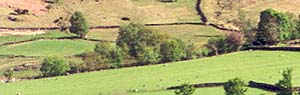
2. Visible along the Wye?
Various sections of the river bank seen by the Wordsworths on their walk would have been pasture land, as today. William Coxe refers to one stretch near Monmouth consisting of "a succession of rich meadows" (and see Gilpin below, point 4). If "Tintern Abbey" is set at New Weir, as I have proposed, Wordsworth would have seen the water meadows which begin just north of New Weir: these fields may have offered a view of such a hedgerow, although none is visible in the vicinity now.
3. Uncertainty of vision vs. accurate natural observation.
Critical opinion has differed. Thomas McFarland, while acknowledging the precision of the preceding lines, claims that this "runs off into fanciful imprecision," implying that Wordsworth has not kept his eye on the object (48). In fact, McFarland argues, "One can move from 'hedgerows' to 'little lines of sportive wood run wild' only by an act of imagination, and the act in this instance is that eddy of mind known as reverie" (52). In contrast, Mary Wedd argues that "Wordsworth was describing exactly what he saw" (153).
4. The picturesque mode
Located between the beautiful (local) and the sublime (distant), the picturesque contains the "rough," drawing attention to the middle distance; it also disallows the explicit, more formal signs of human cultivation. The wildness of the hedgerows thus qualifies them for the picturesque:
"The banks of the Wye consist, almost entirely either of wood, or of pasturage; which I mention as a circumstance of peculiar value in landscape. Furrowed-lands, and waving-corn, however charming in pastoral poetry, are ill-accommodated to painting. The painter never desires the hand of art to touch his grounds." The artist wishes "the lands . . . may approach, as nearly as may be, to nature -- that is, that they may be pasturage" -- Gilpin, Observations on the River Wye, 2nd ed., p. 44.
5. History: Whether signs of enclosure, or an earlier field system now neglected? Wartime poverty?
Levinson claims that "the attractively, 'sportively' sprinkled lines of hedges [are] another emblem of enclosure." By making his view subjective, "the narrator converts substance into formal property, reality into design, the end result being the suppression of the historical significance of those lines: their cause and effect. This is empiricist idealism of a most seductive kind." (42) On the other hand, perhaps the age of the hedges is suggested by their having run wild.
6. Whether a merging of natural and human (as in the "pastoral farms"),
In "Michael" (Wu 346) Wordsworth claims that "natural objects led me on to feel / For passions that were not my own" (ll. 30-31): i.e., he values signs of human/nature collaboration. Cf. his account of the cottages in the Lake District: "these humble dwellings remind the contemplative spectator of a production of nature, and may . . . rather be said to have grown than to have been erected" (Prose, II, 202). Or are the hedges engaged in a struggle of the natural, running "wild" against the cultural?
7. Corruption of native innocence by the order of society.
Rousseau argued that man was was born innocent, a "noble savage," and that such goodness was corrupted by society. Rousseau's views are echoed in Wordsworth's "Immortality Ode" (Wu 375 ff.): e.g., lines 58-68; 164-170. The term "wild" ("sportive wood run wild") suggests a recovery of lost innocence. This term is used six times in "Tintern": e.g.,
8. Associationist divergence, or transcendental organicism?
Since Arthur Beatty's William Wordsworth: His Doctrine and Art in Their Historical Relations (1922), it has been common to see Wordsworth's poetry and his theory (as in the Preface to Lyrical Ballads, 1800) exemplifying the associationist view of the mind of such thinkers as Hartley and Erasmus Darwin. Yet Wordsworth also appears to subscribe to the "one life" view of the world, which may indicate an idealist influence (suggested by the active powers of mind connoted by
9. Legislative order, hierarchy (e.g., Burke) or Jacobin license, the "wild."
Referring to Polwhele's The Unsex'd Females (1798), Mathias complains that "Our unsexed female writers now instruct, or confuse us and themselves in the labyrinth of politicks, or turn us wild with Gallick frenzy" (Thomas James Mathias, The Pursuits of Literature, 1798). The term "wild" (used six times in the poem) is a code word for Jacobinism among its critics. The Anti-Jacobin (1797), for example, quoted Southey's poem on Henry Marten, the regicide incarcerated at Chepstow Castle: "His ardent mind / Shaped goodliest plans of happiness on earth, / And peace and liberty. Wild dreams! but such / As Plato loved" (Poetry of the Anti-Jacobin, 5th Ed., 1807: 5). At the same time, in its distance from abstract ideas and reason, and its elevation of feeling, experience, and memory, "Tintern" appears to echo the Burke of Reflections on the Revolution in France. The hedgerows, at least, are unconstrained by reason.
10. Horizontal vs. vertical modes of understanding, critical theory.
Contrast, say, Levinson's metonymic slide from hedges to enclosure, with McFarland's insistence on the integrity of the poem as a metaphor for imaginative "flow" or reverie. Contrast the hermeneutics of suspicion with the insistence on the integrity of the poetic.
11. Metaphors of "sportive," "wild," animate nature; a subdued erotic.
Wordsworth's great theme: e.g., "The one great life" (10), "Beauty, whose living home is the green earth / . . . Pitches her tents before me as I move, / My hourly neighbour" (30, 34-5): "Prospectus" to The Recluse (Wu 330-31). But also: "She shall be sportive as the fawn" (13) from "Three Years She Grew" (Wu 328), with its intimation of sexual awakening: "vital feelings of delight . . . Her virgin bosom swell" (31-33).
References
Coxe, William. An Historical Tour in Monmouthshire. London: T. Cadell & W. Davies, 1801.
Gilpin, William. Observations on the River Wye and several parts of South Wales, 2nd Ed. London: R. Blamire, 1789.
Levinson, Marjorie. "Insight and Oversight: Reading 'Tintern Abbey'." Wordworth's Great Period Poems: Four Essays. Cambridge: Cambridge University Press, 1986. 14-57.
McFarland, Thomas. William Wordsworth: Intensity and Achievement. Oxford: Clarendon Press, 1992.
Wedd, Mary. "'Tintern Abbey' Restored." Charles Lamb Bulletin 88 (1994): 150-165.
Wordsworth, William. The Prose Works, Vol. II. Ed. W. J. B. Owen and Jane Worthington Smyser. Oxford: Clarendon Press, 1974.
Wu, Duncan and David S. Miall, Eds., Romanticism: An Anthology; edition with CD-ROM. Oxford: Blackwell, 2000.