
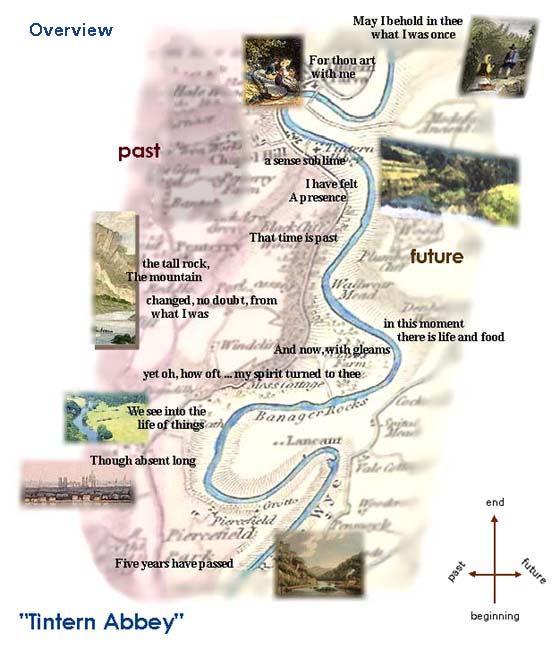
The map and table below summarize the temporal settings of the poem. In addition, the comments below suggest the importance of the theme of change to Wordsworth. Revisiting the Wye in 1798 prompts him to question to what extent he has himself changed since 1793 -- in obvious ways ("Though changed, no doubt"), to less obvious (the "tranquil restoration" he has owed to memories of his first visit). He also begins to envisage changes yet to come in himself and Dorothy (e.g., "When these wild ecstasies shall be matured"). This contemplation of change arouses uncertainty (e.g., "If this / Be but a vain belief"), even "perplexity."
Thus I would also argue for seeing the visionary components of the poem not as final or complete, but centrally as recognitions of change. In the first vision (38-50) there is a liability to see the vision involving stasis, since it requires the blood to be "Almost suspended" and the body to be "laid asleep." Yet these are merely enabling conditions: the vision is constituted by "the deep power of joy" and seeing "into the life of things":
In the second vision (94-103) change seems integral: the presence "disturbs," and it is above all "A motion and a spirit that impels" everything including "the mind of man." Given that Wordsworth is haunted both by his own past and the uncertain future of himself and Dorothy, the problem that the poem sets is how to correlate the contingencies of human life with the sublime level of our life in nature, the "one life" vision.
Part of the problem is the difference in temporal scale of these two components of the poem: (1) the immediate sense of local differences since 1793, or the "still sad music of humanity" with its "evil tongues" and "Rash judgements"; in contrast to (2) the vastness of a power that "impels" everything. The setting of the poem seems to be one way of accommodating both perspectives: the River Wye manifests a visible flux as it flows past the sycamore tree, but it also maintains a presence over a far greater time and across a much greater distance.
|
past
|
present
|
future/present
|
future
|
|
five summers, winters ago / river "rolling" as if from past / raises question of change |
"Five
years have passed": temporality of revisit -- "once
again"; also "this
season ... unripe fruits"; the hedgerows "run
wild"  |
||
| "but
oft in lonely rooms" / "the
din of towns and cities" / "hours"
/ "restoration":
influence of Wye in renovating the poet since 1793.
|
"Though absent long": | ||
| induction:
"another gift"
/ "become a living soul"
/ "see into the life of things":
timeless sense of participation.
|
|||
|
"how oft ... my spirit turned to thee"
how has he "changed
... from what I was"? / haunted by the "mountain,"
the "deep and gloomy wood": picturesque response as escape from
time, his times (1793) |
"And now, with gleams..." / "somewhat of a sad perplexity": confusion over his response; Wordsworth a revenant haunted by his past |
"there is life ... For future years": present projects the envisaged future (what future did 1793 project ?) | |
|
"That
time is past" / "For
I have learned" / induction: "I
have felt a presence ... a sense sublime" / "impels":
integrates vision with time and change; "Therefore
am I still..." |
|||
| "For
thou art with me": Dorothy -- represents his "former
heart": feeling as the agency of time's passing |
|||
|
"Nor
... wilt thou then forget ... We stood together"; i.e., he will
be a revenant to Dorothy: "remember
me" / the Wye loved "for
thy sake". |
"May I behold in thee what I was once" "And in after-years": anticipates for Dorothy both memory and the perplexity of "fear," "pain," etc. |
Document created November 18th 2001