Phase 1. Share ideas and feelings about text(s) to be studied. Sort ideas (use a web?); agree on what aspects most interest you; plan follow up work, who will take on which questions.
Phase 2. Pursue research ideas (in library, online); share findings regularly in meetings or by email. Questions are likely to evolve, new questions come up, during this phase.
Phase 3. Share ideas, agree on outline for presentation and method of presentation. Work up presentation. During presentation: speak slowly; include questions for audience; keep to allotted time (one member of group could be a timekeeper); share resources, e.g., bibliography. Powerpoints: avoid large passages of text; using topic headings, outlines; graphic organizers (see below).
"The Project Method in the Literature Classroom," essay by Miall (1999) http://www.ualberta.ca/~dmiall/Projects_class.htm
Example project, see this section of an essay by Miall, http://www.erudit.org/revue/ron/1999/v/n16/005886ar.html#Montblanc (1999)
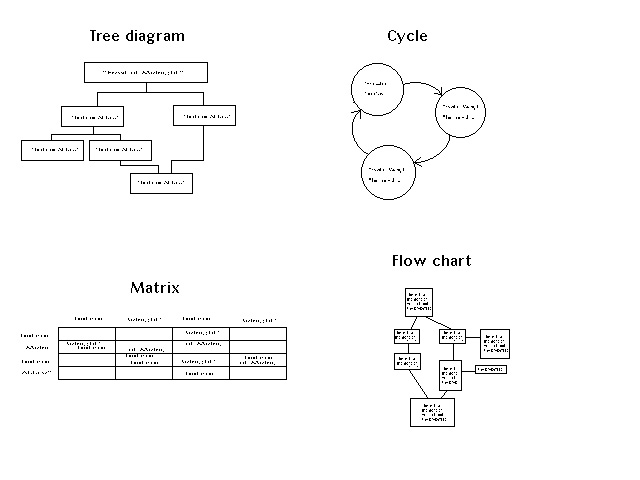
TREE DIAGRAM. E.g., the pathways of influence or relationship between several texts (e.g., Coleridge's "Sonnet to the River Otter" and other river/stream poems of Coleridge, Wordsworth, Shelley...)
CYCLE. E.g., recursive cycle of women's education in Wollstonecraft, where training in accomplishments and emphasis on sensibility result in inferior adults; in turn, such adults are judged incapable of the intellectual education given to men.
MATRIX. E.g., typology of Lyrical Ballad poems, showing type of speaker (as poet: reliable; as poet: unreliable; as character: observer; as character: participants) against type of plot (encounter; incident; event; story).
FLOW CHART. E.g., sequence of issues presented in a poem such as "Tintern Abbey": construal of the present moment, leading to reflections on the past of five years ago, what has been gained or lost in the meantime, what the future holds.
Thumbnail examples, 1 (click to enlarge):
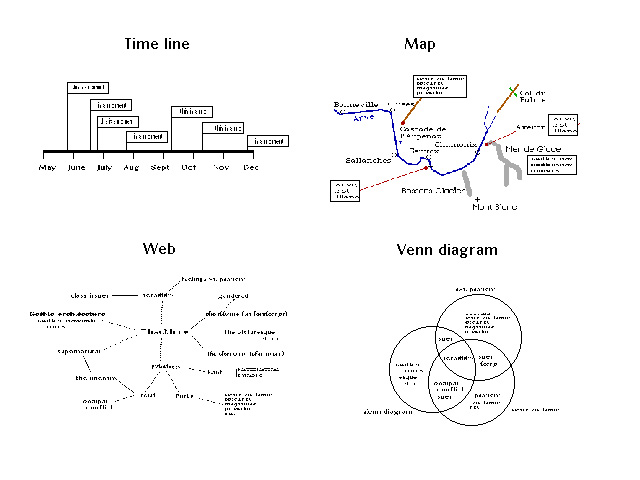
TIME LINE. E.g., sequencing of events in a poem ("Frost at Midnight"; The Prelude), or main occurrences during a significant period (e.g., the Shelley-Byron summer of 1816).
MAP. E.g., geography of a poem that involves significant travel (e.g., the actual travel of Shelley's "Mont Blanc" or the imaginary of "Alastor").
WEB. E.g., articulating the component parts of a significant concept such as the Sublime.
VENN DIAGRAM. E.g., delineating which concerns three poems have in common and which not in common (such as memory in "This Lime-Tree," "Frost at Midnight," and "Tintern Abbey," but childhood only in "Frost," the picturesque only in "Tintern," etc.).
Thumbnail examples, 2 (click to enlarge):
Document created January 21st 2008