1. Introductions. Students: Names, IDs, tel, email. Course
outline
2. Reading:
Broadview Anthology. Includes online resources.
Romanticism
CD in Rutherford S; includes
Wu Anthology, 1st edition.
recommend introductory headnotes to each writer we study (e.g., Coleridge, 407);
-- and general introduction, The Age of Romanticism, xxxv.
Plus Gothic novels The Italian, Frankenstein 1818 (also have useful introductions)
Critical tradition -- challenge of McGann, New Historicism (e.g., Liu, Levinson); "hermeneutics of suspicion"; academic recovery of women poets; why our syllabus
3. "Romantic"
"romantic" as a term: romances; 18th C application to scenery;
but difficulties of term as a literary period/genre (1789-1834)
primitivism; the wild, untamed, native genius (Shakespeare), back to nature
(Rousseau, Social Contract 1762);
Percy Reliques (1765), cf. Coleridge, "Mariner" 1798 version (413)
-- as entertainment (the tour, in search of the picturesque, Gothic; Pope's
"ruins" for Lord Bathurst, Alfred's Hall, 1721)
-- Romantic poets: in search of origins (Wordsworth, Blessed Babe, p. 272, l. 269), aligns human with
natural
raises questions of identity, culture, politics; beginning of modern period,
issues we face (e.g., ecology: cf. Jonathan Bate, Jim McKusick)
4. Political:
French Revolution (1789-1795); Napoleonic wars (Waterloo: 1815; cf. Byron, Childe Harold, Canto III, Stanza 17- )
Repression at home: 1794 Treason Trials (see Contexts viii); 1819 Peterloo
(cf. Shelley, Mask, 752; In Context, 769- )
Industrialization, agricultural revolution (enclosure)
Radical thinkers: Paine, Godwin, Wollstonecraft, Thelwall
-- early influence on poets: Coleridge; Wordsworth; Shelley;
-- cf Hazlitt, Wordsworth's "levelling muse" (564)
later conservatism, notably Wordsworth, Southey
5. Literary establishment
new journals, e.g., Edinburgh Review, Blackwells Magazine
-- power of; Croker's review of Endymion (Quarterly Review, Apr
1818) of Keats -- Shelley's myth (740)
Coleridge, Hazlitt, De Quincey, Lamb, as journalists
(Habermas, public sphere: contest of ideologies)
-- explosive growth of novel, especially Gothic (P. Shelley
supposed author of Frankenstein)
6. Literary theory
Conscious defences of principles, i.e., Wordsworth, Advertisement (214); Shelley,
Defence of Poetry (760);
-- see also Coleridge, Biographia (445); Keats on negative
capability (849-50);
Poetic diction: reaction against 18th C
Self of poet; redemptive example (inward version following failure of French
Revolution; cf. "This Lime-Tree Bower" 425)
Imagination; spontaneity ("if Poetry comes not as naturally as the Leaves to
a tree it had better not come at all": Keats to John Taylor 27 Feb 1818 (852)
Stripping the veil: defamiliarizing; supernatural, sublime; apocalypticism (e.g.,
Wordsworth, "Crossing the Alps" imagination passage)
Romantic heroism, individualism, transgression; the Byronic (Childe Harold, Manfred)
7. Romantic geography
Britain: poets as provincial or outsiders, or exiles;
-- Provinces: see map, 946
European travels: e.g., Wordsworth in France, Switzerland (1790); Radcliffe, Germany, Lake District (1794); Shelleys & Byron at Lake Geneva (1816); Byron
Europe; influence of Byron
Romance: OED.
The vernacular language of France, as opposed to Latin. In later use also extended to related forms of speech, as Provençal and Spanish, and now commonly used as a generic or collective name for the whole group of languages descended from Latin.
A tale in verse, embodying the adventures of some hero of chivalry, esp. of those of the great cycles of mediæval legend, and belonging both in matter and form to the ages of knighthood; also, in later use, a prose tale of a similar character.
A fictitious narrative in prose of which the scene and incidents are very remote from those of ordinary life; esp. one of the class prevalent in the 16th and 17th centuries, in which the story is often overlaid with long disquisitions and digressions. Also occas., a long poem of a similar type.
That class of literature which consists of romances; romantic fiction. spec. a love story; that class of literature which consists of love stories.
Untutored genius:
Or sweetest Shakespear, Fancy's child,
Warble his native wood-notes wild.
-- John Milton, "L'Allegro" 133-4
Rousseau, Emile (opening paragraph, Book I)
Everything is good as it leaves the hands of the author of things, everything degenerates in the hands of man. He forces one soil to nourish the products of another, one tree to bear the fruits of another. He mixes and confuses the climates, the elements, the seasons. He mutilates his dog, his horse, his slave. He turns everything upside down, he disfigures everything, he loves deformities, monsters. He wants nothing as nature made it, not even man himself. For him man must be trained like a saddle-horse; he must be shaped according to the fashion, like trees in his garden.
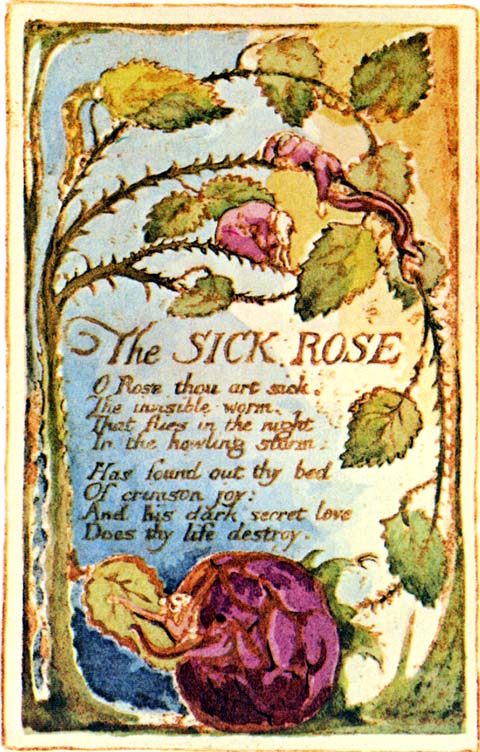
Blake, consider literary and Romantic qualities of this poem:
Oh rose, thou art sick.
The invisible worm
That flies in the night
In the howling stormHas found out thy bed
Of crimson joy,
And his dark secret love
Does thy life destroy.
From Songs of Innocence and of Experience (1789-94). Plate. Broadview 69.
Document created January 7th 2008 / Revised September 2nd 2011