
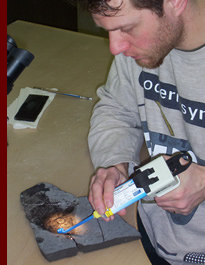
Fossil Deposits, Dental Technology, and Dedication add up to Paleontology at the UofA What have Switzerland and Alberta got in common beyond cattle and mountains? Digging below the surface postdoctoral researcher in Paleontology Dr. Raoul Mutter links the Alps and the Rockies through the fossil record. Raoul did his MA and PhD in Zurich, Switzerland, studying the fossils of ancient fish: “There is a huge collection of fishes from a locality in southern Switzerland, and those fossils are about 242 million years old. I’m interested in fish and evolution. Fishes happen to be ideal objects to do research into evolution, ultimately, because they have complex skeletons which change through time.” But to study the relations between fossil records, paleontologists have to examine the fossils no matter where they find them: “The thing is because I worked on their When asked to explain how he works with the fossils, Raoul said: “Primarily my research is specimen based, such as these fossils from Wapiti Lake. There is a lot of information missing and they are weathered and not very pretty to look at. The specimens need to be prepared, so the sediment is scratched off with steel needles. If the bone is weathered away you only have a part of the imprint in siltstone, so there is no point in scratching that off. What I do instead is acid prepare them in 10-15% hydrochloric acid for a period of time. So after that the bone is gone, leaving a negative cast of the fossil; you see the bone as an imprint from the other side. The problem with some fossils is that the bone is broken away, so that the natural bone margins are hard to see; acid preparation yields clear imprints.” And the process itself is quite fascinating: “Then I become a dental technician for a short while, and I take a gun which forces silicon in two components through a syringe interface ontothe fossil. Waiting five or ten minutes, it hardens on top of the negative cast. Then you lift it out carefully from the imprint underneath and what you get is a positive cast with perfect anatomic details, that you would otherwise have to painstakingly gather with older methods such as scraping.” While Raoul’s topic of study is certainly from the distant past, the study of fossils can allow us to understand the present. “I think the goal is primarily to contribute to the understanding of evolution. Primarily of biogeography and the evolutionary development of certain fishes in space and time. Maybe we can learn in general from studying fossils over a very long time how evolution works. There is not only natural evolution that happens ‘out there’ but mankind evolves as well. How the inherent processes worked in the past may teach us something about the present. That is the great advantage of fossils, they span over a great amount of time that we can never sense otherwise." Research Makes Sense For Students … Students Make Sense In Research |
Close this windows to return to the Profiles page.
 phylogeny, the inherited relations among fishes, I became interested in older layers than the locality in southern Switzerland. Here in Alberta and BC we find the Sulphur Mountain formation and this formation at certain levels yields fossils of the time I am interested in researching. They are from the Wapiti Lake Provincial Park, and that is where I did some fieldwork this past summer. The U of A already had a pretty good collection of these fishes, through the work of Dr. Mark V.H. Wilson (U of A) and Andy Neuman from the Royal Tyrrell Museum of Palaeontology. The fossils stem from layers that were deposited after the greatest mass extinction ever, so the fossils document the recovery process of the fish fauna. That is the reason that I came here to study.”