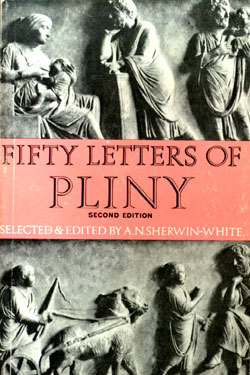
 Fifty Letters of Pliny, selected and edited by A.N. Sherwin-White (available in the Campus Bookstore).
 The following gives the course of our readings plus citations to Charles E. Bennett, New Latin Grammar (the section number, and not the page number).
F Sept. 9 (Letter 1): sequence of tense (267-268)
nominal/substantival ut clause (295)
ablative absolute (227)
indefinite pronoun (91, 252.1)
repetitive meaning of pluperfect (287.2)
M Sept. 12 (Let. 1 con't): construction of paenitet (209)
future perfect (264)
W Sept. 14 (Let. 12): contrafactual conditions (304)
future infinitive (270.1.c)
partitive genitive/gen. of the whole (201)
adverbial accusative (176.2-3)
cum clauses with subjunctive (279)
F Sept. 16 (let. 12 con't): anaphora (350.11.b)
passive periphrastice (115, 337.8)
dative of agent (189)
genitive of indefinite value (203.4)
relative clauses of characteristic (283)
relative pronoun used in subordinate clause (355.1)
incorporation of antecedent into relative clause (251.4)
resumptive use of relative (251.6)
M Sept. 19 (Let.15): correlative use of alius (253.1)
W Sept. 21 (Let. 15 con't): ablative of description/quality (224)
F Sept. 23 (Let. 15 con't): relative clause of purpose (282.2)
M Sept. 26 (Let. 15 con't): ablative of manner (220)
W Sept. 28 (Let. 15 con't): ablative of separation (214)
F Sept. 30 (Let. 25):
Next letter: 14
b) Testing (80%)
c) Deferred final
d) Determination of final grade
Like the University, I have a zero-tolerance policy for plagiarism (as well as cheating). I will not hesitate to seek the highest possible penalty against anyone caught committing these offenses or helping others to commit them. Ignorance of what constitutes academic offenses is not an acceptable defense. Refer to the Code of Student Behaviour in the Calendar (pages 652-675) for a full description of academic offenses and their possible penalties. If you have any questions, see me or refer to The University Secretariat.
contracted forms of perfect active (116.1)
subjective genitive (199)
objective genitive (200)
dative of reference (188)
stems adjs (67a)
indirect questions (315)
quidem (347.1)
-ulus diminutive ending (148.1)
-itas ending (149)
chiasm (350, 11c)
dum with indicative (293 I)
plup. subj. in fut. more vivid condition in ind. disc. in sec. sequence (319.Ba)
dative with compound verbs (187.III.2)
impersonal passive (256.3)
ablative of cause (219)
ellipsis (374)
Grading
a) Paper (20%)
Each student will write a 10-15 page research paper on a topic of their own choosing due on the last day of term (suggested topics will be provided later in the term).
NB See discussion of plagiarism at the end of the syllabus.
Starting in Week 3, there will be a quiz every Monday on the preceding week's reading (there are no make-up quizzes, and the one lowest score will be dropped (5% of overall grade). There will be one midterm on Oct. 24 (35%) and one final examination (40%).
The sole date on which a deferred midterm may be taken is January 16, 2006 (time to be arranged)
Students will receive a percentage score for all graded work. At the end of term these percentage marks will be weighted on the scale indicated above to give an overall percentage. This will then be converted to the letter system of grading on the following basis: 100-97%: A+; 96-93: A; 92-90: A-; 89-87: B+; 86-83: B; 82-80: B-; 79-77: C+; 76-73: C; 72-70: C-; 69-67: D+; 66-60: D; 59 and below: F.
Plagiarism
Plagiarism is defined as "submit[ting] the words, ideas, images or data of another person as the student's own" (Code of Student Behaviour 30.3.2(1)). The University has the following statement on how it handles instances of plagiarism.
"The University of Alberta is committed to the highest standards of academic integrity and honesty. Students are expected to be familiar with these standards regarding academic honesty and to uphold the policies of the University in this respect. Students are particularly urged to familiarize themselves with the provisions of the Code of Student Behavior and avoid any behavior which could potentially result in suspicions of cheating, plagiarism, misrepresentation of facts and/or participation in an offence. Academic dishonesty is a serious offence and can result in suspension or expulsion from the University." (U of A Calendar 23.4.2c)
Back to C. Mackay's homepage