Ch E 416 - Assignment 3 Solutions
Question 1
(1a)
(1b) Unit (c)
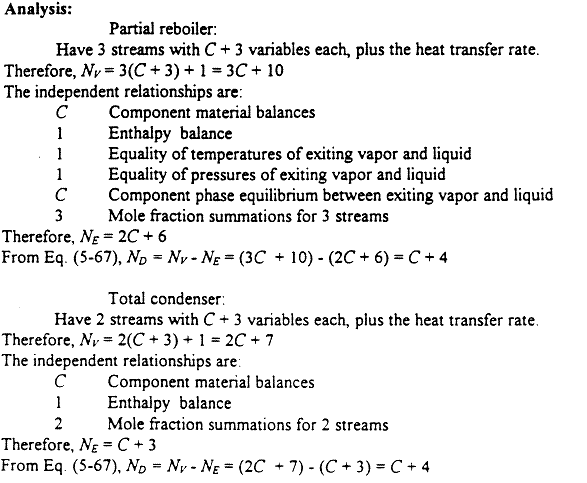
I am deriving Nv, NE and ND for each
of the elements. You were only required to derive the ND for the overall units
(c) and (g).
For a single non – adiabatic stage:
Four streams with C + 3 variables
plus the heat transfer rate.
Nv = 4(C + 3) + 1 = 4C + 13
Number of
equations:
4
Composition summations
1
Heat balance
1
Equality of temperatures for equilibrium streams
1
Equality of pressures for equilibrium streams
C
Component mass balance
C
Equality of fugacities for equilibrium
streams
NE = 2C
+ 7
Hence:
ND = 2C
+ 6
For the feed stage:
The only difference for this stage
is the additional input
One additional stream with C + 3
variables.
Nv = 4C + 13 + C + 3 = 5C + 16
Number of
additional equations:
1
Composition summation
NE = 2C
+ 8
Hence:
ND = 3C
+ 8
For the partial condenser:
Three streams with C + 3 variables
plus the heat transfer rate.
Nv = 3(C + 3) + 1 = 3C + 10
Number of
equations:
3
Composition summations
1
Heat balance
1
Equality of temperatures for equilibrium streams
1
Equality of pressures for equilibrium streams
C
Component mass balance
C
Equality of fugacities for equilibrium
streams
NE = 2C
+ 6
Hence:
ND = C +
4
The
partial reboiler information comes from part 1a.
ND = C + 4
For the enriching section stages:
Number of
stages: (f – 1 )
ND = (f – 1) (2C + 6)
For the stripping section stages:
Number of
stages: (N – f – 1 )
ND = (N – f – 1) (2C +
6)
Total of ND = C + 6N + 2CN + 4
Redundant streams:
Condenser:
2: The vapour entering the condenser and the
liquid leaving it, which is the liquid returning to the column.
Enriching section:
Stage 1
has been counted doing the analysis on the condenser and the splitter
From
stage 2 to stage f – 1 = f – 1 – 1 = f – 2. Two
streams are counted twice between stages, therefore:
2(f – 2)
Feed stage:
4: The streams leaving the stage
Stripping section:
From
stage f + 1 to stage N – 1 = N – 1 – f – 1= N –
f – 2. Two streams are counted twice between stages, therefore:
2(N – f – 2)
Reboiler::
2: The liquid entering and the vapour leaving
it.
Total of NR = 2N
Each stream
adds (C + 2) variables
(C + 2)NR = 2CN + 4N
Additional variables:
2: the location of the feed stage + the
number of stages N
Finally:
(ND)unit = NV
– (C + 2)NR + NA = C + 2N + 6
Unit (g)
The only
addition to this unit is the stream divider:
For the stream divider:
Three streams with C + 3 variables
plus the heat transfer rate.
Nv = 3(C + 3) + 1 = 3C + 10
Number of
equations:
3
Composition summations
1
Equality of temperatures for equilibrium streams
1
Heat Balance
1 Equality
of pressures for equilibrium streams
C
Component mass balance
(C – 1) Equality of compositions for leaving
streams
NE = 2C
+ 5
Hence:
ND = C +
5
Total of ND = C + 6N + 2CN + 4 + C
+ 5 = 2C + 6N + 2CN + 9
Redundant streams:
Condenser:
2: The vapour entering the condenser and the
liquid leaving it.
Stream divider::
1: The liquid returning to the column.
One
additional variable is added, the liquid leaving the condenser. The rest of
the analysis is identical to that of unit (c).
Total of NR = 2N + 1
Finally:
(ND)unit = NV
– (C + 2)NR + NA = C + 2N + 9
If unit
(g) has an additional feed stream: As explained in the last paragraph in
chapter 5 in the text book, for every additional stream, C + 3 degrees of
freedom are added to the unit D.O.F. Therefore,
(ND)unit = C + 2N + 9 +
C + 3 = 2(C + N + 6)
Question 2
1.
Water = 10 litres/s = 555.56 mol/s = L
Ammonia = 291.09 mol/s = G
The operating line equation is given by:

The slope for the line is 
Taking this slope from the intercept
 , clearly shows that the degree of removal of ammonia will
not be possible with such a flow rate of water (The initial Y1
required to reach the degree of removal should be between 0.6 and 0.7 , clearly shows that the degree of removal of ammonia will
not be possible with such a flow rate of water (The initial Y1
required to reach the degree of removal should be between 0.6 and 0.7  ). See figure1. ). See figure1.
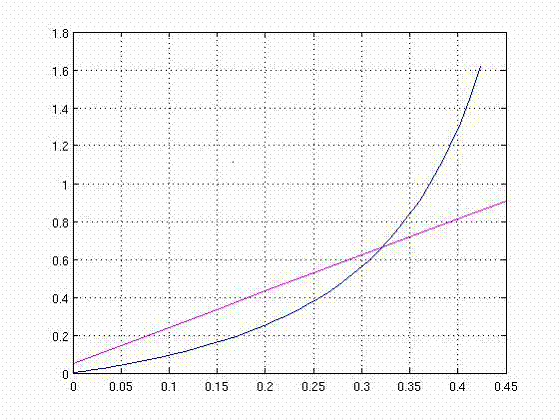
Figure 1. Low flow rate of water
2.
The minimum water flow rate allows reaching
the desired separation at the expense of infinite separation stages. The
slope is estimated according to the operating line equation
 , where XN is obtained from the equilibrium line
(point YN+1,XN). Lmin=745
mol/s=13.4 l/s. See figure 2 , where XN is obtained from the equilibrium line
(point YN+1,XN). Lmin=745
mol/s=13.4 l/s. See figure 2
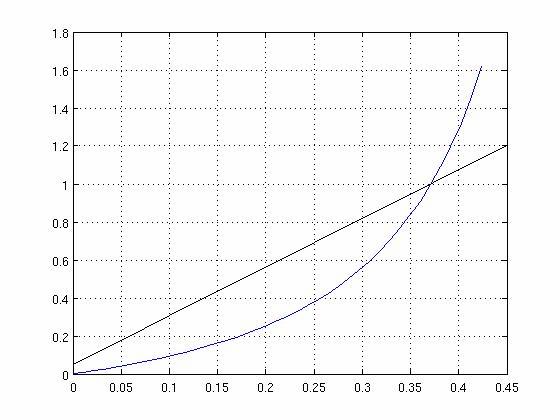
Figure 2. Minimum water flow rate
3.
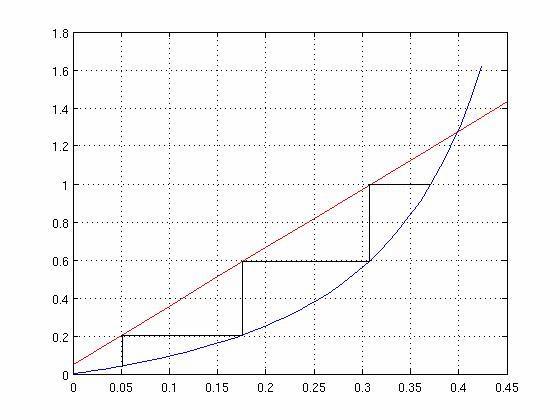
With a molar flow rate of 745 moles/s (16.1
l/s), the new slope of the operating line is  , 3 stages are needed to reach the required separation. See
figure 3. , 3 stages are needed to reach the required separation. See
figure 3.
Posted October 21th, 2006
Return to top of the page
|