1. How does attribution theory explain some biases?
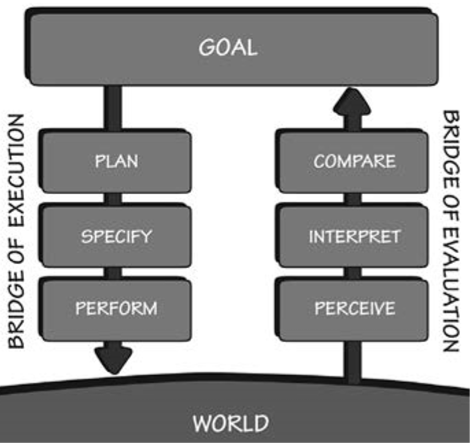
2. Describe Norman’s seven stages of action, and the pros and cons.
3. Explain all components of Norman’s and Jordan’s approaches to emotional design, and their pros and cons. What is Kansei engineering?
4. What is mental workload, and how is it measured?
5. What are the three levels of Situation Awareness, associated “demons,” and design principles?
6. What factors affect inattentional blindness? What things distract drivers?
7. What is Naturalistic Decision Making, and how does the RPD model describe how experts make decisions?
Fritz Heider (1958): What causes are attributed to behaviours?
• _____________: action seen as caused by personality
• ___________: action seen as influenced by environment
Fundamental ___________ Error (a.k.a. Person Bias or Correspondnce Bias):
- in judgments of others’ actions, people tend to:
• overestimate contribution of dispositional factors, &
• underestimate effect of the situation
_____-________ Discrepancy (a.k.a. Situation Bias):
- in judgments of one’s own actions, people tend to:
• underestimate dispositions, &
• overestimate the situation
But when people have difficulty using a machine or device, they tend to blame __________. Why?
- belief that no one else has same problem
- belief that device is ____ to use
Result: incorrect attribution of blame:
- _______ helplessness (Seligman, 1991): every attempt on a task seems to lead to failure--person stops trying
- “______ helplessness” (Norman, 2013): poor design causes person to generalize instances of failure to other, similar tasks
e.g., “I can’t work my VCR; I am no good with technology.”
Seven Stages of Action (Norman, 1988; 2013):
1. form ____ to be achieved
e.g., want best possible mark in course
2. form ______/plan action
e.g., will write term paper
3. specifying ______ sequence
e.g., first choose topic, then get articles to read, etc.
4. _______ action sequence
e.g., pick topic, get articles, read them, etc.
5. ________ state of the system
e.g., typed 12 full pages
6. interpret state of the system as an _______
e.g., minimum 12 page requirement reached
7. _______ outcome to original goal
e.g., it’s not good enough--revise draft
(stage 1: goals, stages 2-4: execution, stages 5-7: evaluation)
- pros & cons:
 separates cognition and ______
can aid design (e.g., where is user having difficulty?)
 has discrete serial stages--but people have multiple, overlapping/conflicting
_____
has discrete serial stages--but people have multiple, overlapping/conflicting
_____
neglects the fact that humans have limited capacity, get fatigued
individual differences/_________ not taken into account
good for understanding simple tasks, not complex tasks in complex systems
There has been a consideration beyond just usability to the user __________ (UX): a person’s subjective experience when using a product, system, or service.
Don Norman (2004): Emotional Design: Why we love (or hate) everyday things
- three levels of processing:
▸ ________ (or reactive) level:
• hardwired, perceptually based; processes simple stimuli (reflexes)
• has “proto-affect”: immediate positive or negative value
• includes sensory pleasure, aesthetics (e.g., colour, texture)
e.g., riding a rollercoaster (thrill of heights, falling, speed)
▸ ___________ (or routine) level:
• based in unconscious expectations and automatic behaviours
• locus of primitive emotions
• includes usability, performance (e.g., ergonomics)
e.g., playing a nice musical instrument (pleasure of using a good tool effectively; skilled accomplishment)
▸ __________ level:
• based in intellect and higher-order cognitive functions, including metacognition, consciousness, and self-reflection
• has fully fledged, complex emotions
• includes self-identity, socialization (e.g., collective identity)
e.g., enjoyment of literature or art (feeling of shared humanity; understanding symbolism and metaphor)
- the effects of emotion in design should not be neglected; can have powerful impact
• in a negative emotional state, people tend to _____, concentrating on details and avoiding distraction (depth-first processing)
• in a moderate-intensity positive emotional state, people are more ________, and overlook minor problems (breadth-first processing)
- the best emotional design allows for a product to be enjoyable at all three levels
• visceral design: __________ and appearance
e.g., the look of Alessi products
• behavioural design: provides good feeling about behavioural interaction/function
e.g., feeling of balance and sharpness of a Global knife
• reflective design: image, ________, and brand considerations
e.g., reputation and status of Infiniti, Prada, Royal Albert
- pros & cons:
explains the role of cognition in emotional design
criticized as overly reducing the complex nature of design
Patrick W. Jordan (2000): Designing pleasurable products: An introduction to the new human factors
- functionality vs. usability vs. pleasure
- pleasure comprises:
▸ ______-pleasure: applies to one’s body and sensory organs
e.g., shape of telephone handset, texture of pen, toothbrush, new clothes, new car smell
▸ ______-pleasure: applies to one’s cognitive and emotional reactions
e.g., really engaging video game, “killer app” software
▸ _____-pleasure: applies to one’s connection to other people; social identity/interaction
e.g., using social media apps on your smartphone to connect with friends
▸ ____-pleasure: applies to one’s values
e.g., drinking only organic, fair trade, bird-friendly, Rainforest Alliance certified coffee from a recycled, biodegradable cup made by a barista earning a living wage
- pros & cons:
provides framework about pleasure that can aid design process
focuses only on unpleasant-pleasant dimension of products, not a theoretical understanding of emotions
______ (“sensory” or “emotional”) engineering
- created by Mitsuo Nagamachi (1989; 2002; 2010)
- development methodology that translates customers’ feelings and emotions about products to design solutions and concrete design elements
- explicitly relates emotions to product design, to create a more satisfactory experience
- case study: Mazda MX-5 Miata
• ____-_____ concept design goal: unification of the human-machine unit (HMU)
• next level comprised of “tight feeling,” “direct feeling,” “speedy feeling,” and “communicative”
• each concept further developed into more specific, concrete design parameters
• surveyed young peoples’ attitudes and driving behaviours
• observed behaviour of young male drivers
• data analyzed to create functional, usable, and pleasurable designs matching design parameters
e.g., gear shifter is 9.5 cm, conveying optimal feeling of sportiness and control
e.g., used sound frequency analysis to determine young peoples’ preference for exhaust sound, and tried over 100 vent pipe designs to create the right “exhaust note,” which suggests the right time to shift
______ workload: feeling of mental effort or level of use of human operator’s limited resources
- as task demand increases, reserve resources decrease
- when ___________ resources are exceeded, further increases in task demand will reduce performance
- new aircraft are analyzed in terms of mental workload
- is one of the most widely used concepts in HF/E
Measuring workload:
• ________ analysis: measure amount of time spent on task relative to time available; shows how time use changes during course of task
• primary task measure: change nature of main task; record performance changes
• _________ task measure: give secondary task; measure performance as primary task changed
• subjective measures: self-reports of users
e.g., NASA Task Load Index (NASA-TLX)
• _____________ measures: monitor EEG or use brain imaging to determine physiological correlates of mental work
Implications for design (Resnick, 2014):
- important information should have higher sensory salience
e.g., Enhanced Ground Proximity Warning System in aircraft has auditory alarm, and visual and spoken messages
- reduce confusions/maximize discriminating features
e.g., in-vehicle GPS navigation systems with graphical displays take the longest time to process, and recall scores are lowest
- tasks allocated to workers must be within their capabilities
• too much: ________/mental fatigue
• too little: ______/dehumanizing/missed events
• determining the “redline” of overload or underload is difficult
- “the perception of the elements in the environment within a volume of space and time, the comprehension of their meaning and the projection of their status in the near future” (Mica R. Endsley, 1988, p.97)
- _______ what is going on around you
- formal definition has three ascending levels:
Level 1 SA: __________ of elements in the environment
- stimuli must be detectable and identifiable
Level 2 SA: _____________ of the current situation
- encompasses how people combine, interpret, store, and retain information
Level 3 SA: __________ of future status
- determines decisions made and actions performed
- denotes those who have the highest-level understanding of the situation (experts)
- e.g., CF-18 Hornet fighter pilot in combat zone:
Level 1: aircraft noticed on radar at five o’clock position; SAM (surface-to-air missile) detected visually at one o’clock position
Level 2: aircraft recognized to have enemy profile, but is a slow Su-25 Rook (a.k.a. “Frogfoot”); SAM cannot be identified: may be radar- or IR-guided
Level 3: pilot predicts that lighting afterburners will allow him to outrun enemy aircraft; expects that dropping bundles of chaff and flares will work as countermeasures against unknown SAM
Then, pilot makes a decision and performs an action.
- SA is the main precursor for ________ ______ and thus performance
- SA can be seen as the current state of the ______ _____
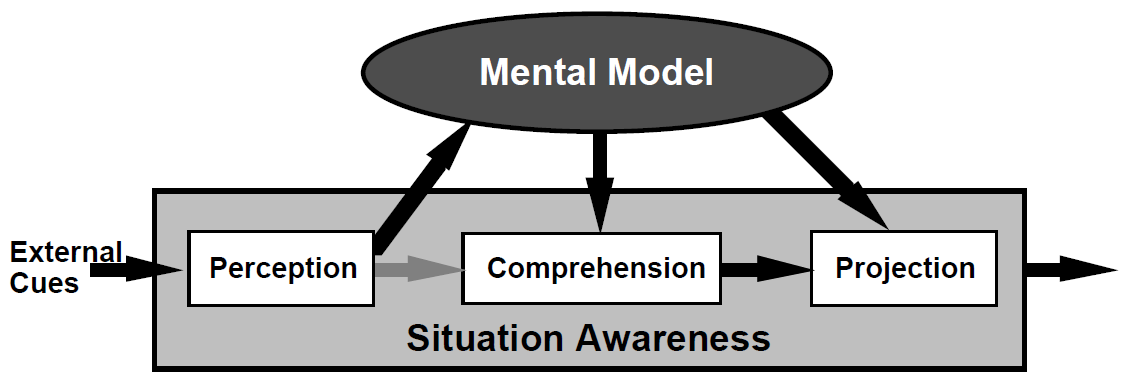
- SA model includes goal-driven (e.g., via mental models) and data-driven (e.g., environmental stimuli) processing
- SA originated in studying aircraft piloting; now also used in domains like weather forecasting, power plant operations, and driving
- assessed with Situation Awareness Global Assessment Technique (Endsley, 2000):
• SAGAT uses dynamic simulations of task environment
• simulation stopped randomly
• people asked questions at each SA level
- SA “demons” (Endsley & Jones, 2011):
• attentional _________ (a.k.a. cognitive tunneling): under stress, attention becomes focused on a single stimulus
e.g., Eastern flight 401: debate over broken indicator light vs. broken landing gear caused crash into Florida everglades
• requisite ______ trap: working memory is limited
e.g., ATC at LAX forgot aircraft was on runway when she assigned another one to land
• workload, anxiety, fatigue, and other stressors (_____): make information processing more error prone
e.g., “mind after midnight” hypothesis: between midnight and 6:00 a.m., neurocognitive functioning is impaired, increasing the likelihood of deficient decision making and maladaptive behaviours (Tubbs et al., 2022)
• data ________: SA affected by organization and display of data
e.g., task saturation
• misplaced ________: too much competition for attention
e.g., “Las Vegas Strip” phenomenon
• __________ creep: too many functions to know them all
e.g., only 20% of people could properly operate their VCR
e.g., 50% of product returns are in full working order, but customers can’t figure out how to operate the devices (Den Ouden, 2006)
• ______ mental models: incomplete understanding (due to use of modes of lack of standardization) is problematic--may not even be noticed
e.g., errors arise when pilots switch aircraft
• out-of-the-____ syndrome: too much reliance on automation
e.g., crash in Detroit: misconfigured flaps/slats; automated takeoff configuration and warning system failed
- categories of SA-oriented design principles (include 50 specific principles):
• _______: incorporate knowledge of SA into design
e.g., organize information around goals
• certainty: increase confidence in information
e.g., explicitly identify missing information
• __________: minimize task complexity
e.g., just say no to feature creep--or even reduce features
• alarms: reduce mental workload due to alarms
e.g., make alarms unambiguous
• __________: automate only if necessary
e.g., keep the operator in control and in the loop
• multioperator: support shared SA
e.g., build a common picture to support team operations
- pros & cons
used to evaluate system/interface designs, and assess ________ techniques
criticized as just an aggregate term for other cognitive processes: perception and working memory
(but SA also depends on long-term memory knowledge)
is SA the process of obtaining awareness or the product of awareness (or both)?
(situation assessment results in situation awareness)
• in 2023, distracted driving killed 3,275 people and injured over 324,000 in the U.S., at a cost of USD$98 billion (NHTSA, 2025)
• 12% of crashes are caused by cell phone use (handheld/hands-free/texting)
• glances away from the road longer than 2 seconds more than double odds of crash
• 30% of inexperienced drivers glance away longer than 2 seconds (e.g., when interacting with radio or cell phone)
• 20% of drivers send or read text messages while driving; 66% of drivers age 18 to 24
Categories of distractions (Ranney et al., 2000):
• visual: e.g., looking at a map
• audible: e.g., listening to music
• physical: e.g., adjusting stereo controls
• _________: e.g., thinking about dinner
Cell phones involve every category of distraction.
Different kinds of distractions lead to different kinds of problems:
- visual distractions cause problems with steering and lateral movements, like staying in your own lane
- _________ distractions lead to less longitudinal vehicle control: difficulty maintaining proper distance from the vehicle ahead of you--but lateral control improves
(Why? Drivers keep their eyes on the centre of the road more, perhaps decreasing their cognitive load.)
Inattentional blindness: stimulus that is presented, but is not attended, is not perceived (a.k.a. “looked-but-didn’t-see” problem)
Simons & Chabris (1999):
- showed participants a video of two teams of three basketball players
- task: count how many times the players wearing white pass the basketball
- 46% of observers ______ the _______
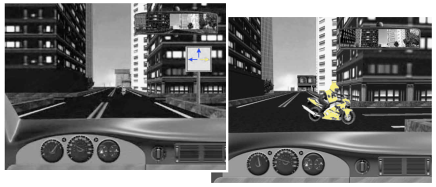
Most & Astur (2007):
- participants in a computer-based driving simulator
- task: before arriving at an intersection, looked for a yellow arrow indicating which way they should turn (and ignore blue arrows)
- just as they entered the intersection, a motorcycle unexpectedly crossed their path and stopped
- results:
• when motorcycle was yellow, 93% of drivers noticed it and avoided a collision
• when it was blue, 36% of them hit it (2 failed to apply the brakes at all!)
- while talking on a cell phone, participants were less likely to notice objects (e.g., pedestrians, cars, signs, etc.), even when _______ directly at them (Strayer & Drews, 2007)
Factors that affect attentional blindness (Green et al., 2008):
1. conspicuity
- _______ conspicuity: increases with greater contrast, size, and flicker (bottom-up processing)
- cognitive conspicuity: you can decide what to attend to; meaningful things capture your attention (top-down processing)
e.g., noticing your name spoken at a noisy cocktail party
2. mental workload and task interference
- greater attentional demand
e.g., counting bounce passes vs. aerial passes resulted in 20% lower detection of _______
- secondary tasks: some kinds interfere less than others with primary task
e.g., walking and chewing gum vs. walking and juggling
- low workload and automation: too low mental workload causes task _____________
e.g., pilots’ increasing reliance on advanced automation leads to poorer manual flying skills or “airmanship” (FAA, 2016; Haslbeck & Hoermann, 2016)
3. expectation
- expertise: attention may not be drawn to irrelevant stimuli (or, it may be!)
e.g., basketball players were more likely to detect the _______ (62% vs. 38% of nonexperts)
- confirmation bias: you see what you expect to see
e.g., in April, 2006 rising waters made a ford through the River Avon near Luckington temporarily impassible. Every day for the next 2 weeks, at least one vehicle--relying on GPS navigation--drove past the warning signs and into the _____
4. ________
- varies from person to person; varies over time; affected by drugs, alcohol, and fatigue
- automatic processes
e.g., pilot flying an unfamiliar aircraft increased fuel flow during an engine fire, because controls were opposite to those of the familiar aircraft
 |
NHTSA (National Highway Traffic Safety Administration, 2006a; 2006b): 100-Car Naturalistic Driving Study |
- over the course of a year, 241 volunteer drivers in Northern Virginia/Washington, DC were studied
- cars/SUVs were outfitted with video-enhanced electronic data recorders
- collected 42,300 hours of data on driving over 3 million km
- results:
• 82 crashes and collisions (any contact between the participant’s vehicle and another vehicle, fixed object, pedestrian, cyclist, or animal)
• 761 near-crashes (rapid, severe evasive manoeuvre to avoid a crash)
• 8,295 critical incidents (involving evasive manoeuvre of less magnitude than a near-crash)
- major findings:
• drowsiness/fatigue increases risk of crash/near-crash by a factor of 4×
• ________ almost triples the risk of a crash
• drivers who are distracted are more likely to be involved in a crash/near-crash; they are unable to predict when it is safe to direct their attention away from driving
• nearly 80% of crashes (65% of near-crashes) involved some driver distraction within 3 seconds before the event
• most common distraction: cell phone (_______ is more dangerous than talking or listening, but occurs less often; all three activities caused similar number of crashes)
• factors increasing crash/near-crash risk:
- reaching for a moving object: 9×
- looking at an external object: 3.7×
- reading: 3×
- applying makeup: 3×
Redelmeier & Tibshirani (1997):
- identified collisions in Toronto having significant damage
- of 5,890 drivers, 1,064 had cell phone; consent & billing records obtained from 699
- 170 drivers made a call up to 10 minutes before the collision
- ___× greater relative risk when using a cell phone, compared to similar interval on the day before
- if blood-alcohol level is 50% above the limit, relative risk = 10
David L. Strayer et al. (2001):
- used Crown Victoria® driving simulator
- while talking on a cell phone, participants were _____ as likely to miss simulated traffic signals compared to controls (7.0% vs. 3.4%)
- drove as if ________
- no advantage for _____-____ vs. hand-held phone
- performance not disrupted by listening to radio or books on tape
- also found by Transport Canada (2002)
- and by Parkes & Hooijmeijer (2000): significant deterioration in __ in hands-free phone condition (vs. no-phone control)
Drews, Pasupathi, & Strayer (2008):
- measured how well drivers followed task instructions (take a particular turn-off) during simulated driving
- compared conversing on a cell phone vs. conversing with a _________ (vs. control)
- talked about close-call situations they experienced
- results (number of participants):
correct exit |
missed exit |
|
|---|---|---|
cell phone |
12 |
12 |
passenger |
21 |
3 |
control |
46 |
2 |
- how is talking to a passenger different from talking to someone on a cell phone?
• it’s easier to hear a passenger, so less attention is required
• passenger conversations make more references to traffic; this creates a ______ SA, mitigating the potential negative effects of conversing on driving
• social demands: there is pressure to keep a conversation going and not stop talking to concentrate on driving
- cell phone-caused driving deficits are not reduced by practice (Cooper & Strayer, 2008)
Olson et al. (2017):
- naturalistic study of long-haul commercial truck drivers
- text messaging results in 23.2× greater risk of crash or near-crash event
Legislation:
- all Canadian provinces have laws against use of handheld cell phones and/or text messaging
- Japan bans all cell phone use while driving
- almost all US states have some form of legislation against hand-held cell phone use and texting while _______
- however, fines are low
e.g., base fine is USD$20 for first offence, USD$50 for subsequent offences in California (vs. $287 + 3 demerit points in Alberta)
laws do not reduce collisions (IIHS/HLDI, 2009)
• before the ban in New York, 2.3% of drivers used phones while driving
• immediately after the ban, the number dropped to 1.1%, but two years later was up to 2.1% (Sundeen, 2007)
- long-term __________ requires publicized enforcement (legislation + enforcement + education campaigns) (McCartt et al., 2006)
Can technology help? Or is it just a _______ effect?
Cell phone safety features:
- Driving Focus (formerly Do Not Disturb While Driving) mode for iPhones
• engages when vehicle’s Bluetooth connection detected
• allows turn-by-turn directions and hands-free calls, but disables texting
- Android Auto app has do not disturb while driving setting
- problem: these features are optional
- worse problem: revenge effects
• Apple CarPlay and Android Auto allow drivers to use apps and phone functions on in-vehicle display
• these functions may encourage more use of ___________ distracting interactions
• they cause distraction, and increase visual & cognitive demand and interaction time (Strayer et al., 2018)
• RTs are five times slower than driving impaired (Ramnath et al., 2020)
 BMW iDrive
- i=“intuitive”; introduced for 2002 model year
“The sole purpose of the iDrive is to eliminate driver ___________.” -- Gordon Keil, BMW of North America
- components:
• control _______: next to instrument panel
• driving zone: functions for driving and safety
e.g., directional signals, windshield wipers, cruise control
• comfort zone: frequently used systems that require frequent adjustments
e.g., lights, climate control, seat position
▸ controlled by conventional switches on dashboard/centre console
• __________: manages over 700 other infrequently accessed functions
▸ large knob in console between front seats: combo rotary/pushbutton/slide control with force feedback
▸ to change functions, push console knob; twist knob to scroll through menus; click button on knob to select functions
▸ knob: 8 categories corresponding to compass positions: communication, car, drive, help, entertainment, configuration, climate control, information
▸ simplified version has only 4
▸ different types of haptic ________ given for different functions
- problems:
obscure abbreviations (e.g., “Auto P,” “DSC/DTC,” and “PDC PIC”)
more difficult for inexperienced users to use
slow response times: require additional attention; experienced users make more errors
poor conceptual model
Other technologies:
• Intelligent Transportations Systems (ITS): aid transport and traffic management to increase safety, coordination, and efficiency of transportation ________
e.g., red light cameras, variable speed limits, Intervehicular Information System (car-to-car communication), etc.
• Advanced Driver Assistance Systems (ADAS): integrated in-vehicle systems that augment drivers' abilities, increasing safety and effectiveness
e.g., adaptive cruise control, automatic parking, forward collision warning, etc.
• autonomous vehicles: self-driving cars
e.g., SAE levels of driving automation (2021) range from Level 0 (no automation) to Level 5 (full automation)
- has been strongly influenced by traditional decision models like Kahneman and Tversky’s (1979, 1984) Prospect Theory (the “heuristics and biases” approach)
- heuristics are mental shortcuts, and cognitive biases are systematic deviations from rationality
e.g., _______ effect: decisions can be affected by the way information is presented
• per 125 mL serving, Breyers’ Smooth & DreamyTM chocolate ice cream (½ the fat) has the same calories (130) and more sugar (16 g) than regular Double Churn ice cream (15 g)
- however, this approach has been criticized for its lack of __________ validity (Berthet, 2021)
- that is, it focuses on how naïve participants make choices in static laboratory environments
- these findings may not generalize to decision-making in complex, high-stress naturalistic settings
- “NDM is the way people use their experience to make decisions in field settings” (Zsambok, 1997, p.4)
- NDM is a ___________ approach (how people actually make decisions), not a normative one (how people should make decisions)
- real-world operational settings have unique characteristics (Orasanu & Connolly, 1993):
• uncertain _______ environments: information may be incomplete or ambiguous; situation can change quickly
e.g., number of firefighting units available (known) vs. current extent of the fire when obscured by thick smoke (unknown)
• shifting, ill-defined, or competing goals: as a situation develops, goals may change
e.g., save the burning building with aggressive fire suppression--but if the room collapses, fire crews may be in danger
• ____ pressure: can lead to exhaustion and simplified reasoning strategies
e.g., there is no time to consider every possible alternative course of action in fighting a fire
• high stakes: outcomes include catastrophic system failure, loss of property or value, physical injury, or loss of life
e.g., ordering a crew into a building experiencing thermal layering can result in a catastrophic flashover, leading to firefighter fatalities, civilian casualties, and destruction of the building
- the RPD model describes how experts blend intuition (pattern matching to recognize a typical situation) and analysis (mental simulation to evaluate a course of action)
- experts evaluate options sequentially rather than simultaneously, selecting the first workable option (satisficing) rather than searching for the optimal choice
- three variations:
Variation 1 (simple _____): situation is recognized as typical and familiar
• operator executes standard course of action immediately
Variation 2 (diagnose the _________): situation is unclear, unfamiliar, or has conflicting data
• operator gathers more data, checks environmental cues, or builds a mental narrative to understand the situation before selecting an action
Variation 3 (evaluate course of ______): situation is recognized, but the course of action must be evaluated via mental simulation
• operator mentally plays out the chosen option to anticipate problems
• plan may be modified to overcome problems, or rejected in favour of the next most typical option
RPD Model Example (Klein, 1989):
- study of fireground commanders making life-or-death tactical choices under extreme time constraints
- experience (23 years on average) allowed them to instantly recognize a situation as typical and identify a single viable course of action
- evaluated their actions sequentially through mental __________ rather than comparing them to other options
Variation 1
• fireground commander arrives at a minor residential kitchen fire
• instantly match smoke and flame patterns to a typical kitchen fire and immediately order fire crew to “charge the line,” entering with a standard hose line
• no alternate tactics are weighed or simulated
Variation 2
• commander arrives at a house fire but notices unusually dense, black smoke billowing from basement windows while flames are visible on the roof
• they pause to diagnose this anomaly and realize the fire is traveling internally through a vertical laundry shaft
• once the situation is clarified, they execute the matching strategy for multi-floor extension fires
Variation 3
• commander recognizes a severe warehouse fire and automatically selects an aggressive interior attack
• before giving orders, they mentally simulate the plan and realize the roof uses lightweight steel trusses that buckle rapidly under intense heat
• understanding the extreme risk of crew entrapment, they modify the plan to a defensive exterior attack instead
How to apply RPD model to improve decision making:
- ShadowBox™ method uses real-life scenarios to train novices in the perceptual and cognitive skills of experts in their domain (Borders et al., 2015)
- training has five steps (ShadowBox, 2026):
1. present complex scenarios based on real cases to trainees
2. include ________ points with multiple options
3. trainees rank the alternatives, and give their rationale
4. discuss responses with peers
5. responses are compared with those of skilled practitioners
- trainees “shadow” the performance of experts, and write their responses in boxes
- shown to improve decision making by 18-28% after only a half-day training session
RPD model pros & cons:
supporting ________ in multiple domains (military and naval command, commercial aviation, critical care and emergency medicine, competitive chess, high-speed team sports)
accounts for the critical role of domain expertise, situation awareness, and intuition in human performance
difficult to quantify, formalize, or validate using traditional __________ methods
vulnerable to catastrophic failure if situation is misdiagnosed or initial environmental cues are misleading
____-continuation bias: tendency to continue following a predetermined plan or course of action, despite contraindications due to a change in original conditions (Dismukes et al., 2007)
e.g., pilots following their original flight plan, even though changing inclement weather conditions have made it inappropriate
- factors in 11.1% of fatal aviation crashes; 4th most common primary causal factor (Khatwa & Helmreich, 1998/1999)
- related to ____-____ fallacy: tendency to continue investing more time, effort, or money in a decision one is committed to, even if the costs outweigh the expected benefits
e.g., flight is more than halfway to the destination, so turning around to avoid bad weather would waste time and fuel
- likely influenced by overconfidence, anchoring to the original plan, and availability in memory of past success
- may be exacerbated by fatigue and high workload, which reduces strategic thinking in favour of simply reacting to events
- also linked to poor monitoring, caused by automation that does not guide attention appropriately
e.g., faulty airspeed indicator led pilot of Air France flight 447 to steeply increase angle of attack, ironically causing a stall and subsequent crash
- can be mitigated by NDM:
• pre-planning ___________ creates hard thresholds in advance (if visibility drops below 800 m, we divert)
• having a neutral third-party observer review the plan
• using mental __________ to imagine adverse consequences of continuing